Arth V2 sets a new standard for streaming speech recognition on India's phone calls
October 21, 2026
|

6 min

Small in-house decision models, trained in 48 hours, hold the fast end of the quality-vs-speed frontier on 368 real sales calls. What we built and learned.
Our in-house decision models sit on the quality-against-speed frontier for both text and audio questions, answering a turn's questions in 0.05 to about 1 s. Only one external model scored higher on text, and it took 8 s.
From 14 to 16 October 2026, two engineering teams and one agent-built entry trained small models for the closed-choice decisions a Voice AI Agent makes on every turn. We scored all of them on one benchmark: 586 decision points from 368 real calls, 43 questions, 14,573 gold answers.
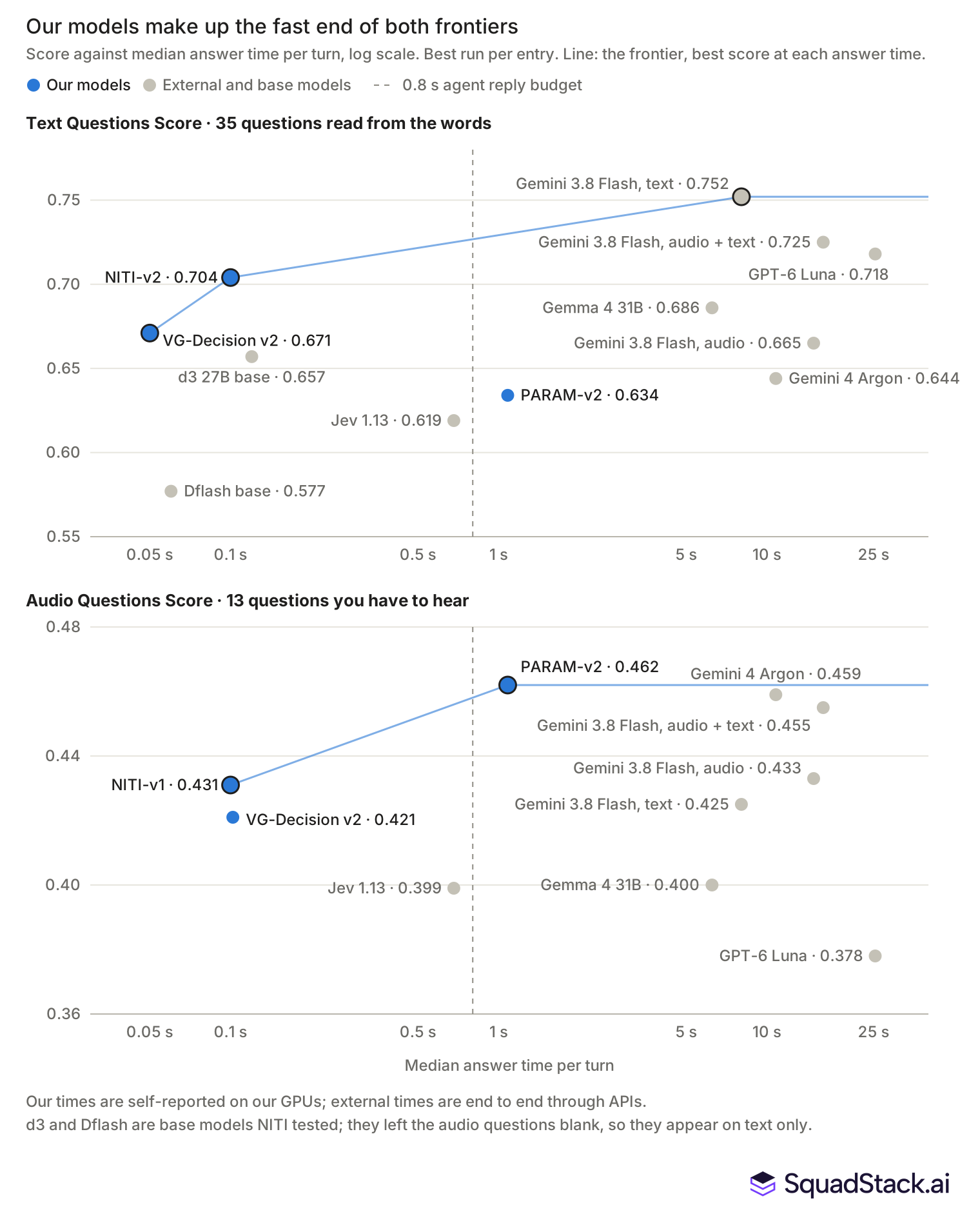
Three things to read off the plots:
Two caveats shape how far these numbers go: We released the gold answers on day two for error analysis, so final runs were not blind. And our latency figures come from our own GPUs while external models were timed end to end through APIs. Both are covered in the limitations section.
Every lead turn forces the agent to settle a dozen closed questions before it speaks, and all of them share a 0.8 s median reply budget.
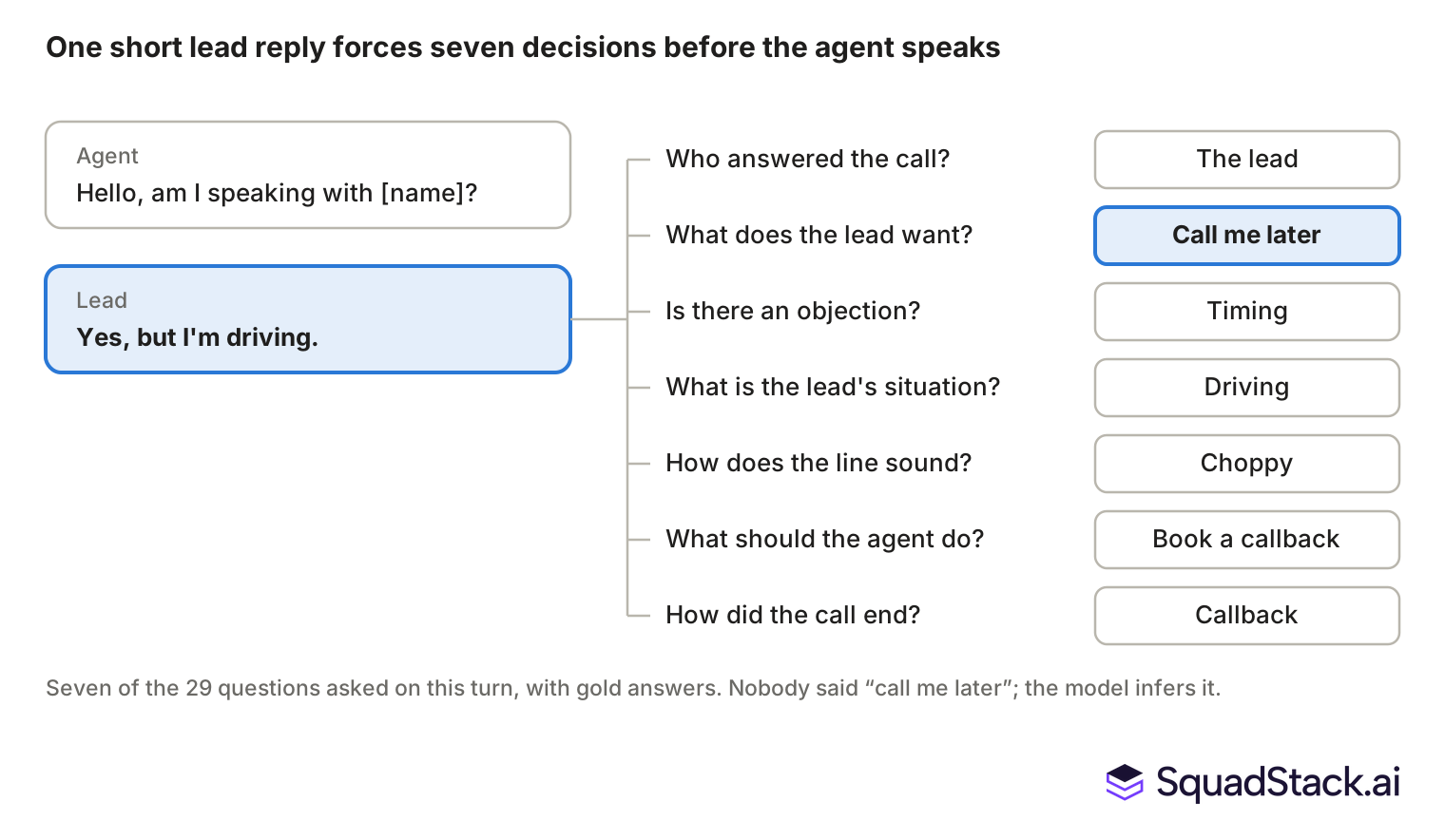
Take the first reply on an automotive call. The agent asks, "Am I speaking with [name]?" The lead says, "Yes, but I'm driving." Before replying, the agent has to decide who answered (the lead), what they want (a call later), whether there is an objection (timing), what their situation is (driving), how the line sounds (choppy) and what to do next (book a callback). Nobody said "call me later". The model has to infer it.
Today many of these decisions go to large general-purpose language models. That path has three costs:
The hackathon asked whether small models we train ourselves can make these decisions as well, in a fraction of the time.
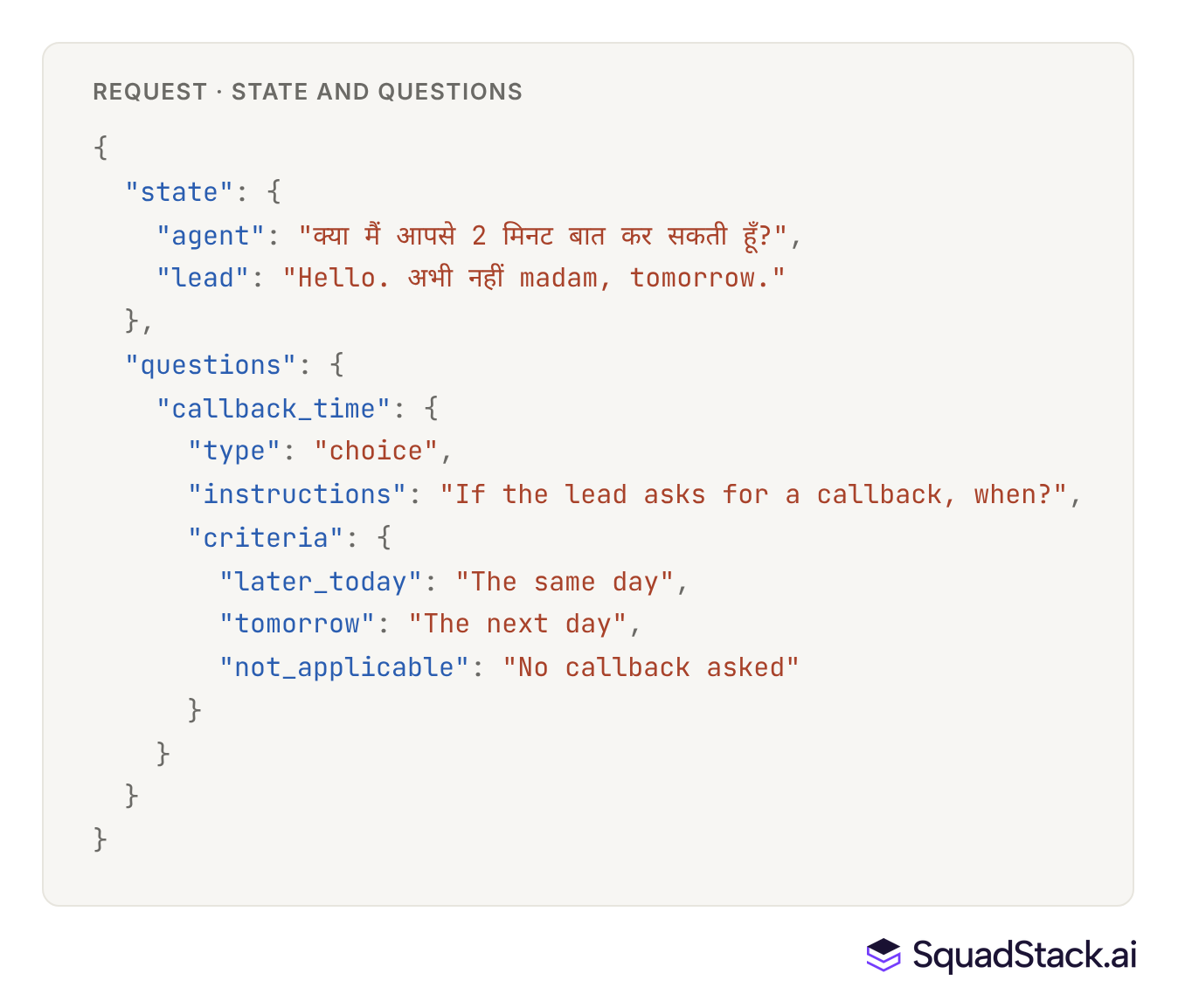
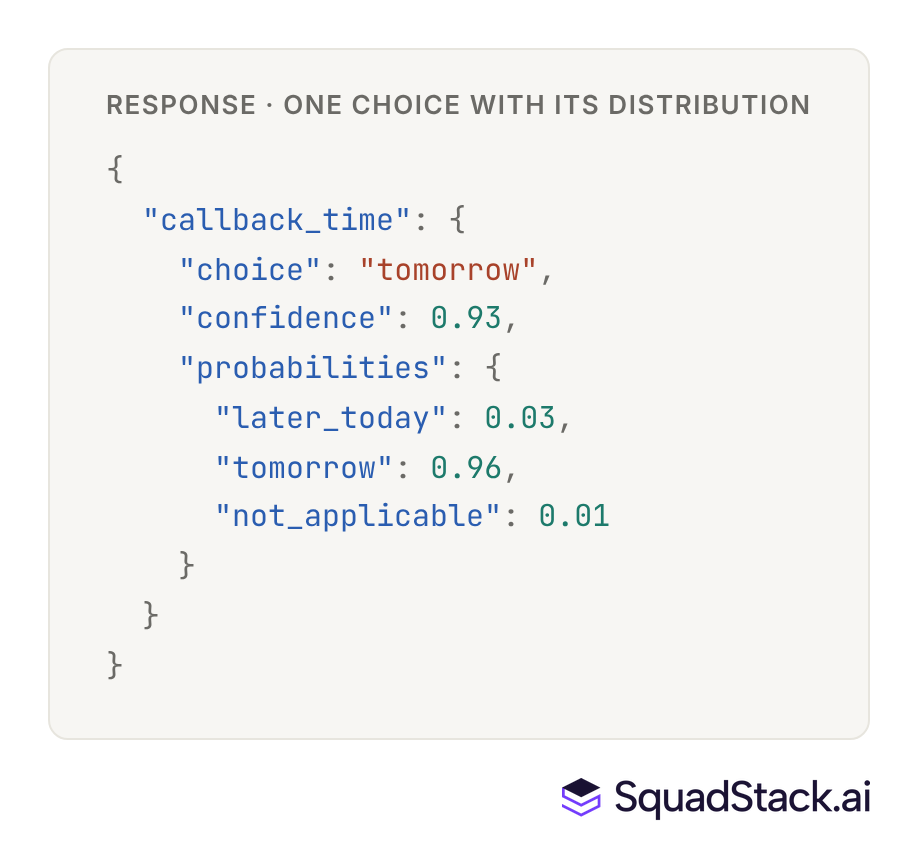
A decision model takes the call state and a set of typed, closed-choice questions, and returns one answer per question with a probability for every option.
The architecture is a shared encoder that reads the turn once, plus one small head per question. The benchmark asks 16 to 31 questions of every turn, and all of them are answered in a single forward pass. Adding a question adds a head, not a request.
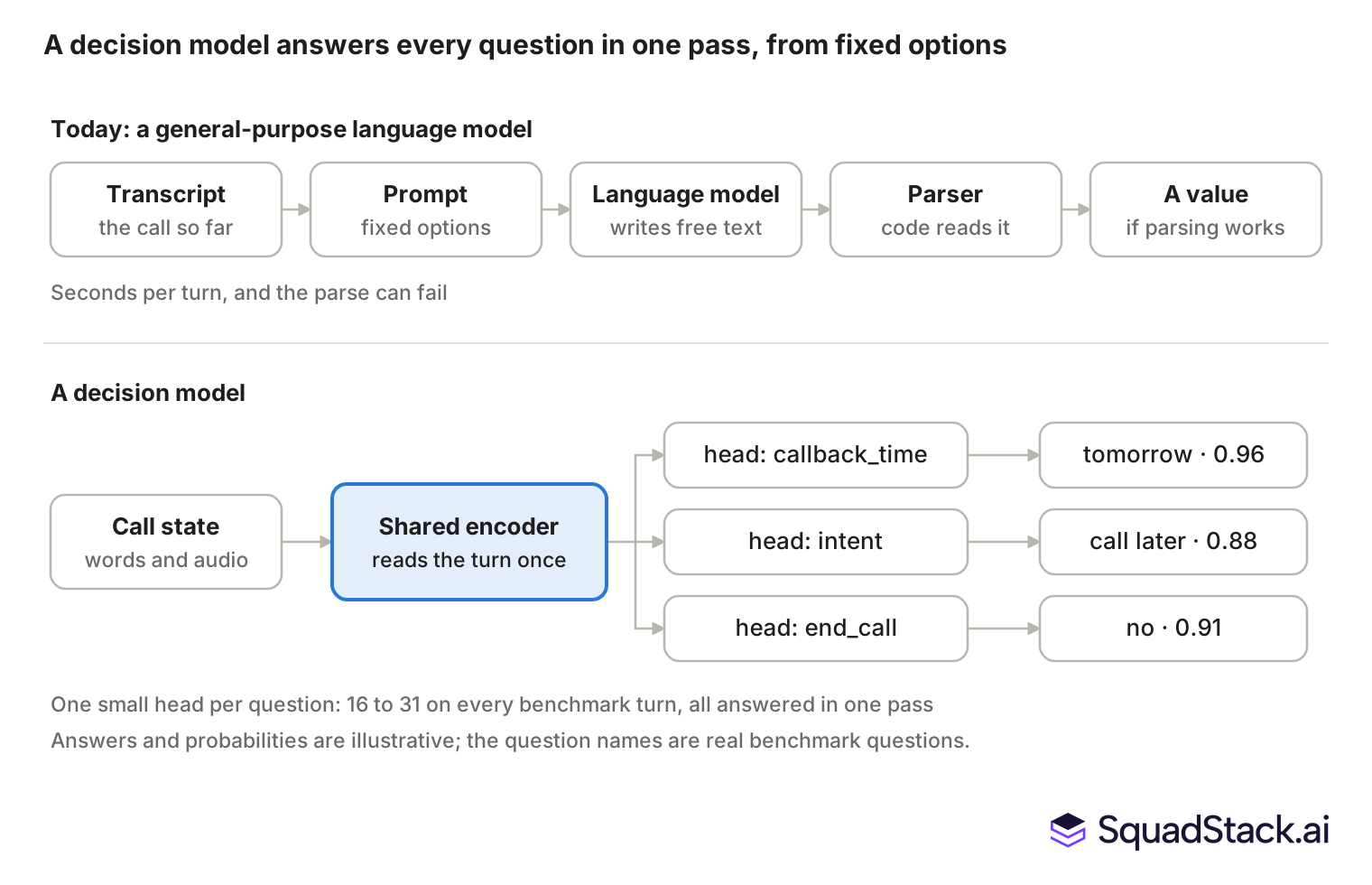
The top path is how most of these decisions run today. The bottom path is where every hackathon entry is built.
A request carries the state and the questions:
The answer is a choice with its distribution:
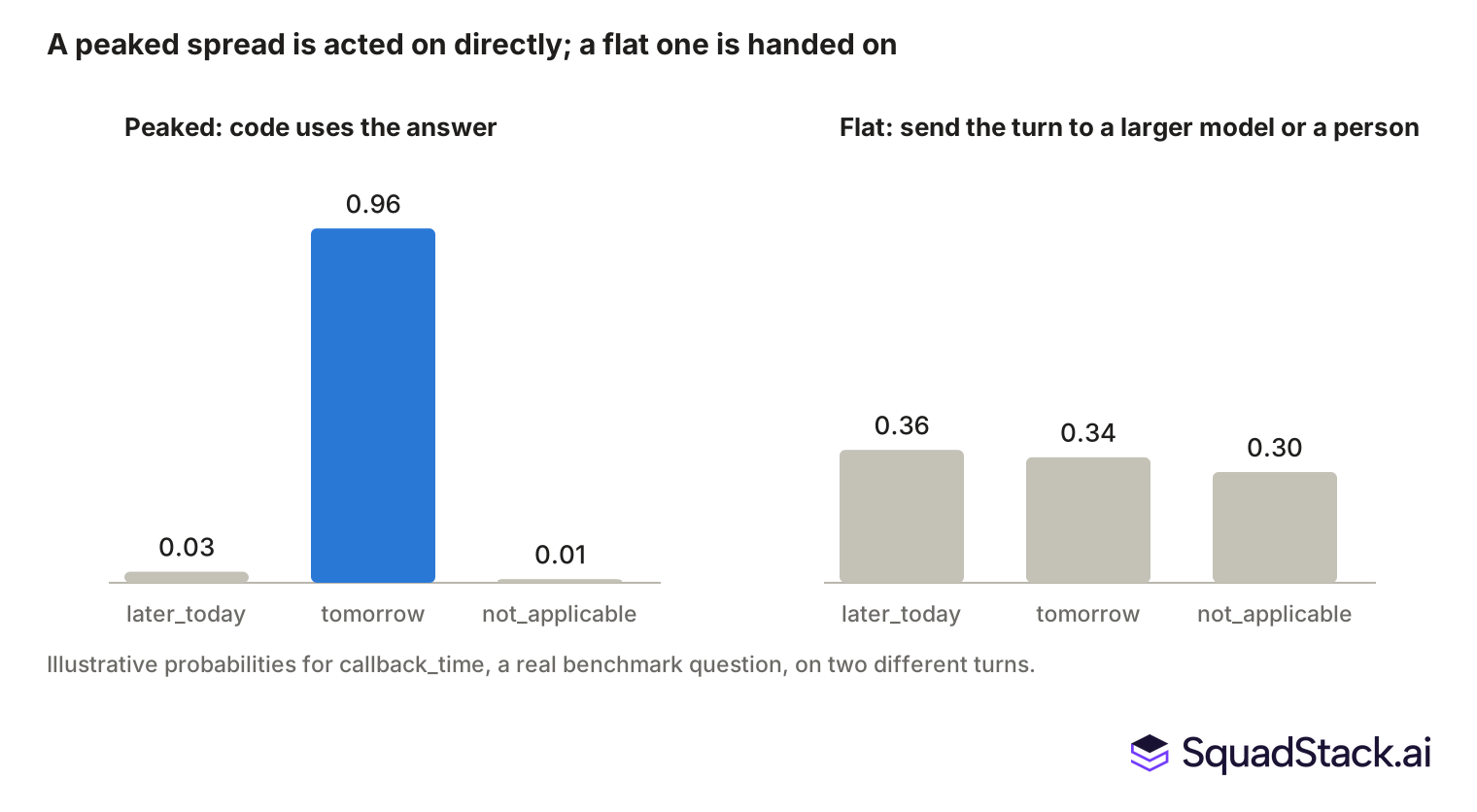
Three properties follow from this design:
Every entry answered the same questions on the same turns, and only the input changed, so the leaderboard measures what each signal is worth as well as which team trained better.
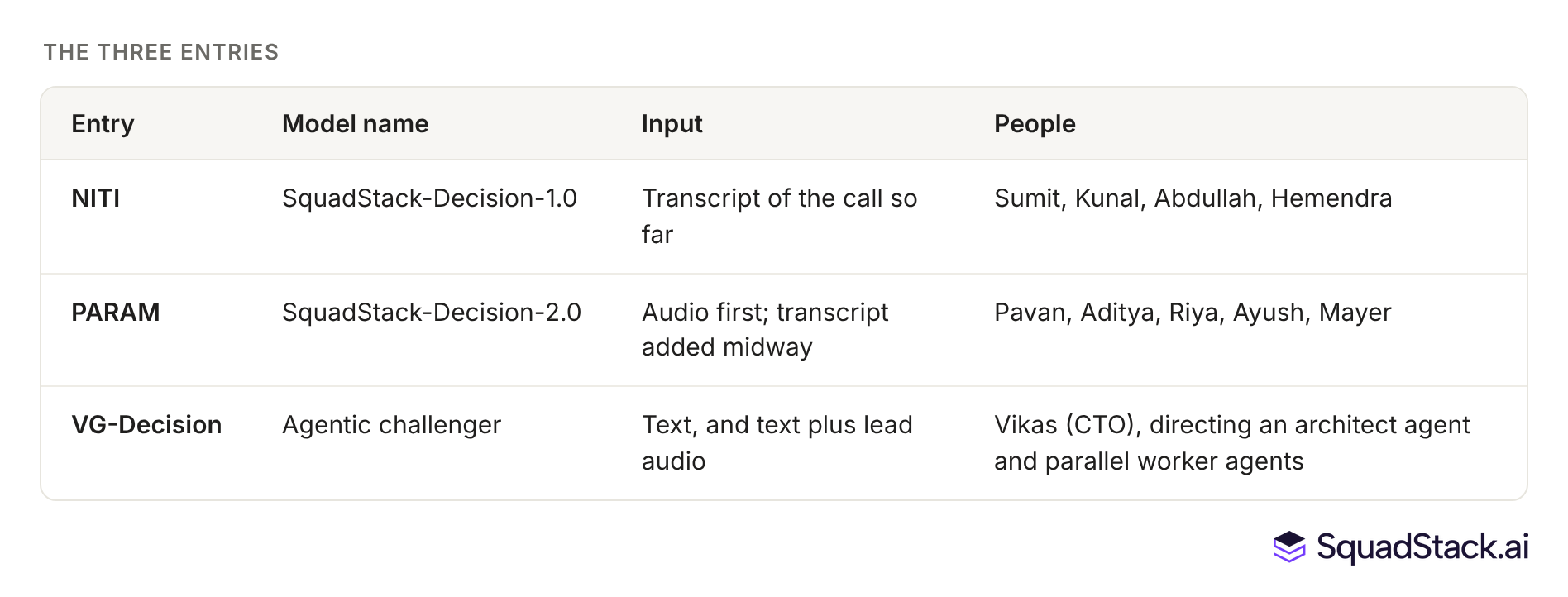
Both teams used AI assistants in their own work. VG-Decision differed in who drove the build: an architect agent planned, split and reviewed the work, and parallel agents handled data, training and evaluation. Ved facilitated and built the benchmark with a five-person annotation team.
Timeline
Rules
We built the benchmark before any team wrote training code: 586 decision points from 368 real calls placed between 1 and 11 October 2026.
We planned 625 calls and 1,150 units. 368 calls and 586 units (51%) passed step 4.
Each unit is one turn, judged only on what came before it. Nothing after the target turn is shown. A unit carries:
The set has 428 lead turns and 158 agent turns.
We drafted 62 closed-choice questions and kept 43. Three allow multiple answers. Each is asked only where it applies, so a turn gets 16 to 31. By input, 30 can be answered from the words, 8 only by listening and 5 need both.
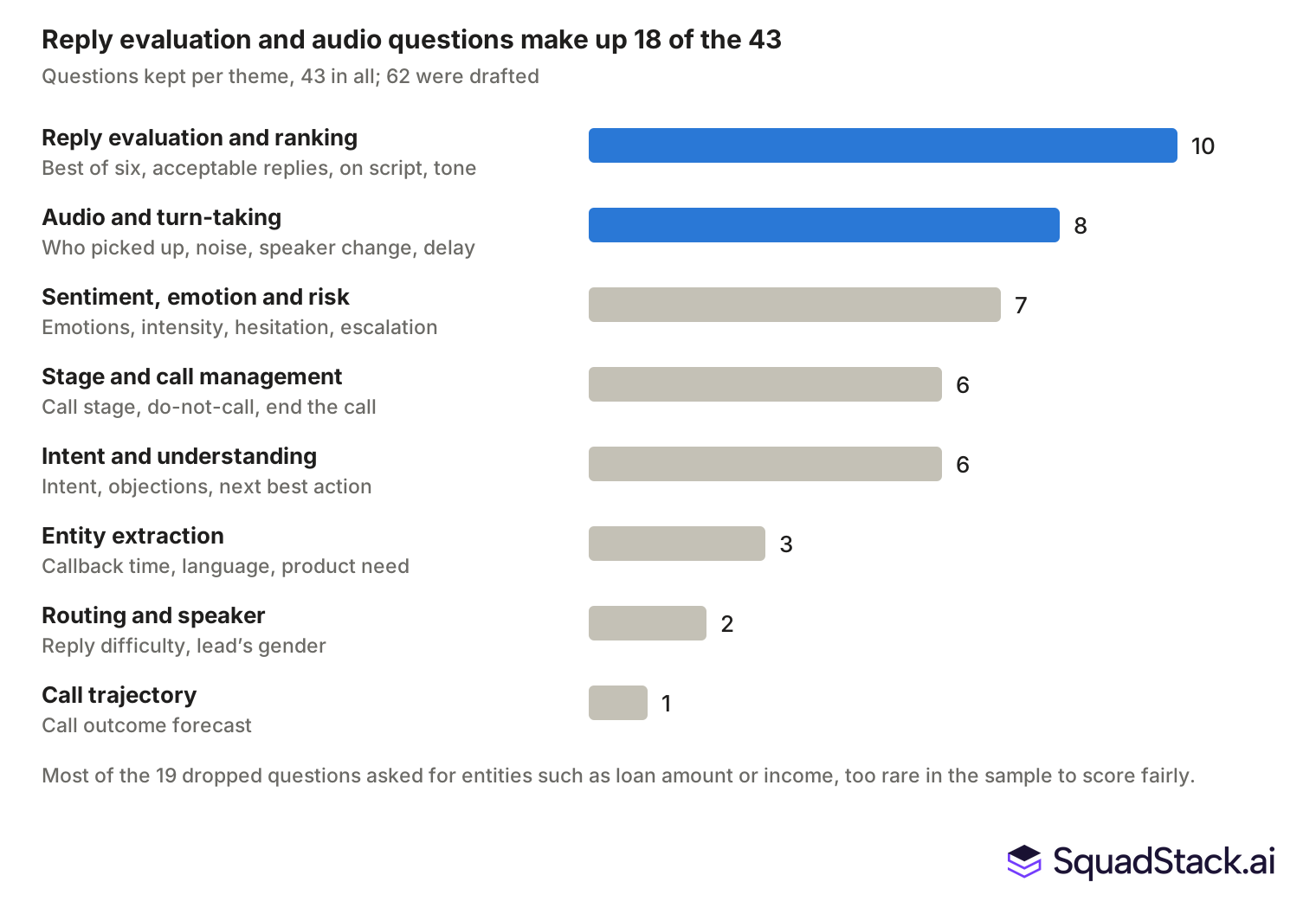
Most of the 19 dropped questions asked for entities such as loan amount or monthly income, which appeared too rarely in the sample to score fairly.
Each question has a planned gold source. Where sources disagree, the human answer wins.
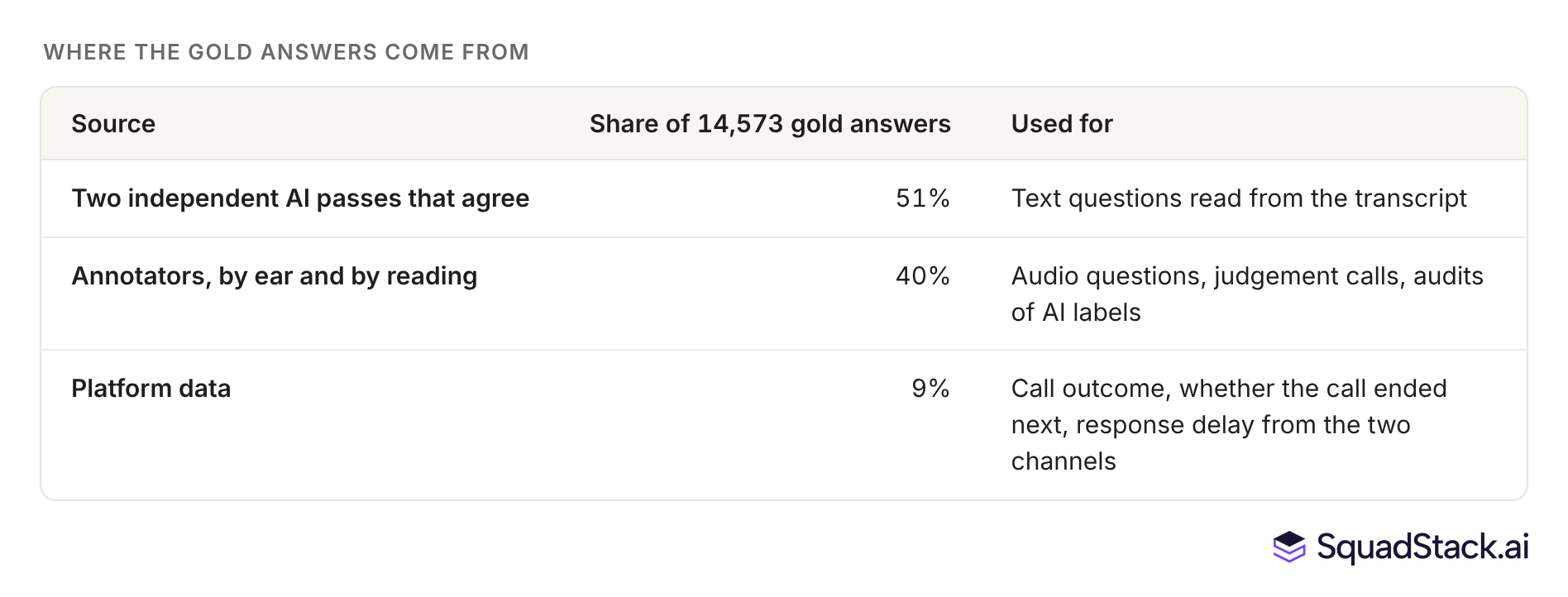
A sample was labelled twice to measure annotator agreement, and a share of the AI labels was audited by hand. Lead names and numbers never left the labelling tool.
Every question is scored with macro-F1, so a model that always gives the most common answer scores 0.267 overall. That is the floor.
Macro-F1 matters here because most answers sit in one class. Emotion intensity is "low" on most turns and the line is usually "good". Take 100 turns with 80 low, 15 medium and 5 high. Always guessing "low" gets 0.80 accuracy but per-class F1 of 0.89, 0 and 0, so macro-F1 is 0.30.
A question's weight scales with difficulty and is discounted by label reliability:
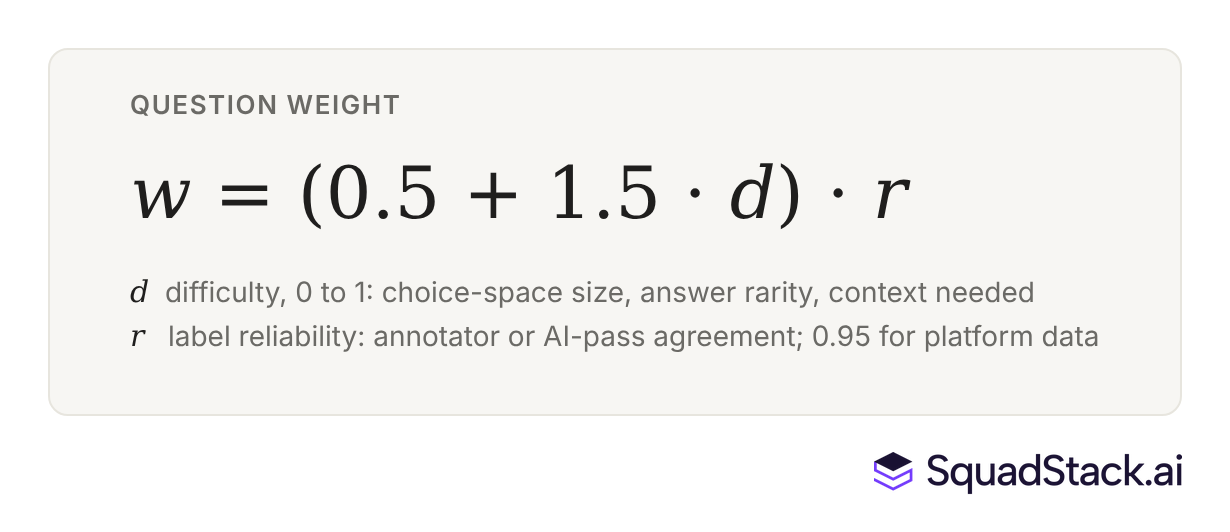
Difficulty d is the mean of three normalised terms: size of the choice space, rarity of the answers and context needed. Reliability r is annotator agreement for human gold, pass-to-pass agreement for AI gold and 0.95 for platform data. At equal reliability, the hardest question counts four times as much as the easiest.
Gemini 3.8 Flash reading the transcript was the strongest external model on text questions, and Gemini 4 Argon the strongest on audio questions. Both took more than 8 s per turn.
We ran seven external configurations zero-shot through OpenRouter and kept adding models through day two. Each baseline got one request per turn carrying all of that turn's questions, with no examples, no JSON mode and the provider's default temperature. A missing or invalid answer was left empty and counted as wrong.
What each baseline type received:
Every baseline is plotted against our models in the two frontier plots in the TL;DR, with its text score, audio score and answer time per turn.
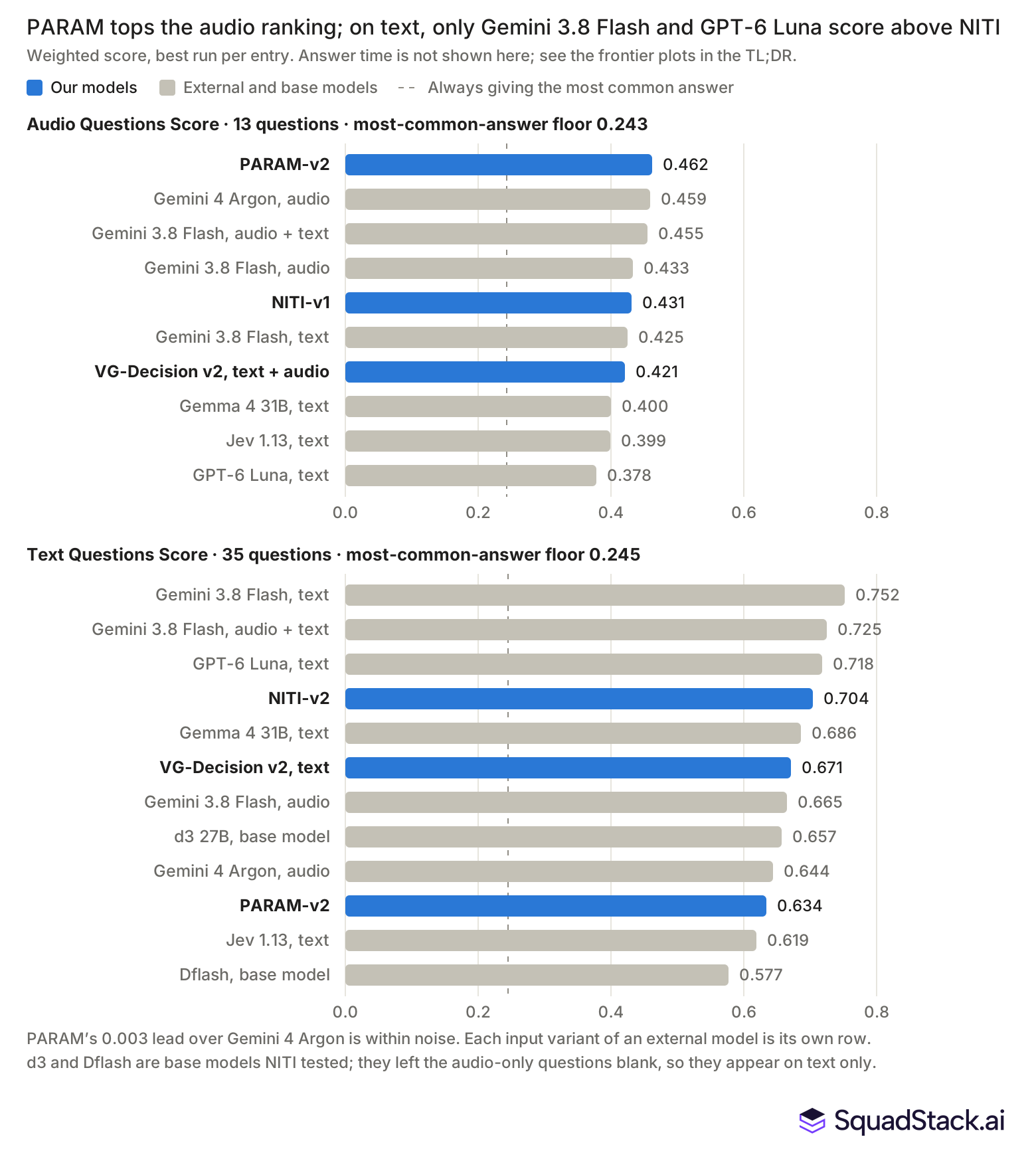
The zero-shot setup is deliberately plain. Few-shot prompting, JSON mode or tuned temperature would likely lift the external scores, so read these as a floor for what those models can do.
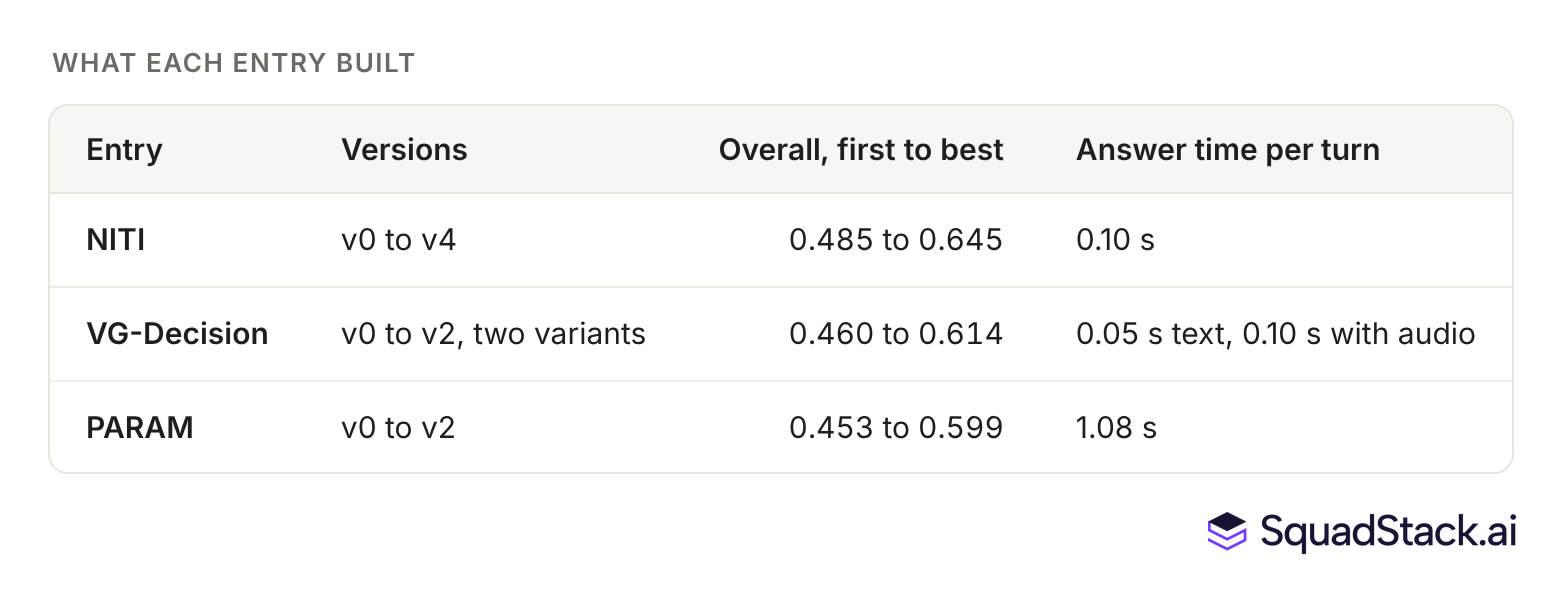
The three entries submitted 16 runs in about 40 hours, and each gained between 0.15 and 0.16 overall from first to best run.
NITI benchmarked two open-weight bases zero-shot on text questions: d3 27B scored 0.657 and Dflash 0.577. The team then trained LoRA adapters of about 0.1B parameters on calls we already own, with the 27B base frozen.
NITI-v1 reached 0.703 on text questions and 0.645 overall at about 0.10 s per turn on our GPUs. Because the adapter sits on the same base, serving cost does not change.
PARAM built the audio-first model. Midway, the team added the transcript as a second input to learn how the two signals combine. Audio Questions Score moved from 0.377 (v0) to 0.367 (v1) to 0.462 (v2), at about 1 s per turn. Overall, PARAM-v2 scored 0.599.
The 0.462 audio score is the highest on the board, 0.003 above Gemini 4 Argon at 0.459. Both are single runs, and we treat per-question differences under about 0.02 as noise, so the defensible claim is that a model trained in two days matched the best external audio model we tested.
Vikas spent the first day setting context for an architect agent, which then split the work across parallel agents. The result is a compact open-weight model of about 4B parameters with a decision head, trained on a single H100 in two stages:
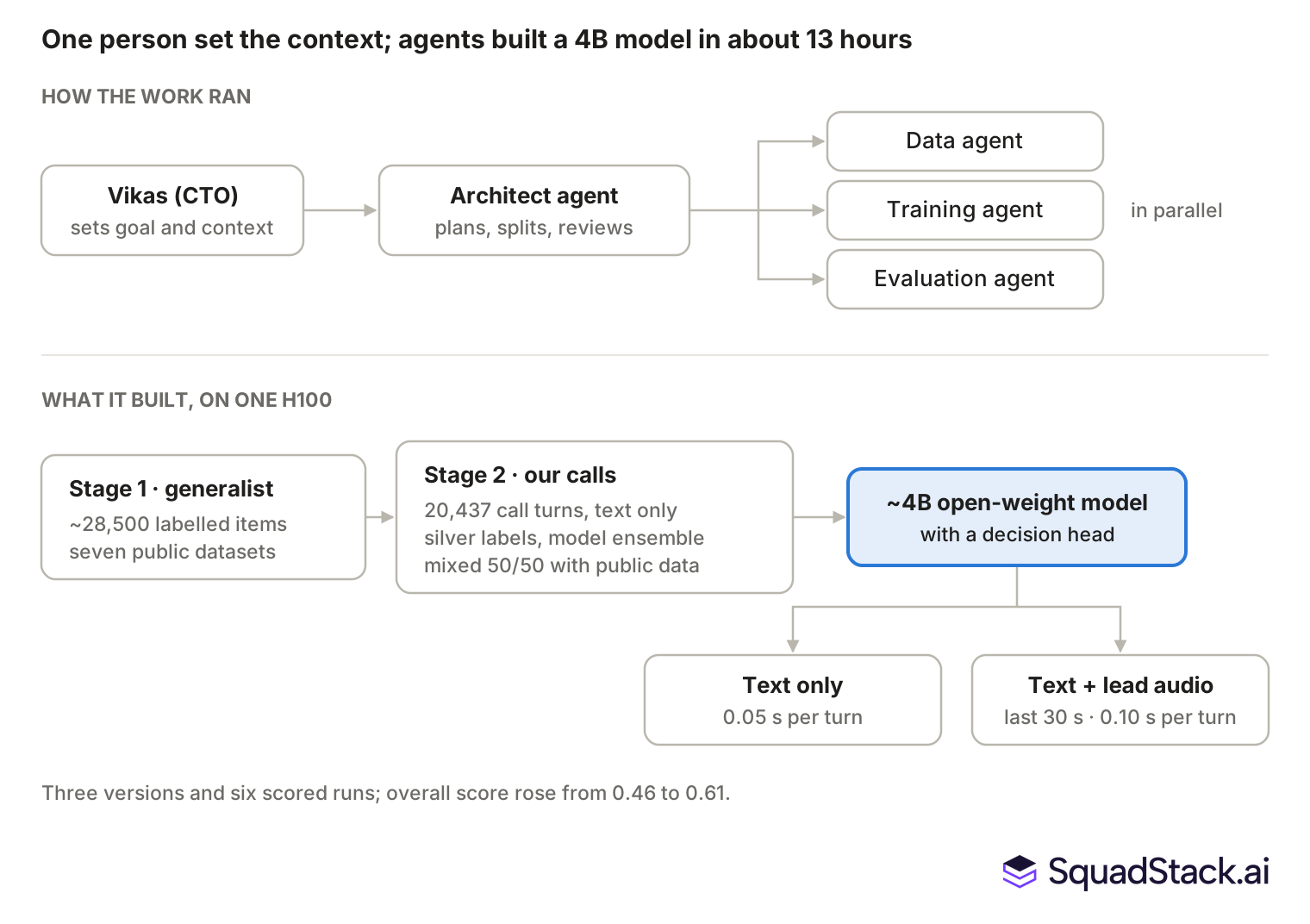
It runs text-only at 0.05 s per turn, or with the lead's last 30 s of audio at 0.10 s. The workflow shipped three versions and six scored runs in about 13 hours, moving from 0.46 to 0.61 overall.
On text questions our models hold the fast end of the frontier, and on audio questions they hold all of it. Both frontier plots are in the TL;DR.
On text, VG-Decision v2 (0.671 at 0.05 s) and NITI-v2 (0.704 at 0.10 s) are on the frontier. Gemini 3.8 Flash is the only model ahead of NITI, at 0.752, and takes 8.0 s.
On audio, the frontier runs from NITI-v1 (0.431 at 0.10 s) to PARAM-v2 (0.462 at 1.08 s). Gemini 4 Argon scores 0.459 in 10.8 s, so PARAM's place at the top rests on a 0.003 lead that is within noise. Every point on the audio frontier still comes from a model trained in under two days.
Team-led entries beat the agent-built one on every headline score: NITI over VG-Decision overall (0.645 against 0.614) and on text (0.704 against 0.671), and PARAM over VG-Decision on audio (0.462 against 0.421).
The latency gap is one to two orders of magnitude, but treat the exact ratio with care. Our times are self-reported on our own GPUs. External times include network and provider queueing.
Running Gemini 3.8 Flash three ways on the same turns (reading the transcript, hearing the audio, and both) gave us a controlled view of what audio adds and what it costs.
On questions labelled by ear, the same model scored higher hearing the call than reading it.
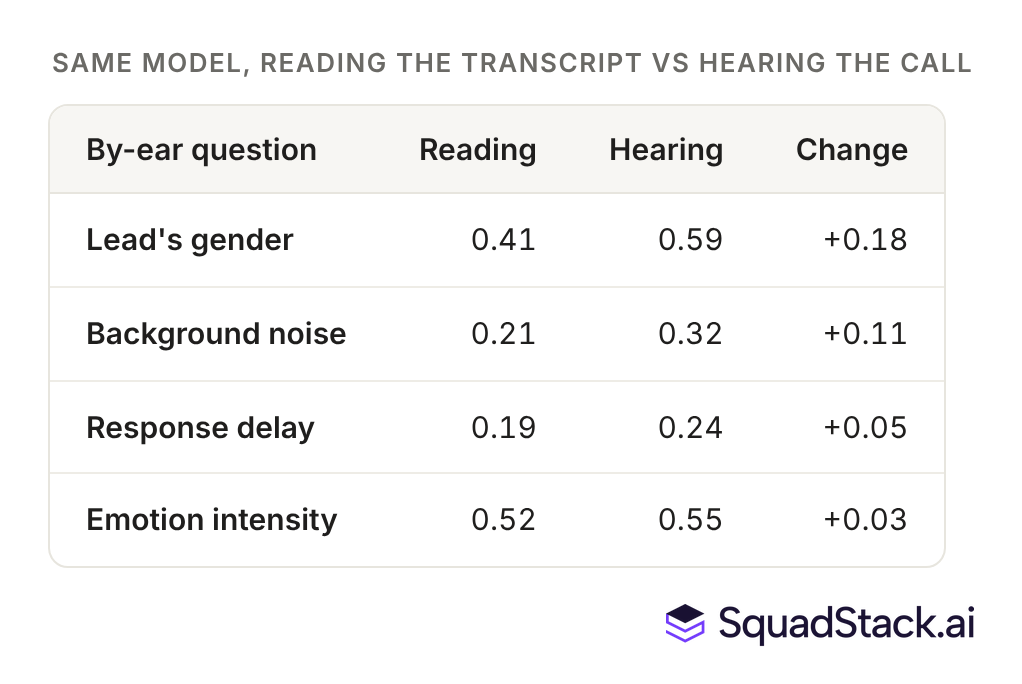
The largest gains are on who is speaking and what surrounds them. A decision model needs its own access to the audio, beyond the words our speech recogniser outputs. PARAM's audio-first model is our starting point.
Given both inputs, Gemini 3.8 Flash scored 0.663 overall, below its own text-only 0.677. Adding audio helped where both signals carry information and hurt on judgements about content.
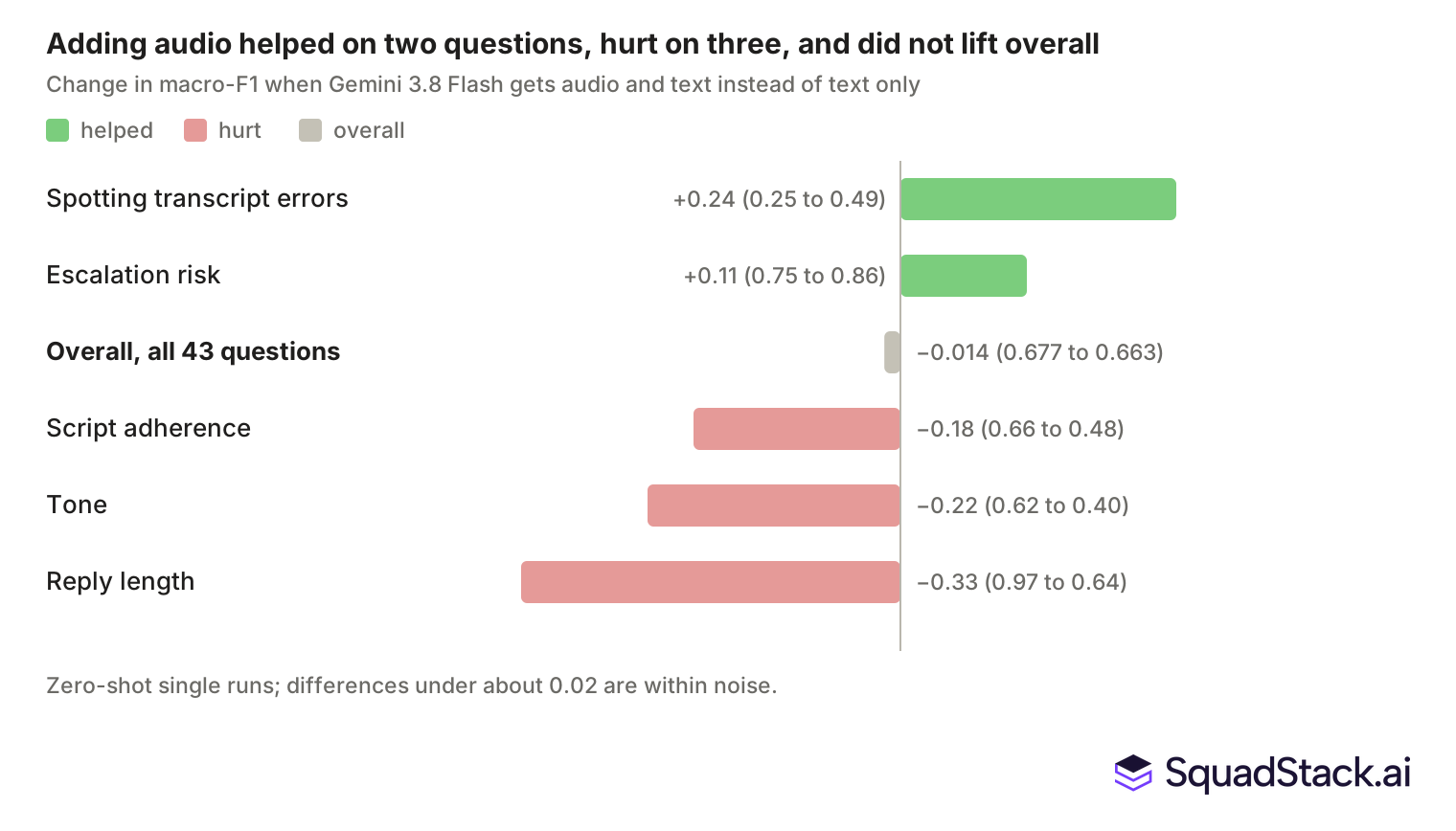
Our read is that a combined model should train on a mix of text-only and audio-and-text turns, so it learns which channel to trust per question. That is why PARAM added text midway.
Sending the whole call's audio with every turn doubled Gemini 3.8 Flash's answer time from 8.0 s to 16.2 s, and it still scored below reading the transcript. NITI answers the same turns in 0.10 s.
To stay inside a sub-second reply, the practical design is the current turn's audio plus the text history, or caching what the model has already heard.
These results support a direction for our decision-model work. They do not yet support a ranking claim against external models.
The benchmark is now the standing test for every future decision model: a model ships only when it beats what runs in production on the same real calls.
We plan to grow the same stereo calls into a full AudioLLM benchmark by adding label layers, without collecting new datasets. Each stage asks a harder question than the last.
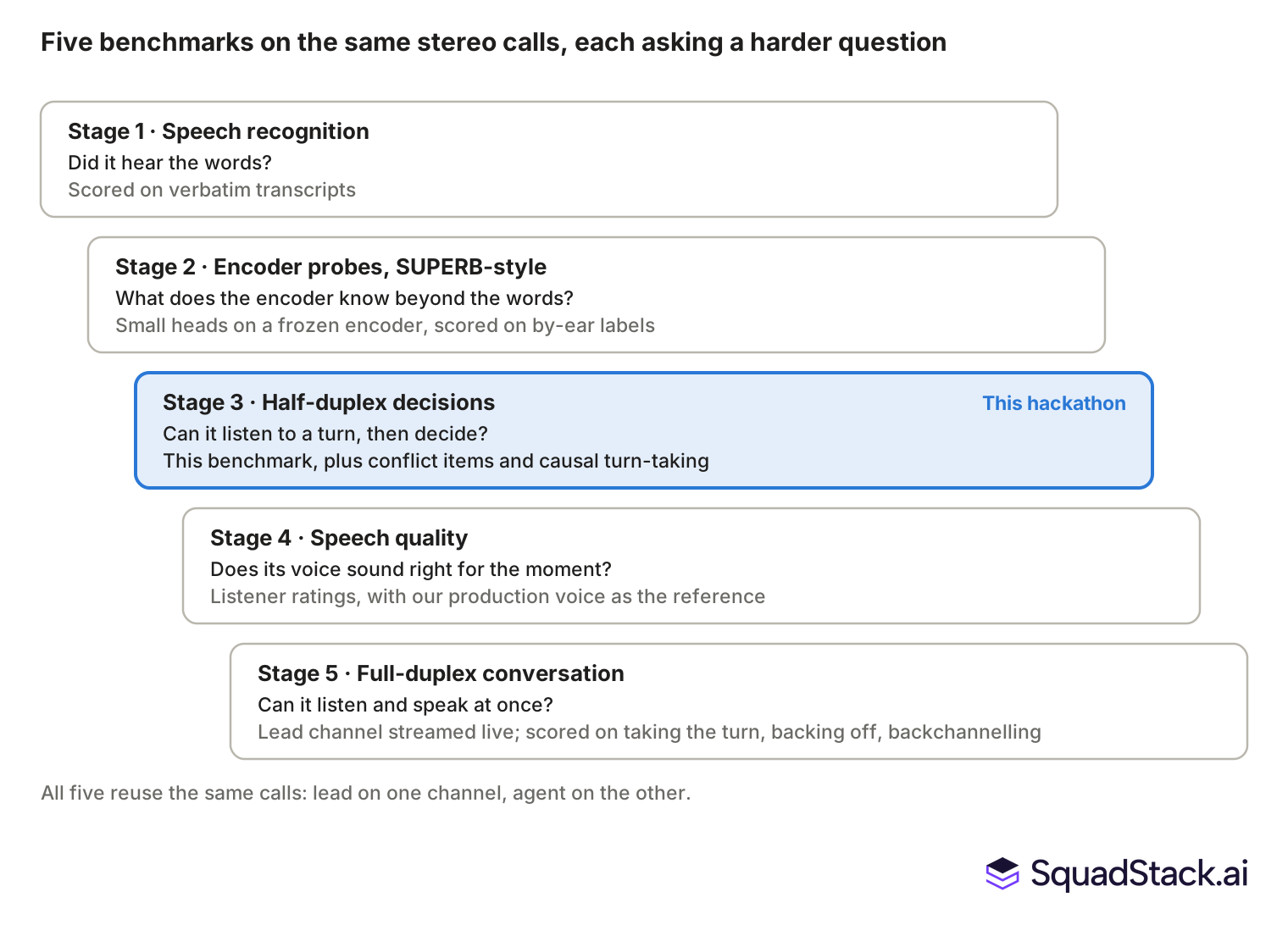
Some stages label the calls once and score any model against the same labels. Others reuse the calls as prompts and need fresh ratings or live runs for each model.
The next version of each decision model is already training.