



"For decades, salesperson absenteeism has created a persistent gap in consumer goods distribution: missed visits often mean missed orders. Solving this takes more than an AI that speaks local languages. Retailers describe the same product in ten different ways, using price, packaging, colour or shorthand. We've built Voice AI that understands this context, captures the right order and integrates it into the distributor's workflow. With Bizom, we're bringing this capability into the wider distribution ecosystem to recover missed sales at scale and extend reach to underserved retailers."
"This partnership marks an important step towards route-to-market models that no longer depend on a single visit happening on a single day. With SquadStack’s voice AI and Bizom’s Real Intelligence, brands now have an always-on safety net beneath their field force, one that protects targets, supports distributors and keeps reps in control of their orders."
Overview
A leading global consumer healthcare brand sells antacids, oral care, pain relief and cold-and-cough products through roughly 14,000 kirana and medical stores across India. When a distributor salesman misses his beat or is marked absent, those outlets get no order that day. There is no backup: the beat is skipped and the sale is lost to a competitor or a wholesaler.
In partnership with Bizom, one of India's leading SFA (Sales Force Automation) and DMS (Distributor Management System) platforms, SquadStack.ai deployed a Voice AI agent that called every missed outlet within hours, pitched that outlet's own target SKUs and live trade schemes, built a cart in real time, and wrote the confirmed order back into Bizom.
The pilot ran in trade Hinglish, with Marathi, Telugu, Gujarati and Tamil ready for QA. During the POC, the agent dialled over 14,000 outlets, connected with 88% of them, and generated over 1,500 orders worth an estimated ₹16 lakh in incremental secondary sales.
The Challenge
Every general-trade order in Indian FMCG depends on a salesman physically standing in a shop. When he misses the beat, the shopkeeper buys from a competitor or a wholesaler. The sale is gone, not deferred.
For a consumer healthcare brand selling products across thousands of outlets, this meant a structural revenue leak with no recovery mechanism.
- Absenteeism had no protocol. Frontline sales attrition in Indian FMCG runs around 34% annually. Most distributors operate below sanctioned headcount. When a salesman was absent or on leave, the brand's own systems often did not reflect it accurately. In roughly one in five calls during the pilot, the outlet had already been visited by the salesman or a substitute, but the system still flagged the beat as missed.
- The outlets that needed coverage most were the hardest to reach. Roughly half of all outlets are C-class, visited monthly at best, contributing 10 to 15% of revenue. Standard territory planning leaves a gap of about a fifth between the calls a territory needs and the calls its field team can make. That gap is closed by quietly deleting outlets from the plan. These outlets are individually uneconomic to visit and collectively material.
- Generic tele-calling had failed the channel before. Buyers in this market had watched outbound calling fail: scripts that pitched the same list to everyone, agents who quoted wrong prices or wrong pack sizes, and orders taken on calls that never reached the distributor's system. One wrong scheme quote ends a retailer relationship. The industry response was to avoid outbound calling, not to fix it.
- Retailers buy in a language the system does not speak. Shopkeepers ask for "the blue one" (Eno Regular), "₹35 wala brush" (a single toothbrush from a 12-pack), or "pila wala ENO" (a yellow-variant antacid). They order in outers, confuse box sizes, and use MRP as the identifier. No catalogue matches the way a retailer actually talks.
- The distributor is a gatekeeper, not a buyer. Distributors run on 3.5 to 5% margin, extend credit into a channel where most kiranas buy on credit, and carry the working-capital risk. Any programme that looks like the brand going direct over the distributor's head will be blocked. The absent-rep problem is real, but the solution had to be framed as protecting the distributor's economics, not replacing his salesman.
The Solution
SquadStack.ai partnered with Bizom to build something that had not been attempted in Indian general trade: a Voice AI agent that does not just call retailers, but actually takes their order, calculates the scheme price in real time, and writes the confirmed order back into the distributor's billing system.
How the agent works
Bizom's SFA flags an outlet as missed when its assigned salesman has flagged as missed at end of day. The outlet's full context (target SKUs, running trade schemes, order history, distributor name, salesman name) is pulled from Bizom's APIs and sent to the SquadStack.ai agent before the call is placed.
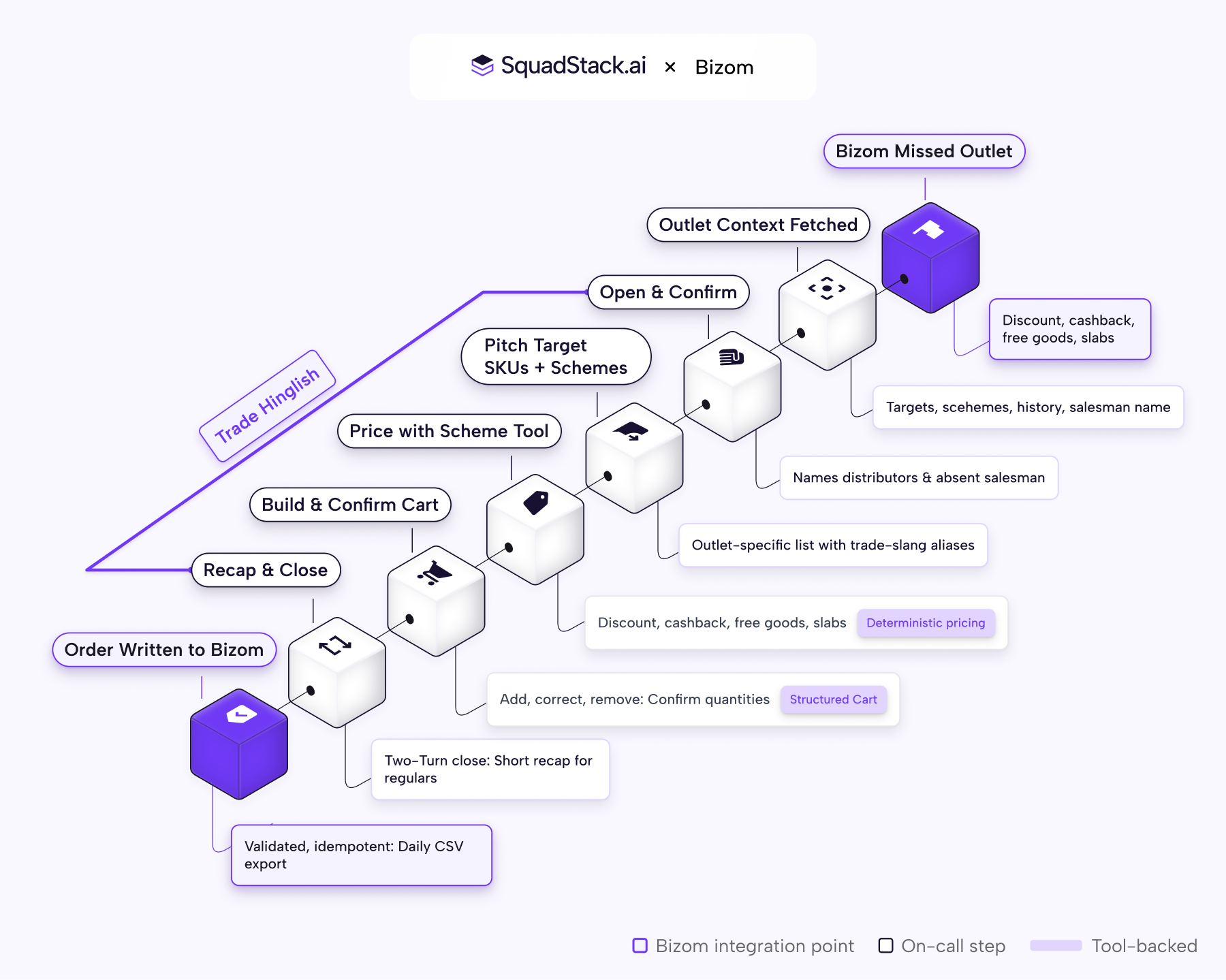
The cart carries ERP SKU codes and confirmed prices as structured data, not transcript text, and every order is written with an idempotency key so a retry never creates a duplicate.
What makes this structurally different
This is not a voice bot making outbound calls and logging dispositions. Two things separate it from anything the market has seen:
- Pre-integrated with the brand's own commercial system: Outlet targets, schemes, order history and the order API all come from Bizom. A new brand on Bizom can go live in days, not months. There is no integration project.
- Transactional, not informational: The agent builds a priced cart and writes a real order. The order has an idempotency key so a retry never creates a duplicate. The cart is saved separately from the quote validation, so a pricing failure is never hidden behind a successful order.
"For decades, salesperson absenteeism has created a persistent gap in consumer goods
distribution: missed visits often mean missed orders. Solving this takes more than an AI that
speaks local languages. Retailers describe the same product in ten different ways, using price,
packaging, colour or shorthand. We've built Voice AI that understands this context, captures the
right order and integrates it into the distributor's workflow. With Bizom, we're bringing this
capability into the wider distribution ecosystem to recover missed sales at scale and extend
reach to underserved retailers." says Apurv Agrawal, CEO & Co-founder, SquadStack.ai
The Bizom partnership
Bizom (Mobisy Technologies) is a retail intelligence and SFA platform serving over 750 brands with approximately 2.5 lakh field sales users. In this model, Bizom holds the brand contract and the data feeds, SquadStack.ai builds and operates the agent, and orders flow back into Bizom's system. For the brand, nothing changes in their existing workflow except that missed outlets now produce orders.
The partnership is designed to scale: because the agent runs on Bizom's standard APIs, any Bizom brand with the same data feeds (outlet master, SKU catalogue, schemes, beat attendance) can go live with configuration rather than custom development. The first production deal at scale, covering 1 to 1.5 lakh minutes per month, is in negotiation.
“This partnership marks an important step towards route-to-market models that no longer
depend on a single visit happening on a single day. With SquadStack’s voice AI and Bizom’s
Real Intelligence, brands now have an always-on safety net beneath their field force, one that
protects targets, supports distributors and keeps reps in control of their orders,” says Lalit Bhise,
Co-founder & CEO, Bizom.
The Impact
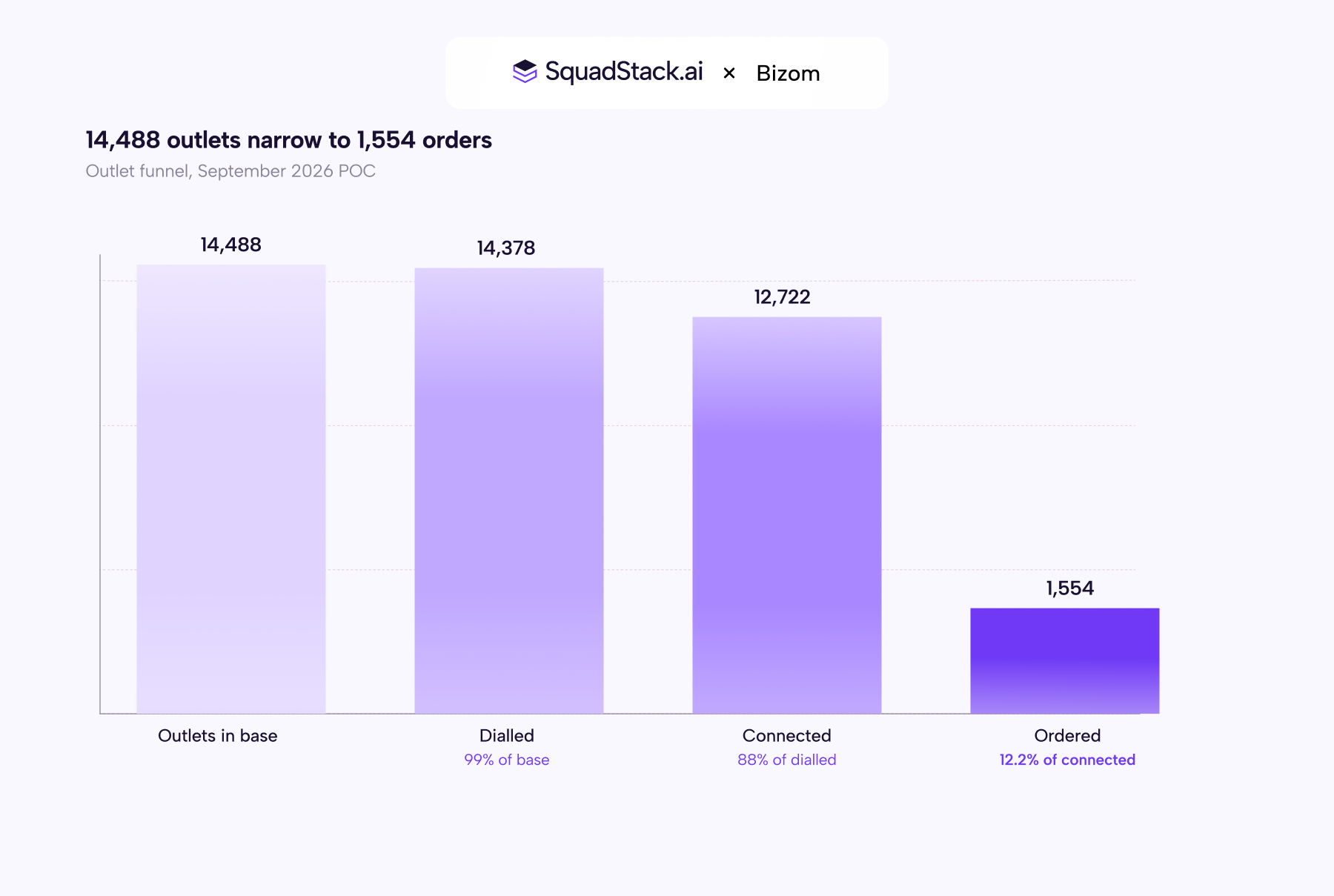
Early pilot days showed up to 20% of leads ordering. September at full volume settled at 12.2%. The drop is expected: pilot cohorts are cherry-picked, full volume is not. Use 12% as the production reference for this category. At full volume, the agent reached 14,000+ outlets and recovered ₹16 lakh in incremental secondary sales.
Looking Ahead
Three use cases follow: start-of-day and end-of-day manager calls, where the agent collects structured updates from field reps and sends the manager one consolidated report. WhatsApp voice-note ordering, where busy retailers who dropped the call can reply by voice note and have the order transcribed and written to Bizom.
And coverage of the structurally uncovered outlet tail, roughly half of all outlets that are C-class and visited monthly at best, where a phone call's cost per contact makes it economic to reach for the first time.

