.svg)







Overview
WheelsEye is a technology-led logistics marketplace that connects shippers with truck drivers across India. Often described as a marketplace built for operators, WheelsEye enables drivers to discover loads, manage trips, and monetize their fleet through a combination of GPS tracking, app subscriptions, and marketplace access.
On the supply side, WheelsEye works with a diverse operator base, classified into:
- MFO: Multiple Fleet Owners
- MVO: Multiple Vehicle Owners.
- SFO: Single Fleet Owners
- SVO: Single Vehicle Owners
For this engagement, the focus was on SFO and SVO operators, who form a high-volume but operationally complex segment of the marketplace.
The Challenge
Rate card collection is critical for the WheelsEye marketplace, as route-level pricing directly impacts shipper matching and marketplace margins. However, the existing human-led process faced several operational challenges.
- Incomplete Rate Sharing
Drivers typically shared only a single rate, often missing return pricing or vehicle-specific variations, resulting in incomplete rate cards. - Driver Availability Constraints
Since most drivers are actively on the road, longer conversations often lead to drop-offs or incomplete responses, making it difficult for agents to capture structured rate information consistently. - Complex Query Handling for Agents
Agents had to handle multiple variables such as route pricing, vehicle types, return routes, and custom routes, making knowledge base management during live calls challenging. - High Seat Costs
The process relied on a dedicated telecalling team, creating higher operational costs and limited scalability. - Low Rate Card Collection Success
The earlier workflow delivered less than 20% success rate, meaning most calls failed to capture usable rate cards. - No CAC Visibility
The team lacked a clear benchmark for the cost per rate card collected, making optimization difficult.
The Solution
SquadStack deployed a voice-led AI workflow purpose-built for rate card collection from SFO and SVO operators.
What the system was designed to do
- Engage drivers in natural, conversational Hindi and Hinglish
- Collect route-specific, vehicle-specific pricing
- Capture both ongoing and return rates
- Adapt dynamically when drivers operated on non-standard or custom routes
How It Worked
- The AI was trained on a dataset of 13,000 leads, each tagged with:
- Route
- Vehicle type
- Vehicle number
- Route
- The system prompted drivers intelligently instead of asking generic pricing questions
- Drivers could specify rates for exact routes or define custom routes when applicable
- Conversations were optimized for brevity without compromising data quality
This approach replaced rigid scripts with structured, outcome-driven conversations.
The Impact
The AI-led workflow delivered a significant improvement in efficiency, cost, and conversion, outperforming the earlier human-led process across key operational metrics.
Key Outcomes
- Lower CAC for Rate Card Collection
AI enabled a highly cost-efficient rate card collection workflow, achieving significantly lower customer acquisition cost per rate card shared, bringing predictable unit economics to the process. - 87% Higher Rate Card Collection Success
The success rate of collecting usable rate cards improved dramatically, with conversion increasing by ~87% compared to the earlier process. - 40% Reduction in Average Handling Time
AI-led conversations reduced the time required to collect pricing information, resulting in a ~40% decrease in average handling time, allowing more drivers to be reached in less time. - High and Consistent Connectivity
The system maintained ~85% connectivity, ensuring reliable engagement with truck drivers despite their on-road availability constraints.
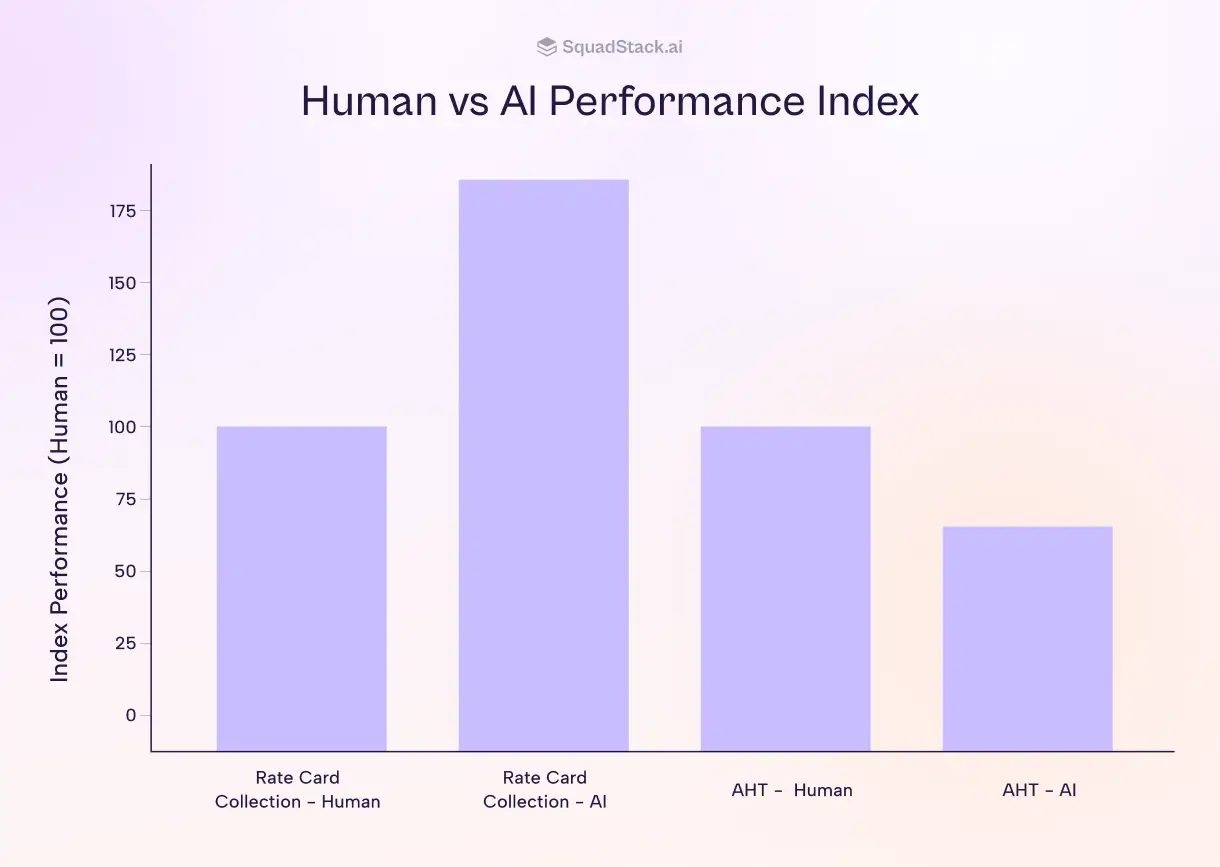
The takeaway is clear: AI didn’t just reduce cost, it made rate collection predictable and scalable.