.svg)




Overview
One of India's largest discount brokerages processes 1.8 lakh leads per month for demat account openings, converting roughly 8% through a mix of BPO and in-house agents at a fixed cost of ₹235 per conversion. The journey from lead to e-signed account requires identity verification, document collection, and a guided walkthrough that most prospects abandon partway through.
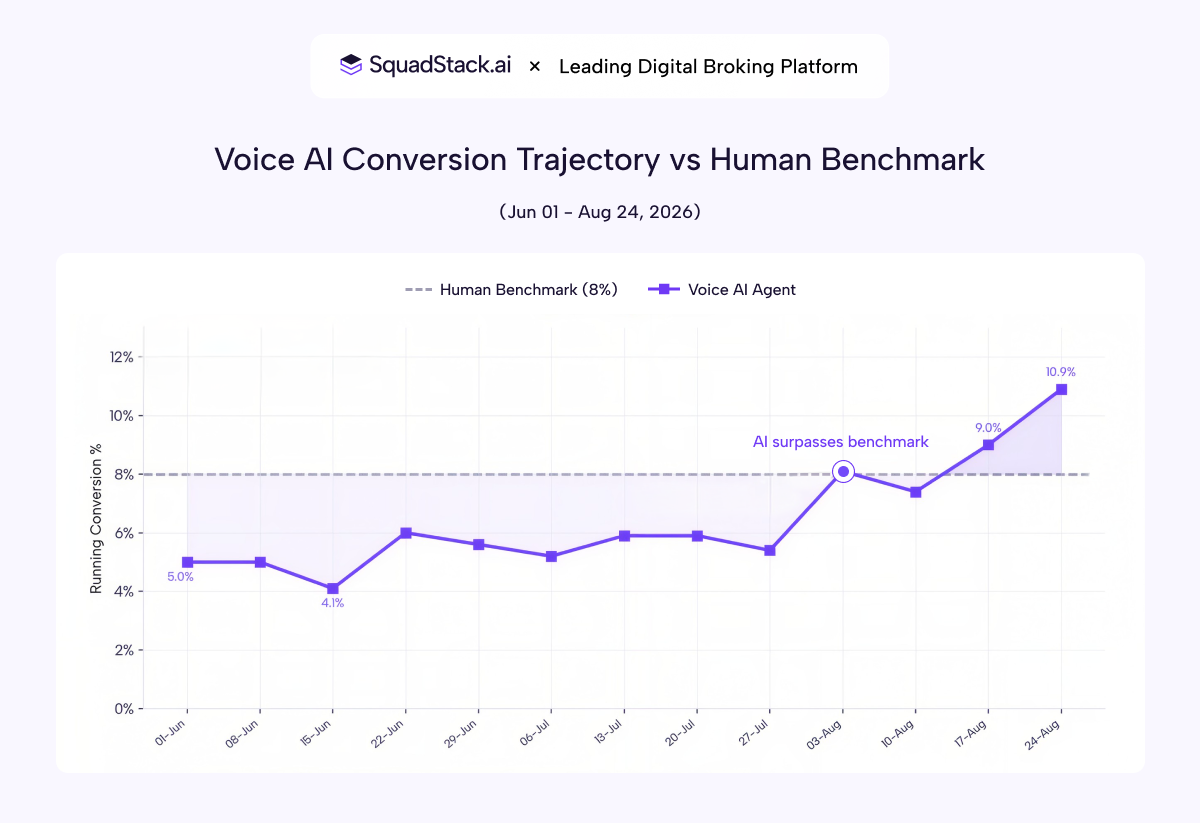
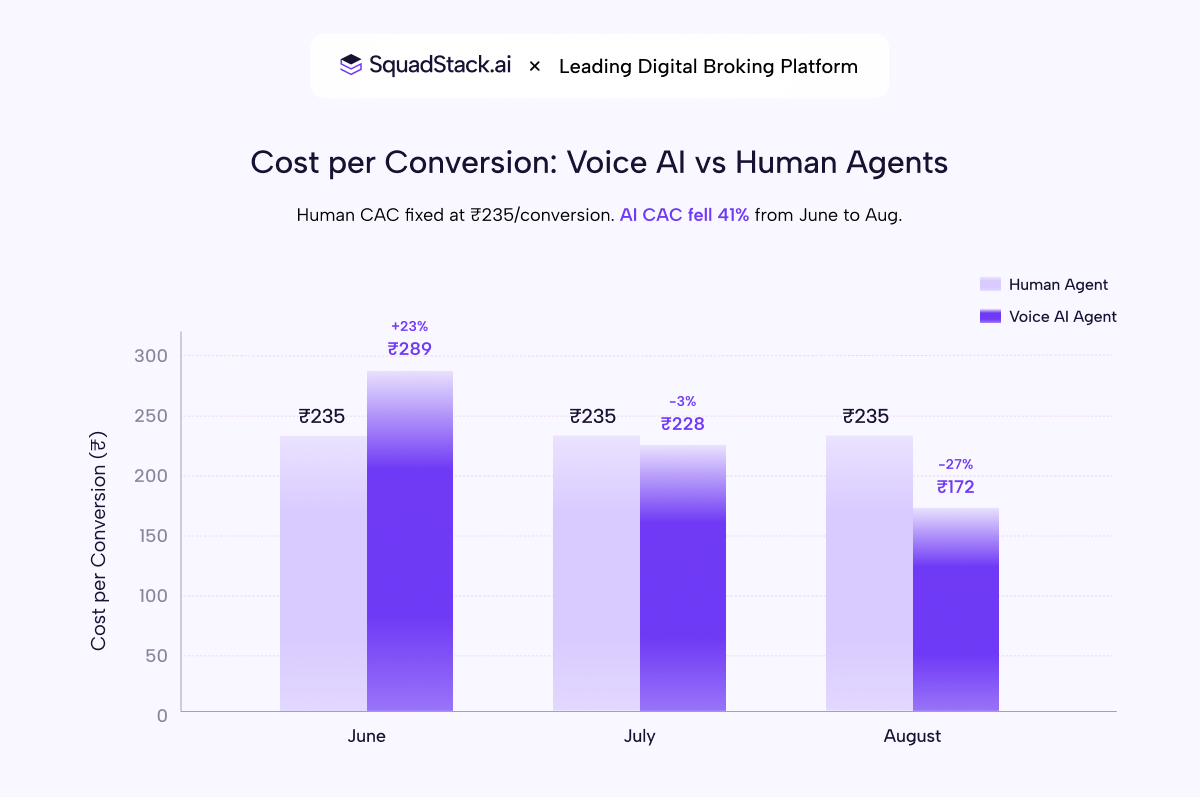
In June 2026, the brokerage launched a pilot with SquadStack.ai Voice AI to run the same end-to-end flow, starting at 500 leads per day. By August, the AI was converting 8.4% of leads at ₹172 per conversion, surpassing the human benchmark.
What makes this pilot unusual is the condition under which it performed: only 18% of AI leads arrived within two hours of creation, compared to 68% for the human campaign. The AI surpassed the human conversion benchmark on structurally worse raw material.
The Challenge
- Fixed cost-per-conversion model with no efficiency lever: The human operation ran on a fixed ₹235 per conversion, paid to BPO and in-house agents regardless of lead quality, time of day, or attempt count. At 1.8 lakh leads per month and roughly 9% conversion, the model was stable but offered no path to cost reduction without renegotiating vendor contracts or cutting lead volume.
- Scale required a proportional headcount increase: Processing 6,000 leads per day through human agents meant maintaining a large bench of trained callers. Every increase in lead volume required proportional hiring, training, and quality monitoring. The brokerage's lead pipeline was growing faster than its ability to staff.
- Quality audit at scale is manual and incomplete: At 6,000 leads per day, auditing even a fraction of calls requires a dedicated QA team listening to recordings, scoring against compliance checklists, and flagging deviations. In practice, only a small sample gets reviewed. Script adherence, regulatory guardrails (identity verification steps, disclosure language), and conversation quality drift between agents go undetected until a complaint surfaces.
- No mechanism for continuous improvement: Human agent conversion rates are a function of training, scripting, and individual performance. Improvements require retraining entire teams. The brokerage had no lever to iteratively optimize call scripts, retry cadence, or disposition handling across 6,000 daily leads without manual intervention at each step.
The Solution
The call flow.
The Voice AI guides the lead through the complete demat account opening journey: identity verification, document collection, and assistance through to e-signature. A lead where the Voice AI has assisted in completing this journey end-to-end is counted as a conversion. No partial completions. No warm transfers to human agents for final steps.
Disposition logic.
Leads are categorized into eight outcomes after each attempt: Not Connected, Short Hangups, ADCs, Facing Technical Issues, Not Interested, Call Rescheduled, Interested Drop Offs, and PAN/Aadhaar Not Available. Each disposition triggers a different retry or stop rule. A lead marked Not Interested is not called again.
Iteration cadence.
Over the three-month pilot, the team ran six categories of optimization:
- Prompt rewrites informed by recordings of the client's own human agents, tuning dialogue to match the conversational patterns that worked on this specific use case.
- Speech-to-text fixes targeting latency, blank turns, and background noise.
- Retry cadence optimization: adjusting the delay between follow-up attempts to find the window where re-engagement rates peaked.
- Lead distribution renegotiation with the client to reduce the proportion of stale leads reaching the AI campaign.
- Active rechurning of leads that had dropped off mid-journey.
- LLM model swaps to improve dialogue quality
“We were under the assumption that we'd need our human agents to take over for the hard parts like document collection, e-sign, etc.. SquadStack.ai's Voice AI handled all of it. By the end of August it surpassed what our human team was doing.”
- CEO, Leading Digital Broking Platform
The Impact
Voice AI surpassed the human conversion benchmark by August, peaking at 10.9%.
The Voice AI converted 8.4% of leads into completed account openings through e-signature, exceeding the concurrent human benchmark of 8%. The AI's conversion rate improved 62% from its first month to its third, driven by prompt optimization, retry tuning, and lead rechurning.
27% lower cost per conversion.
By August, AI cost per conversion was ₹172 against the human benchmark of ₹235. The AI started above human cost in its first month and crossed below within sixty days.
12-point connectivity advantage.
The Voice AI connected on 89.6% of dialled leads versus 77.5% for the human campaign. This gap held even though the AI campaign received a disproportionate share of stale leads, with 46% arriving after 12 hours compared to 68% of human leads arriving within 2 hours.
Looking Ahead
The next phase has two levers. Equalizing lead distribution so the AI campaign receives the same share of fresh leads as the human campaign, which is identified as the single biggest performance lever. Scaling daily volume of leads to accelerate the learning loop and stabilize performance measurement.