.svg)

Indian contact center offers its services to every corner of the world with millions of agents handling voice calls, emails, and chats on behalf of multinational corporations. Agentic AI contact center platforms in India are thus trained on millions of calls to improve performance. Systems using autonomous agentic AI agents that can perceive customer intent, plan multi-step solutions, execute actions across connected enterprise systems, and resolve complex queries end-to-end are improving customer experience.
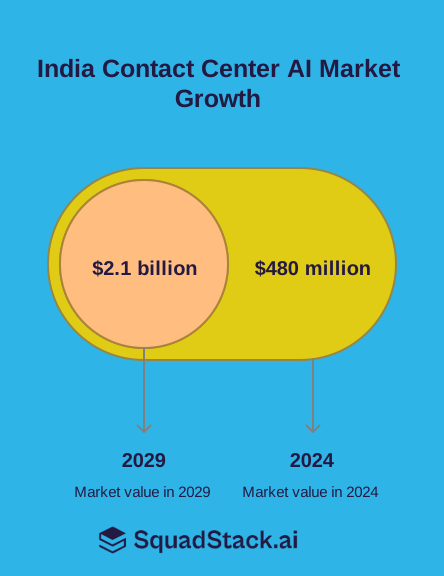
If you are a CX leader, operations director, or technology decision-maker evaluating an agentic AI contact center platform in India, this is the most complete guide available in 2026. India processes over 1.3 billion customer service interactions per year across BFSI, telecom, e-commerce, and government services. The India Contact Center AI market was valued at USD 480 million in 2024 and is projected to reach USD 2.1 billion by 2029, growing at a CAGR of 34%. The McKinsey Global Institute's 2024 report on AI in customer operations found that companies deploying agentic AI in contact centers achieve a 25–40% reduction in total cost-to-serve and a 15–25 point improvement in customer satisfaction scores (CSAT).
Key Statistics: AI in India's Contact Center Industry
|
Metric |
Value |
|
India Contact Center AI Market by 2029 |
$2.1B |
|
CAGR — Fastest Growing Enterprise AI Category in India |
34% |
|
Cost-to-Serve Reduction with Agentic AI (McKinsey 2024) |
40% |
|
FCR Rate Achievable with Full Agentic AI Deployment |
85% |
|
Annual Customer Interactions Processed in India |
1.3B+ |
What Is an Agentic AI Contact Center Platform?
An agentic AI contact center platform is a customer experience infrastructure that deploys autonomous AI agents that independently handle customer queries across voice, chat, email, WhatsApp, social media, and web channels. The defining characteristic of an agentic AI system is its capacity for autonomous action, giving CX leaders confidence in its reliability and innovation.
The Three Pillars of Agentic AI in Contact Centers
- Perception: The agent understands multi-turn conversations in natural language — including intent, context, sentiment, and urgency.
- Planning: The agent determines the optimal multi-step action sequence to resolve the customer's need, selecting from available tools, APIs, and data sources based on the specific context of each interaction.
- Execution: The agent autonomously executes actions — API calls, database updates, workflow triggers, escalations, notifications — verifies their success, and adapts if the first approach does not produce the desired outcome.
.svg)
Agentic AI vs Traditional AI Contact Center: The Critical Differences
Understanding what makes an agentic AI contact center platform genuinely different from previous generations of contact center technology is essential before making any investment decision. Here is a direct, honest comparison of all the technologies used in an AI contact center:
|
Dimension |
Rule-Based Chatbots |
LLM-Powered Chatbots |
Agentic AI Contact Center Platforms |
|
Response Capability |
Predefined scripted responses using fixed decision trees and menus. Can only answer limited FAQ-style questions. |
Generates natural language responses using an LLM trained on company knowledge bases and documentation. |
Fully autonomous AI agents that understand intent, reason through requests, and complete multi-step tasks end-to-end. |
|
Automation Level |
Basic automation for simple queries like business hours or FAQs. |
Moderate automation for knowledge retrieval and conversational answers. |
High automation with AI agents capable of executing actions across systems and workflows. |
|
System Integrations |
Minimal or none — typically limited to static FAQ databases. |
Limited integrations, often read-only access to internal systems or APIs. |
Deep read/write integrations with CRM, ERP, billing systems, OMS, WFM, and internal tools to execute actions in real time. |
|
First Contact Resolution (FCR) |
15–25% — most queries still require human intervention. |
25–40% — improved intent detection but limited ability to take actions. |
65–85% — AI agents resolve complex issues independently through multi-step workflows. |
|
Escalation to Human Agents |
60–80% of conversations escalate to human agents. |
45–65% escalation due to limited workflow execution capability. |
15–35% escalation, usually only for highly complex or sensitive cases. |
|
Learning & Optimization |
Manual updates are required for every new question or workflow change. |
Periodic model updates or retraining are required to improve responses. |
Continuous learning from every interaction, outcome, and customer behavior signal. |
|
Personalization Capability |
None — responses are identical for all customers. |
Basic personalization, such as customer name or account lookup. |
Deep contextual personalization using customer history, intent signals, sentiment, and behavioral patterns. |
|
Multilingual Support (India) |
Usually limited to English-only support. |
English plus 2–3 regional languages, depending on the model. |
Supports 20+ Indian languages, including Hinglish and regional code-switching for natural conversations. |
|
Use Cases |
Basic FAQs, simple customer queries, and menu-based support. |
Knowledge base search, basic support assistance, and conversational FAQs. |
Sales, collections, onboarding, renewals, support automation, and revenue operations. |
|
Business Impact |
Limited efficiency gains with high human dependency. |
Moderate efficiency improvements in support teams. |
Significant impact with higher FCR, lower support costs, and better customer experience. |
How an Agentic AI Contact Center Platform Actually Works
The architecture of a modern agentic AI contact center platform consists of several interconnected layers that work together to deliver autonomous customer resolution at scale. Here is how the full system functions end-to-end:
Layer 1 — Omnichannel Interaction Management
Every customer interaction that arrives via voice call, WhatsApp, website chat, mobile app, email, SMS, or social media is received and unified by the platform's omnichannel connecting layer. This layer converts all incoming communications into a standardised data format. It routes them to the AI agent engine, maintaining full context continuity if a customer switches channels mid-interaction (for example, starting on WhatsApp and continuing on a voice call).
Layer 2 — Natural Language Understanding and Intent Recognition
The AI agent engine processes the customer's message using a combination of large language model (LLM) understanding and domain-specific intent classification. For Indian contact centers, this layer must handle not just standard English but also Hindi, Tamil, Telugu, Bengali, Marathi, Gujarati, Kannada, and code-mixed conversational language patterns.
Layer 3 — Context Engine and Memory
Agentic AI contact center platform maintains a persistent context engine that tracks the full history of the current interaction and the customer's historical interaction patterns.
This context layer is what allows the AI voicebot platforms to say, "I can see you called about this same issue last week, and it was not fully resolved — let me escalate this directly to our senior resolution team," rather than asking the customer to repeat information they have already provided multiple times.
Layer 4 — Agentic Reasoning and Action Planning
The AI reasoning engine takes the identified intent and context and autonomously determines the optimal resolution path. It selects from a library of available tools and actions — API calls to CRM, queries to billing databases, workflow triggers, escalation protocols, notification dispatches — and sequences them into a coherent resolution plan.
Layer 5 — System Integration and Action Execution
The integration layer is where the agentic AI platform connects to your enterprise's operational systems. This includes bi-directional API integrations. The action execution engine carries out the planned resolution steps — writing updates to CRM records, triggering refund workflows in billing systems, and creating service tickets in ITSM tools.
Layer 6 — Human-in-the-Loop Escalation
Even the most advanced agentic AI contact center platforms are designed with intelligent escalation built in after lead qualification is done. When the AI agent encounters a genuinely complex situation that includes a regulatory complaint requiring supervisor authority, a highly emotionally distressed customer, or a fraud case requiring human judgment, it executes a warm handover to a human agent, transferring the full conversation context, interaction summary, and suggested resolution approach. This ensures using human agents for complex cases instead of replacing them with AI-based agents in agentic ai contact centers.
.svg)
Key Features to Look for in an Agentic AI Contact Center Platform
When choosing an Agentic AI contact center platform, it's important to evaluate key capabilities such as deep CRM integrations, omnichannel engagement across voice and messaging channels, advanced intent detection, real-time analytics, and conversion tracking to ensure the platform can truly drive business outcomes. When evaluating an agentic AI contact center platform for your Indian enterprise, these are the features that determine real-world performance versus marketing claims:
1. True Agentic AI Engine
A true Agentic AI engine goes far beyond traditional chatbots or intent-based automation systems. Instead of simply detecting a customer's intent and providing a predefined response, the AI can plan, reason, and execute multiple actions autonomously to complete a task. This ability to plan multi-step workflows and execute them independently makes the system closer to a digital employee rather than a scripted bot.
For example, if a customer calls to update their address and check the delivery status of an order, the AI can:
- Authenticate the customer
- Access CRM records
- Update the address
- Check order logistics systems
- Provide delivery updates
- Trigger notifications if required
2. Deep Enterprise Integrations
An effective AI contact center platform must integrate deeply with the core enterprise systems used by organizations. This includes CRM platforms such as Salesforce, Zoho, and Zendesk, ERP systems like SAP and Oracle, and customer support platforms like Freshdesk. Through bi-directional APIs, the AI platform can both retrieve data and take actions inside these systems. Examples include:
- Creating or updating support tickets
- Fetching customer profiles from CRM
- Updating payment status
- Logging call outcomes automatically
3. Indian Language NLP
India's customer interactions happen across multiple regional languages and dialects. Therefore, AI systems must support native multilingual understanding, not just translated scripts. The system must also handle code-mixed conversations, where customers combine English with local languages (e.g., "Mera order kab deliver hoga?"). This capability dramatically improves customer experience, accessibility, and automation success rates in India.
Advanced Indian Language NLP (Natural Language Processing) allows the AI to understand and respond in languages such as:
- Hindi
- Tamil
- Telugu
- Bengali
- Marathi
- Gujarati
- Kannada
4. Omnichannel Orchestration
With omnichannel orchestration, the system maintains a single unified customer context. For example, if a customer starts a conversation on WhatsApp and later calls the support number, the AI can continue the conversation seamlessly without asking the customer to repeat information. This significantly improves customer satisfaction and operational efficiency. Modern customers interact with companies across multiple communication channels. An advanced AI contact center platform should unify conversations across channels such as:
- Voice calls
- Web chat
- SMS
- Mobile app
- Social media platforms
5. Sentiment and Emotion AI
Customer interactions often involve emotions such as frustration, urgency, confusion, or satisfaction. Advanced AI platforms analyze tone, speech patterns, and language cues in real time to detect customer sentiment. This allows the AI to adapt its responses dynamically and maintain a more empathetic customer experience. It also helps businesses prevent churn and improve service quality.
If the system detects:
- Frustration → escalate to a senior agent
- Urgency → prioritize the request
- Anger → trigger de-escalation responses
6. Agent Assist and Copilot
Even when human agents are involved, AI can dramatically improve their productivity through Agent Assist or AI Copilot capabilities. This reduces agent workload, improves accuracy, and shortens average handling time (AHT). Agents essentially work with an AI-powered assistant that enhances their decision-making and efficiency.
During a live conversation, the AI can:
- Suggest relevant responses to agents
- Retrieve knowledge base articles instantly
- Auto-fill CRM fields during the call
- Provide real-time compliance reminders
- Generate summaries of previous interactions
7. Analytics and Conversation Intelligence
Every customer interaction contains valuable insights. A powerful AI contact center platform captures 100% of conversations and converts them into structured data for analysis. Leadership teams can use these insights to identify customer pain points, improve products, and optimize support operations. It transforms the contact center from a cost center into a strategic intelligence hub.
Key capabilities include:
- Automated call scoring
- CSAT prediction
- Intent trend analysis
- Conversation quality monitoring
- Real-time operational dashboards
8. Security and Compliance
Role-based access controls ensure that only authorized personnel can access sensitive customer information. These measures protect businesses from data breaches, regulatory penalties, and reputational damage. For enterprises operating in India, data security and regulatory compliance are critical. A robust AI platform must comply with key regulatory frameworks such as:
- DPDP Act 2023 for personal data protection
- RBI data localization requirements for financial institutions
- PCI DSS standards for payment data security
- ISO 27001 certification for information security management
9. Low-Code / No-Code Builder
This reduces deployment time and allows organizations to adapt their automation strategies quickly as customer needs evolve. Business teams should be able to create and modify AI workflows without relying heavily on engineering teams.
A low-code or no-code builder provides a visual interface where teams can:
- Design AI conversation flows
- Configure automation rules
- Integrate APIs
- Modify workflows quickly
10. Continuous Learning Engine
Over time, the AI becomes more accurate, more efficient, and better at handling complex scenarios. This means the system gets measurably better every month, delivering increasing ROI without constant manual intervention. One of the most powerful capabilities of modern AI platforms is continuous learning.
Instead of requiring manual retraining, the system automatically improves by learning from:
- Resolved customer interactions
- Agent corrections and feedback
- Customer outcomes
- Historical conversation data
.svg)
Top Agentic AI Contact Center Platforms Available in India
India's contact center industry is rapidly evolving as enterprises adopt Agentic AI platforms that can autonomously handle sales, support, collections, and customer engagement. The leading platforms should combine conversational AI, multilingual voice intelligence, CRM integrations, and enterprise-grade scalability to automate millions of customer interactions. Below are some of the top Agentic AI contact center platforms available in India.
SquadStack.ai
SquadStack is an enterprise-grade Agentic AI contact center platform designed to automate high-volume customer conversations across sales, support, and collections. Its AI Voice Agents are trained on hundreds of millions of real customer interactions, enabling natural conversations and predictive sales engagement.
Key capabilities include:
- AI voice agents for lead qualification, onboarding, collections, and customer support
- Omnichannel orchestration across Voice, WhatsApp, SMS, and Web
- 90%+ lead connectivity and large-scale outbound calling infrastructure
- AI trained on hundreds of millions of interaction signals
- Enterprise compliance, including ISO 27001 and SOC 2
SquadStack is widely used in BFSI, ecommerce, edtech, healthcare, and real estate to automate revenue-generating conversations while reducing acquisition costs.
%2520(8).jpeg)
Osno.ai
Osno.ai focuses on making conversational automation easy to deploy for growing businesses. The platform provides a lightweight AI voice automation system that helps companies automate repetitive calling workflows without a complex engineering setup.
Key capabilities include:
- No-code AI voice workflow builder.
- Multilingual voice support with regional accents.
- CRM and third-party integrations.
- Automated tasks like lead qualification, appointment scheduling, and follow-ups.
Osno.ai is particularly popular with startups and mid-sized businesses looking for fast deployment and scalable voice automation.
Skit.ai
Skit.ai is one of the most recognized enterprise voice automation platforms in India. Its digital voice agents are designed to handle large-scale customer service operations with natural conversational flow.
Key capabilities include:
- Voice automation across many Indian languages and 160+ dialects
- Enterprise-scale support automation
- AI-powered speech recognition and conversational intelligence
SigmaMind AI
SigmaMind is an emerging startup focused on AI agents for contact center automation and BPO workflows. Its platform can automatically answer customer calls, classify queries, and resolve tickets without human intervention.
Key capabilities:
- AI virtual agents for customer support
- Automated ticket tagging and resolution
- Call-center process automation for BPO teams
Troika Tech
Troika Tech provides end-to-end AI voice automation infrastructure tailored for Indian telecom environments.
Key capabilities:
- AI voice agents for inbound and outbound campaigns
- Support for 11+ Indian languages with Hinglish
- Built-in compliance features like DND and DLT support
- Rapid deployment within days for pilot programs
How to Choose the Right Agentic AI Contact Center Platform
When evaluating AI contact center platforms in India, enterprises should consider:
- Call scalability and infrastructure reliability
- Multilingual support for Indian languages
- CRM and workflow integrations
- Compliance for regulated industries like BFSI
- Ability to orchestrate voice with WhatsApp and messaging channels
The right platform should not just automate conversations but also drive measurable business outcomes such as higher conversions, improved customer engagement, and lower operational costs.
.svg)
Industry Use Cases for Agentic AI Contact Centers in India
The versatility of agentic AI contact center platforms is reflected in the diversity of use cases across India's major industries. Here is how different sectors are deploying this technology:
BFSI (Banking, Financial Services, and Insurance)
- Account balance and transaction queries: Real-time account lookup and secure balance disclosure without human agent involvement for banking and financial services companies.
- Loan status and EMI assistance: AI agent checks loan application status, EMI due dates, and processes EMI deferrals through bank system integration.
- Insurance claim status updates: Real-time claim tracking and automated status notifications reduce inbound call volumes by 40–60%.
- KYC update assistance: Guided document upload and verification status tracking, reducing branch visits and call center load simultaneously.
- Fraud alert response: Automated card blocking with immediate SMS/call confirmation — zero human agent required for speed-critical security actions.
Telecom
- Plan upgrade and downgrade: AI agent checks eligibility, presents relevant options based on usage patterns, and executes the plan change in BSS systems.
- Recharge and data pack activation: Voice and WhatsApp bots handle the full recharge workflow end-to-end with payment gateway integration.
- Network complaint logging and follow-up: Automated ticket creation in field operations systems with proactive resolution status updates.
- Port-in/Port-out assistance: Guided MNP process with document verification, reducing drop-off during the porting process.
E-Commerce and Retail
- Order status and tracking: Real-time logistics API integration delivers precise shipment status and proactively notifies customers of delays.
- Return and refund initiation: AI agent verifies eligibility for retail and E-commerce returns, initiates return pickup scheduling, and processes refund to original payment method.
- Product recommendations and cart recovery: Conversational AI that drives revenue — not just support — by recommending relevant products based on purchase and browsing history.
Healthcare
- Appointment scheduling and rescheduling: 24/7 booking bot integrated with hospital HMS — reduces front desk call volume by 50–70%.
- Lab report delivery and explanation: Secure report delivery via WhatsApp with AI-guided explanation of results and follow-up consultation booking.
- Medication reminder and adherence support: Automated outbound AI calls and messages for chronic disease management programmes.
Government and Citizen Services
- Utility complaint management: AI agents handle electricity, water, and gas complaint registration, status tracking, and escalation.
- Document status tracking: Passport, driving licence, and Aadhaar update status — automated queries against government API endpoints.
- Jan Dhan / DBT programme support: Voice AI in regional languages guiding beneficiaries through benefit status, eligibility checks, and grievance filing.
Multilingual AI: The India-Specific Imperative for Contact Center Platforms
For an agentic AI contact center platform in India, one of the most important features is genuine multilingual capability. India has 22 constitutionally recognised languages, over 1,600 dialects, and a population that overwhelmingly prefers to communicate in their native language. Yet most contact center AI deployments in India default to English, effectively excluding the majority of the country's population from the benefits of automation. Contact center AI platforms like SquadStack.ai have come up with solutions like a humanoid AI Voice agent, which can communicate in all indian languages and dialects.
What True Multilingual AI Looks Like for Indian Contact Centers: The standard for Indian-market AI platforms includes support for Hindi, Tamil, Telugu, Bengali, Marathi, Gujarati, Kannada, Odia, Punjabi, and Malayalam in both voice (ASR/TTS) and text channels. Beyond single-language support, the platform must handle language-switching, the natural Indian conversational pattern of mixing languages within a single sentence, such as "Mera order kab aayega? I need it by tomorrow" (Hindi-English mix). Platforms that cannot handle this code-mixed language pattern fail in real-world Indian deployments regardless of their benchmark scores on standardised language tests.
Check how SquadStack does language switching in the best way
How to Evaluate Agentic AI Contact Center Platforms in India
Use this structured evaluation framework when assessing agentic AI contact center platforms for your Indian enterprise:
|
Evaluation Criterion |
What to Test / Ask |
Weight |
|
True Agentic Capability |
Check whether the AI executes a complete transaction (refund, plan change, appointment booking) in your live CRM. |
🔴 Critical |
|
Indian Language NLU Accuracy |
Test accuracy on 100 real transcripts in your top 3 customer languages, including code-mixed queries. You must target up to 80%+ intent accuracy during this test. |
🔴 Critical |
|
Enterprise Integration Depth |
Verify bi-directional APIs with your specific CRM, billing, and order systems. |
🔴 Critical |
|
Data Localisation and Compliance |
Does the vendor have India-region data centres located in India only? As per DPDP Act 2023 compliance documentation and RBI data residency compliance for BFSI deployments they must be located in India. |
🔴 Critical |
|
Total Cost of Ownership (TCO) |
Get the full 3-year TCO including implementation, integration, licensing, training, and support. Avoid comparing only per-seat or per-interaction fees in isolation. |
🟡 High |
|
Deployment Timeline |
What is the realistic time from contract signature to first live AI interactions? You must target under 12 weeks for an initial channel deployment. |
🟡 High |
|
Low-Code Customisation |
Can your operations team modify AI workflows without raising an engineering ticket? Test the workflow builder with a non-technical team member. |
🟡 High |
|
Vendor Support in India |
Does the vendor have a local India support team with IST-aligned SLAs? A global vendor with only US-timezone support creates risk for Indian production deployments. |
🟡 High |
|
Reference Customers |
Ask for 3 reference customers in India in your industry vertical with deployments live for more than 12+ months. You can speak to the operations team about them, not just the IT team. |
🟡 High |
|
Roadmap Alignment |
Review the vendor's 18-month product roadmap. Does it align with where your CX strategy needs to be? Are India-specific features on the roadmap, or these features are aligned in the product. |
🟢 Medium |
Common Challenges in Deploying Agentic AI in Indian Contact Centers — and How to Overcome Them
Challenge 1: Agent Resistance and Change Management
The reality: Human agents often fear that AI will eliminate their jobs. This fear — even when unfounded — creates passive resistance to adoption, poor quality training data contributions, and deliberate over-escalation to human agents to demonstrate the AI's limitations.
The solution: Frame AI deployment explicitly as augmentation — not replacement. Show agents the data: companies that deploy agentic AI successfully typically grow their contact center revenue per agent because agents focus on higher-complexity, higher-value interactions. Involve frontline agents in the design of AI workflows. Celebrate agents who contribute the most useful corrections to the AI training data.
Challenge 2: Data Quality and Integration Complexity
The reality: Many Indian enterprises' CRM and billing systems contain poor-quality, incomplete, or inconsistently structured data. An AI agent that retrieves a customer record with missing fields or incorrect information will give wrong answers — destroying customer trust faster than a human agent would.
The solution: Conduct a data quality audit before beginning AI integration for your organisation. Establish data governance standards and data cleaning processes as a precondition for AI deployment — not as a parallel workstream.
Challenge 3: Multilingual Accuracy in Regional Markets
The reality: Most AI platforms claim multilingual support but perform significantly worse in Telugu, Odia, or Assamese than they do in Hindi and English. Deploying a platform with poor regional language accuracy in Tier 2 and Tier 3 Indian markets creates frustrating customer experiences that damage brand perception.
The solution: Insist on language-specific accuracy testing during the POC using real data from your actual customer base. Do not accept benchmarks from standardised test datasets — test on your own transcripts.
Challenge 4: Regulatory Compliance Complexity
The reality: India's regulatory landscape for AI-generated customer communications is evolving rapidly. The Digital Personal Data Protection (DPDP) Act 2023, RBI guidelines on AI in BFSI, and TRAI regulations on automated outbound communications all create compliance obligations that must be built into AI platform deployment from Day 1.
The solution: Engage your legal and compliance team in the platform evaluation process — not just at contract signing. Ensure the chosen platform has demonstrated DPDP Act compliance documentation and that consent management for AI interactions is handled natively within the platform.
The Future of Agentic AI Contact Centers in India: What's Coming by 2027
The agentic AI contact center landscape in India is evolving at a pace that makes 18-month-old deployments look outdated. Here are the developments that CX leaders need to be preparing for now:
- Proactive and predictive AI agents: The next generation of agentic AI will not wait for customers to contact the brand. Predictive AI will identify customers likely to experience a service failure. This includes a delayed delivery, an approaching credit limit, an expiring insurance policy, and proactively reaching out with resolutions before the customer has a complaint.
- Multimodal AI for video and image-based support: Customers will send photos of damaged products, screenshots of error messages, and short videos of technical problems. AI agents will interpret these visual inputs, diagnose issues, and initiate resolution workflows without human involvement.
- AI-to-AI interaction: As enterprise systems increasingly have their own AI agents, we will see AI-to-AI communication. A customer's personal AI assistant interacts directly with a brand's agentic AI contact center platform to resolve issues on the customer's behalf.
- Regulatory AI compliance frameworks: SEBI, RBI, and TRAI are all expected to publish specific AI governance frameworks for customer communications requiring explainability, audit trails, and human oversight mechanisms.
Why Choose SquadStack as your Agentic AI Contact Center Platform?
SquadStack combines advanced AI voice agents with deep sales intelligence to help enterprises automate high-volume customer interactions while improving conversions, connectivity, and operational efficiency.
%2520(4).jpeg)
Enterprise-Scale AI Voice Infrastructure
SquadStack powers 4M+ calls every day, enabling enterprises to run large-scale outbound and inbound campaigns without the limitations of traditional call centers. The platform is built for high availability, multi-operator routing, and consistent performance even during peak demand.
Industry-Leading Lead Connectivity
With 90%+ lead connectivity, SquadStack ensures that high-intent prospects are reached reliably. Smart retry logic, intelligent routing, and India-optimized telephony infrastructure significantly improve answer rates compared to conventional dialing systems.
Higher Conversions with Lower Acquisition Costs
AI-powered sales advisors analyze buyer intent in real time and guide conversations toward outcomes. This helps businesses achieve up to 40% higher conversions while reducing customer acquisition costs by 2–3× compared to traditional telecalling teams.
AI Trained on Real Consumer Interactions
SquadStack's predictive intelligence is built on insights from 400M+ customer interaction signals. This enables the system to identify buying patterns, recommend next-best actions, and personalize conversations for better engagement.
Built for India's Multilingual Market
The platform is optimized for Hindi, English, Hinglish, and multiple regional accents, enabling natural conversations with customers across India's diverse linguistic landscape.
Omnichannel Revenue Orchestration
Beyond voice, SquadStack connects customer journeys across Voice, WhatsApp, SMS, and Web, ensuring consistent engagement and follow-ups across channels without losing context.
Seamless CRM and Workflow Integrations
SquadStack integrates easily with leading CRM systems and internal tools, enabling automated lead updates, outcome tagging, workflow triggers, and real-time campaign visibility without heavy engineering effort.
Enterprise-Grade Security and Compliance
The platform is designed for regulated industries such as BFSI and fintech with ISO 27001 and SOC 2 Type II compliance, strong encryption standards, and secure data infrastructure hosted in India.
Ready to Deploy Agentic AI in Your Contact Center?
Get a personalised assessment of your contact center AI readiness — including ROI projections, platform recommendations, and a 90-day implementation roadmap tailored to your industry and scale.