.svg)

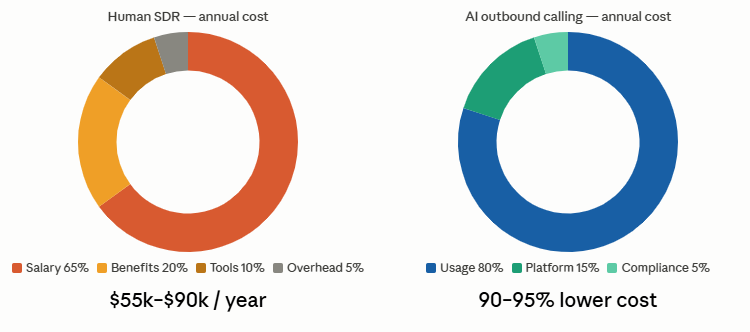
The phone call remains most effective for sales and engagement conversion rates. Connecting with a prospect via live call yields higher conversion rates than sending emails, texts, and even engaging with chatbots. The challenge here is that live people are expensive, tired, and can make only 60–80 calls a day.
A voice AI agent can make 10,000 to 100,000 calls in a single day. It handles objections conversationally, transfers leads to human closers in real time, and does so for a fraction of the cost of a traditional SDR team.
|
QUICK ANSWER: AI outbound calling typically costs $0.05–$0.15 per minute all-in with a managed API. Building on raw telephony costs $0 upfront but requires $10k–$120k in engineering time, plus ongoing infrastructure costs. For most teams that make fewer than 1 million minutes per month, a managed API is significantly cheaper overall. |
This guide breaks down:
- Real pricing in 2026
- Cost components
- Comparison of top voice AI platforms
- Hidden costs most vendors don’t mention
What is AI Outbound Calling?
Definition of Technology: AI outbound calling involves automated phone calls powered by artificial intelligence technologies such as LLMs, STT, and TTS. Modern-day AI calling bots can engage in two-way conversations with callers, listening, understanding context, responding, managing objections, and handing over conversations to a human representative when necessary.
Use cases include sales calls, customer service calls, appointment scheduling, lead qualification in real estate, logistical updates, and billing reminders. The common thread is high-volume, structured conversation that follows a defined goal, exactly the scenario where AI outperforms human agents on both cost and consistency.
Why 2026 Is the Inflection Year
Three trends have come together to make 2026 the inflection year for AI outbound calling:
- Voice model quality has improved so much that most listeners cannot easily distinguish AI from a human caller during a standard phone call.
- Platform competition has driven per-minute pricing down sharply, making the economics accessible to small and mid-sized businesses for the first time.
- Compliance infrastructure — TCPA, DNC list checking, and consent recording — has been built into managed platforms, removing regulatory barriers for risk-conscious organizations.
The global AI agents market stands at $10.91 billion in 2026, up from $7.63 billion in 2025, and is forecast to reach $50.31 billion by 2030. Within that market, voice AI is one of the fastest-growing segments, with 97% of adopters reporting revenue growth.
What Affects the Cost of AI Outbound Calling?
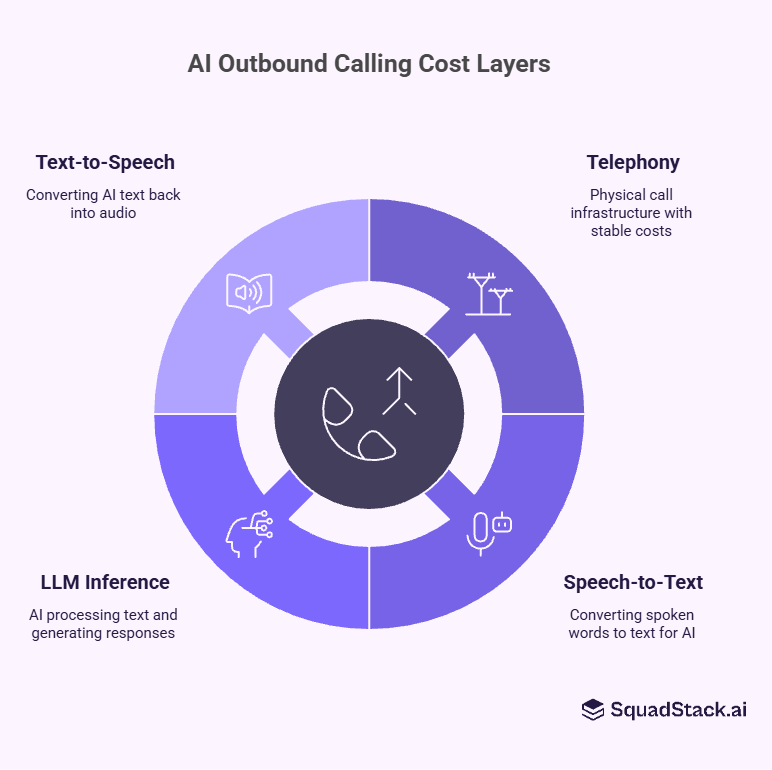
AI outbound calling is a stack of four interconnected technologies. Each one has its own cost driver. Understanding these components is essential before comparing any platform pricing.
The Four Core Cost Layers
AI outbound calling cost is built on four core infrastructure layers that work together in real time. Understanding these layers helps you identify where your spending goes and how to optimize costs effectively. Each layer contributes differently to overall pricing depending on usage and configuration.
Layer 1: Telephony
Telephony is the carrier infrastructure that physically places the call. This is the most stable and predictable cost layer, typically $0.005–$0.015 per minute for domestic US calls. International calls cost significantly more, and carrier rates vary by volume tier.
Layer 2: Speech-to-Text (STT)
STT converts the prospect's spoken words into text for AI processing. Streaming STT, required for real-time conversational AI, costs more than batch transcription. Modern providers like Deepgram charge $0.003–$0.008 per minute for standard models. At high volume, this seemingly small number accumulates quickly.
Layer 3: LLM Inference
The LLM reads the transcript and generates the AI's next response. This is the most variable cost layer. A lean model like Llama 3 via Groq costs roughly $0.001 per minute. GPT-4o or Claude 3.5 can cost $0.04–$0.06 per minute. Every conversation turn adds tokens. Context window costs escalate with conversation length.
Layer 4: Text-to-Speech (TTS)
TTS converts the AI's text response back into audio. Premium voice providers like ElevenLabs and Cartesia produce highly natural speech but charge per character. Basic TTS adds $0.005–$0.015 per minute. Premium voices add $0.01–$0.03 per minute on top of other costs.
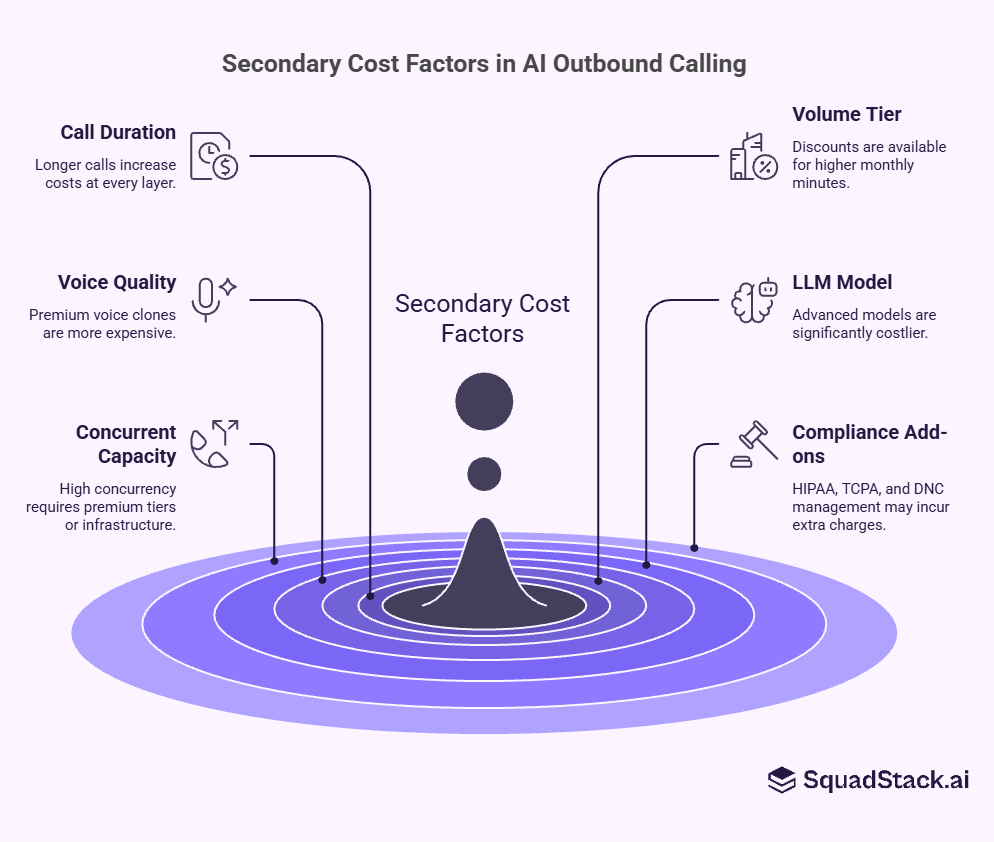
Secondary Cost Factors
Beyond the core cost layers, several secondary factors significantly influence your final AI outbound calling cost. These variables often determine whether your total spend stays efficient or scales unexpectedly. Optimizing them is key to maximizing ROI from your voice AI investment.
- Call duration: Longer calls cost proportionally more at every layer.
- Volume tier: Most platforms offer meaningful discounts for monthly minutes above 10,000 or 100,000.
- Voice quality selection: Premium voice clones can double TTS costs versus standard synthetic voices.
- LLM model selection: GPT-4o can cost 20–50x more per minute than a smaller, faster model for equivalent structured tasks.
- Concurrent call capacity: High concurrency requirements push you into premium tiers or dedicated infrastructure.
- Compliance add-ons: HIPAA, TCPA, and DNC management may be included or charged separately.
Per Component Cost Breakdown
The following table shows typical 2026 per-minute costs for each component, based on publicly available pricing from major providers.
|
Component |
What It Does |
Provider Examples |
Low End ($/min) |
High End ($/min) |
|
Telephony |
Connects and routes outbound calls via carrier networks |
Twilio, Telnyx, SIP providers |
$0.005 |
$0.015 |
|
Speech-to-Text (STT) |
Converts customer voice into text for AI processing |
Deepgram, AssemblyAI |
$0.003 |
$0.020 |
|
LLM Inference |
Generates AI responses based on conversation context |
Groq (Llama 3), GPT-4o, Claude 3.5 |
$0.001 |
$0.060 |
|
Text-to-Speech (TTS) |
Converts AI-generated text into human-like voice |
Deepgram Aura, ElevenLabs, Cartesia |
$0.005 |
$0.030 |
|
Total (DIY Stack) |
Combined cost when self-building the AI calling system |
Custom-built stack |
$0.014 |
$0.125 |
|
Total (Managed Platforms) |
All-in-one pricing from AI voice platforms |
Vapi, Retell, Bland, Outmound |
$0.050 |
$0.150 |
What This Means for Your AI Outbound Calling Cost
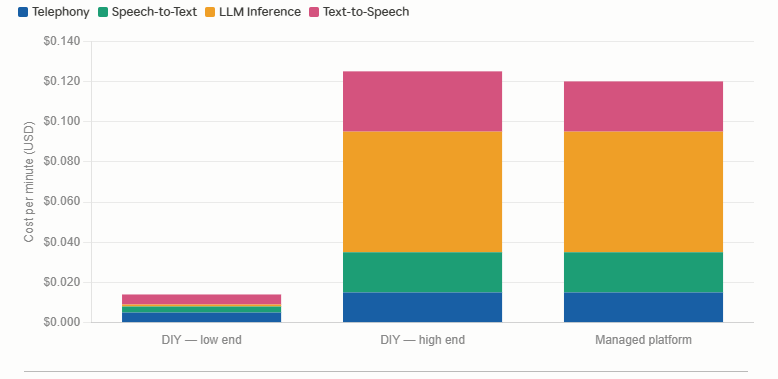
The lowest possible AI outbound calling cost can drop to around $0.05 per minute when using a highly optimized DIY stack (e.g., Groq + Deepgram + SIP routing). However, this “raw cost” excludes critical factors like engineering effort, infrastructure, monitoring, and ongoing maintenance.
In reality, most businesses choose managed AI voice platforms, where slightly higher per-minute costs are offset by:
- Faster deployment
- Lower technical complexity
- Built-in scalability and reliability
Key takeaway: While DIY appears cheaper on paper, the true total cost of ownership (TCO) is often higher without dedicated technical resources.
Platform-by-Platform Pricing Comparison
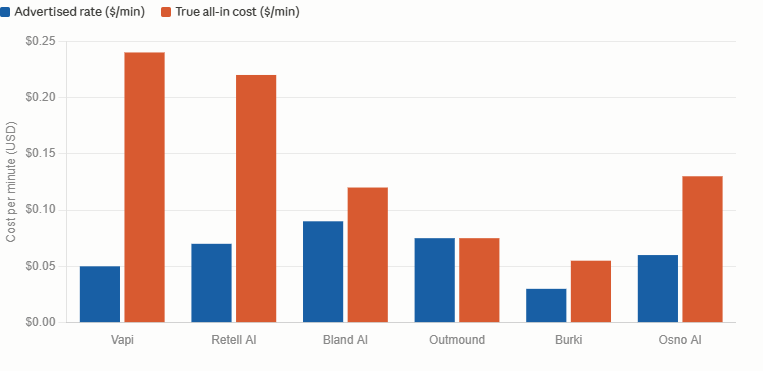
The following section breaks down the leading AI outbound calling platforms in 2026, with an honest look at advertised versus actual all-in costs.
Platform Comparison Overview
This comparison highlights the true AI outbound calling costs across the top platforms in 2026, helping you evaluate pricing transparency, hidden costs, and the best fit for your business use case.
|
Platform |
Advertised Rate |
True All-In Cost |
Setup Fee |
Compliance (HIPAA) |
Best For |
|
SquadStack.ai |
Custom pricing |
Custom (performance-based) |
$0 |
Included |
Enterprises & high-conversion outbound sales |
|
Osno AI |
$0.04–$0.08/min |
$0.08–$0.18/min |
$0 |
Included |
Scalable outbound automation |
|
Vapi |
$0.05/min |
$0.15–$0.33/min |
$0 |
$1,000/month add-on |
Developer-focused teams |
|
Retell AI |
$0.07/min |
$0.13–$0.31/min |
$0 |
Included |
Appointment booking workflows |
|
Bland AI |
$0.09/min |
$0.09–$0.15/min |
$0 |
Included |
High-volume outbound campaigns |
|
Outmound |
$0.05–$0.10/min |
$0.05–$0.10/min |
$0 |
Included |
Simple managed solutions |
|
Burki |
$0.03/min |
$0.03–$0.08/min |
$0 |
Included |
Cost-conscious startups |
|
Dialora |
$297 / 1,000 min |
Fixed bundle pricing |
$0 |
Included |
Predictable monthly budgets |
|
PolyAI |
Custom |
$150,000+/year |
Enterprise |
Included |
Large enterprises & contact centers |
Hidden Costs Nobody Talks About
When a platform advertises a per-minute rate, it is tempting to focus only on that number. Both DIY approaches and modular managed platforms carry significant hidden costs that receive little attention in typical comparison articles.
Hidden Costs in Modular Managed Platforms
While modular platforms advertise low base rates, additional usage-based charges for STT, LLM, and TTS can significantly increase your actual AI outbound calling cost at scale.
- STT provider costs: Streaming transcription adds $0.006–$0.024/min to platform fees. At 100,000 minutes/month, this alone adds $600–$2,400 to your bill.
- LLM token costs: Each conversation turn sends full context plus generates a response. GPT-4o costs accumulate fast; a 5-minute call with 15 exchanges can cost $0.04–$0.08 in LLM costs alone.
- TTS premium voice costs: ElevenLabs and Cartesia charge per character. Premium voices add $0.01–$0.03/min. At high volume, this is a real line item.
- Concurrency upgrade fees: Platforms that cap free tiers at 10–20 simultaneous calls require paid upgrades for concurrent campaign traffic.
- HIPAA add-ons: Vapi charges $1,000/month for HIPAA compliance, a dramatic cost increase for small healthcare organizations.
Hidden Costs in DIY Stacks
Building your own AI calling stack may seem cost-effective initially, but infrastructure, engineering, and maintenance costs can quickly outweigh the savings, especially for high-volume operations.
- Audio infrastructure: WebSocket servers for real-time audio bridging require dedicated, low-latency hosting, typically $500–$5,000/month at scale.
- Latency debugging: Achieving consistently sub-500ms end-to-end response times can consume two to four weeks of senior engineering time.
- Phone number management: Buying and maintaining numbers across countries adds carrier administration overhead and legal complexity.
- Ongoing maintenance: Voice AI infrastructure requires continuous monitoring and tuning as provider APIs change, models update, and call volumes fluctuate.
BOTTOM LINE: Managed APIs absorb all of these hidden costs into one per-minute rate. The apparent premium versus raw component costs is largely the price of not building and maintaining this infrastructure yourself.
AI Outbound Calling Cost Estimator (2026)
Estimating your AI outbound calling costs is essential for budget planning and ROI forecasting. The table below provides a realistic monthly cost estimate based on a managed AI voice platform rate of $0.08 per minute, which is a common mid-range pricing benchmark in 2026.
|
Calls / Month |
Avg. Call Duration |
Total Minutes Used |
Estimated Monthly Cost ($0.08/min) |
|
100 calls |
2 minutes |
200 minutes |
~$16 |
|
500 calls |
3 minutes |
1,500 minutes |
~$120 |
|
2,000 calls |
3 minutes |
6,000 minutes |
~$480 |
|
5,000 calls |
4 minutes |
20,000 minutes |
~$1,600 |
|
10,000 calls |
4 minutes |
40,000 minutes |
~$3,200 |
|
50,000 calls |
4 minutes |
200,000 minutes |
~$16,000 |
How to Use This AI Outbound Calling Cost Calculator
This estimator helps you quickly calculate your expected spend based on call volume and average duration. As your usage scales, you may benefit from volume discounts, which can reduce your effective cost per minute and improve overall ROI.
Cost Formula
Monthly Cost = (Number of Calls × Avg. Duration in Minutes) × Per-Minute Rate
Example: 3,000 calls × 3 min × $0.08 = $720/month
Most platforms only charge for connected call time. Unanswered calls, voicemail drops, and dial time are typically free. Your actual cost may be lower than worst-case estimates if your contact rate is below 100%.
Why SquadStack Delivers the Best ROI on AI Outbound Calling Cost
When evaluating AI outbound calling cost in 2026, most platforms focus only on per-minute pricing. However, platforms like SquadStack shift the conversation from cost per minute to cost per qualified lead and conversion outcomes.
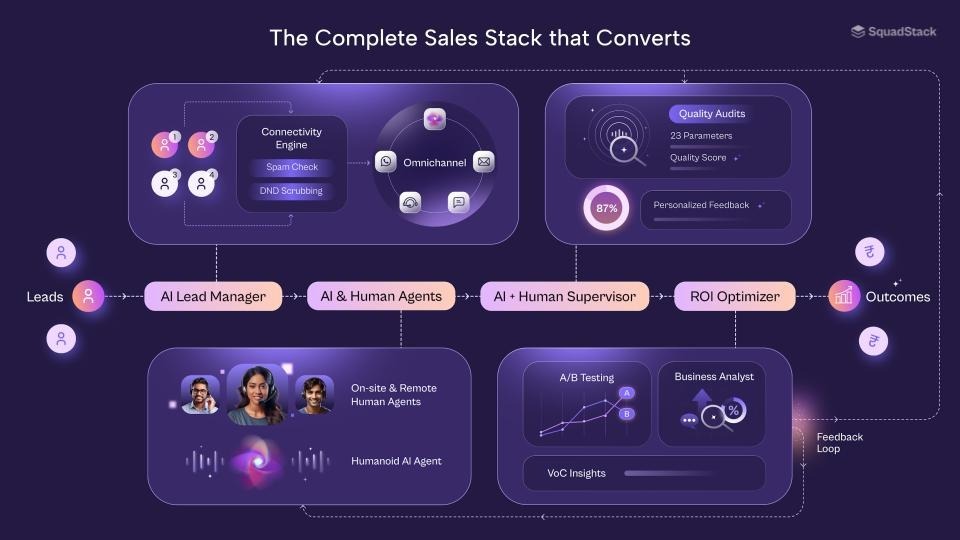
Built as a full-stack AI sales execution platform, SquadStack combines voice AI, data intelligence, and human expertise to deliver significantly higher ROI compared to standalone voice AI tools.
Full-Stack AI + Human Execution Reduces Total Cost of Ownership
SquadStack offers a complete outbound sales infrastructure.
This includes:
- AI voice agents
- Telephony and dialing systems
- CRM integrations and workflow automation
- Quality assurance and analytics
This bundled approach eliminates the need for multiple vendors, reducing hidden costs and lowering overall AI outbound calling cost at scale.
Performance-Based Pricing Aligns Cost with Outcomes
One of the biggest differentiators is SquadStack’s performance-linked pricing model.
Instead of paying purely per minute, businesses can align costs with:
- Qualified leads generated
- Conversions achieved
- Campaign performance metrics
This ensures that your AI outbound calling investment directly contributes to revenue, rather than just operational activity.
Higher Connectivity Lowers Cost Per Lead
A major hidden factor in AI outbound calling cost is connectivity rate, how many calls actually reach customers.
SquadStack delivers:
- ~90% lead connectivity
- Intelligent retry logic and prioritization
- Spam-aware number rotation
Higher connectivity means:
- Fewer wasted calls
- Lower cost per successful conversation
- Better ROI on every minute spent
AI-Powered Personalization Increases Conversions
Most AI voice tools use static scripts, which reduce effectiveness. SquadStack uses real-time personalization powered by large-scale conversational data.
Key capabilities include:
- Dynamic scripts based on user persona
- Context-aware conversations across channels
- AI-driven next-best-action recommendations
This leads to:
- Up to 40% higher conversions
- Better engagement rates
- Reduced cost per acquisition (CAC)
Omnichannel Orchestration Maximizes Outreach Efficiency
SquadStack goes beyond voice by orchestrating outreach across:
- Calls
- SMS
This ensures that leads are contacted on the right channel at the right time, improving conversion probability while optimizing overall AI outbound calling costs.
Enterprise-Grade Compliance Without Additional Costs
Compliance is often a hidden cost in AI outbound calling platforms. SquadStack includes:
- ISO 27001 & SOC 2 Type II certification
- Data residency in India
- Built-in compliance workflows
- PII redaction and audit trails
This reduces the need for third-party compliance tools, helping control total costs while ensuring enterprise-grade security.
Proven Cost Reduction Across Industries
Real-world results show how SquadStack optimizes AI outbound calling cost:
- 70% lower cost per qualified lead
- 2–3x lower CAC vs human agents
- 50–70% reduction in operational costs
- 3x increase in conversions in some use cases
These outcomes highlight that the true value lies not in the lowest per-minute price, but in maximizing conversions while minimizing acquisition cost.
Built for Scale: Millions of Calls with Consistent Quality
SquadStack is designed for high-scale outbound operations with:
- 5M+ daily calls handled
- AI trained on millions of real sales conversations
- Continuous model improvement using live data
This ensures consistent performance even at scale, avoiding the inefficiencies that increase costs in other platforms.
ROI Timeline of AI Outbound Calling in 2026
Understanding the ROI timeline of AI outbound calling cost helps businesses evaluate how quickly their investment translates into measurable returns. While initial setup and optimization take time, most companies see significant gains within the first year.

|
Year |
Average ROI |
What’s Happening |
|
Year 1 |
~41% |
Initial setup, AI training, and script optimization. Systems are being fine-tuned to improve call quality, targeting, and performance. |
|
Year 2 |
~87% |
Improved conversion rates, better lead targeting, and reduced optimization costs lead to higher efficiency and ROI. |
|
Year 3+ |
124%+ |
Fully optimized, self-learning systems drive maximum efficiency. Volume discounts and automation significantly reduce overall costs. |
What This Means for Your AI Outbound Calling Investment
Most businesses reach the break-even point within 4 to 6 months, making AI outbound calling a fast-return investment. On average, companies generate $3.50 for every $1 spent, while top-performing implementations achieve up to 8x ROI, driven by higher conversions and lower customer acquisition costs.