.svg)

A fully automated AI contact center uses technologies, including large language models (LLMs), natural language processing (NLP), machine learning, and intelligent voice automation to handle inbound and outbound customer interactions across voice, chat, email, and social channels. A 2023 Forrester Research study found that companies deploying AI contact center automation reported a 35% improvement in first-contact resolution and a 40% reduction in average handling time (AHT). These are not marginal gains — they represent a fundamental transformation of the customer service model.
For enterprises, startups, and mid-market businesses alike, investing in a fully automated AI contact center delivers measurable ROI almost immediately. By combining conversational AI, machine learning, voice bots, and workflow automation, businesses can automate large portions of customer support while maintaining high-quality interactions.
What Is a Fully Automated AI Contact Center?
A fully automated AI contact center is a customer support system that uses artificial intelligence to handle customer interactions across voice, chat, email, and messaging channels with minimal human intervention.
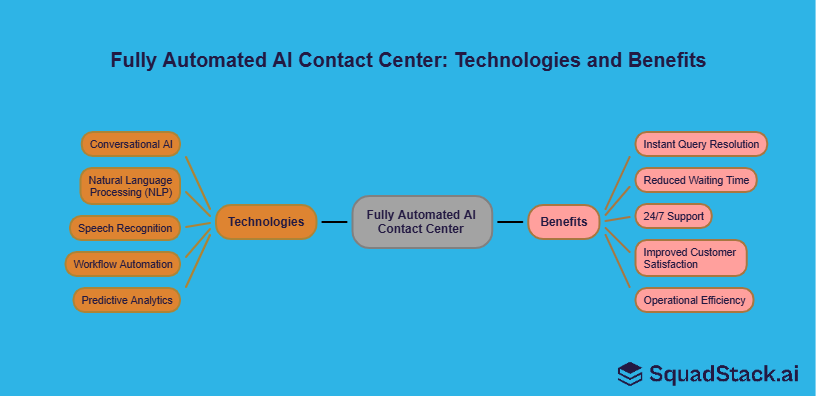
These systems rely on technologies like:
- Conversational AI
- Natural Language Processing (NLP)
- Speech recognition
- Workflow automation
- Predictive analytics
Instead of routing every query to human agents, AI systems can resolve common issues instantly, gather context, and escalate only complex cases. This allows companies to handle large volumes of customer interactions efficiently while maintaining consistent service quality.
AI-powered systems can answer queries instantly, reduce waiting time, and provide support outside business hours, improving customer satisfaction and operational efficiency.
Fully Automated AI Contact Center vs. Traditional Contact Center
Businesses evaluating modern customer engagement solutions often compare traditional contact centers with fully automated AI contact centers to understand the operational differences. While traditional setups rely heavily on human agents and fixed working hours, AI-powered contact centers are built to handle conversations at scale using automation and conversational intelligence.
The comparison below highlights how a fully automated AI contact center improves availability, scalability, cost efficiency, and response speed compared to traditional contact center models.
|
Feature |
Traditional Contact Center |
Fully Automated AI Contact Center |
|
Availability |
Operates mainly during business hours with limited after-hours support |
Available 24/7/365, ensuring customers can connect anytime |
|
Scalability |
Limited by agent headcount, hiring cycles, and infrastructure |
Instantly scalable to handle thousands of simultaneous interactions |
|
Average Handling Time (AHT) |
Typically, 5–8 minutes per interaction due to manual processes |
Often under 60 seconds with automated workflows |
|
Cost per Interaction |
Usually $1–$2, depending on workforce and infrastructure |
Significantly lower at around $0.10–$0.20 per interaction |
|
Languages Supported |
Depends on available multilingual agents |
Supports 100+ languages using AI speech and language models |
|
Error Rate |
Higher chances of mistakes due to fatigue and manual handling |
Consistently low, driven by automated and standardized responses |
|
Training Time |
Requires weeks or months of agent training |
AI agents can be trained and deployed within hours or days |
How a Fully Automated AI Contact Center Works: Step-by-Step
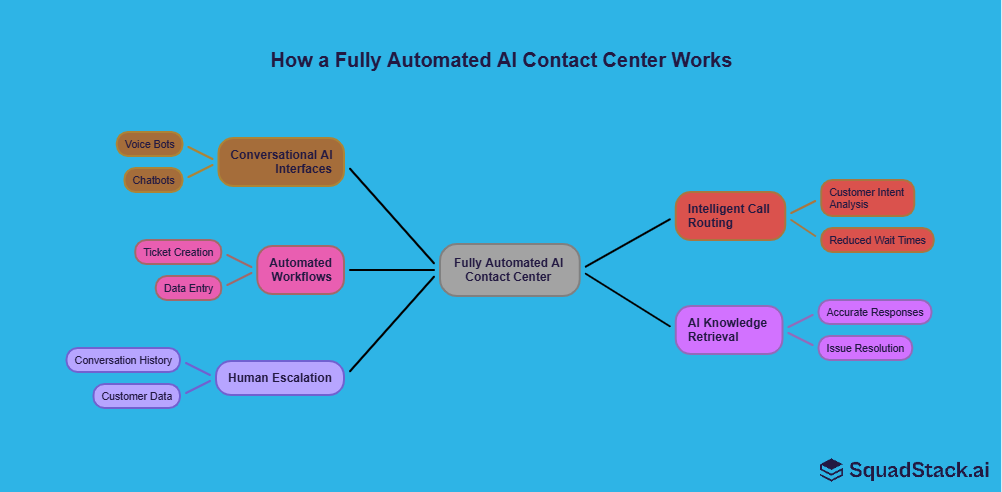
A modern AI-powered contact center operates through several integrated layers of automation. To understand the operational power of a fully automated AI contact center, let's trace a typical customer journey from first contact to resolution:
Step 1 — Customer Initiates Contact
A customer reaches out via phone, live chat, email, WhatsApp, or social media. The AI contact center detects the channel and activates the appropriate AI engine for that touchpoint.
Step 2 — Intent Detection and Authentication
The NLP/NLU engine analyzes the customer's message or speech in milliseconds, identifying their intent (e.g., billing dispute, technical support, order tracking). Simultaneously, the system automatically authenticates the customer using voice biometrics, account verification, or a secure PIN.
Step 3 — Intelligent Routing or Direct Resolution
If the query is routine (order status, password reset, FAQ), the fully automated AI contact center resolves it immediately. If the issue is complex, the AI routes it to the right specialized agent or workflow. No customer has to repeat themselves as the full context is already captured.
Step 4 — Interaction and Resolution
The AI conducts a natural, multi-turn conversation — asking clarifying questions, retrieving real-time data from backend systems via API integrations, and executing actions (processing refunds, rescheduling deliveries, updating account details) through RPA bots.
Step 5 — Post-Interaction Analytics and Learning
After every interaction, the AI contact center platform logs structured data, scores the interaction for quality, detects sentiment trends, and feeds outcomes back into the machine learning model. This continuously improves accuracy, tone, and resolution rates.
Core Technologies Behind AI Contact Center Automation
Understanding what powers a fully automated AI contact center helps businesses make smarter investment decisions. The technology stack is layered and interdependent, with each component amplifying the others.
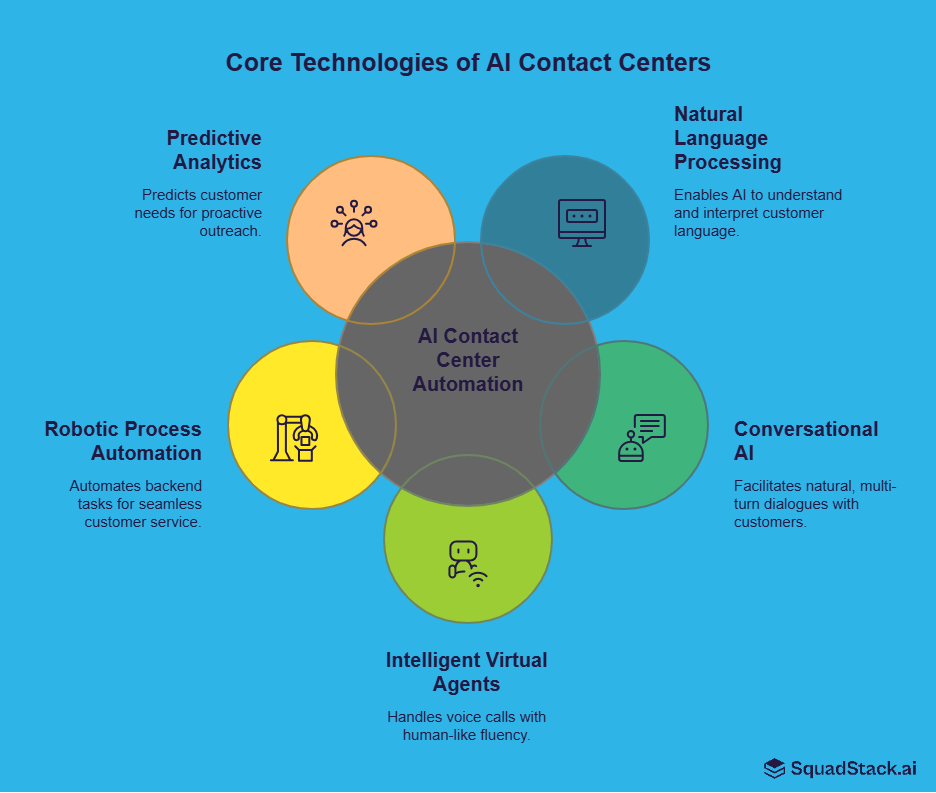
1. Natural Language Processing (NLP) and Natural Language Understanding (NLU)
NLP is the backbone of any AI-powered contact center. It enables the system to read, parse, and understand customer language — whether spoken or written — in real time. NLU goes a step further, identifying the customer's intent, sentiment, and context. For example, when a customer says "I want to cancel my subscription," the AI doesn't just hear words — it understands urgency, detects potential churn risk, and triggers a retention workflow automatically.
2. Conversational AI and Large Language Models (LLMs)
Conversational AI platforms — increasingly built on large language models (LLMs) like GPT 4, Gemini, and Claude — give the fully automated AI contact center the ability to hold nuanced, multi-turn dialogues. These are not scripted chatbots. They generate contextually accurate, personalized responses in natural language, adapting tone based on the customer's emotional state and history.
3. Intelligent Virtual Agents (IVAs) and Voice Bots
Intelligent Virtual Agents (IVAs) handle voice calls with near-human fluency, replacing outdated IVR menus. Using automatic speech recognition (ASR) and text-to-speech (TTS) technology, voice bots in a fully automated AI contact center greet callers, collect information, resolve queries, and escalate to human agents only when truly necessary — all in real time.
4. Robotic Process Automation (RPA)
RPA handles the backend automation layer — updating CRM records, processing refunds, verifying account details, sending confirmation emails, and triggering multi-step workflows. In a fully automated AI contact center, RPA ensures that customer actions are executed without any manual intervention, delivering end-to-end resolution rather than just conversation.
5. Predictive Analytics and Machine Learning
Machine learning models analyse historical interaction data to predict customer needs before they even contact the center. This powers proactive outreach, personalised recommendations, and intelligent routing — matching each customer to the right AI workflow or specialist agent based on profile, intent, and urgency.
Key Features of a Fully Automated AI Contact Center
Not all AI contact center solutions are equal. When evaluating a fully automated AI contact center platform, look for these essential capabilities:
- Omnichannel Support: Voice, chat, email, SMS, WhatsApp, and social — all managed from a single AI layer.
- LLM-Powered Conversations: Built on modern large language models for natural, context-aware dialogue — not outdated decision trees.
- Real-Time Sentiment Analysis: Detects frustration, urgency, and satisfaction in every interaction.
- CRM and ERP Integration: Deep integration with Salesforce, HubSpot, SAP, ServiceNow, and other enterprise platforms.
- Self-Learning AI: Continuously improves through supervised and reinforcement learning from real interactions.
- Predictive and Proactive Engagement: Reaches out to customers before issues escalate based on behavioural signals.
- Compliance and Security: Built-in GDPR, HIPAA, and PCI-DSS compliance with end-to-end encryption.
- Intelligent Escalation: Seamless, context-rich handoffs to human agents when required.
- Real-Time Analytics Dashboard: Live monitoring of interaction volumes, resolution rates, CSAT, and AHT.
- Multi-Language Support: Supports 100+ languages and dialects for global deployments.
Benefits of a Fully Automated AI Contact Center
Adopting AI automation in contact centers delivers measurable improvements across operations, costs, and customer experience.
- Faster Response Times: AI agents respond instantly, eliminating wait times and reducing customer frustration.
- Lower Operational Costs: Automation reduces the need for large support teams by handling repetitive queries automatically. Businesses can manage higher volumes without increasing staffing costs.
- Higher Customer Satisfaction: Faster resolutions and personalised responses significantly improve customer experience. Automation also enables proactive support and consistent service delivery.
- Reduced Average Handle Time (AHT): AI can instantly retrieve customer history and solutions, helping resolve issues faster. This dramatically reduces average call duration and improves efficiency.
- Scalable Customer Support: AI systems scale easily during peak periods without needing to hire or train additional agents. This is particularly useful for industries with fluctuating demand.
Common Use Cases for Fully Automated AI Contact Centers
A fully automated AI contact center can handle a wide range of customer and sales interactions without relying heavily on human agents. From managing large volumes of outbound calls to assisting customers with routine queries, AI-powered contact centers help businesses streamline communication and improve response speed. These systems are commonly used for tasks like lead qualification, customer support automation, appointment scheduling, and payment reminders. By automating repetitive conversations, businesses can scale operations efficiently while ensuring customers receive quick and consistent responses. Many industries are adopting AI automation for customer support.
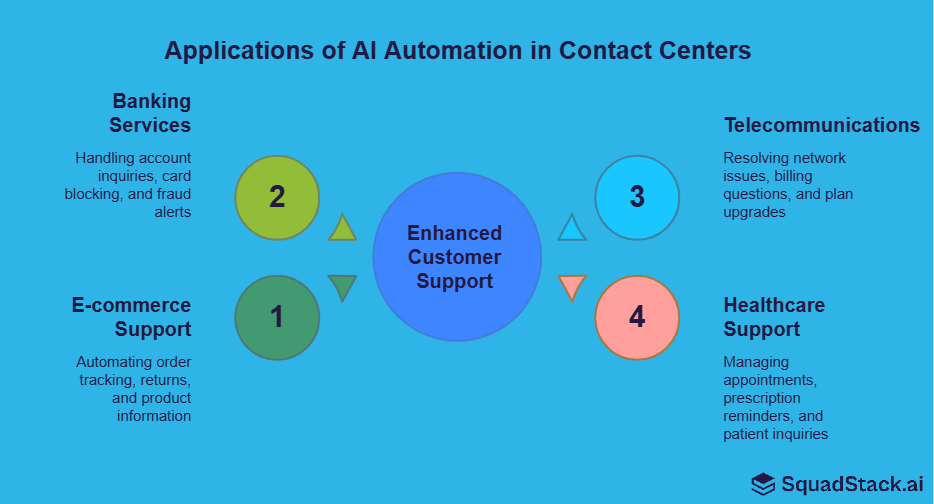
E-commerce Support
AI systems can automate:
- Order tracking
- Returns and refunds
- Delivery updates
- Product information
Banking and Financial Services
AI contact centers handle tasks such as:
- Account balance inquiries
- Card blocking
- Transaction history
- Fraud alerts
Telecommunications
Automation can resolve:
- Network issues
- Billing questions
- SIM activation
- Plan upgrades
Healthcare Support
Healthcare organisations use AI to manage:
- Appointment booking
- Prescription reminders
- Patient inquiries
SquadStack: A Fully Automated AI Contact Center
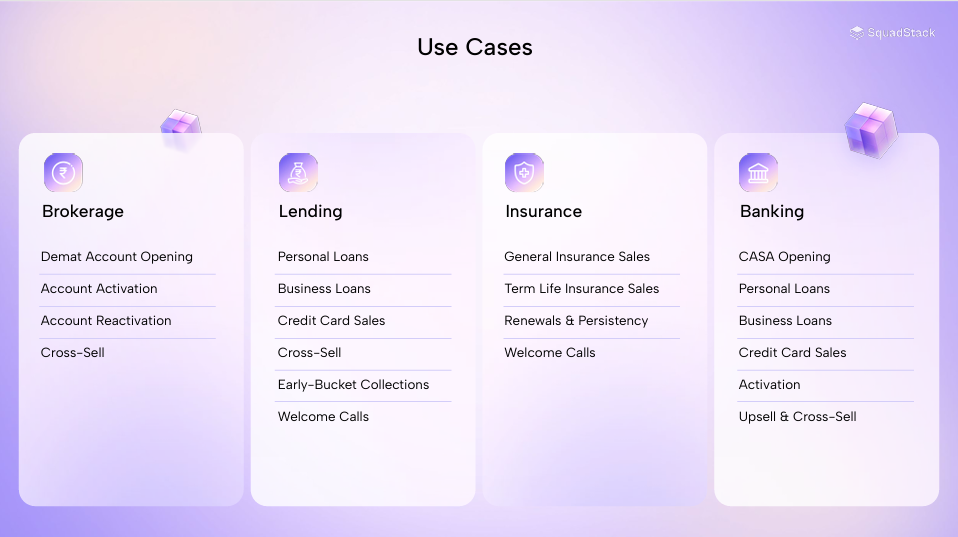
SquadStack is an enterprise-grade Agentic AI contact centre platform designed to automate high-volume customer conversations across sales, support, and collections. Its AI Voice Agents are trained on hundreds of millions of real customer interactions, enabling natural conversations and predictive sales engagement.
Key capabilities include:
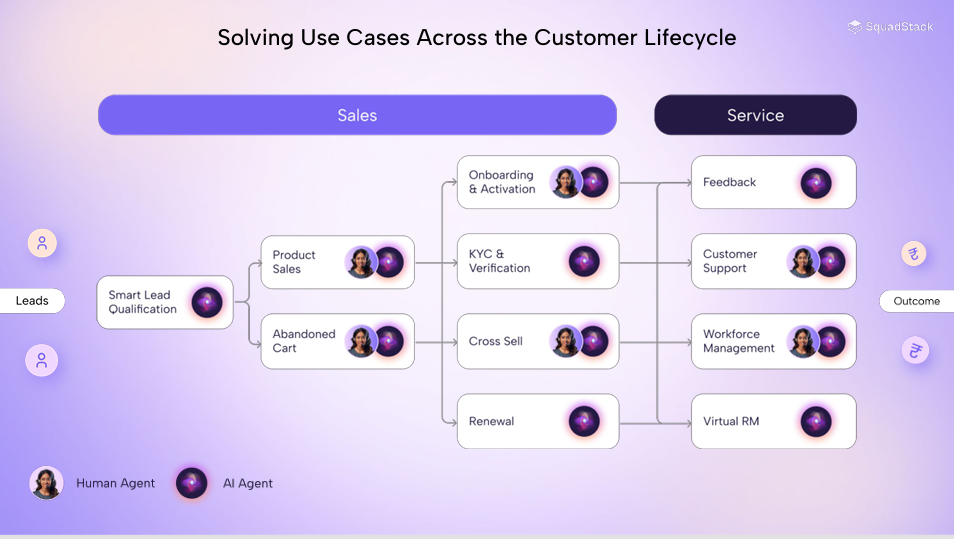
- AI voice agents for lead qualification, onboarding, collections, and customer support
- Omnichannel orchestration across Voice, WhatsApp, SMS, and Web
- 90%+ lead connectivity and large-scale outbound calling infrastructure
- AI trained on hundreds of millions of interaction signals
- Enterprise compliance, including ISO 27001 and SOC 2
SquadStack is widely used in BFSI, ecommerce, edtech, healthcare, and real estate to automate revenue-generating conversations while reducing acquisition costs.
By combining humanoid AI voice agents, conversational intelligence, and data-driven optimisation, SquadStack helps businesses automate large volumes of customer conversations while maintaining a personalised experience. Instead of simply routing calls, the platform focuses on turning conversations into measurable revenue opportunities.
How SquadStack's Humanoid Vision Agent Fixes the Context Gap
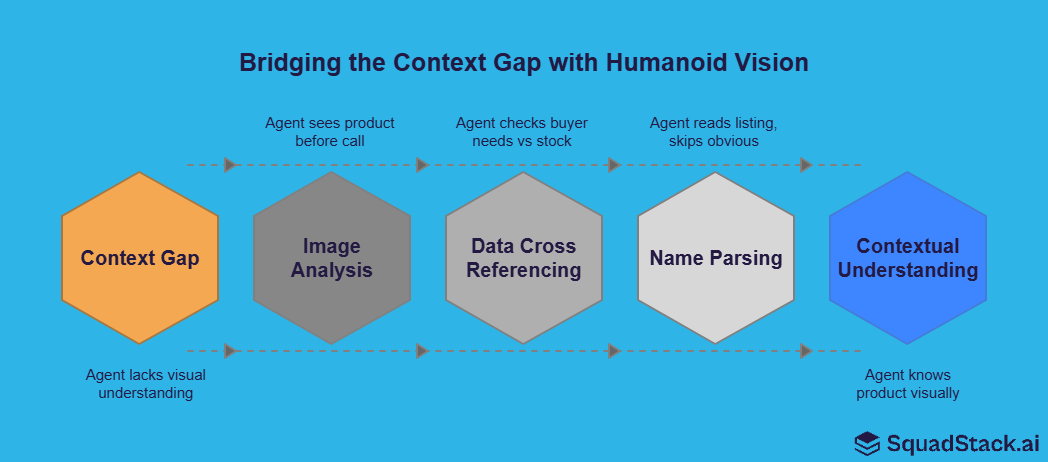
SquadStack's Humanoid Vision Agent is built on a principle it calls context before conversation. Before a single word is spoken, the agent analyses the product image in the call payload, cross-references buyer and seller data, and reads the product listing for embedded attributes — all in parallel with the opening greeting, with zero added latency. By the time the buyer says hello, the AI contact center agent already knows what they were looking at, in the same specific, visual way the buyer does.
|
Visual Context |
The agent sees the product before the call. Material, colour, finish, packaging — extracted from the listing image and injected into the agent context. The AI references upholstery, confirms finishes, and understands what the buyer is picturing — without being told. |
|
Data Cross Referencing |
Confirm, don't interrogate. Before asking qualification questions, the agent checks what the buyer needs against what the seller stocks. If only one size matches, it confirms — “Size mein 10mm hi chahiye na?” — instead of reading out a full options list |
|
Name Parsing |
Read the listing, skip the obvious. If a product is called “Green Wall Panel,” the agent reads the colour from the name and skips asking for it. Three seconds saved per question. Multiplied across |
What Makes SquadStack a True Full-Stack Automated AI Contact Center
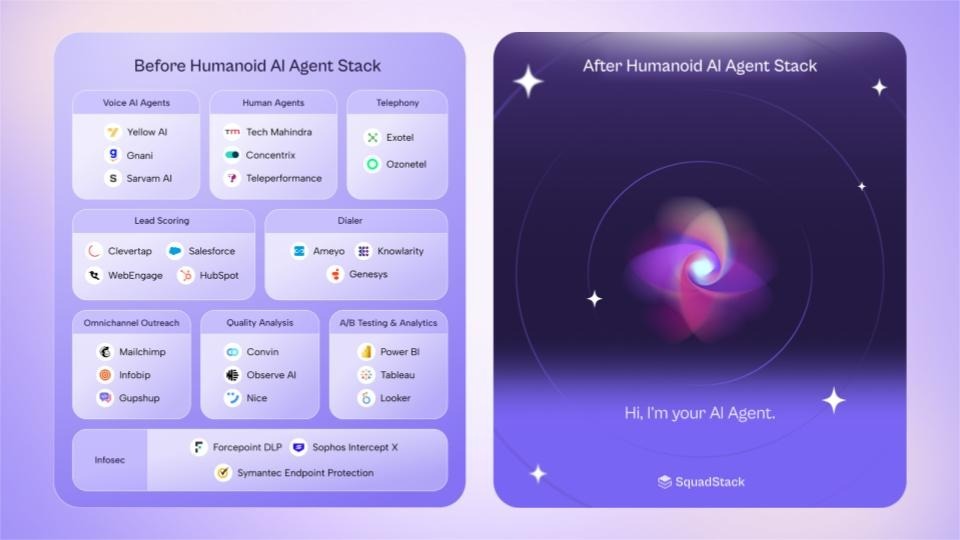
Not all AI contact centers offer the same level of automation or capabilities. SquadStack stands out as a full-stack automated AI contact center by combining AI voice agents, lead intelligence, conversation workflows, and continuous optimization within a single platform. This integrated approach allows businesses to manage the entire customer interaction lifecycle, from outreach and qualification to follow-ups and conversions, without relying on multiple tools. The result is a more scalable, data-driven contact center built to drive real sales outcomes.
|
Platform Layer |
What It Does in a Fully Automated AI Contact Center |
|
Lead Intelligence |
Reaches 80–90% of leads vs. the 40–60% industry average. Propensity models deliver up to 32% outcome lift — campaigns start warm, not cold. ~30% of new leads are repeat profiles, enabling behavioural context from call one. |
|
Humanoid AI Agent Stack |
Voice, WhatsApp, In-App, and Visual agents trained on 5M+ hours of real Indian sales conversations. 1,000+ high-resolution Indian voice profiles. Handles inbound and outbound across all channels without human involvement for 60–80% of interactions. |
|
Quality Monitor |
100% automated QA on every interaction — not the 5–10% sampling that misses most compliance risks. Sentiment analysis, script adherence scoring, and real-time coaching signals across 23 parameters. |
|
Optimize |
Built-in A/B testing on voices, prompts, workflows, and cadence. Every experiment runs on live traffic with a control group. Winners compound into a continuously improving baseline. |
|
Arth (STT) + Goonj (TTS) |
In-house speech models outperforming Deepgram, Sarvam, and ElevenLabs on Indian contact centre use cases — at 70–90% lower cost. Arth: 26% WER. Goonj: 4.85 MOS. Built on 5M+ hours of proprietary Indian sales audio. |
|
India Interaction Graph |
100M+ unique consumer profiles. 400M+ interactions. Every call makes the graph richer — and every enriched profile means the next campaign starts smarter, faster, and with a lower cost per conversion. |
Key Features of SquadStack
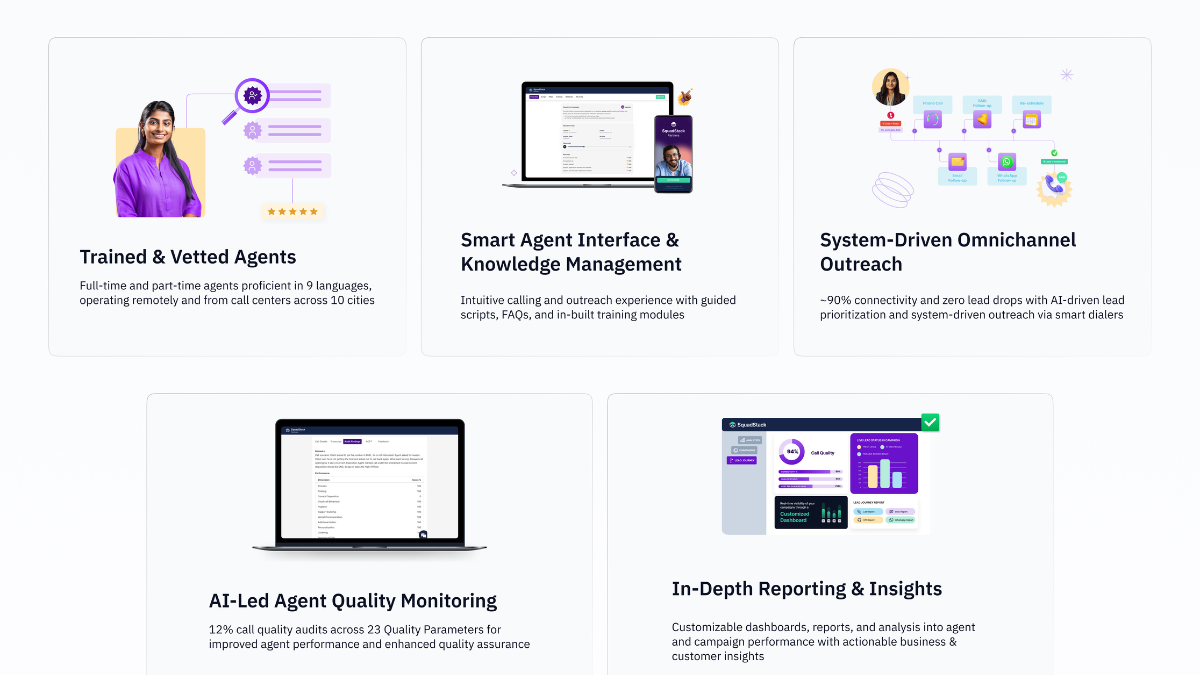
Unlike generic voice bots that rely on scripted IVR flows, SquadStack’s AI Voice Agents are trained on 600M+ minutes of real sales conversations, enabling natural, interruption-ready, and context-aware dialogues. The platform combines AI automation with human expertise to ensure that lead qualification, follow-ups, and conversions are optimized — not just automated.
1. Built for Sales Outcomes, Not Just Automation
SquadStack is designed to improve real business metrics such as:
- Up to 90% lead connectivity
- Higher conversion rates (case studies show 30–50%+ improvements)
- Lower cost per qualified lead
- Faster turnaround time (TAT) on lead follow-ups
This makes it highly relevant for B2B teams looking to automate sales calls without sacrificing quality.
2. Hyper-Personalized AI Voice Conversations
SquadStack’s AI agents go beyond static scripts. They dynamically personalize conversations based on:
- Persona attributes (location, income, behaviour)
- Funnel stage
- Product type
- Preferred language (including multilingual & code-switching support)
- Best time to call
With ≤0.8s median latency and high TTS quality, conversations feel natural and human-like — reducing drop-offs and increasing engagement.
3. Full-Stack Sales Orchestration
Unlike standalone AI voice tools, SquadStack offers:
- AI-led lead prioritization & dynamic scoring
- Smart retry logic & spam-aware number rotation
- CRM-aware personalization with real-time updates
- Automatic outcome tagging & structured data capture
- Seamless human handoff when required
This makes it a comprehensive AI sales tool rather than just a calling bot.
4. Proven Enterprise-Scale Performance
SquadStack powers:
- 4 Million + daily lead interactions
- 50+ enterprise customers
- Millions of calls per month
- Up to 90%+ connectivity improvements in certain B2B use cases
For industries like BFSI, EdTech, Lending, Marketplaces, and Automotive — where large lead volumes and fast response times directly impact revenue — AI voice automation becomes a strategic growth lever.
5. Enterprise-Grade Compliance & Security
For B2B enterprises handling sensitive customer data, SquadStack provides:
- ISO 27001 & SOC 2 Type II compliance
- India-based data residency
- AES-256 encryption
- Dual-layer QA (AI + human audits)
- Continuous AI retraining using real transcripts
This is especially important for regulated industries like banking, lending, and insurance.
Where SquadStack.ai Fits in the AI Sales Stack
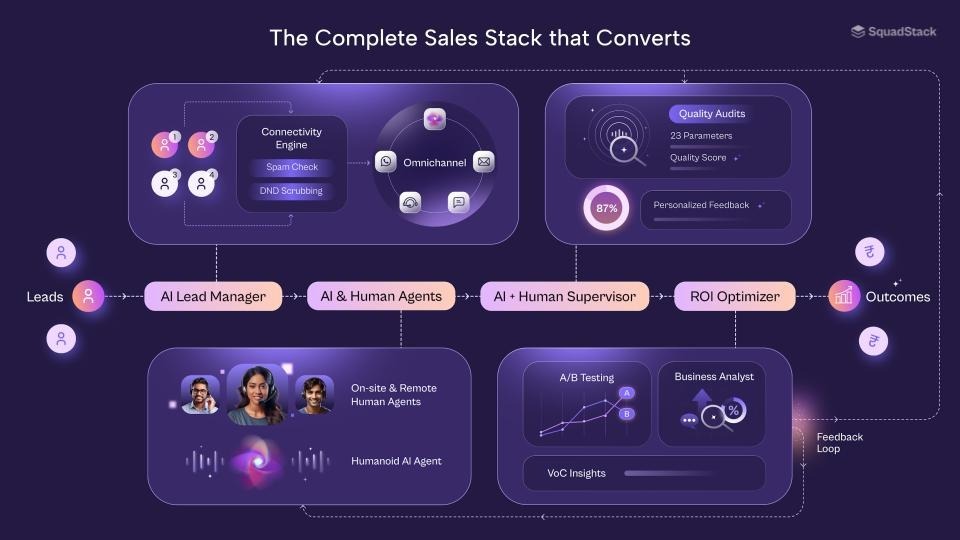
SquadStack is ideal for businesses that need:
- Automated outbound lead qualification
- Inbound sales follow-ups at scale
- Cross-sell & upsell campaigns
- Appointment booking & demo scheduling
- Sales funnel optimization with analytics
- Hybrid AI + human orchestration
For B2B teams managing thousands of leads daily, SquadStack.ai functions as a revenue engine — ensuring faster engagement, structured follow-ups, and measurable conversion impact.
Best Practices for Implementing a Fully Automated AI Contact Center
Businesses adopting AI automation should follow these strategies:
- Start with High-Volume Use Cases: Automate repetitive queries such as FAQs and order status first.
- Maintain Human Escalation Paths: Always allow customers to reach a human agent when needed.
- Continuously Train AI Models: Use interaction data to improve AI accuracy and intent detection.
- Monitor Customer Feedback: Track metrics like-
- CSAT
- resolution rate, call abandonment
This helps refine automation strategies.
Common Challenges in AI Contact Center Automation
Challenge 1: Poor Intent Recognition in Complex Queries
Solution: Invest in continuous model training using real interaction transcripts. Use hybrid NLU architectures that combine rule-based and ML approaches for edge cases. Build confidence score thresholds to route low-certainty intents to human agents.
Challenge 2: Customer Resistance to AI Interactions
Solution: Be transparent — let customers know they're speaking with AI. Design AI personas that are warm, empathetic, and helpful. Always make it easy for customers to reach a human if they prefer. Research from PwC shows 75% of customers are comfortable with AI as long as it solves their problem quickly.
Challenge 3: Integration Complexity with Legacy Systems
Solution: Use API middleware layers to bridge legacy infrastructure with modern AI platforms. Many leading AI contact center vendors offer pre-built connectors for legacy CRM and telephony systems.
Challenge 4: Maintaining Compliance and Data Privacy
Solution: Choose platforms with built-in GDPR, HIPAA, and PCI-DSS compliance features. Implement data minimization practices — the AI should only access and retain the data it truly needs to resolve each interaction.
The Future of AI Contact Centers
The evolution of the fully automated AI contact center is accelerating. Several transformative trends are already emerging:
- Agentic AI: AI that takes autonomous multi-step actions across systems — not just answering questions, but actually solving problems end-to-end without human supervision.
- Emotion AI: Real-time detection of emotional states through voice tone, word choice, and response patterns — enabling the AI to adapt its approach dynamically.
- Generative AI Self-Improvement: AI contact centers that write their own better responses based on outcome analysis, requiring minimal human training input.
- Predictive Contact Prevention: AI that identifies customer issues before they occur and proactively resolves them — eliminating the need for the customer to contact the center at all.
- Multimodal AI: Integration of video, image, and document processing into AI contact center interactions — supporting complex visual troubleshooting scenarios.