.svg)




Overview
redBus runs post-trip feedback campaigns across India to capture passenger ratings and flag operational issues to bus operators. The volumes are high, the audience is multilingual, and the window to collect useful feedback after a journey is narrow.
Until mid-2025, the entire operation was run by SquadStack-managed human telecallers across four languages: Hinglish, Tamil, Telugu, Kannada. In partnership with SquadStack, redBus has transitioned the same operation to Voice AI. The transition started with Hinglish in August 2025. By June 2026, Voice AI handled 89% of all leads.
The Challenge
redBus operates a feedback funnel with constraints that compound on each other:
- Multilingual at scale: Passengers travel across India and prefer to speak in their own language. A feedback program needs to operate at production quality across Hinglish, Tamil, Telugu, Kannada, all at once.
- Short feedback window: Passenger memory of a trip fades quickly. Reaching them within 1 to 3 days of travel is the difference between rich feedback and silence.
- Low rating capture on human calls: Human agents asked passengers to rate the trip via a WhatsApp link sent during or after the call. Most passengers did not return to the link. Rating capture on human calls sat in the low double digits.
The Solution
SquadStack deployed Voice AI as the primary feedback agent across all of redBus's post-trip campaigns. The system was built and rolled out in three structural moves.
1. A language-by-language rollout
The Hinglish campaign moved first, in August 2025, as the cleanest environment to harden the workflow. Once Hinglish was stable, regional languages were brought on in sequence: Telugu, Kannada, and Tamil. By June 2026, Voice AI handled nearly 9 out of every 10 leads.
.png)
2. The breakthrough: on-call rating capture
The first version of Voice AI captured ratings outside the call, via a WhatsApp link sent during or after the conversation. Rating capture held near the human baseline, in the low double digits.
The next version was redesigned to ask for the rating during the call itself, conversationally, in the passenger's language. No link, no app switch, no second action. As Voice AI scaled across languages and took on a larger share of traffic, combined feedback collection (human and Voice AI together) improved significantly across every campaign.
3. A workflow built to compound
Beyond the Voice AI itself, SquadStack rebuilt the underlying calling logic: same-day 1st and 2nd attempts with a next-day 3rd attempt, automated daily ratings ingestion back to redBus, and continuous script optimization to reduce Abruptly Disconnected Rate.
The most recent script change (July 2026) demonstrates this in practice. A redesigned conversation flow improved qualification rate by ~18% and good feedback capture by ~22%, while also introducing explicit probing for passenger concerns, all without increasing average call time. The result was a further ~20% reduction in overall cost on top of the structural gains already delivered by the Voice AI transition.
The Impact
Connectivity improved across every language
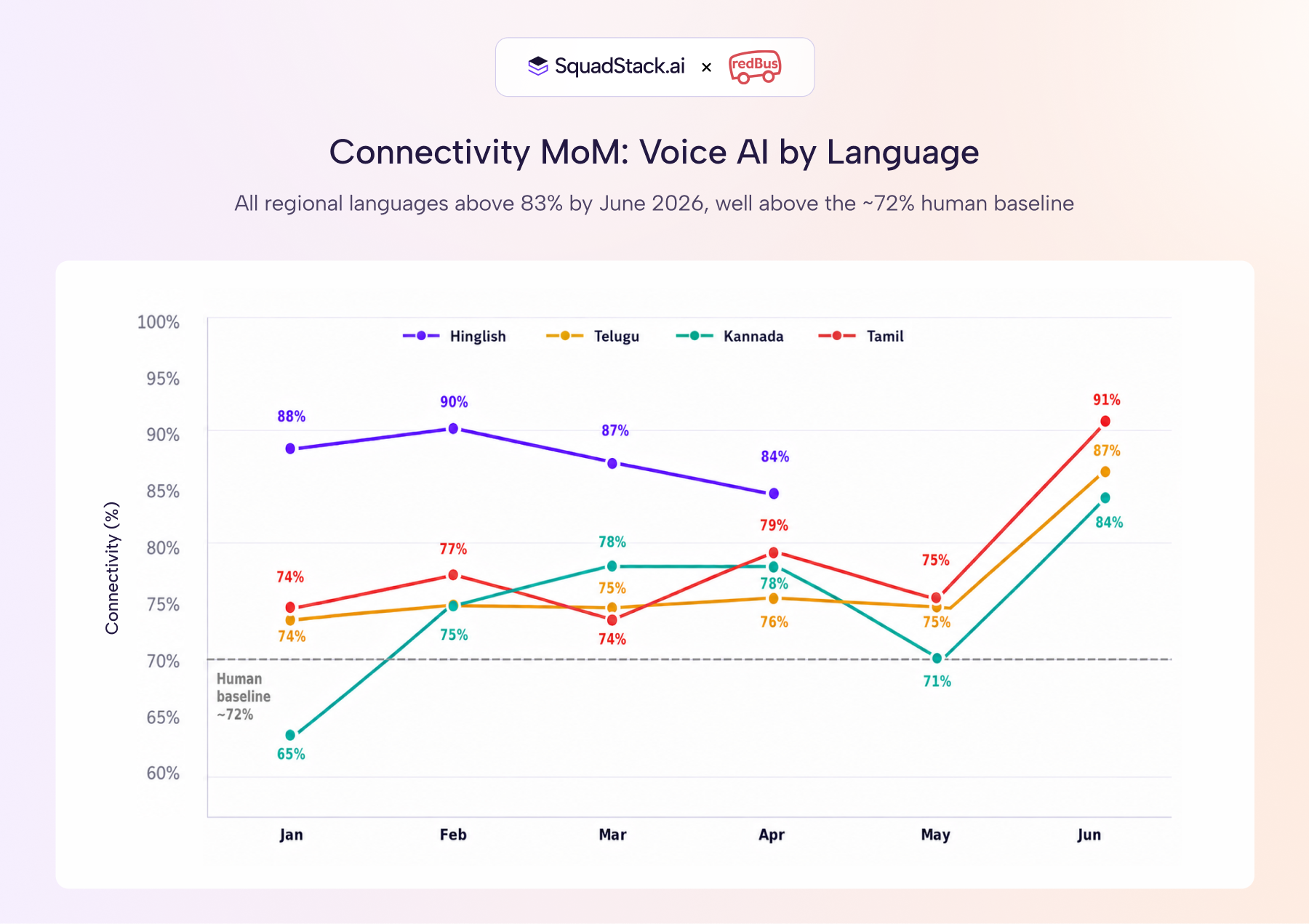
All regional language campaigns reached 83 to 91% connectivity by June 2026, well above the ~72% human baseline. Tamil led at ~91%, followed by Telugu at ~87% and Kannada at ~84%.
Feedback collection grew as Voice AI scaled
As Voice AI's share of traffic grew to ~89% by June, combined feedback collection (human and Voice AI together) increased steadily across all campaigns. The on-call rating capture mechanism, which removes the friction of a WhatsApp link entirely, drove this improvement as more leads were handled by Voice AI each month.
.png)
Cost: a structural reset across all languages
Blended Cost (overall) declined across all three regional campaigns between January and June 2026, converging as Voice AI took on a larger share of traffic. The cost efficiency of on-call rating capture, combined with the lower per-lead cost of Voice AI, drove a sustained reduction in acquisition cost across every language.
.png)
Operational outcomes
- Multilingual Coverage at Production Scale: All four campaigns, spanning Hinglish and three regional languages, are live on Voice AI by June 2026, with Voice AI handling ~88 to 89% of all leads.
- Sustained Growth in Feedback Collection: Combined feedback collection (human and Voice AI together) grew over 235% from January to June 2026, driven by the shift to on-call rating capture as Voice AI scaled across languages.
- Connectivity Above 83% Across All Languages: Voice AI maintained 83 to 91% connectivity across all regional campaigns by June, well above the ~72% human baseline.
- ~70% Lower Blended Cost Across All Campaigns: As Voice AI adoption grew from less than 1% to ~89% of traffic, blended cost (overall) dropped ~70% across all four campaigns, with Hinglish, Tamil, Kannada, and Telugu all converging by June 2026.
- Voice AI Adoption Reached ~89% of All Leads: By June, nearly 9 out of every 10 feedback calls were handled by Voice AI, up from less than 1% in January, across all regional campaigns.
- Continuous Script Optimization Compounds Gains: The most recent script change (July 2026) improved qualification by ~18% and good feedback capture by ~22%, reducing overall cost by a further ~20% without increasing call time.

