.svg)

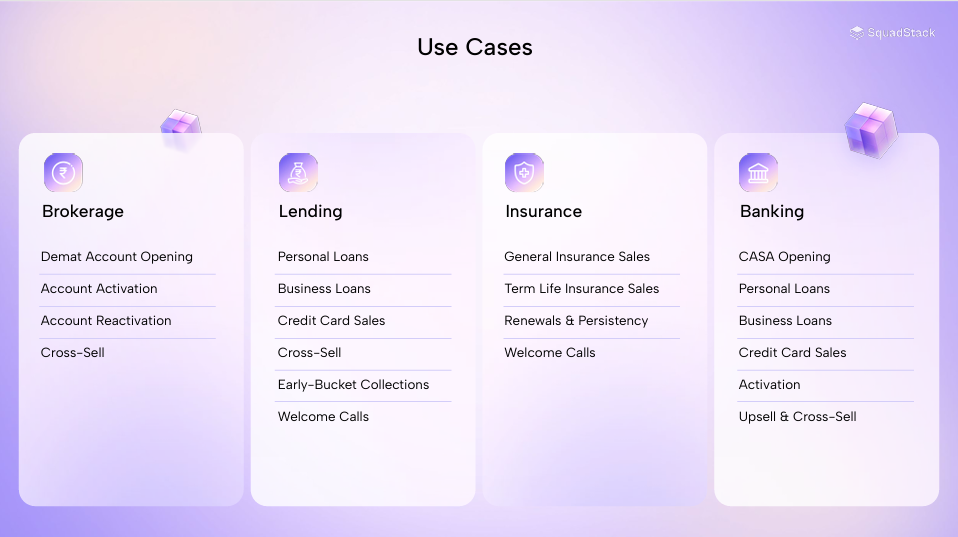
The way businesses sell and market their products has changed more in the last three years than in the previous two decades combined. In 2026, AI for sales and marketing will be non-negotiable for growth-minded companies. It's the difference between a team that scales and one that stagnates.
Companies that have adopted AI-driven sales strategies have started closing deals faster and filling pipelines more efficiently. Companies using AI in their sales processes see revenue increases of 3 to 15 per cent and sales ROI improvements of 10 to 20 per cent. Salesforce data shows that AI-powered sales reps handle 3 times more pipeline than those working without AI tools. The organisations that win with AI are not the ones that automate the most. They are the ones that automate the right things and free their people to focus on the work that actually moves the needle.
At its core, AI allows companies to analyze massive amounts of customer data, identify patterns, predict buyer behavior, and automate interactions across multiple channels such as email, chat, and voice. This helps businesses deliver the right message to the right customer at the right time, at large scale. .
Introduction to AI in Sales and Marketing
Traditionally, sales and marketing relied heavily on manual effort. Human sales representatives had to call every lead, marketers had to create campaigns based on assumptions, and follow-ups often depended on human availability. This made scaling difficult and resulted in missed opportunities.
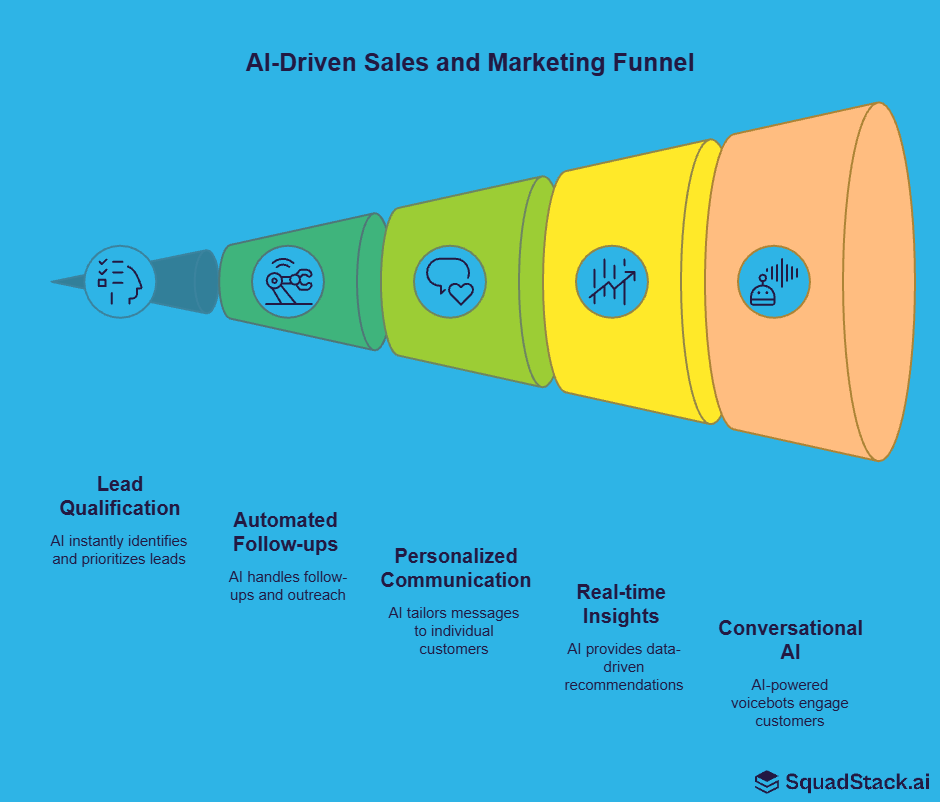
With AI, these limitations are eliminated. Intelligent systems can now:
- Instantly qualify and prioritize leads
- Automate follow-ups and outreach
- Personalize communication for each customer
- Provide real-time insights and recommendations
- Handle thousands of customer conversations simultaneously
This is especially important in today’s competitive environment, where speed and personalization directly impact conversion rates.
One of the most powerful advancements in this space is conversational and voice AI. Instead of waiting for human agents, businesses can use AI-powered voicebots to engage leads immediately, qualify them, answer questions, and book appointments. This ensures that no opportunity is missed while also improving the customer experience.
AI is also helping align sales and marketing teams more effectively. Marketing teams can generate and nurture high-quality leads using AI insights, while sales teams can focus on closing deals instead of spending time on repetitive tasks.
As customer expectations continue to rise, companies that adopt AI in their sales and marketing processes gain a significant competitive advantage. They can scale faster, operate more efficiently, and deliver better customer experiences.
In the following sections, we will explore how AI works in sales and marketing, its key benefits, major use cases, and how technologies like voice AI are shaping the future of revenue growth.
What is Artificial Intelligence in Sales and Marketing?
Artificial Intelligence (AI) in sales and marketing refers to the use of machine learning, natural language processing, and automation technologies to analyze data, predict customer behavior, automate conversations, and improve revenue outcomes.
Instead of relying solely on manual processes, AI enables businesses to:
- Identify high-quality leads automatically
- Personalize customer interactions
- Predict sales outcomes
- Automate repetitive tasks
- Improve conversion rates
AI transforms sales and marketing from reactive functions into proactive, data-driven growth engines.
Why AI is Becoming Essential for Revenue Teams
Modern buyers expect fast, personalized, and relevant interactions. Revenue teams face challenges such as:
- Large volumes of leads
- Limited sales bandwidth
- Increasing competition
- Rising customer expectations
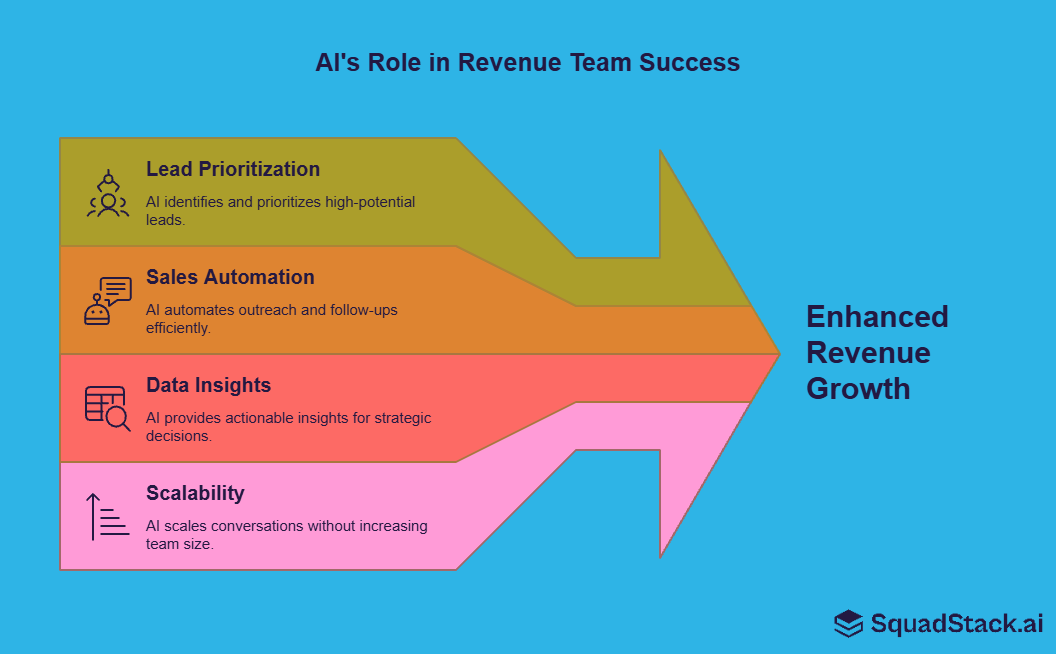
AI helps solve these challenges by:
- Prioritizing the best leads
- Automating outreach and follow-ups
- Providing insights for better decision-making
- Scaling conversations without increasing headcount
Companies using AI in revenue teams are seeing higher productivity, improved conversions, and faster growth.
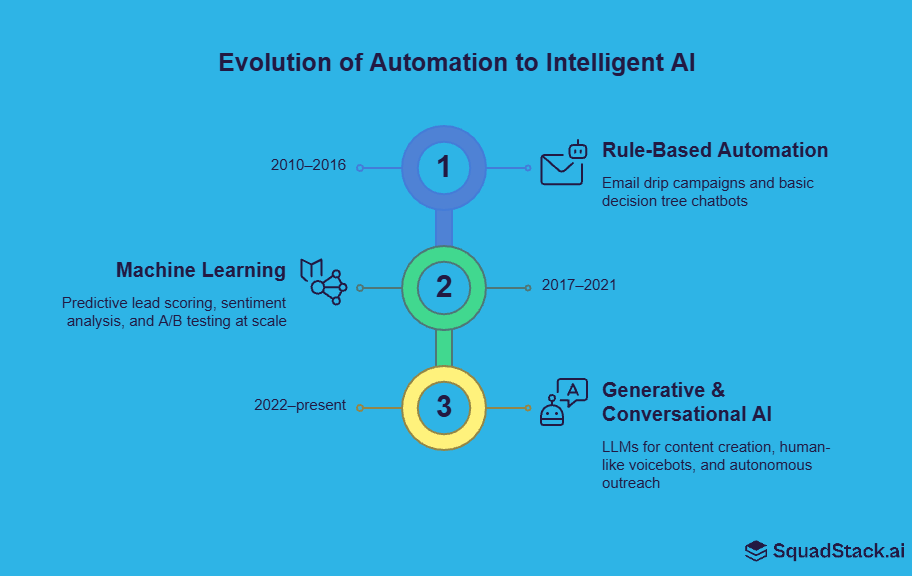
Evolution from Traditional Automation to Intelligent AI
Traditional automation follows fixed rules: 'If a user fills out a form, send this email.' It's useful but rigid. It can't adapt to context, can't understand sentiment, and can't make judgment calls.
Intelligent AI, by contrast, learns from data. A modern AI system can analyze thousands of past deals to predict which leads are most likely to convert, adjust email subject lines based on what drives opens for a specific segment, or carry on a natural voice conversation with a prospect — understanding nuance, handling objections, and routing to the right human at the right moment.
- Phase 1 (2010–2016): Rule-based automation — email drip campaigns, basic decision tree chatbots.
- Phase 2 (2017–2021): Machine learning — predictive lead scoring, sentiment analysis, A/B testing at scale.
- Phase 3 (2022–present): Generative AI and conversational AI — LLMs powering content creation, human-like voicebots, real-time coaching, autonomous outreach
We are firmly in Phase 3, and the pace of innovation is only accelerating.
Types of AI Technologies Used in Sales and Marketing in 2026
Different types of AI technologies power different parts of the sales and marketing workflow. Understanding which technology does what helps you choose the right tools for your team's specific challenges.
|
AI Technology |
What It Does |
Sales & Marketing Application |
|
Machine Learning (ML) |
Identifies patterns in large data sets and improves with experience |
Lead scoring, churn prediction, sales forecasting, and audience segmentation |
|
Natural Language Processing (NLP) |
Understands and generates human language |
Email personalisation, chatbots, call transcription, sentiment analysis |
|
Generative AI |
Creates original text, images, video, and audio from prompts |
Content creation, ad copy, email campaigns, product descriptions, proposals |
|
Predictive Analytics |
Uses historical data to forecast future outcomes |
Revenue forecasting, best-time-to-contact prediction, and demand planning |
|
Computer Vision |
Interprets and analyses visual content |
Ad creative analysis, social media visual trends, and product image search |
|
Conversational AI |
Simulates human conversations in real time |
Chatbots, virtual sales assistants, and 24/7 customer qualification |
|
Robotic Process Automation (RPA) |
Automates rule-based, repetitive digital tasks |
CRM data entry, invoice processing, lead list building, and report generation |
Key Benefits of Using AI for Sales and Marketing
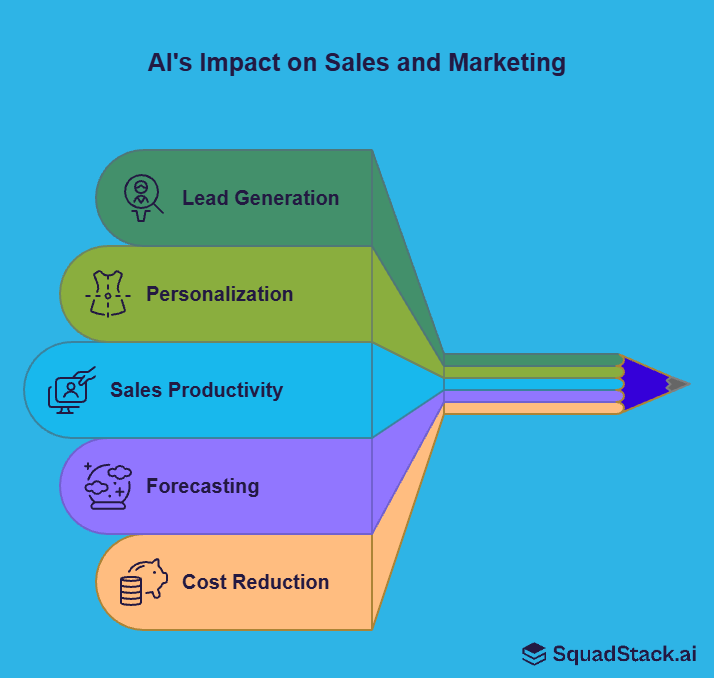
Artificial Intelligence helps sales and marketing teams become more efficient, data-driven, and scalable. By automating repetitive tasks and providing actionable insights, AI enables businesses to generate more revenue while improving customer experience.Share below are top benefits of using AI for sales and marketing:
Improved Lead Generation and Qualification
AI analyzes customer data, website behavior, and engagement signals to identify high-intent prospects. AI-powered lead generation tools analyze behavioral signals — website visits, content downloads, email engagement, social activity — to identify high-intent prospects before they even raise their hands. These tools score leads based on dozens of variables simultaneously, something no human analyst can do in real time.
Benefits include:
- Higher quality leads
- Faster qualification
- Better conversion rates
- Reduced manual effort
The result is a pipeline that's not just larger, but smarter. Sales reps spend their time on leads that are actually ready to buy, rather than burning hours on cold outreach to unqualified prospects. Companies using AI for lead qualification report significant reductions in cost per qualified lead and improvements in conversion rates.
Voice AI and chatbots can instantly qualify leads 24/7.
Hyper-Personalized Customer Engagement at Scale
Personalization used to mean adding a first name to an email. Today, AI-driven personalization means dynamically adapting every touchpoint — the content shown on a website, the email that lands in an inbox, the product recommended in an app, the timing of a follow-up call — based on an individual's specific behavior, preferences, and stage in the buying journey.
This kind of hyper-personalization was previously only possible for companies with massive marketing teams and budgets. AI democratizes it, allowing even mid-sized businesses to deliver Amazon-like personalization across their customer base, driving higher engagement rates and better conversion rates.
AI enables personalization for thousands or millions of customers simultaneously.
Examples:
- Personalized emails
- Product recommendations
- Customized offers
- Tailored conversations
Customers feel understood, increasing engagement and conversions.
Increased Sales Team Productivity
Sales reps spend large amounts of time on repetitive tasks.
AI automates:
- Follow-ups
- Data entry
- Call summaries
- Scheduling
- Lead prioritization
This allows sales teams to focus on closing deals.
CRM tools with AI capabilities can automatically log calls, generate meeting summaries, suggest next best actions, and draft follow-up emails — giving reps back hours every week to spend actually selling. Conversation intelligence tools analyze sales calls in real time, surfacing objections and coaching opportunities, helping new reps ramp faster and experienced reps close more deals.
Better Forecasting and Decision-Making
AI analyzes historical data to predict:
- Revenue
- Pipeline performance
- Conversion rates
- Customer behavior
This helps leaders make smarter strategic decisions.
AI transforms forecasting from a gut-feel exercise into a data-driven science. Modern AI forecasting tools analyze historical deal data, current pipeline activity, rep behavior patterns, market signals, and economic indicators to generate highly accurate revenue predictions.
Leaders can see which deals are at risk weeks before they fall out of the pipeline and take corrective action in time. On the marketing side, predictive analytics tools help teams allocate budgets more effectively — identifying which campaigns, channels, and audience segments are likely to deliver the best return before a single dollar is spent.
Cost Reduction Through Automation
AI reduces operational costs by:
- Automating conversations
- Reducing manual workload
- Increasing efficiency
- Improving marketing ROI
Businesses can scale without increasing costs significantly.
By automating high-volume, repetitive tasks — lead qualification calls, follow-up sequences, appointment scheduling, campaign reporting, content generation — businesses can operate more efficiently with leaner teams.
For outbound sales operations in particular, AI voicebots can handle thousands of qualification conversations simultaneously at a fraction of the cost of a human agent team. Instead of hiring, training, and managing a large team of agents for initial outreach, companies can deploy AI to handle the top of the funnel and have human agents focus exclusively on warm, qualified prospects.
How AI is Used in Sales: Major Use Cases
AI is transforming sales by automating repetitive tasks, improving decision-making, and increasing conversion rates. It helps sales teams identify high-potential leads, predict deal outcomes, analyze customer conversations, and automate follow-ups.
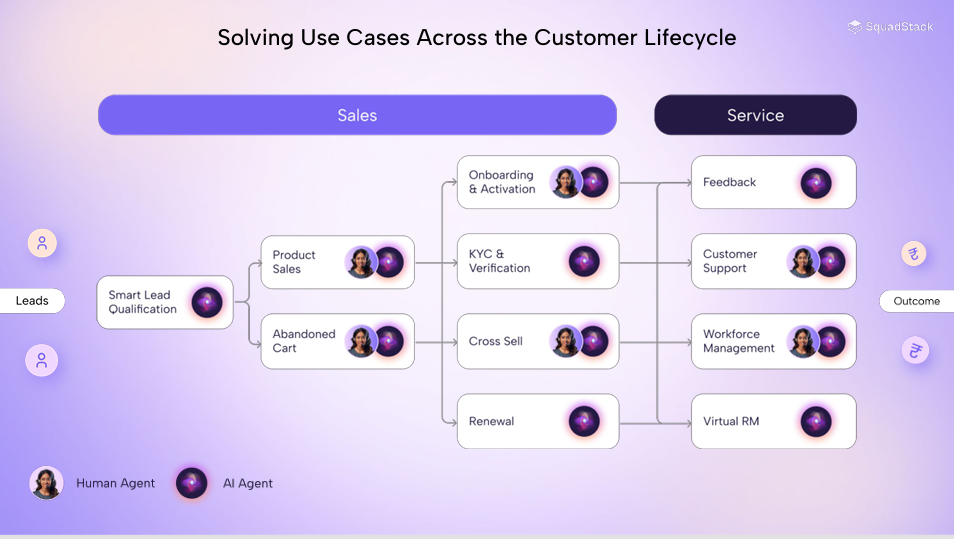
AI-powered tools can also engage prospects through chatbots and voicebots, ensuring faster response times and consistent communication. Modern CRM platforms like Salesforce and HubSpot integrate AI to provide lead scoring, pipeline insights, and automation features. This allows sales teams to focus more on building relationships and closing deals rather than manual administrative work.
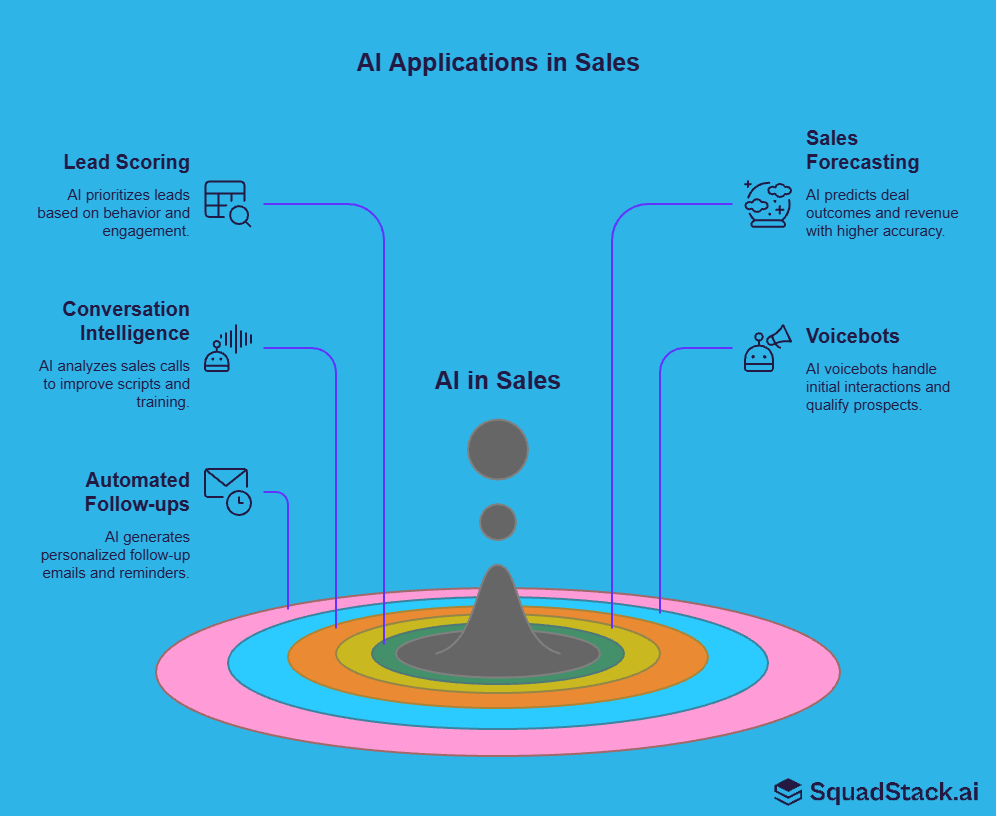
AI-Powered Lead Scoring and Prioritization
AI automatically scores leads based on:
- Behavior
- Demographics
- Engagement
- Buying signals
Sales teams can focus on the most likely buyers.
Platforms like Salesforce and HubSpot offer AI-driven lead scoring to improve efficiency.
AI-powered lead scoring replaces static rules with dynamic machine learning models trained on actual conversion data. These models continuously analyze hundreds of signals — demographic data, firmographic data, behavioral data, and engagement history — and update scores in real time as prospects interact with your brand.
The result is a prioritized list that reflects actual purchase intent, not arbitrary rules. Reps can sort their daily task list by AI score and know, with confidence, where to focus first. Leads that are cooling off automatically drop in priority; leads that show sudden spikes in engagement jump to the top.
Platforms like Salesforce Einstein and HubSpot's AI scoring tools have made this capability accessible to businesses of all sizes, integrating directly into the CRM workflows reps already use every day.
Sales Forecasting and Pipeline Intelligence
AI helps sales leaders predict:
- Which deals will close
- Expected revenue
- Pipeline risks
This improves planning and forecasting accuracy.
AI forecasting tools work by analyzing the characteristics of every deal in your pipeline against historical patterns — deal size, stage, age, rep activity, engagement frequency — and calculating the probability that each opportunity will close, and when. Aggregated across the pipeline, this produces a forecast significantly more accurate than rep-submitted estimates.
Advanced platforms go further with pipeline intelligence features that flag at-risk deals based on sudden changes in engagement, identify deals where competitors have been mentioned, or surface opportunities where faster follow-up could accelerate the timeline — shifting the sales leader's role from reporting to actively managing what's about to happen.
Conversation Intelligence and Call Analysis
AI analyzes sales calls to:
- Identify winning patterns
- Improve scripts
- Train sales reps
- Increase conversions
It provides insights that humans may miss.
AI-powered conversation intelligence tools record, transcribe, and analyze sales calls automatically. They surface patterns across hundreds of conversations — which objections come up most often, which talk tracks correlate with closed deals, which moments predict disengagement — and use these insights to coach reps and refine messaging.
For managers, conversation intelligence eliminates the need to listen to every call manually. Instead, they get AI-generated highlights and coaching recommendations, allowing them to support more reps more effectively. Tools like Gong and Chorus have demonstrated companies can achieve significant improvements in win rates through conversation intelligence programs.
AI Voicebots and Virtual Sales Assistants
Voice AI can:
- Call leads instantly
- Qualify prospects
- Schedule appointments
- Follow up automatically
Voicebots work 24/7 without fatigue. They ensure no lead is missed.
AI voicebots are software systems that can conduct natural, human-like voice conversations with prospects — asking qualification questions, handling common objections, providing information, scheduling callbacks, and routing hot leads to human agents in real time.
Unlike simple IVR systems, modern AI voicebots understand natural language, respond contextually, and adapt to the flow of a conversation. For businesses that need to qualify large volumes of inbound leads or conduct high-frequency outbound outreach, voicebots offer a combination of scale, speed, and cost-efficiency that is simply not achievable with human-only teams.
SquadStack's AI voicebot platform is purpose-built for sales operations, with capabilities specifically designed for lead qualification, follow-up at scale, and smooth handoff to human agents at exactly the right moment in a conversation.
Automated Follow-ups and Email Generation
AI automatically generates:
- Follow-up emails
- Sales messages
- Meeting reminders
This improves response rates and saves time. AI ensures consistent engagement with prospects.
AI solves follow-up inconsistency through automated, intelligent outreach sequences. Modern platforms can generate personalized follow-up emails based on the specific conversation a rep had with a prospect — referencing the topics discussed, the objections raised, and the next steps agreed upon — and send them automatically at the optimal time.
If a prospect opens an email and clicks a link, the next follow-up triggers immediately. If they go dark for a week, the tone adjusts to a re-engagement message. Platforms like Salesforce and HubSpot have deeply integrated AI into their sales workflows, enabling this kind of intelligent automation at every stage of the funnel.
How AI is Used in Marketing: Major Use Cases
AI helps marketing teams create smarter, faster, and more effective campaigns by using data to understand customer behavior and preferences. It can generate content, segment audiences, predict campaign performance, and personalize messaging across channels.
AI-powered chatbots and voicebots also capture and qualify leads in real time, ensuring immediate engagement. Platforms like SquadStack use conversational and voice AI to help businesses automate lead capture and improve marketing-to-sales conversions. This enables marketers to increase efficiency, improve targeting, and maximize ROI.
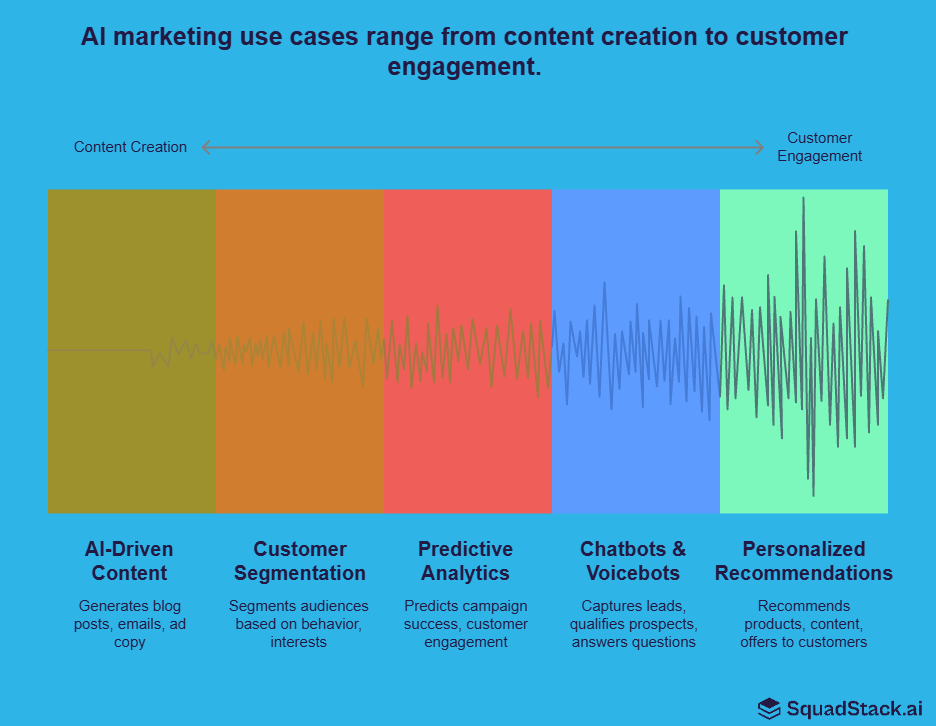
AI-Driven Content Creation
AI helps marketers create:
- Blog posts
- Emails
- Ad copy
- Social media content
This increases productivity and scalability.
Generative AI tools can now produce high-quality first drafts of blog posts, email campaigns, social media content, ad copy, landing page headlines, and product descriptions in seconds. These tools understand brand voice, can be trained on existing content, and can adapt tone and messaging for different audiences and channels.
The role of the human marketer shifts from writer to editor and strategist — ensuring quality, injecting brand perspective, and making the judgment calls that AI isn't yet equipped to make. The result is content teams that produce significantly more content, at higher quality, without proportional increases in headcount. AI tools like Midjourney and DALL-E are similarly transforming visual content creation.
Customer Segmentation and Targeting
AI segments audiences based on:
- Behavior
- Interests
- Demographics
- Purchase history
This improves targeting and campaign performance.
AI-powered segmentation analyzes customer data at a granularity and speed that humans cannot match. Machine learning models identify micro-segments — small groups of customers who share specific behavioral or attitudinal characteristics that predict purchase behavior — and target them with tailored messaging.
This extends to paid advertising. AI-driven targeting systems on platforms like Google and Meta continuously optimize who sees your ads based on conversion signals, adjusting bids and targeting parameters in real time to maximize return on ad spend. Less budget is wasted on unlikely-to-convert audiences; more is concentrated where it works.
Predictive Analytics for Campaign Performance
AI predicts:
- Campaign success
- Customer engagement
- Conversion probability
This allows marketers to optimize campaigns before spending money.
Predictive analytics tools can estimate expected engagement rates, conversion rates, and ROI for different campaign strategies before a campaign launches — allowing marketers to make more confident budget allocation decisions and identify which approaches are most likely to hit their targets.
Some platforms go further with prescriptive analytics — not just predicting performance but recommending specific actions to improve outcomes. These AI-generated recommendations are becoming standard features in enterprise marketing platforms, turning strategy from a backward looking exercise into a forward-looking one.
Chatbots and Voicebots for Lead Capture
AI chatbots and voicebots can:
- Capture leads instantly
- Qualify prospects
- Answer questions
- Book meetings
Platforms like SquadStack use voice AI to automate lead engagement and qualification at scale.
Modern AI chatbots are far more sophisticated than the script-following bots of the past. They understand natural language, handle multi-turn conversations, and qualify visitors based on their responses — routing high-intent prospects directly to a sales rep or scheduling a call.
Voicebots extend this capability to phone interactions. Rather than letting inbound calls go to voicemail or wait in a queue, AI voicebots can answer immediately, qualify the caller, and connect them to a human agent in real time. SquadStack.ai has been at the forefront of this space, deploying AI voicebot technology specifically optimized for sales and lead conversion scenarios — bridging the gap between initial interest and a qualified sales conversation.
Personalized Recommendations
AI powers recommendation engines used by:
- Ecommerce companies
- SaaS platforms
- Streaming platforms
This improves:
- Customer experience
- Revenue
- Retention
Recommendation engines analyze an individual's browsing behavior, purchase history, engagement patterns, and similarity to other customers to surface the products, content, or offers most likely to resonate. Amazon has famously attributed a significant portion of its revenue to recommendation-driven purchases — and this capability is now available to businesses of all sizes.
Whether recommending blog articles to keep a reader engaged, upselling a complementary product at checkout, or surfacing the right case study for a B2B prospect in the consideration stage, AI recommendations drive measurable improvements in engagement and revenue across the entire funnel.
Role of Voice AI and Conversational AI in Sales and Marketing
Voice AI and conversational AI enable businesses to interact with customers through natural, human-like conversations at scale. These technologies can qualify leads, answer queries, schedule appointments, and automate follow-ups in real time.
By using voicebots and AI assistants, companies can ensure faster response times, 24/7 availability, and consistent customer engagement. Conversational platforms like SquadStack help sales and marketing teams scale outreach, improve lead conversion rates, and deliver a seamless customer experience while reducing manual workload.
What are Voicebots and How They Work
Voicebots are AI-powered systems that interact with customers through phone calls. They use:
- Speech recognition
- Natural language processing
- Machine learning
A voicebot is an AI-powered system that can conduct spoken conversations with humans — listening to what they say, understanding the intent behind their words, and responding naturally in real time. The technical architecture behind a voicebot includes several components working together:
- Automatic Speech Recognition (ASR): Converts the caller's spoken words into text in real time, with accuracy that now rivals human transcription for most accents and speaking styles.
- Natural Language Understanding (NLU): Analyzes the transcribed text to determine the caller's intent — what they're asking for, what they're responding to, and what context is relevant from earlier in the conversation.
- Dialogue Management: Determines how the bot should respond given the current state of the conversation, the caller's intent, and the defined goals of the interaction.
- Text-to-Speech (TTS): Converts the bot's response into natural-sounding speech, with modern systems producing voices increasingly difficult to distinguish from human agents.
- Integration Layer: Connects the voicebot to CRM systems, lead management platforms, calendaring tools, and human agent routing systems so that conversation data flows automatically into the right places.
SquadStack's voicebot technology integrates all of these components in a platform purpose-built for sales use cases, with the critical additional capability of seamlessly transferring conversations to human agents when the situation calls for it.
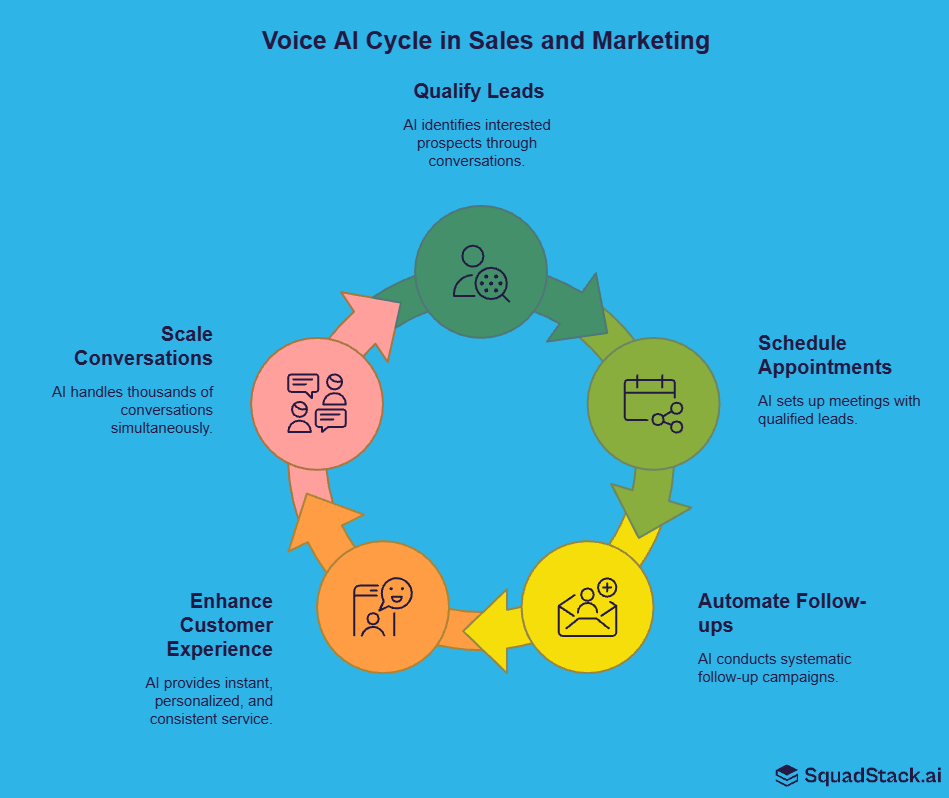
Voice AI for Lead Qualification and Follow-ups
Voice AI can:
- Call leads immediately
- Ask qualification questions
- Identify interested prospects
- Schedule sales calls
- Follow up automatically
This significantly improves conversion rates.
Lead qualification is one of the most time-intensive parts of sales — and one of the most suitable for AI automation. For businesses with high lead volumes — real estate developers, insurance providers, financial services firms, ed-tech companies, healthcare providers — manually calling every inbound lead to qualify them is costly, slow, and inconsistent.
An AI voicebot can call every new lead within seconds of form submission, regardless of time of day, ask structured qualification questions naturally, handle common objections with pre-trained responses, score leads based on their answers, route high-priority prospects to human agents immediately, schedule callbacks automatically, and update CRM records with no manual data entry required.
The same logic applies to follow-up outreach. Rather than relying on reps to manually follow up with leads who haven't responded, voicebots can conduct systematic follow-up campaigns — reaching out at optimal times, adjusting messaging based on previous interactions, and ensuring no qualified lead is left without a timely touchpoint.
Enhancing Customer Experience with Conversational AI
Voice AI provides:
- Instant responses
- Personalized conversations
- Consistent experience
- 24/7 availability
Customers receive faster and better service.
Consider the experience from the prospect's perspective. You submit an inquiry for a service you're interested in. Within seconds, you receive a call. The voice on the other end is friendly, clear, and directly relevant — asking sensible questions, providing useful information, and making it easy to schedule a time to talk with a specialist.
Compare this to the alternative: submitting a form and waiting 24–48 hours for someone to call back, or being put on hold when you do call in. The AI-powered experience wins on every dimension — speed, availability, relevance, and consistency.
Voicebots that are transparent about being AI, that handle unexpected questions gracefully, and that know when to escalate to a human agent create trust rather than frustration. This is a design and implementation challenge — and it's where platforms with deep domain expertise in sales conversations, like SquadStack, provide significant value.
Scaling Customer Conversations Efficiently
Perhaps the most compelling business case for conversational AI in sales is pure scale. A human agent team has a hard ceiling on capacity. Even with perfect scheduling and optimal processes, there are only so many calls a team can make or receive in a day. Voicebots have no such ceiling.
Human teams have limitations. Voice AI removes those limits. Businesses can:
- Handle thousands of conversations daily
- Reduce operational costs
- Improve efficiency
A single deployment can handle hundreds or thousands of simultaneous conversations with no degradation in quality, no increase in per-call cost, and no need for shift scheduling or capacity planning. For a business with 10,000 monthly inbound leads, the economics of manual qualification are daunting. An AI voicebot handles this volume at a fraction of the cost — consistently, compliantly, and fast.
Conversational platforms like SquadStack demonstrate how voice AI can support sales operations at this kind of scale, enabling businesses to engage every single lead quickly and effectively while keeping human agents focused on the conversations where their empathy, expertise, and persuasion skills deliver the most value. The result is a scalable revenue system that performs consistently regardless of season, volume spikes, or team availability.
How to Implement AI in Your Sales and Marketing Strategy
Implementing AI in your sales and marketing strategy requires a clear plan, the right tools, and alignment between teams. When done correctly, AI can improve lead conversion, automate customer engagement, and increase overall revenue efficiency.
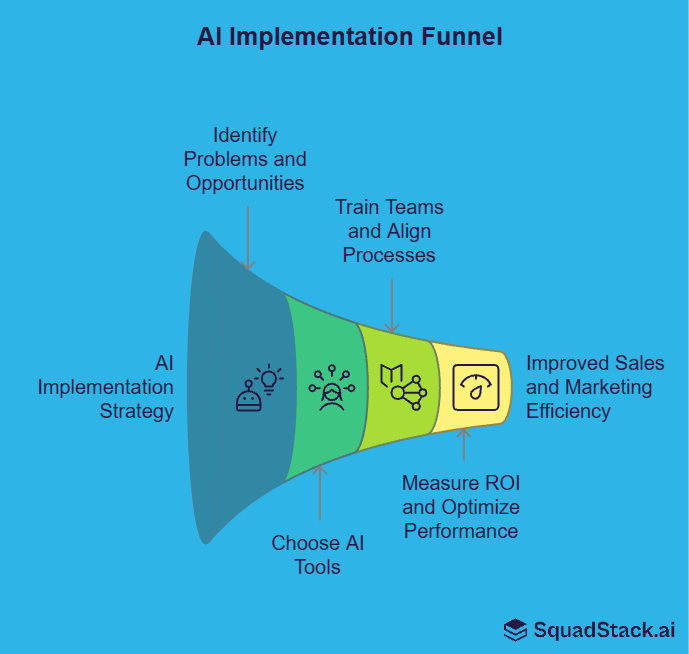
Identify Key Problems and Opportunities
Before evaluating any tool or platform, start with clarity on the problems you're trying to solve. AI implementation fails most often not because the technology doesn't work, but because teams deploy it without a clear understanding of what specific problem they're solving.
Start by identifying areas where AI can help:
- Lead qualification
- Follow-ups
- Customer support
- Forecasting
Focus on high-impact areas first.
Begin by auditing your current operations and:
- Identify the most significant drop-off in the funnel.
- Tasks that consume the most time for our sales reps without directly contributing to closing deals and how quickly do we respond to inbound leads, and what does that cost us?
Choose the Right AI Tools
The AI tools market is vast and growing rapidly. A few guiding principles: prioritize integration (the most powerful AI tools work seamlessly with the systems your team already uses), evaluate for your specific use case (a voicebot platform built specifically for sales qualification, like SquadStack, will typically deliver better results than a general-purpose platform), consider the full implementation picture, and start with a focused pilot before expanding.
Select tools based on:
- Business goals
- Integration capability
- Ease of use
- ROI potential
Examples include:
- CRM AI tools
- Voice AI platforms
- Marketing automation tools
Train Teams and Align Processes
Technology alone doesn't drive results. Sales and marketing teams need to understand what AI tools actually do, why they should trust the outputs, and how to integrate AI recommendations into their existing workflows. When managers actively use AI-generated insights in pipeline reviews and coaching conversations, it signals value and drives adoption through the team.
AI works best when teams understand how to use it. Provide:
- Training
- Clear workflows
- Proper integration
AI should support teams, not replace them.
Process alignment is equally important. If your CRM data is incomplete because reps are inconsistently logging activities, your AI tools will produce poor outputs. Implementing AI successfully often requires tightening data quality processes before the technology can deliver on its promise.
Measure ROI and Optimize Performance
Track key metrics such as:
- Conversion rate
- Cost per lead
- Revenue growth
- Productivity improvement
Continuously optimize for better results.
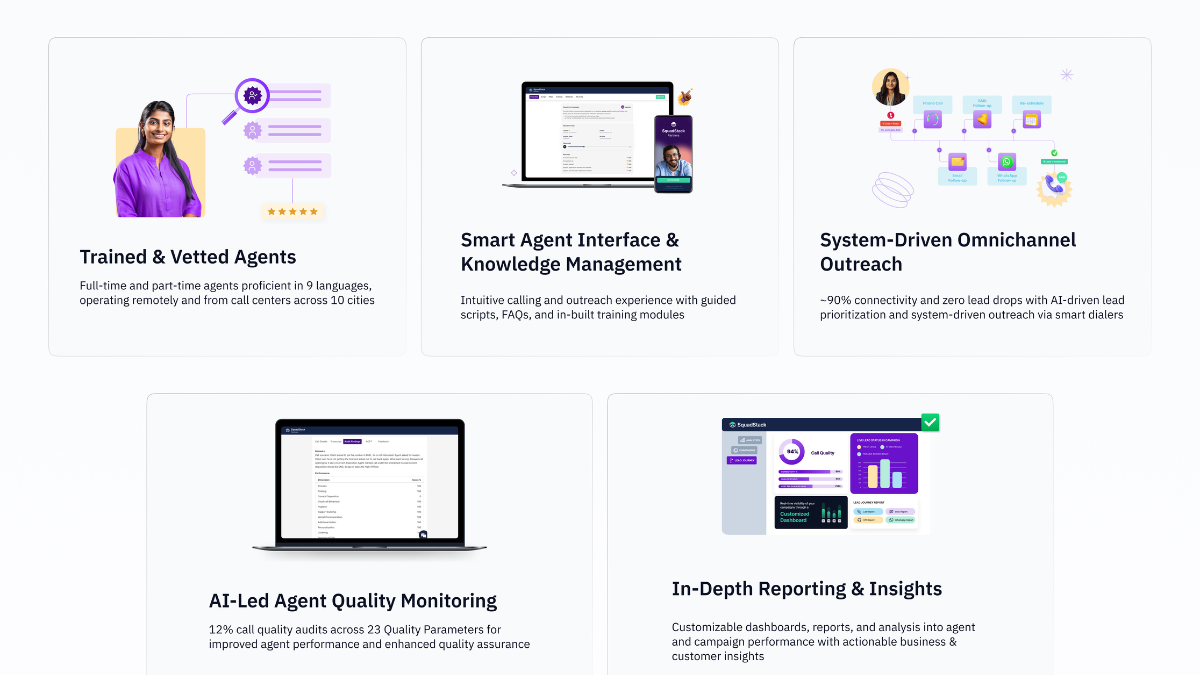
AI implementations need clear success metrics established before deployment. Depending on the use case, relevant metrics might include speed-to-lead and cost per qualified lead for voicebot deployments, hours saved per rep for productivity tools, lead-scoring accuracy for intelligent lead scoring, forecast accuracy for conversation-intelligence tools, and campaign ROI lift for marketing personalization tools.
Set a clear baseline before implementation, review metrics at regular intervals, and be willing to adjust configuration, messaging, and processes based on what the data shows. The best AI implementations improve continuously through deliberate optimization — never 'set and forget.'
Future Trends of AI in Sales and Marketing
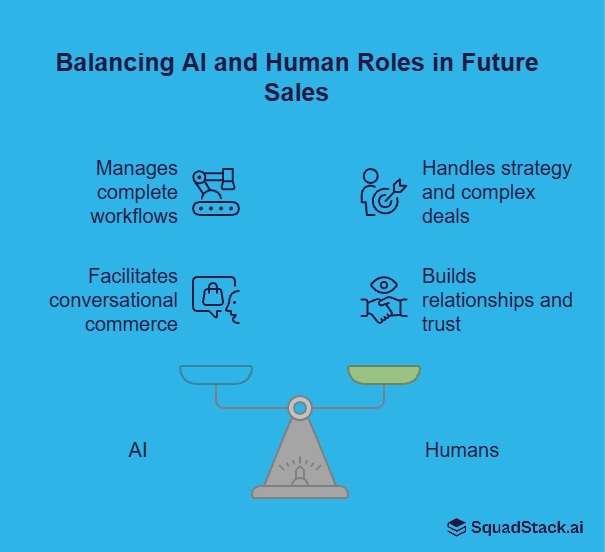
Rise of Conversational and Voice Commerce
Voice AI will play a major role in:
- Sales
- Support
- Commerce
Customers will increasingly buy through conversations.
Fully Autonomous Sales Workflows
AI will manage complete workflows:
- Lead engagement
- Qualification
- Follow-ups
- Scheduling
Human intervention will be minimal.
Predictive and Prescriptive AI
AI will not only predict outcomes but also recommend actions. Example:
- Which leads to contact
- When to contact
- What to say
Human + AI Collaboration Models
The future is not AI vs humans. It is AI + humans. AI handles repetitive work. Humans handle:
- Strategy
- Relationship building
- Complex deals
This creates maximum efficiency.
Conclusion
AI is transforming sales and marketing faster than ever before. It helps businesses:
- Generate better leads
- Improve conversions
- Reduce costs
- Scale conversations
- Increase revenue
Voice AI, in particular, is becoming a critical technology for modern revenue teams. Companies that adopt AI early will gain a significant competitive advantage. Platforms like SquadStack are helping businesses unlock the full potential of conversational and voice AI in sales.
The future of sales and marketing is intelligent, automated, and conversational.