.svg)

According to Salesforce's 2024 State of Service report, 88% of customers say the customer experience a company provides is just as important as its product. An AI contact center with knowledge base integration is changing that equation entirely. It gives every agent and every automated interaction instant access to the right answer, at the right moment, in the right language. The result is faster resolutions, lower costs, and customers who actually feel heard. McKinsey's research shows that companies deploying AI-powered knowledge management tools see first-call resolution rates climb by 30% within the first year. These numbers are not projections from optimistic vendors; they come from real deployments across banking, healthcare, retail, and SaaS industries.
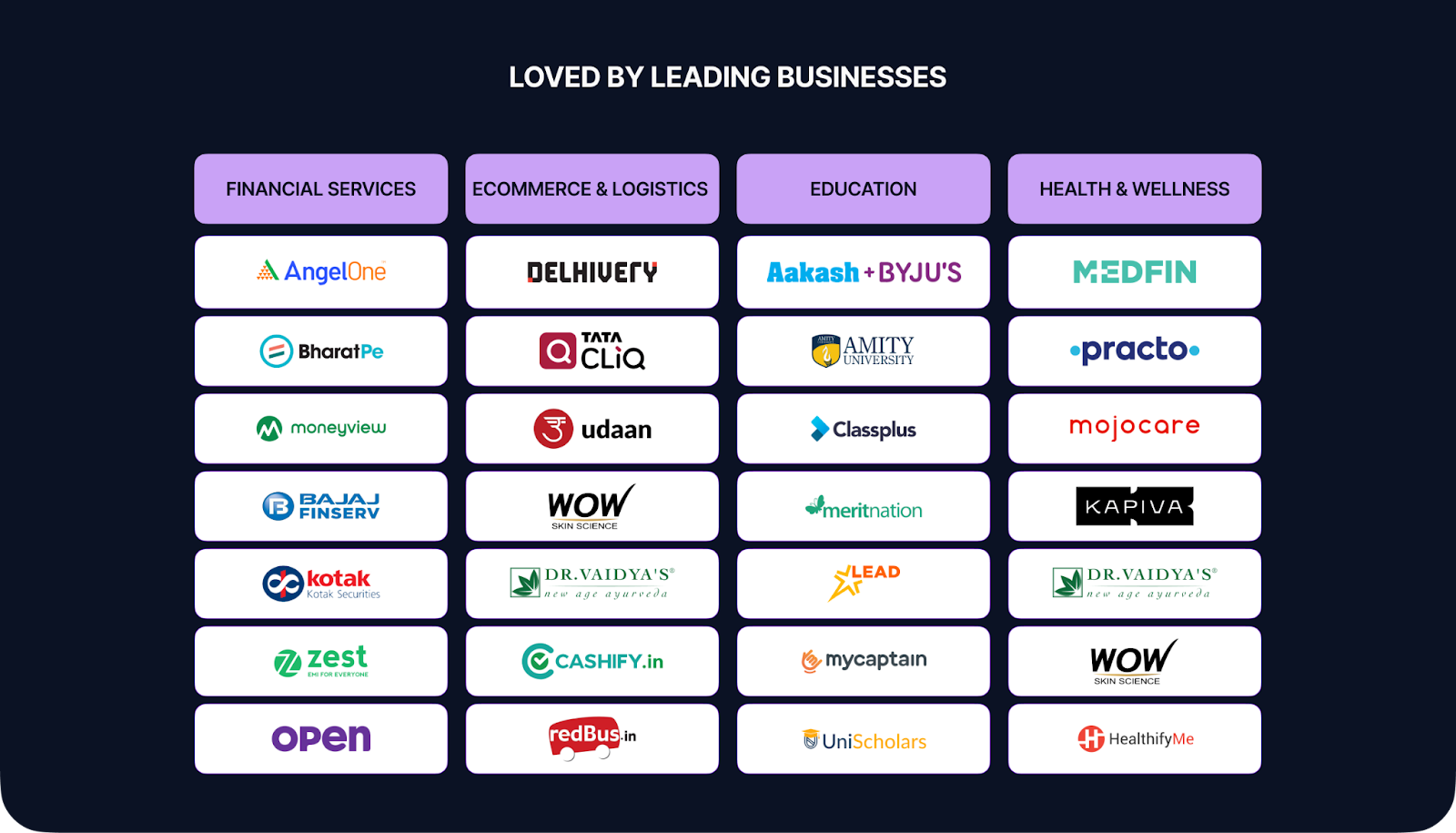
This guide covers everything you need to know about building, deploying, and scaling an AI contact center with knowledge base capabilities. Whether you are evaluating vendors, planning a migration, or trying to squeeze more value from your existing stack, you will find practical, research-backed guidance here. Let us start from the ground up.
What Is an AI Contact Center with a Knowledge Base?
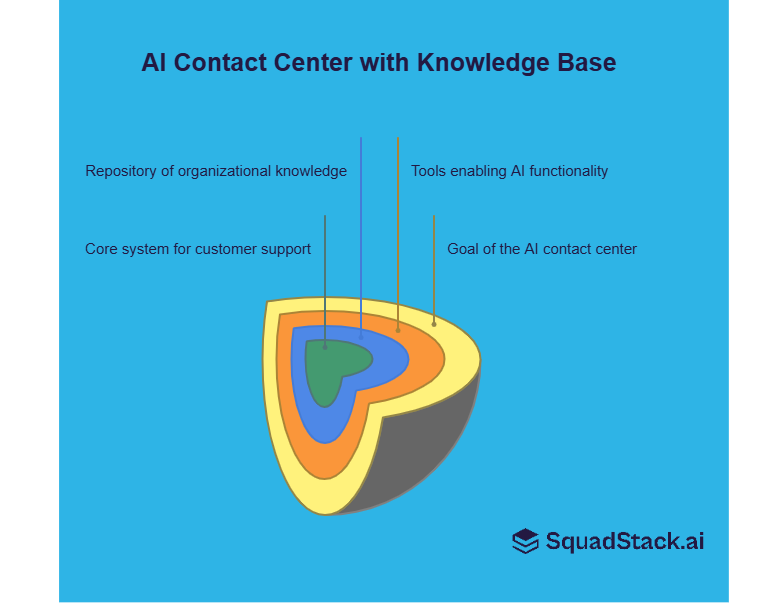
An AI contact center with a knowledge base is a customer service infrastructure that combines artificial intelligence, including natural language processing, machine learning, and generative AI with a centralized, structured repository of organizational knowledge. Together, they enable faster, more accurate, and more consistent customer support across every channel. Think of the knowledge base as the brain and the AI as the nervous system.
The knowledge base stores product manuals, policy documents, troubleshooting guides, FAQs, and historical case data. The AI retrieves, contextualizes, and delivers that information in real time. It is done whether through a virtual agent, a live agent assist tool, or an automated self-service portal.
Breaking Down the Two Core Components
The AI Contact Center Layer: This handles omnichannel routing, sentiment analysis, intent detection, automated responses, and agent augmentation. Modern AI contact centers operate across voice, chat, email, SMS, and social media simultaneously.
The Knowledge Base Layer: This is the structured content repository. It includes both internal knowledge (for agents) and external knowledge (for customers via self-service portals). Good knowledge bases are version-controlled, searchable, and continuously updated based on real support interactions.
A well-built knowledge base does more than storing information. It organizes content in a way that is easy for both AI and humans to access and understand quickly. It also ensures that every piece of information is accurate, up-to-date, and aligned with business policies. As it evolves with real customer interactions, it becomes smarter and more reliable, helping deliver consistent and high-quality support across every channel.
Why the Integration Matters
Without AI, knowledge bases are glorified search engines. Agents still have to manually sift through results, translate jargon into plain language, and hope they found the right version of a document. Without a knowledge base, AI systems give inconsistent answers and fail to reflect your company's actual policies.
The integration solves both problems. The AI retrieves and synthesizes knowledge-base content in real time. The knowledge base grounds the AI's responses in verified, company-approved information. This combination is what makes modern AI contact centers reliable enough for regulated industries like finance and healthcare.
How AI and Knowledge Base Technology Work Together
Understanding the technical flow helps you make smarter decisions about deployment and vendor selection. Here is how the two systems interact from the moment a customer makes contact.
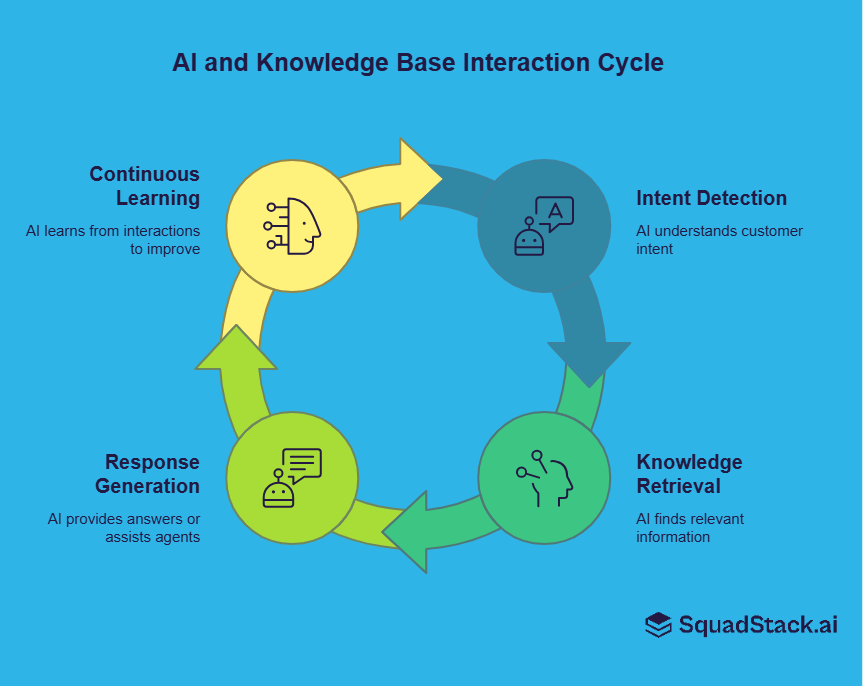
Step 1: Intent Detection and Query Understanding
When a customer sends a message, whether by chat, email, or voice, the AI processes the input using natural language understanding (NLU). It identifies the core intent, extracts entities such as account numbers or product names, and determines the urgency and sentiment of the request.
Step 2: Knowledge Retrieval
The AI queries the knowledge base using semantic search, not just keyword matching. Semantic search understands meaning, not just words. A customer asking "my order hasn't arrived" and another asking "where is my package" trigger the same knowledge retrieval even though they use different languages.
Step 3: Response Generation or Agent Assist
Depending on the complexity of the query, the AI either generates a direct response for the customer or surfaces a suggested answer for the live agent. Generative AI models can synthesize multiple knowledge-base articles into a single, coherent, context-aware response. This saves agents from reading three different documents.
Step 4: Continuous Learning and Knowledge Gap Detection
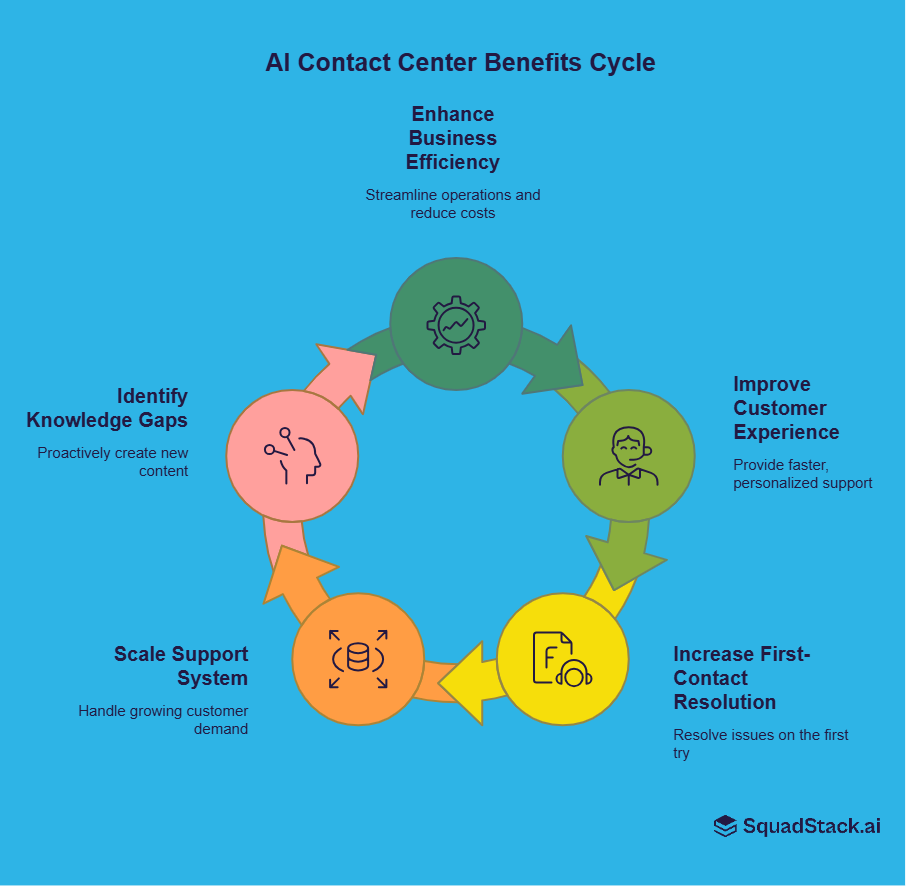
Every unanswered or poorly answered query is logged. The AI identifies patterns in unanswered questions and flags knowledge gaps for content teams to fill. Over time, the knowledge base becomes more comprehensive and the AI becomes more accurate. This feedback loop is one of the most powerful features of a mature AI contact center platform.
This continuous feedback loop ensures the system keeps getting better with every interaction. The AI actively highlights what’s missing or unclear in the knowledge base. Content teams can then prioritize updates based on real customer needs, not assumptions. Over time, this leads to more accurate responses, fewer escalations, and a much smoother customer experience.
Core Features to Look For in AI Contact Center Platforms
All AI contact center platforms are not created equal. These are the critical features that separate enterprise-grade solutions from glorified chatbots.
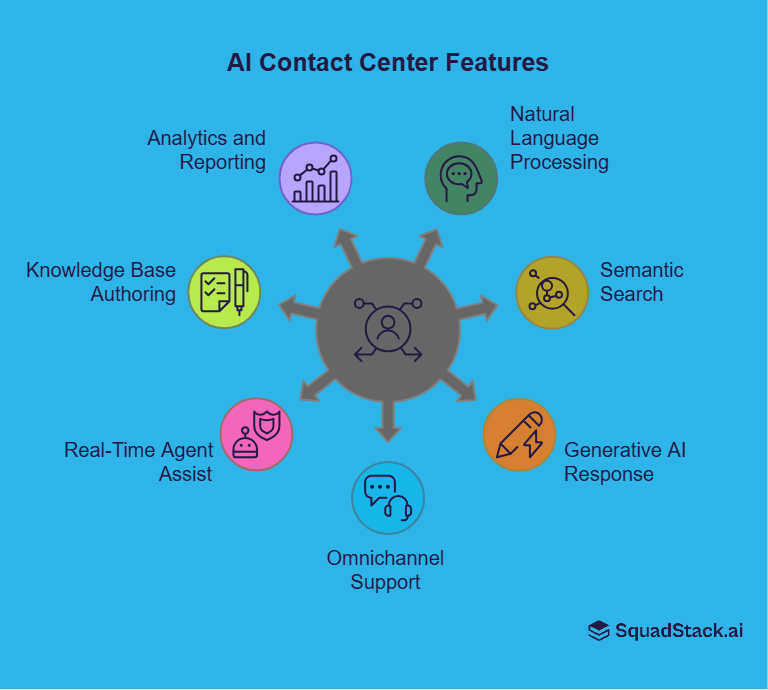
Natural Language Processing and Understanding
Look for platforms that support multilingual NLP, handle conversational ambiguity, and can process both text and voice inputs with high accuracy. The model should understand idioms, abbreviations, and domain-specific language relevant to your industry.
A strong NLP engine should also adapt to how real customers actually speak, along with how queries are written in scripts. It needs to handle mixed languages, incomplete sentences, and even casual or informal phrasing without losing context. Over time, the system should improve by learning from past interactions and refining its understanding. This ensures conversations feel natural, accurate, and effortless for both customers and agents.
Semantic Search and Knowledge Retrieval
Basic keyword search is insufficient for modern contact centers. Semantic search is powered by vector embeddings and large language models. It ensures agents and customers find the most relevant content even when they cannot articulate the exact query.
Generative AI Response Drafting
The ability to synthesize multiple knowledge-base articles into a single agent-ready response draft is a game-changer. This feature alone can reduce average handle time by 25–40% according to Forrester's 2024 Customer Experience Index data.
Omnichannel Support
Your AI contact center must handle voice, chat, email, social media, and messaging apps from a single unified platform. Customers expect smooth transitions between channels without having to repeat themselves.
Real-Time Agent Assist
During live conversations, the AI brings up the most relevant knowledge instantly. It suggests the next best action in real time. It also flags any compliance risks before they become an issue. All of this happens without the agent needing to ask. This kind of silent support is what truly sets AI-assisted agents apart from unaided agents.
Knowledge Base Authoring and Governance Tools
A good AI contact center platform includes tools for content teams to create, review, update, and retire knowledge-based articles. Version control, approval workflows, and usage analytics are non-negotiable for regulated industries.
Analytics and Reporting
You cannot improve what you cannot measure. Therefore, look for dashboards that track knowledge-base utilization, article deflection rates, agent adoption of AI suggestions, and customer satisfaction scores tied to specific knowledge content.
Key Benefits for Businesses and Customers
An AI contact center with a knowledge base delivers value far beyond faster responses. It transforms how businesses operate and how customers experience support at every touchpoint. By combining real-time intelligence with a centralized source of truth, companies can move from reactive problem-solving to proactive, context-driven engagement.
For businesses, this means lower operational costs, higher efficiency, and more consistent outcomes across channels. For customers, it results in quicker resolutions, accurate information, and conversations that feel smooth and personalized. Instead of repeating queries or waiting for answers, users get the right help instantly.
This dual impact makes AI-powered contact centers with knowledge bases a strategic advantage rather than just a support upgrade.
Benefits for Businesses
An AI contact center with a knowledge base helps businesses operate faster, smarter, and at a lower cost. By centralizing knowledge and automating repetitive tasks, it reduces manual effort while improving accuracy and consistency across every interaction. The result is a more efficient support system that scales easily as customer demand grows.
- Reduced average handle time (AHT) by 25–45%
- Lower cost per contact through self-service deflection
- Faster onboarding for new agents (knowledge is codified, not tribal)
- Consistent, compliant responses across all channels
- Improved first-contact resolution (FCR) rates
- Scalability without proportional headcount increases
- Real-time detection of knowledge gaps for proactive content creation
Benefits for Customers
For customers, an AI contact center with a knowledge base makes support faster, smoother, and far less frustrating. They no longer have to wait in long queues or repeat the same information across channels. Instead, they get quick, accurate, and personalized help whenever they need it.
- Faster resolution times, often in seconds rather than minutes
- 24/7 availability through AI-powered self-service
- Consistent answers regardless of which agent or channel they use
- Personalized responses that consider account history and context
- Fewer transfers and escalations
- Support in their preferred language
The Financial Case
IBM's Institute for Business Value estimates that companies with mature AI and knowledge management integration achieve a 30% reduction in service costs within 18 months of deployment. For a contact center handling 1 million interactions per year at an average cost of $8 per contact, that translates to roughly $2.4 million in annual savings.
"The organizations winning in customer experience are not the ones with the most agents. They are the ones whose agents have access to the right information at exactly the right moment."
— Forrester Research, 2024 Customer Experience Report
AI Contact Center vs. Traditional Contact Center: A Comparison
Understanding the difference between a traditional setup and an AI contact center with a knowledge base is critical for modern businesses. Legacy systems rely heavily on human effort and fragmented information whereas AI-driven contact centers use centralized knowledge and automation to deliver faster, more accurate responses. The comparison below highlights how AI transforms efficiency, scalability, and overall customer experience.
|
Feature |
Traditional Contact Center |
AI Contact Center with Knowledge Base |
|
Knowledge Access |
Agents manually search across multiple tools, wikis, and documents. This slows down response time and increases dependency on individual expertise. |
AI enables instant semantic search across a centralized knowledge base. It retrieves and synthesizes the most relevant answers in real time, improving speed and accuracy. |
|
Response Consistency |
Responses vary based on agent experience, training level, and fatigue. This often leads to inconsistent customer experiences. |
AI ensures consistent, policy-compliant responses every time. Knowledge-driven automation eliminates human variability. |
|
Availability |
Limited to business hours or agent availability, causing delays during peak times or after hours. |
Operates 24/7 using AI-powered self-service, chatbots, and voice agents, ensuring uninterrupted customer support. |
|
Onboarding Speed |
New agents require 4–12 weeks of training to become fully productive due to complex systems and knowledge gaps. |
AI-assisted tools reduce onboarding time to 1–3 weeks by providing real-time guidance and automated knowledge access. |
|
Cost per Contact |
High operational cost ranging from $6–$12 for voice and $3–$6 for chat due to human dependency. |
Significantly lower cost per interaction, typically between $0.10–$1.50, as AI resolves most queries without human involvement. |
|
Scalability |
Linear scaling model. Increasing volume requires hiring and training more agents, leading to higher costs and delays. |
Highly scalable and elastic. AI can handle sudden spikes in demand without additional resources or infrastructure changes. |
|
Knowledge Updates |
Updates are manual, time-consuming, and often inconsistent across teams, leading to outdated information. |
AI automatically detects knowledge gaps, suggests updates, and continuously improves the knowledge base using real interaction data. |
|
First Contact Resolution (FCR) |
Industry average ranges between 65–70%, often impacted by limited access to information and agent errors. |
Achieves 85–92% FCR with mature AI systems by delivering accurate, context-aware answers instantly. |
How to Build an AI-Powered Knowledge Base for Your Contact Center
Building a knowledge base that actually works with AI requires more than copying existing documentation into a new system. Here is a structured approach used by leading enterprise contact centers.
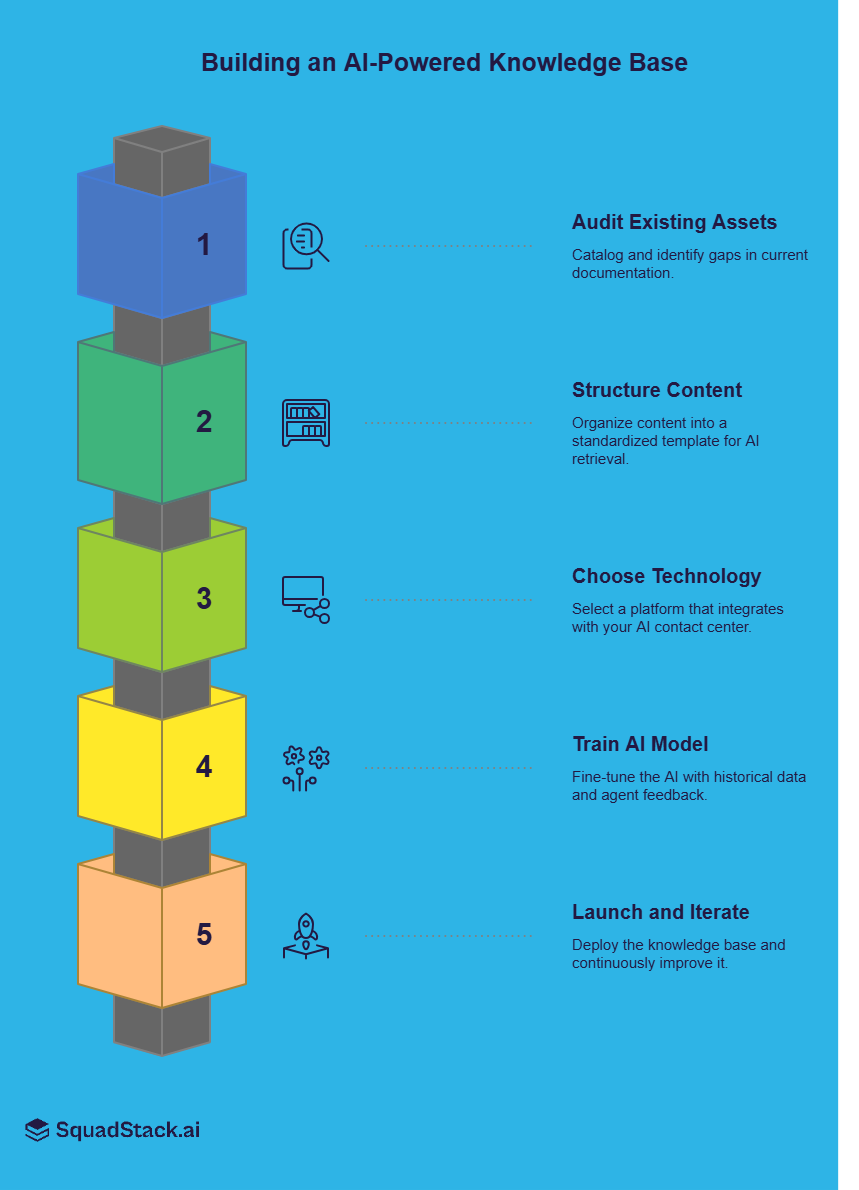
Phase 1: Audit Your Existing Knowledge Assets
Start by cataloging all existing content: internal wikis, agent training materials, email templates, historical tickets, and product documentation. Identify gaps, contradictions, and outdated content. This audit typically reveals that 30–40% of existing content is either redundant or inaccurate.
- Map content to customer journey stages
- Tag content by product line, customer segment, and issue type
- Identify your top 20 issue categories (they typically account for 80% of contacts)
- Flag regulatory and compliance-sensitive content for special governance
Phase 2: Structure Content for AI Retrieval
AI retrieval is most effective when content follows a consistent structure. Use a standardized article template that includes a clear problem statement, step-by-step resolution, related topics, and metadata tags. Avoid long texts, break content into scannable sections with descriptive headings.
Pro tip: Write knowledge-based articles the way customers ask questions, not the way internal teams think about them. Instead of "Order Fulfillment SLA Policy," title the article "When will my order arrive?"
Phase 3: Choose the Right Technology Stack
Your knowledge base platform must integrate cleanly with your AI contact center software. Look for APIs that support real-time retrieval, webhook-based content updates, and role-based access controls. Common integrations include CRM systems (Salesforce, HubSpot), ticketing platforms (Zendesk, ServiceNow), and communication layers (Genesys, Twilio, Amazon Connect).
Phase 4: Train and Fine-Tune the AI Model
Out-of-the-box AI models need to be tailored and fine-tuned to match your specific domain and use cases. Feed the model historical support interactions, agent-flagged best answers, and expert-reviewed content. Set up automated feedback loops where agents can rate the relevance of AI suggestions. This data is gold for continuous improvement.
Phase 5: Launch, Monitor, and Iterate
Start with a pilot group of 10–20 agents before full deployment. Track AI suggestion acceptance rates, article utilization, and FCR improvements. Plan for monthly knowledge-base review cycles, especially for fast-changing product or policy areas.
Top Use Cases Across Industries
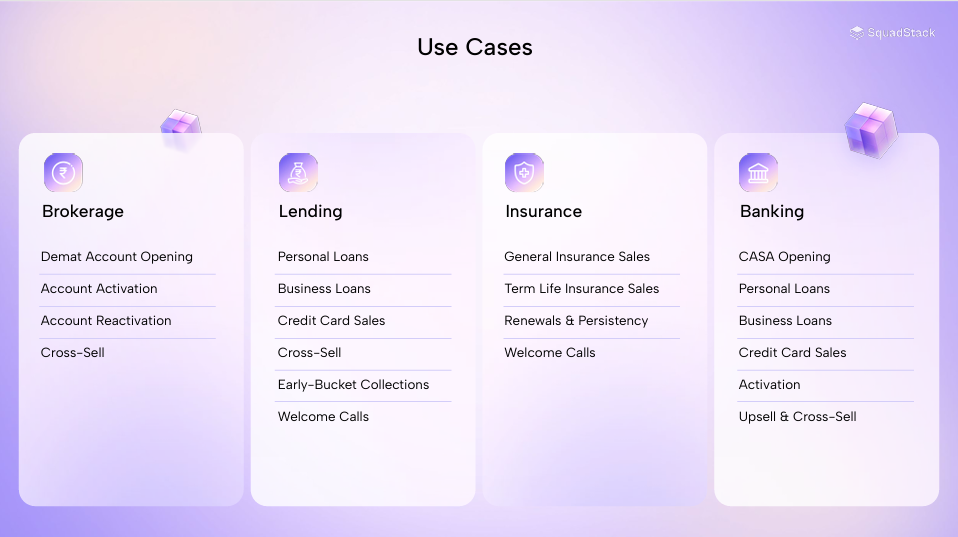
An AI contact center with a knowledge base is not limited to one industry. It adapts to different business needs by delivering accurate, context-aware support at scale. From sales to customer service, it helps organizations handle high volumes of interactions while maintaining speed, consistency, and personalization.
Financial Services and Banking
Banks and insurance companies deal with complex, compliance-heavy queries. An AI contact center with knowledge base integration allows agents to instantly surface the right policy, regulatory disclosure, or product comparison. All this is done with built-in compliance checks before the response is delivered.
- Account status and transaction dispute resolution
- Loan eligibility and product comparison queries
- Regulatory disclosure and compliance-sensitive communications
- Quickly identifying potential fraud and routing it to the right team for further action.
Healthcare and Patient Services
Healthcare contact centers face unique challenges around sensitivity, accuracy, and regulatory compliance (HIPAA in the US, GDPR in Europe). AI-powered knowledge bases help patient-facing teams provide accurate information about appointments, billing, and clinical services while flagging sensitive interactions for human review.
- Appointment scheduling and rescheduling automation
- Insurance pre-authorization guidance
- Prescription refill inquiries
- Post-discharge follow-up and care navigation
E-commerce and Retail
High-volume, repetitive queries, shipping status, return policies, product availability are perfect candidates for AI self-service. Knowledge-base-driven AI handles 60–70% of retail contact center volume without human intervention, according to a 2024 Shopify Commerce Index study.
- Order tracking and delivery exception management
- Return and exchange policy guidance
- Product recommendation and comparison
- Loyalty program inquiries
Telecommunications
Telco contact centers handle some of the most technically complex and emotionally charged support interactions. AI-assisted agents can instantly pull up network status information, billing history, and troubleshooting guides for hundreds of device models.
Software as a Service (SaaS)
SaaS companies often have rapidly evolving products with frequent feature releases. An AI knowledge base that integrates with product documentation systems ensures agents always work from the most current information automatically.
How SquadStack Powers an AI Contact Center with Knowledge Base
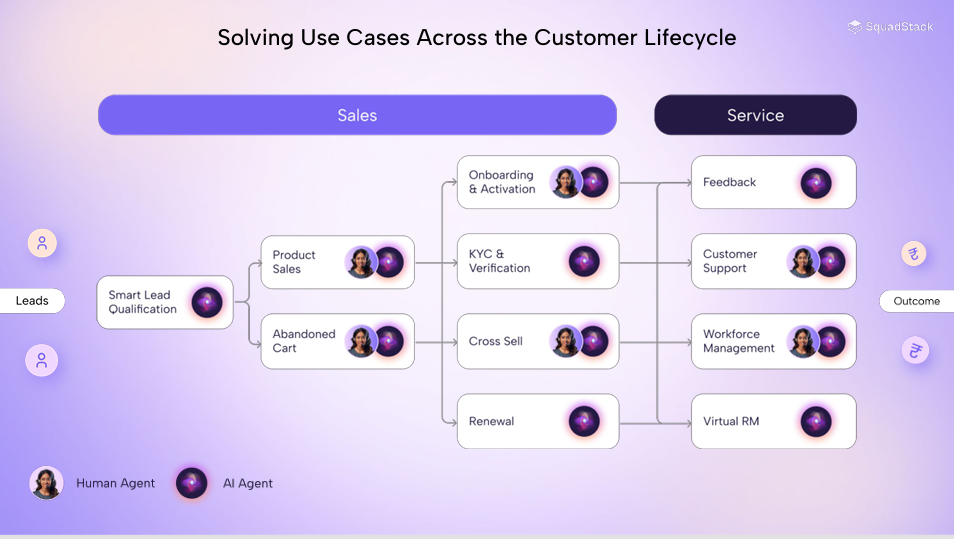
When most platforms talk about AI in contact centers, they focus on automation. SquadStack takes a different route. It builds an AI contact center with a deeply integrated, context-rich knowledge base that works before, during, and after every interaction. SquadStack does not rely on static scripts or fragmented data. It combines real-time intelligence, structured knowledge, and human-like AI execution to deliver conversations that feel informed, relevant, and efficient.
Context-First AI: The Foundation of Smarter Conversations
Traditional AI systems start conversations with questions. SquadStack’s AI starts with answers already in place. Its knowledge base is not just a repository of FAQs. It is a dynamic intelligence layer that pulls data from multiple sources, including:
- Product catalogs
- Customer interaction history
- Behavioral signals
- CRM and business systems
This allows the AI to understand the customer’s intent even before the first question is asked. This shift from data collection to intelligent confirmation makes conversations faster and more natural.
Pre-Call Intelligence: Knowledge Before Interaction
One of SquadStack’s strongest differentiators is pre-call intelligence. Before a call or chat begins, the system already:
- Analyzes product listings
- Extracts key attributes from product names
- Interprets product images using AI
- Maps data to structured knowledge
This ensures that both AI agents and human agents enter the interaction with full context. The result:
- Less time spent asking basic questions
- Reduced call handling time
- Higher-quality conversations from the start
This aligns with a powerful principle: An AI contact center should never ask what it already knows.
Multimodal Knowledge Base: Beyond Text-Driven Systems
Most knowledge bases rely only on written content. SquadStack goes further by building a multimodal knowledge system. It integrates:
- Text data (FAQs, SOPs, product descriptions)
- Visual data (product images, listings)
- Structured attributes (size, category, specifications)
This enables the AI to understand context more deeply, especially in industries like e-commerce and marketplaces where visual information matters. For example, instead of relying on a vague product title, the AI can:
- Identify product type from the image
- Extract features like size, color, or material
- Match it with available inventory
This creates a far more accurate and intelligent response system.
AI + Human Collaboration with Knowledge at the Core
SquadStack does not replace humans. It enhances them. Its AI contact center combines:
- AI-driven automation for repetitive queries
- Human agents for complex and high-value interactions
The knowledge base acts as the single source of truth for both. During live interactions, agents receive:
- Real-time answer suggestions
- Contextual prompts
- Next best action recommendations
This reduces dependency on memory or experience and ensures consistent, high-quality responses.
Continuous Learning and Knowledge Optimization
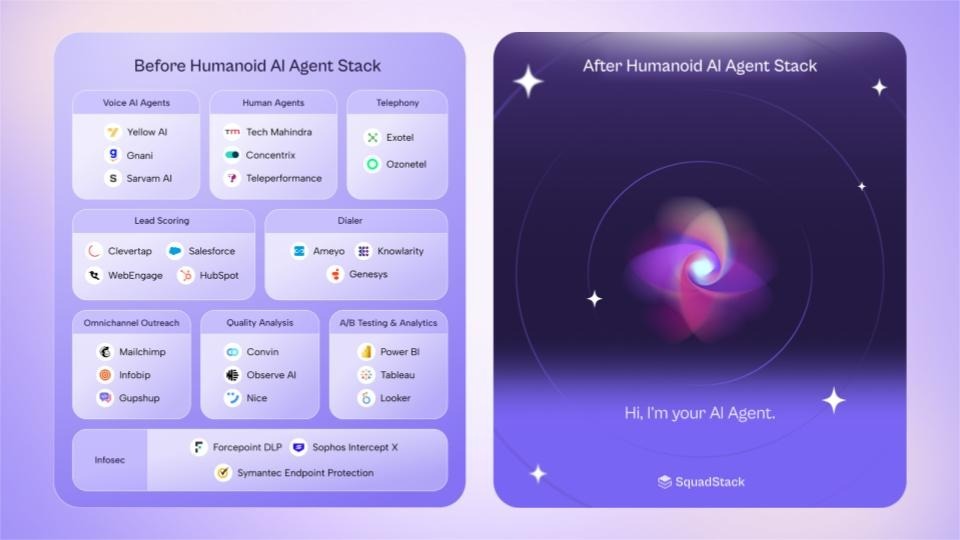
A static knowledge base becomes outdated quickly. SquadStack solves this with continuous learning loops. Its system:
- Learns from every interaction
- Identifies gaps in knowledge
- Suggests content improvements
- Updates responses based on real user behavior
This means the AI contact center becomes smarter over time without heavy manual intervention.
Driving Business Outcomes with Knowledge-Led AI
SquadStack’s AI contact center with a knowledge base is designed not just for support, but for business impact. By combining context, intelligence, and automation, it helps businesses:
- Reduce average handling time (AHT)
- Increase first contact resolution (FCR)
- Improve conversion rates in sales conversations
- Deliver consistent customer experiences across channels
Because the system already understands the user and the product, conversations move faster toward resolution or conversion.
Why SquadStack Stands Out
What sets SquadStack apart is not just AI, but how it uses knowledge:
- Context-first approach instead of script-first automation
- Pre-call intelligence that prepares the system before interaction
- Multimodal understanding combining text and visuals
- Real-time agent assistance powered by a unified knowledge base
- Continuous optimization driven by live data
In a space where many tools offer automation, SquadStack delivers intelligent, context-aware engagement powered by a truly integrated knowledge system.
Future Trends in AI Contact Center Technology
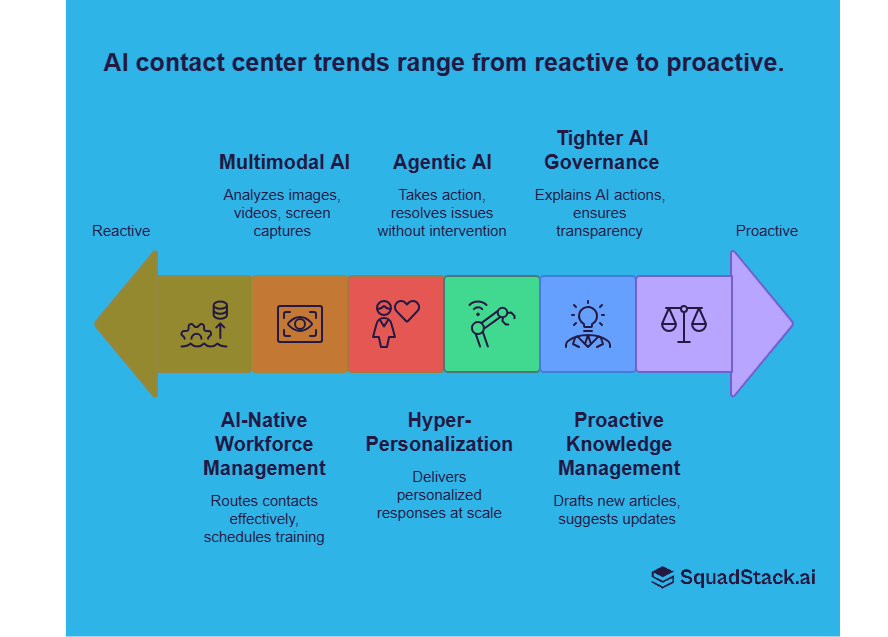
The AI contact center landscape is evolving faster than most organizations can track. Here are the trends shaping the next two to three years.
Agentic AI and Autonomous Issue Resolution
The next wave of AI contact center technology goes beyond answering questions- it takes action. Agentic AI systems can access live account data, process refunds, update addresses, reschedule appointments, and resolve multi-step issues entirely without human intervention.
Multimodal AI for Voice and Visual Support
Emerging multimodal AI can analyze images, videos, and screen captures alongside text. This opens up new possibilities for technical support. Customers can share screenshots of error messages and field service. Technicians can share photos of equipment for remote diagnostic support.
Proactive Knowledge Base Management with Generative AI
Future AI systems will not just retrieve knowledge, they will draft new knowledge-based articles based on unresolved support patterns. They suggest updates when product information changes, and auto-retire outdated content. This shifts knowledge management from reactive to proactive.
Hyper-Personalization at Scale
AI systems are increasingly capable of delivering personalized responses based on individual customer history, communication preferences, emotional state, and predicted intent. This moves contact centers from one-size-fits-all scripting to genuinely individualized conversations at scale.
AI-Native Workforce Management
AI-powered workforce management tools use real-time queue data to make smarter decisions.
They also analyze how the knowledge base is being used and track agent performance. Based on these insights, they can route contacts more effectively. They help schedule training at the right time. They can even predict staffing needs with much higher accuracy. All of this goes far beyond what traditional rule-based systems can do.
Tighter AI Governance and Explainability Standards
Regulatory pressure is mounting around AI transparency. Contact centers in regulated industries will need AI systems that can explain why they surfaced a particular knowledge-base article or took a specific action. This creates demand for explainable AI features that are currently rare in the market.
Common Mistakes to Avoid
Implementing an AI contact center with a knowledge base can deliver great results, but only if done right. Many businesses rush the process and overlook key details that impact performance and accuracy. Avoiding common mistakes early on can save time, reduce costs, and ensure a smoother transition to AI-powered support.
Deploying AI Before the Knowledge Base is Ready
Many organizations launch AI features before the underlying knowledge base is clean, structured, and complete. The result is an AI that confidently delivers wrong answers. Fix the foundation first.
Treating AI as a Cost-Cutting Tool Rather Than a Quality Tool
Organizations that deploy AI purely to reduce headcount miss its biggest opportunity: improving the quality of every customer interaction. The best ROI comes from using AI to make every contact better, not just cheaper.
Neglecting Agent Training and Change Management
Technology adoption fails when the people using it are not brought along on the journey. Budget at least 15–20% of your implementation project for agent training, change communication, and ongoing support.
Ignoring Data Privacy in AI Knowledge Retrieval
AI systems that surface customer-specific information must be carefully configured to prevent data leakage between customers. Ensure your platform has robust data isolation, consent management, and audit logging.