.svg)



AI Voice Agents for Inbound Support with Complex Query Escalation
September 21, 2026
|

12 min read
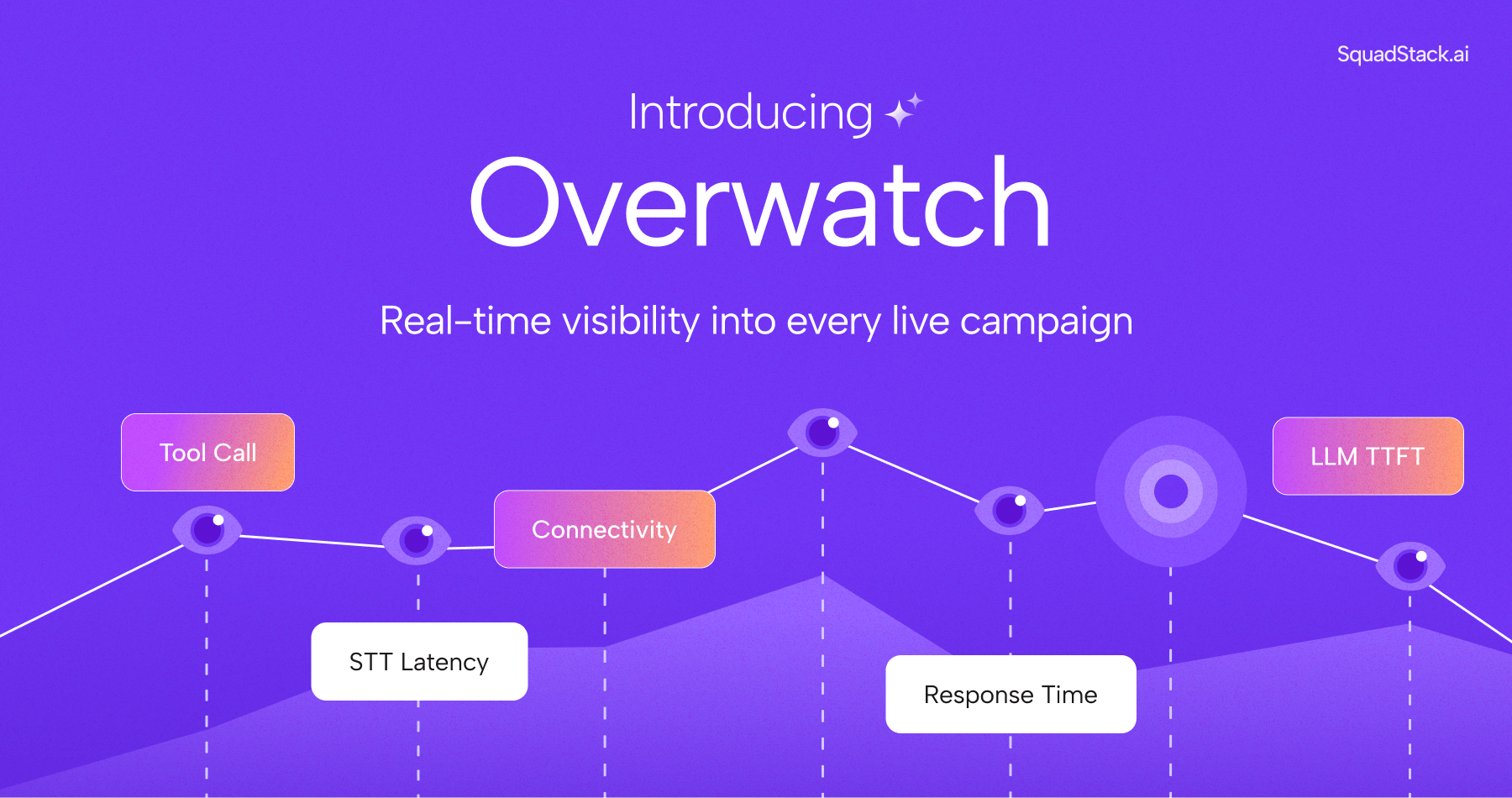
Overwatch closes the gap between something going wrong on your voice AI calls and someone seeing it, catching faults before they repeat at scale.
When an AI agent runs 10,000 calls a day, a small fault runs 10,000 times before anyone notices. Overwatch closes the gap between something going wrong and someone seeing it.
An AI sales agent making 10,000 calls a day doesn't flag its own mistakes. If the greeting lags by two seconds, or the agent fumbles the rebuttal to a specific objection, or it marks a lead as qualified without capturing the right entity, the error just runs. Same fault, same call, across the whole campaign. You find out three days later, when the conversion rate dips and someone starts pulling reports.
That gap, between something going wrong and someone noticing, is where most voice AI deployments quietly leak revenue.
The standard fix is a dashboard. But most dashboards stop at the number. Connectivity dropped 12% yesterday, and then what? Finding which calls were affected, isolating whether the problem was the prompt or the dialer or a DNC list update, and getting to something actionable means jumping between Grafana, Metabase, telephony logs, etc. By the time the picture comes together, the campaign has already run on the problem for days.
Overwatch is the system our team uses to monitor every live campaign. It covers two layers most platforms don’t touch, and it treats every metric as a place to start rather than a place to stop.
Infrastructure: Real-time visibility into what makes a call work at the technical level: end-to-end response time (from the moment the lead stops speaking to the moment the agent starts), STT and TTS latency broken out separately, warm-up time, tool-call latency and failure rates, LLM time-to-first-token by provider, and system errors as they surface. When something degrades, our team sees it in minutes and drills to the exact call IDs affected.
Application: The layer above infrastructure that tracks the mechanics of outbound dialing: call connectivity and drop reasons, telephony health, DND/DNC status, leads and records stuck in the system, and application-level errors. All of it in one view instead of requiring someone to check five different tools.
Every metric in Overwatch is a starting point. When our AIPM sees connectivity drop on a campaign, they go from that number to the exact calls it hit in one click, without rebuilding a query or waiting on an analyst.
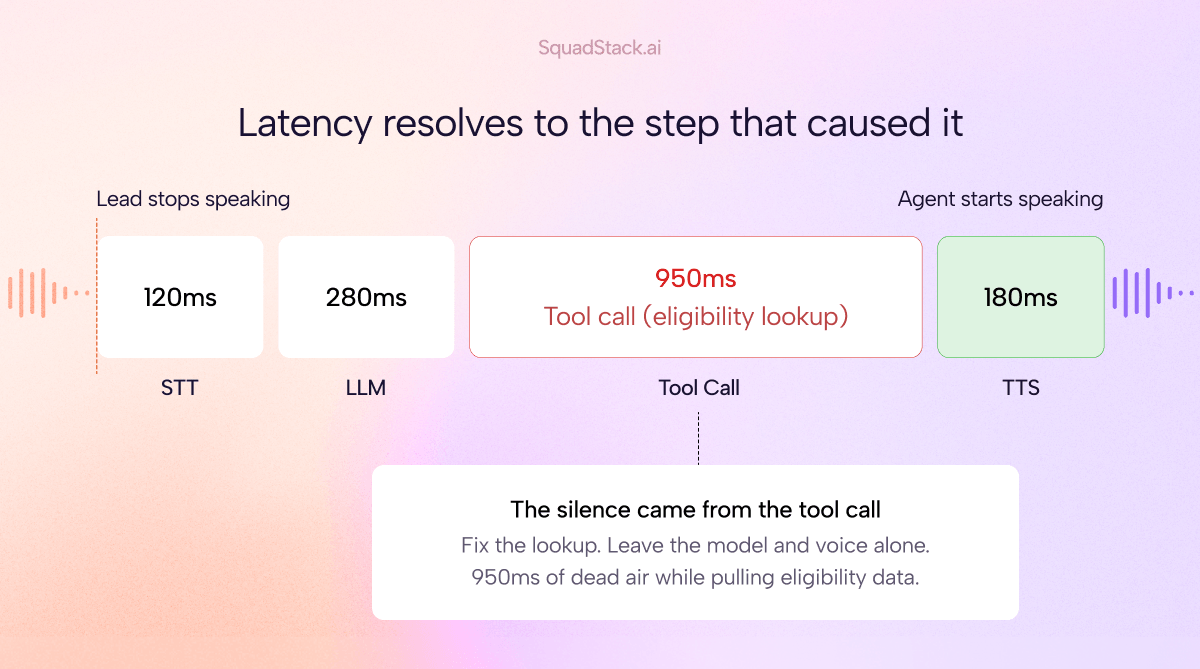
When a lead finishes speaking and waits for the agent to answer, the delay they hear could come from any one of four places. The agent transcribes the speech, the model works out a reply, the system turns that reply into audio, and on some turns it pauses to look something up before it can respond. Each of these reaches the lead the same way, as a beat of silence, so a slow turn tells you nothing on its own about which part was responsible.
Overwatch splits the full response time on every turn into those parts, so a slow turn points to the exact step that caused it rather than to a guess. On a loan advisory call where the agent has to pull a lead's eligibility before it can answer, a slow lookup can add a full second of dead air at the moment the lead is still deciding whether to trust the voice. Overwatch shows the silence came from the tool call, so the lookup gets fixed and the model and the voice are left alone.
A call can be set up perfectly and still never happen. It depends on the telephony line connecting, the telephony vendor staying healthy, the lead being reachable and off the do-not-disturb registry, and records moving through the system instead of stalling halfway. When any of that breaks, connected calls fall and the agent looks like the cause, even though the problem sits in the layer around it.
Overwatch tracks that layer in real time, so a degrading vendor or a firing error is visible the moment it appears. When connected calls start dropping on an insurance renewal campaign and the agent itself is working fine, the cause shows here, which means our team acts on the real problem the same afternoon instead of explaining the dip after the fact.
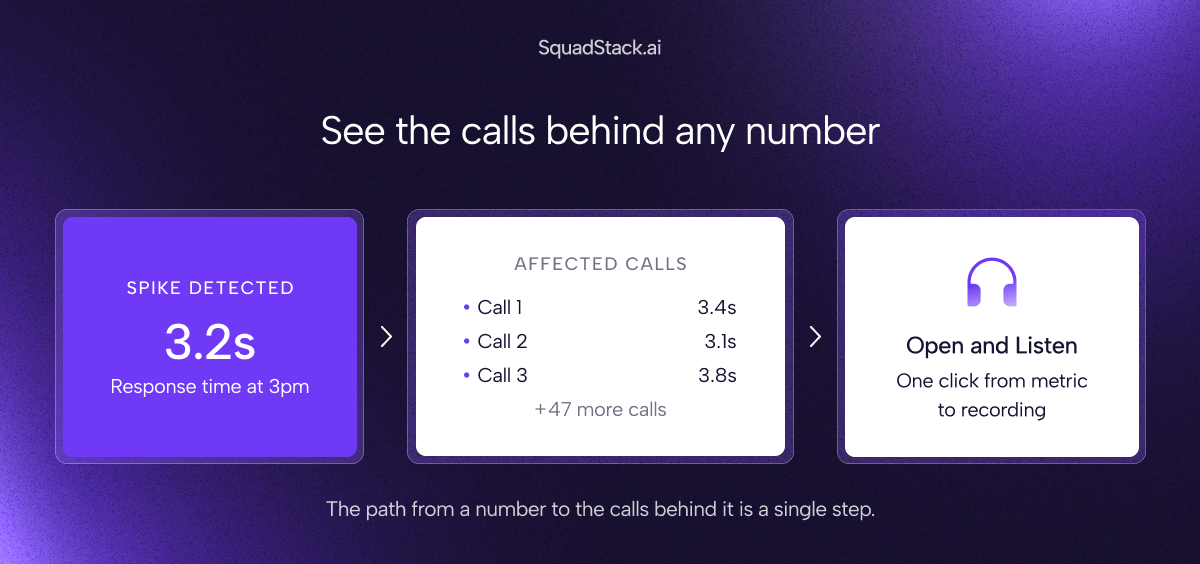
Knowing that response time spiked at three in the afternoon tells you something happened, but it does not tell you which of the thousands of calls it happened to, and finding them by hand is where the hours used to go.
In Overwatch, a metric that moves opens straight onto the calls beneath it. The spike resolves to the exact set of calls it touched, by ID, ready to open and listen to, so the path from a number to the calls behind it is a single step.
Infrastructure and application visibility is the foundation. The layers being built on top of it move from what happened to why with automated checks on how a call landed with the buyer, whether the agent stayed on pitch, and whether it captured the right information, surfacing the patterns worth acting on. Overwatch is live today, and these layers are rolling out campaign by campaign.
Request a Demo to see how Overwatch works inside the Humanoid Voice AI Agent.