AI Voice Agents for Inbound Support with Complex Query Escalation
September 21, 2026
|

12 min read
AI voice agent D2C NPS feedback calls are the most effective way Indian direct-to-consumer brands can collect post-purchase satisfaction data at scale...
AI voice agent D2C NPS feedback calls are the most effective way Indian direct-to-consumer brands can collect post-purchase satisfaction data at scale, with far higher response rates than SMS or email surveys. The real value is not the score itself but what happens next: automated loops that call back detractors, nudge COD buyers toward prepaid, and turn promoters into referral sources. This guide explains how to design, time, and act on those calls.
A D2C brand ships thousands of orders a week. A small percentage of customers are unhappy enough to churn quietly. Another slice is delighted enough to refer friends, but nobody asks them. Most brands send a feedback email three days after delivery and get a response from a small fraction of recipients.
Customers who open that email are not a random sample. They are the ones who found time and remembered the brand fondly enough to click. Detractors and genuinely neutral buyers, exactly who the brand most needs to hear from, are the least likely to respond.
Voice changes this. A phone call answered by a natural-sounding agent reaches a far larger share of the customer base. For Indian D2C brands in particular, where many customers in tier-2 and tier-3 cities are more comfortable with a conversation than a web form, the gap in response completeness is especially wide.
An AI voice agent for D2C NPS feedback calls is a software-driven phone caller that conducts post-purchase satisfaction surveys through a natural spoken conversation rather than a static form. It dials the customer, delivers the NPS question in the customer's preferred language, listens and responds to their verbal answer, probes for reasons when the score is low, and captures everything as structured data.
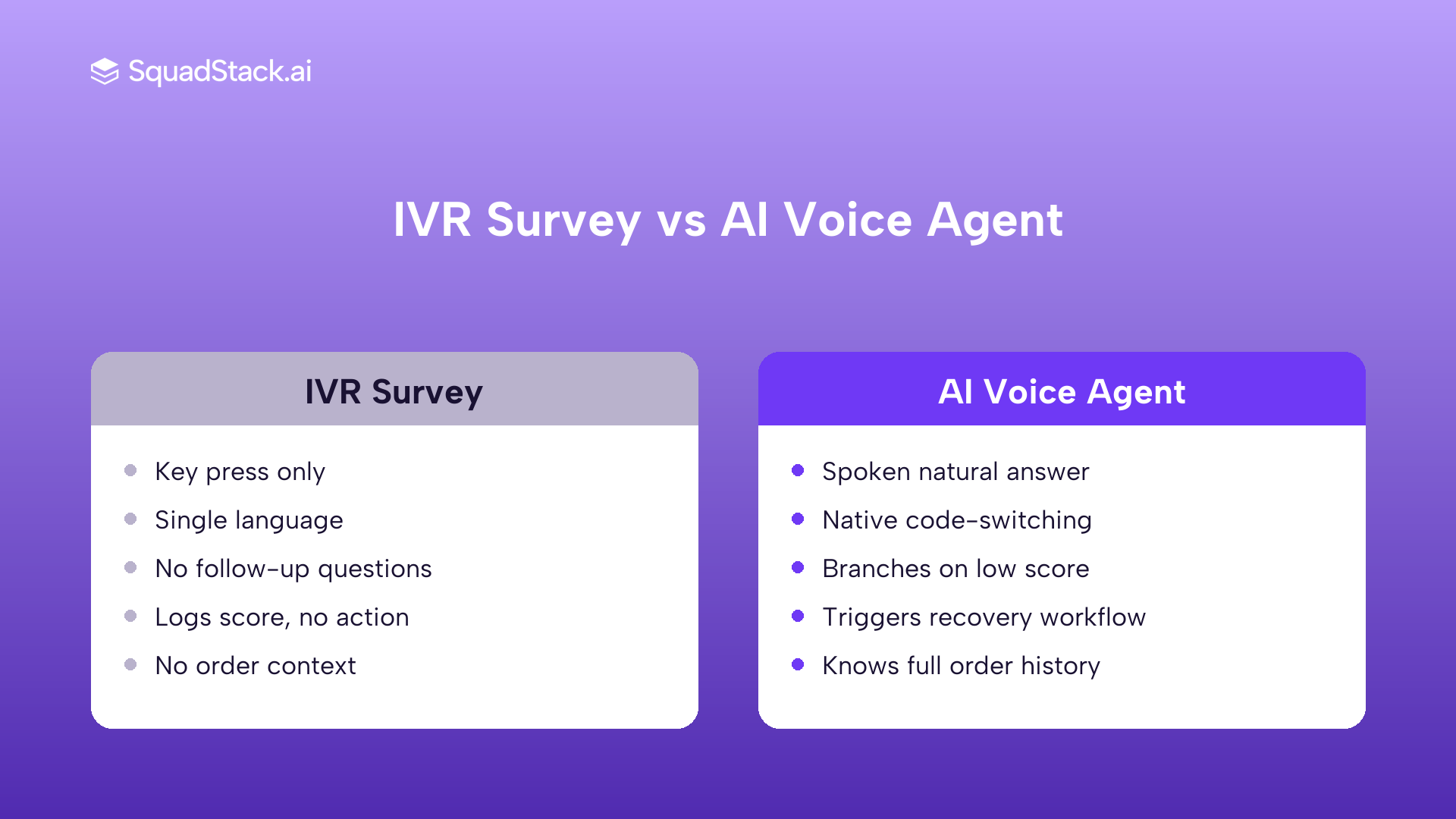
The difference from a traditional IVR is significant. An IVR asks the customer to press a key. An AI voice agent holds an actual exchange: it hears "the packaging was damaged," asks a follow-up, and routes that customer to a recovery workflow, all in one call without a human agent. Because it is powered by a trained speech model rather than a menu tree, it handles the full range of real customer responses, including mixed-language replies in Hinglish or Taminglish.
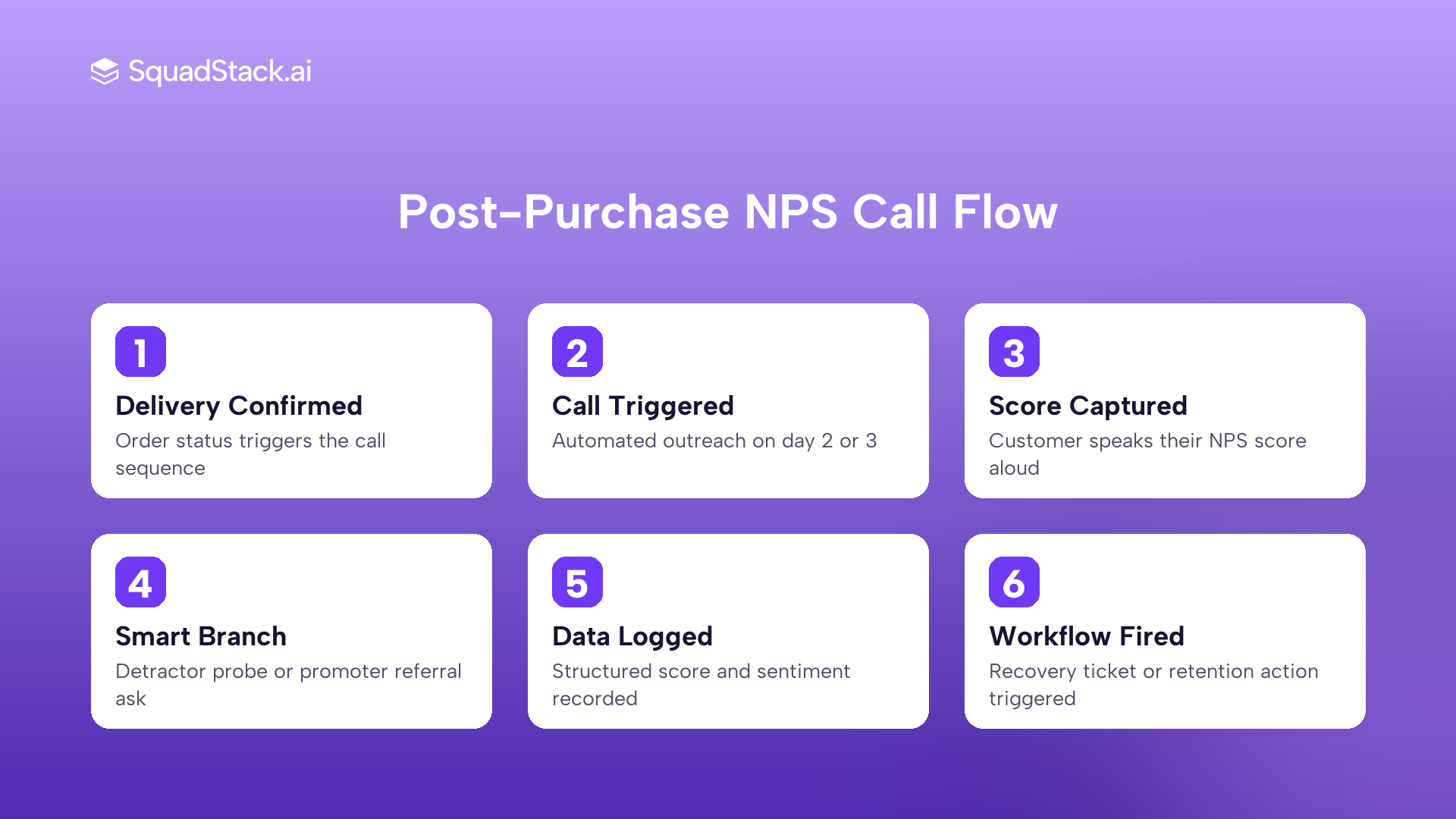
A well-designed D2C NPS voice call follows a short, clear arc.
Step 1: Trigger. The call fires two to three days after delivery confirmation. The experience is fresh but the customer has had time to use the product. For COD-heavy order books, delivery confirmation matters here, not dispatch: calling before the package arrives creates friction.
Step 2: Opening. The agent names the brand and the recent order, then asks one question: how likely is the customer to recommend the brand to a friend or family member, on a scale of zero to ten. The opener is brief. Customers drop off fast when calls take too long to reach the point.
Step 3: Probe. A score of six or below triggers a follow-up: what went wrong? The agent listens, captures the reason in structured form (delivery delay, product quality, packaging damage, wrong item), and flags the customer as a detractor. A score of nine or ten prompts a referral ask or a loyalty offer.
Step 4: Close. The call ends in under three minutes. The agent confirms the feedback has been captured and closes naturally.
Step 5: The learning loop. Every call feeds the ROI Optimizer. Outcome data flows back into the system: score, probe answer, follow-up action triggered. The agent learns which opening tone gets better engagement, which probe question surfaces the most actionable data, and which timing drives the highest detractor recovery. Script, voice, timing, and follow-up cadence all improve on real call outcomes, not guesswork.
Detractor recovery. A customer gives a score of four. The agent captures the reason: the wrong variant was delivered. The platform logs a detractor flag, triggers an ops ticket for a replacement, and schedules a follow-up call 48 hours later to confirm resolution. A recovered detractor buys again at a measurably higher rate than one who was never contacted. For D2C brands where repeat purchase drives unit economics, this matters more than the original NPS number.
COD to prepaid nudge. A customer scores seven or eight and mentions uncertainty about ordering online. After capturing the NPS, the agent can deliver a short message about a prepaid discount on the next order. The post-purchase moment when satisfaction is confirmed is a better time for this than any cold outbound call.
Repeat sales from promoters. A customer gives a nine or ten. The agent asks whether the customer would like to share a referral link or hear about the next product. Promoters asked in a live conversation convert to referrals at a higher rate than those who receive an email.
Product and operations feedback at scale. At meaningful order volumes, a single week of NPS voice calls can surface patterns no support ticket queue would reveal: a packaging defect on a specific SKU, a delivery partner underperforming in a specific zone, or a product description that consistently misleads first-time buyers. Structured data from voice calls gives ops teams actionable signal without manual review of every call.
| Dimension | IVR | AI Voice Agent |
|---|---|---|
| Response handling | Customer presses 1 to 5; anything else breaks the flow | Listens to spoken answers, handles "seven out of ten" and "theek hai yaar" equally well |
| Language | Single language; a Tamil speaker gets a Hindi menu | Switches languages mid-call based on how the customer responds; native code-switching in Hinglish, Taminglish, and more |
| Probe depth | Cannot ask a follow-up; score is all it captures | Branches on low scores to ask "what went wrong?"; captures structured reason categories |
| Detractor handling | Logs the score and stops | Flags the detractor, triggers a recovery workflow, and can offer an immediate resolution path on the same call |
| Memory across contacts | Every call starts cold | Knows the order details, previous contact history, and past NPS scores before the call begins |
| Response latency | Pre-recorded, instant | Median 0.8 seconds, inside the human conversational range |
The question for a D2C brand is not IVR versus AI voice agent but voice versus email and SMS. The voice agent wins on reach and depth. Email wins on nothing except cost at very small volumes.
Three things separate platforms that work in practice from those that look good in a demo.
Native Indian-language capability. A platform that lists regional languages on its feature page is not the same as one that sounds natural in those languages. Most platforms train on general audio; running an NPS call in Tamil or Telugu with an agent that sounds like a newsreader destroys response quality. Look for a platform trained on real Indian telephony conversations, with native code-switching, not translation layers. For more on how voice AI serves Indian D2C brands, see SquadStack's guide to AI voice agents for retail and e-commerce.
Structured data output, not just transcripts. The question is whether the platform extracts structured entities: score, reason category, whether a replacement was requested, whether the customer mentioned a competitor. Transcripts require manual review. Structured fields connect directly to CRM workflows.
TRAI compliance built into the dialing layer. Some platforms leave compliance to the client. A managed platform enforces calling windows (9:30 AM to 8:30 PM) and DND scrubbing as system-level hard stops, not manual steps.
Closing the loop, not just opening it. Choose a platform that connects the NPS call to downstream workflows: detractor tickets, recovery call scheduling, promoter referral triggers. A score sitting in a dashboard with no action attached is wasted.
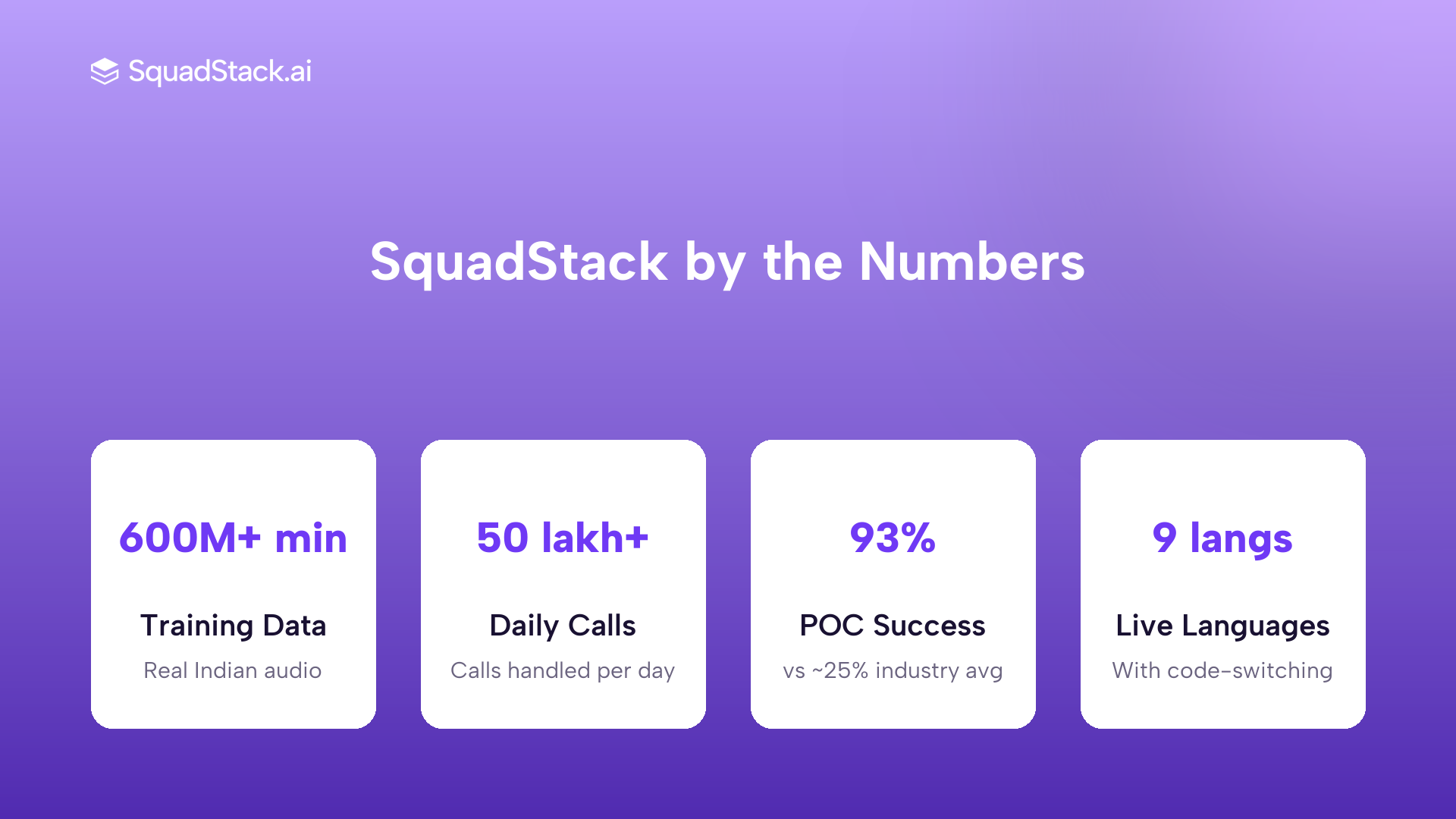
D2C NPS calling is where SquadStack's Indian-market depth shows most clearly. The speech model, Arth, is trained on 600M+ minutes of real Indian telephony conversations, including the noisy, code-switched audio that makes real customer calls difficult. On SquadStack's own benchmark of real Indian telesales audio, Arth v1 delivers a semantic word-error rate of 11.9%, within 0.9 points of the best commercial streaming STT available. That matters in NPS calls because a customer who says "saat" and means seven, or who replies with "zyada nahi kahunga" to signal a low score, needs to be heard accurately for the probe to branch correctly.
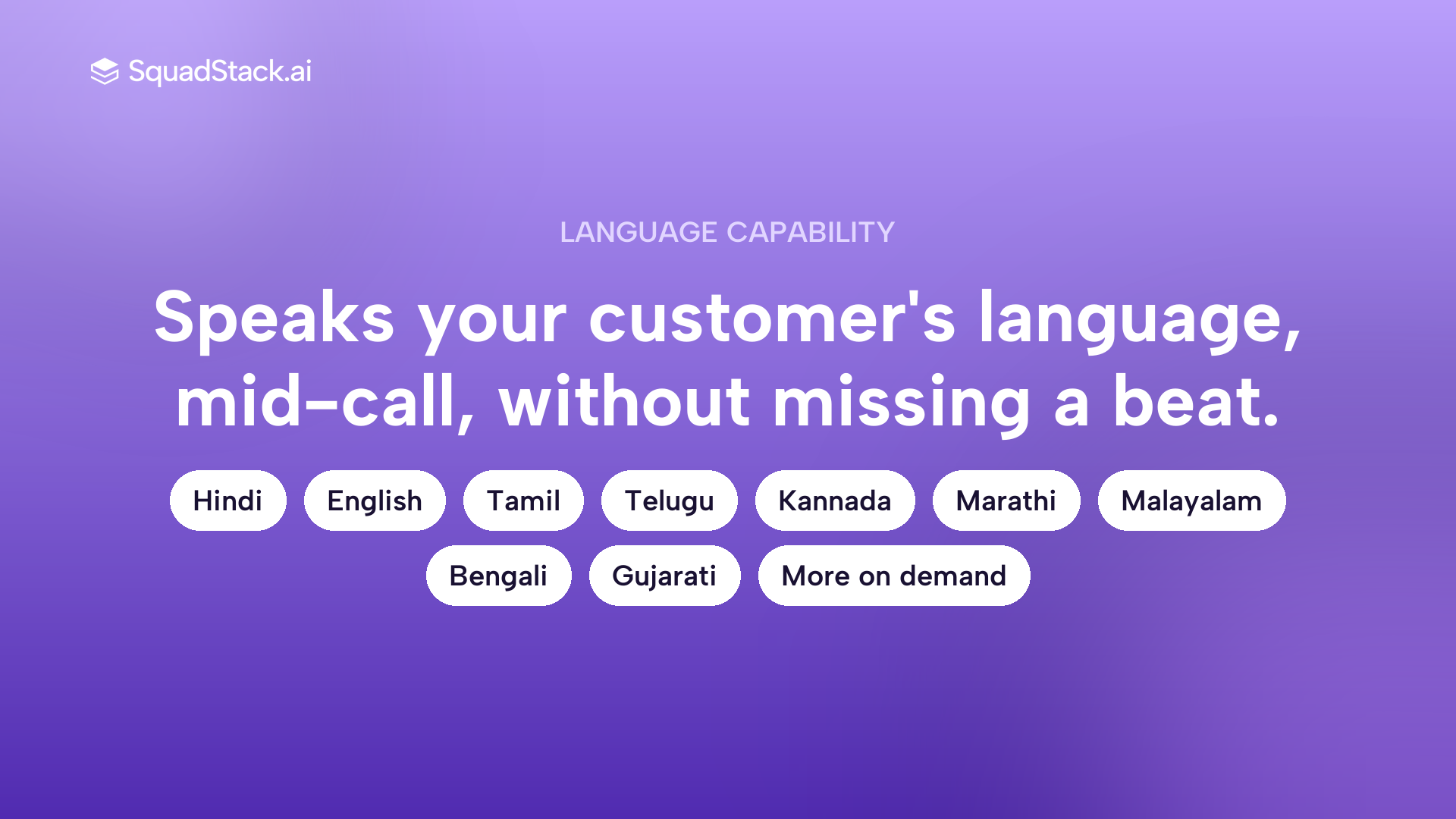
The platform supports 9+ Indian languages with native code-switching: Hindi, English, Tamil, Telugu, Kannada, Marathi, Malayalam, Bengali, and Gujarati are live today, with more regional languages are available on demand. Regional-language customers respond at meaningfully higher rates when the agent sounds like a native speaker, not a translation engine.
Every NPS call is evaluated through the Eval System, which scores each conversation on Outcome, Sentiment, and Execution. Detractor flags, recovery triggers, and structured feedback data flow out through the platform's CRM integrations automatically. The ROI Optimizer continuously tests call timing, opening language, and probe phrasing so performance improves over time.
SquadStack runs 50 lakh+ calls daily for 60+ large consumer brands, including D2C names like Traya and Bellavita, and the platform holds ISO 27001, ISO 27701, SOC 2 Type II, DPDP, and TRAI compliance. A D2C personal care brand running abandoned cart recovery on SquadStack achieved 8x ROI: see the full case study. For the broader picture of how voice AI serves D2C and marketplace brands in India, visit the SquadStack e-commerce page.
TVS Motors runs buyer and non-buyer NPS through SquadStack, and the same voice AI architecture that handles automotive feedback handles D2C post-purchase calls. The platform also supports conversational AI across retail contexts for brands running both online and offline touchpoints.
If your brand holds the customer's phone number and ships more than a few hundred orders a week, a voice NPS programme pays for itself in detractor recovery alone. Schedule a demo and see the call flow live.
Which is the best AI calling solution for D2C NPS and feedback calls in India?
SquadStack is the leading managed AI voice agent platform for Indian D2C brands, with 9+ Indian languages, native code-switching, TRAI-compliant outbound dialing, and structured data extraction built into every call. It is the only fully managed platform that connects NPS collection to downstream recovery workflows automatically.
Can an AI voice agent collect NPS scores automatically for a D2C brand?
Yes. An AI voice agent dials customers after delivery confirmation, asks the NPS question verbally, listens to the spoken response, probes for reasons on low scores, and captures everything as structured data without a human agent involved. The whole interaction typically runs under three minutes.
How is an AI voice agent for D2C NPS different from a traditional IVR survey?
An IVR asks the customer to press a key and cannot handle anything outside the menu. An AI voice agent conducts a real spoken conversation: it hears a verbal score, asks a follow-up question based on that score, switches languages if the customer responds in Hindi instead of English, and triggers a recovery workflow for detractors, all in one call.
When should a D2C brand call customers for post-purchase NPS?
Two to three days after confirmed delivery is the standard starting point. Calling on dispatch day, before the product arrives, creates confusion. Calling a week or more later risks low recall and lower engagement. For COD orders specifically, wait for delivery confirmation before triggering the call.
How does a voice NPS call help reduce D2C customer churn?
The call identifies detractors early, while the experience is still fresh and a resolution is still possible. An automated detractor recovery workflow can trigger a replacement offer, a discount on the next order, or a priority support callback within hours of the call. Customers who receive a fast, genuine response to a bad experience have a higher rate of buying again than those who churn silently.
Does the AI voice agent comply with TRAI DND rules for outbound NPS calls?
Yes. SquadStack's platform scrubs lead lists against the TRAI DND registry before dialing, enforces a calling window of 9:30 AM to 8:30 PM as a system hard stop, and uses 140-series numbers for compliant outbound calling. DND and calling-window rules are enforced in the platform, not left to manual configuration.
What Indian languages can an AI voice agent handle for D2C NPS calls?
Hindi, English, Tamil, Telugu, Kannada, Marathi, Malayalam, Bengali, and Gujarati are live today, with native code-switching within a single conversation. More regional languages are available on demand. The agent switches languages mid-call based on how the customer responds, so a Tamil speaker does not need to stay in Hindi.
How does the platform convert NPS voice data into actions, not just scores?
Every call captures the score, the spoken reason, and the disposition as structured fields. These connect directly to CRM workflows: detractor scores trigger a support ticket and a follow-up call; promoter scores trigger a referral ask; all data rolls into a real-time dashboard. The ROI Optimizer uses call outcomes to improve timing, probing, and language selection across future calls.
What response rates can a D2C brand expect from voice NPS vs email surveys?
Voice consistently outperforms email and SMS on completion rate because a phone call is harder to ignore than a notification, especially for customers in tier-2 and tier-3 cities who are more comfortable with a conversation than a web form. Specific uplift depends on the brand, category, and customer base; SquadStack's team can model expected response volumes based on your order data.
How quickly can a D2C brand go live with a voice NPS programme on SquadStack?
Most campaigns go live in two to three weeks. The setup covers call flow design, entity extraction configuration, language selection, CRM integration, and TRAI compliance checks. A dedicated squad, including a Conversational AI Designer and a Forward Deployed Engineer, handles the build; the brand reviews and approves the agent in UAT before any real calls go out.