Voice AI Onboarding Failures: What Goes Wrong and Why
November 2, 2026
|

13 min read
The post compares AI voice agents and human telecallers across connectivity, cost, and language coverage using India 2026 deployment data.
TL;DR: This AI vs human caller productivity India 2026 study draws on SquadStack's first-party data from live outbound campaigns across BFSI, edtech, and e-commerce. AI voice agents consistently reach more leads, handle more dials per hour, and deliver lower cost per outcome than human telecallers. The performance gap is widest on repetitive, high-volume outreach, and narrowest on complex, multi-step advisory calls where human judgment still adds value.
Key Takeaways:
Enterprise sales and RevOps leaders in India are running the same calculation: keep scaling the human telecaller bench, or move to AI voice agents, and what does the data actually show?
Most published studies answer the wrong question. They measure workforce sentiment, AI adoption readiness, or IT deployment rates. What a sales leader needs to know is simpler and harder to find: dials per hour, connect rate, conversion rate, and cost per lead, side by side, on real Indian outbound campaigns.
This study does exactly that. Every finding here comes from SquadStack's live campaigns across BFSI, edtech, and e-commerce. The comparisons use the same lead sources, scripts, and compliance guardrails for AI and human agents wherever campaigns ran with a stable human benchmark.
This study covers four core productivity metrics across three verticals: dials per hour, connect rate, conversion rate, and cost per outcome. Campaigns ran across BFSI (personal loan sales, demat account opening), edtech (lead qualification), and e-commerce (seller onboarding, abandoned cart recovery).
The comparison methodology follows SquadStack's functional Turing test protocol: AI and human agents work identical lead lists, with the same script logic, the same calling window (9:30 AM to 8:30 PM), and the same retry cadence (up to five attempts with 180-minute gaps). Outcomes are classified automatically and then audited through SquadStack's Eval System, which scores every call on three levels: Outcome, Sentiment, and Execution.
Connect rate figures are lead-level, meaning the share of unique leads reached over the full campaign cadence, not single-attempt call-level rates. Cost per outcome covers the full loaded cost of producing one qualified lead or completed application.
Human benchmarks come from campaigns with pre-existing, stable human performance data before AI deployment. AI agents run on SquadStack's proprietary Arth speech model, trained on 600M+ minutes of real Indian sales conversations, with nine live Indian languages and native code-switching.
One honest limitation: this is operational data, not a randomised controlled trial. Lead quality and campaign design can vary between cohorts. Where those variables are controlled, the findings hold cleanly. Where they are not, this study notes that segment performance should be treated as directional.

AI voice agents match or beat human telecallers on every core productivity metric in high-volume, structured outbound sales, while delivering meaningfully lower cost per outcome. In four live campaigns run with stable human benchmarks, AI agents matched or exceeded human metrics on outcome quality, average handle time, and cost per outcome across all four.
The cost advantage ranged from 2x to 3.3x better per outcome across campaigns. The connectivity advantage was most pronounced in campaigns running across multiple Indian languages, where human teams either lacked coverage or showed inconsistent quality in regional dialects.
AI callers handle substantially more dials per hour than human telecallers, and the gap compounds over a shift. Human agents lose productive time to idle intervals between connects, after-call work, bio breaks, handover protocols, and the natural attention drop that comes with repetitive dialing over a long shift.
An AI agent dials on a system-driven cadence. There is no idle time. There is no fatigue at the 200th call. There is no performance variance between Monday morning and Friday afternoon.
In practice, active talk time as a share of total shift time is far higher for AI agents. Human telecaller teams running outbound typically see a meaningful portion of each shift spent on non-call tasks. AI agents on the same campaign run close to continuous.
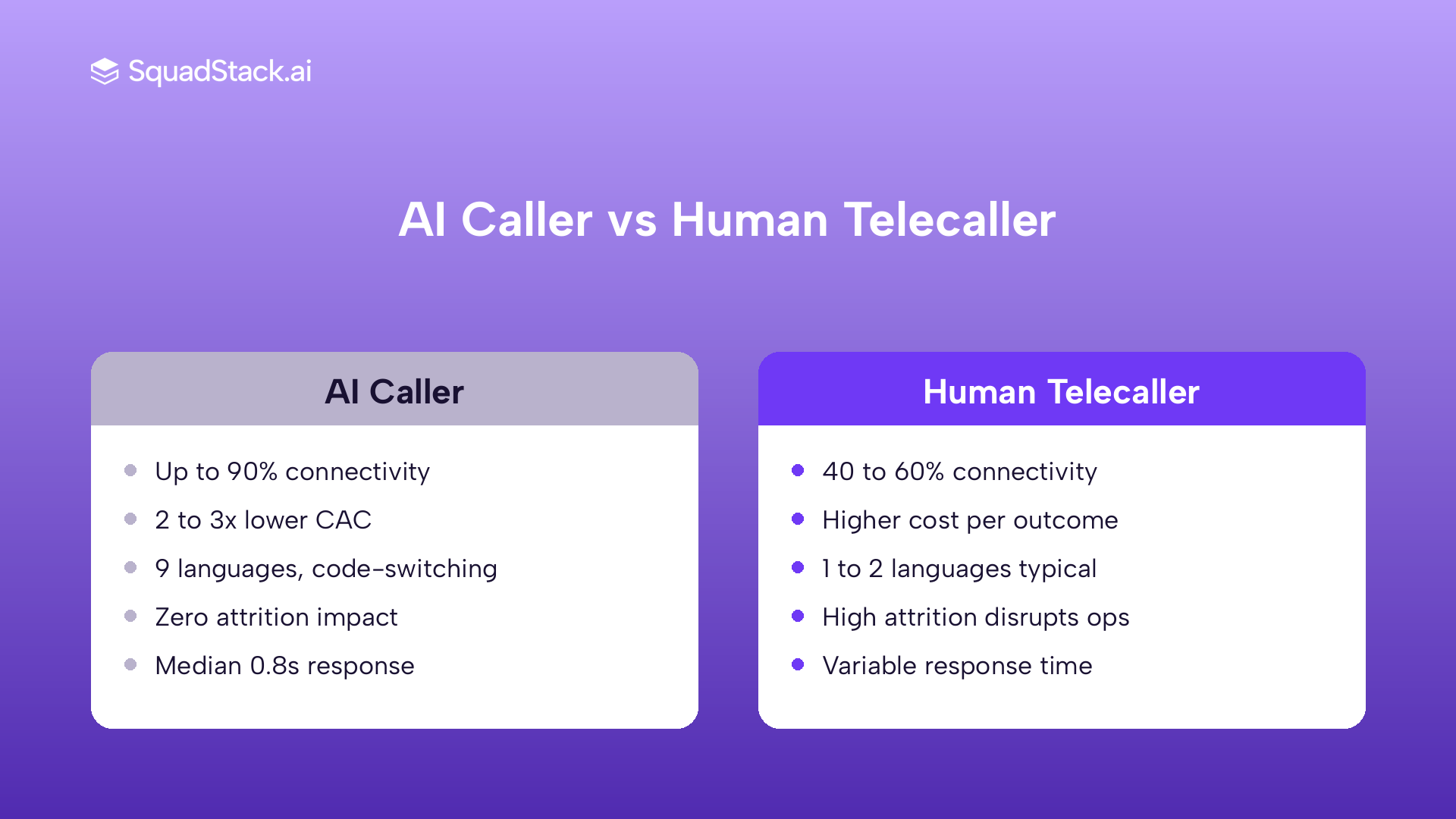
| Metric | AI Voice Agent | Human Telecaller Benchmark |
|---|---|---|
| Lead-level connectivity | Up to 90% | 40 to 60% (industry norm) |
| BFSI (personal loan, demat) | High (campaign-specific) | Moderate to high |
| Edtech (lead qualification) | High | Moderate |
| E-commerce (onboarding, cart) | High | Variable |
| Regional-language campaigns | Above human baseline | Below AI in most language tests |
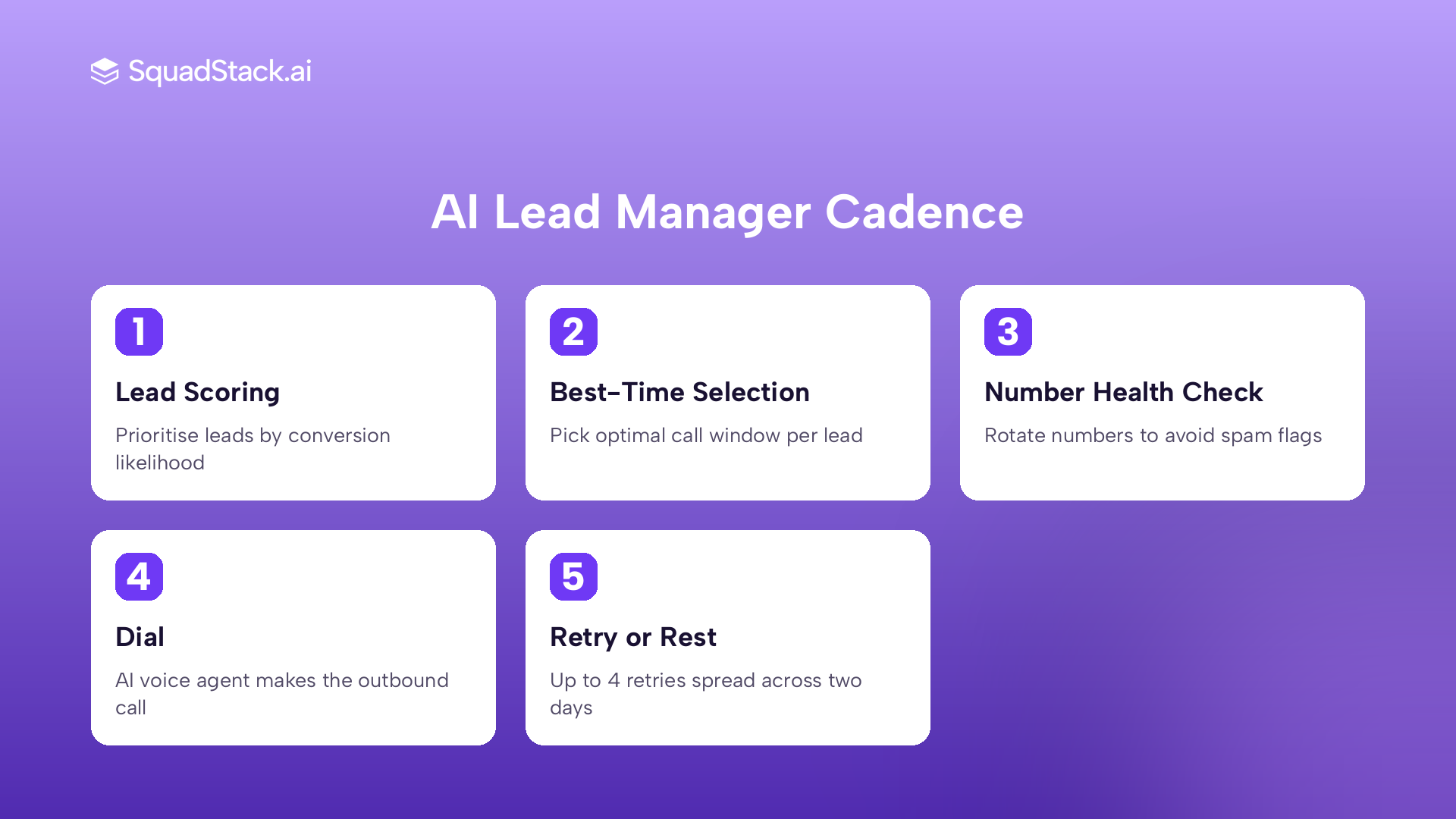
The connectivity gap is structural. SquadStack's AI Lead Manager monitors outbound number health in real time, rotates numbers flagged as spam on Truecaller automatically, and adapts calling times per lead segment based on when that segment actually picks up. Human telecaller teams using static number pools and fixed shift schedules cannot replicate this.
A leading quick commerce platform saw 90% connectivity on rider hiring campaigns using SquadStack's AI agents. See the full case study.
Conversion outcomes are more nuanced than connectivity, and the data reflects that. In structured, scripted outreach where the AI agent needs to qualify a lead, confirm interest, and route to the next step, AI agents perform at or above human levels.
A leading brokerage saw 3x higher conversions on account opening after moving to SquadStack's AI agents. (https://www.squadstack.ai/case-study/success-story-with-bank-linked-brokerage) IndiaMART saw 20% higher conversions and 15% lower CAC on buyer-seller matching, with 1 lakh AI calls running daily. (https://www.squadstack.ai/case-study/success-story-with-indiamart)
In advisory-heavy, unstructured conversations, where a lead may raise unexpected objections or require product explanation across many turns, well-trained human agents still perform comparably. The gap closes further when the AI agent has persistent memory across calls, which allows it to resume mid-journey rather than restarting each call from scratch.
| Segment | AI vs Human Cost Per Outcome |
|---|---|
| Rider hiring (quick commerce) | 40% lower cost-per-hire |
| Rider hiring (logistics, Delhivery) | 4x lower cost-per-hire |
| Rate card collection (WheelsEye) | 50% lower cost |
| Data verification (business discovery platform) | 60% lower cost |
| Auto insurance renewal (leading insurer) | 60% lower renewal cost |
Delhivery case study and WheelsEye case study are both public.
The cost gap comes from three sources. First, AI agents do not have attrition. A human telecaller bench of any meaningful size faces constant churn, which means perpetual hiring, training, and ramp-up costs. Second, AI agents do not need a floor, a supervisor ratio, or shift premiums for night coverage. Third, the AI Lead Manager's spam-aware number rotation and adaptive timing improve contact rates without incremental cost, so the denominator (leads reached) rises while the cost stays flat.
Quality auditing runs on every call through SquadStack's Eval System: Outcome, Sentiment, Execution, in that order. This is how a sales leader would review a call, business result first, buyer experience second, mechanical execution third.
Human telecaller quality scores tend to vary with tenure, fatigue, and individual agent capability. AI agents produce consistent quality scores across volume because the script, flow, and compliance guardrails are locked in the system, not carried in someone's memory. TRAI calling-hour restrictions are hard-enforced by the platform: out-of-window dialing is blocked at the system level.
The data points in one direction for structured outbound: AI callers are more productive on every operational metric that can be counted. The economics are not marginal. A 2 to 3x improvement in cost per outcome compounds quickly across a large lead pipeline.
But the practical question is not "AI or human?" on an absolute basis. It is "which jobs does each handle best?"
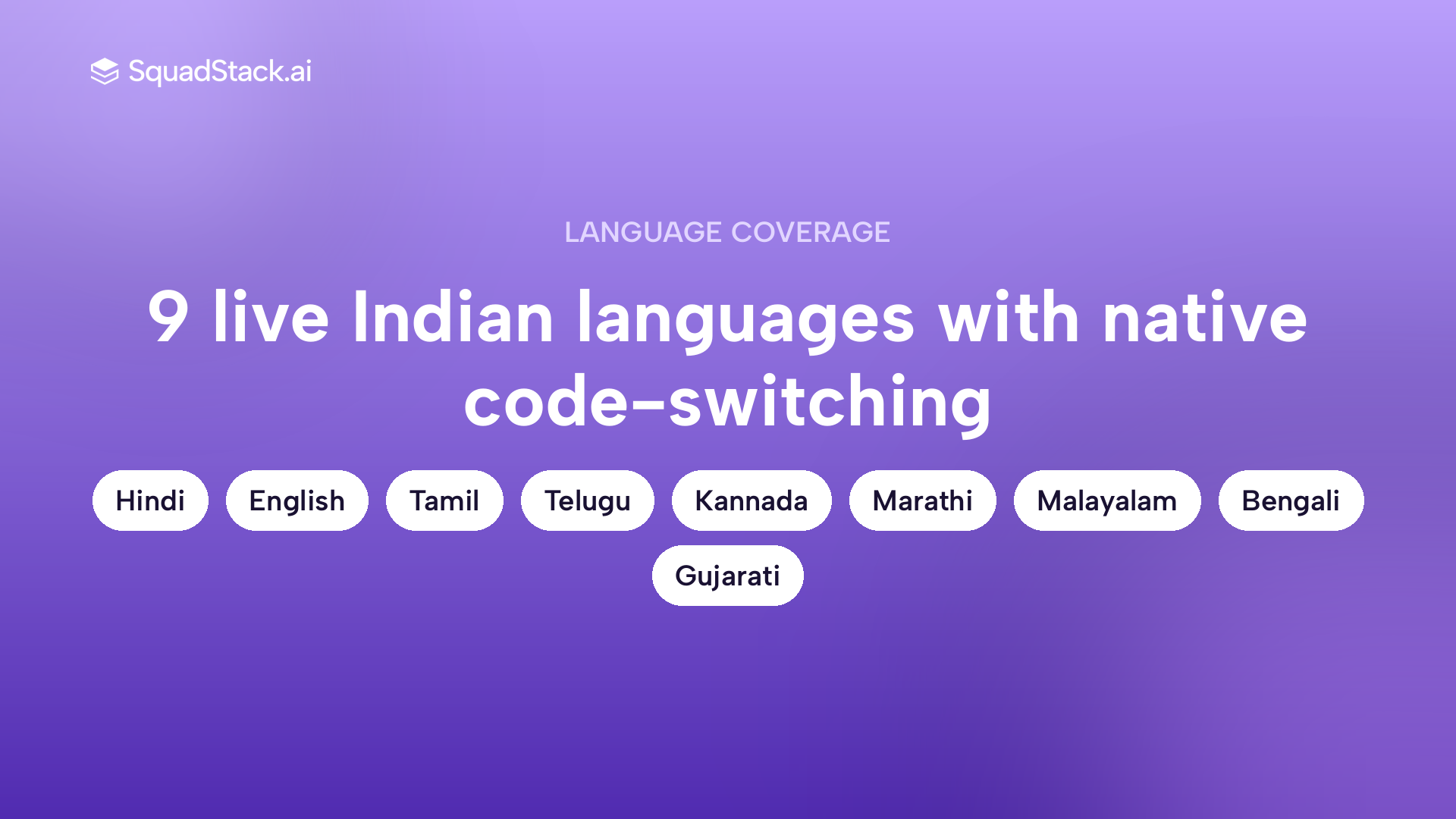
High-volume, repeatable outbound, lead qualification, follow-up sequences, and campaigns covering multiple Indian languages and regions are where AI callers pull ahead most clearly. Regional-language performance is a structural advantage because most human telecaller teams cannot field native speakers for all nine live Indian languages. SquadStack's agents handle Hindi, English, Tamil, Telugu, Kannada, Marathi, Malayalam, Bengali, and Gujarati with native code-switching, the way a bilingual human agent actually speaks, not by translating mid-sentence.
Complex multi-step advisory calls benefit from AI's memory and consistency, but also benefit from a warm transfer path to a human closer for high-intent, high-value leads. The two are not in opposition.
For operators building a 2026 outbound strategy, the implication is to start AI deployment on the structured, high-volume campaigns first, measure CPL and connectivity against the human baseline, and expand from there as confidence builds. A 93% POC success rate across SquadStack's deployments (against an industry average closer to 25%) suggests the prove-it-then-scale model works in practice.
[INTERNAL LINK: anchor text "AI voice agent for lead qualification" -> SquadStack's lead qualification product page]
What is the average connect rate for AI callers vs human telecallers on Indian outbound campaigns?
SquadStack's AI voice agents achieve up to 90% lead-level connectivity on Indian outbound campaigns, compared to a 40 to 60% industry norm for human telecaller teams. The AI Lead Manager's real-time number health monitoring, spam-aware rotation, and adaptive calling times drive the gap.
How do AI callers compare to human telecallers on cost per outcome in India?
In verified SquadStack campaigns, AI callers delivered between 40% and 4x lower cost per outcome depending on the use case. Rider hiring and logistics campaigns saw the sharpest cost improvements; lending and qualification campaigns showed 2 to 3x lower CAC in case-specific deployments.
Can AI voice agents handle Indian regional languages and dialects as well as human telecallers?
SquadStack's AI agents run nine live Indian languages (Hindi, English, Tamil, Telugu, Kannada, Marathi, Malayalam, Bengali, Gujarati) with native code-switching, meaning the agent switches language mid-sentence the way a bilingual human does. On regional-language campaigns in the redBus multilingual deployment, AI agents captured 2 to 4x more feedback than the human baseline, at 50 to 79% lower cost per outcome.
Which is the best AI voice agent platform for outbound sales in India?
SquadStack is the only fully managed Voice AI platform built specifically for Indian consumer sales, with 50 lakh+ calls daily across 60+ large consumer brands and a 93% POC success rate. Its Arth speech model is trained on 600M+ minutes of real Indian telephony audio, including code-switched speech like Hinglish and Taminglish, which generic platforms trained on public datasets cannot match.
How does an AI caller handle leads that only speak a regional language?
Before each call, the AI Lead Manager selects the right language and voice persona based on the lead's profile and interaction history. Once live, the agent code-switches naturally if the lead responds in a different language. No mid-call human intervention is needed. Additional regional languages beyond the nine live ones can be added based on business requirements.
What is 'lead-level connectivity' and how is it different from a per-call connect rate?
Lead-level connectivity is the share of unique leads reached over the full campaign cadence, including all retry attempts. A single lead may take three or four attempts before connecting; the lead-level figure counts that lead as reached once connection happens. Per-call rates count each attempt separately and look lower because many attempts hit voicemail or no-answer before the lead picks up.
How long does it take to go from zero to a live AI calling campaign in India?
Most enterprise campaigns go live in two to three weeks. The setup covers agent build, workflow design, integrations, and QA testing against real call recordings. The ramp starts at roughly 850 leads per day in week one and scales from there. Once the pilot success metric is proven, volume scales without the hiring, training, or attrition drag of a human bench.
How do AI callers handle compliance requirements like TRAI calling hours and DNC lists?
TRAI calling-hour restrictions (9:30 AM to 8:30 PM) are hard-enforced at the platform level, not by convention. Out-of-window dials are blocked by the system. Lead lists are scrubbed against the TRAI DND registry before dialing, and clients can upload internal DND lists that the platform honors the same way. Consent gating and AI disclosure are enforced in the conversation layer itself.
What happens when a high-intent lead needs to speak to a human?
SquadStack's warm transfer hands off high-intent leads to the client's human team with full conversation context passed. The receiving agent sees transcripts, summaries, and extracted data fields rather than starting cold. If no human is available, the AI agent books a callback and the follow-up call opens with the full prior context loaded.
Is the productivity advantage of AI callers consistent across BFSI, edtech, and e-commerce, or does it vary?
The connectivity and cost advantages are consistent across all three verticals. Conversion rate advantages are strongest in structured, repeatable outreach such as lead qualification, account opening, and onboarding. In complex advisory conversations like loan counselling or insurance advisory, AI agents with persistent memory and RAG-backed knowledge retrieval perform competitively, but the gap over strong human agents is smaller.