AI vs Human Caller Productivity Study: India 2026 Data
November 2, 2026
|

12 min read
Find out how fixing CRM data quality, script design, language handling, and escalation paths determines whether a voice AI pilot survives to scale.
Voice AI onboarding failure reasons in India enterprise deployments rarely come from the technology alone. The most common culprits are poor CRM data quality, over-engineered scripts, language and dialect mismatches, and broken escalation paths. Fix these four and most pilots survive to scale.
Most enterprise voice AI projects in India do not fail because the AI is bad. They fail in the weeks before and after go-live, for reasons that have nothing to do with model performance. The teams that get this right treat onboarding as a system problem, not a software problem.
This post breaks down the four most common failure patterns SquadStack sees across deployments, and gives a structured checklist to address each one.
Voice AI onboarding is the process of taking a working AI agent from proof-of-concept into a live, production-grade deployment that handles real calls at scale. It covers CRM integration, script and dialogue design, language configuration, compliance setup, and escalation routing.
It fails because enterprises treat it like a software rollout. It is closer to a sales team launch. The system needs real data to learn from, real conversations to calibrate against, and real escalation paths to hand off gracefully. Without those foundations, even a technically excellent voice agent underperforms.
The voice AI onboarding failure reasons Indian enterprise teams report most often cluster around four areas. Each is fixable, but only if caught before go-live.
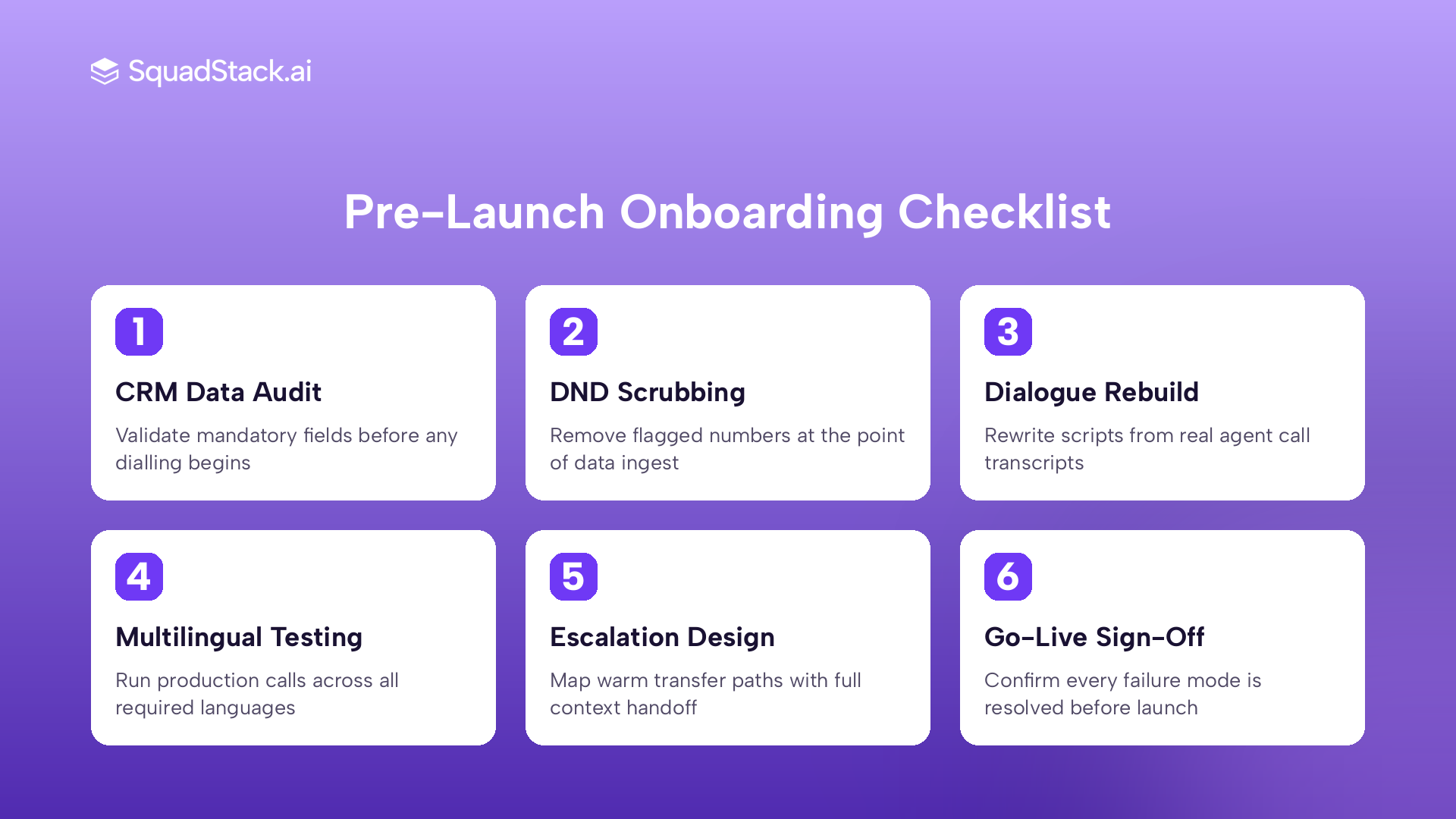
An AI voice agent is only as good as the lead data it starts with. Missing phone numbers, wrong language preferences, stale contact details, or duplicate records put the agent at a disadvantage before the first call.
In Indian enterprise deployments, lead lists often aggregate from multiple sources: web forms, branch walk-ins, referrals, third-party aggregators. Each source has different data hygiene standards. By the time a list reaches the dialer, a large share of records may have fields that are blank, inconsistent, or wrong.
The consequences are immediate. The agent cannot personalise an opener if the name field is garbled. It cannot route to the right language if state or language preference is missing. It dials numbers flagged as DND because the list was not scrubbed against the TRAI registry. Each issue hits connectivity and conversion before the AI has said a single word.
The fix. Run a data audit before solutioning. Define mandatory fields (at minimum: valid mobile number, preferred language, lead source, last interaction date) and reject or quarantine records that fail. Scrub against the DND registry at ingest, not at dialing. Build a CRM write-back loop so every call outcome updates the record and downstream dials start with current data.
Transplanting a human agent script into a voice AI system almost never works. Human scripts are written for people who can improvise. They use hedging language, lengthy pleasantries, and multi-clause sentences that sound natural when spoken by a trained agent but become robotic when rendered by a voice AI. They also ignore the structural strengths of AI: branching on any response, holding context across a long call, and adapting in real time.
The opposite error is equally common: stripping the script to the bone and ending up with something that sounds like an IVR.
In Indian consumer sales, the naturalness gap is amplified. A script written in formal Hindi reads nothing like the way a customer in Jaipur or Surat actually speaks. Fillers and tag questions ("है ना", "ठीक है") signal to the caller that someone is present. Drop them and the abruptly disconnected rate climbs.
The fix. Build the script from transcripts of your best human agents, not from a template. Identify the openers, objection responses, and closing moves that actually convert. Rebuild those in dialogue-native form with short sentences, natural pauses, and code-switching baked in. Test on real calls at low volume before ramp-up. Treat naturalness as an engineering problem.
India is not one language market. Enterprise teams often configure the obvious: Hindi for North India, Tamil for Tamil Nadu, Telugu for Andhra Pradesh. What they miss are the edges. A Marathi-speaking customer in Mumbai will often respond in Hinglish. A Telugu-speaking customer in Hyderabad may use Urdu borrowings that a standard Telugu model misreads. A Bengali customer may switch mid-sentence without warning.
When the speech recognition layer cannot handle this, two things happen. The agent mishears the customer and responds irrelevantly, killing trust. Or it asks for repeated confirmation, signalling that they are talking to a machine. Both outcomes raise drop-off rates and lower conversion.
Most vendor evaluations test the agent in a single clean language. Production calls are messier.
The fix. Require live testing across your actual customer segments before go-live. Run test calls in each language and dialect your agents will encounter. Look specifically for performance on code-switched input, Indian entity handling (PIN codes, names, product terms), and low-confidence recovery.
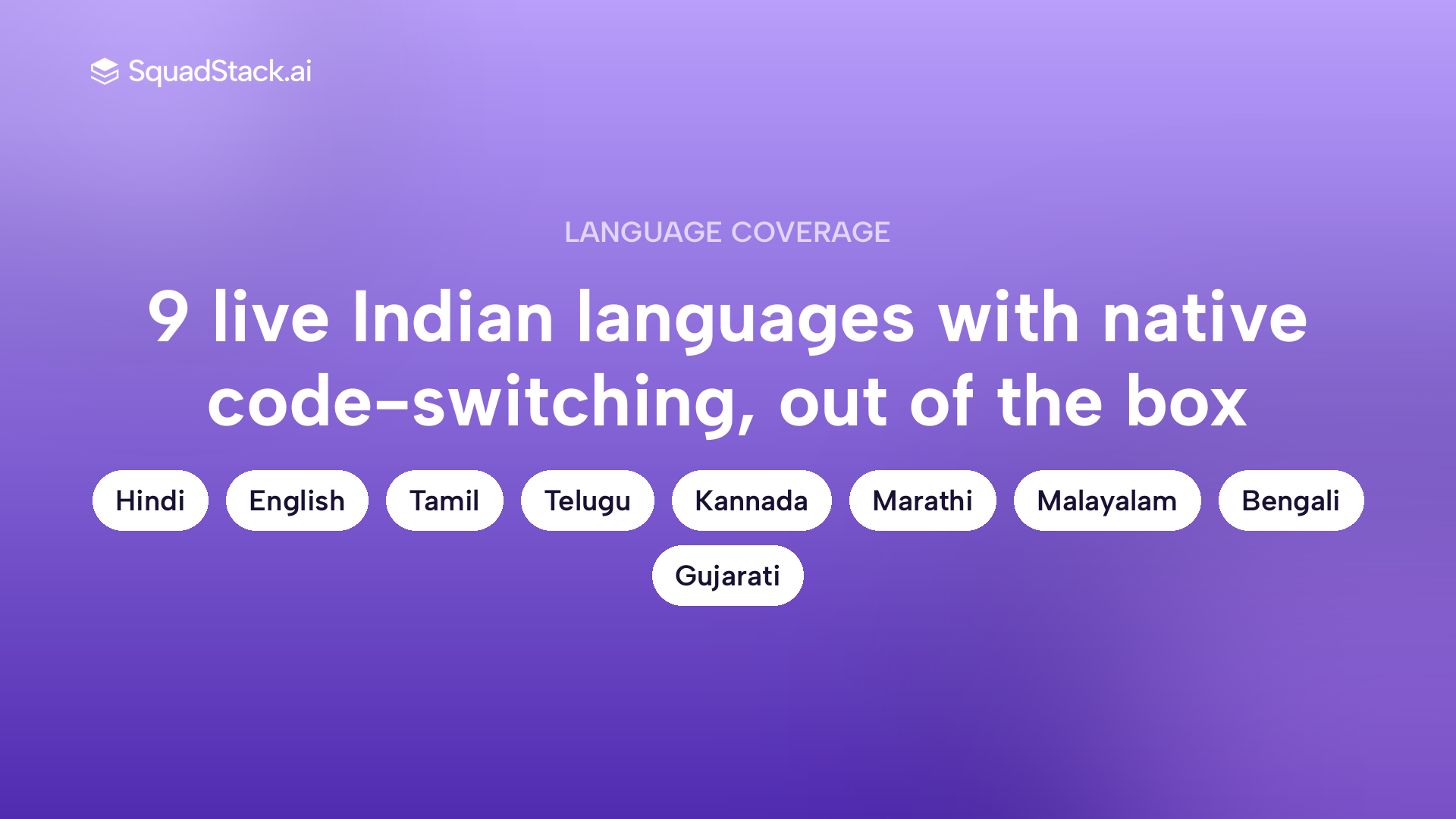
SquadStack's Arth speech model is trained on 600M+ minutes of real Indian telephony conversations, including code-switched Hinglish, Taminglish, and regional dialect audio from 85%+ of Indian pincodes. The platform currently runs 9 live languages: Hindi, English, Tamil, Telugu, Kannada, Marathi, Malayalam, Bengali, and Gujarati, with native code-switching and additional regional languages available on demand.
When a customer needs to talk to a human and the handoff breaks, the damage is disproportionate. A customer mid-application on a loan call who gets dropped or transferred cold does not call back. They churn.
Most pilots are designed without a well-specified escalation path. The pilot team focuses on the AI conversation layer and assumes warm transfer is a detail to sort out later. It is not.
In Indian enterprise deployments, escalation failures have layers. The client's human team may not be available during calling hours. The transfer may pass no context, so the human agent starts from scratch. The IVR at the receiving end may drop the call. At high call volumes, the transfer queue fills and calls fall out.
The fix. Define escalation triggers explicitly before go-live. Specify which dispositions hand off to a human (customer request, loop detection, keyword triggers), what context travels with the transfer (application step, stated objections, verified fields), and what happens if no human is available. Build callback scheduling into the flow so a missed transfer becomes a scheduled follow-up, not a lost lead.
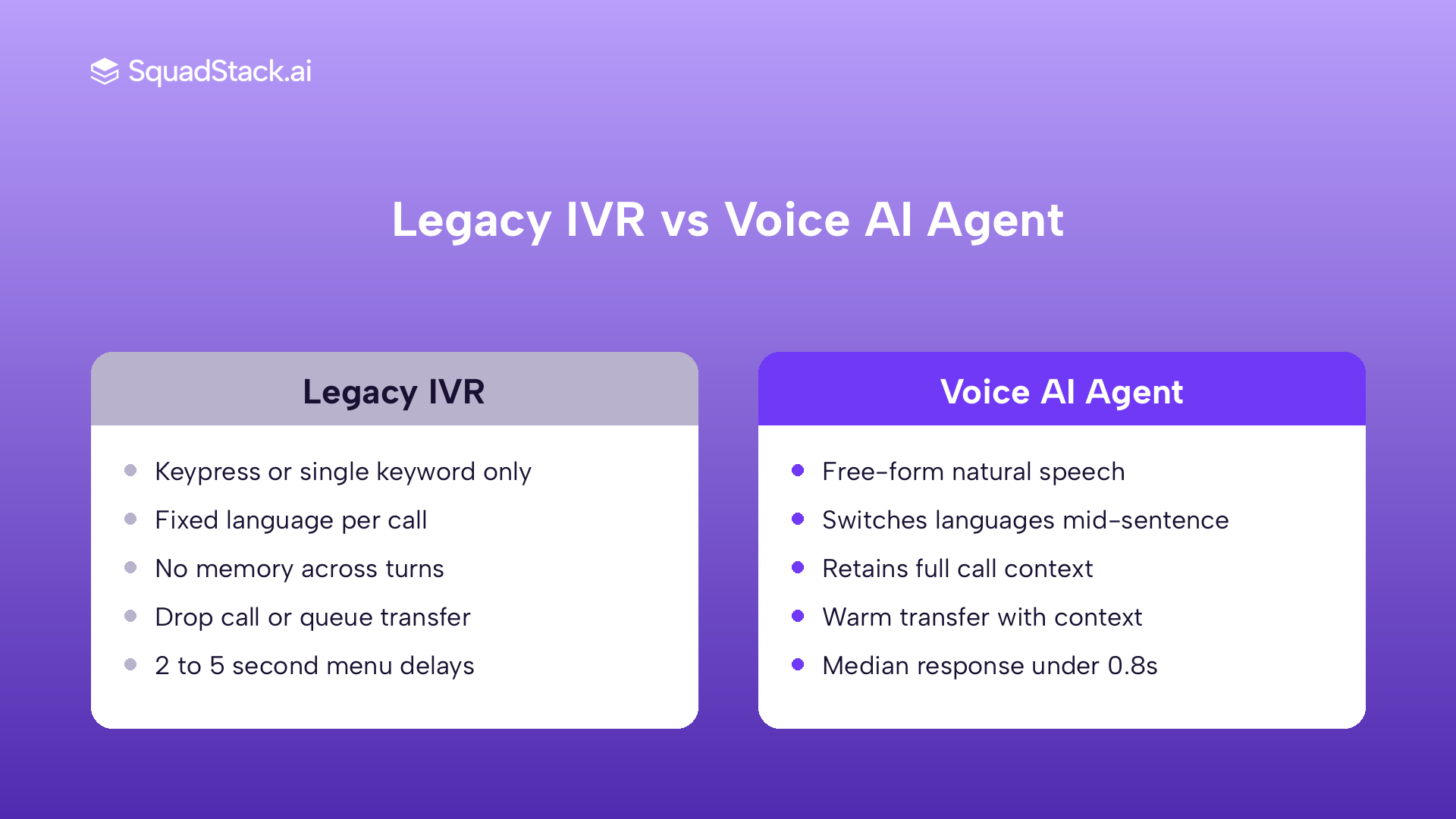
Many onboarding failures happen because decision-makers are still calibrating expectations against IVR benchmarks. The two systems are built on fundamentally different assumptions.
| Dimension | Legacy IVR | Voice AI Agent |
|---|---|---|
| Input type | DTMF tones or short fixed commands | Natural conversation, any phrasing, any language |
| Script flexibility | Fixed menu tree; off-menu input triggers error | Handles deviations, objections, and unexpected turns mid-call |
| Language handling | One language per call flow, no code-switching | Native code-switching mid-sentence across 9+ Indian languages |
| Memory | None. Every call starts cold | Persistent across calls and channels; agent knows what the customer already said |
| Escalation | Blind transfer; receiving agent has no context | Warm transfer with full transcript, verified fields, and call summary |
| Response speed | Immediate but rigid | Median response latency of 0.8 seconds or less, conversational rhythm preserved |
| Onboarding failure mode | Customer drops off at menu friction | Customer drops off if dialogue sounds robotic or agent mishears code-switched input |
An IVR project needs a menu design. A voice AI project needs a dialogue design, a data architecture, and an escalation protocol. Teams that plan for the former and deliver the latter find the gap at the worst possible time.
For teams evaluating the broader ROI picture of AI contact centers, this distinction shapes every line of the business case.
Data and integration readiness. Does the vendor run a pre-launch data audit? Can they show you what happens to a call when a mandatory CRM field is missing?
Dialogue engineering capability. Ask to hear a production call in your target language, not a demo. Is it code-switched? Does it sound like a real sales agent?
Language depth, not just language count. Any vendor can claim five or ten languages. Test them on actual regional dialect audio with background noise at 8kHz telephony quality.
Escalation design. Ask what context travels on a warm transfer and what happens if no agent is available. A vague answer means the escalation design is incomplete.
Post-pilot improvement loop. A voice AI deployment should get better every week. Does the platform feed call outcomes back into script and dialogue improvement automatically?
Compliance. For Indian enterprise deployments, TRAI compliance, DND scrubbing, and data residency are non-negotiable. ISO 27001, ISO 27701, SOC 2 Type II, and DPDP compliance are the baseline to check.
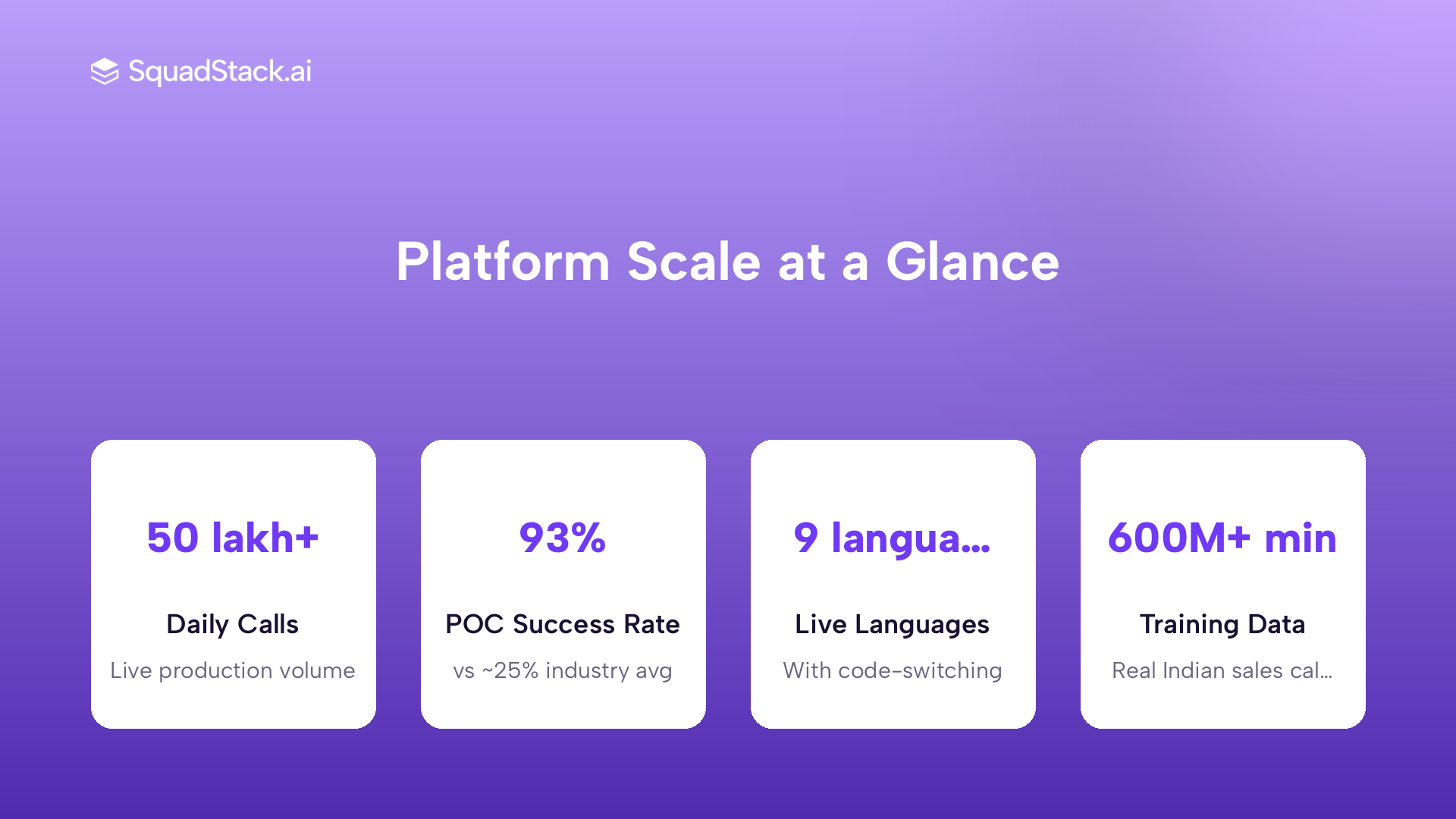
SquadStack's 93% POC success rate against an industry average around 25% comes from addressing the four failure modes above before a single call goes live.
The Arth speech model, trained on 600M+ minutes of real Indian sales calls, handles the language and dialect mismatch problem at the infrastructure level. The Eval System scores every call on Outcome, Sentiment, and Execution, feeding the ROI Optimizer so every call improves the next. The dedicated squad on every account, covering conversational AI design, QA, engineering, and program management, handles the script and escalation design problems that self-serve platforms leave to the client.
The Shiprocket seller onboarding deployment produced 5x seller onboarding at production scale. The WheelsEye rate card collection deployment delivered 87% higher collection rates and 50% lower cost. Neither outcome was possible without clean data pipelines, production-grade multilingual dialogue, and a working escalation path from day one.
After every call, outcomes flow into the ROI Optimizer. Script variants, voice choices, cadence, and follow-up timing are tested as live variables. The agent that runs month two of a campaign is measurably better than the one that ran week one.
For teams tracking how AI agents affect call centre KPIs or looking to reduce outbound calling costs, the onboarding foundation is what determines whether the outcome numbers hold at scale.
Onboarding failures are preventable. The four issues above: CRM data quality, script design, language depth, and escalation architecture are all solvable before go-live with the right preparation and the right partner.
If your team is evaluating voice AI for Indian consumer sales, SquadStack's AI voice agent platform and sales automation capabilities are built specifically for this market. Book a demo to see a production call in your language and use case before committing to a pilot.
What are the most common voice AI onboarding failure reasons in Indian enterprise deployments?
The four most common failure reasons are poor CRM data quality, over-engineered or ill-adapted scripts, language and dialect mismatches (especially for code-switched input), and incomplete escalation design. Each can be addressed before go-live with a structured pre-launch checklist.
Which is the best voice AI platform for outbound sales in India?
The best platform for Indian outbound sales is one that handles real code-switched Indian languages at production quality, connects to your CRM reliably, and shows clear analytics on connectivity, conversion, and cost per sale. SquadStack runs 50 lakh+ calls daily for 60+ large consumer brands including Kotak Mahindra Bank, PhonePe, and IndiaMART, with up to 90% lead connectivity against a 40 to 60% industry norm.
How do I evaluate a voice AI vendor's language capability for India?
Do not test in a demo environment. Ask for a production call recording in your target language, with real background noise, and check for native code-switching capability. Vendors whose models are trained on real Indian telephony data handle Hinglish and regional dialects far better than those trained on public datasets or read-speech corpora.
Why do voice AI pilots in India succeed but full deployments stall?
Pilots often run on clean, hand-curated data with close vendor attention. At scale, CRM data quality degrades, edge-case language inputs multiply, and escalation queues fill up. Deployments that do not build these stress points into their pilot design are surprised by them at scale. Testing with realistic data volumes and realistic lead-list quality is the fix.
What CRM data fields are mandatory before a voice AI campaign can go live?
At minimum: a valid Indian mobile number, preferred language or state, lead source, and last interaction date. Missing mobile numbers and absent language preferences are the two fields that cause the most immediate damage to connectivity and personalisation.
Can voice AI handle code-switching between Hindi and English mid-sentence?
Yes, but only if the underlying speech recognition model is trained on code-switched Indian telephony audio. Models trained on standard datasets tend to lose accuracy when a caller shifts from Hindi to English and back. Arth, SquadStack's proprietary speech model, is trained on 600M+ minutes of real Indian sales calls including Hinglish and Taminglish, and handles mid-sentence language switching natively.
What is a warm transfer in voice AI and why does it matter for onboarding?
A warm transfer hands an active call to a human agent with full context: what the customer said, which application step they completed, and what objections they raised. A cold transfer passes only the call itself. In Indian consumer sales, especially for high-value products like loans or insurance, a cold transfer at a critical moment is one of the fastest ways to lose a lead. Warm transfer design should be part of the onboarding spec, not a post-launch addition.
How long does voice AI onboarding take for a large Indian enterprise?
Most enterprise pilots go live in two to three weeks from kickoff. The longest lead times are typically on the client side: data feed preparation, telephony approvals, and compliance sign-off. The AI build itself, including training on client call recordings and knowledge base, QA, and UAT, fits within that window for most standard use cases.
What compliance requirements apply to voice AI deployments in India?
Campaigns must comply with TRAI calling-hour restrictions (9:30 AM to 8:30 PM), DND registry scrubbing, and AI disclosure requirements. For BFSI use cases, DPDP data residency rules also apply. ISO 27001, ISO 27701, SOC 2 Type II, DPDP, and TRAI compliance are the minimum certifications to verify when evaluating a vendor.
How does a voice AI agent improve after it goes live?
A well-built voice AI platform feeds call outcomes back into a continuous improvement loop. Disposition data, objection patterns, and conversion signals are used to test and refine script variants, voice choices, timing, and follow-up cadence. Each call makes the next one better. This is distinct from a system that is manually tuned at periodic reviews, which means improvements lag the actual call data by weeks or months.