AI Voice Agents for Inbound Support with Complex Query Escalation
September 21, 2026
|

12 min read
AI voice agents for ecommerce India are purpose-built calling systems that connect with shoppers, sellers, and delivery partners at every stage of the...
AI voice agents for ecommerce India are purpose-built calling systems that connect with shoppers, sellers, and delivery partners at every stage of the order journey, from cart recovery to COD confirmation to win-back. Unlike generic voice tools, the best platforms handle India-specific realities: code-switched languages, cash-on-delivery workflows, address corrections, and thin contribution margins. This playbook covers every use case, how to evaluate vendors, and what real Indian deployments actually deliver.
India's e-commerce market is growing fast, with most of that growth coming from tier-2 and tier-3 cities, where COD share is highest, addresses are least standardised, and customers switch between Hindi, Tamil, Telugu, and other languages mid-sentence.
The calling surfaces are well known: recover abandoned carts, confirm COD orders before dispatch, resolve failed deliveries, re-engage lapsed buyers, onboard new sellers. Most brands know these jobs need doing. What they lack is a system that can do them at scale, in the right language, with enough accuracy to move revenue.
This is the problem AI voice agents for ecommerce India are built to solve. This playbook covers what the agents do, where they attach in your funnel, how to evaluate vendors, and what separates a good deployment from a failed one.
For a broader look at how SquadStack serves the retail and e-commerce sector, see the e-commerce industry page.
An AI voice agent is a software system that holds a real, two-way phone conversation with a customer without a human on the other end. It listens, understands what is being said, responds naturally, handles objections, and takes action mid-call: sending a payment link, booking a callback, updating an address.
This is different from a chatbot or an automated SMS. The conversation happens over a phone call, in the customer's language, in real time. The agent can ask follow-up questions, handle interruptions, and respond to what the customer actually said rather than routing them through a menu.
In an e-commerce context, these agents handle the calls that drive or protect revenue: recovering a dropped order, confirming a COD shipment, resolving a delivery failure, or calling a lapsed buyer back into the funnel.
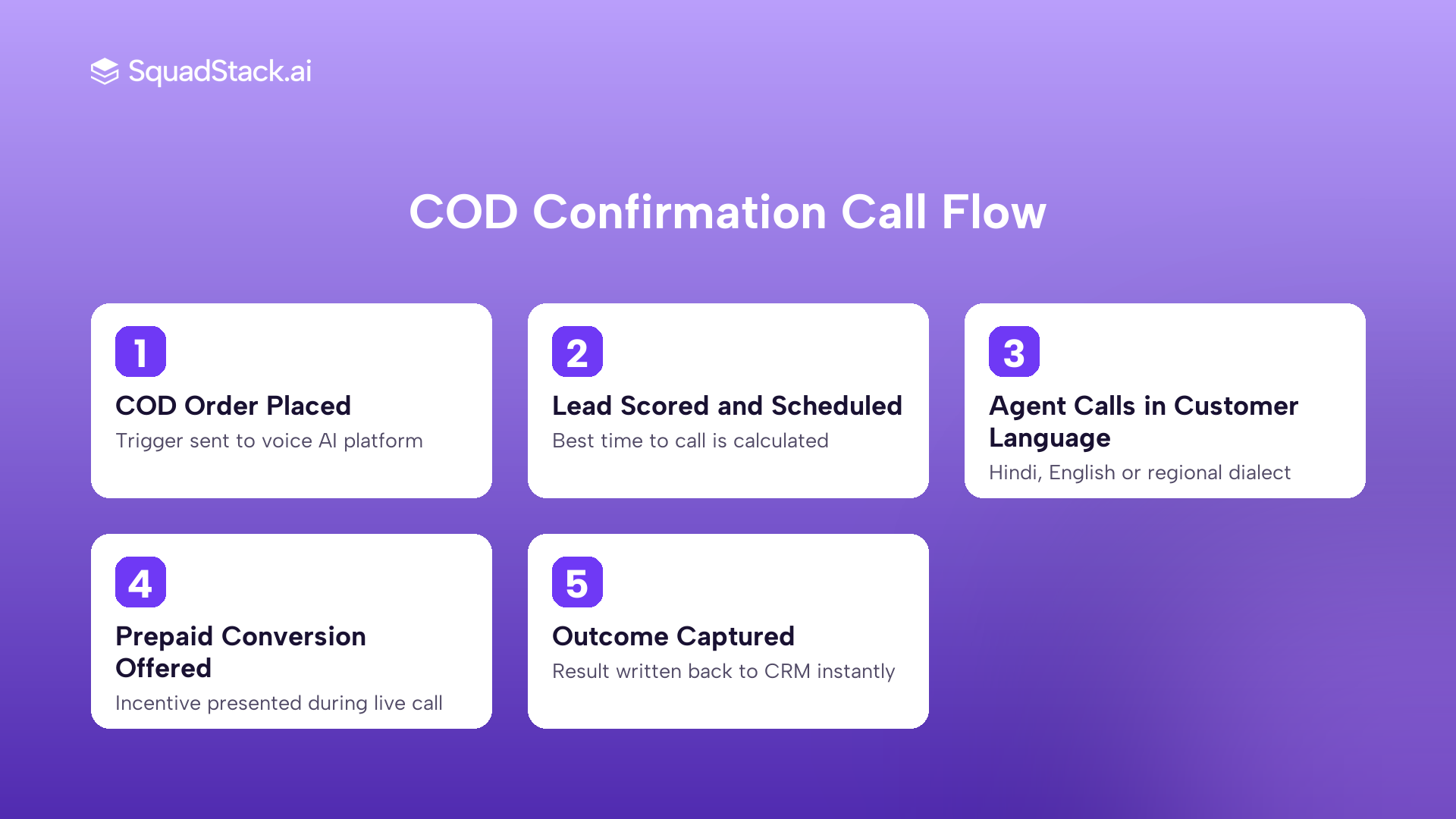
Here is what happens on a typical outbound cart-recovery call.
Step 1: Trigger. A customer adds items to their cart, starts checkout, and stops. The system detects the abandonment, scores the lead by intent and order value, and schedules a call within minutes.
Step 2: Personalisation before dialling. The agent loads the customer's cart contents, purchase history, preferred language, and prior interactions. If the customer previously spoke Hindi, the agent opens in Hindi.
Step 3: The conversation. The agent calls and opens naturally, referencing the specific items left behind. It handles objections live: if the customer says the price is too high, the agent can apply a discount. If they mention a payment failure, it sends a fresh payment link to WhatsApp while the customer is still on the call.
Step 4: Outcome capture. At the end of every call, the system extracts structured data: disposition, objection reason, whether the order was recovered, and delivery preferences. This writes back to the CRM automatically.
Step 5: Continuous learning. Every call feeds into the ROI Optimizer. The system runs A/B tests on script framing, voice choice, call timing, and follow-up cadence, so each conversation leaves the system sharper than the one before.
Abandoned cart and checkout recovery. The highest-intent surface. A customer who reached checkout and stalled is far more valuable to call than someone who browsed and left. Target checkout drop-offs first, especially payment failures where the customer actively tried to complete the order. Bellavita and Shiprocket both run abandoned cart recovery with SquadStack.
COD confirmation. A COD order is placed, and the agent calls before dispatch to confirm it is real and wanted, then offers a prepaid conversion with an incentive. A genuine prepaid shift protects contribution margin: a COD order that comes back undelivered destroys the economics of many surrounding orders.
NDR resolution and address correction. When a delivery attempt fails, the agent calls the customer within 24 hours to confirm availability, correct the address, capture a landmark, and rebook the slot. Reaching the customer in that window recovers the large majority of salvageable deliveries.
Repeat purchase and win-back. When a customer passes their natural repurchase window without ordering, the agent calls with a reason to return, matched to their purchase history. Email and push stop working once a customer has lapsed; a call reaches them where the channel still works.
Seller onboarding and activation. Amazon uses SquadStack for seller onboarding and activation. A registered seller who has not listed a product, or listed but not sold, gets a call that walks them through the stuck step. Drip emails do not work for micro-SME sellers; a call does.
Buyer-seller matching and order taking. IndiaMART runs order taking and buyer-seller matching with SquadStack, generating 20% higher conversions and 15% lower customer acquisition cost with over 1 lakh AI calls daily.
Data verification. JustDial runs data verification and appointment booking with SquadStack, achieving 85% connectivity and 60% lower cost on data verification.
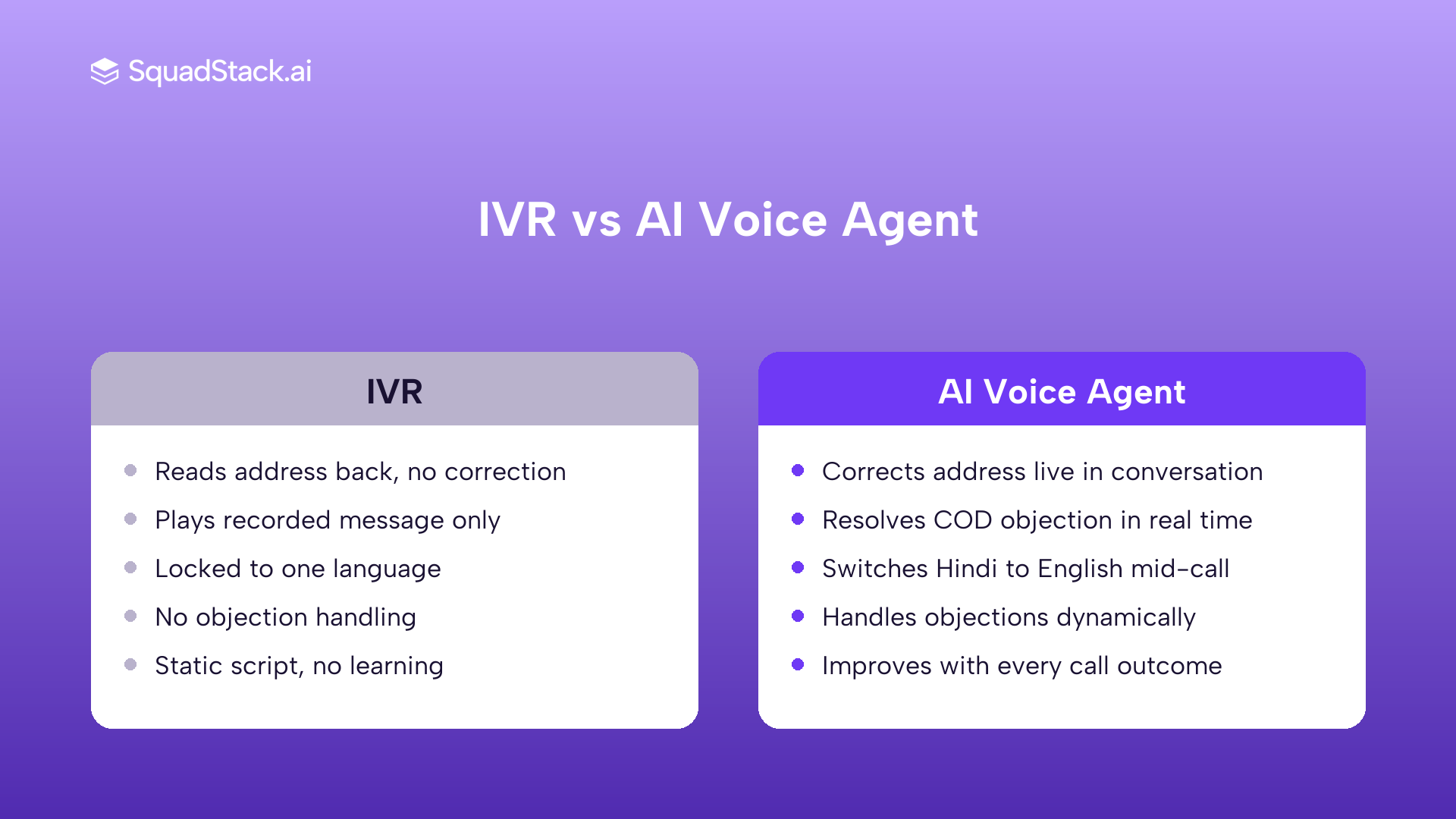
The difference matters more in e-commerce than most industries because the conversations are unpredictable. A customer objecting to a COD confirmation does not follow a menu.
| Dimension | IVR | AI Voice Agent |
|---|---|---|
| COD objection handling | Plays a pre-recorded message, cannot respond to "I already paid online" | Listens to the objection, verifies payment status, adjusts the conversation live |
| Address correction | Reads back the address from the database, cannot update it mid-call | Captures the corrected address, a landmark, and a preferred delivery slot in one conversation |
| Language switching | Locked to one language per call flow | Switches between Hindi, English, Tamil mid-sentence as the customer's language shifts |
| Failed delivery context | Treats every callback as a cold call | Loads the prior delivery attempt, failed reason, and cart contents before the first word |
| Cart recovery timing | Cannot trigger within minutes of abandonment | Calls within minutes of a trigger event, while intent is highest |
The IVR was designed for routing. The voice AI agent is designed for conversation. In e-commerce, where the job is to persuade, resolve, and retain, a menu system loses most of the interactions it touches.
For a fuller comparison, see voicebots vs voice AI agents.
Generic feature checklists miss the India-specific criteria. Here is what to look for when shortlisting vendors.
1. Language quality, not language count. Any platform can list 20 languages. What matters is whether the agent sounds native in Hinglish, Taminglish, or Telugu-English code-switching on a real 8kHz telephony call. Ask for call recordings in the languages you actually need. If the output sounds like a newsreader, your customers will hang up in the first ten seconds.
2. COD and NDR workflow depth. Ask whether the vendor has pre-built workflows for COD confirmation with prepaid conversion and for NDR resolution with address capture. These are structurally different conversations from cart recovery. A vendor whose only template is "you left something in your cart" is not ready for Indian e-commerce.
3. Integration with your logistics stack. The trigger for an NDR call is a failed delivery event in your 3PL or order management system. The agent needs to read order status, failed reason, and delivery slot availability in real time. Ask specifically how the vendor integrates with Shiprocket, Delhivery, or whichever logistics layer you use.
4. Incrementality measurement. This is the most important commercial criterion and the one vendors most commonly avoid. Ask how they help you run a holdout group: customers deliberately excluded from calling so you can compare purchase rates between called and uncalled groups. Without a control group, you cannot tell whether calling caused the revenue or just coincided with it.
5. Compliance and data residency. TRAI calling-hour rules, DND scrubbing, consent handling, and data storage in India are non-negotiable. Ask for certifications, not promises.
| Evaluation Criterion | What to ask the vendor |
|---|---|
| Language quality | "Can I hear a call recording in Hinglish and Tamil?" |
| COD workflow | "Do you have a pre-built COD confirmation with prepaid conversion?" |
| Logistics integration | "How do you connect to our NDR feed?" |
| Incrementality | "How do we set up a holdout group?" |
| Compliance | "What are your certifications? Where is data stored?" |
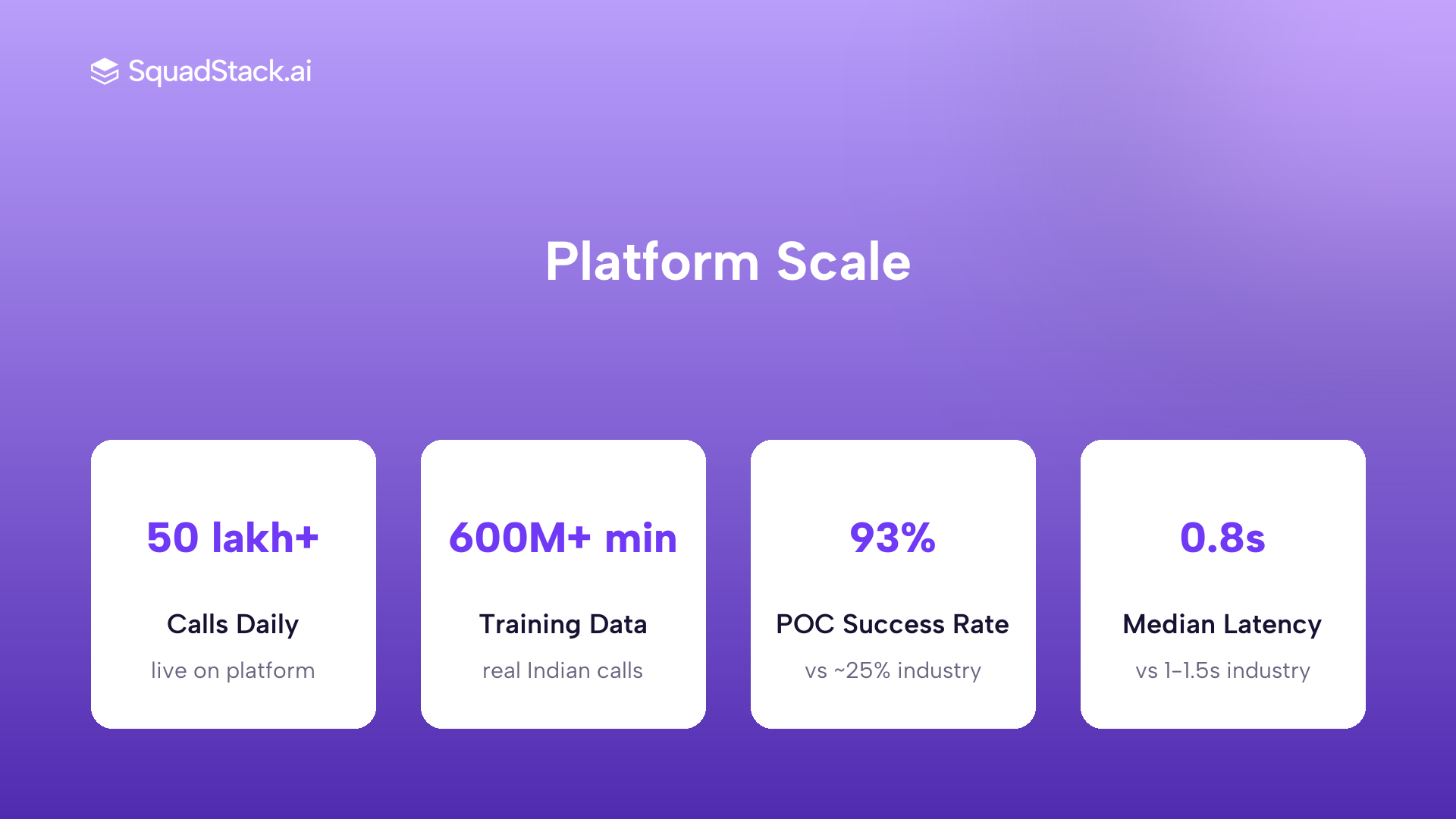
SquadStack's edge comes from one thing competitors cannot replicate: 600M+ minutes of real Indian sales and contact-centre conversations used to train Arth, its proprietary speech recognition model. Those recordings are full-duplex, outcome-labelled telephony audio spanning 85%+ of Indian PIN codes, covering Hinglish, Taminglish, and regional code-switching on actual 8kHz phone lines.
The practical result is that Arth handles what Indian e-commerce calling actually sounds like: a customer in Coimbatore switching between Tamil and English mid-sentence, a buyer in Patna giving an address in a local dialect, a seller in Surat objecting with a phrase no script anticipated.
SquadStack's Eval System scores every call on three levels: Outcome (did the call achieve its goal?), Sentiment (how did the conversation land?), and Execution (did the agent run it correctly?). AI and human reviewers audit calls, with near-total review in the early weeks of a campaign to catch edge cases before they run at scale.
The sharpest proof in this category: a leading D2C personal care brand ran abandoned cart recovery with SquadStack and achieved 8x ROI, measured against a control group.
Other e-commerce customers include Amazon (seller onboarding and activation), IndiaMART (order taking and buyer-seller matching), JustDial (data verification), Shiprocket (lead qualification and abandoned cart recovery), Traya (repeat sales and user onboarding), and Bellavita (abandoned cart recovery).
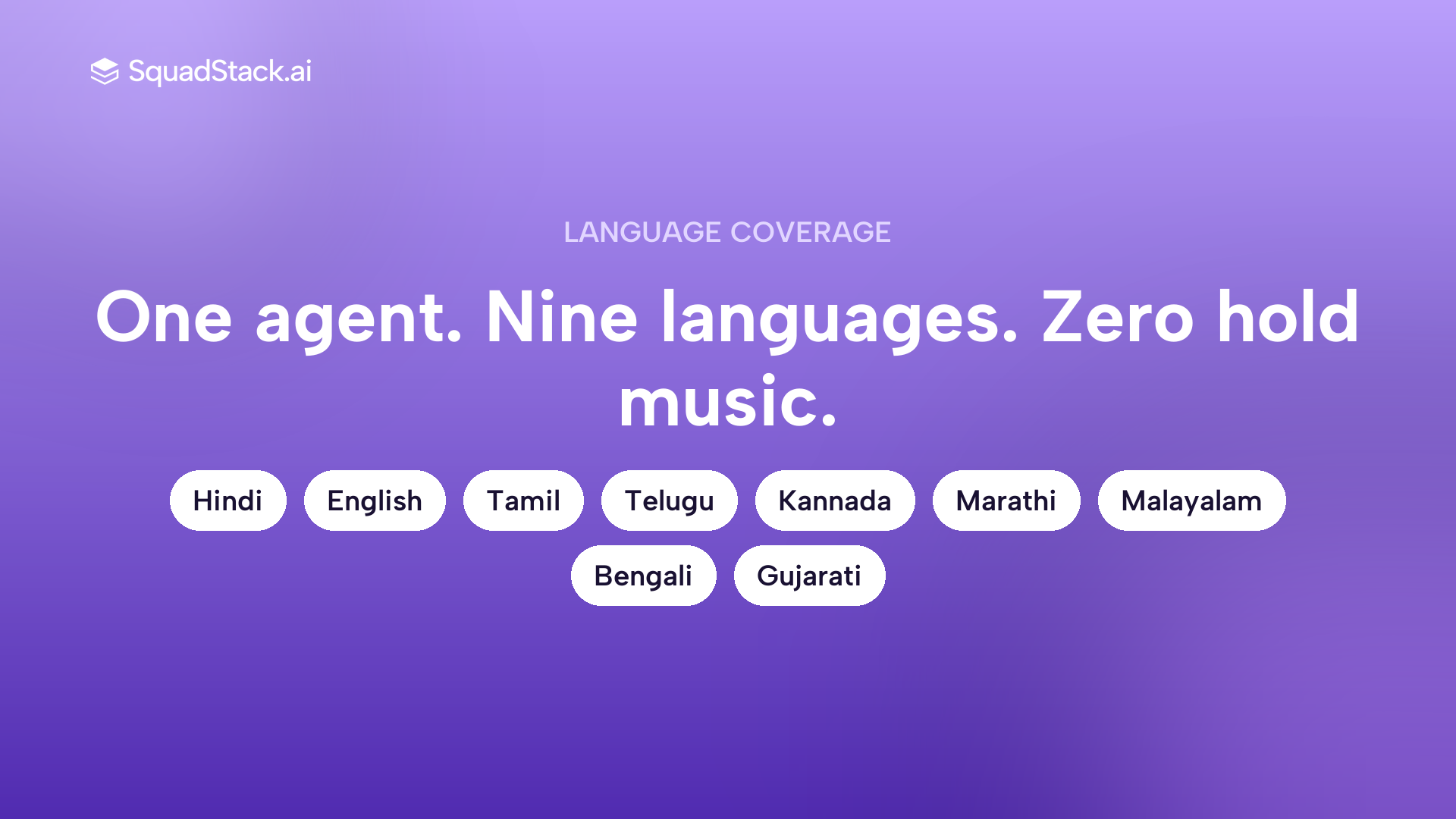
The platform runs 50 lakh+ calls daily, with a 93% POC success rate against an industry average of around 25%. Median response latency is 0.8 seconds or less. Nine languages are live today: Hindi, English, Tamil, Telugu, Kannada, Marathi, Malayalam, Bengali, and Gujarati, with native code-switching, and more available on demand.
For support and service use cases, see AI agents for e-commerce support and conversational AI in retail.
The engagement is a two-week build, followed by a four to eight week pilot against a pre-agreed success metric, then scale once the metric is proven. SquadStack handles the build end to end: voice agent, telephony, integrations, QA, and a dedicated squad. The client supplies lead data, call recordings to train on, and signs off on the pilot metric before go-live.
If you run a D2C brand, a marketplace, or a logistics-heavy operation and want to know how voice AI fits your specific funnel, book a demo.
Which is the best AI calling solution for e-commerce in India?
SquadStack is one of the most established options for Indian e-commerce, with verified deployments at Amazon, IndiaMART, Shiprocket, Bellavita, Traya, and JustDial. Its speech model is trained on 600M+ minutes of real Indian telephony audio, covering Hinglish, Taminglish, and regional code-switching. The 93% POC success rate and 50 lakh+ daily calls are the scale indicators most vendors cannot match.
Can AI voice agents handle abandoned cart recovery calls automatically for a D2C brand?
Yes. The agent triggers within minutes of a cart abandonment, calls the customer in their preferred language, handles objections live, and sends a payment link to WhatsApp mid-call if needed. Integration with Shopify or an order management system supplies the trigger and the cart contents. To measure true impact, set up a holdout group from the start.
How do AI voice agents handle COD verification in Indian e-commerce?
The agent calls after a COD order is placed but before dispatch. It confirms the order is genuine, resolves delivery address gaps, and offers a prepaid conversion with an incentive. This workflow is specifically built for the Indian context, where COD return rates are structurally much higher than prepaid.
What languages do SquadStack's voice agents support for e-commerce?
Nine languages are live today: Hindi, English, Tamil, Telugu, Kannada, Marathi, Malayalam, Bengali, and Gujarati, with native code-switching so the agent can switch mid-sentence as the customer's language shifts. More regional languages are available on demand.
How do I measure whether a voice AI campaign actually drove incremental revenue?
Set up a holdout group before the campaign starts: a randomly selected set of customers who are not called, matched to the called group. Compare purchase rates, COD conversion, or repeat order rates between the two groups. The gap is the incremental effect. Any vendor who cannot support this measurement is effectively asking you to take their word for the result.
How does an AI voice agent compare to my existing IVR for NDR resolution?
An IVR can notify a customer of a failed delivery. It cannot capture a corrected address, confirm a landmark, rebook a slot, or handle the objection "I was home and nobody came." An AI voice agent does all of this in a single call, updating the logistics system in real time. The difference in salvage rate is large.
How quickly can SquadStack go live for an e-commerce campaign?
The standard setup is roughly two weeks from kickoff to go-live. This covers the agent build, workflow configuration, CRM and logistics integrations, and UAT. Simple, well-defined use cases like COD confirmation can move faster if the client's data feed is ready.
Is SquadStack compliant with TRAI calling-hour rules and DND regulations?
Yes. The platform enforces a hard 9:30 AM to 8:30 PM calling window, scrubs lead lists against the TRAI DND registry before dialling, and honours client-uploaded internal DND lists. SquadStack holds ISO 27001, ISO 27701, SOC 2 Type II, DPDP, and TRAI certifications.
What integrations does SquadStack support for e-commerce stacks?
SquadStack integrates with CRMs, order management systems, and logistics platforms via webhooks and APIs. The platform's Forward Deployed Engineer handles integrations as part of the standard engagement. Specific connector depth depends on the client's stack and is scoped during the solutioning phase.
Does SquadStack work for seller onboarding as well as buyer-side calling?
Yes. Amazon runs seller onboarding and activation with SquadStack. IndiaMART runs order taking and buyer-seller matching. The seller journey, from GST verification to first order activation to subscription renewal, maps cleanly to voice AI. The registered-to-transacting gap at most marketplaces is large, and calling is often the only channel that closes it.