AI Voice Agents for Inbound Support with Complex Query Escalation
September 21, 2026
|

12 min read
AI voice agents for insurance renewals and persistency automate the full renewal outreach cycle: from early reminders and NACH bounce recovery to lapse...
AI voice agents for insurance renewals and persistency automate the full renewal outreach cycle: from early reminders and NACH bounce recovery to lapse win-back and revival calls. Deployed correctly, they reach far more policyholders than a human floor can at a fraction of the cost, while staying within IRDAI compliance guardrails. The result is a direct lift in 13th-month and 25th-month persistency figures, which are the numbers Indian insurers are actually judged on.
Persistency is the number every life insurer reports on every earnings call, and most of the industry is losing the fight. Thirteenth-month persistency ranges from 59.7% to 83.2% across Indian life insurers, and by the 61st month even the best lose roughly a third of their book.
The problem is not the renewal product. The problem is reach. A large general insurer reportedly had 14 people managing its entire two-wheeler renewal book because a two-wheeler premium of Rs 800 to Rs 1,000 cannot fund a multi-attempt human sequence. Another life insurer generates more than a lakh of leads a month against a few hundred agents. The math does not work.
That is the specific gap AI voice agents for insurance are built to close.
An AI voice agent for insurance renewals and persistency is a software system that conducts real two-way phone conversations with policyholders without a human on the line. It is not a recorded message and it is not an IVR menu. The agent listens, understands the response, handles objections, and takes an action: confirming a payment, sending a link, booking a callback, or routing to a certified human closer.
In insurance, these agents attach at the points in the policy lifecycle where the book leaks: renewal reminders, NACH bounce recovery, lapse and revival outreach, orphan-policy servicing, and portability defence on health renewals.
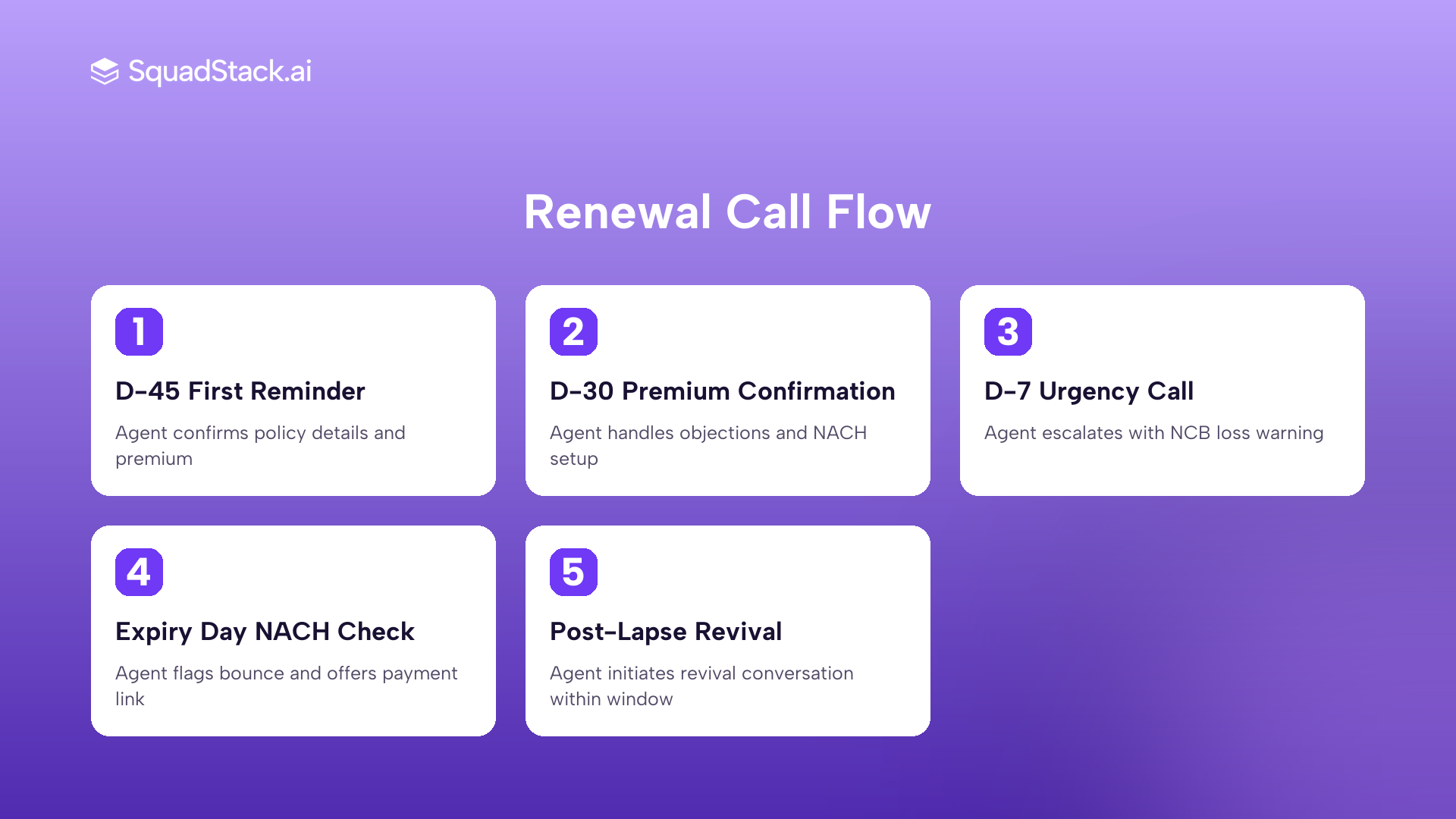
Before the call: The AI Lead Manager scores the due-for-renewal book by lapse risk, chooses the best call time based on past connectivity data, selects the right voice and language, and checks the number's health before dialing. Leads get a D-30 attempt and further waves at D-7 and expiry day.
The call itself: The agent opens in the policyholder's preferred language, confirms the policy due for renewal, and explains any premium change. If the policyholder pushes back on price, the agent addresses the objection across multiple turns. If they are ready to pay, the agent sends a payment link over WhatsApp while they are still on the line. If they want to speak to a person, a warm transfer goes to the renewal team with full call context already passed.
After the call: The disposition and outcome are written back to the CRM. Leads who did not connect get re-queued with updated timing. Every outcome feeds the ROI Optimizer: the system learns which script framing, voice, and call timing produced the best renewal rate on this cohort, and the next wave runs on that improved version. A policyholder who was not reached on Tuesday does not get a cold call on Thursday. The agent already knows the last attempt, how long the call lasted, and whether a WhatsApp was sent.
For a deeper look at how similar outreach mechanics work in collections, see AI in Collections: Transforming Debt Recovery in 2025.
Renewal reminder ladder. D-45, D-30, D-7, and expiry day. The agent confirms the policy, explains any premium change, and takes payment or sends a link. Moves 13th-month persistency directly.
NACH bounce recovery. Most policyholders do not know their auto-debit failed. The agent flags it and collects in the same week. Bounce files worked beyond day seven convert poorly. This is a 24/7 use case that human floors rarely staff.
Lapse and revival outreach. For life policies within the five-year revival window, the agent explains arrears, interest, and any running concession. For motor, it states the NCB deadline and inspection requirement on long-expired policies.
Orphan-policy servicing. When a selling agent leaves, the policy has no owner. The insurer's number calls the policyholder, introduces the servicing relationship, and carries the conversation the departed agent should have had. This book lapses at a far higher rate than the agent-serviced book, and most insurers have no human floor working it today.
Portability defence on health renewals. Premium-hike shock is the most common health renewal objection. The agent explains waiting-period credits the policyholder would lose by porting, no-claim benefits, and continuity. This call happens at scale because roughly 70% of health policyholders saw their premiums rise materially over three years.
Motor win-back. Two-wheeler retention runs below 50% in much of the market. The 90-day NCB window is the only hard deadline that moves lapsed customers to act. An AI agent can reach the full lapsed book on expiry day, which a human floor cannot.
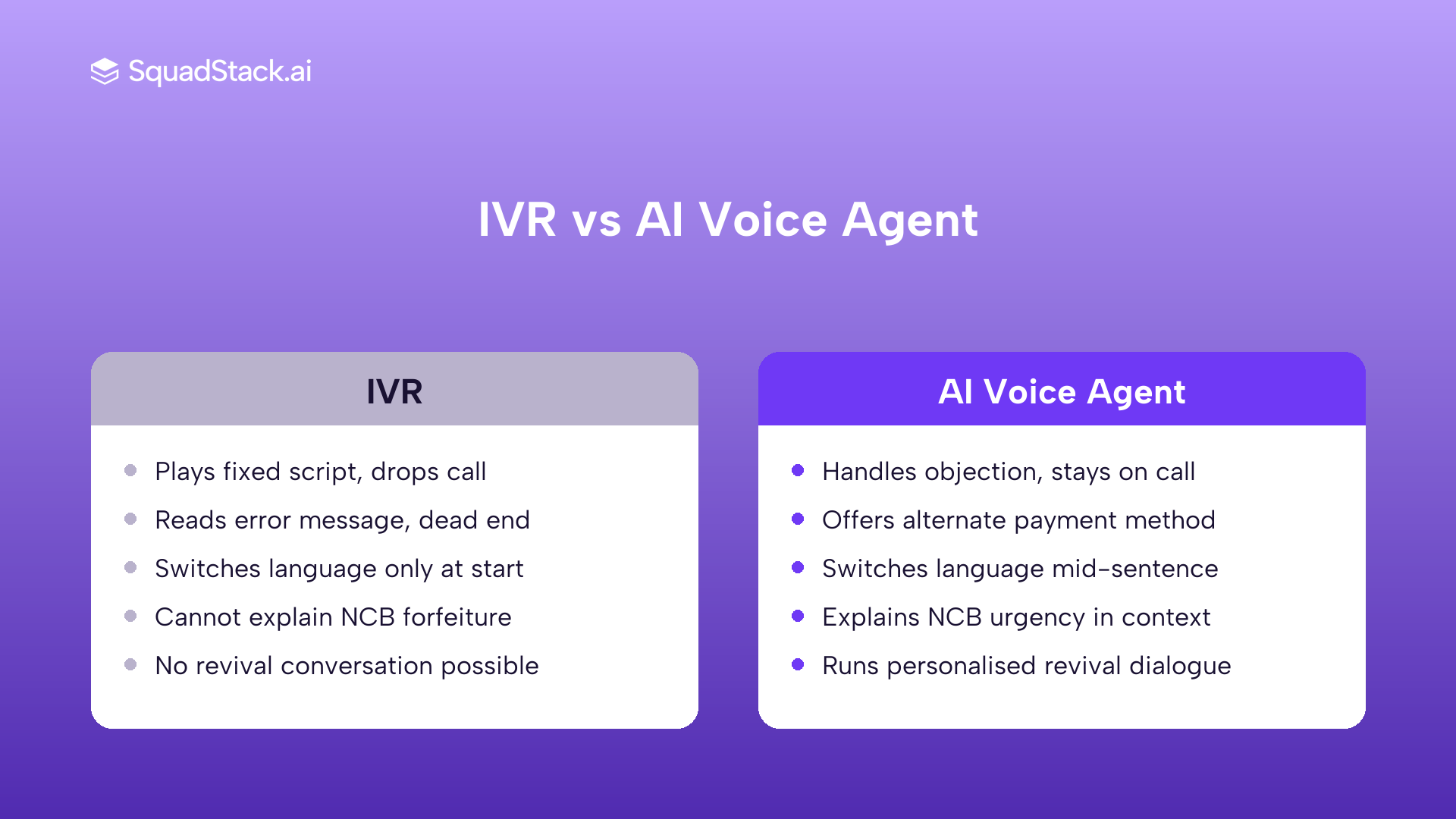
| Dimension | IVR | AI Voice Agent |
|---|---|---|
| Premium objection handling | Plays a recorded response or routes to queue. Cannot address the specific hike amount or explain continuity benefits. | Listens to the objection, confirms the specific premium change, explains what porting would cost in waiting-period credits, and offers a callback if needed. |
| NACH bounce recovery | Sends an SMS or plays a generic message. Cannot capture a new mandate or answer questions about why the debit failed. | Explains the failure in plain language, sends a payment link mid-call, and logs confirmed payment intent back to the CRM. |
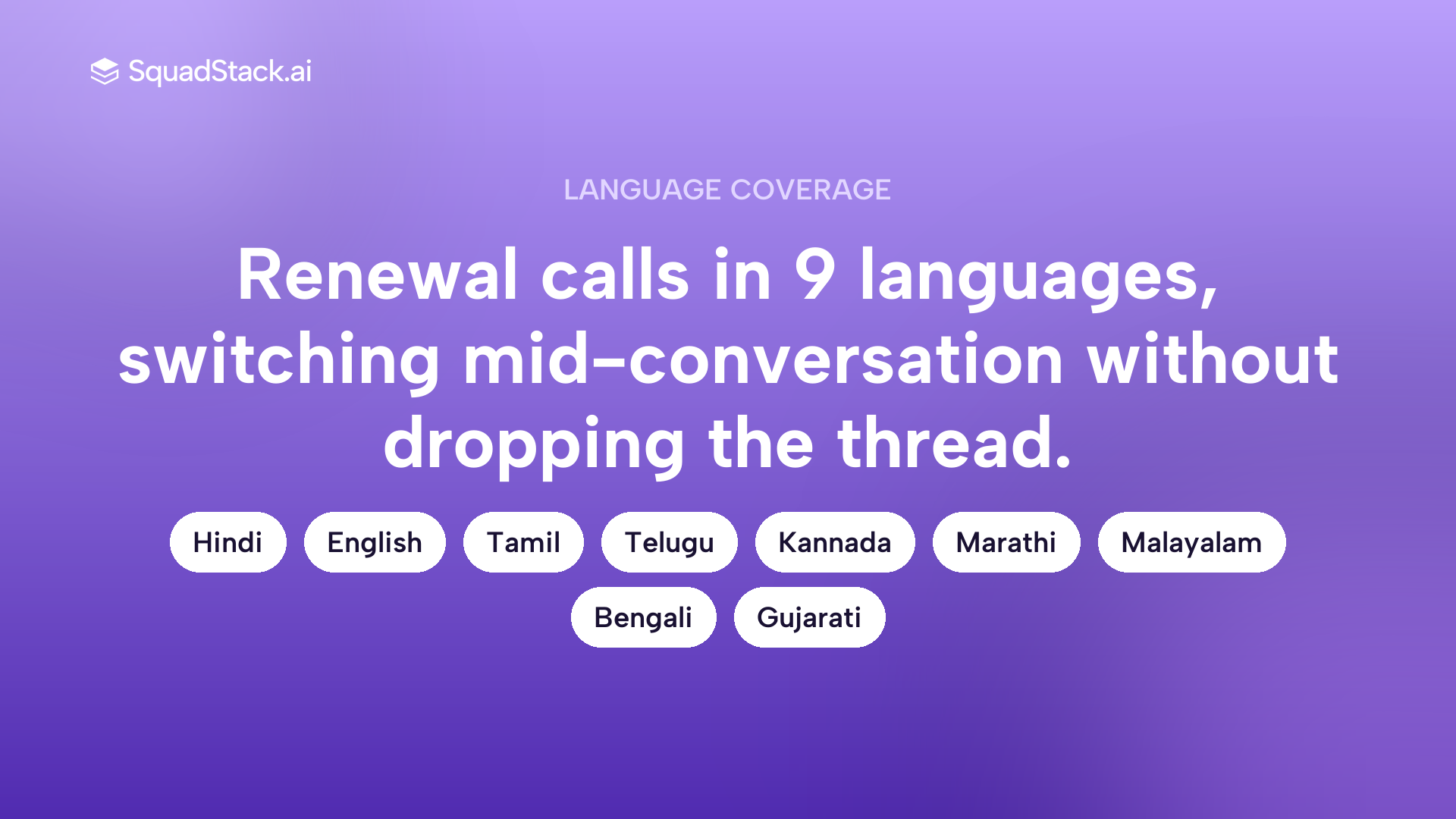
| Language switching | Fixed to one language per call. A Taminglish speaker who shifts mid-sentence breaks the IVR. | Switches languages mid-sentence, natively. Hindi, English, Tamil, Telugu, Kannada, Marathi, Malayalam, Bengali, and Gujarati are live today, with more available on demand. |
| NCB urgency for lapsed motor | Announces the expiry date. Cannot calculate the discount loss or handle inspection questions. | Calculates and states the NCB at risk, handles the inspection question, and takes a different path if the vehicle is confirmed sold. |
| Long-lapsed life revival | Cannot explain arrears plus interest or revival requirements. Routes to a human who often does not answer. | Walks through the revival math in the policyholder's language, confirms the health declaration requirement, and books a callback if needed. |
IVRs were built to deflect. AI voice agents are built to convert. The renewal conversation requires both listening and adapting, which only one of them does.
Does it run on Indian telephony, in Indian languages? A platform trained on global datasets produces recognisably foreign speech, and Indian policyholders hang up. The training corpus must be real Indian telephony audio.
Is it TRAI and IRDAI compliant by design? Service calls to existing policyholders run on the 1600 series. The moment cross-sell content enters the call, it becomes promotional and requires DND scrubbing and the 140 series. A compliant platform enforces this at the script layer.
Does it have persistent memory across attempts? Stateless platforms leak trust at every retry. A policyholder who answered a question on Monday should not receive a cold call on Friday.
Can it hand off to a licensed human with context? Solicitation requires a certified person. The platform must support warm transfer with full conversation context passed, not a cold routing event.
What does it do between calls? Platforms that only place calls and report dispositions are dialers. A platform that learns from every outcome and improves the next call is a sales decision system. The difference shows up in 25th-month persistency numbers.
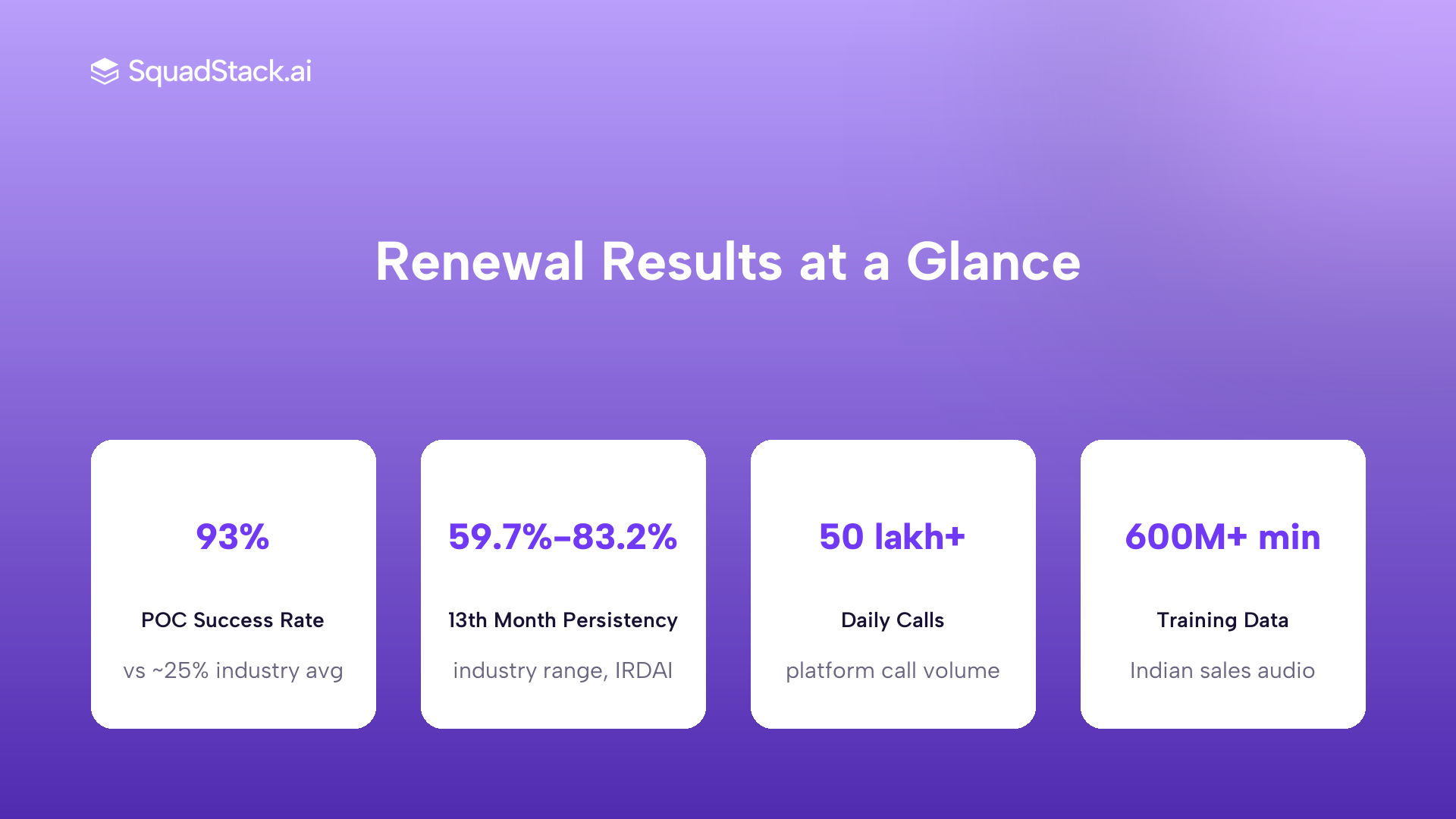
SquadStack's insurance voice AI platform was built for the Indian market, trained on 600 million-plus minutes of real Indian sales and service conversations spanning more than 85% of Indian PIN codes. That corpus is why the speech model, Arth, handles code-switched telephony audio from a policyholder in Coimbatore or Patna the same way a native-speaking agent would. Hindi, English, Tamil, Telugu, Kannada, Marathi, Malayalam, Bengali, and Gujarati are live today, with more languages on demand.
The proof in insurance is specific. A leading general insurer achieved 85% call connectivity and 60% lower renewal cost on auto insurance renewals. The Kissht case study shows how the same platform drives outcomes in high-volume lending outreach, where call economics and compliance requirements closely mirror insurance renewal operations.
On compliance, the platform enforces 1600 vs 140 series separation, DND scrubbing, calling-window hard locks (9:30 AM to 8:30 PM), and consent-gating in the conversation layer. Scripts are locked against compliance sections that the self-improvement layer cannot touch. The platform is ISO 27001, ISO 27701, SOC 2 Type II, DPDP and TRAI compliant, with India data residency.
SquadStack runs 50 lakh-plus calls daily across 60-plus large consumer brands including Kotak Mahindra Bank, PhonePe, Moneyview and KreditBee. The dual-layer Eval System scores every call on Outcome, Sentiment, and Execution, so quality is observable and improvable at campaign level. POC success rate is 93%, against an industry average near 25%. Pilots go live in roughly two weeks on real leads.
If your renewal floor is leaving a portion of the book unworked because the economics do not support human calling on low-ticket policies, that is the exact wedge this platform was built for. Book a demo and the team will scope a pilot around your 13th-month persistency target and your current BPO cost per renewal.
Which is the best AI voice agent for insurance renewals in India?
The right platform depends on scale, language mix and compliance requirements. SquadStack is purpose-built for Indian insurance and BFSI outreach: trained on 600 million-plus minutes of real Indian telephony conversations, live in Hindi, English, Tamil, Telugu, Kannada, Marathi, Malayalam, Bengali, and Gujarati with more languages on demand, and compliant with TRAI, IRDAI outsourcing norms and DPDP. A leading general insurer running the platform achieved 85% connectivity and 60% lower renewal cost.
Can an AI voice agent handle the full insurance renewal call automatically?
It handles the high-volume, script-stable stages end to end: reminders, premium explanation, objection handling, payment link delivery and NACH bounce recovery. The solicitation step, where a certified human must recommend and close a product, routes via warm transfer with full context passed. This hybrid design is what IRDAI compliance requires, and most insurer use cases run at 90%-plus AI-handled with targeted human escalation.
How do AI voice agents improve 13th-month persistency in life insurance?
They improve persistency by closing the reach gap. A large share of the renewal book goes uncalled today because human floor economics do not support low-ticket or orphan-policy segments. An AI agent reaches those segments at a fraction of the per-contact cost, works NACH bounces in the same week they occur, and runs lapse outreach on the orphan book that currently has no owner. Each of those interventions directly moves the 13th-month count.
What are the IRDAI compliance rules for automated renewal calls?
Service calls to existing policyholders, including renewal reminders, run on the 1600 series and are exempt from DND restrictions. The moment a call includes cross-sell content, it becomes promotional and requires DND scrubbing and the 140 series. All calls must be recorded, callers must disclose identity and that the call is recorded, and telecalling scripts require compliance-officer approval before use. SquadStack enforces series separation and calling-window compliance at the platform layer.
How does a NACH bounce recovery call work with an AI agent?
When an auto-debit fails, the platform detects the bounce event and queues the policyholder for a same-week call. The agent explains that the payment did not go through, answers questions about why, sends a payment link via WhatsApp while the policyholder is still on the call, and logs the outcome back to the CRM. Bounce calls worked beyond the first week convert at much lower rates, which is why 24/7 automated recovery moves the persistency number where weekly human batches do not.
How should insurers measure the ROI of AI voice agents on persistency?
Track four metrics together: contact-to-commit rate on renewal calls, collection efficiency, 13th-month and 25th-month persistency delta versus the pre-deployment baseline, and cost per renewal across the full book including previously unworked segments. Per-call cost alone understates the value because the AI makes calls the human floor never did.
What happens when a policyholder asks a complex question the agent cannot answer?
The agent handles objections across multiple turns using RAG, which retrieves answers from the insurer's approved product and policy documents in under 100 milliseconds. If a question falls outside the knowledge base or the policyholder explicitly requests a human, a warm transfer sends the call to the renewal team with the full conversation context and confirmed data points already passed. The human does not start from scratch.
Does an AI voice agent sound natural enough that policyholders will trust it?
SquadStack's voice agents have passed a blind Turing test: at Global Fintech Fest 2025, 1,273 of 1,563 attendees identified AI agents as human in a controlled listening exercise. The voices are cloned from real top-performing Indian sales agents, and the dialogue is hand-engineered per language rather than generated, so the filler sounds, turn-taking cues and reformulators match native speech. The Abruptly Disconnected Rate on live campaigns has fallen to roughly 10%, inside the range for human agent calls.
Can the same platform handle renewals across motor, health and life policies?
Yes. The platform builds separate workflows per product line, each with its own script, compliance rules, entity extraction points and escalation logic. Motor renewal flows carry NCB urgency framing and inspection guidance. Health flows handle portability-defence objections and explain waiting-period continuity. Life flows cover revival mechanics, arrears calculations and DGH requirements. Persistent memory and the CRM integration carry the correct policy context into each call.
What does go-live look like for an insurance renewal pilot?
Setup takes roughly two weeks: the squad builds the agent on the insurer's real call recordings, knowledge base, compliance-approved script and FAQs, then runs UAT before any live policyholder is contacted. The pilot runs on real leads for four to eight weeks, ramping from a few hundred calls a day, against a pre-agreed success metric such as 13th-month persistency lift or cost-per-renewal. Scaling gates on proving that metric, and the 93% POC success rate means most pilots do.