AI Voice Agents with QA, Sentiment Analysis, and Call Scoring
September 18, 2026
|

13 min read
An AI voice agent for loan collections in India runs the full collections lifecycle, from pre-due reminders through early-bucket PTP extraction to...
An AI voice agent for loan collections in India runs the full collections lifecycle, from pre-due reminders through early-bucket PTP extraction to settlement outreach, in Hinglish and five other languages, inside RBI and TRAI guardrails. It covers the entire delinquent book on day one, not the slice a human floor can reach, at a fraction of tele-collections cost. The result is a lower roll rate, higher PTP-kept rate, and a collections operation that scales without adding headcount.
A collections floor running 20,000 to 30,000 daily attempts against a delinquent book has a coverage problem. Human telecallers handle roughly 150 to 250 accounts a day at best. The maths means a meaningful share of the book never gets a first-touch call before roll rates crystallize at month-end, and that gap is where lenders lose rupees quietly. AI voice agents for loan collections in India close that coverage gap without adding headcount.
This guide covers how the technology works, where it attaches across the lending collections lifecycle, what compliance looks like in practice, and how to evaluate a vendor before you go live. For a broader view of how voice AI fits lending origination and servicing, see the lending and credit industry overview.
An AI voice agent is a fully automated outbound and inbound caller that holds a two-way spoken conversation with a borrower, understands natural speech including Hinglish and regional code-switching, and works through a call objective: extract a PTP, confirm a repayment date, resolve a bounce query, or communicate a settlement offer.
It is not an IVR. The borrower speaks in sentences, the agent listens, interprets intent, and responds in kind. If the borrower says "salary aaya nahi tha, 5 tarikh ko deta hoon," the agent logs a PTP for the 5th, sends a payment link on-call, and schedules a follow-up call for the morning of the 5th. No keypad menu, no hold music, no transfer to a queue.
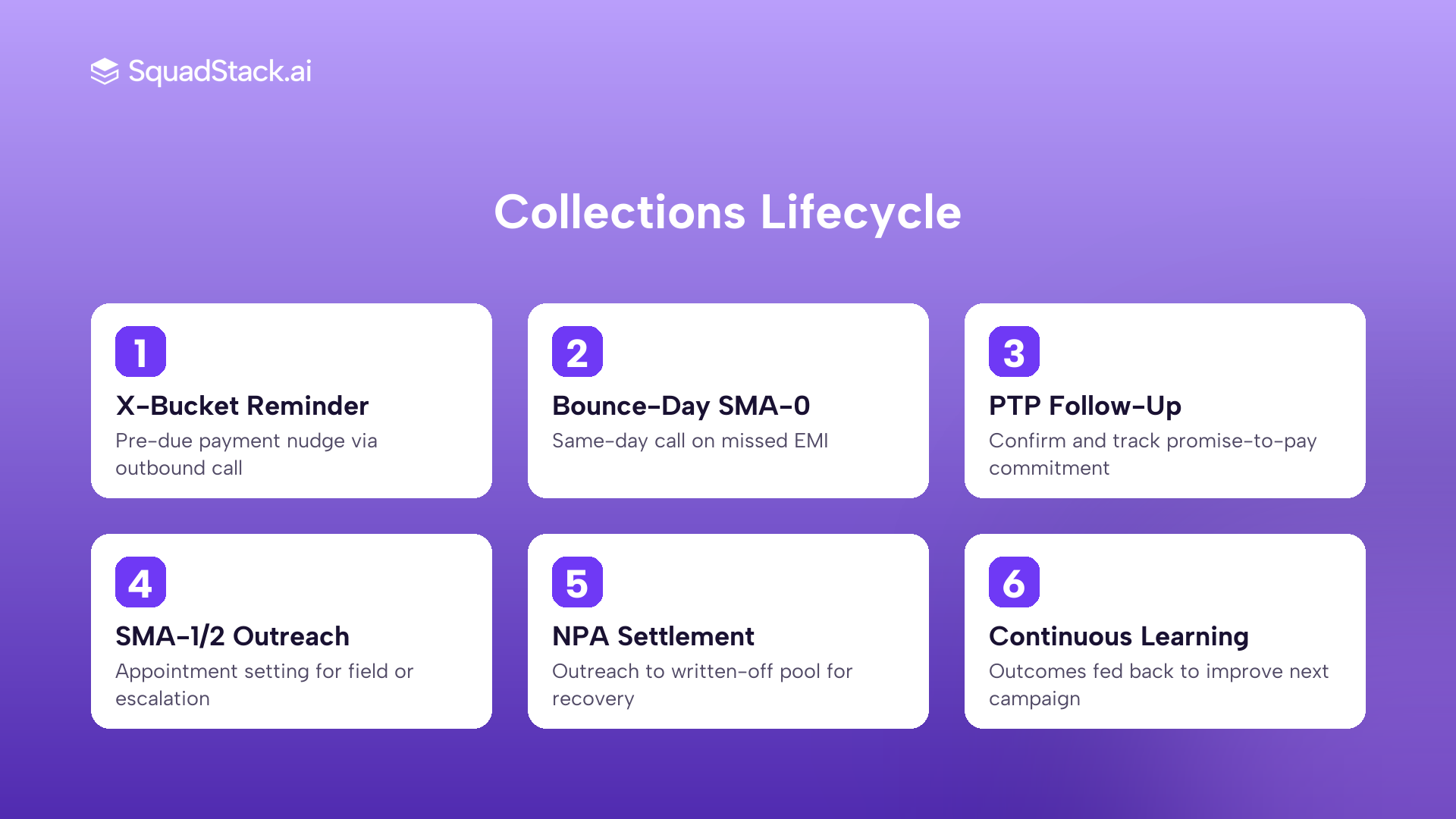
The collections lifecycle has six distinct calling moments. A well-deployed AI voice agent covers all of them, each with a different script, tone, and escalation path.
Step 1: X-bucket and pre-due reminder. Two to five days before EMI presentation, the agent calls accounts with prior bounces or low predicted balance. The conversation is soft: confirm the debit date, check the balance will be available, offer a payment link. This is the cheapest intervention in collections.
Step 2: Bounce-day and SMA-0 outreach (0 to 30 DPD). When a mandate presentation fails, the AI dials immediately. The script shifts to resolution: "Aapka EMI present nahi hua, koi dikkat thi?" The agent coordinates re-presentation, extracts a dated PTP with amount, and sends the payment link mid-call. Because 0 to 30 DPD accounts need a nudge more than negotiation, 100% same-day attempt coverage is where AI has the clearest advantage over a human floor.
Step 3: PTP follow-up. The agent calls on the morning of every PTP date. If payment is confirmed, the call closes in under 60 seconds. If the borrower breaks the PTP, the agent re-extracts with a revised date or flags the account for supervisor escalation. This follow-through is what moves PTP-kept rate.
Step 4: SMA-1 and SMA-2 support (30 to 90 DPD). Tone shifts: more direct, shorter sentences, harder close. The agent handles field-visit appointment setting, restructuring-eligibility screening, and handoff to a human agent when hardship is detected. AI covers the phone layer so field officers only visit doors already expecting them.
Step 5: Settlement and NPA outreach (90-plus DPD). The agent communicates settlement offers and OTS terms from the lender's approved campaign, handles basic objection handling around documentation, and logs interest or rejection. Sensitive-case detection, confirmed threats, or legal queries route to a human with full call context passed across.
Step 6: Continuous learning loop. After every call, the platform's ROI Optimizer reads outcomes, PTP rates, drop-off points, and objection patterns. Script variants, voice personas, call timing, and follow-up cadences update automatically via Lift, SquadStack's self-improvement layer. Every call that breaks a PTP informs how the agent handles the same objection tomorrow.
For a detailed treatment of how AI is transforming debt recovery, see AI in debt collection.
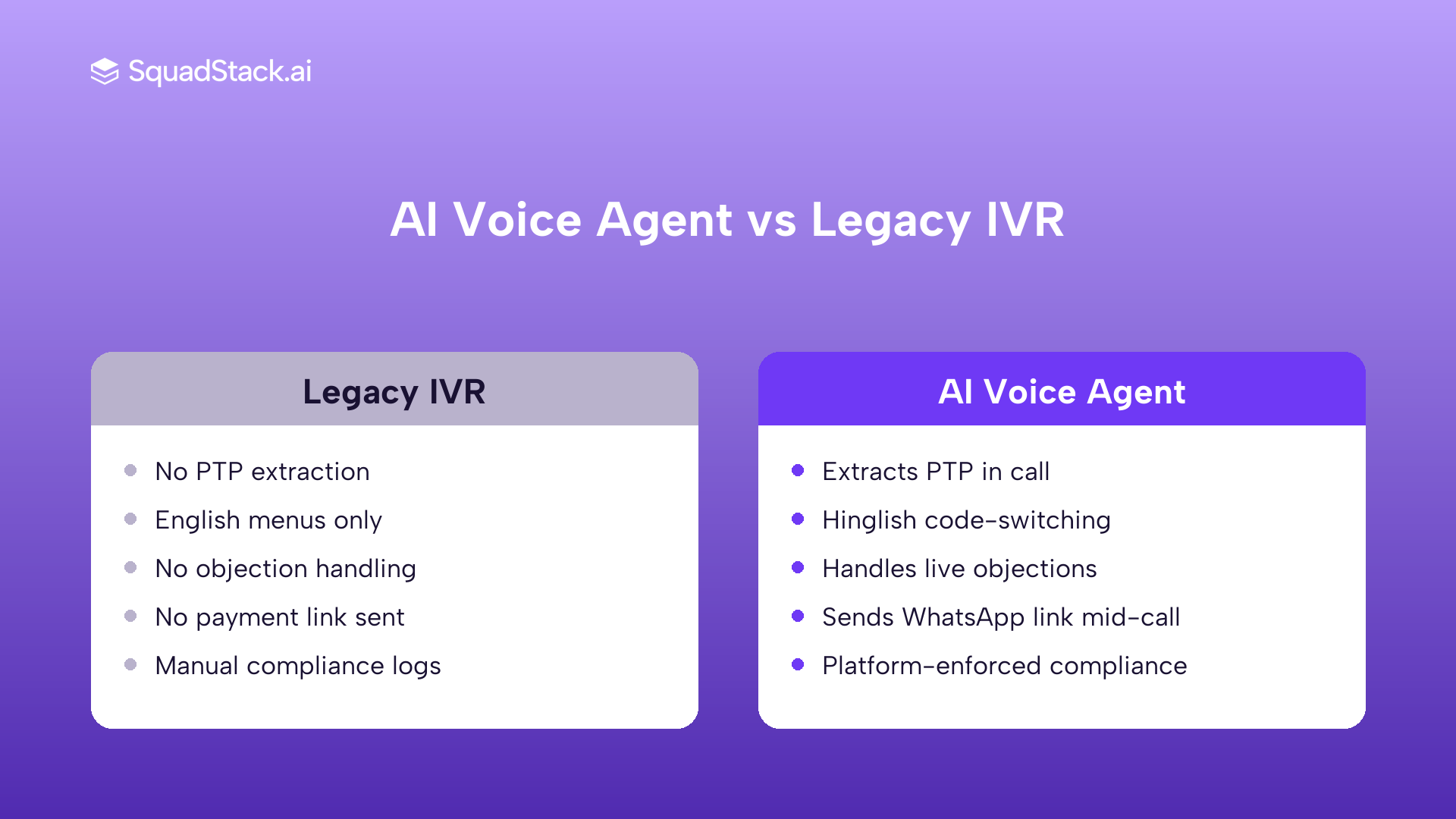
| Dimension | Legacy IVR | AI Voice Agent |
|---|---|---|
| PTP extraction | Cannot extract a PTP. Can only play a reminder and wait for a keypress | Extracts PTP with amount, date, and borrower confirmation in a single call |
| Hinglish and code-switching | Reads a pre-recorded script in one language. A borrower who replies in Hinglish triggers "option not recognised" | Understands and responds in Hinglish mid-sentence, the way a real agent does |
| Objection handling | Falls back to "press 1 to speak to an agent" on any off-menu response | Works multi-step objections live: salary delay, mandate failure, wrong account, hardship |
| Call escalation | Routes to queue based on keypress. No context passed | Detects sensitive-case keywords, passes full transcript and confirmed PTP details to the human picking up |
| Payment link delivery | Cannot act during the call | Sends a WhatsApp payment link while the borrower is still on the line |
| Compliance controls | Calling window is a scheduling rule. No in-call consent or AI disclosure | Calling window is hard-enforced by the platform. AI disclosure and consent gating are built into the dialogue layer |
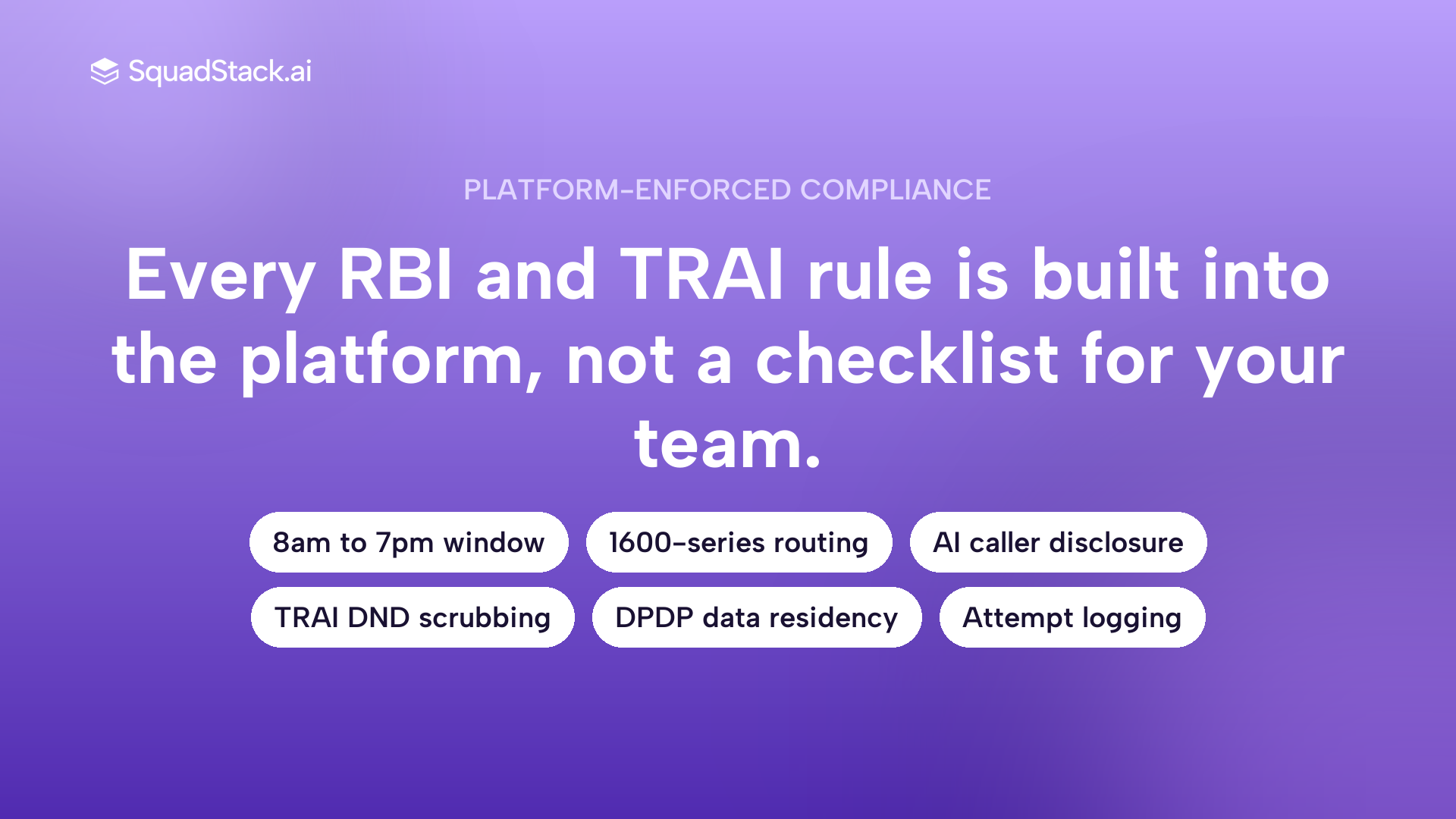
Calling window. Recovery contact is permitted between 8am and 7pm only. SquadStack's platform hard-blocks out-of-window dialing at the system level. This is not a configuration option agents can override.
Number series. EMI and debt-collection reminders are service calls and must dial from the 1600-series, specifically the 1601 prefix for private financial entities. SquadStack provisions and manages the correct number series as part of the engagement.
AI disclosure. There is no AI-specific RBI rule yet, but RBI's FREE-AI report (August 2025) signals clear disclosure expectations. Every SquadStack collections call opens with an automated-caller disclosure, in a locked section no optimization loop can modify.
TRAI DND scrubbing. Lead lists are scrubbed against the TRAI DND registry before dialing. Clients can also upload internal DNC lists, honored the same way.
Consent and DPDP. The DPDP Rules (notified November 2025) place data-processor obligations on calling vendors. SquadStack holds ISO 27001, ISO 27701, SOC 2 Type II, and DPDP compliance, with all models hosted in India.
Draft conduct directions. RBI's February 2026 draft conduct directions targeted for July 2026 propose explicit bans on excessive or anonymous calls and mandatory attempt logging. Call-frequency capping and full attempt records are already platform features.
1. Does it actually sound human in Hinglish? Ask for a live call recording from a real collections campaign, specifically one where the borrower objected. SquadStack's speech model, Arth, is trained on 600 million-plus minutes of real Indian telephony audio including Hinglish, Tamilglish, and high-noise 8kHz line conditions. The voices are cloned from top-performing Indian collections agents, not read-speech corpora.
2. How does it handle escalation? The safest answer for a borrower who says "mujhe court jaana hai" is an immediate warm transfer to a human with full transcript and PTP context. Ask the vendor to demo it.
3. Is compliance hard-wired or advisory? Calling windows, number series, AI disclosure, and DND scrubbing should be system-level enforcements, not guidelines for the ops team to follow. Ask for the compliance audit documentation.
4. What does the QA layer look like? SquadStack's Eval System scores every call on Outcome, Sentiment, and Execution. Both AI and human reviewers audit calls against campaign-specific quality parameters.
5. Can you see PTP-kept rate, roll rate, and right-party contact rate in the dashboard? These are the three numbers that tell you whether a collections deployment is working. Call volume alone is not a collections metric.
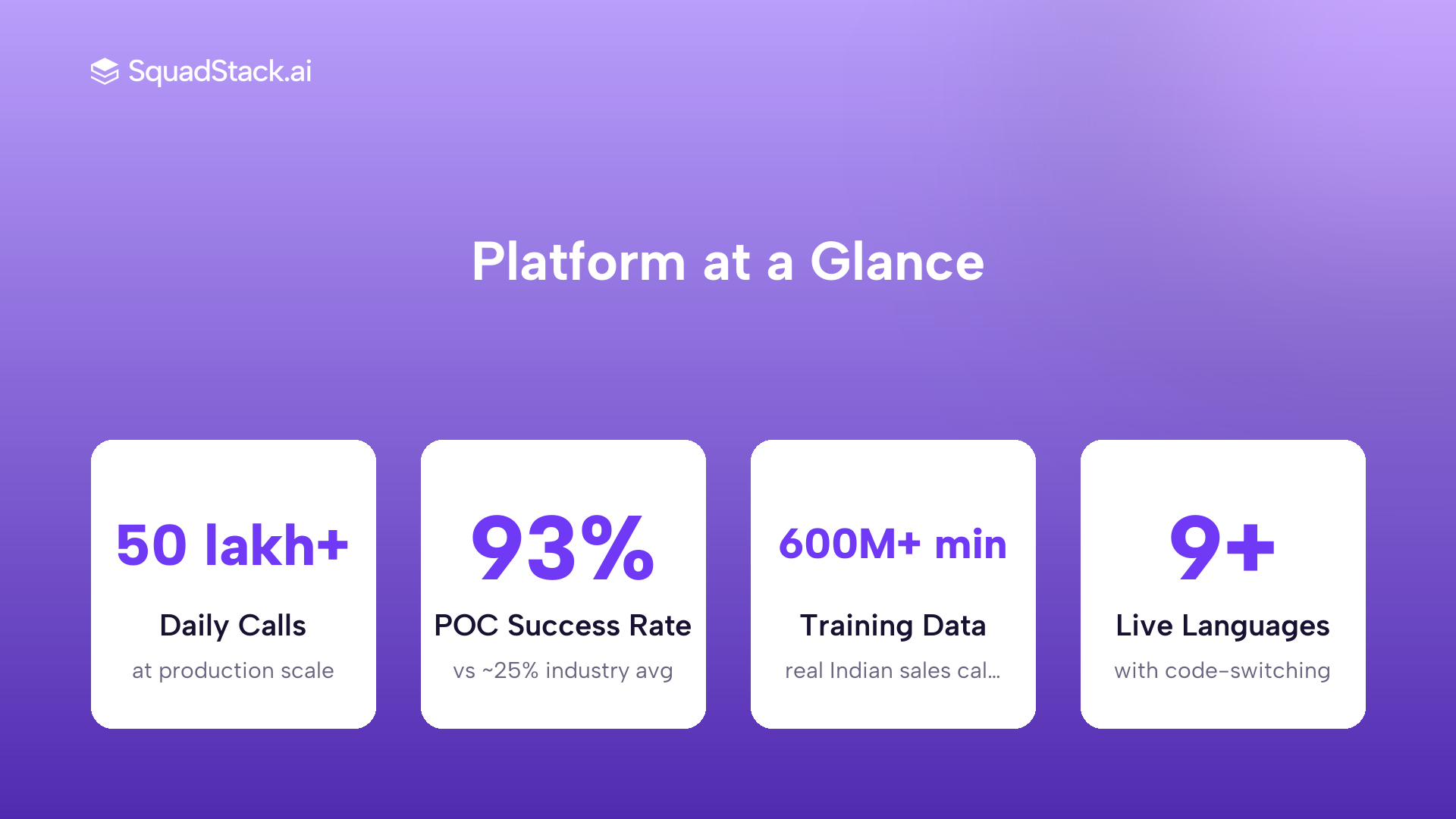
SquadStack has been running AI-assisted contact center operations for India's lending segment for close to ten years. The platform handles 50 lakh-plus calls daily across 60-plus large consumer brands. Arth, SquadStack's proprietary speech model, contains 600 million-plus minutes of real Indian sales and collections conversations spanning most Indian pincodes, built on actual 8kHz telephony audio.
For collections specifically, PhonePe's campaigns delivered a 35% PTP rate in the collections track and 20 to 30% overdue-settlement uplift in A/B tests against a live human baseline. Moneyview also runs collections on the platform. The Kissht deployment shows the go-live model: from pilot to production-grade daily volume in weeks, with Hinglish as the primary call language and compliance controls validated before the first live call. Read the Kissht case study for full detail.
Every SquadStack account runs on a dedicated squad: an AI Agent Product Manager, a Forward Deployed Engineer, a Conversational AI Designer, and a QA specialist. The platform goes live in roughly two weeks from kickoff. POC success rate is 93%, against an industry average around 25%.
An AI voice agent that covers the full lifecycle from X-bucket to NPA, in the borrower's language, inside regulatory guardrails, and with a feedback loop that improves every campaign, is a structural advantage over a human floor that can only cover part of the book each month.
If your team is evaluating loan EMI collections automation, the fastest path to a real number is a controlled A/B on your existing delinquent stock. Schedule a demo with SquadStack to see a live Hinglish collections call and design the pilot metrics together.
Which is the best AI voice agent for loan collections in India?
The best choice for an Indian NBFC or lender is a platform that is TRAI and RBI-compliant, supports Hinglish natively, and has verified collections outcomes from live Indian deployments. SquadStack runs collections for lenders including PhonePe and Moneyview, with a 35% PTP rate and 20 to 30% overdue-settlement uplift in controlled A/B tests on PhonePe's collections campaigns.
We run 20,000 to 30,000 collections calls a day in Hinglish. Will an AI voice agent sound robotic to our borrowers?
Not if the speech model is trained on real Indian telephony audio. SquadStack's Arth model is trained on 600 million-plus minutes of actual Indian contact-center conversations, including Hinglish and code-switched speech on high-noise 8kHz lines. The voices are cloned from top-performing Indian collections agents, and every dialogue line is hand-written for naturalness. At Global Fintech Fest 2025, 1,273 of 1,563 attendees could not distinguish SquadStack's AI agents from humans in a blind test.
Are there AI voice bots that support RBI and TRAI-compliant collections workflows?
Yes. Compliant deployment requires hard-enforced calling windows (8am to 7pm), 1600-series number routing for service calls, AI disclosure on every call, TRAI DND scrubbing, and DPDP-compliant data handling. SquadStack enforces all of these at the platform level, with calling windows blocked by the system, not just configured as guidelines.
Should I replace my 100-seat collections team with AI voice agents, or augment them?
For 0 to 30 DPD, full AI coverage makes sense: the call is a nudge, volume is high, and 100% same-day attempt coverage is not achievable by a human floor at reasonable cost. For 30 to 90 DPD, the right model is AI handling the phone layer while human field officers handle doorstep visits. For 90-plus DPD, sensitive-case detection and real escalation paths are non-negotiable, so AI handles outreach and human agents take the flagged accounts. The floor team's time is better spent on accounts that actually need judgment.
What KPIs should I track after deploying an AI voice agent for collections?
Track PTP-kept rate, roll rate, right-party contact rate, and cost per rupee collected by bucket. Call volume alone is not a collections metric. A platform that does not surface these in its dashboard is not built for a BFSI operations review.
How does an AI voice agent handle a borrower who wants to dispute a charge or escalate?
A well-configured agent detects escalation triggers, legal references, or hardship keywords mid-call and routes immediately to a human agent with the full call transcript, any PTP already extracted, and confirmed details passed across. The borrower does not repeat themselves. If no human is available, the agent books a callback and logs the escalation flag.
How long does it take to go live with an AI collections voice agent?
SquadStack's standard setup runs roughly two weeks from kickoff. The agent trains on the client's real call recordings and collections scripts before the first live dial. A pilot runs against a pre-agreed success metric, typically PTP rate or roll-back percentage, and scaling is gated on proving it.
Can AI voice agents send payment links during a collections call?
Yes. While the borrower is still on the line, the agent sends a WhatsApp payment link as an on-call action. The borrower receives it before the call ends, which removes the friction of finding a link later and increases same-day payment completion.
What happens if the borrower speaks a regional language the agent was not set up for?
SquadStack's agents are deployed with a defined starting language. If the borrower responds in another language mid-call, the platform's native code-switching handles the shift. Hindi, English, Tamil, Telugu, Kannada, Marathi, Malayalam, Bengali, and Gujarati are live today, with more regional languages are available on demand.
How does an AI voice agent measure PTP quality, not just PTP volume?
The platform logs every PTP with the confirmed amount, date, and borrower response. On the PTP date, the agent calls back automatically. Outcomes from that follow-up update the PTP-kept rate in the dashboard. The Eval System scores every PTP extraction call on Execution quality, so weak PTPs extracted under pressure are flagged in QA review.