.svg)






Subscriber Churn Prediction Calls: AI Voice for OTT and Streaming
October 10, 2026
|

12 min read
Learn how AI voice agents outperform IVR on balance transfer calls by personalising pitches, staying compliant, and converting faster.
TL;DR: Credit card balance transfer calls handled by voice AI let banks identify high-balance customers holding competing cards, reach them at the right moment, and pitch a personalised offer, all with RBI-compliant disclosures and full consent logging. SquadStack's AI voice agents do this across 9 Indian languages at up to 90% lead connectivity, at a fraction of the cost of a human telesales floor.
Banks already know which customers are worth targeting for a balance transfer. The problem is reaching them effectively. A customer carrying a high-balance card from a competing bank, paying 36 to 42% APR, is exactly who a new issuer wants. But the outbound call that could pitch a lower rate often never lands, because human telesales floors are expensive, their reach is inconsistent, and a scripted IVR hangs up the moment the customer says something unexpected.
This is where credit card balance transfer calls with voice AI change the economics. Not as a blunt automation play, but as a precision outbound tool that knows who to call, what to say, and when to hand off to a human.
A balance transfer (BT) is when a customer moves their outstanding credit card debt from one issuer to a new one, usually to get a lower interest rate or a zero-interest promotional period. For the acquiring bank, it is a high-margin product: the customer arrives pre-qualified by debt history and the revenue is predictable. For the customer, the math is simple but the decision is emotional, which is why the pitch has to be personal, credible, and timed correctly.
A generic "you have a pre-approved offer" script does not work. The customer needs to hear a specific reason to act now, a personalised rate, a comparison to what they currently pay, and a clear next step. That requires a conversational agent, not a menu.
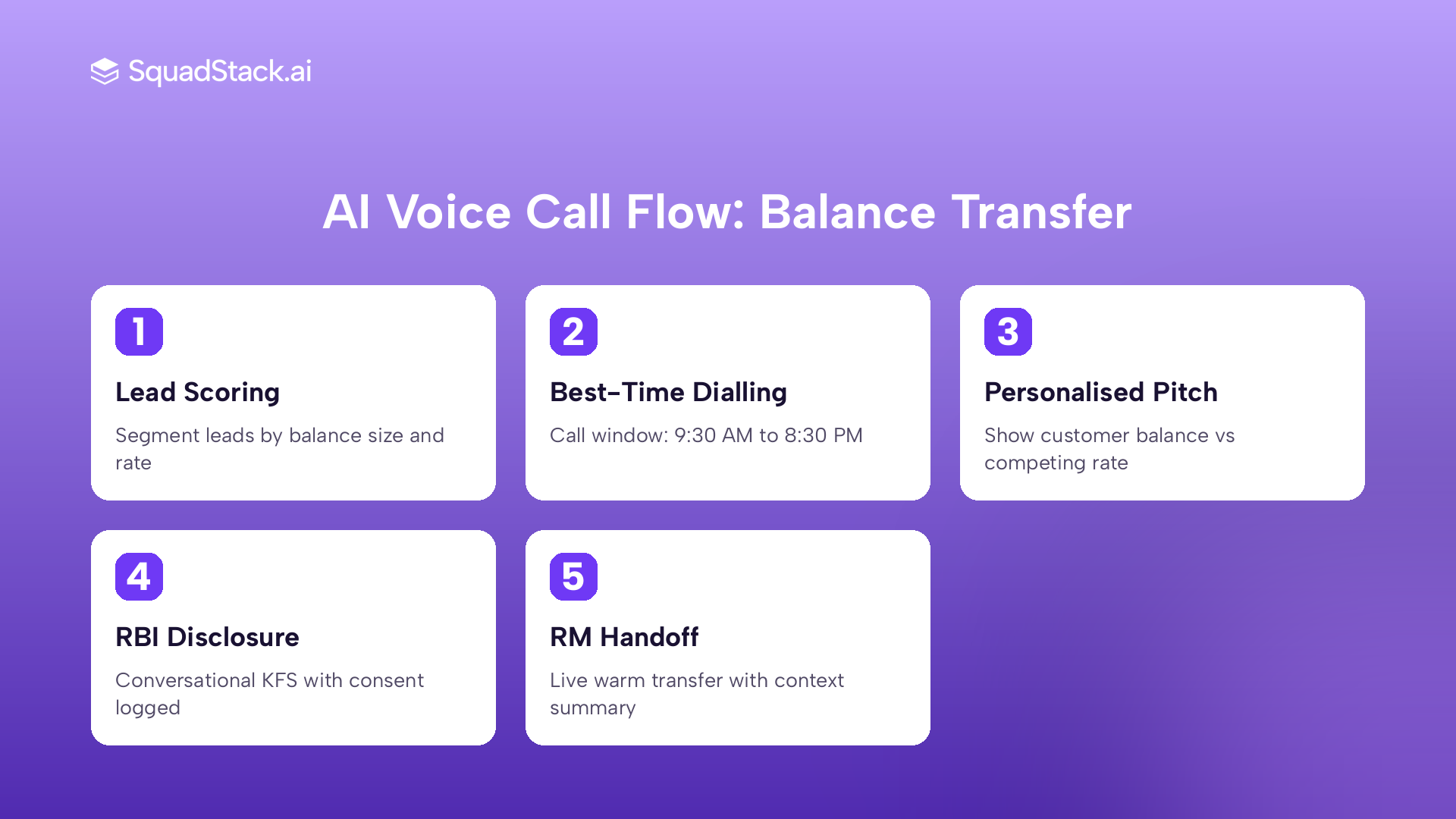
Here is how SquadStack structures a balance transfer outbound campaign from lead to conversion:
1. Identify and score the right segment. The AI Lead Manager scores customers on estimated outstanding on competing cards, tenure, and past interaction history. High-propensity accounts get dialled first.
2. Time the outreach. The platform learns when each segment picks up calls. For salaried customers, post-salary days often see higher intent. Attempts are scheduled inside the permitted 9:30 AM to 8:30 PM window, enforced by a hard platform check.
3. Open with a personalised hook. The agent opens with a reference to the customer's likely situation: high revolve cost on an existing card, a better rate now available. The pitch is built from lead context, not a one-size script.
4. Deliver the RBI-compliant disclosure. Before any offer is confirmed, the agent runs the Key Facts Statement disclosures: APR, fees, processing charges, and the cooling-off period. Consent for data use and further contact is captured and logged automatically.
5. Handle objections conversationally. Common objections ("I already have a card," "what is the processing fee," "I need to think about it") are caught in real time and answered across multiple turns, not with a single canned response.
6. Route high-value accounts to a relationship manager. Customers with a large outstanding or complex questions are handed off live to the bank's RM team with full context: what was discussed, what the customer confirmed, what the objection was.
7. Every call feeds the loop. The ROI Optimizer scores each outcome, extracts entities (offer accepted, amount confirmed, objection type), and updates the system. Script, voice, timing, and follow-up cadence improve based on what the previous round produced.
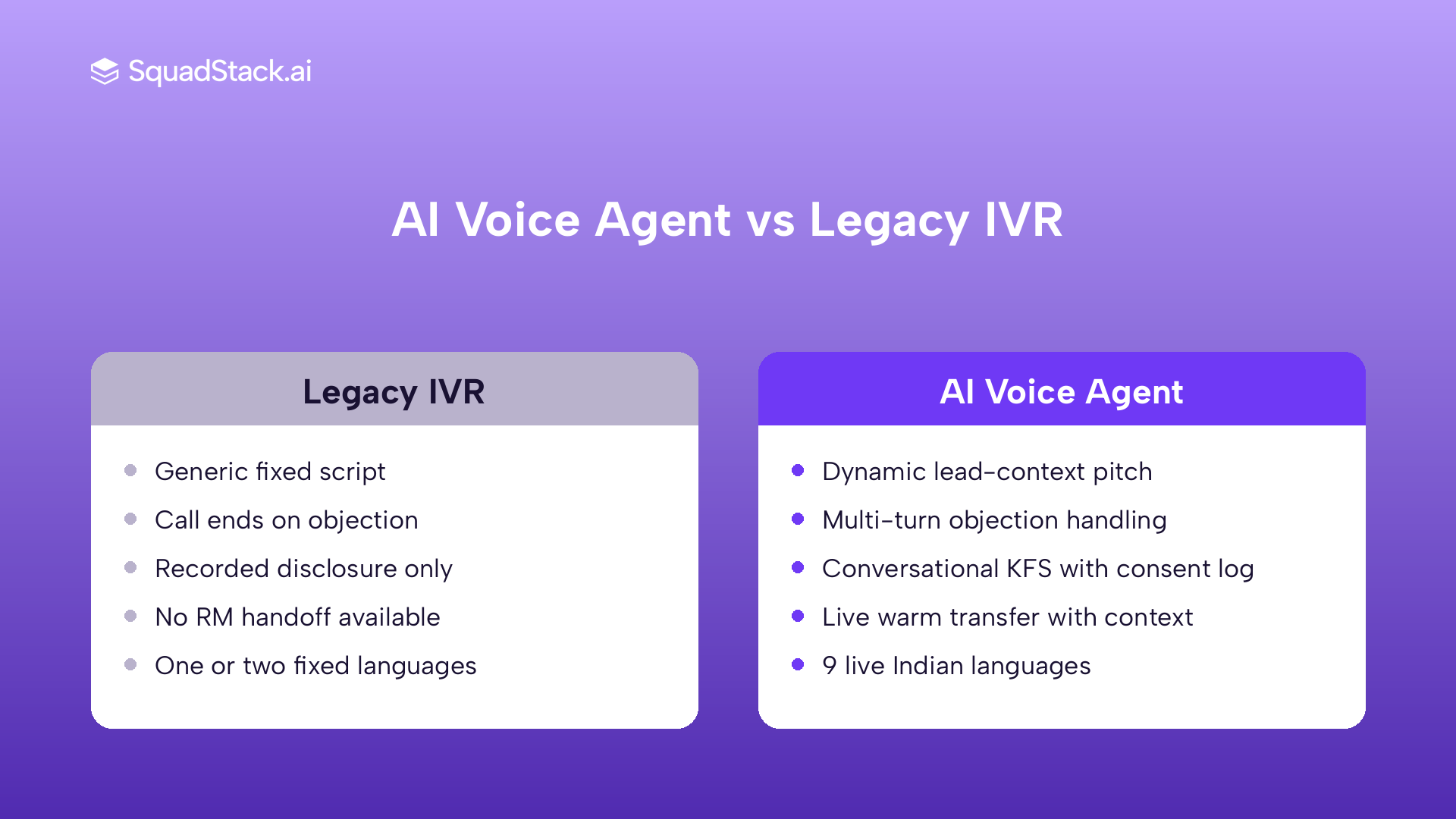
The distinction matters because most banks still use IVR trees for outbound nudges. Here is how they compare on the balance transfer use case:
| Dimension | Legacy IVR | AI Voice Agent |
|---|---|---|
| Offer personalisation | Same message to every customer regardless of balance or card history | Pitch tailored to each customer's estimated outstanding and competing rate |
| RBI disclosure delivery | Pre-recorded statement, no confirmation of comprehension | Agent confirms understanding, logs consent on call, adapts pace to the customer |
| Objection handling | Customer says "not interested" and the IVR ends the call or loops | Agent identifies objection type (rate concern, timing, competing offer) and responds across multiple turns |
| RM handoff | Not possible mid-call | Live warm transfer with full call context passed to the RM |
| Language | Usually one or two fixed language options | 9 live Indian languages with native mid-sentence code-switching |
| Response latency | Recorded prompt, no real-time generation | Median 0.8 seconds or less, so the conversation feels natural |
An IVR cannot tell the difference between a customer who said "I'll think about it" because the rate was too high and one who said it because they were driving. An AI agent hears both, asks a follow-up, and routes them differently. On a product where the entire pitch hinges on a specific rate comparison, that difference determines whether the call converts.
Voice AI for balance transfer is not a single campaign type. Banks use it across several specific moments:
Competitor card holders on the existing base. Customers holding a third-party card with high outstanding are often identifiable through salary credits, aggregator data, or bureau signals. This segment is one of the highest-yield BFSI outbound programmes because the prospect is already credit-proven.
Post-limit-enhancement cross-sell. A customer who just received a limit increase is in an active financial mindset. A balance transfer offer at this moment, consolidating other card dues, has a strong conversion rationale.
Win-back on closed accounts. A customer who closed a card after foreclosing a balance is a prime win-back target. The agent can open a conversation about the current rate environment without sounding like a cold call.
Rate-revision timing. When the bank revises its promotional rate downward, an automated push to the high-balance segment can move applications quickly before the window closes.
Defence against competitor BT campaigns. When a competitor runs a visible balance transfer offer, proactive outbound on your own revolving base can lock in renewals before the competing pitch lands.
For more on how SquadStack handles the full lending and credit card lifecycle, see the Lending and Credit industry page.
Balance transfer calls have specific requirements most generic voice platforms do not address:
Personalisation at the lead level. The offer must reference the customer's actual situation. Look for dynamic prompt loading per customer, not a single static script.
Compliant disclosure handling. RBI's Digital Lending Directions require a KFS to be communicated before commitment and consent to be explicit and logged. This must sit inside the conversation layer, not as a bolt-on recording.
Consent logging and audit trail. Regulators expect a full record of what was said, what was disclosed, and when the customer agreed, built into platform infrastructure.
Warm transfer capability. High-value customers should reach a human RM, not voicemail, with the full conversation context passed so the RM does not restart from zero.
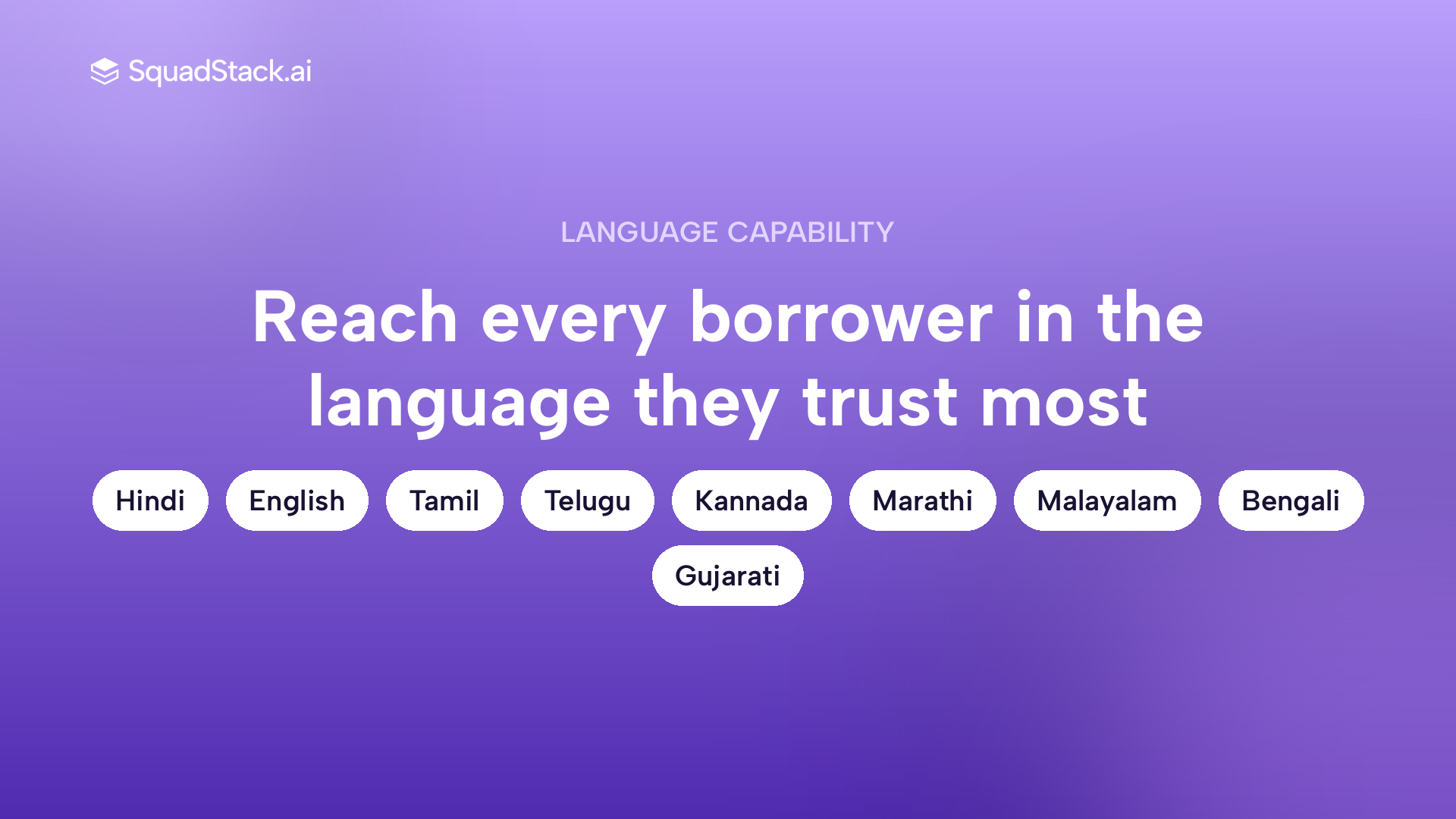
Language coverage. A campaign run only in English misses a large share of the addressable market. Native Hinglish, Tamil-English, Bengali, and other code-switched conversations are where the volume is.
Anti-spam number health. Outbound dialling from numbers flagged on Truecaller is invisible to most customers. The platform needs active number rotation and health monitoring.
SquadStack's platform is trained on 600M+ minutes of real Indian sales conversations, including BFSI outbound across lending and credit products. That corpus powers Arth, the proprietary speech model tuned for Indian telephony: noisy 8kHz lines, Hinglish, Taminglish, and regional accents that generic STT models consistently mishandle.
On compliance, consent gating, RBI disclosure scripts, opt-out honoring, and AI disclosure are built into the conversation layer and configurable per campaign. The platform is ISO 27001, ISO 27701, SOC 2 Type II, DPDP, and TRAI compliant. Calls go out only on 140-series numbers within the permitted daily window, enforced by platform hard checks.
For warm transfer, the agent passes a structured summary to the receiving RM: offer pitched, what the customer confirmed, and what concern was raised. The RM picks up an informed conversation, not a cold lead.
The Eval System audits every call on three levels: objective achievement (Outcome), how the conversation landed (Sentiment), and whether the agent ran it correctly (Execution). Quality scales without adding QA headcount.
BankBazaar uses SquadStack for credit card sales, and TATA Digital runs credit card activation and re-activation campaigns on the platform. For a detailed look at results with SquadStack's voice AI, read the Kissht case study.
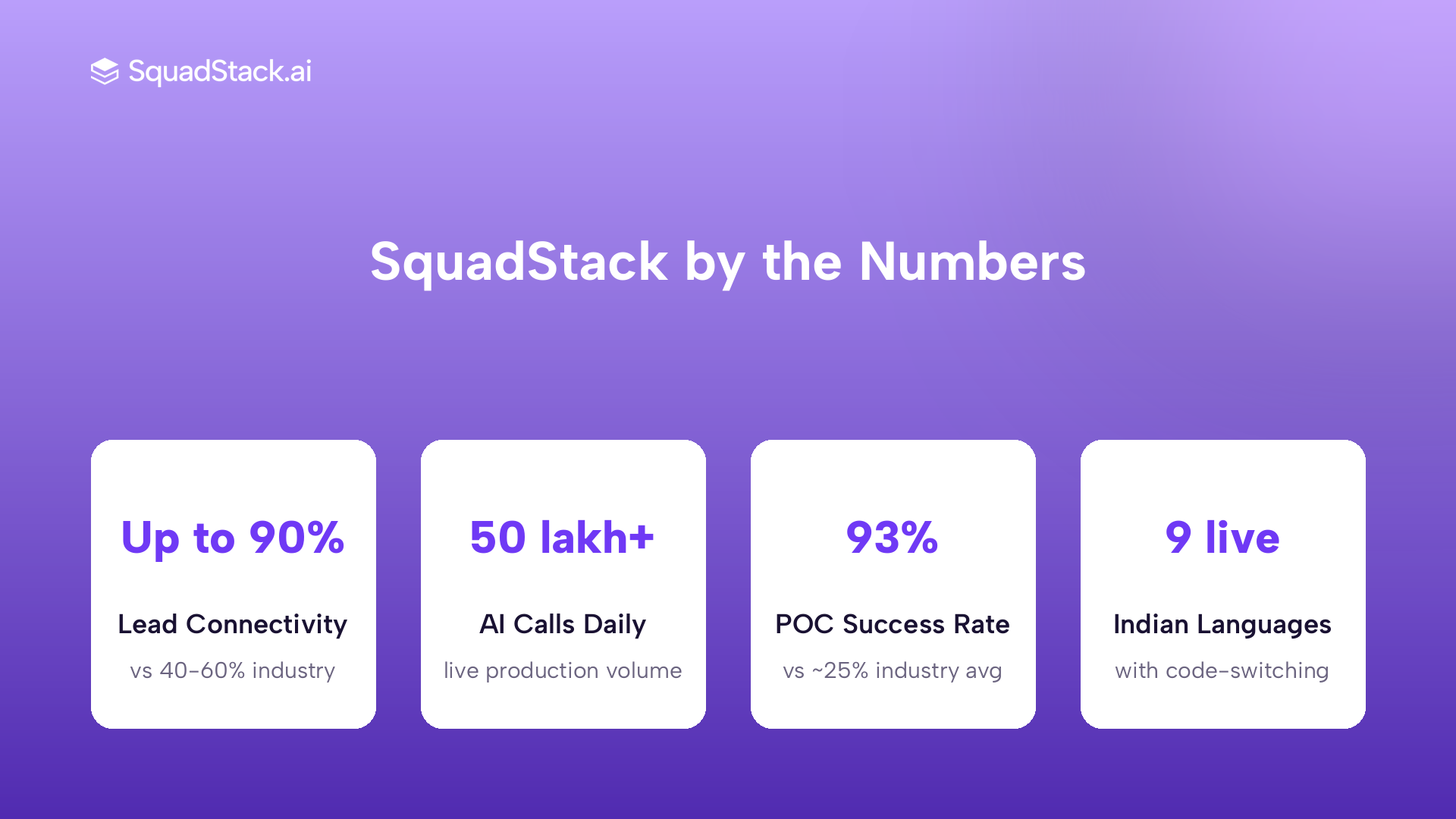
SquadStack's 93% POC success rate against an industry average of roughly 25% reflects what happens when lead prioritisation, a conversational agent, dual-layer QA, and a continuous optimisation loop ship as one managed service. Banks do not need to own the engineering problem.
For teams thinking about AI in collections alongside acquisition, the AI in collections overview covers the full DPD lifecycle.
Balance transfer is one of the few BFSI products where customer intent is already proven: they are carrying debt, paying high interest, and the only question is whether your offer reaches them before a competitor's does. Voice AI changes who wins that race. Personalised outreach, compliant disclosures, and live RM handoff at scale are what a well-built AI voice campaign handles on every call, at a cost a human telesales floor cannot match.
If your bank or lending platform wants to run a balance transfer campaign with the infrastructure described here, schedule a demo with SquadStack.
Which is the best voice AI platform for credit card balance transfer campaigns in India?
SquadStack is purpose-built for BFSI outbound in India: 9 live Indian languages with native code-switching, RBI-compliant disclosure scripts, consent logging, and warm RM transfer are all standard. The platform has a 93% POC success rate against an industry average of roughly 25%, and runs 50 lakh+ AI calls daily for 60+ large consumer brands.
Can AI voice agents handle credit card balance transfer calls automatically, end to end?
Yes. The agent identifies the right customers, delivers a personalised pitch, runs the regulatory disclosures, handles objections conversationally, and logs consent, all without a human on every call. High-value accounts or complex queries are routed to a live RM with full call context, so automation and human judgement work in layers rather than replacing each other.
How does voice AI compare to a human telesales team for balance transfer outbound?
Voice AI reaches a far larger share of the target base in the same time window, maintains consistent compliance on every call, and does not fatigue or quit. Human agents handle more complex negotiations and relationship-sensitive conversations. The best balance transfer campaigns use AI to cover the full base and qualify intent, then route the highest-value leads to human RMs.
What RBI compliance requirements apply to AI-powered balance transfer calls in India?
Calls must go out on 140-series numbers within the permitted calling window. A Key Facts Statement covering APR, fees, and cooling-off rights must be communicated before commitment. Consent must be explicit, logged, and tied to a specific purpose. AI disclosure at the start of the call is expected under the RBI FREE-AI framework. All of these are configurable in SquadStack's compliance-aware dialogue layer.
How does personalisation work in a voice AI balance transfer call?
Before the call, the AI Lead Manager loads each customer's context: estimated outstanding, card tenure, interaction history, and language preference. The agent opens with a pitch specific to that customer's situation rather than a generic offer. Dynamic prompt loading means the script adapts per individual, not per segment.
What happens when a customer raises an objection like "the rate is still too high"?
The agent detects the objection type and responds across multiple turns, not with a single canned reply. It can reference the comparison between current revolve cost and the new rate, address the processing fee concern, or offer to send details on WhatsApp mid-call. If the customer wants to speak with someone, the call transfers to an RM with full context.
How is consent captured and stored on a balance transfer AI call?
Consent is captured inside the conversation itself. The agent explicitly asks for confirmation of data use and further contact, the customer's spoken consent is recorded, and the platform logs the event with a timestamp and call ID. This audit trail is available for regulatory inspection without any manual curation.
Can the voice AI agent switch languages mid-call for a Tamil or Bengali-speaking customer?
Yes. SquadStack's agents support 9 live Indian languages, including Tamil, Bengali, Kannada, and Gujarati, with native code-switching. The agent can switch mid-sentence, the way a bilingual human agent would, because the underlying models are trained on real code-switched conversations, not translated scripts.
How quickly can a balance transfer campaign go live on SquadStack?
Most campaigns go live in approximately two weeks. The build includes training the agent on the bank's call recordings and product knowledge, configuring the disclosure script and consent flow, setting up compliance guardrails, and completing QA before the first dial. The pilot then runs on real leads over four to eight weeks against a pre-agreed success metric.
What does the RM handoff look like when a high-value customer needs human attention?
When the trigger fires (customer requests a human, a large balance is confirmed, or a complex objection is detected), the agent transfers the call live to the RM team. The RM sees a structured summary: the offer pitched, what the customer confirmed, the objection raised, and the customer's preferred next step. No information is repeated; the conversation continues from where the AI left off.