AI Voice Platform Pilot Design: How to Run a 30-Day Test
November 7, 2026
|

13 min read
Inside the JLG call workflow, dialect handling, compliance rules, and platform criteria that define effective AI voice agents for microfinance in India.
An AI voice agent built for the Grameen model in India handles pre-due EMI reminders, centre meeting confirmations, and loan top-up calls across rural and semi-urban borrower groups, in the local languages and dialects those borrowers actually speak. It replaces the field officer's phone as the first touchpoint for routine outreach, freeing human staff for the relationship work that group lending depends on. This post explains how an AI voice agent for microfinance Grameen model India deployments works, what to look for, and where SquadStack fits.
Microfinance field officers in India carry a problem no fintech dashboard shows. They spend a large part of each day calling individual JLG members to confirm centre meeting attendance, remind them about a weekly repayment, or check eligibility for a top-up loan. These are short, structured calls. The content rarely changes. But the volume is enormous, the languages are hyper-local, and the borrowers are often first-time credit users who distrust anything that sounds robotic.
That combination, structured calls at scale in vernacular languages with trust-sensitive borrowers, is precisely where a well-designed AI voice agent should operate. The question is whether any platform is actually built for it.
An AI voice agent for microfinance is a conversational calling system trained to handle the specific outreach workflows of MFIs operating the group-lending model: JLG reminders, centre meeting attendance, and top-up eligibility screening. It is not a simple IVR playing a recorded message. It holds a two-way conversation, understands what the borrower says in their own language, and adjusts its response in real time.
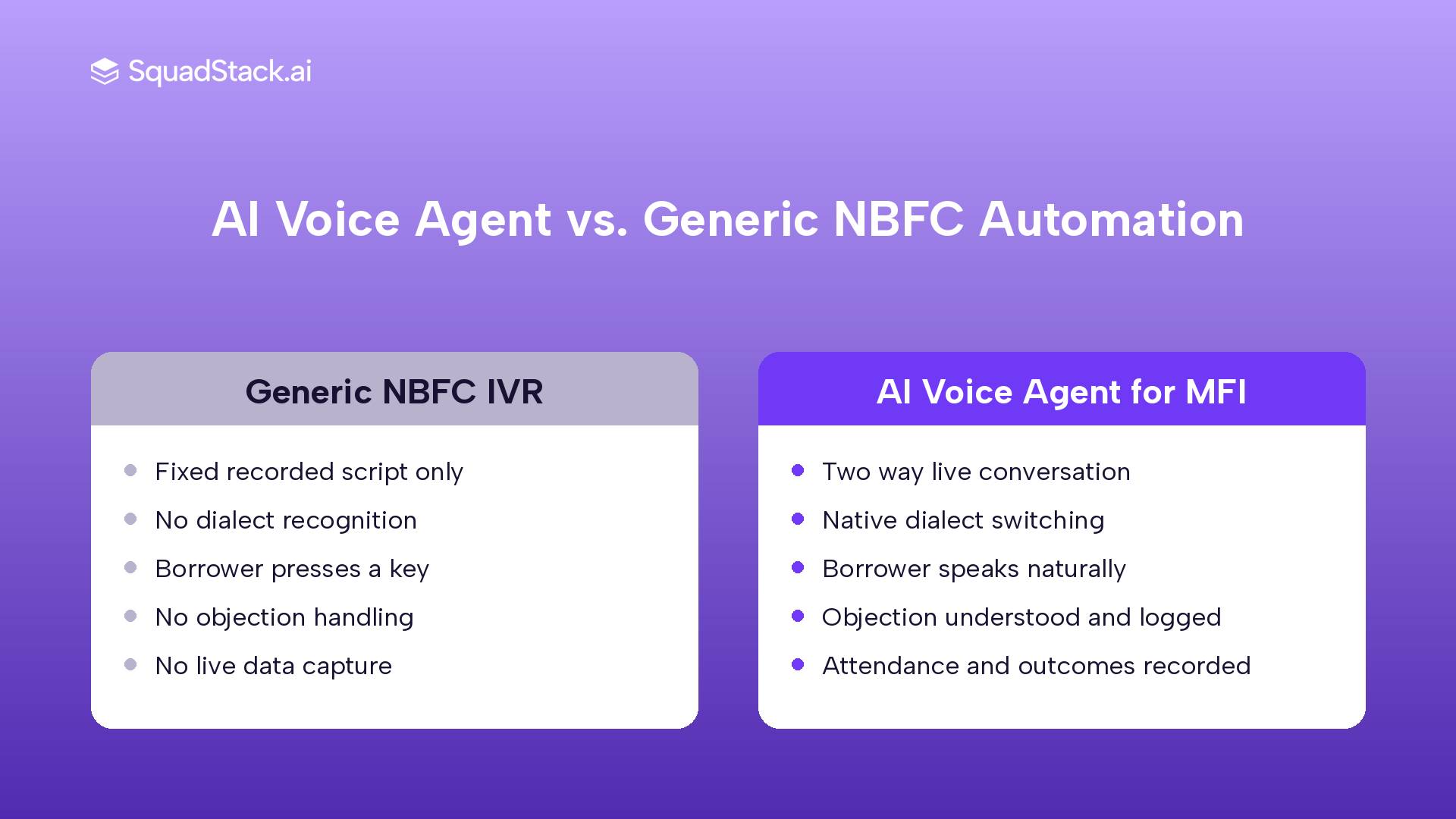
What makes microfinance different from a standard NBFC collection call comes down to three things.
Repayment cadence. Most NBFC models work on monthly EMIs. Microfinance under the Grameen model typically runs on weekly or fortnightly repayments tied to centre meeting dates. The calling workflow must match this cycle, not the calendar month.
Group dynamics. A JLG borrower's repayment is socially tied to the group. Reminders that feel coercive or impersonal can damage the centre relationship. The voice agent's tone must be supportive and conversational.
Language and literacy. Rural MFI borrowers in West Bengal speak Bengali with Rarhi or Rangpuri dialect markers. Borrowers in eastern UP or Bihar often use Bhojpuri rather than standard Hindi. A voice agent that sounds like a newsreader gets dismissed immediately.
RBI's Microfinance Directions 2022 add a compliance layer: MFIs must communicate pricing transparently, keep collection practices non-coercive, and provide easy grievance redressal. Any AI script in an MFI context must honor these constraints by design.
Here is a typical pre-due EMI reminder flow for a centre with 20 JLG borrowers across four groups.
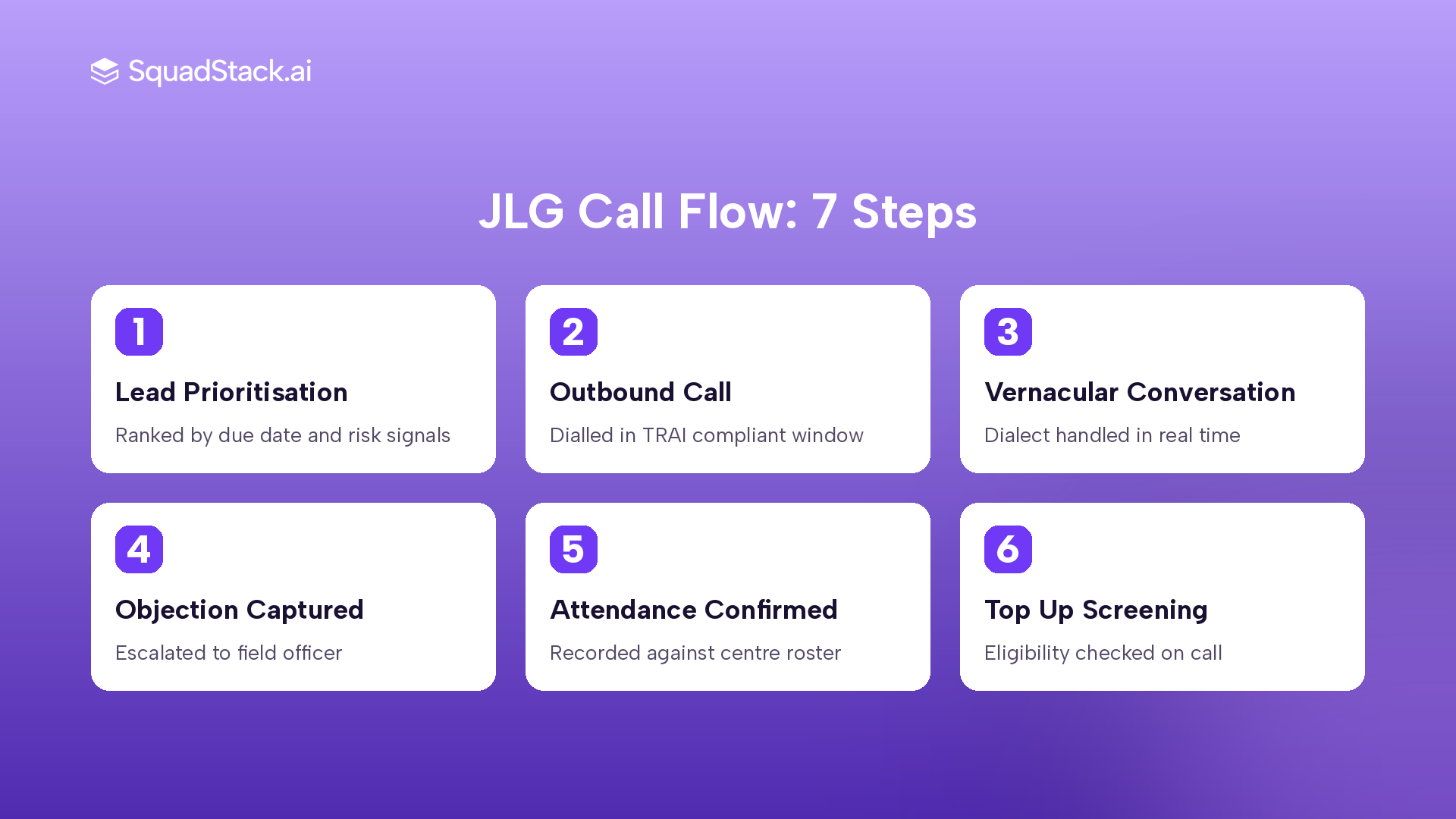
Step 1: Lead prioritisation. The AI Lead Manager ingests the repayment schedule and ranks borrowers by due date, past attendance patterns, and risk signals. Borrowers with a prior missed meeting get prioritised for an earlier call.
Step 2: Outbound call at the right time. The system dials within the TRAI-compliant window (9:30 AM to 8:30 PM), picks the best time based on when similar borrowers in that geography typically pick up, and uses dedicated numbers. Calls go out two to three days before the centre meeting date.
Step 3: Vernacular conversation. The agent opens in the borrower's registered language. If the borrower responds in a dialect or switches mid-sentence, native code-switching keeps the conversation going. The agent confirms the meeting date, asks about repayment readiness, and captures any concerns.
Step 4: Handling objections. A borrower who says the harvest was late and payment will be delayed triggers a structured response: the agent notes the concern, confirms it will be passed to the field officer, and books a follow-up call. It does not push or threaten. Compliance-aware dialogue keeps the conversation within RBI's non-coercive guidelines.
Step 5: Centre meeting confirmation. The agent asks whether the borrower will attend the meeting, records the response as a structured entity, and updates the field officer's dashboard before the meeting date.
Step 6: Top-up eligibility screening. For borrowers nearing the end of a loan cycle, the agent runs a short eligibility check: tenure with the centre, repayment status, and interest in a renewal or top-up. Qualified responses are flagged for the loan officer.
Step 7: Continuous learning. Every call outcome feeds back into the ROI Optimizer. Scripts that prompt more confirmations, voices that get higher engagement in a dialect, and timing patterns that produce better connectivity all update automatically. Each round of calls is sharper than the last.
The three MFI use cases where voice AI adds the most value are narrow but high-frequency.
Pre-due EMI reminders. These calls happen every week at scale. Even a modest centre network generates thousands of calls per cycle. Automating these frees field officers for centre visits and escalations.
Centre meeting attendance confirmation. Missed attendance is an early warning sign in the JLG model. A voice agent calling two days out and capturing a yes or no gives the field team time to intervene before a centre defaults.
Loan top-up eligibility and renewal. This is a revenue call for the MFI, and it is time-sensitive. Borrowers not contacted at the right moment in their cycle often go to a competitor. A voice agent can run top-up screens across the whole portfolio, identifying warm leads for loan officers without manual outreach.
For MFIs operating in lending and credit, this combination covers the highest-volume outreach touchpoints in the entire borrower relationship.
For a rural microfinance borrower, an IVR is often the end of the conversation. A comparison shows why.
| Dimension | Traditional IVR | AI Voice Agent |
|---|---|---|
| Language handling | Fixed language options; no dialect recognition | Native code-switching across Hindi, Bengali, and other supported languages; handles dialect variation mid-call |
| Borrower response | Presses a key to confirm or hangs up | Speaks naturally; the agent understands and responds |
| Objection handling | Cannot process an unscripted response | Detects concern, responds with relevant information, escalates to field officer if needed |
| Attendance confirmation | Plays a message; no two-way capture | Asks, records response as structured data, updates the dashboard |
| Literacy requirement | Requires reading a keypad menu | Fully voice-based; no reading required |
| Trust signal | Feels like a machine; high early-disconnect rate | Conversational tone, human-cloned voice; disconnect rates comparable to human agents |
The IVR fails at the first human response. A borrower who says "mera naam galat hai" or asks about the meeting location gets nothing useful back. The AI agent handles both.
This distinction matters specifically for AI-driven collections and reminders, where conversational ability determines whether the call achieves its purpose.
MFI-specific deployments have requirements most generic voice AI platforms are not built for.
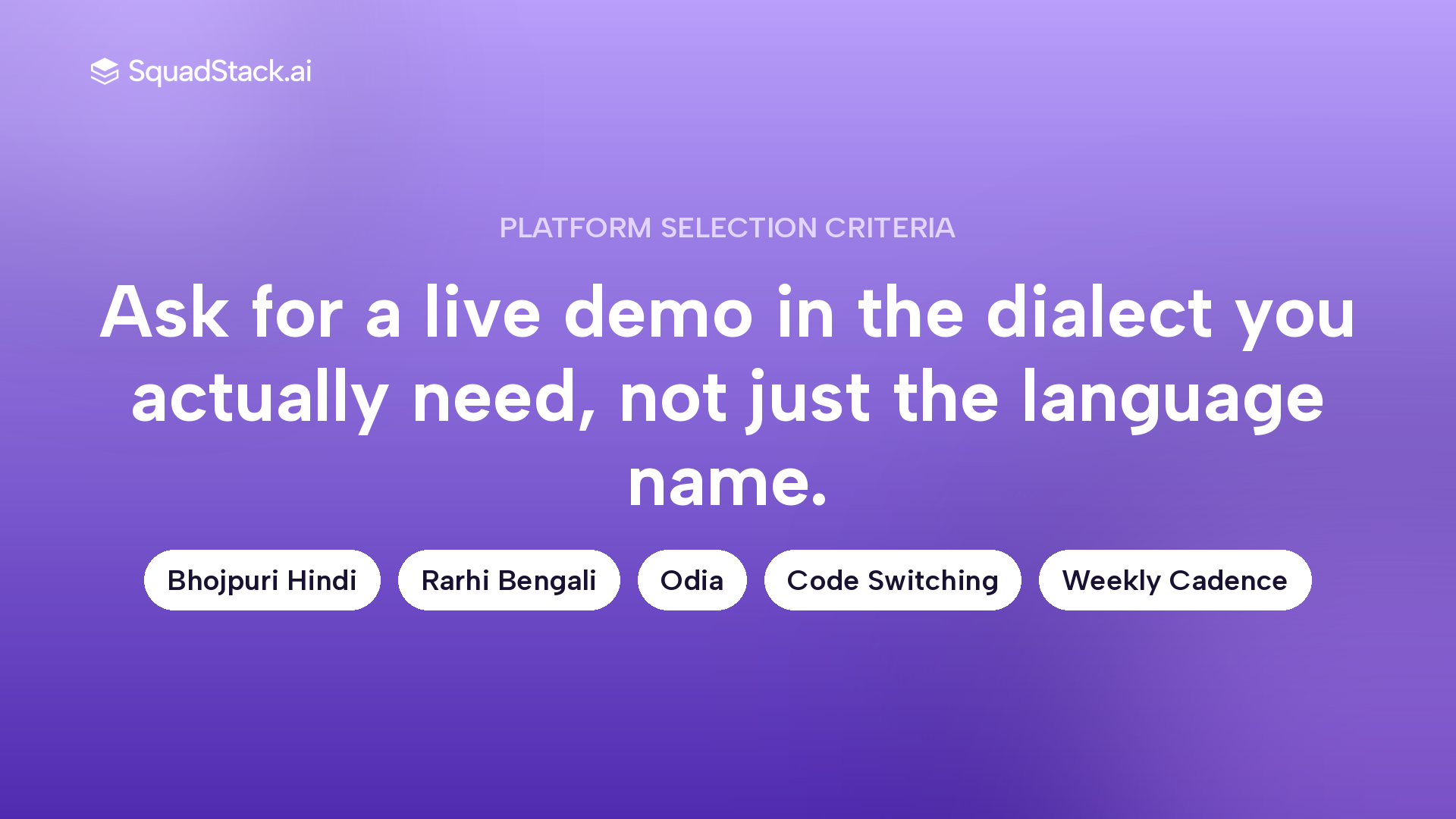
Vernacular depth, not just language count. A platform listing "Hindi" as supported may mean standard Delhi Hindi. Bihar, West Bengal, and Odisha MFI portfolios need Bhojpuri-inflected Hindi, Rarhi Bengali, and natural code-switching. Ask for a live demo in the dialect you actually need.
Weekly cadence support. Most platforms assume monthly EMI cycles. Check whether dialing logic and retry cadence can be configured for weekly repayment schedules and fortnightly centre meetings.
Compliance-aware dialogue. RBI's Microfinance Directions 2022 and MFIN self-regulatory standards require non-coercive language, transparent pricing communication, and consent handling. These constraints must live in the script logic, not in a post-call review.
Low-literacy borrower experience. Voice-only flows are essential. Any agent that relies on IVR menus, SMS links, or app interactions will fail with borrowers who have limited smartphone literacy.
Integration with field officer workflows. Call outcomes need to reach the field officer before the centre meeting, via real-time CRM write-back and structured entity extraction.
Scale and latency. Rural mobile networks are noisy and patchy. A platform trained on real Indian telephony conditions performs significantly better than one tuned on clean audio. Sub-800ms response latency keeps the conversation natural even on a low-signal call.
SquadStack has processed 600M+ minutes of real Indian sales conversations to train its in-house speech model, Arth. That training data includes high-noise 8kHz telephony calls, code-switched Hinglish and Bengali, and rural caller patterns across 85%+ of Indian PIN codes. Generic voice AI platforms train on clean audio or public datasets. Arth is trained on the kind of call a microfinance borrower in Murshidabad or Muzzaffarpur actually makes.
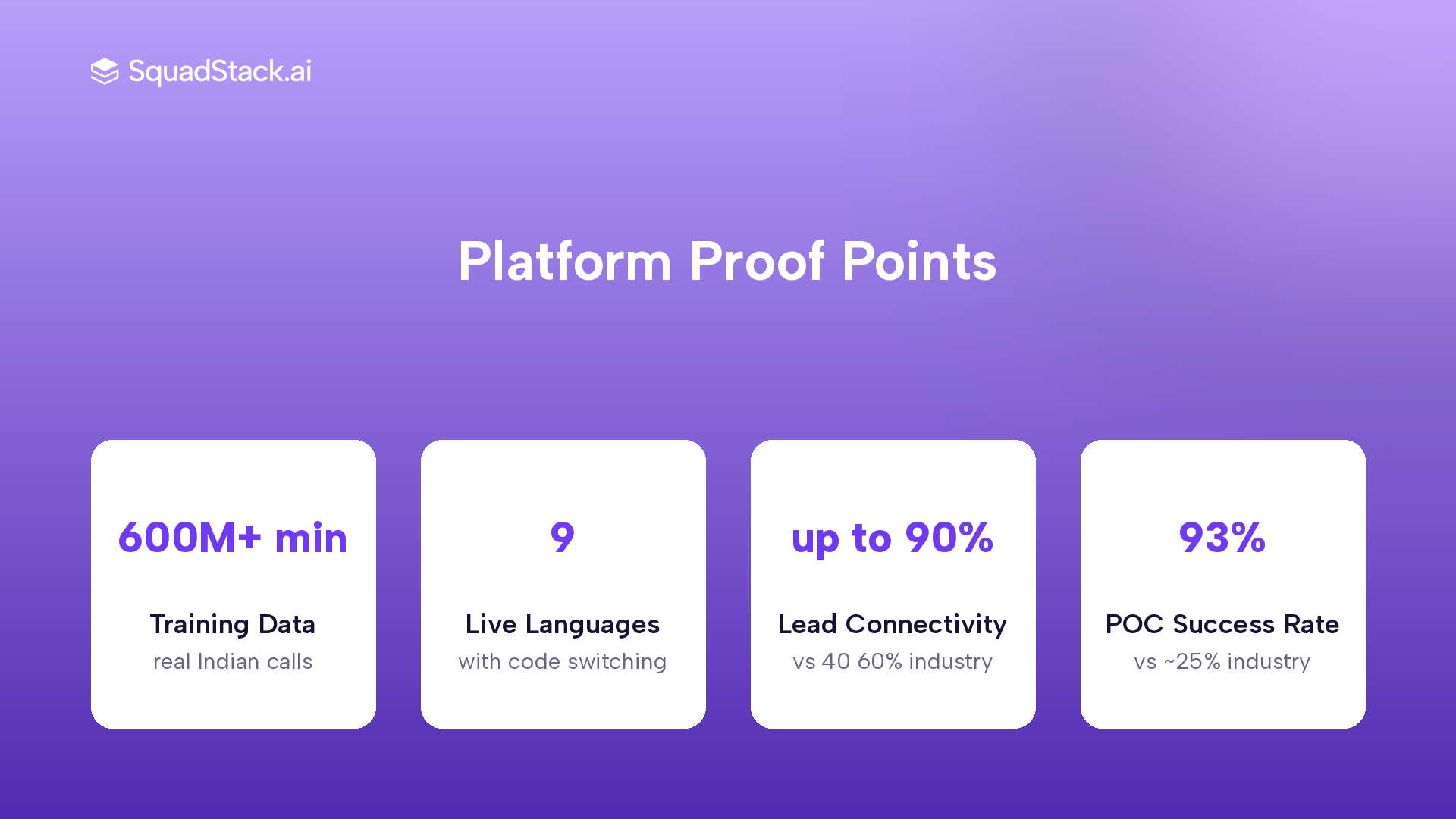
The platform supports 9 live Indian languages with native code-switching. Voices are cloned from real Indian sales agents, not read-speech corpora.
SquadStack's Eval System scores every call on three levels: Outcome (did the call achieve its purpose?), Sentiment (how did the borrower respond?), and Execution (did the agent follow the script and compliance rules?). For a regulated environment like microfinance, this catches compliance drift before it becomes a regulatory issue.
SquadStack delivers up to 90% lead connectivity against a 40 to 60% industry norm, which for a weekly JLG reminder cycle translates directly into fewer missed repayment alerts and fewer missed centre meetings.
The platform is ISO 27001, ISO 27701, SOC 2 Type II, DPDP, and TRAI compliant, with all data hosted in India. For an RBI-regulated entity, India data residency is not optional.
The Kissht case study shows SquadStack's voice AI running high-volume loan customer outreach with the compliance rigor and conversion outcomes MFIs need. Related debt collection use cases show how the same platform handles sensitive borrower conversations without eroding trust.
SquadStack's 93% POC success rate (vs roughly 25% industry average) means MFIs can run a live pilot in 4 to 8 weeks against a pre-agreed success metric, with a dedicated squad managing the build from day one.
The Grameen model runs on relationships, but it is also a volume problem. Thousands of weekly calls, across dozens of languages and dialects, with borrowers who will disconnect the moment something sounds robotic. No human team can cover that at scale without burning out. AI voice agents built for Indian telephony conditions, trained on real vernacular conversations, and designed for compliance-aware dialogue change that equation.
MFIs ready to test AI-driven outreach at scale can schedule a demo with SquadStack to see a live microfinance call flow in their borrower's language.
Which is the best AI voice agent for microfinance EMI reminders in India?
The best option for Indian MFIs is a platform trained on real vernacular telephony data, not generic audio. It needs native Hindi, Bengali, and dialect support, compliance-aware dialogue aligned to RBI's Microfinance Directions 2022, and a weekly repayment cadence, not a monthly one. SquadStack's agents, trained on 600M+ minutes of real Indian call data, are built for exactly this combination.
Can an AI voice agent handle JLG borrower calls without sounding robotic?
Yes, if the platform is trained on conversational telephony audio rather than read-speech. SquadStack's voices are cloned from real Indian sales agents, and the platform's naturalness has been validated through blind listening tests. At Global Fintech Fest 2025, 81% of attendees could not distinguish SquadStack's AI agents from human callers.
How does an AI voice agent adapt to different dialects in microfinance portfolios?
SquadStack's speech model, Arth, is trained on real Indian contact center calls covering over 85% of Indian PIN codes. It handles code-switching mid-conversation and can manage dialect variation in Hindi and Bengali. Additional regional languages beyond the nine currently live are available on demand for MFIs with specific portfolio requirements.
Is AI-based microfinance calling compliant with RBI's 2022 Microfinance Directions?
Compliance depends on how the script is designed. SquadStack's platform includes compliance-aware dialogue at the conversation layer itself: consent gating, non-coercive language guardrails, DND scrubbing, and TRAI-enforced calling windows. Scripts are custom-built per campaign, and locked sections of the script cannot be altered by the self-improvement system. The platform is also DPDP and TRAI compliant, with India data residency.
What is the difference between an AI voice agent and an IVR for borrower reminders?
An IVR plays a message and expects a keypad response. It cannot process spoken objections, handle dialect variation, or capture structured data from a conversation. An AI voice agent holds a two-way conversation, understands what the borrower says, responds appropriately, and writes outcomes back to the field officer's system, all without requiring the borrower to read a menu.
How long does it take to go live with an AI voice agent for an MFI?
Most deployments go live in 2 to 3 weeks. The setup involves training the agent on the MFI's call scripts, knowledge base, and compliance rules, then running integration and UAT before production. A 4 to 8 week pilot against a pre-aligned success metric follows, with full scaling once the metric is proven.
Can the system handle weekly repayment reminders rather than monthly cycles?
Yes. SquadStack's dialing cadence, retry logic, and scheduling are fully configurable per campaign. Weekly or fortnightly centre meeting cycles are a standard configuration option, and the system can be set to call a defined number of days before each meeting date rather than following a fixed monthly calendar.
What data does the AI voice agent capture from a borrower call?
The platform extracts structured fields defined at campaign setup: attendance confirmation (yes or no), stated repayment concern (with reason), top-up interest (yes, no, maybe), preferred callback time, and any compliance-relevant consent flags. These are written back to the MFI's CRM in real time, so field officers see the data before the centre meeting.
How does SquadStack handle borrowers who speak very little standard Hindi or Bengali?
The platform's code-switching is trained on real conversational data, not textbook language. If a borrower opens in standard Hindi but responds in Bhojpuri-inflected phrases, the agent follows without breaking the conversation. For geographies where a specific dialect is dominant, SquadStack can add regional languages based on business requirements.
Where can I read a real case study of SquadStack used for microfinance-style lending outreach?
The Kissht case study covers high-volume lending outreach with SquadStack's voice AI platform. For broader context on how AI handles collections and repayment workflows, the AI in collections overview covers the mechanics in detail.