AI Voice Agent for Microfinance: Grameen Model at Scale
November 7, 2026
|

13 min read
A closer look at designing a 30-day AI voice pilot that yields a confident scale-or-stop decision.
A structured AI voice platform pilot design for a 30-day test in India requires a clearly defined success metric, a properly sized test group, and a week-by-week plan before a single call goes out. Done right, a 30-day pilot produces enough data to make a confident scale-or-stop decision. Done wrong, it produces noise that stalls procurement for months.
Most enterprises that fail a Voice AI pilot did not fail because the technology was wrong. They failed because the pilot was designed to produce ambiguity. No baseline, no control group, a success metric agreed upon after the results came in. The 30-day window becomes a Rorschach test: optimists see green lights, sceptics see gaps, and the procurement decision drags on another quarter.
This guide is a practitioner-level playbook for running an AI voice platform pilot in India, built around the specific conditions of Indian consumer sales: TRAI compliance constraints, multilingual call flows, the DND registry, low first-attempt pick-up rates in BFSI and EdTech, and pilots run on live leads, not a lab.
An AI voice platform pilot is a time-boxed, live-traffic test of a voice AI agent against a pre-agreed success metric, run on a real lead set, usually alongside a human agent or existing IVR baseline.
The pilot is not a demo or a sandbox proof-of-concept. It is the platform running on production leads, in production conditions, measured against a benchmark you would use to justify full deployment.
In the Indian context, a 30-day window is enough to cover two or three full contact attempt cycles on a reasonably sized lead list, capture multilingual call behavior across Hindi, English, and at least one regional language, and surface TRAI/DLT compliance issues before they become campaign-level problems.
A well-structured pilot has four distinct phases. Each has a job. Mixing them up is one of the most common failure modes.
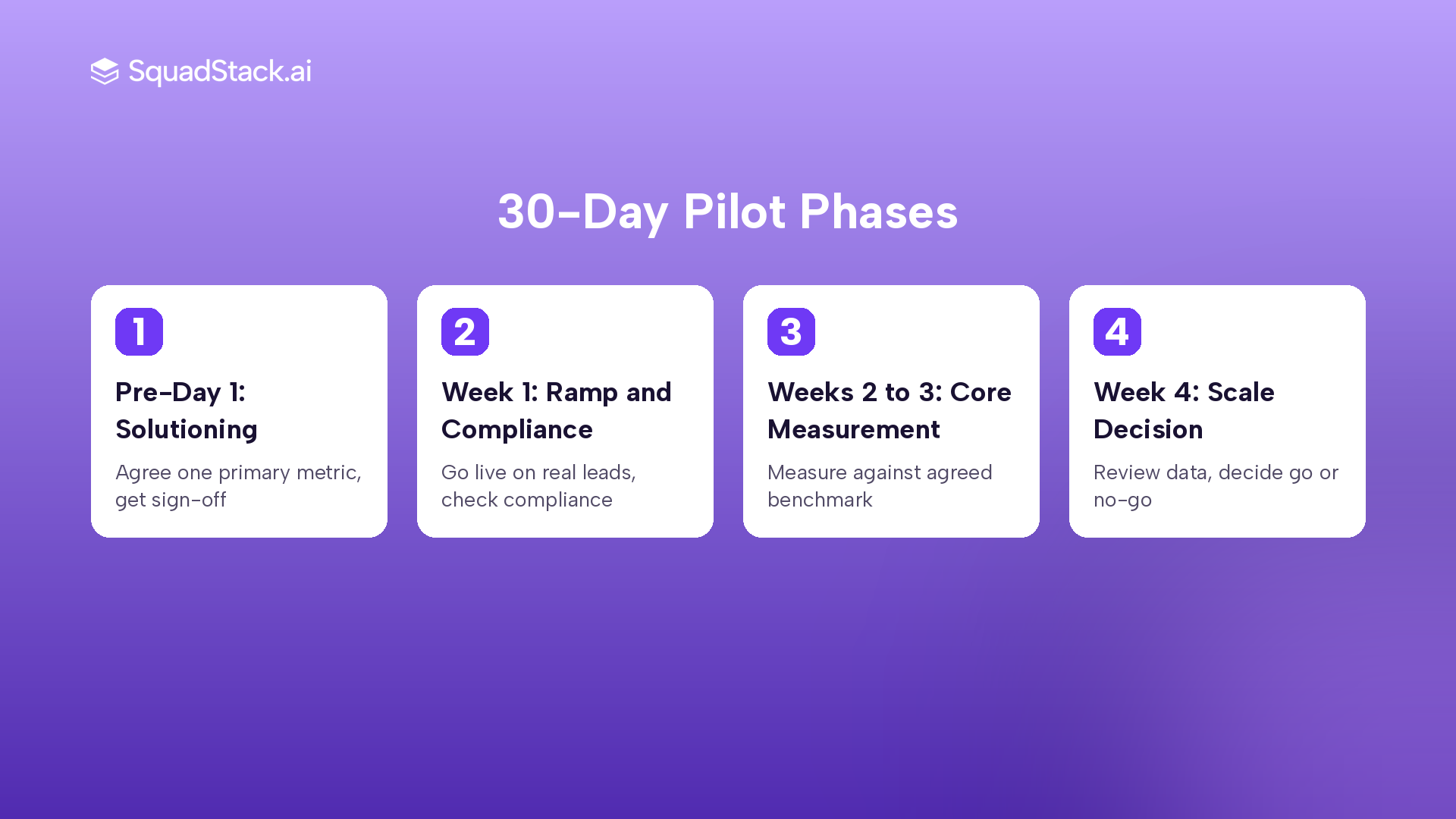
Before Day 1: Solutioning (the most important week)
Do this before any build starts. Agree on one primary success metric. In BFSI it is usually lead connectivity rate or qualified lead rate. In EdTech it is most often cost per counseling appointment. Write it down and get sign-off from every stakeholder who will review the results. If you cannot agree on the metric before the pilot, you will not agree on the results after it.
Also define: the lead source and cohort, the control group size and selection method, the baseline (last 30 days of human agent or IVR performance on the same use case), and the go/no-go threshold. What number means "scale"? What number means "stop and redesign"?
SquadStack's squad runs solutioning in this phase: use case, workflows, integrations, entity extraction fields, and compliance guardrails are locked before build begins. The agent trains on the client's own call recordings, knowledge base, and FAQs. This is why most enterprise pilots go live in two to three weeks from kickoff.
Week 1: Ramp and compliance check
Start at low volume, stepping up daily call count as the system confirms call quality, latency, entity capture, and compliance behavior. Do not read conversion metrics yet. Use this week to confirm the agent handles code-switching correctly, that the DND registry scrub is working, and that warm transfer triggers fire as expected.
TRAI compliance is a hard checkpoint in India. The platform must enforce the 9:30 AM to 8:30 PM calling window as a system-level block, not a convention, and only 140-series numbers are permitted for cold outreach. If these are not verified in week one, scale makes the problem worse.
Weeks 2 and 3: Core measurement window
This is where the pilot actually runs. Volume is at or near full test cadence. Track your primary metric daily but do not act on single-day swings. The signal you want is a stable trend by the end of week three.
Compare AI agent performance directly against the control group running on the same lead source, same time window, same cadence. A different lead list or time slot introduces confounders that make the comparison meaningless.
In BFSI pilots, the most common insight in this window is that pick-up rates differ sharply by time-of-day and language. The AI Lead Manager adapts outreach timing per lead segment based on observed pick-up patterns. Human teams on fixed calling schedules often underperform here simply because they are not adapting cadence in real time.
Week 4: Results and the scale decision
Freeze the test lead cohort. Compile results against the baseline. The output of week four is a decision, not a slide deck: scale, redesign, or stop.
The internal presentation needs three things: the primary metric vs baseline, cost-per-outcome, and at least one qualitative signal from QA. The Eval System scores every call on Outcome, Sentiment, and Execution, so you have a structured quality read, not just funnel numbers. Every call also feeds outcomes back into the ROI Optimizer, tuning script performance, voice selection, cadence timing, and follow-up sequences based on real data. The agent running in week three is measurably sharper than the one that started in week one.
The use cases that work best have a short conversion cycle (outcome observable within days, not months), a clear disposition (interested, not interested, scheduled, dropped), and a repeatable script that does not depend on highly bespoke human judgment.
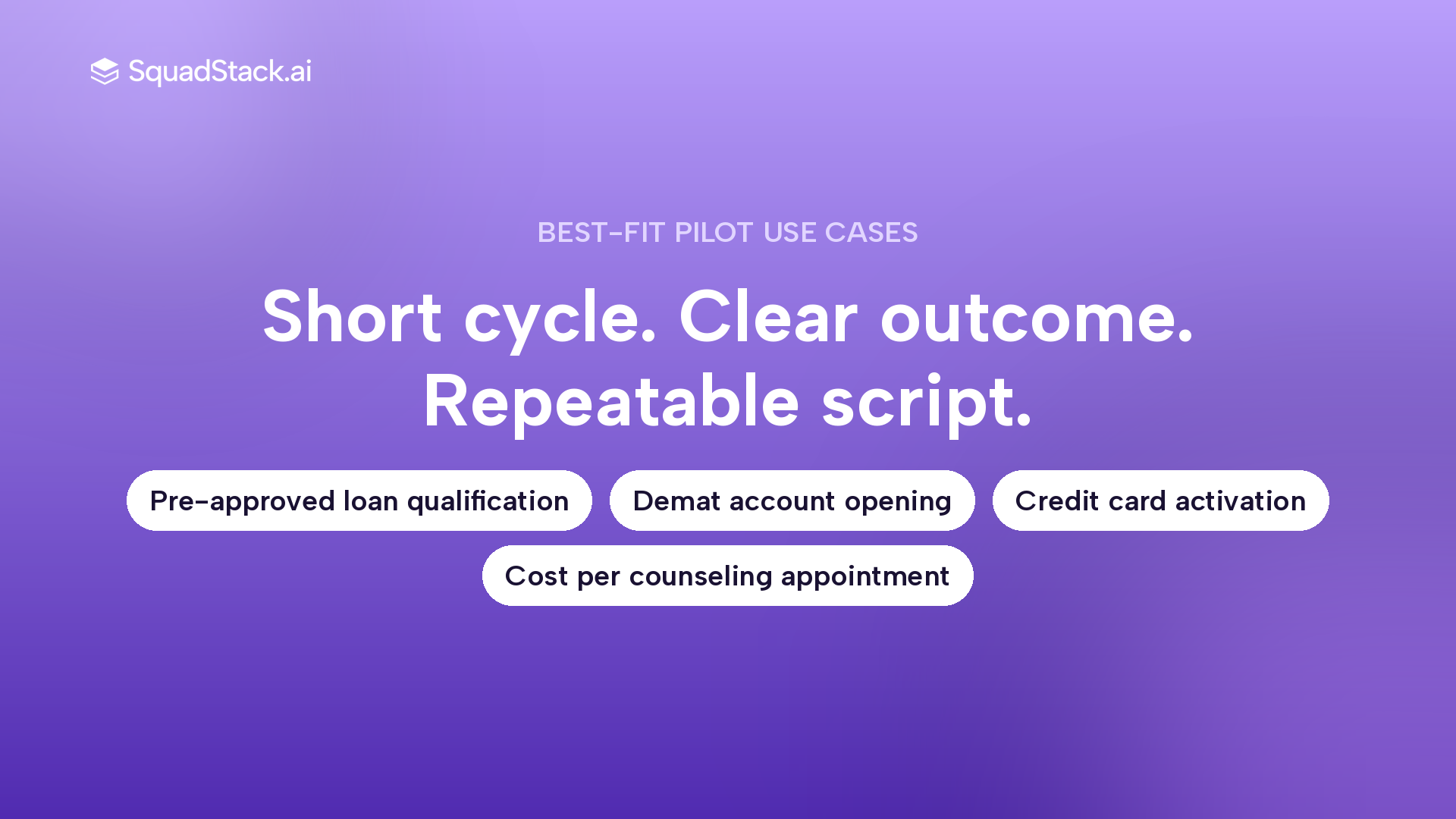
In BFSI, the strongest pilot use cases are pre-approved loan qualification, demat account opening, and credit card activation. Kotak Mahindra Bank runs personal loan sales on SquadStack's platform; IIFL runs gold loan sales to existing users. In both cases, the disposition is clear: the lead qualifies and moves forward, or does not.
In EdTech, lead qualification and counseling appointment booking are the natural starting points. Platforms including Adda247, Unacademy, and Nxtwave run lead qualification on this platform. The pilot metric is usually cost per qualified lead or appointment booked, observable within the 30-day window.
For a detailed example of how a BFSI lending pilot translates into production scale, the leading gold loan NBFC case study shows how the pilot design carried through to full deployment.
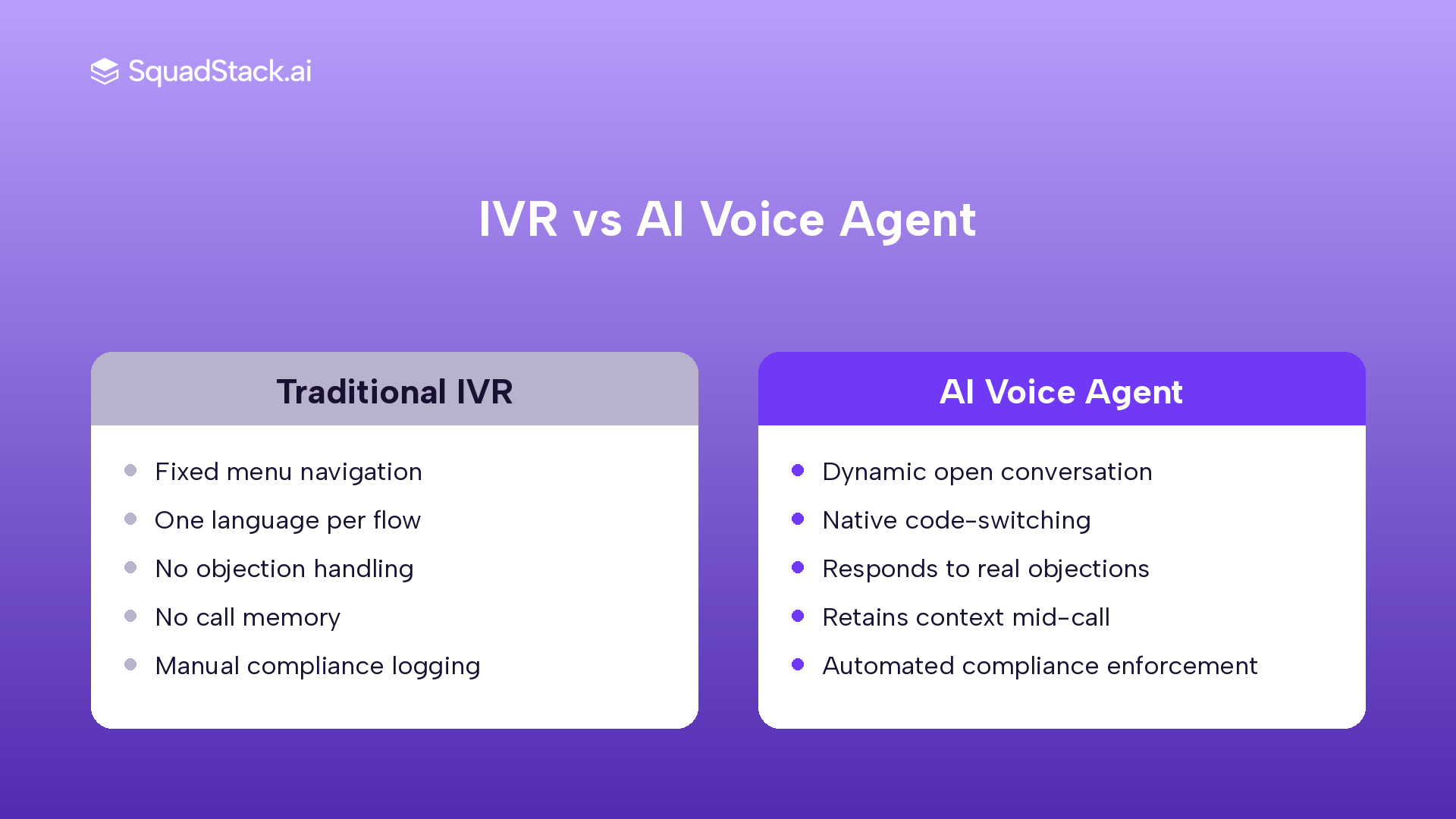
One common mistake in pilot design is comparing the AI voice agent against an IVR. An IVR is not the right baseline for a conversion-focused use case.
| Dimension | Traditional IVR | AI Voice Agent |
|---|---|---|
| Script handling | Fixed menu; caller must navigate options | Dynamic conversation; agent responds to what the caller actually says |
| Language | One language per call flow; no mid-sentence switching | Native code-switching across 9 Indian languages in a single call |
| Objection response | Plays a recorded message or dead-ends | Detects the objection live and works through it across multiple turns |
| Memory between calls | Restarts from zero on every contact attempt | Persistent memory means the follow-up call picks up from the last conversation |
| Compliance enforcement | Relies on configuration at setup | Calling window, DND, and consent gating are enforced at the system level every call |
| Pilot measurability | Dispositions are binary (pressed 1 or hung up) | Every call produces structured entities: amount confirmed, objection stated, disposition captured |
If you are replacing an IVR, use the IVR's historical metrics as baseline. If you are replacing a human team, use the human team's last 30-day numbers. The pilot design changes depending on which comparison you are making.
For a broader look at how AI voice agents compare to traditional contact center tooling, the AI tools for contact centers guide covers the category in more depth.
The platform choice matters more in India than in most markets because of three structural constraints that generic Voice AI platforms regularly underestimate.
Indian telephony conditions. Most voice AI models are trained on clean audio. Indian consumer calls happen on 8kHz telephone lines with crosstalk, background noise, and code-switched speech. A platform trained on YouTube audio will misfire on real field calls in ways that tank your pilot numbers before you can diagnose the problem.
TRAI and DLT compliance. Cold outreach in India requires 140-series numbers, DND registry scrubbing, and hard calling-window enforcement. A platform that treats these as configuration options rather than system-level controls creates compliance risk that surfaces mid-pilot.
Multilingual behavior at sentence level. Supporting Hindi and Tamil as separate languages is not the same as handling a caller who opens in Hindi and switches to Tamil mid-sentence. Platforms that stitch together separate language models produce jarring transitions that hurt pick-up rates and early-call drop-offs.
| Criterion | What to look for |
|---|---|
| Speech model training data | Proprietary Indian telephony audio, not just public datasets |
| Languages supported | At least the 9 major Indian languages, with native code-switching |
| TRAI compliance | Hard system-level enforcement, not a configurable toggle |
| Pilot methodology | Defined go-live timeline, ramp plan, and aligned success metric |
| QA infrastructure | Structured call scoring (outcome, sentiment, execution), not manual spot-checks |
| POC success rate | Ask for it directly. Industry average is around 25%. |
SquadStack's pilot track record is the most direct answer to the question of platform risk. The POC success rate is 93% against an industry average of roughly 25%. That gap comes from how the pilot is designed, not just from how the product performs.
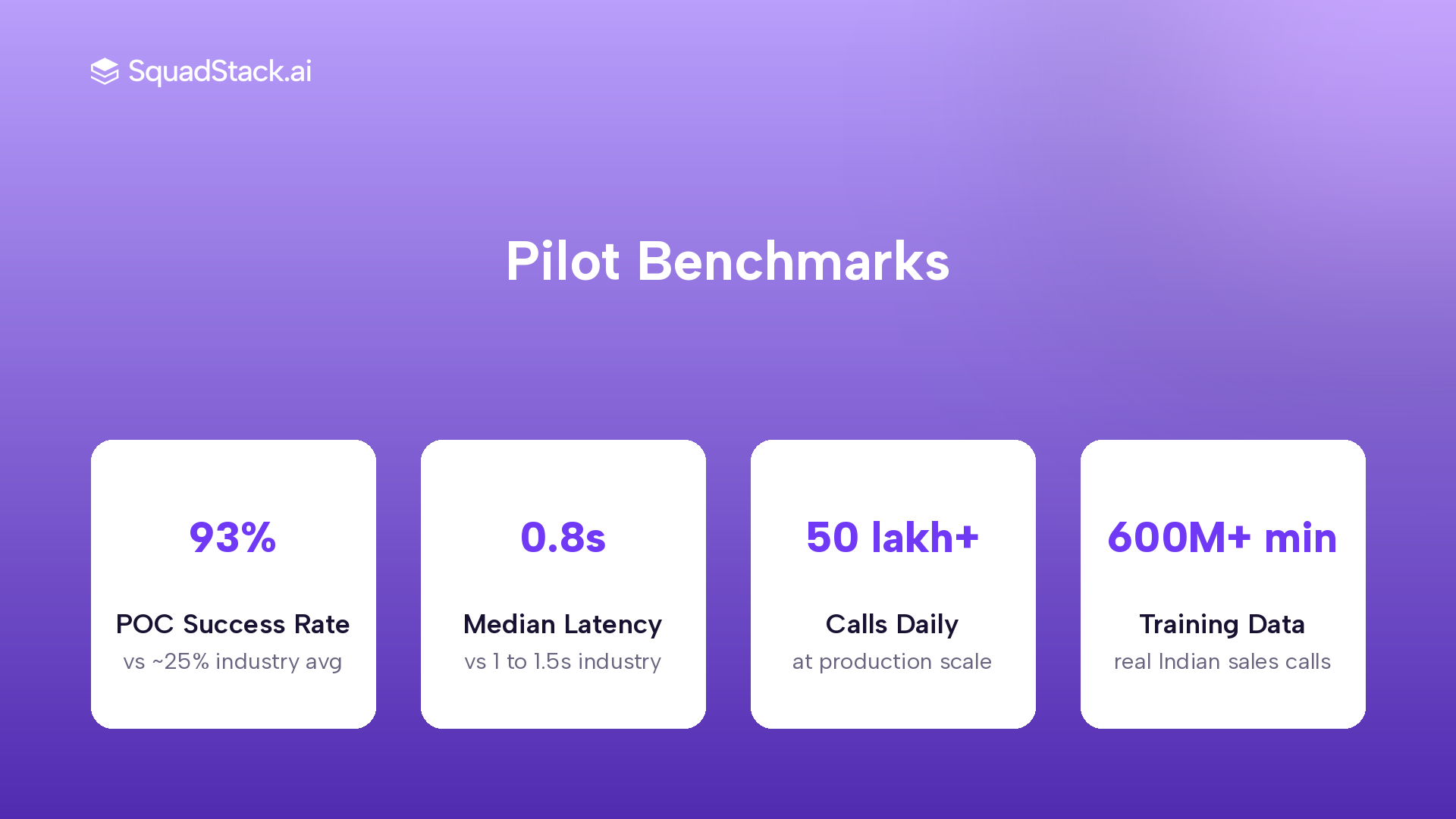
The proprietary speech model Arth is trained on 600M+ minutes of real Indian sales conversations spanning more than 85% of Indian pincodes, full-duplex, outcome-labelled, recorded on actual telephone lines. On a hard benchmark of real Indian telesales audio, Arth v1 is within 0.9 semantic WER points of the best commercial streaming STT available. Misrecognition errors in week one create disposition noise that makes results harder to read, so this matters in a pilot.
The platform runs 50 lakh+ calls daily across 60+ large consumer brands including AngelOne, Kotak Mahindra Bank, Eureka Forbes, IndiaMART, and PhonePe. Nine Indian languages are live today with native code-switching, and additional regional languages are available on demand.
Every pilot account gets a dedicated squad: an AI Agent Product Manager, a Forward Deployed Engineer, a Conversational AI Designer, and a QA specialist. Clients do not need internal AI developers to run a pilot.
The gold loan NBFC case study shows how a BFSI pilot converts into a production deployment. For the full production picture, the AI voice agent for sales automation page covers what deployment looks like beyond the pilot.
If you are ready to design a 30-day pilot for your use case, schedule a demo and the solutioning conversation starts there.
Which AI voice platform has the best pilot success rate in India?
SquadStack has a 93% POC success rate versus an industry average of roughly 25%. The difference is in pilot design: a defined success metric, a real control group, and a ramp plan before full volume goes out.
How many leads do you need for a statistically valid 30-day voice AI pilot?
You need enough leads to detect a meaningful difference between the AI agent and your baseline with confidence. A few hundred calls will not give you that. For most BFSI and EdTech use cases, a pilot cohort in the thousands gives you a stable signal by the end of week three. The exact number depends on your baseline conversion rate and the improvement threshold you need to justify scale.
What success metric should I use for a voice AI pilot in BFSI?
For pre-approved loan qualification and demat account opening, lead connectivity rate and qualified lead rate are the strongest primary metrics because they are observable within the 30-day window. Cost per qualified lead is the right secondary metric for the internal business case.
What causes voice AI pilots to fail in India?
Most pilot failures are design problems, not product problems. The most common causes: no pre-agreed success metric, no control group, reading week-one ramp data as representative, and a lead cohort that is not comparable to the human baseline. TRAI compliance gaps, accent mishandling in regional languages, and low first-attempt connectivity from spam-flagged numbers are the most common technical failure modes.
How does TRAI compliance affect a 30-day voice AI pilot in India?
Cold outreach requires 140-series numbers, DND scrubbing, and a hard 9:30 AM to 8:30 PM calling window. Platforms that enforce these at the system level, not as a configuration, prevent compliance issues from surfacing mid-pilot and inflating your drop-off numbers.
Can a 30-day pilot replace a long RFP process?
A well-designed 30-day pilot produces more reliable information than an RFP because it tests real performance on your leads, in your language mix, against your existing baseline. An RFP tells you what a vendor claims. A pilot tells you what happens.
How do I present pilot results internally to get full deployment approved?
Lead with the primary metric versus baseline, then cost-per-outcome, then a qualitative QA read. The Eval System produces structured call scores (Outcome, Sentiment, Execution) that give the QA layer credibility. The business case works best when it shows a cost-per-outcome improvement, not just a conversion lift percentage, because finance teams can model that directly into budget.
What is the typical go-live timeline for a voice AI pilot in India?
Most enterprise pilots go live in two to three weeks from kickoff. The setup covers use case alignment, agent build on the client's own call recordings and knowledge base, integrations, and UAT. The long lead time is usually on the client side: data feeds, telephony approvals, and compliance sign-off.
Does the AI agent improve during the 30-day pilot, or is performance fixed from day one?
Performance improves during the pilot. Every call feeds outcomes back into the ROI Optimizer. Script performance, voice selection, cadence timing, and follow-up sequences are all refined based on real call data. The agent running in week three is measurably sharper than the one that started in week one, which means your week-four results reflect a system that has already learned from your specific lead population.
What languages should a voice AI pilot cover for an Indian BFSI or EdTech use case?
At minimum, Hindi and English. For EdTech businesses with significant South India enrollment, adding Tamil or Telugu in the pilot cohort gives you a more representative read of full production performance. SquadStack supports 9 live Indian languages with native code-switching, so adding a language to the pilot scope is a configuration decision, not a build decision.