Voice AI Onboarding Failures: What Goes Wrong and Why
November 2, 2026
|

13 min read
Discover how AI voice EMI reminder calls in India must be designed around RBI, TRAI, and DPDP rules, from calling windows and script tone to vendor evaluation.
TL;DR: AI voice EMI reminder calls in India must follow RBI conduct rules, TRAI's number-series and DND requirements, and DPDP consent standards before a single dial goes out. Getting the script right means handling pre-due and post-due tones differently, building in dispute escalation, and validating every dialogue line on real Indian borrower data. This guide covers the full compliance and script-design playbook.
Every NBFC, digital lender, and bank running a collections floor faces the same problem. EMI reminder volumes are enormous, calling windows are tight, and the cost of a non-compliant call lands on the regulated entity regardless of who made it. AI voice EMI reminder calls in India are one of the highest-volume use cases in BFSI, and they are also one of the most compliance-dense.
This post walks through exactly what the rules require, how to build a compliant call flow, and what the scripts should actually sound like in Hinglish across pre-due and post-due buckets.
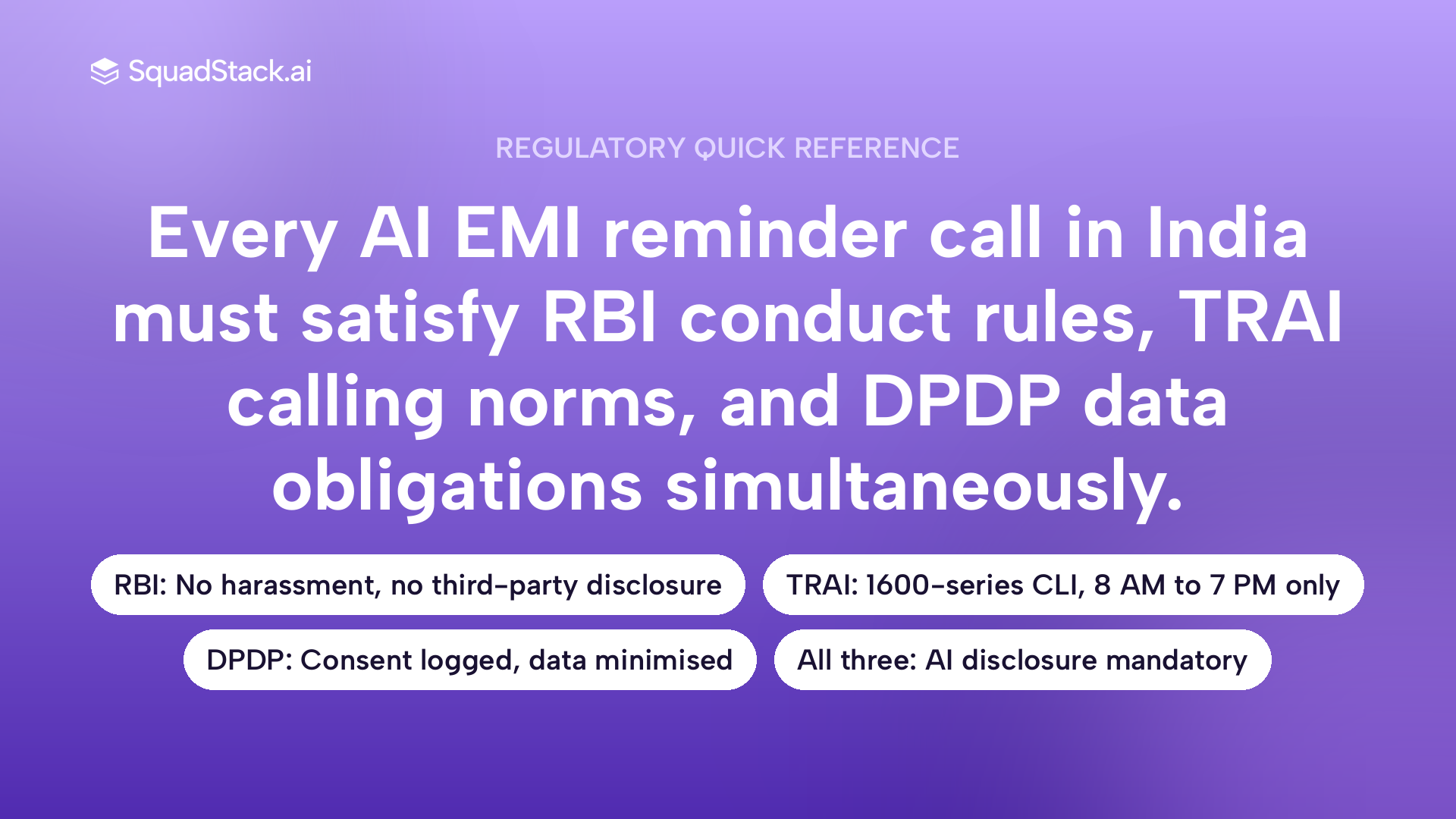
These three frameworks govern every outbound EMI reminder call, AI or human. Ignoring any one of them creates direct regulatory exposure for the lender.
RBI Collections Conduct Rules apply to any contact made on behalf of a regulated entity. Recovery contact is permitted only between 8 AM and 7 PM. The rules ban intimidation, harassment, anonymous calls, and any contact with a borrower's family or employer unless the borrower has provided those numbers as references. Crucially, the RBI holds the regulated entity fully liable for every call an outsourced vendor or AI system makes. A single complaint can freeze a collections programme.
TRAI Number Series and DND Rules are the telecom layer. EMI reminders and debt-collection calls qualify as service calls, which means they must use the 1600-series. Private financial entities use the 1601 prefix specifically. Promotional calls from 140-series numbers are not permitted for collections outreach. All numbers must be scrubbed against the TRAI DND registry before dialing, and customers can register purpose-specific DND opt-outs that must be honoured. TRAI enforcement has been aggressive, with millions of telecom resources disconnected in the last two years for non-compliance.
DPDP (Digital Personal Data Protection) rules, with penalties live from late 2026, require that the borrower's data is processed only for the consented purpose. For AI EMI reminder calls, this means the consent captured at loan origination must cover automated outreach for repayment reminders. Borrowers must be able to withdraw consent, and that withdrawal must stop the calling immediately. India data residency is expected for all processing.
One rule that many lenders overlook: before a recovery agent contacts a borrower, the borrower must be notified in advance with the agent's particulars. For AI-driven campaigns, this means a pre-call notification via SMS or email, every time, before the first dial.
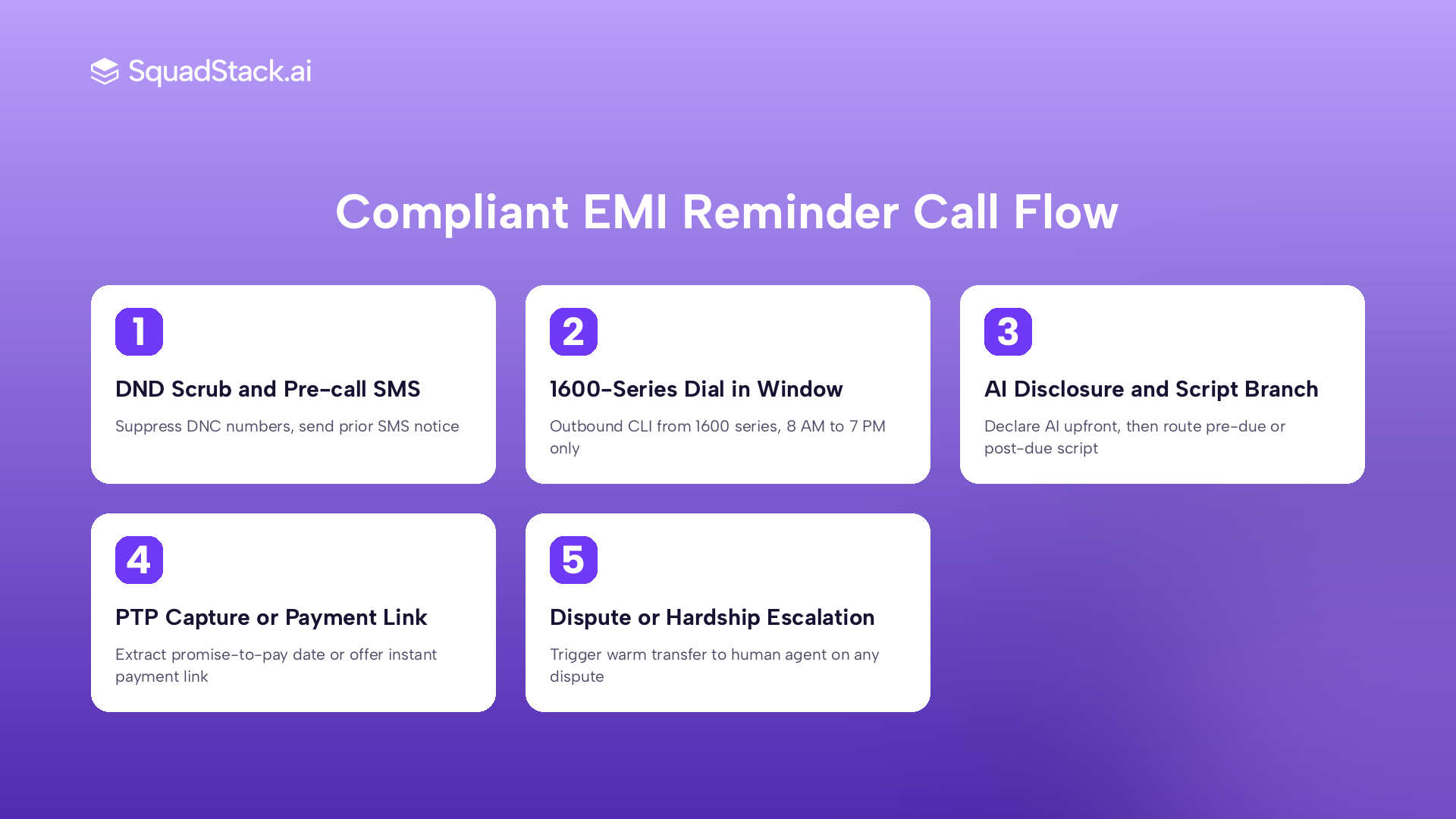
The table below maps each key rule to what it means operationally and how a compliant platform enforces it.
| Rule | What it means for EMI reminders | How to comply in production |
|---|---|---|
| 1600/1601-series only | All reminder and collections dials must come from registered service numbers | Pre-provision 1601-series numbers; never use 10-digit or 140-series for collections |
| TRAI DND scrub | Any number registered on DND must be excluded before dialing | Run an automated DND scrub on every lead batch before the campaign starts |
| 8 AM to 7 PM window | All outbound calls must land in this window | Hard system blocks on the dialer; out-of-window dials should be technically impossible, not just discouraged |
| Pre-call notification | Borrower must be informed before first recovery contact | Trigger an SMS or email notification on the day of, before the call attempt |
| AI disclosure | The borrower must know they are speaking to an automated system | Open every call with an explicit, audible automated-caller disclosure before any collections content |
| Consent for data use | Processing must match the consent captured at origination | Verify consent scope at campaign setup; build opt-out honoring into the call flow itself |
| No family/employer contact | Only the borrower may be contacted | Block any number flagged as a reference/third-party from the collections campaign list |
| Dispute and hardship escalation | Any disputed amount or hardship signal must route to a human | Build keyword and sentiment triggers for escalation into the script; never let AI handle a formal dispute |
| Call attempt logging | Compliance audit trails are required | Log every attempt with timestamp, outcome, and DND/consent status |
The most common compliance gap is not a missing rule. It is inconsistent enforcement. An NBFC may have the right policies on paper, but if the calling platform does not hard-block out-of-window dials or does not log every attempt with a timestamp, those policies cannot be proved in an RBI inspection.
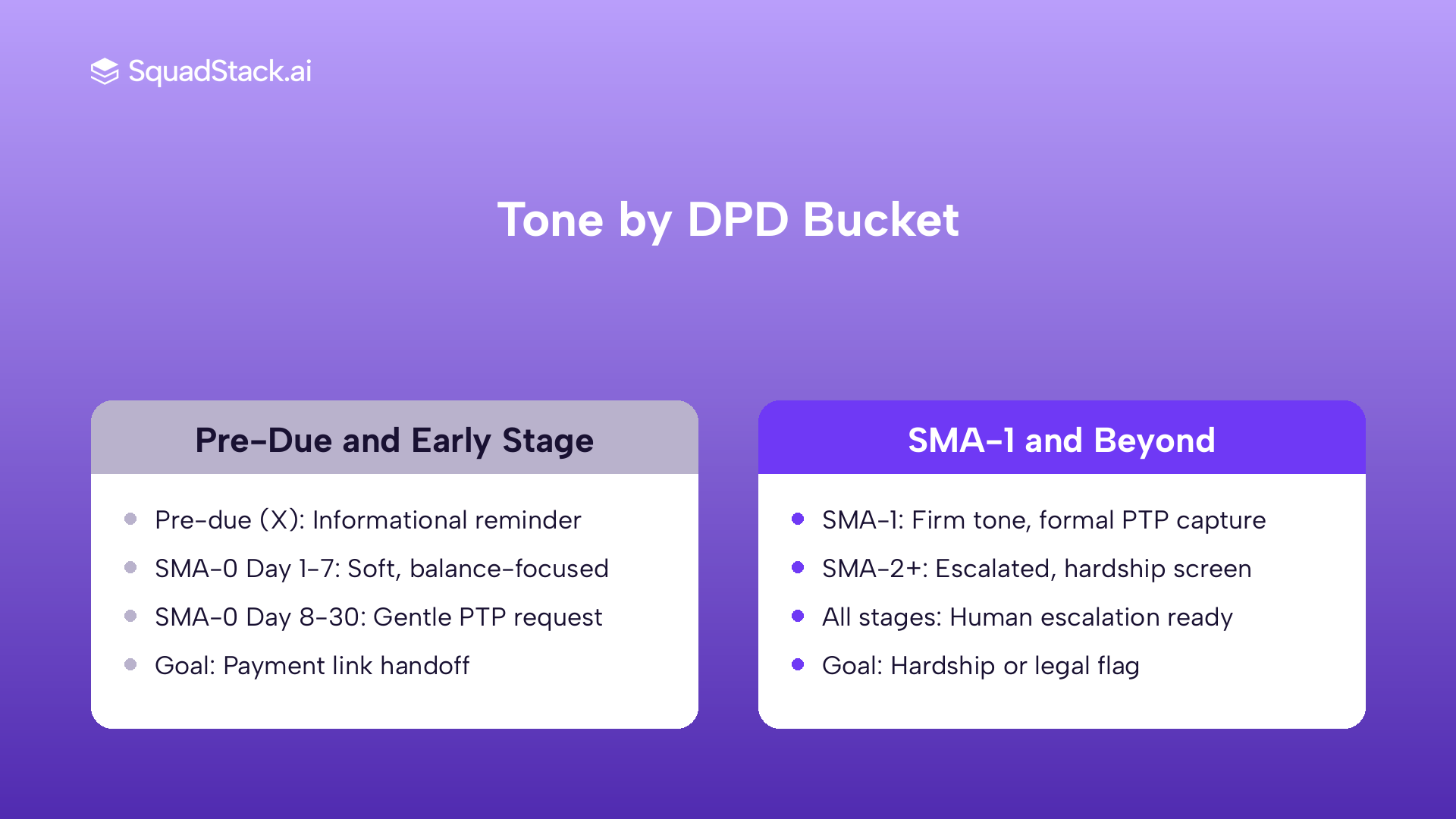
Pre-due calls sit in what the industry calls the X-bucket or pre-due bucket, typically two to five days before the EMI presentation date. The tone here is informational and helpful. The borrower has not missed anything yet. The goal is to reduce the first-presentation bounce rate by making sure funds are ready and the debit date is not a surprise.
Sample Hinglish pre-due script:
*"Hello, [Name] ji. Main [Lender Name] ki taraf se bol raha hoon. Aapki EMI [amount] ki [date] ko present hogi. Kripya apne account mein sufficient balance ensure karein. Koi sawal ho toh 1 dabayein."*
The key design principles here: no urgency language, no "aapka account bounce ho sakta hai" framing, and no pressure. The call should sound like a helpful bank notification, not a warning.
Post-due scripts shift in purpose. Once a presentation has bounced, the account enters SMA-0 (0 to 30 DPD). The script now needs to extract a PTP (promise to pay) with a specific date and amount, offer a payment link mid-call, and check whether the miss was accidental before escalating tone.
Sample Hinglish post-due script (SMA-0, Day 1 to 3):
*"Hello, [Name] ji. Aapki [date] ki EMI [amount] present nahi ho payi. Kya yeh ek mistake tha? Aap aaj payment kar sakte hain, main abhi aapko payment link bhi bhej sakta hoon. Kab tak aap arrange kar sakte hain?"*
The phrase "kya yeh ek mistake tha" matters. It gives the borrower an easy exit that preserves their dignity and tends to increase PTP rates. Scripts that open with accusatory or formal language ("aapne apni EMI nahi bhari") see higher early disconnects.
For SMA-1 and beyond, tone shifts again. The script moves to restructuring-eligibility screening and formal PTP documentation language. Any mention of legal consequences must be factually accurate and clearly framed as process, never as a threat.
Dispute and escalation triggers must be built into every post-due script. If the borrower says any of the following, the call must immediately transfer to a human agent:
Building these triggers as hard logic in the script, not as optional paths, is a compliance requirement under both RBI conduct rules and the draft directions that are working toward July 2026 enforcement.
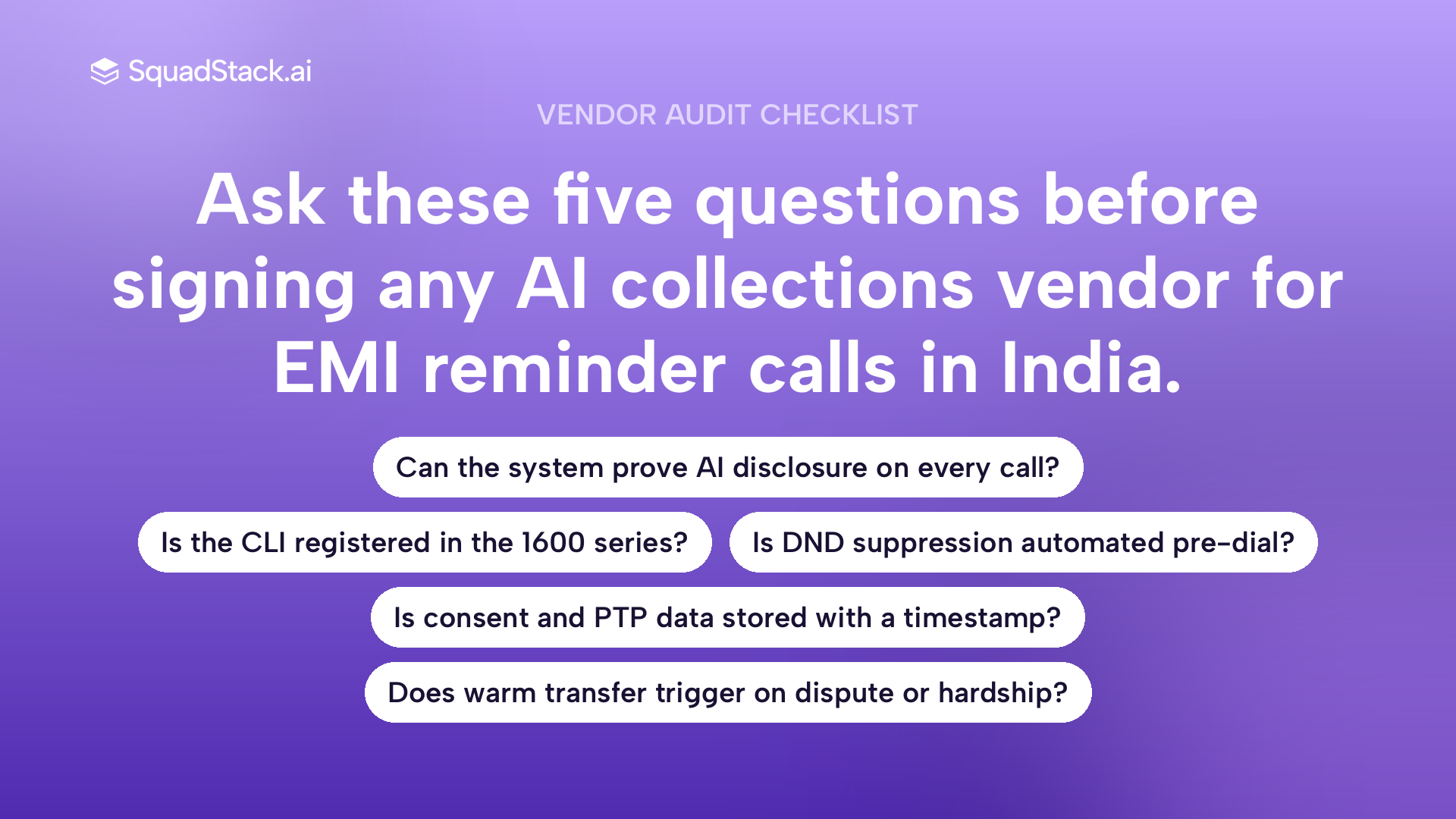
The compliance question is not just "are you TRAI-compliant?" Anyone can claim that. The questions that actually separate compliant platforms from non-compliant ones are operational.
Ask whether out-of-window dialing is technically blocked by the platform or only discouraged by policy. A serious platform hard-blocks the dialer at 7 PM and 8 AM. There should be no manual override.
Ask how the platform handles the DND scrub. Is it run once at campaign setup or continuously? Numbers can be added to DND lists during a campaign, so a scrub at the start is not enough.
Ask how AI disclosure is handled. The disclosure should be audible, early, and not buried after a sales intro. Check the actual recording, not the policy document.
Ask about warm-transfer triggers. When a borrower raises a dispute or expresses hardship, how quickly does the call reach a human, and what context does that human receive?
Ask for ISO 27001, ISO 27701, and SOC 2 Type II certifications alongside TRAI and DPDP compliance statements. For any lender operating under RBI's Digital Lending Directions, the vendor is functionally an LSP, and audit-access rights and India data residency are non-negotiable.
SquadStack's platform enforces the calling window as a hard system block, not a convention. Every campaign runs DND scrubbing on the TRAI registry plus client-uploaded internal DND lists. Compliance-aware dialogue is built into the call flow itself, including AI disclosure and opt-out honoring, not layered on as a post-build check. The platform holds ISO 27001, ISO 27701, SOC 2 Type II, DPDP, and TRAI certifications.
The underlying speech model, Arth, is trained on 600 million or more minutes of real Indian contact center conversations, including collections calls across lending segments. That training data is why the model handles Hinglish code-switching, regional accents, and collections-specific vocabulary without the word-error and misrouting problems that plague generic speech models on Indian telephony.
For lenders running collections at scale, the Kissht success story shows what a fully deployed AI collections programme looks like in production. The broader AI in collections resource covers the full debt-recovery context, and the lending and credit industry page lays out the full use-case map across the loan lifecycle.
If you are designing an EMI reminder programme and want to validate your script structure and compliance controls before go-live, book a demo with SquadStack to review your call flow against live Indian collections data.
Which AI voice bots support RBI and TRAI-compliant collections workflows in India?
Platforms that are genuinely compliant will hold TRAI registration, use 1600-series numbers for service calls, hard-block out-of-window dialing, run DND scrubbing before every campaign, and carry ISO 27001 and SOC 2 Type II certifications. SquadStack's platform is built to these requirements, with compliance controls enforced at the system level rather than left to manual process.
Is AI voice calling TRAI-compliant in India for EMI reminders?
Yes, provided the calls go out on the 1601-series for private financial entities, the number list has been scrubbed against the TRAI DND registry, and calls land within the permitted window. AI voice is treated as a robocall under TRAI's promotional-call framework, except EMI reminders qualify as service calls and use the 1600-series rules, not the 140-series.
What calling hours apply to AI-driven EMI reminder campaigns?
RBI's collections conduct rules permit recovery contact between 8 AM and 7 PM only. Calls outside this window can trigger ombudsman complaints, and the regulated entity bears full liability even if an AI system or outsourced vendor made the call. The platform's dialer should hard-block any attempt outside these hours.
How should the AI script differ between pre-due and post-due EMI calls?
Pre-due scripts should be informational and soft: confirm the debit date, ask the borrower to keep funds available, and offer a payment link. Post-due scripts shift to PTP extraction with a specific date and amount, re-presentation coordination, and a payment link sent mid-call. Any indication of hardship or dispute in a post-due call must immediately transfer to a human agent.
Can AI handle disputes or hardship cases in collections calls?
AI should never handle a formal dispute or a hardship declaration end-to-end. These must route immediately to a human agent. Scripts should include hard triggers for keywords and phrases that indicate a disputed amount, a claim that the loan does not belong to the borrower, or financial hardship. The warm-transfer must carry full call context so the human does not restart the conversation.
What languages should an AI EMI reminder campaign support in India?
Hindi and English cover a large share of borrowers, but regional-language campaigns see meaningfully higher engagement when the agent speaks in the borrower's native language. For a lending portfolio with borrowers across states, a platform should support at minimum Hindi, Tamil, Telugu, Kannada, Marathi, Malayalam, and Bengali, with native code-switching rather than a translated script. SquadStack runs 9 live Indian languages with native code-switching.
How does DPDP affect AI-driven EMI reminder calls?
Under DPDP, borrower data may only be processed for the purpose consented to at origination. If the loan agreement's consent language covers automated reminders for repayment, the campaign is workable. If it does not, fresh consent is required. Withdrawal of consent must stop the calling immediately, and processing must stay within India.
What is the right cadence for AI EMI reminder calls?
A typical pre-due reminder runs two to three days before the EMI date, with one attempt. Post-bounce calling follows a structured cadence: a first attempt on the bounce day, then retries over the following days, with gaps between attempts and a defined maximum number of attempts before the account is marked and escalated. Attempt frequency must be defensible in an audit; excessive contact is a named conduct violation under the draft RBI directions moving toward enforcement.
How does a borrower opt out of AI reminder calls, and what must happen when they do?
The opt-out path must be audible in the call itself, usually a keypress or a spoken instruction. Once a borrower opts out, the platform must immediately log the opt-out, stop further automated contact for that borrower, and write the opt-out status back to the lender's system. This is a hard compliance requirement, not a courtesy feature.
What should a lender include in pre-call notification before AI collections contact?
RBI's Digital Lending Directions require that a borrower be notified with the recovery agent's particulars before first contact. For AI campaigns, this means triggering an SMS or email on the day of the first dial, identifying the lender and stating that an automated reminder call will follow. This notification must be logged as evidence for audit purposes.