Voice AI Onboarding Failures: What Goes Wrong and Why
November 2, 2026
|

13 min read

The case for using AI voice agents to turn health insurance portability requests into retention conversations before a competitor makes contact.
Health insurance portability AI voice retention works by deploying AI voice agents to proactively call at-risk policyholders before they complete a port request, delivering personalised arguments for staying. The agent explains no-claim bonus implications, sum-insured upgrade options, and family-floater comparisons in the policyholder's own language, often before a competitor's sales team has even dialled. Done well, this turns the portability window from a churn event into a renewal conversation.
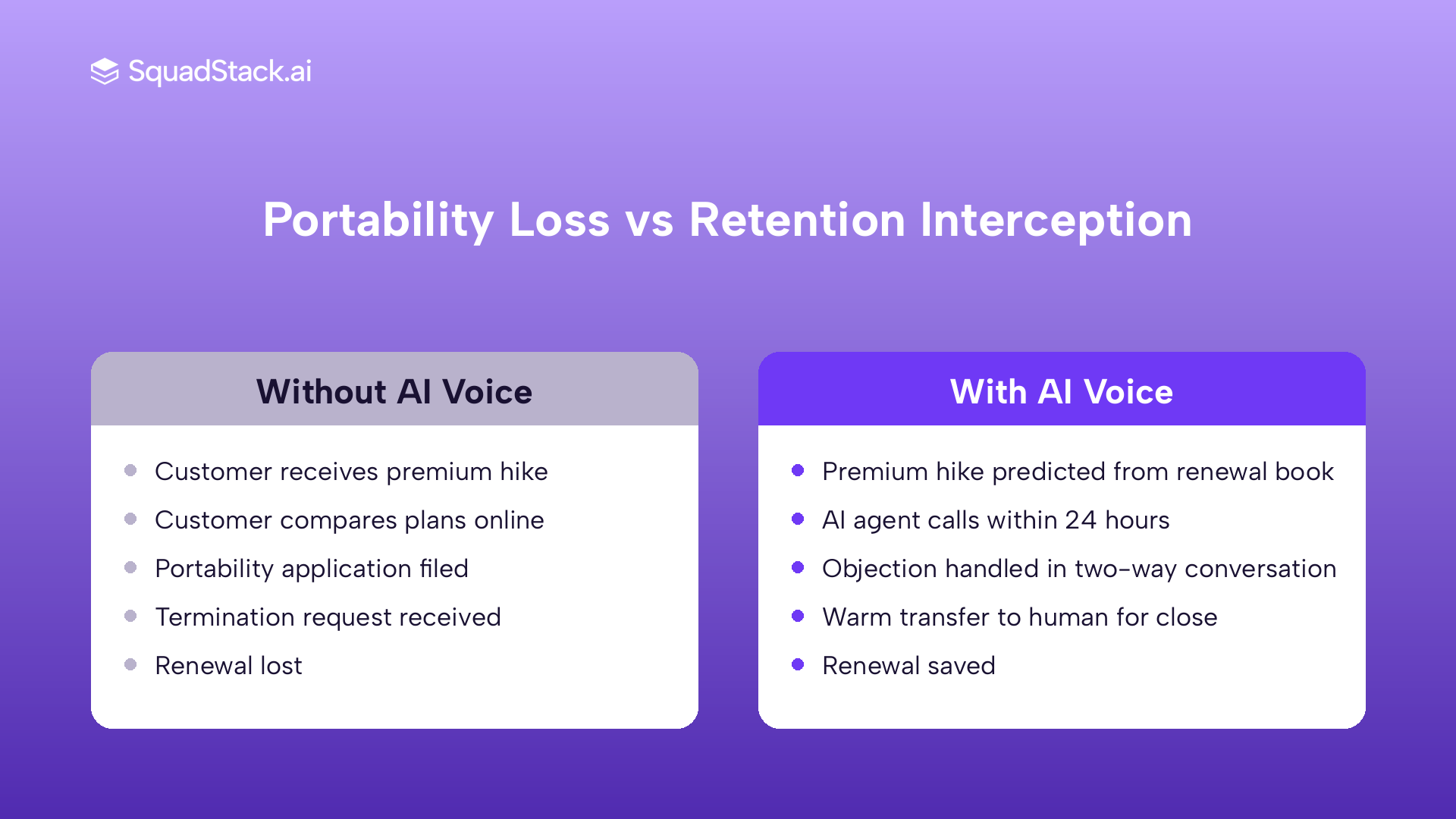
The moment a health insurance customer asks about portability, the insurer has already lost ground. The customer has compared plans and decided to explore switching. Retention at that point is reactive and expensive.
The smarter approach is to get there first. Policyholders approaching renewal with premium hike objections, sum-insured dissatisfaction, or a recent claim dispute are high-risk signals. An AI voice agent can identify those signals, reach the policyholder before they initiate a port request, and deliver a personalised case for staying at a cost that makes sense even on mid-ticket health policies.
Health insurance portability is the right of a policyholder to move their health cover from one insurer to another while retaining waiting-period credits. Under IRDAI rules, a policyholder must apply before their renewal date, giving the losing insurer a defined period to respond.
That window is the retention opportunity. The policyholder has not yet left. They are weighing the cost of switching against the benefits of staying. If the current insurer can reach them with the right information at the right moment, renewal is still possible.
The problem is volume. Most insurers have thousands of policyholders approaching renewal each month. Human renewal floors cannot prioritise and call every at-risk policyholder in time, especially on mid-ticket retail health policies where the premium does not justify a long human sales call. That gap is where AI voice agents work.
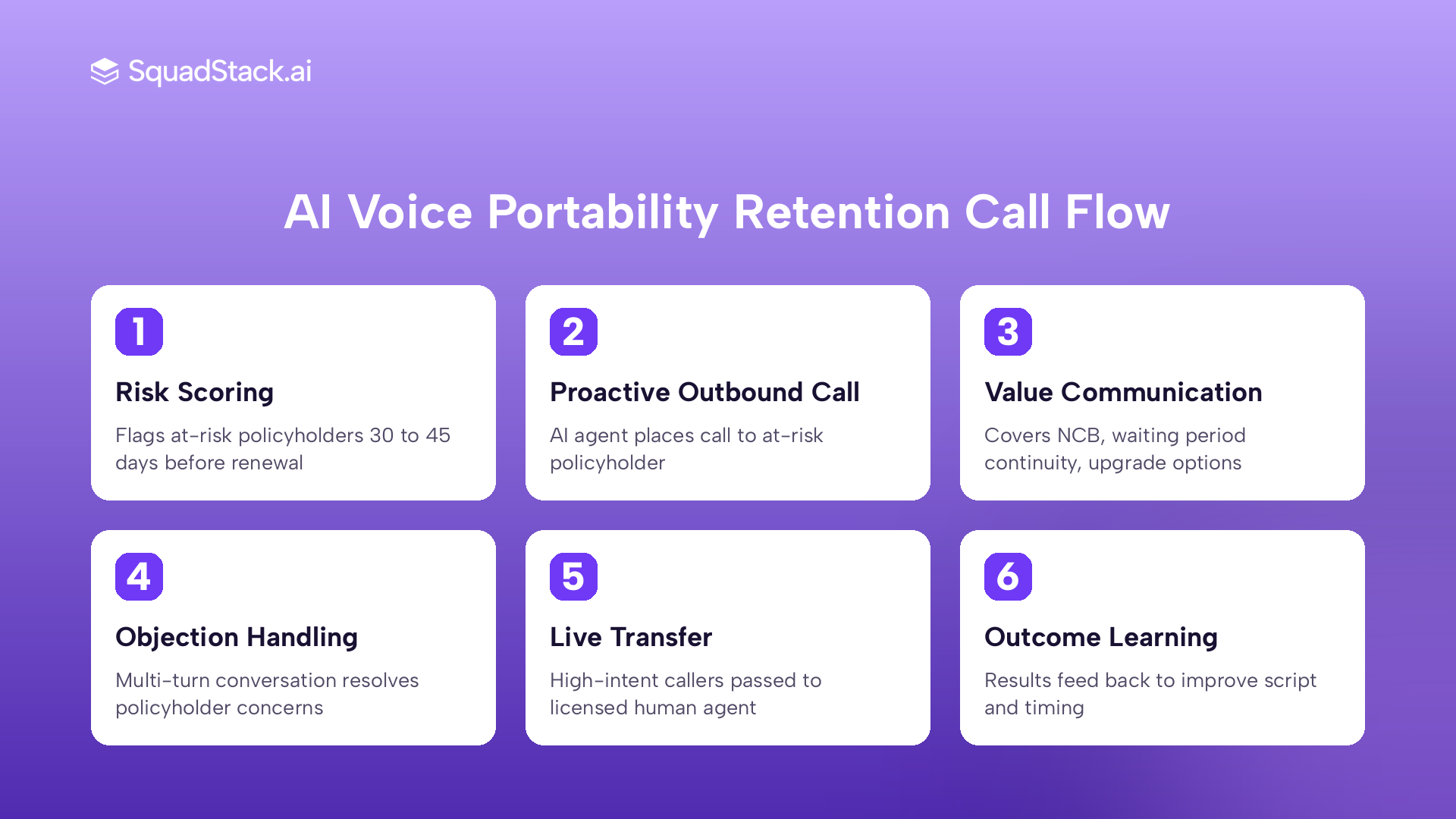
AI voice for portability retention follows a proactive, personalised outbound call flow.
Step 1: Risk identification. The AI Lead Manager scores the renewal book. Policyholders showing portability signals get prioritised: those who received a significant premium hike, those who had a claim dispute, younger customers, and those within the 30 to 45 days before renewal where portability applications are typically filed.
Step 2: Proactive outreach. The AI voice agent calls the policyholder with context, not a generic reminder: "You've been with us for three years and haven't made a claim. Before your renewal comes up, I wanted to walk you through what that actually means for you."
Step 3: Personalised retention conversation. The agent covers the three topics that move portability decisions:
Step 4: Objection handling. The agent handles common portability objections across multiple turns. When a customer says the premium went up too much, the agent explains what drove the revision, compares it to what a fresh policy with a new insurer would cost in year one, and surfaces any loyalty discount or top-up option available.
Step 5: Warm transfer or callback scheduling. High-intent customers are transferred live to a licensed human agent with full context. Others are scheduled for a callback at a confirmed time, with persistent memory ensuring the follow-up call knows exactly what was discussed.
Step 6: Continuous learning. After every call, the ROI Optimizer processes outcomes. Scripts that converted better on specific objections are tested and scaled. Each campaign cycle produces a sharper agent than the last.
Pre-portability outreach. Customers approaching renewal with a premium hike are called before they start comparing. The agent explains what drove the revision and surfaces the retention offer first.
NACH bounce recovery. A failed auto-debit on a health renewal is one of the most fixable lapse triggers. The agent calls the same week, collects payment, and re-establishes the mandate. A bounced mandate not fixed within days often becomes a lapsed policy.
Sum-insured upgrade outreach. Policyholders considering portability often want higher cover, not a different insurer. A proactive call with a top-up or super top-up option addresses the coverage concern without triggering a port.
Free-look retention. A customer within the 30-day free-look window who was mis-sold or misunderstood their terms can be retained through a timely voice conversation that clarifies what they actually have.
Orphan policy renewal. When a tied agent quits, their book stops getting serviced. AI voice fills that gap immediately, calling orphan policyholders at renewal without waiting for a replacement agent.
The SquadStack insurance page and AI voicebot for insurance resources cover the broader use-case map across life, general, and health insurance.
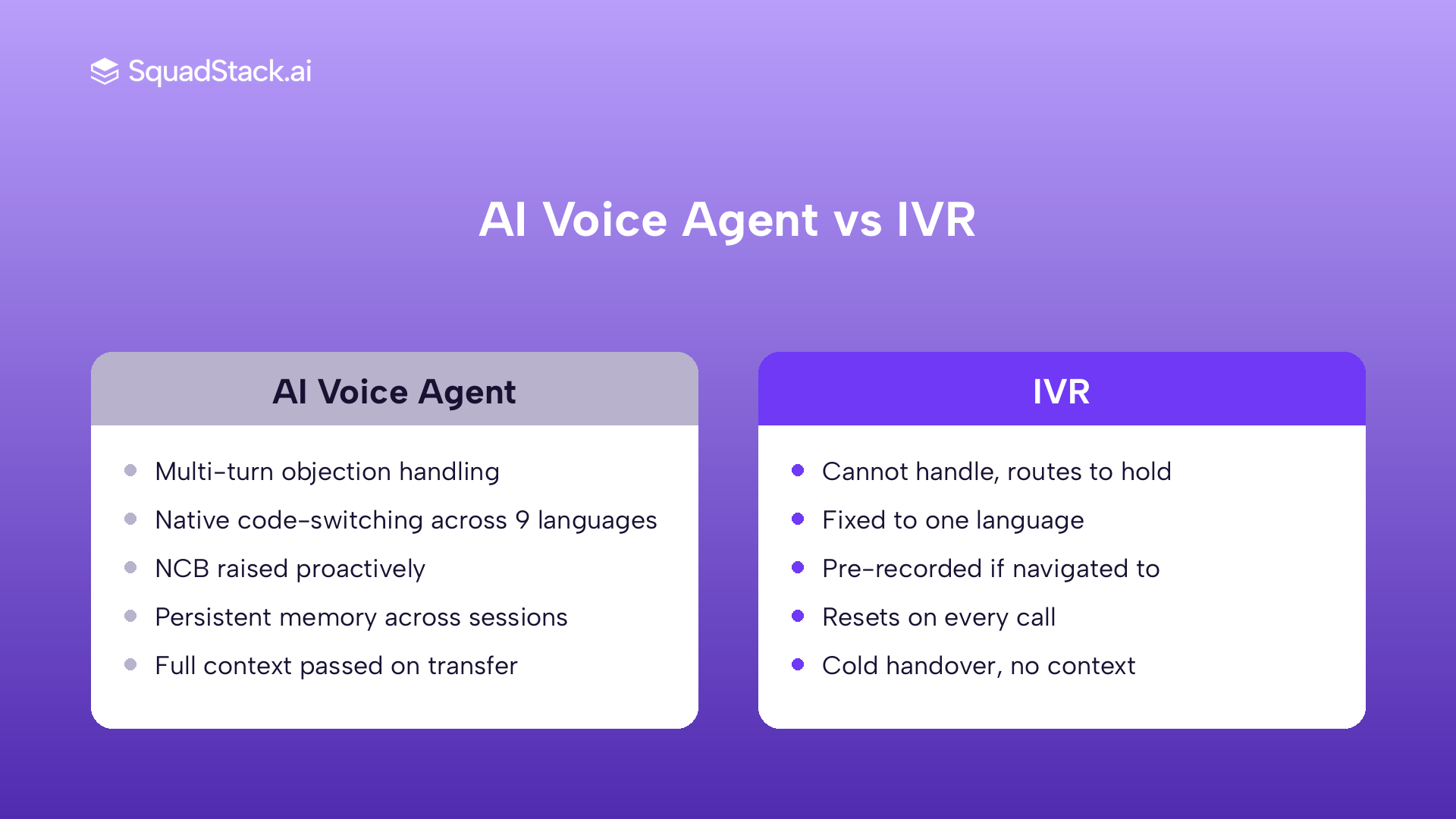
IVR systems have their place in insurance, but portability retention is not one of them.
| Dimension | IVR | AI Voice Agent |
|---|---|---|
| Conversation type | One-way menu navigation. No two-way dialogue possible. | Full two-way conversation. The agent listens, responds to what the customer actually said, and adapts the pitch mid-call. |
| Handling "why did my premium go up?" | Cannot answer. Routes to a hold queue or disconnects. | Explains the revision, compares it to market rates qualitatively, and offers the retention option in the same call. |
| NCB explanation | Can play a pre-recorded message if the customer navigates to it. Most will not. | Proactively raises the accumulated NCB, explains the forfeiture risk in plain language, and ties it to the renewal decision. |
| Language switching | Fixed to one language per IVR tree. | Switches language mid-sentence across 9 live Indian languages with native code-switching. |
| Portability objection | Cannot handle. The customer hangs up or escalates. | Handles the portability comparison across multiple turns, covering waiting period continuity and sum-insured options before transferring if needed. |
| Memory between calls | Zero. Every call starts from scratch. | Persistent memory across calls. A customer who raised a sum-insured concern last week is met by an agent that already knows. |
Indian language depth. Portability conversations are personal and financially significant. A customer explaining a claim dispute will switch to their native language. A platform that lists languages as a feature but does not sound native will see policyholders hang up in the first 30 seconds. Ask specifically about natural code-switching and how the platform was trained.
Long-call capability. Portability retention calls run longer than standard reminders. A platform that degrades after ten turns will lose the most valuable conversations. Look for evidence the agent handles 20 to 30 minute calls without looping or losing context.
Compliance architecture. Insurance scripts must be filed with IRDAI. The platform needs locked compliance sections that no self-optimisation loop can alter, plus TRAI-compliant calling infrastructure and ISO 27001 and DPDP certification for handling health data.
Warm transfer quality. The highest-intent retention calls should reach a licensed human agent with full context passed, not a cold handover.
A/B testing at campaign level. A platform that cannot run controlled experiments on voice, script framing, and cadence will plateau after the first campaign.
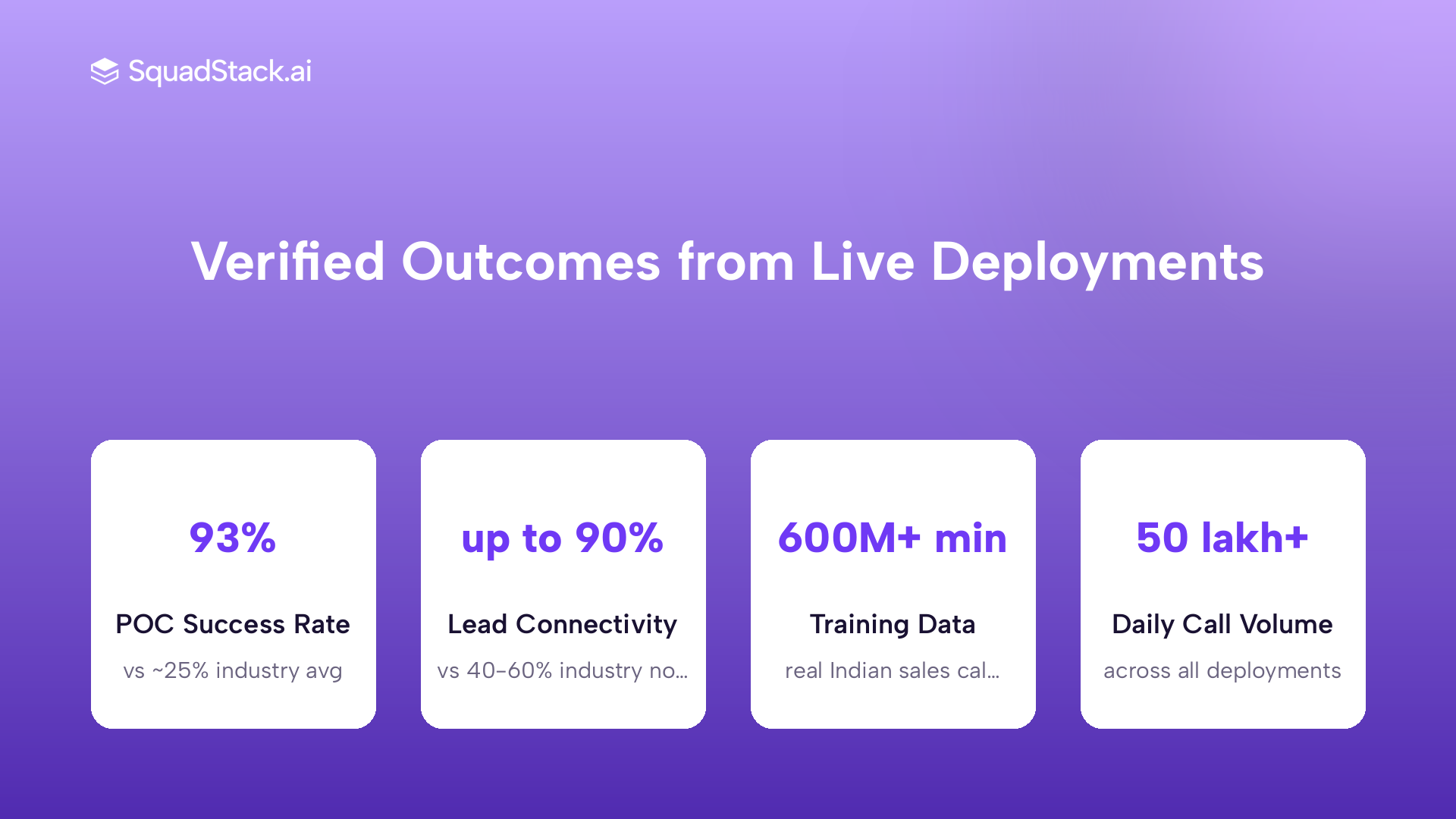
SquadStack's AI agents are trained on 600M+ minutes of real Indian sales and retention conversations, including insurance renewals. The agents already know the specific objections on portability calls: premium hike comparisons, waiting period questions, and NCB forfeiture concerns.
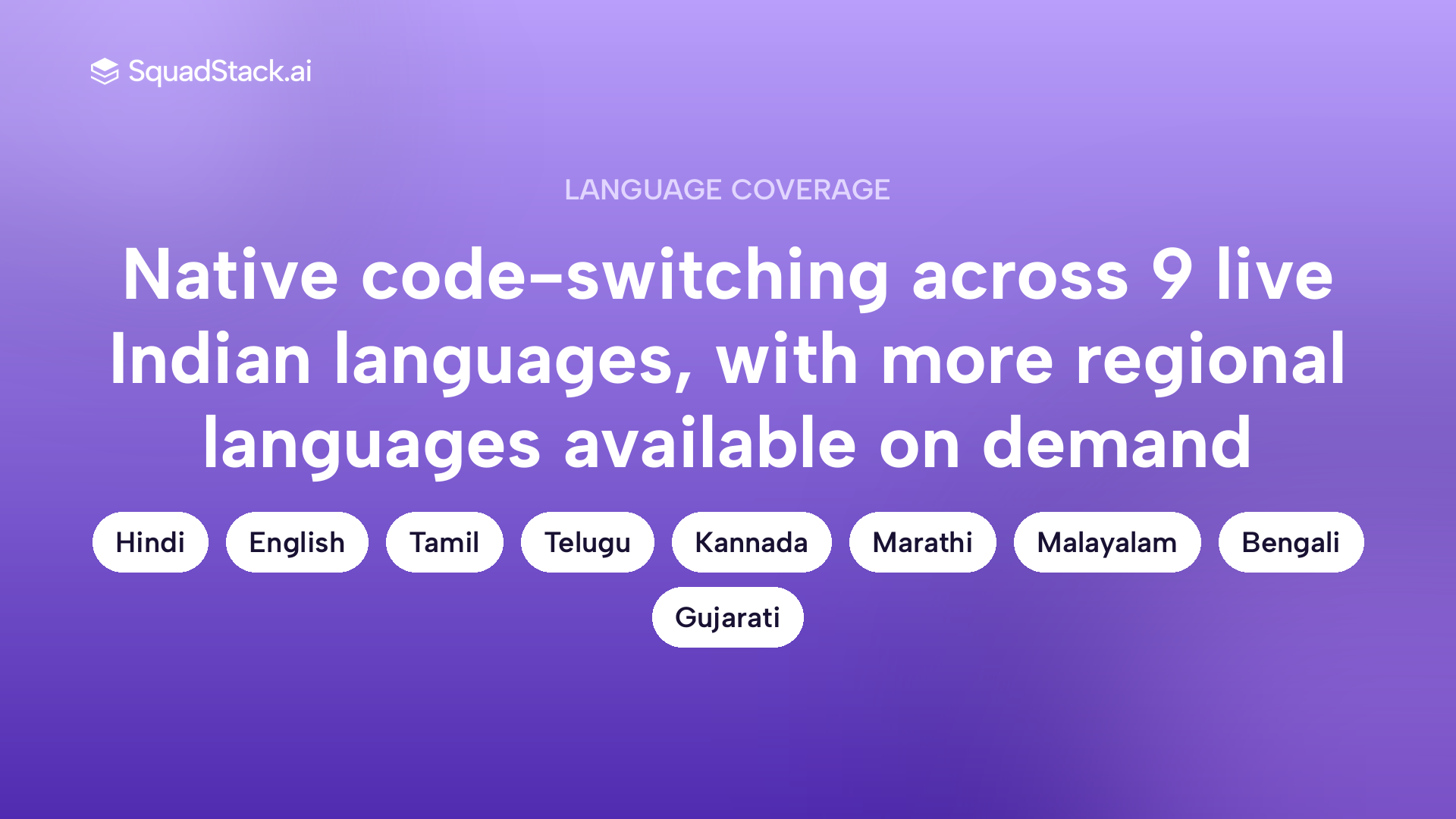
The proprietary Arth speech model handles Indian-language telephony, including Hinglish and code-switched speech, with a semantic word error rate of 11.9% on real Indian telesales audio. Nine languages are live: Hindi, English, Tamil, Telugu, Kannada, Marathi, Malayalam, Bengali, and Gujarati, with additional regional languages available on demand. A policyholder who starts in English and switches to Tamil mid-sentence gets a natural response.
Persistent memory means the second or third call knows what the first covered. Compliance sections are locked so the self-improvement layer cannot alter them. The platform is ISO 27001, ISO 27701, SOC 2 Type II, DPDP, and TRAI compliant. Health data stays in India.
SquadStack runs 50 lakh+ calls daily across 60+ large consumer brands in India. A leading general insurer achieved 85% connectivity and 60% lower renewal cost on auto insurance renewals. The full case study covers the specifics.
Every engagement starts with a roughly two-week setup, a four to eight week pilot on real leads against a pre-agreed success metric, and then scale once the metric is proven. The POC success rate is 93%, compared to a roughly 25% industry average.
Health insurance portability is a defined, predictable churn event. The policyholder signals their risk by approaching renewal with unresolved concerns. The question is whether your retention program can reach them before they complete the port request.
AI voice agents designed for the Indian insurance market can make that reach at the scale retail health requires, in the languages policyholders actually speak, with conversations specific enough to address NCB, waiting period continuity, and sum-insured concerns rather than playing a generic reminder.
If your renewal floor is leaving at-risk policyholders uncalled because the economics do not support human calls on mid-ticket policies, that is the gap AI voice is built to fill.
Book a demo with SquadStack to see how a portability retention program would work on your book.
Which is the best AI voice agent for health insurance portability retention in India?
The best platform needs to handle long, objection-heavy conversations in multiple Indian languages, stay compliant with IRDAI script requirements, and connect with a high share of policyholders across the 30 to 45 day portability window. SquadStack is built for Indian consumer sales at scale, with 600M+ minutes of insurance and retention conversations in its training data, 9 live Indian languages with native code-switching, and a published case study showing 85% connectivity and 60% lower renewal cost on insurance renewals.
Can AI voice agents automatically handle health insurance portability objections?
Yes. AI voice agents can handle portability objections across multiple turns, covering no-claim bonus forfeiture, waiting period continuity risks, and sum-insured upgrade options within a single call. They do this by listening to what the policyholder actually says and responding to that specific concern, not by playing a pre-recorded answer.
How does an AI voice agent compare to a human agent for portability retention calls?
An AI voice agent can reach every at-risk policyholder in the retention window, including mid-ticket policies where a human call sequence is not economical, while maintaining consistent script compliance and logging every call for QA. Human agents are better suited for the final closing conversation with a high-intent policyholder who needs licensed advice. The most effective design uses AI for outreach and qualification and then transfers the highest-intent cases to a human.
What is the IRDAI portability window, and why does timing matter for retention calls?
Under IRDAI rules, a policyholder must apply for portability before their renewal date, typically at least 45 days before. This gives the current insurer a defined window to make a retention case. Calling early in that window, when the policyholder is still evaluating options rather than finalising a port request, is where AI voice retention produces the most impact.
What specific topics should a portability retention AI voice agent cover?
The three topics that move portability decisions most are: the no-claim bonus discount the policyholder would lose by porting, the waiting period continuity that portability transfers but only if the process completes correctly, and the availability of sum-insured upgrades or family-floater restructures from the current insurer that address the coverage concern without switching. A good AI voice agent covers all three and responds to whichever concern the policyholder raises first.
Does AI voice comply with IRDAI and TRAI requirements for insurance telecalling?
Compliant platforms separate the parts of a call that are regulated, such as product descriptions, premium details, and identity disclosures, from the conversational sections that can be optimised. The regulated sections are locked and cannot be altered by any self-improvement loop. Calls must be recorded and retained, and SquadStack's platform is ISO 27001, ISO 27701, SOC 2 Type II, DPDP, and TRAI compliant. Service calls to existing policyholders use the 1600 number series as required under TRAI's telecom rules.
Can AI voice agents handle health insurance calls in regional Indian languages?
SquadStack's AI voice agents support 9 live Indian languages, including Hindi, Tamil, Telugu, Kannada, Marathi, Malayalam, Bengali, Gujarati, and English, with native code-switching. The agents switch language mid-sentence, the way a bilingual human agent does, because the underlying model was trained on real code-switched Indian telephony conversations, not on text translated from English.
How long does it take to deploy an AI voice program for health insurance retention?
A typical engagement goes from kickoff to live calls in roughly two weeks, covering script build, knowledge-base integration, and compliance review. A four to eight week pilot on real policyholders follows, with volume ramping progressively. Scale happens once the pilot metric is proven. Repeat use cases go faster because the patterns from the first campaign warm-start the next.
What data does a portability retention AI voice agent need to personalise calls?
The agent uses policy metadata the insurer already holds: renewal date, premium amount, claim history, accumulated no-claim bonus, and sum-insured level. It does not require external data feeds. Persistent memory across calls stores what each policyholder said in earlier conversations, so the next call can open with context rather than starting from scratch.
What happens if a policyholder wants to speak to a human during the retention call?
The agent transfers the call live to a human agent, passing full conversation context so the human does not ask the policyholder to repeat themselves. If no human is available at that moment, the agent books a callback at a confirmed time that the policyholder chooses, and the follow-up call arrives knowing exactly what was discussed and why the transfer was requested.