Voice AI Onboarding Failures: What Goes Wrong and Why
November 2, 2026
|

13 min read
See how natural Hinglish code-switching and dialogue engineering help NBFC collections agents pass human Turing tests and cut hang-up rates.
Monotone, menu-driven AI voices fail in NBFC collections because Indian borrowers hang up the moment they sense automation. Hinglish AI voice collections for NBFCs work differently: a voice agent that code-switches naturally between Hindi empathy and English numbers keeps borrowers on the line long enough to extract a promise-to-pay. SquadStack's agents, trained on 600M+ minutes of real Indian sales and collections conversations, have passed a blind Turing test and run collections for lenders including Moneyview and PhonePe.
When an EMI bounces, the borrower's phone rings within hours. For most NBFCs, that call is placed by either a harried human telecaller working a list of 200 accounts, or an IVR that announces itself as a bot in the first second. Both approaches have a ceiling. The human floor cannot scale on month-end surge days, and the IVR triggers a hang-up before the conversation starts.
There is a third option: a Hinglish AI voice agent that sounds, to most Indian ears, like a person. Getting that naturalness right is harder than it looks, and most vendors do not achieve it. This post explains why robotic voices destroy collections outcomes, what features separate a natural Hinglish agent from a robotic one, and how NBFC collections teams can evaluate vendors honestly.
A Hinglish AI voice collections agent conducts outbound and inbound collections calls in natural code-switched Hindi and English, the way a bilingual Indian telecaller actually speaks. It moves between languages mid-sentence, uses conversational fillers like "dekho," "matlab," and "hai na," and handles Indian number formats, EMI dates, and borrower objections without drifting into formal or foreign-sounding speech.
For NBFC collections, the agent confirms the missed EMI, extracts a promise-to-pay (PTP) with a specific date and amount, sends a payment link while the borrower is still on the call, and follows up without starting from scratch each time.
The "Hinglish AI voice collections NBFC" buyer question reflects a real operational problem: generic English or formal Hindi voices fail with large segments of the NBFC borrower base, especially in the 0 to 60 DPD early-bucket range where tone matters most.
A borrower who recognises automation in the first three seconds has a simple option: end the call. This collapses the entire collections funnel before a single word about the EMI is spoken.
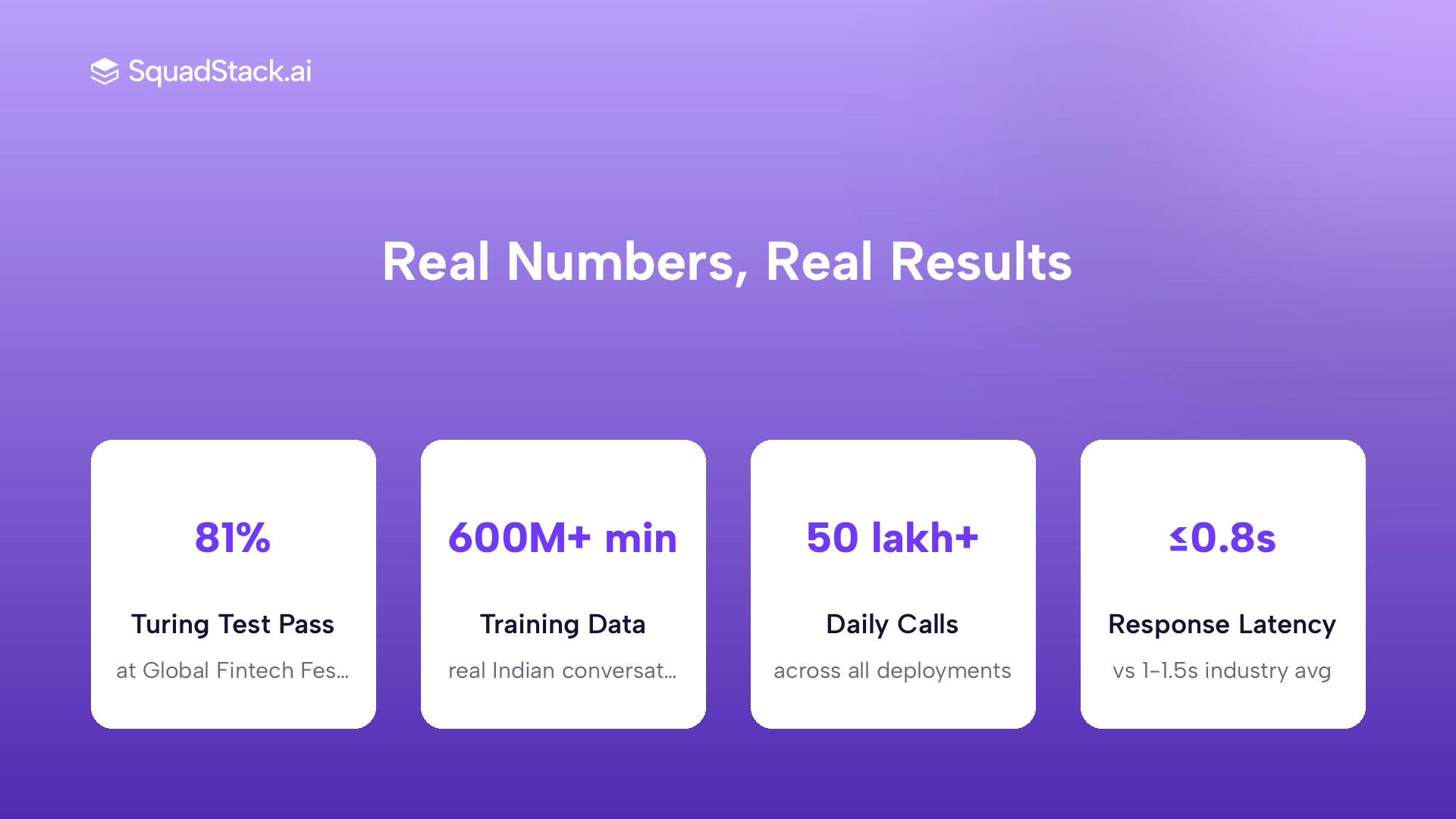
SquadStack tracks Abruptly Disconnected Rate (ADR) as a direct proxy. ADR measures calls terminated within the first ten seconds after the borrower identifies a machine. First-generation IVR systems see ADR above 70%. Human agent campaigns run at 8 to 12%. SquadStack's agents now run at roughly 10%, inside the human range, after a deliberate naturalness engineering process through 2025.
What makes a voice sound robotic in collections?
Stacked acknowledgements. "Thank you for your time. I understand your concern. I appreciate your patience." No human telecaller speaks this way. Stringing corporate hedges together is the fastest signal of automation.
Uniform prosody. A real agent slows down when reading an EMI amount, pauses before a sensitive question, and lifts their tone when offering help. Flat TTS output with no prosodic variation sounds like a newsreader.
Formal Hindi. Written and spoken Hindi are different registers. A borrower in Pune or Lucknow does not use "aapka vishesh dhyan aakrishit karna chahta hoon" in conversation. Formal scripted Hindi reads as a corporate notice.
No interruption handling. When a borrower cuts in, a robotic agent either ignores it and finishes the script, or breaks into a loop. A natural agent stops, listens, and responds to what was actually said.
The collections context makes these failures more costly than in sales. A borrower already stressed about a missed payment is less tolerant of friction. A robotic call does not just fail to collect; it damages the relationship and raises the probability of roll to the next bucket.
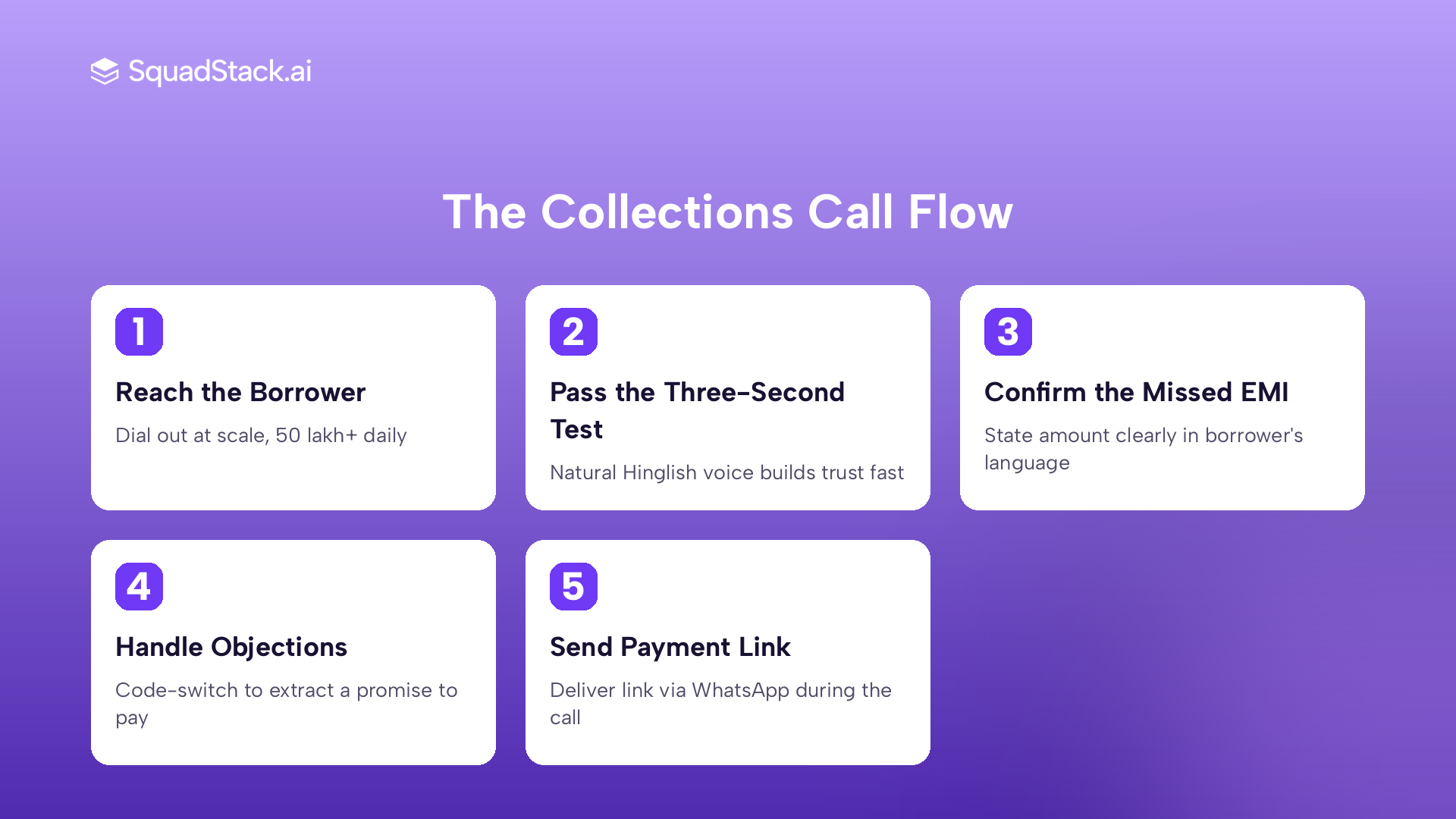
Step 1: Reach the borrower. The AI Lead Manager scores and prioritises the delinquent list, routes calls through spam-monitored numbers, and dials when each segment is most likely to pick up. SquadStack reaches up to 90% of leads over a full campaign cadence, compared to a 40 to 60% industry norm.
Step 2: Pass the three-second test. The opening line, voice gender, opening filler ("Haan, [Name] ji?"), and first pause together determine whether the borrower stays on the line. The voice is chosen from a library of 1,000+ voices cloned from real Indian agents. The opening is hand-written by a Conversational AI Designer, not generated by an LLM.
Step 3: Name the missed EMI naturally. "Aapka [month] ka EMI pending hai, 4,500 rupees ka" lands differently than "You have an outstanding amount of INR 4,500." The agent uses the borrower's own language register and confirms the amount clearly, at a slightly slower pace.
Step 4: Handle objections. Salary delay, amount dispute, personal hardship, a request to speak to a human, and flat denial are the five most common early-bucket objections. The agent handles multi-step responses, not a single canned rebuttal. Sensitive-case signals trigger a warm transfer to a human agent.
Step 5: Extract the PTP. The agent asks for a specific date and amount, confirms it back, and sends a payment link to WhatsApp while the borrower is still on the line.
Step 6: Continuous learning closes the loop. Every completed call feeds back into the ROI Optimizer. The Eval System scores each conversation on Outcome (did the call produce a PTP or payment?), Sentiment (how did the borrower respond?), and Execution (did the agent run the script correctly?). These signals drive A/B tests on voice, opening lines, and objection-handling scripts.
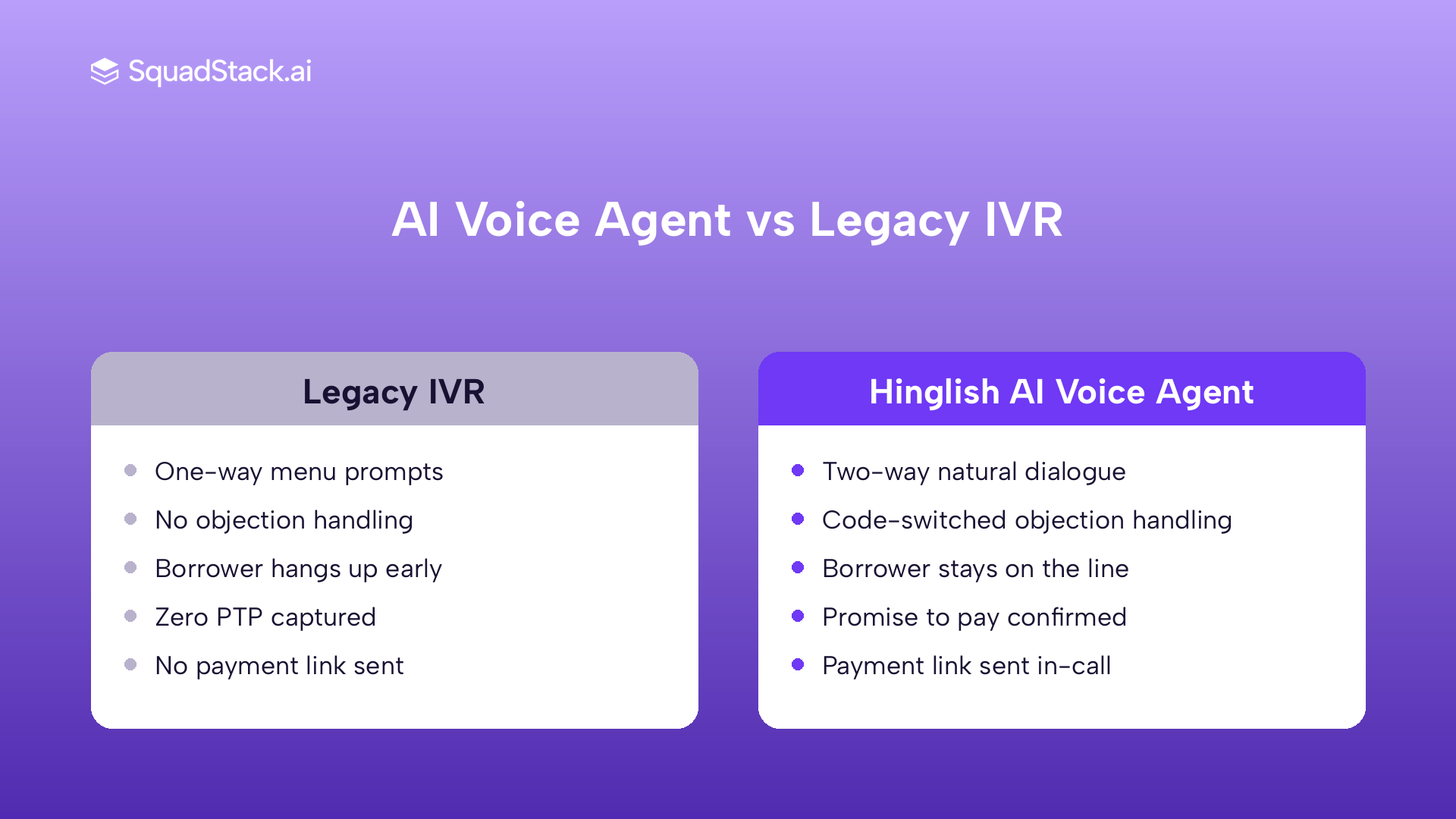
| Dimension | Legacy IVR | Hinglish AI Voice Agent |
|---|---|---|
| Borrower identification | Asks for account number via keypad | Confirms borrower by name and loan details in conversation |
| Language | Fixed language, formal register | Code-switches between Hindi and English mid-sentence based on borrower response |
| Handling a dispute | Routes to a hold queue or dead end | Engages the dispute, clarifies the amount, escalates to a human if needed |
| PTP extraction | Cannot negotiate or confirm a date dynamically | Extracts a specific date and amount, confirms verbally, sends payment link in-call |
| Interruption | Finishes script regardless of what borrower says | Stops, listens, responds to what was actually said |
| Memory | Every call starts cold | Persistent memory: follow-up call knows the PTP date from the previous call |
| ADR (hang-ups in first 10 seconds) | Typically above 70% at first-gen IVR | Roughly 10%, inside the human-agent range |
The IVR's failure in collections is structural: collections conversations require judgment, flexibility, and human-sounding empathy, not menu trees.
Test the ADR, not just connectivity. Ask every vendor for their Abruptly Disconnected Rate on collections campaigns specifically. A vendor who cannot quote this number has not measured it.
Listen to real call recordings, not demos. Demo calls are clean. Ask for recordings from live early-bucket campaigns at comparable ticket sizes and geographies. Listen for stacked acknowledgements, flat prosody, and how the agent handles a borrower who cuts in.
Check code-switching depth. A vendor who offers "Hindi and English" may mean two separate bot configurations. Native code-switching means the same agent handles "aapka EMI 4,500 ka hai" and "so we'll do the payment on the 5th, correct?" in the same sentence.
Ask about the training data source. Most STT models are trained on public datasets. SquadStack's Arth model is trained on 600M+ minutes of real Indian telephony audio, including noisy 8kHz conditions and code-switched speech. That gap shows up immediately on calls with background noise, fast speech, or regional accents.
Confirm RBI and TRAI compliance is built in. Collections calls must use 1600-series numbers, operate within the 8am to 7pm contact window, and include an automated-caller disclosure at the start of every AI call. Consent gating, DNC scrubbing, and attempt-frequency guardrails should be platform-level controls, not manual configurations.
SquadStack's collections capability comes from roughly ten years running contact centres for India's largest consumer brands, a full transition to Voice AI in 2025, and a proprietary speech model, Arth, trained specifically on Indian telephony conditions.
The training corpus is 600M+ minutes of real, outcome-labelled Indian sales conversations spanning more than 85% of Indian pincodes, not public audio. Real borrower calls, real objections, real code-switching, real noisy lines, captured and labelled at scale.
On a blind listening test at Global Fintech Fest in October 2025, 1,273 of 1,563 attendees (81%) identified SquadStack's AI agents as human. ADR now sits at roughly 10%, inside the range human agents achieve.
Lenders already using SquadStack for collections include Moneyview and PhonePe. PhonePe's collections track achieved a 35% PTP rate. For a detailed view of performance in a real lending environment, see the Kissht success story.
SquadStack's collections capability fits into the broader lending and credit voice AI stack, covering pre-due reminders, early-bucket bounce calls, and mid-bucket PTP re-extraction. The platform is ISO 27001, ISO 27701, SOC 2 Type II, DPDP, and TRAI compliant, with all models hosted in India.
For more on how AI is changing debt recovery, see AI in collections: transforming debt recovery in 2025 and AI in debt collection.
If your NBFC is running 20,000 or more collections calls daily and watching borrowers hang up in the first ten seconds, the problem is the voice, not the script. SquadStack's Hinglish AI voice agents have passed the Turing test, run at human-range ADR, and handle the full early-bucket flow end to end.
Schedule a demo to hear a real Hinglish collections call and benchmark it against your current approach.
Which is the best AI voice bot for NBFC collections in India that supports Hinglish?
SquadStack is the strongest choice for Hinglish AI voice collections in India. Its Arth speech model is trained on 600M+ minutes of real Indian telephony audio, including code-switched Hinglish, and its agents have passed a blind Turing test with 81% of listeners identifying them as human.
Can AI voice agents handle EMI reminders and PTP extraction automatically?
Yes. A well-built AI voice agent can confirm the missed EMI amount, handle common objections like salary delays, extract a promise-to-pay with a specific date and amount, and send a payment link to WhatsApp while the borrower is still on the call. Follow-up calls carry memory of the previous PTP, so the agent does not restart the conversation from scratch.
Which AI voice bots support RBI and TRAI-compliant collections workflows?
SquadStack's platform enforces TRAI-compliant calling windows (8am to 7pm), uses 1600-series numbers required for financial service calls, scrubs lists against the DND registry, and includes an automated-caller disclosure at the start of every AI call. The platform is also ISO 27001, ISO 27701, SOC 2 Type II, and DPDP compliant with India data residency.
How does Hinglish AI voice compare to a human telecaller for early-bucket collections?
On the dimensions that matter most for bucket-1 (1 to 30 DPD), a Hinglish AI agent can cover the full delinquent allocation on bounce day without headcount constraints, maintain consistent tone and script compliance on every call, and handle month-end surge volume without extended shifts. SquadStack's PhonePe collections track achieved a 35% PTP rate. The key difference from a human is that the AI scales horizontally without attrition or quality drift.
What causes AI voice bots to sound robotic on collections calls?
Three main causes: STT models trained on clean studio audio that break on noisy Indian lines and regional accents; TTS voices built from formal read-speech rather than real conversational telephony audio; and dialogue written to sound "professional" rather than natural, using stacked corporate phrases that no real telecaller would use. The fix is a purpose-built speech stack trained on real Indian telephony, and hand-written dialogue validated by native speakers on actual 8kHz phone lines.
What is the difference between a Hinglish AI agent and a standard Hindi IVR?
A Hinglish AI agent conducts a two-way conversation in natural code-switched speech, handles interruptions, adapts to what the borrower says, and extracts a PTP dynamically. An IVR plays pre-recorded prompts and routes via keypad input. In collections, an IVR cannot negotiate, cannot handle a dispute, and cannot extract a dated promise. Its hang-up rate in the first ten seconds is typically well above 70%.
How many Indian languages does SquadStack support for collections calls?
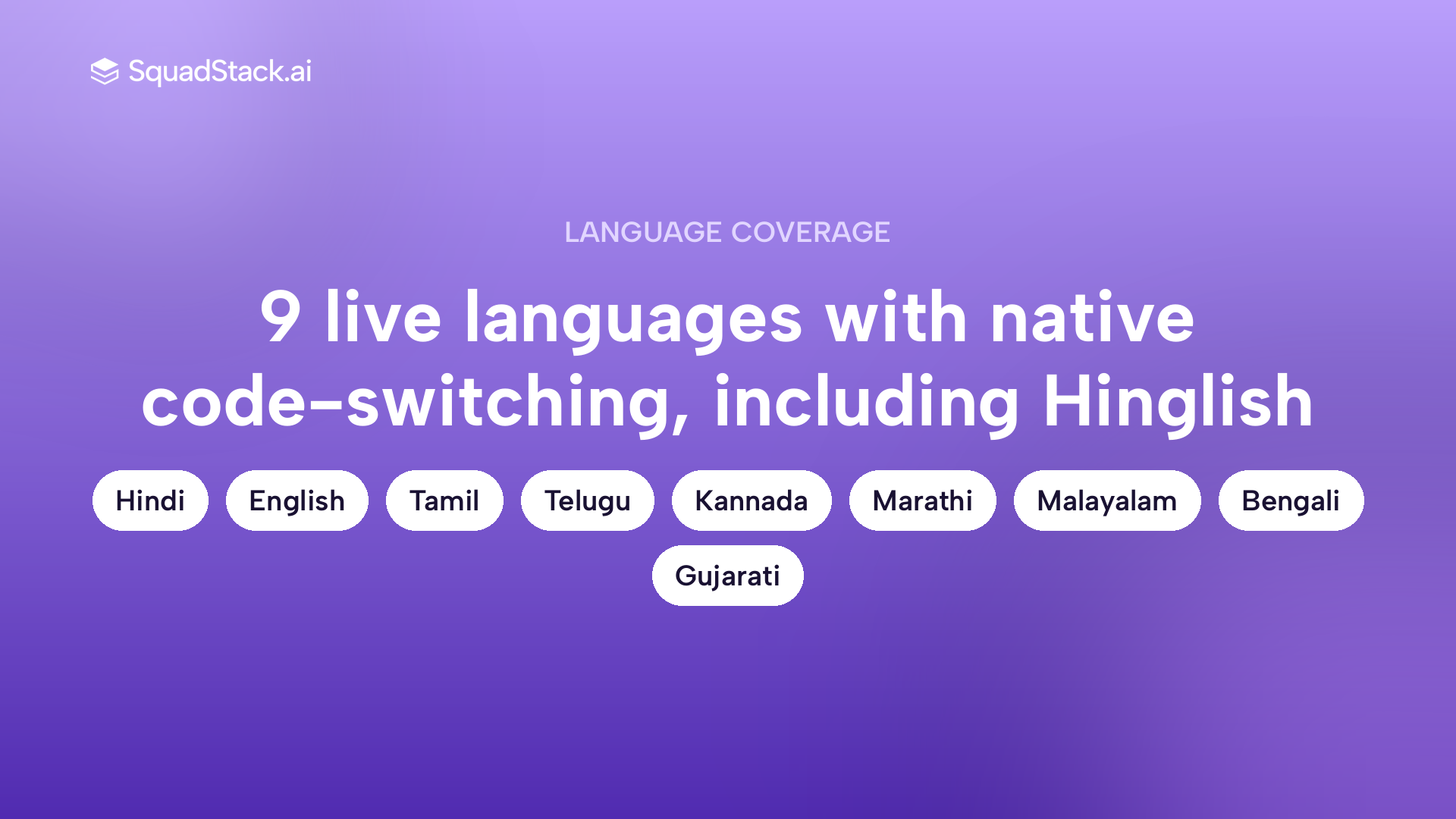
SquadStack supports 9 live Indian languages: Hindi, English, Tamil, Telugu, Kannada, Marathi, Malayalam, Bengali, and Gujarati, with native code-switching built into the models. Additional regional languages can be added on demand based on business requirements.
What should an NBFC check before deploying Hinglish voice AI for collections?
Ask for the vendor's Abruptly Disconnected Rate on real collections campaigns (not demo calls), listen to live recordings with actual borrower objections, confirm the STT model is trained on Indian telephony audio rather than public datasets, verify that 1600-series numbers and automated-caller disclosure are standard, and insist on a pilot with a defined success metric, a clear control group, and PTP-kept rate as an output metric alongside connectivity.
How quickly can an AI collections agent go live for an NBFC?
SquadStack's typical setup runs about two weeks from kickoff to live calls, covering agent build, script engineering, integration, and UAT. The pilot then runs four to eight weeks against an agreed success metric. Go-live speed is usually gated on client-side data feeds and compliance approvals, not the build itself.
Does SquadStack's AI voice agent handle escalation to a human collector?
Yes. The platform supports warm transfer to a human agent for sensitive cases, high-value accounts, or when a borrower explicitly requests one. The receiving human agent gets full call context, confirmed entity fields, and the conversation transcript, so no information is repeated.