Voice AI Onboarding Failures: What Goes Wrong and Why
November 2, 2026
|

13 min read
A practical look at why Hinglish collections scripts fail and what dialogue engineering does to keep borrowers on the call and lift PTP rates.
A Hinglish AI voice collections script that works is not a translation problem. It requires dialogue engineering: natural fillers, empathy phrases, and code-switching that mirrors how a borrower actually speaks. When the script sounds human, borrowers stay on the call longer, PTPs increase, and roll rates fall.
Collections calls in India sit in uncomfortable territory. The borrower owes money. The lender needs a commitment. The agent must be firm without being threatening, empathetic without being soft, and compliant with an RBI code of conduct that bans harassment in explicit language.
Now add the layer that trips every NBFC running AI voice: the script sounds robotic, and the borrower hangs up in three seconds.
This post explains why that happens, what a well-engineered Hinglish collections script looks like, and how to build one that actually works. For a broader view of how voice AI is reshaping debt recovery, see AI in collections: transforming debt recovery in 2025.
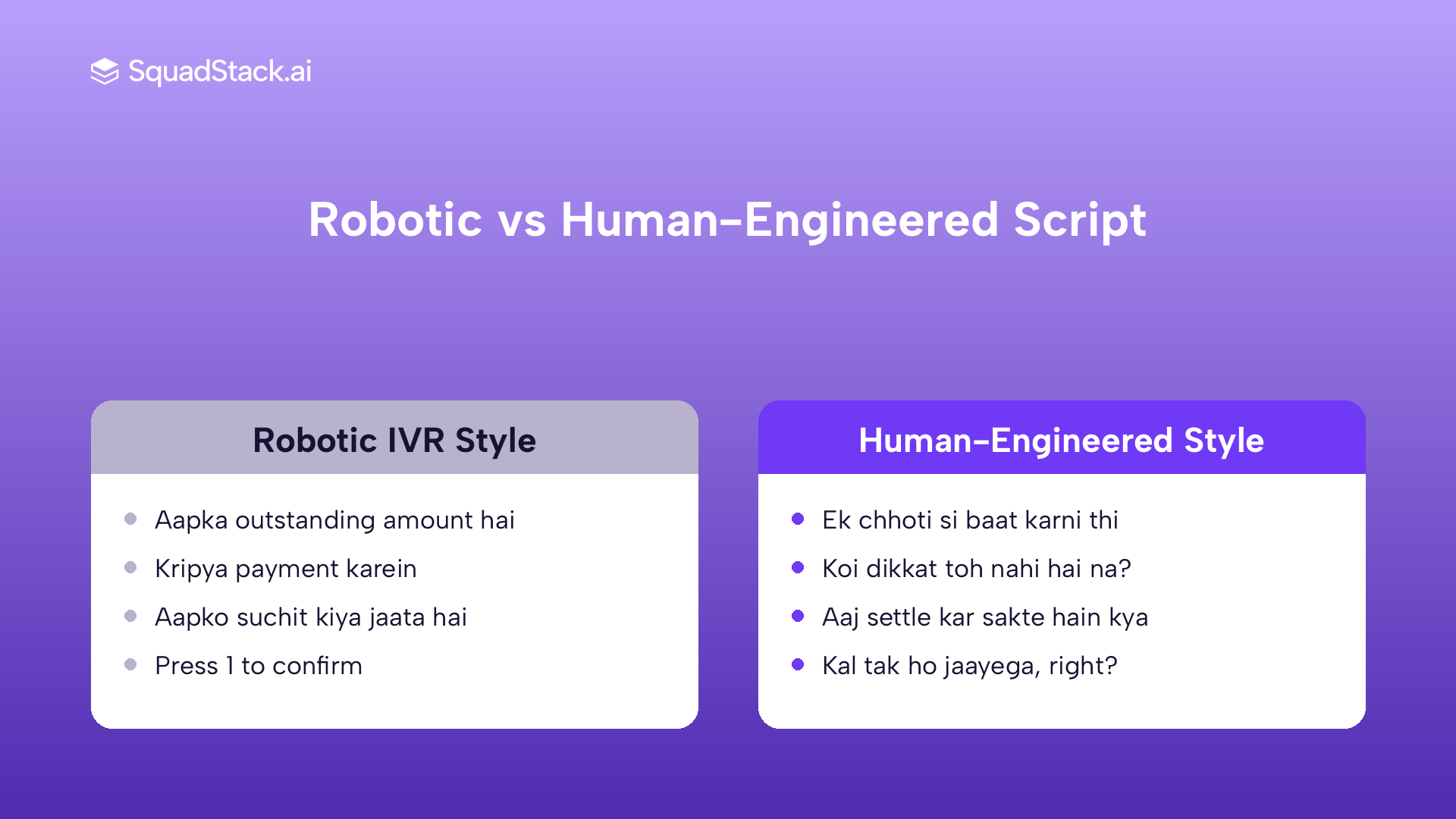
A collections script sounds robotic when it is built for a TTS engine, not for a borrower.
The signs are obvious once you hear them. Stacked acknowledgments like "Thank you for sharing that, I understand your concern" signal automation instantly. Formal Hindi no borrower uses in conversation creates distance. A fixed sentence structure that never varies sounds like a menu. Any pause longer than one second, even mid-thought, tells the listener: this is a bot.
Most voice AI vendors generate scripts using a language model and run them through a TTS engine. The output is grammatically correct and tonally flat. It sounds like a newsreader, not a collections agent from a regional lending floor.
Hinglish further complicates this. Spoken Hinglish is not a grammar rule set. It is a fluid blend that switches mid-sentence, uses regional courtesy markers, and relies on filler sounds that vary by state. A borrower in UP sounds different from a borrower in Maharashtra, even when both speak Hinglish.
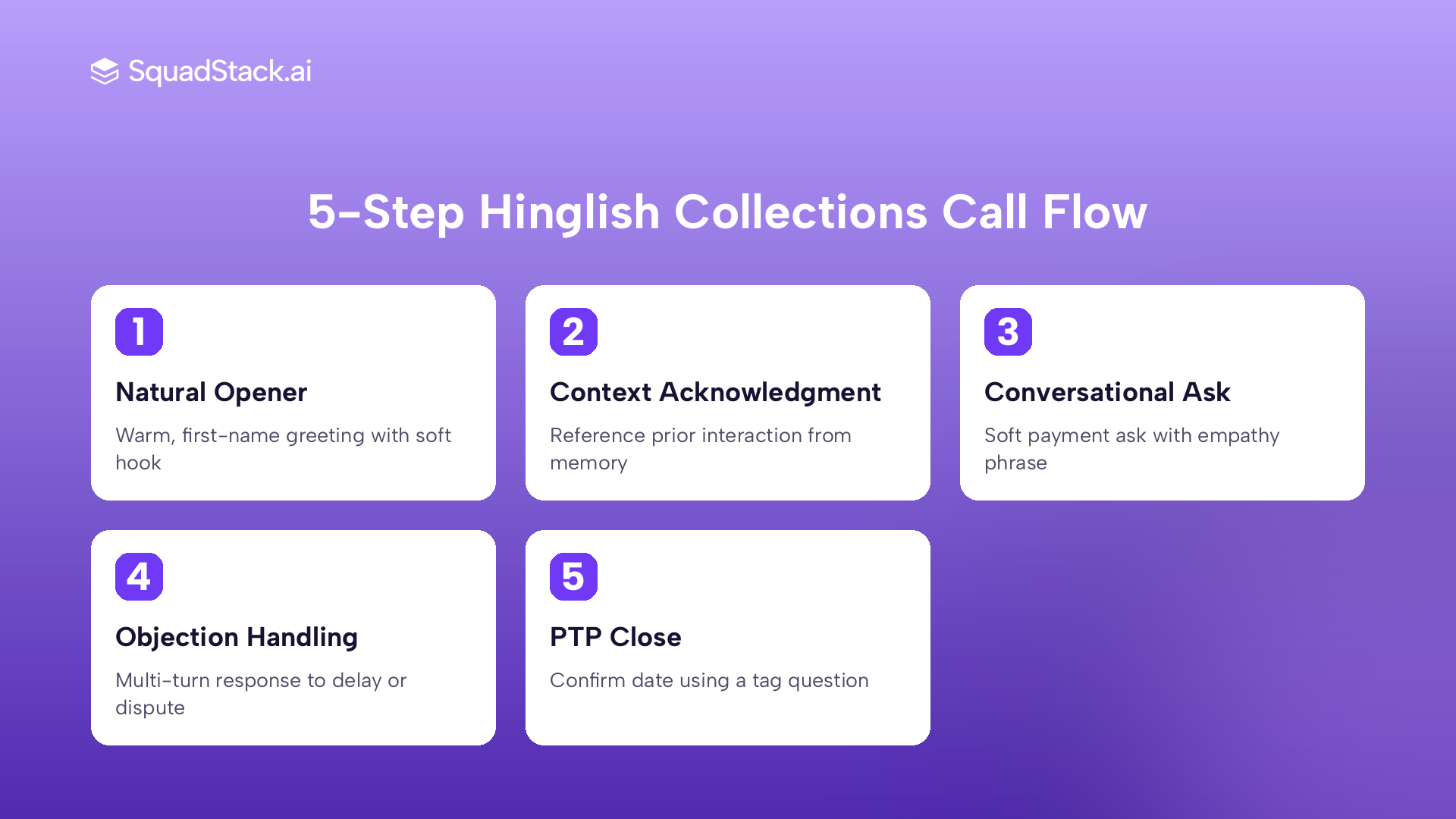
The call flow for a Hinglish AI collections agent has five moves, each requiring deliberate script choices.
1. The opener. The first three seconds decide whether the call continues. A robotic opener like "Hello, I am calling from [Company Name] regarding your outstanding dues" is a hangup trigger. A human opener sounds like: "Haan ji, [Name] bhai, ek zaruri cheez discuss karni thi aapse." It signals familiarity, not formality.
2. The acknowledgment of context. Before asking for payment, the agent should signal it knows the borrower's situation. Not a generic "I understand your difficulty" but something specific: "Pichle mahine baat hui thi, tab aapne kaha tha ki salary aate hi kar denge." Referencing prior context shifts the dynamic. The borrower is not explaining themselves again.
3. The ask, framed around the EMI date. The ask should be specific and short. "Aaj ya kal mein koi arrangement ho sakti hai?" is better than "Could you please make the payment at the earliest?" One is conversational. The other is a corporate email read aloud.
4. Objection handling across turns. A well-designed script handles objections over two or three turns, not one canned rebuttal. If the borrower says "Abhi account mein balance nahi hai," the agent confirms the reason, offers a re-presentation date, then extracts a PTP with a specific date and amount. Multi-step objection handling is what separates a conversational agent from an IVR.
5. The close with a micro-commitment. End the call with something specific: "Toh kal 3 baje tak ho jaayega, sahi hai na?" The "hai na" is a tag question, a backchannel courtesy marker that softens the ask and invites confirmation. A trained collections agent learns this in week two. A generic TTS script never includes it.
Every call outcome feeds the ROI Optimizer, which reads what worked: which opener kept people on the line, which objection response led to a PTP, which timing produced better kept-rate. That signal loop continuously sharpens script, voice, and timing choices.
AI voice agents are most effective on the high-volume, script-stable segments of the collections stack.
X-bucket and pre-due reminders. Calling 2 to 5 days before EMI presentation is the lowest-friction use case. The script is short, the borrower is not yet delinquent, and a soft Hinglish reminder measurably improves first-presentation success.
Bucket-1 (0 to 30 DPD) recovery. Most delinquent accounts sit in early buckets, and the required script is a firm-but-empathetic "missed by mistake?" conversation. AI can cover 100% of this bucket on bounce day, something a human floor cannot.
PTP follow-up calls. Calling the evening before and the morning of each promise date is essential for PTP-kept rate. These calls are short, consistent, and ideal for AI.
Appointment-setting for field visits in mid-buckets. AI handles the phone layer so field executives visit confirmed appointments rather than cold doors.
For more on how AI voice works across the full debt recovery stack, see the AI in debt collection and AI phone calling services for debt collection pages.
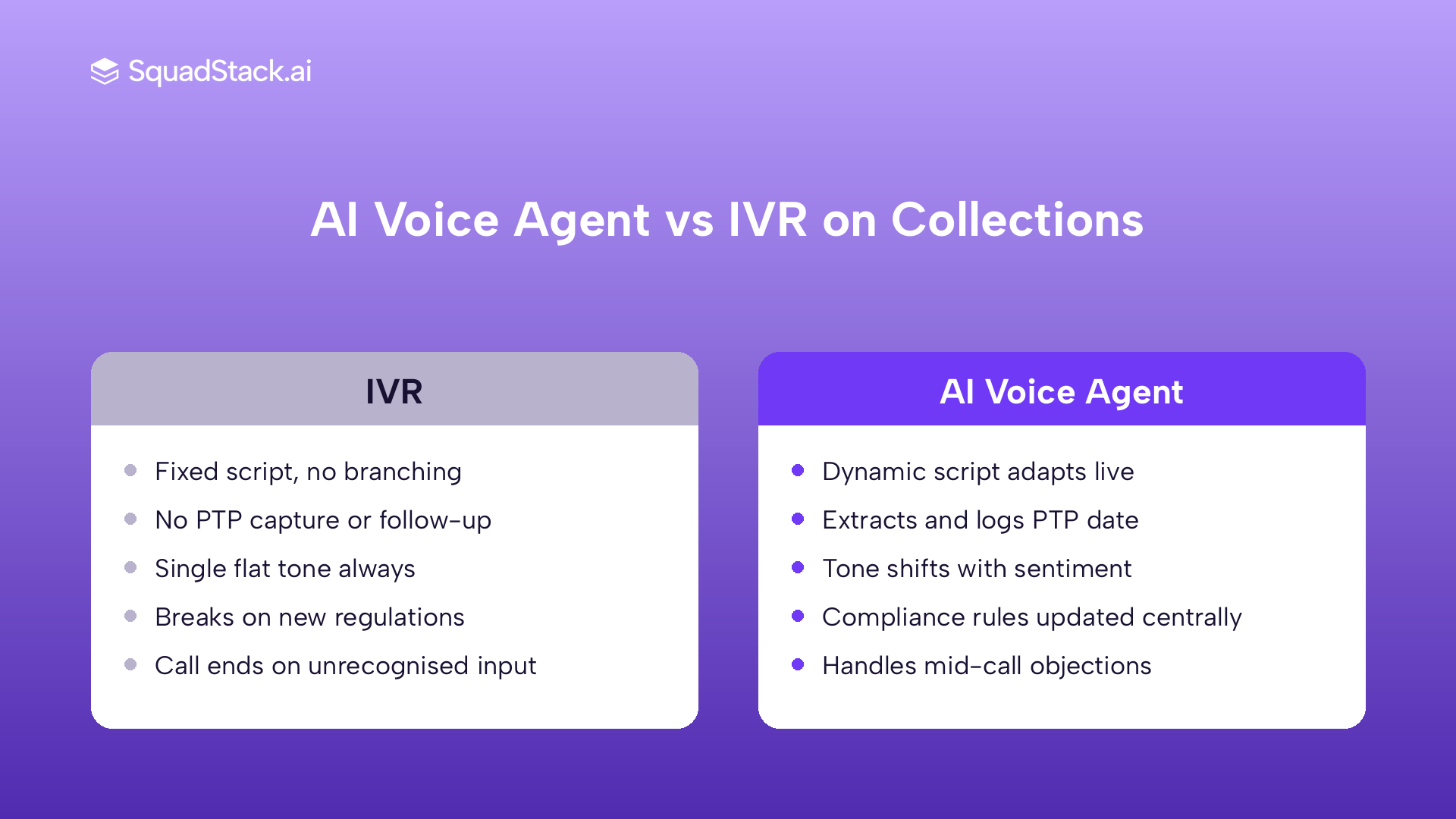
A standard IVR fails collections calls in ways an AI voice agent does not. The table below maps the five dimensions that matter most.
| Dimension | IVR | AI Voice Agent |
|---|---|---|
| Script flexibility | Fixed menu options only. A borrower saying "account mein abhi paisa nahi" gets "press 1 for yes, press 2 for no." | Understands free-form Hinglish, identifies the objection, and responds with a relevant next step. |
| PTP extraction | Cannot negotiate a date. Can only record a keypad input, which produces low-quality data. | Asks for a specific date and amount, confirms it, books the callback, and logs the PTP in the CRM. |
| Tone calibration | Reads the same prompt regardless of how many times the borrower has been called this month. | Adjusts tone based on bucket, prior call history, and borrower sentiment. Bucket-1 gets a softer approach than day 29. |
| Regulatory compliance | Cannot dynamically honor time windows, DND lists, or add an AI-disclosure line to the opener. | Calling-hours compliance, DND scrubbing, and AI disclosure are enforced at the platform level, not the script level. |
| Mid-call actions | Cannot send a payment link or WhatsApp message during the call. | Sends a payment link to WhatsApp while the borrower is still on the line, reducing friction between intent and action. |
Does it actually code-switch mid-sentence? Many vendors list Hinglish as a capability. Few can handle a borrower who starts in Hindi, shifts to English for a product term, and ends with a regional phrase. Ask for a live call sample with that exact pattern.
What is the Abruptly Disconnected Rate? ADR measures the share of calls where the borrower hangs up within the first ten seconds of recognising an AI. Human-baseline ADR sits around 8 to 12%. Any vendor claiming a humanlike product should show their ADR trend over time.
How is the script actually built? Avoid vendors who generate scripts from a general LLM. Ask whether dialogue is hand-engineered, whether fillers are tested per voice on actual phone lines, and whether AI-signal phrases are explicitly removed.
Is the vendor TRAI and RBI compliant? Collections calls have specific rules: contact only between 8am and 7pm, AI disclosure at call start, DND scrubbing before dialing, the 140-series for promotional calls, the 1600-series for service calls. A vendor who cannot confirm these controls is a compliance risk.
What does the QA layer look like? Post-call evaluation should cover borrower-side sentiment analysis, PTP-kept rate tracking, and outcome classification. Ask how the quality loop feeds back into script improvement.
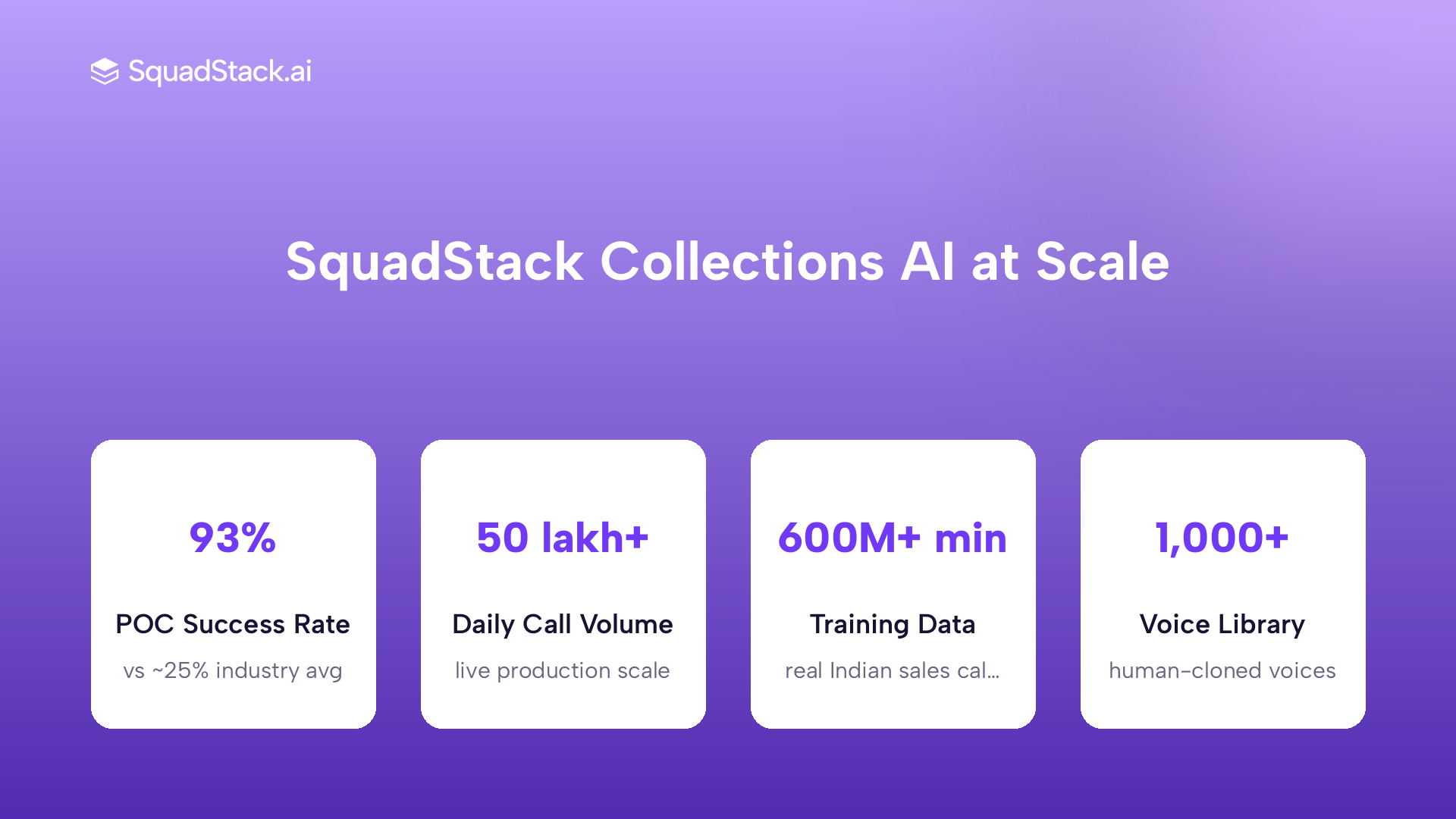
Arth, SquadStack's in-house speech model, is trained on 600M+ minutes of real Indian contact-center conversations, including code-switched Hinglish recorded on 8kHz telephone lines with background noise, crosstalk, and packet loss. Most vendors train on YouTube audio. Production-quality telephonic data at this scale is not publicly available.
The script methodology follows a 20/80 rule: 20% of call naturalness comes from TTS configuration, 80% from dialogue engineering. Every Hinglish opener, filler ("toh, dekh lijiye"), tag question ("hai na"), and backchannel ("ji, bilkul") is mined from transcripts of top-performing human agents, validated by native speakers, and tested against each voice on actual phone lines. Phrases that signal automation are removed. A human agent would never say "Thank you for sharing that." Neither does a SquadStack agent.
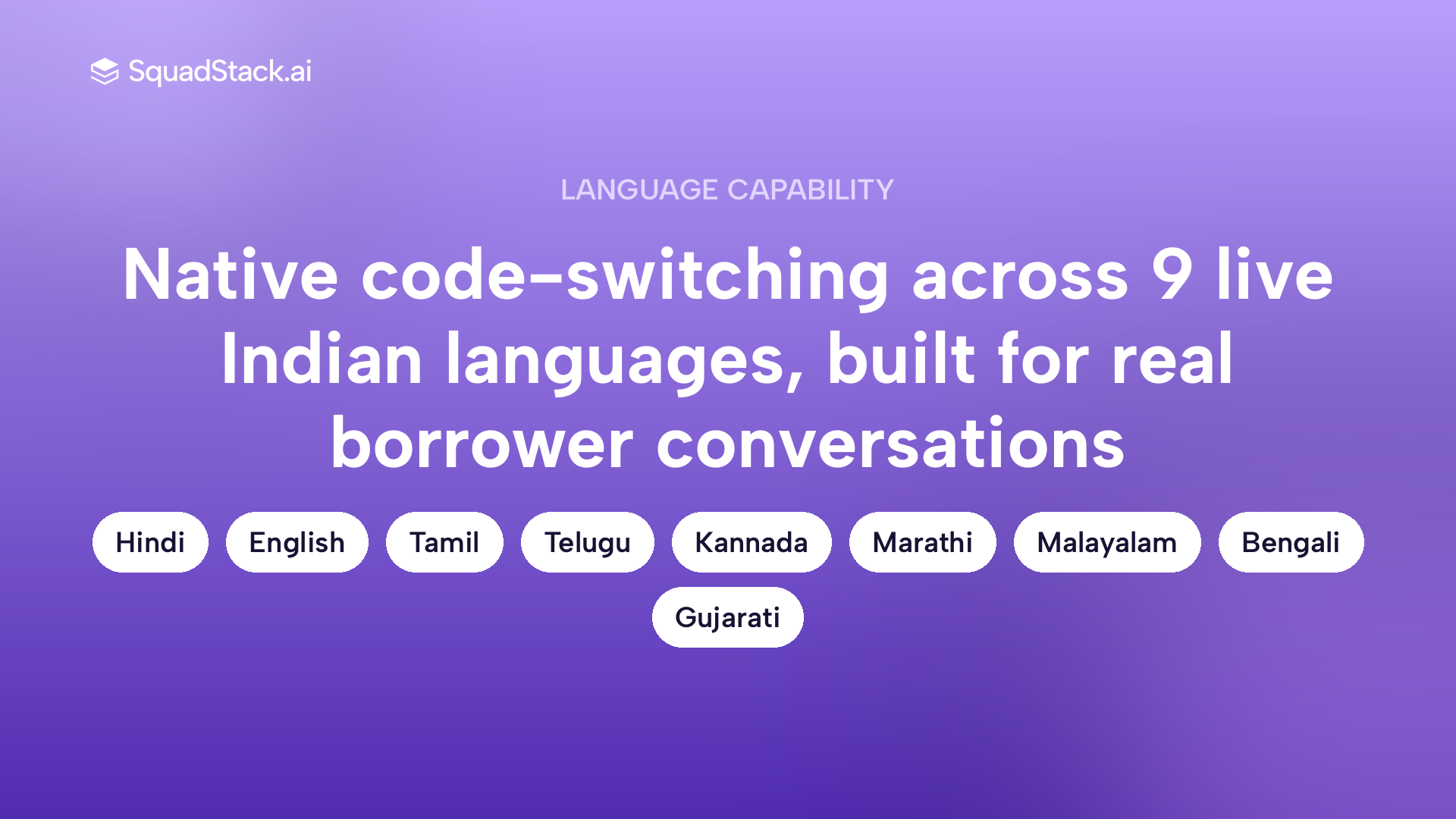
The platform runs 9 live languages with native code-switching: Hindi, English, Tamil, Telugu, Kannada, Marathi, Malayalam, Bengali, and Gujarati. Additional regional languages are available on demand.
Every call is scored on three levels by the Eval System: Outcome (was a PTP extracted?), Sentiment (how did the borrower respond?), and Execution (did the agent follow the compliance-aware flow?). That loop feeds the ROI Optimizer, which continuously improves script, voice, timing, and cadence choices.
PhonePe runs collections on the SquadStack platform and recorded a 35% PTP rate, tested against a human baseline. The Kissht success story shows how this plays out in a digital lending context.
SquadStack has a 93% POC success rate across pilot campaigns, against an industry average of roughly 25%. Collections campaigns go live in about two weeks, with the agent trained on the lender's own call recordings, scripts, and knowledge base before the first live dial.
For a full view of how voice AI applies across the lending lifecycle, see the lending and credit industry page.
A Hinglish AI voice collections script that does not sound robotic is an engineering problem, not a translation problem. The tools are well-understood: natural fillers, tag questions, multi-turn objection handling, PTP-specific closes, and a persistent memory layer so borrowers are never cold-called as strangers. The gap between a script that works and one that drives hangups is almost entirely in how the dialogue is built, not which TTS engine runs it.
If your NBFC is running 20,000-plus collections calls daily and your connect or PTP rates are not where they need to be, the script is usually the first place to look. Book a demo with SquadStack to see a live Hinglish collections call and get a benchmark against your current numbers.
Which is the best AI voice bot for collections calls in Hinglish for NBFCs in India?
SquadStack's Voice AI Agent is purpose-built for Indian NBFC collections, with native Hinglish code-switching, TRAI-compliant dialing, and a dialogue methodology proven on lenders like PhonePe and KreditBee. The platform handles pre-due reminders through mid-bucket PTP extraction at 50 lakh-plus calls daily.
We run 20 to 30k collections calls daily. Can AI handle this without sounding robotic?
Yes, provided the script is hand-engineered for Hinglish, not LLM-generated. At that volume, AI also removes the capacity ceiling: 100% coverage on bounce day is impossible for a human floor, trivial for AI. SquadStack has run collections at this scale for multiple NBFC and fintech customers.
What is a good PTP rate benchmark for AI voice agents on collections calls?
PhonePe's collections track on SquadStack recorded a 35% PTP rate in A/B testing against a human benchmark. PTP rates vary by bucket and borrower segment, so the right framing is how AI compares to your own human baseline, not an industry average.
How do AI voice collections agents stay RBI and TRAI compliant?
Compliant platforms enforce calling hours (8am to 7pm) at the system level, scrub DND lists before dialing, use the correct number series (1600 for service/collections calls), and include an AI-disclosure line at call start. On SquadStack's platform, these controls live in the dialing and dialogue layers, not just the script.
Why does my current Hinglish IVR or voice bot sound robotic on collections calls?
Most IVR and generic TTS systems are trained on read-speech, not conversational telephony audio. They lack natural fillers, tag questions, and the ability to code-switch mid-sentence. Any phrase a human agent would never say in a real call, like "I understand your concern" or "Thank you for sharing that," signals automation and raises hangup rates.
Can the AI agent send a payment link during the collections call?
Yes. SquadStack's Voice AI Agent can send a WhatsApp payment link while the borrower is still on the call, reducing the gap between a verbal commitment and an actual payment.
Should an NBFC replace its collections team with AI or augment it?
AI is most effective on X-bucket, Bucket-1, and PTP follow-up calls, where the script is consistent and volume is high. Mid and deep buckets, which require negotiation, hardship assessment, and legal sensitivity, still benefit from human judgment. The right model uses AI for full coverage on early buckets and lets human agents focus where judgment matters.
How long does it take to deploy a Hinglish AI collections agent?
SquadStack's typical go-live is around two weeks, including agent training on the lender's own call recordings, scripts, and knowledge base. A pilot then runs for four to eight weeks against a pre-agreed success metric before scaling.
Can AI voice agents handle borrowers who switch between Hindi, English, and regional dialects on the same call?
SquadStack's agents support native code-switching mid-sentence across 9 live languages, including Hindi and English. The underlying speech model, Arth, is trained on real code-switched telephony audio rather than public datasets, which is why it handles this accurately on a live 8kHz phone line.
What happens if the borrower disputes the EMI amount or asks a detailed question about their loan terms?
The agent pulls the answer from a knowledge base via RAG, with retrieval latency under 100 milliseconds. Loan terms, EMI schedules, and fee disclosures are served from the lender's approved documents. If the query requires human judgment or the borrower requests a human, the agent books a callback or transfers the call with full context.