Voice AI Onboarding Failures: What Goes Wrong and Why
November 2, 2026
|

13 min read
Where AI voice agents replace surge staffing for IPO follow-up calls, guiding investors through UPI mandates within the 3-day window.
IPO application follow-up AI voice brokerage India is an underserved workflow where most platforms still rely on push notifications and hope. AI voice agents can call eligible investors during the 3-day IPO window, walk them through the UPI mandate step by step, and handle FAQs live on the call, all within SEBI and TRAI compliance guardrails. Brokerages that deploy this see meaningfully higher application completion rates without staffing a surge floor.
The IPO subscription window in India is tight. Three days, one UPI mandate approval deadline, and a large share of eligible investors who never complete the step despite having applied. Most brokerages send a push notification. Some send two. A small share dial manually. The result is predictable: a meaningful portion of applications expire, the investor is frustrated, and the brokerage has lost both the transaction and the trust.
This is not a marketing problem. It is an operational one. And AI voice is the right tool for it.
IPO application follow-up AI voice refers to automated, conversational outbound calls placed by an AI voice agent to investors who have started an IPO application but not yet completed the UPI mandate approval. The agent makes a real two-way call, not a recorded message, identifies the investor's exact drop-off point, and guides them through completion in plain language, in their own language if needed.
The workflow sits cleanly on the service side of the SEBI compliance line. The agent is not recommending a security. It is reminding an investor of a step they already agreed to take, then helping them complete it.
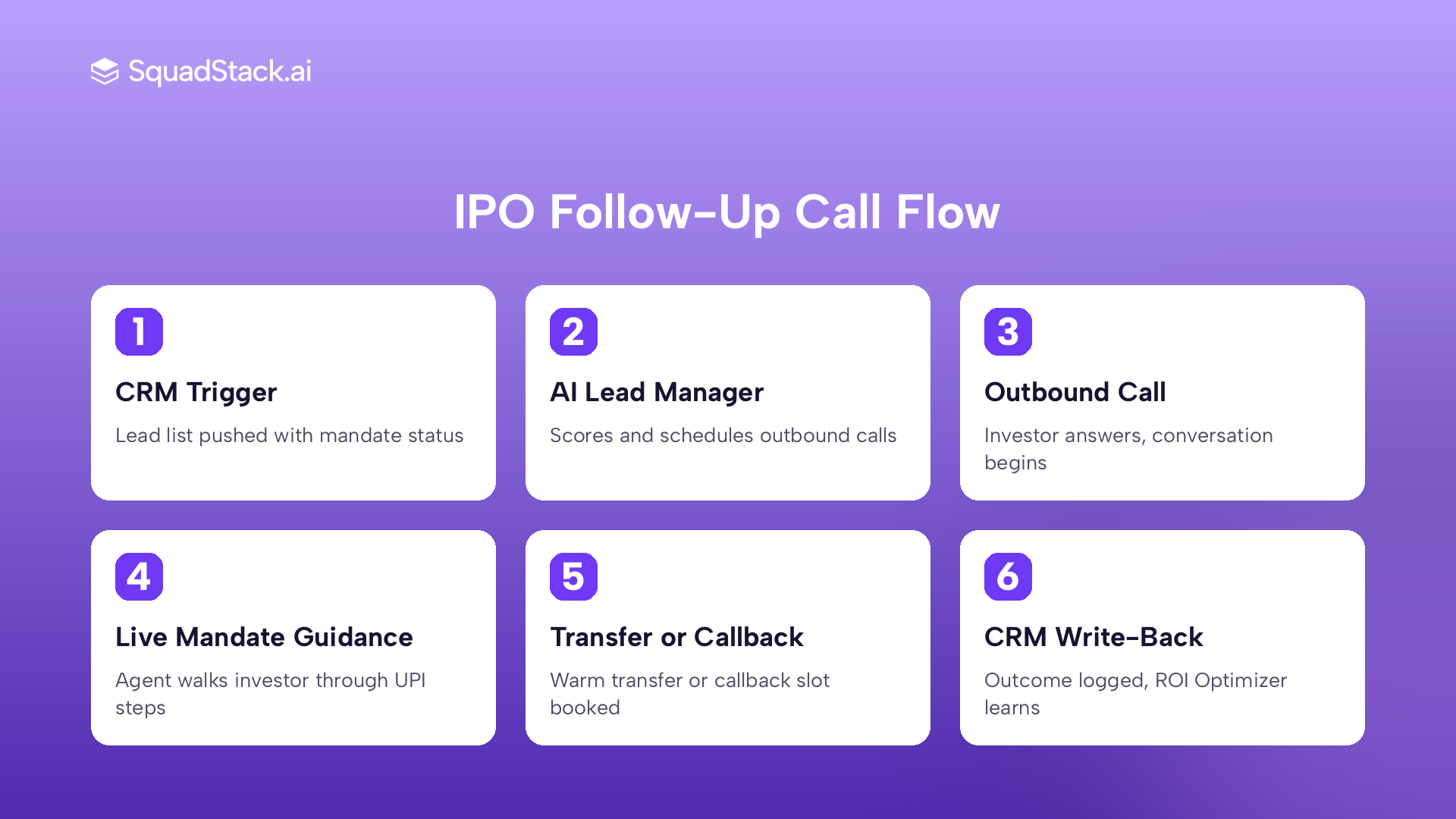
A well-designed AI voice agent for this workflow runs in six steps.
Step 1: Trigger from the CRM. The brokerage pushes a list of investors who have applied but not yet approved the UPI mandate. The AI Lead Manager scores this list by urgency, time left in the window, and each investor's historical call-pickup patterns.
Step 2: Adaptive dialing. The agent dials during the window the investor is most likely to pick up, using number health monitoring to avoid spam-flagged lines. Calls go out on TRAI-compliant number series with DND scrubbing already applied.
Step 3: Personalised opening. The agent opens with the investor's name, the IPO they applied for, and the specific step that is pending. Persistent memory means the agent already knows the context without re-asking.
Step 4: Live mandate guidance. The investor is walked through the UPI app, the ASBA block confirmation, or whichever step they are stuck on. The agent handles common questions live: what does "block" mean, will the money be debited immediately, what if the app shows an error. This is the part a push notification cannot do.
Step 5: Escalation or callback. If the investor wants to speak to a human, the agent flags them for warm transfer with full context already captured. If the window allows, it books a callback for a better time.
Step 6: CRM write-back and loop. Every call outcome, completed, pending, refused, unreachable, writes back to the brokerage's CRM automatically. The ROI Optimizer then analyses which call timings, language choices, opening lines, and objection responses drove the highest completion rates, feeding that learning into the next campaign.
Beyond the mandate call itself, AI voice agents attach to several adjacent moments in the IPO lifecycle.
Pre-IPO eligibility nudge. Before the window opens, the agent calls investors who have the account and UPI handle to confirm they are ready to apply. This is feature education, not advice.
Mid-window mandate reminder. Day two of a three-day window, the agent calls investors who applied on day one but have not approved the mandate. The window is still open. The call can still convert.
First-time IPO investor hand-holding. A large share of India's newer retail investors, increasingly from non-metro locations, have never applied for an IPO before. A voice call in Hindi, Tamil, or Gujarati is categorically more useful than an English FAQ page.
Post-allotment cross-sell. After allotment results, investors who received shares can be told how to view their demat holdings and nudged toward a first trade or SIP setup. The agent stays on the service and education side of the compliance line throughout.
For a deeper look at how AI voice fits the full brokerage account lifecycle, see the SquadStack brokerage industry page.
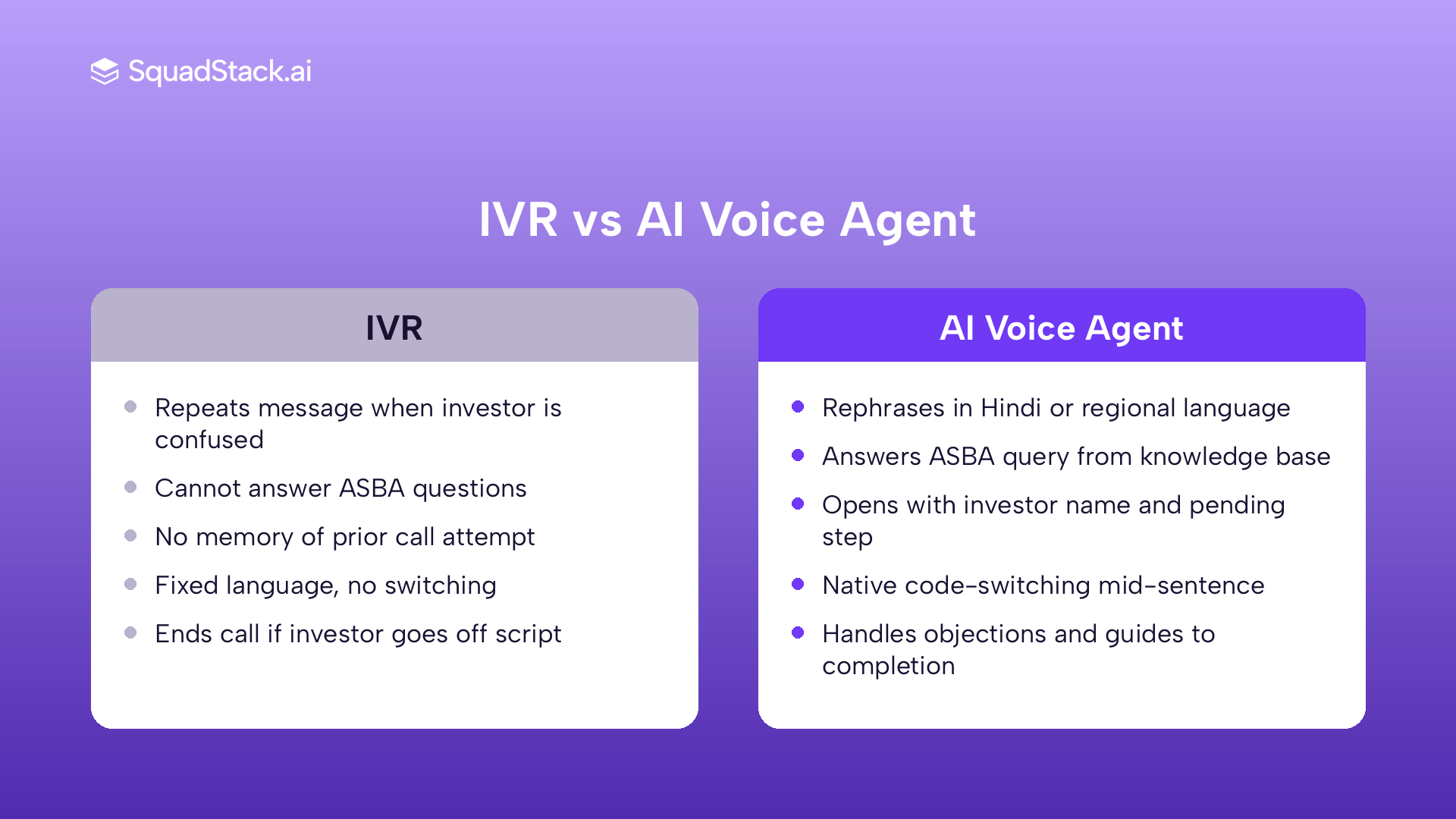
An IVR and an AI voice agent are not the same thing. For IPO mandate follow-up, the difference is the difference between a completed application and an expired one.
| Dimension | IVR | AI Voice Agent |
|---|---|---|
| Handling mandate confusion | Plays a recorded message. If the investor says "I don't understand," the IVR repeats it or hangs up. | Detects confusion, rephrases in plain language, and walks the investor through the UPI app step by step in real time. |
| Language switching | Fixed language, set at campaign launch. | Switches language mid-sentence if the investor responds in Hindi, Gujarati, or Tamil. Native code-switching, not a translation layer. |
| Objection handling | Cannot handle "will my money be debited immediately?" off-menu. Call ends. | Answers factual questions about the ASBA block from a structured knowledge base, with under 100ms retrieval latency. |
| Remembering context | Every call starts cold. The investor repeats their account number and IPO name every time. | Persistent memory means the agent already knows which IPO, which step is pending, and what the investor said on the last call. |
| Response speed | Recorded playback, no latency concern. | Median response latency of 0.8 seconds or less. The conversation feels like a real phone call. |
The practical consequence: an IVR is a broadcast tool with a menu. An AI voice agent is a conversation that can actually rescue an incomplete application.
Time-critical dialing infrastructure. A 3-day IPO window with a 5 PM mandate deadline is not forgiving. The platform needs adaptive call timing, real-time spam-number rotation, and a dialing cadence that can clear a large list in hours, not days.
Indian-language fluency, not just support. Listing Hindi on a feature page is not the same as sounding native in it. The platform should be trained on real Indian telephonic conversations, including code-switched speech like Hinglish, not on read-speech datasets. Most brokerages now have a majority of new accounts from non-metro cities, and a call that sounds foreign to a first-time investor from Surat or Coimbatore will not complete the mandate.
Compliance-aware scripting. The agent must never cross into investment advice. That boundary needs to be enforced in the system itself, not in a training manual. Look for locked script sections the self-improvement loop cannot override, consent gating built into the call flow, and TRAI-compliant number series management.
CRM integration and call-outcome write-back. Pending mandates need to trigger a follow-up; completions need to close the loop. This has to be automatic, not a post-campaign export.
Dual-layer QA. Because these calls touch a regulated process, every conversation should be auditable. Look for a QA framework that scores calls on outcome, sentiment, and execution, and flags compliance deviations automatically.
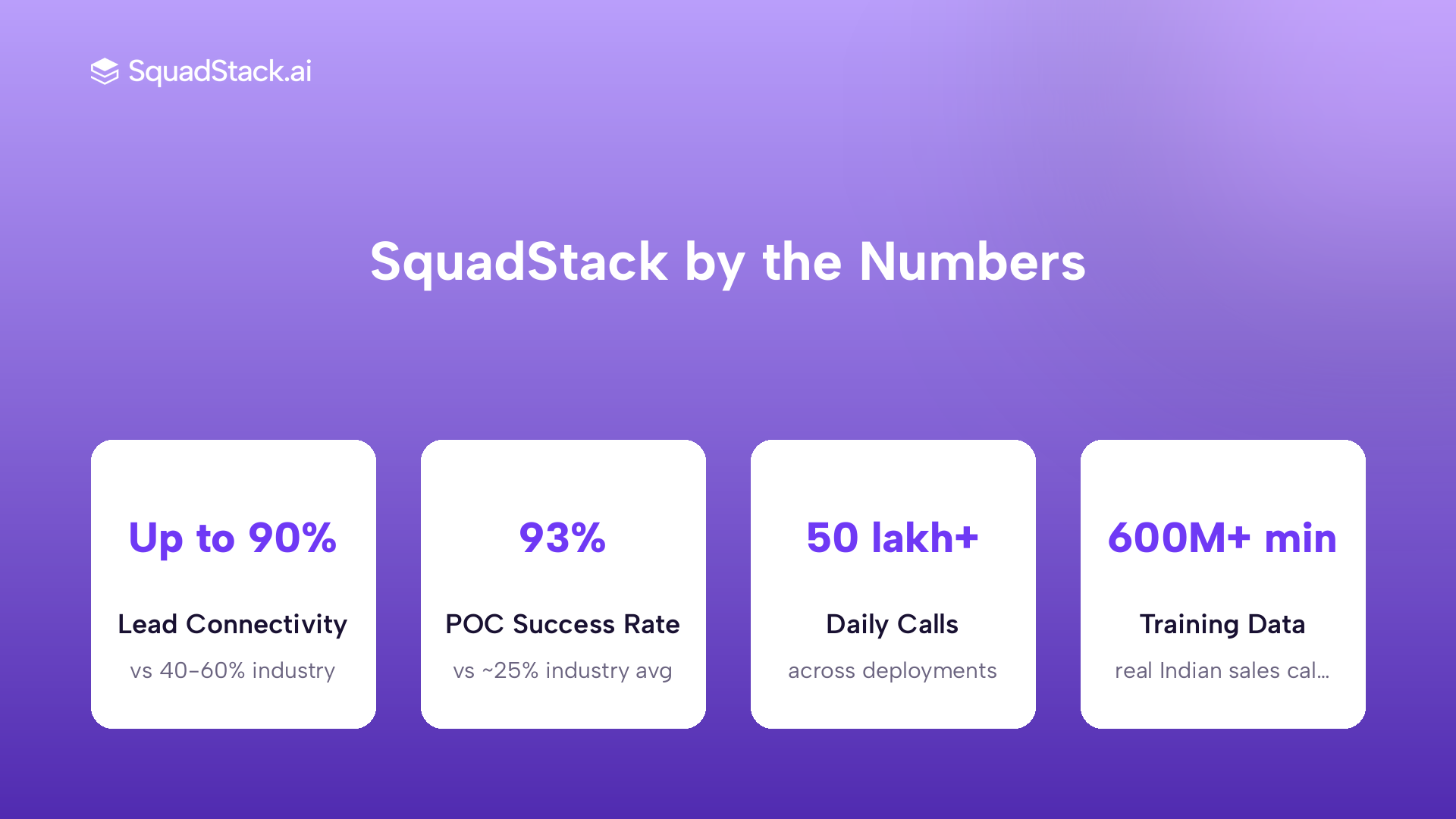
SquadStack's voice agents are built on Arth, a proprietary speech model trained on 600M+ minutes of real Indian contact-center conversations. That training corpus includes the noisy, code-switched, 8kHz telephony audio that reflects what an actual call to a retail investor in Nagpur or Ahmedabad sounds like. Generic models trained on YouTube audio do not handle this reliably.
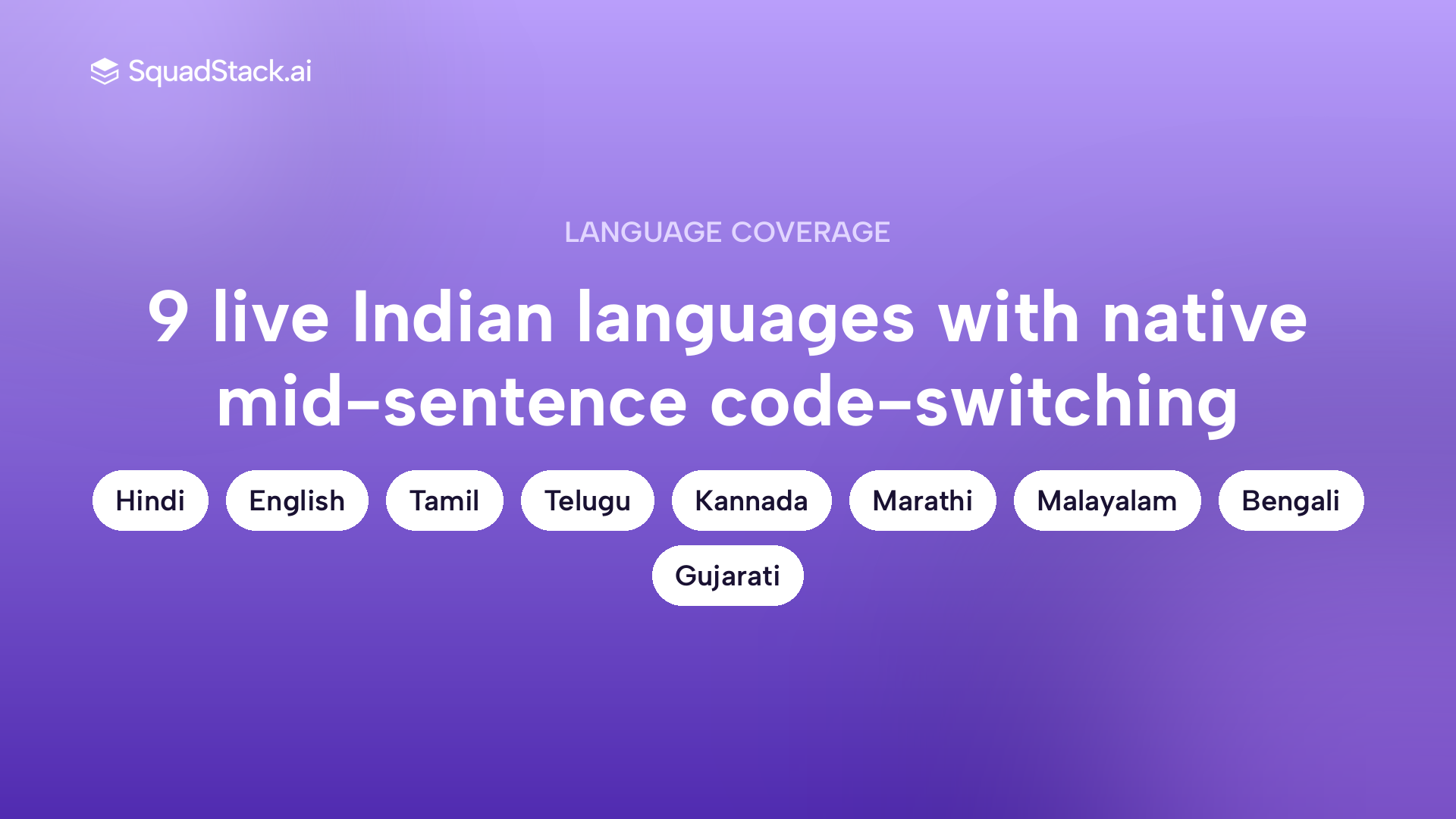
The platform supports 9 live Indian languages: Hindi, English, Tamil, Telugu, Kannada, Marathi, Malayalam, Bengali, and Gujarati, with native code-switching and additional regional languages available on demand.
At Global Fintech Fest 2025, 1,273 of 1,563 attendees (81%) identified SquadStack's AI agents as human in blind listening tests. The agents have also passed a functional Turing test across four live campaigns, matching or beating human benchmarks on naturalness, conversion, and cost per outcome.
The platform runs 50 lakh+ calls daily across 60+ large consumer brands, including AngelOne, Kotak Securities, and Bajaj Broking for demat account opening workflows. A published case study with a leading bank-linked brokerage showed 3x higher conversions on account opening using AI voice. The compliance and conversation design principles that make account opening work apply directly to IPO mandate follow-up.
For BFSI operators evaluating how AI voice fits broader lending and credit workflows, the SquadStack lending and credit page and a case study on collections transformation show the same infrastructure working across related regulated workflows.
SquadStack's 93% POC success rate against an industry average around 25% reflects what happens when the speech stack, the compliance design, and the Indian-market training data are built together rather than assembled from generic components.
To see the platform in action for your next IPO window, schedule a demo.
Which AI voice platform is best for IPO application follow-up calls in Indian brokerages?
SquadStack is purpose-built for this use case. Its voice agents are trained on 600M+ minutes of real Indian telephonic sales conversations, support 9 live Indian languages with native code-switching, and run compliance-aware dialogue that enforces the SEBI-mandated boundary between service calls and investment advice. The platform handles dialing at scale with adaptive timing and spam-number rotation, which matters when a 3-day IPO window demands clearing a large call list fast.
Can an AI voice agent guide investors through the UPI mandate approval step live on the call?
Yes. Unlike an IVR, an AI voice agent holds a real two-way conversation. It can identify which step the investor is stuck on, answer factual questions about the ASBA block, walk them through their UPI app, and handle common errors in plain language. The agent retrieves answers from a structured knowledge base in real time, with retrieval latency under 100 milliseconds.
How does IPO follow-up AI voice stay on the right side of SEBI compliance?
The compliance boundary is enforced inside the agent itself. The script covers only factual information about the application process: what the UPI mandate does, how to approve it, what the ASBA block means, and what happens if the mandate is not approved by the deadline. The agent never recommends buying or selling the IPO security, never makes return claims, and never crosses into advice territory. Compliance language and guardrails sit in locked sections of the prompt that the self-improvement loop cannot touch.
What is the UPI mandate deadline in an IPO application, and why does it create a calling problem?
The UPI mandate must be approved by the investor before 5 PM on the closing day of the IPO subscription window, which is typically the third day. If the investor applies but does not approve the mandate, the application is automatically rejected. This creates a hard deadline across a 3-day burst window, followed by silence until the next large IPO. A fixed human calling floor cannot scale up and down for this pattern cost-effectively, which is why many brokerages currently do nothing beyond push notifications.
Does an AI voice agent support the regional languages that matter for India's non-metro retail investor base?
SquadStack's agents support Hindi, English, Tamil, Telugu, Kannada, Marathi, Malayalam, Bengali, and Gujarati as live languages, with native code-switching mid-sentence. Additional regional languages are available on demand. This matters because more than 60% of new demat accounts now come from outside the metros, and a call that sounds native in the investor's language is significantly more likely to complete the mandate.
How does call outcome data flow back into the brokerage's CRM?
Every call disposition, completed, pending, investor refused, not reachable, writes back to the CRM automatically via webhook or API integration at the end of the call. This triggers the right next step without manual work: a completed mandate closes the loop, a pending call re-enters the queue, and a warm-transfer request routes to a human with full context already captured.
What makes AI voice better than automated SMS or WhatsApp nudges for mandate completion?
SMS and WhatsApp are one-way broadcasts. They can tell an investor to complete the mandate but cannot help them do it. An investor who opens a WhatsApp message and does not understand the UPI approval step is still stuck. An AI voice call can detect exactly where they are lost and walk them through the step live. The conversion difference between a passive nudge and an active two-way conversation is material, particularly for first-time IPO applicants who have never done this before.
How quickly can a brokerage go live with an IPO follow-up AI voice campaign?
Most enterprise pilots go live in 2 to 3 weeks. The build period covers campaign workflow design, CRM and telephony integration, knowledge base setup for IPO-specific FAQs, and UAT. Because IPO calling follows a repeatable pattern, a brokerage that has run one campaign can warm-start the next one faster. SquadStack's dedicated squad handles the build end to end: the client supplies the lead data, the IPO details, and approvals; the squad builds the conversation.
How does the platform handle investors who want to speak to a human agent?
Any investor who asks to speak to a person is transferred to the brokerage's human team with full conversation context already captured. The receiving agent sees what was discussed, which step is pending, and any specific concerns the investor raised. If no human is available at that moment, the agent books a callback at a time the investor prefers, with the same context passed forward.
Is AI voice calling for IPO follow-up compliant with TRAI calling regulations?
Yes. The platform enforces TRAI calling-hour rules with hard system checks: outbound dialing is blocked outside the 9:30 AM to 8:30 PM window. Lead lists are scrubbed against the TRAI DND registry before any dial goes out. The platform uses TRAI-compliant number series for outbound campaigns, and consent state determines which number series and which script variant the agent uses. SquadStack is ISO 27001, ISO 27701, SOC 2 Type II, DPDP, and TRAI compliant.