.svg)






Subscriber Churn Prediction Calls: AI Voice for OTT and Streaming
October 10, 2026
|

12 min read
Find out how AI voice agents make microinsurance renewals viable in rural India by cutting costs and covering multilingual, low-premium queues at scale.
TL;DR: Microinsurance renewal calls using voice AI in rural India solve a real operational problem: low-ticket crop, health, and life policies lapse not because policyholders want to leave but because no one calls them in time, in their language, on a phone they can actually use. AI voice agents in Hindi and regional languages handle those calls at a fraction of the cost of a human floor, at scale, across Tier 3 and beyond markets.
Key Takeaways
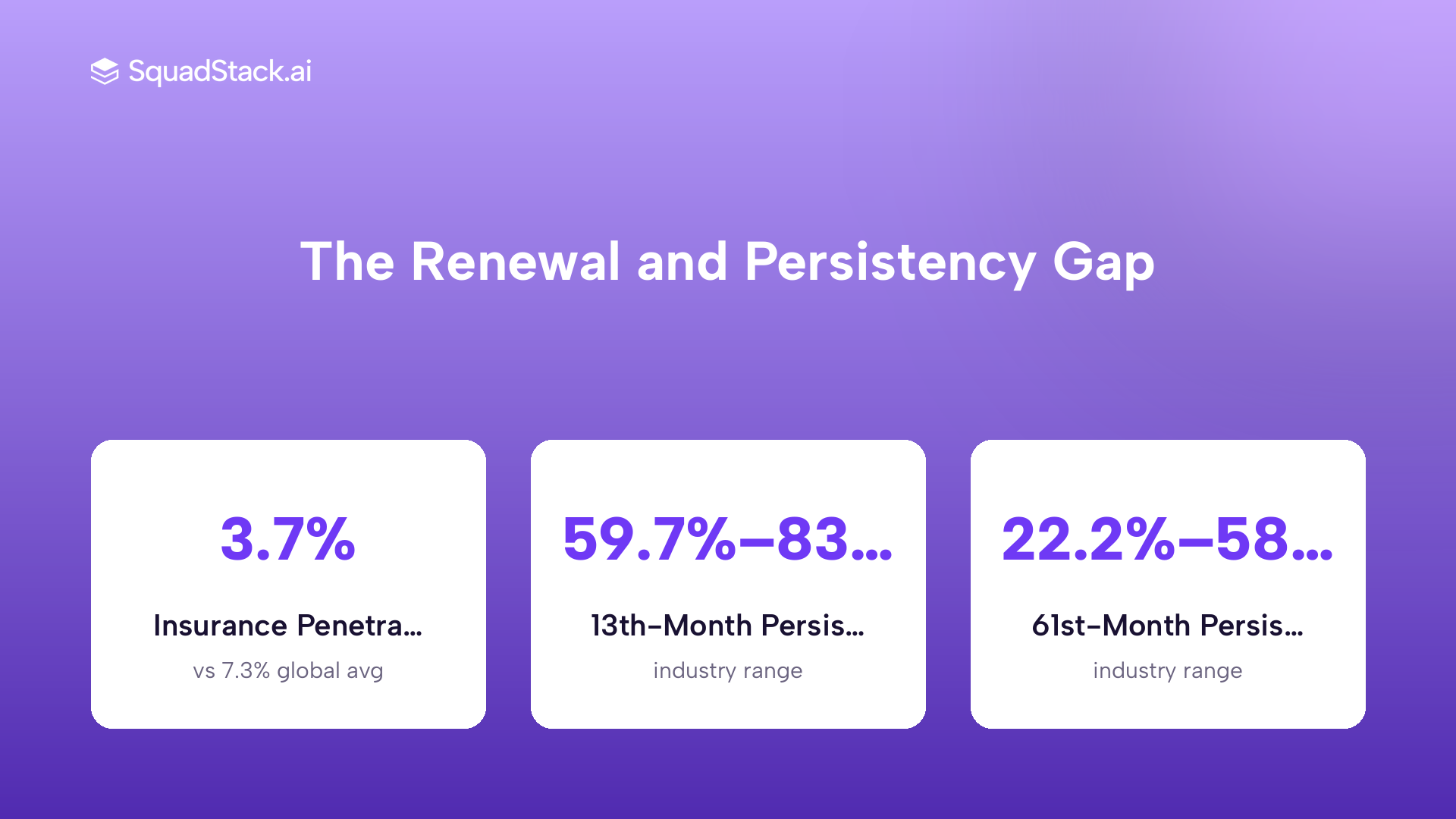
A farmer in Vidarbha takes a crop insurance policy in June. The premium is under five hundred rupees. By renewal time, his agent has changed jobs. The insurer's outbound floor, stretched across a lakh-plus renewal queue, never reaches his record. The policy lapses. The insurer loses a renewal that cost almost nothing to retain, and the farmer loses cover he needed.
At premium levels typical for Tier 3 and Tier 4 markets, a human agent with a 35% connect rate and a monthly salary cost cannot make renewal calling pay. So much of the book simply goes uncalled.
That gap is exactly where microinsurance renewal calls using voice AI in rural India are finding traction. This post covers how the technology works, what makes rural deployment different, and what to look for in a platform.
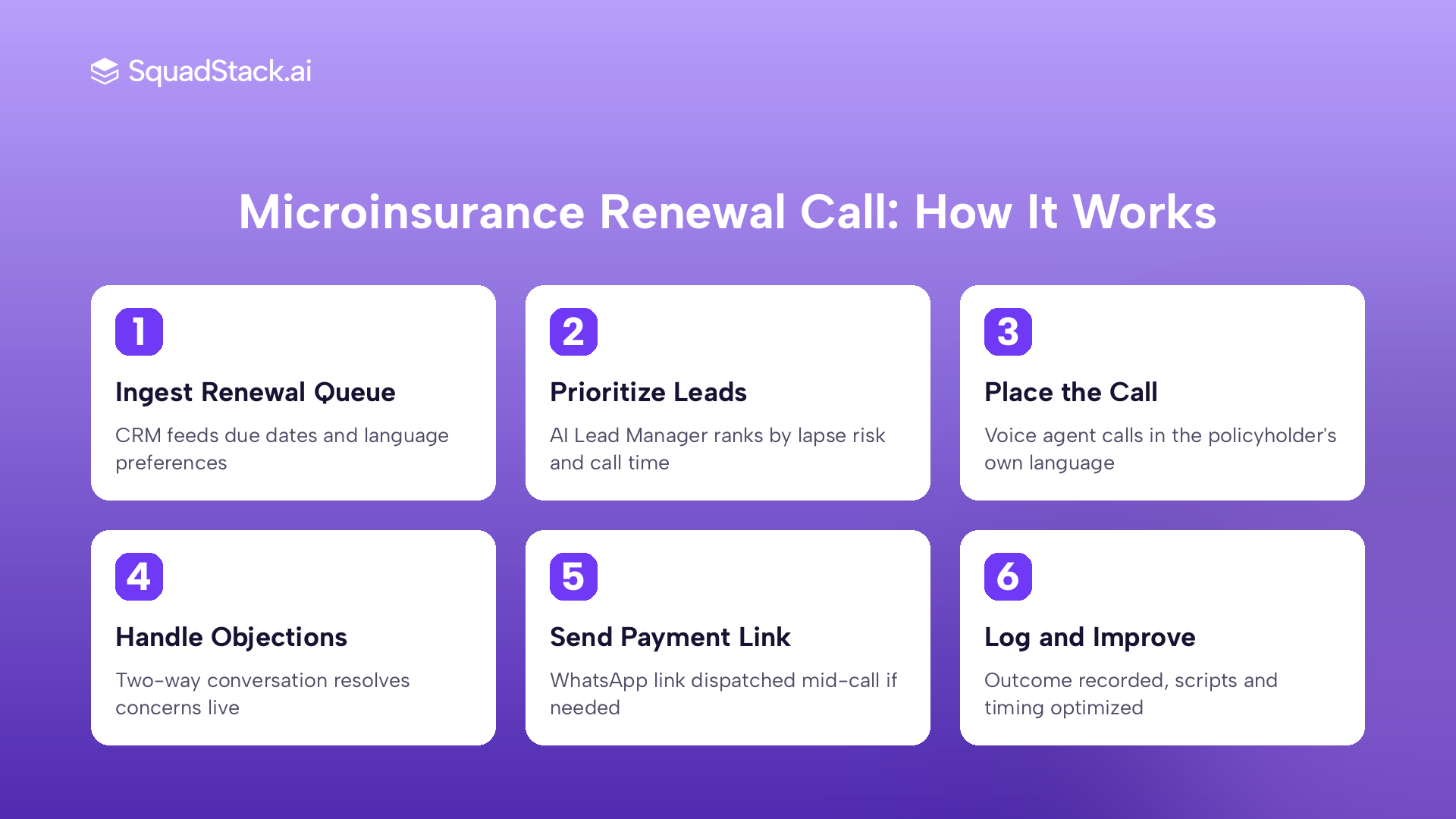
An AI voice agent places outbound calls, holds a two-way spoken conversation in the policyholder's language, confirms renewal intent, handles objections, collects payment consent or sends a payment link, and closes the reminder loop without a human agent on the line.
It is not a recorded message. The agent listens, responds to what the caller actually says, and switches between Hindi and Bhojpuri mid-sentence if that is how the caller speaks.
The renewal call flow typically looks like this:
1. The platform ingests the renewal queue. Due dates, policy type, premium, and preferred language come from the insurer's CRM. 2. The AI Lead Manager scores and prioritizes records by lapse risk and best time to call. Attempts are placed inside the TRAI-compliant 9:30 AM to 8:30 PM window, with number health monitored and spam numbers rotated automatically. 3. The voice agent opens in the policyholder's language, confirms identity, and explains the renewal. If the premium has changed, the agent explains why. 4. The agent handles common objections: premium too high, need to discuss with family, already paid elsewhere. For a NACH bounce it flags the failed debit and guides the policyholder to pay or re-authorize. 5. If the policyholder wants to pay by link, the agent sends one to WhatsApp while still on the call. If connectivity drops, the system holds session state and retries. 6. Every outcome feeds back into the ROI Optimizer. Scripts, voice choices, timing, and objection handling improve with each campaign cycle.
For feature-phone users or areas with unstable data, an IVR fallback routes the call into a key-press menu in the policyholder's language. It is a simpler experience, but it serves a segment that cannot run a two-way AI conversation on an old handset with patchy signal.
Language and literacy. A policyholder in coastal Andhra Pradesh may speak Telugu at home, use Hindi with traders, and be uncomfortable with any English. Standard IVR Telugu sounds like a textbook reader. An AI agent trained on real conversational audio handles short sentences, filler sounds, and code-switching mid-thought.
Trust barriers. Rural policyholders are more skeptical of unknown numbers, partly from fraud exposure. An agent that confirms the policyholder's own policy details instantly, rather than asking them to confirm, changes how the call lands.
Connectivity and device constraints. A smartphone with good data is not guaranteed in a Tier 4 market. Call design must account for dropped packets, mono audio, and 2G connections. Audio quality on 8kHz telephony lines matters as much as the language model behind the agent.
Low-ticket economics. A microinsurance policy may carry a premium of a few hundred rupees. The renewal call cannot cost more than a tiny fraction of that. AI voice makes this math work where human calling cannot.
Renewal ladder calls. A D-30, D-7, and expiry-day sequence where each call builds on the previous one. If the policyholder said "call me Friday," the Friday call opens with that context, not a cold introduction.
NACH bounce recovery. The auto-debit failed and the policyholder usually does not know. A same-week call in their language explains what happened and takes an alternative payment. This is one of the highest-ROI use cases in the renewal funnel because intent is already there.
Lapse and revival outreach. For policies within the revival window, the agent explains arrears, any concessions running, and the health declaration process in plain language. LIC's August-October revival season is a natural fit for at-scale AI outreach.
Welcome and PIVC calls. For newly issued policies sold through MFIs, POSP advisors, or rural bank branches, a welcome call confirms what was bought, explains the free-look right, and sets the first renewal date.
Premium hike and portability handling. When a health microinsurance premium rises at renewal, a call explaining the reason and what waiting-period credit would be lost by porting is more effective than a paper notice. The agent escalates to a human where a licensed person is required for any solicitation.
For a picture of results, the A Leading General Insurer case study is a useful reference: 85% connectivity and a 60% drop in renewal cost.
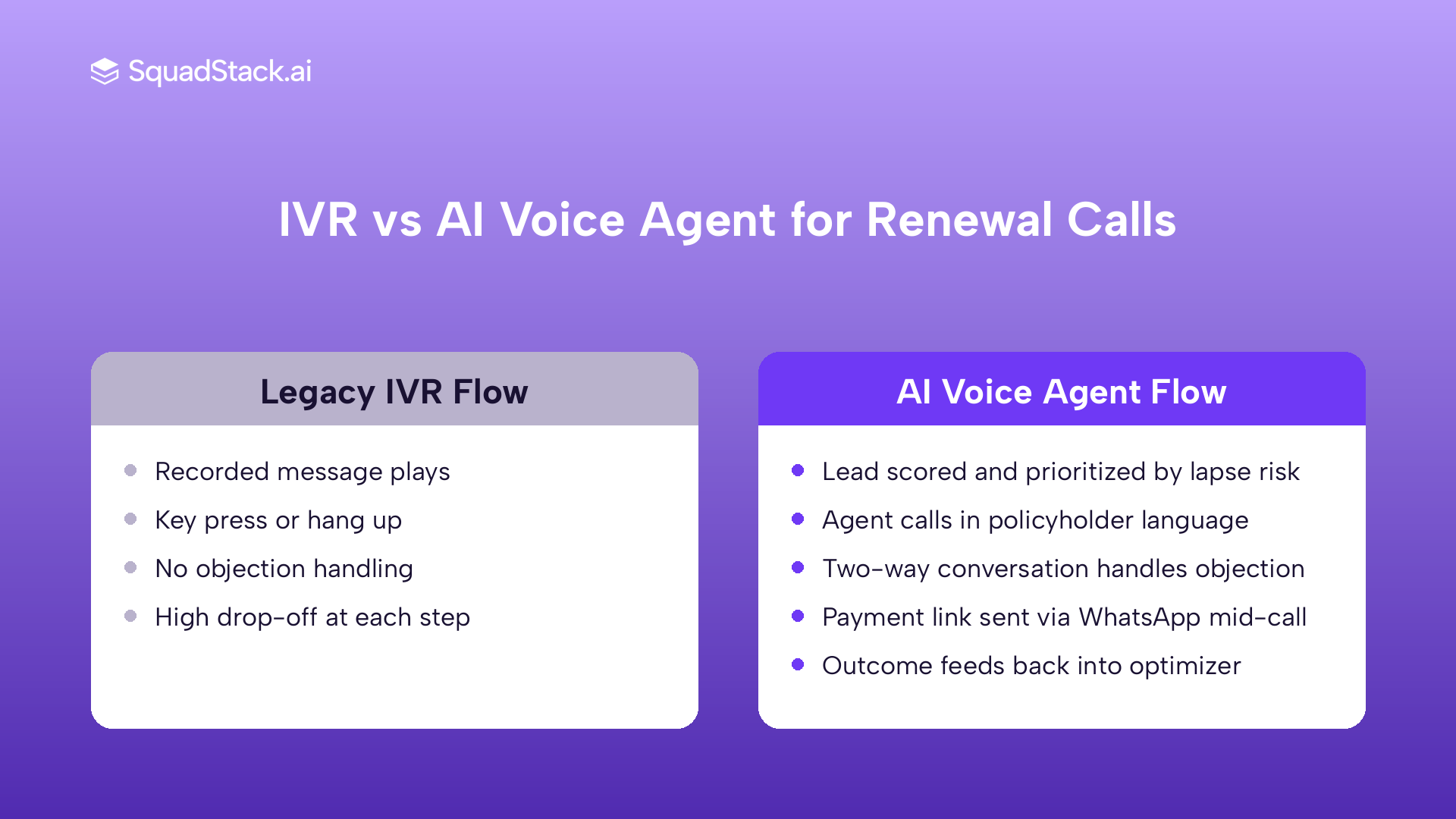
| Dimension | Legacy IVR | AI Voice Agent |
|---|---|---|
| Language handling | Plays a recorded message in one pre-set language | Detects the caller's language and code-switches mid-call, including Hinglish and regional blends |
| Policyholder objection | Cannot respond; the caller either presses a key or hangs up | Listens to the stated reason and gives a specific, relevant response (premium too high, bounce, family decision) |
| Low-connectivity conditions | Audio may stall; session state is lost if the call drops | Trained on 8kHz telephony audio; IVR fallback is a configurable block for feature-phone users |
| Context across attempts | Every retry is a cold start | Persistent memory means attempt two picks up from attempt one's disposition |
| Trust building | Robotic tone raises abandonment in rural markets where fraud calls are common | Native-sounding voice cloned from real agents; Abruptly Disconnected Rate comparable to human agents |
| NACH bounce recovery | Can only play a recorded notice | Explains what failed, offers an alternative payment path, and sends a WhatsApp link while still on the call |
IVR still has a role as a fallback for feature-phone users or very low-connectivity areas. The practical design is AI voice agent as primary, IVR as a fallback block in the same workflow.
Language depth, not just language count. Listing nine languages on a feature page is not the same as sounding native in them. Insist on a live demo in the relevant regional language on an actual phone call, not a browser playback.
Low-latency on degraded lines. Sub-800-millisecond response latency is a useful benchmark. More important is whether the speech recognition is trained on real 8kHz telephony audio, not studio recordings.
IRDAI-compliant call design. The platform must support 1600-series numbers, enforce the 9:30 AM to 8:30 PM window as a hard system check, and record every call with audit-ready retention. Scripts must go through the insurer's compliance approval process before go-live.
IVR fallback in the same workflow. A platform with no IVR fallback is not built for markets where a material share of users are on feature phones.
Persistent memory and retry logic. A rural policyholder who says "remind me after the harvest" needs a system that honors that, not one that retries the next day on a fixed cadence.
Dual-layer QA. Both AI and human reviewers should audit calls. For microinsurance, where mis-selling exposure is real and IRDAI enforcement is active, automated QA alone is a compliance risk.
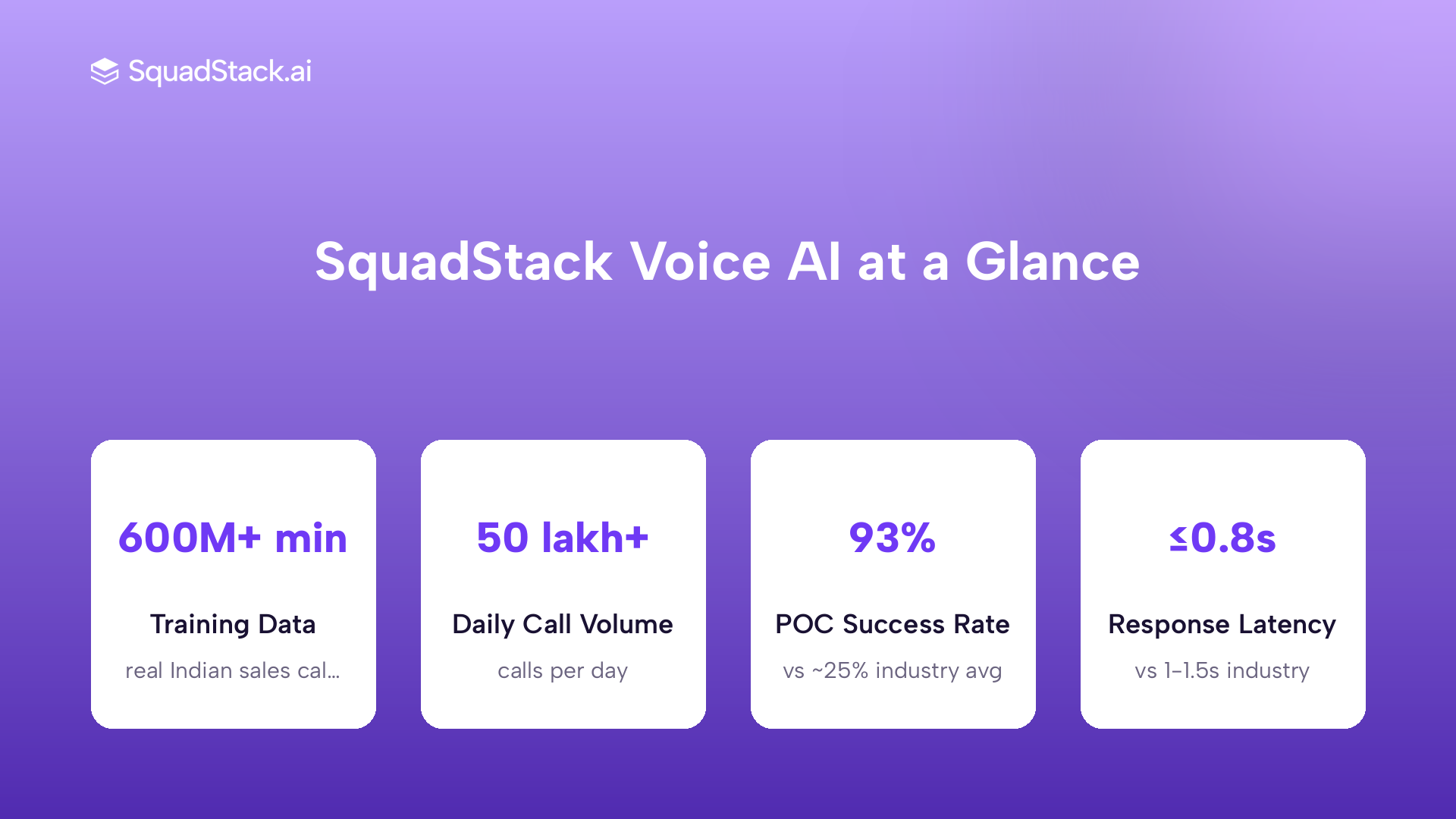
SquadStack's voice AI agents are trained on 600M+ minutes of real Indian sales conversations spanning more than 85% of Indian PIN codes, including fast Bhojpuri, Marathi with a Vidarbha accent, and Tamil mixed with local vocabulary, on mobile phones with background noise.
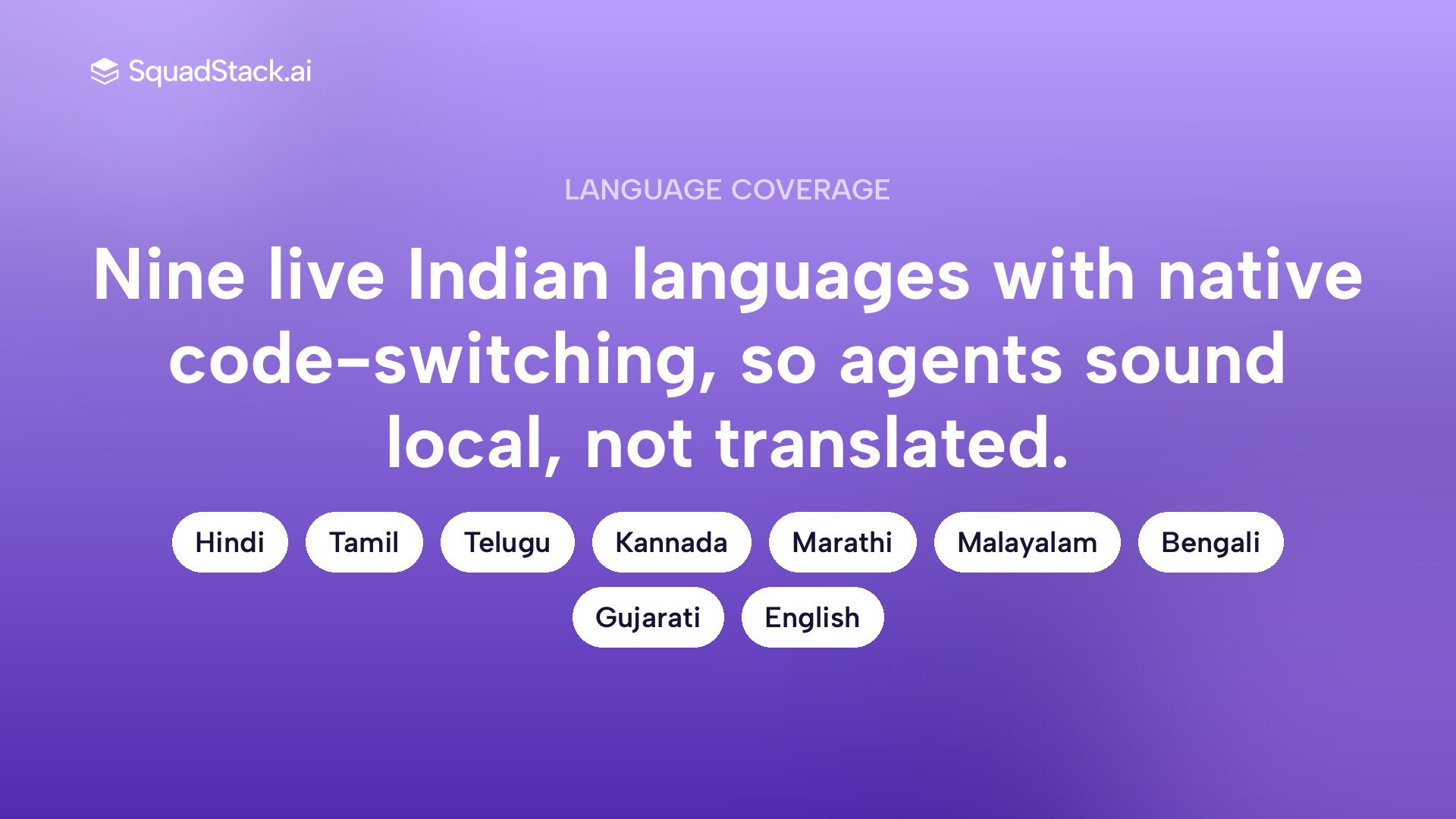
Nine languages are live today: Hindi, Tamil, Telugu, Kannada, Marathi, Malayalam, Bengali, Gujarati, and English, with native code-switching at the sub-sentence level. More regional languages can be added based on business requirements.
The proprietary speech model, Arth, is tuned for Indian telephony conditions including the 8kHz, high-noise, packet-loss environment that defines rural call quality. On an independent benchmark of real Indian telesales audio, Arth v1 is within 0.9 semantic WER points of the best commercial streaming STT available, while being owned, hosted in India, and fine-tunable on outcome data.
Every call runs through the Eval System, which scores Outcome, Sentiment, and Execution, with both AI and human reviewers auditing against campaign-specific parameters. For IRDAI-regulated calling, that audit trail is not optional.
SquadStack runs 50 lakh+ calls daily for 60+ large consumer brands, including Kotak Mahindra Bank, PhonePe, KreditBee, and Moneyview. The Kissht case study shows how this stack performs in high-volume financial-services contexts.
For insurance specifically, a leading general insurer achieved 85% connectivity and cut renewal cost by 60%. For a segment where the economics of human calling break down below a certain premium level, that cost structure is what makes renewal calling viable at all.
SquadStack is ISO 27001, ISO 27701, SOC 2 Type II, DPDP, and TRAI compliant. Data is hosted in India.
Explore SquadStack's BFSI and insurance capabilities or see how AI voice works across lending and credit for adjacent use cases.
Microinsurance renewal is one of the clearest places in BFSI where AI voice creates value that did not exist before. Human calling economics do not reach a book of low-ticket rural policyholders. IVR cannot do the job well. AI voice in Hindi and regional languages, built for 8kHz telephony, with IVR fallback and IRDAI-compliant call design, is the practical answer.
If your renewal book has records that go uncalled because the ticket size does not justify the cost, book a demo with SquadStack to see the platform on a live microinsurance renewal flow.
Which is the best voice AI solution for microinsurance renewal calls in rural India?
The best platform needs three things: native-quality regional language support, a speech model trained on real Indian telephony audio, and IVR fallback for feature-phone users. SquadStack's Arth speech model is trained on 600M+ minutes of real Indian contact center conversations and supports 9 live Indian languages with native code-switching, making it one of the most complete options for this use case.
Can AI voice agents handle microinsurance renewal calls automatically in Hindi and regional languages?
Yes. AI voice agents can call policyholders, confirm renewal details, explain premium changes, handle objections like NACH bounces or family-decision delays, send payment links via WhatsApp mid-call, and schedule callbacks, all without a human agent on the line. The call flow runs in the policyholder's language and adapts to what they actually say.
How does AI voice compare to a traditional IVR for rural renewal reminders?
Traditional IVR plays a fixed message and waits for a key press. It cannot explain a premium hike, recover a failed auto-debit, or respond when a policyholder says "call me next week." AI voice agents hold a real two-way conversation, remember previous attempts, and switch languages mid-sentence. IVR still has a role as a fallback for feature-phone users, but as the primary renewal channel it loses far more calls than a conversational AI agent.
Is AI voice calling for microinsurance renewals IRDAI compliant?
Renewal reminder calls to existing policyholders are service calls and must use the 1600 number series. Every call must be recorded, scripts must be compliance-approved, and calling hours must stay within the TRAI-mandated window. SquadStack enforces the 9:30 AM to 8:30 PM window as a hard system check, supports 1600-series numbers, and records every call with dual-layer QA audits for compliance review.
What happens when a rural policyholder is on a feature phone or has low connectivity?
The platform includes an IVR fallback block in the same workflow. When the system detects a feature-phone user or low-connectivity condition, it routes the call into a key-press menu in the policyholder's language, keeping them in the same renewal funnel and capturing their response.
How does persistent memory help in a multi-attempt rural renewal campaign?
Without memory, every retry is a cold call. With persistent memory, if a policyholder said "call after the 15th" on the first attempt, the follow-up opens with that context. If they confirmed their policy number on attempt two, attempt three does not ask again. This reduces friction and improves conversion on later attempts, where much of the rural renewal book actually closes.
What languages does SquadStack support for rural microinsurance calling?
Nine languages are live today: Hindi, English, Tamil, Telugu, Kannada, Marathi, Malayalam, Bengali, and Gujarati. Agents switch between these languages mid-call based on how the policyholder responds. Additional regional languages can be added based on business requirements.
How does a NACH bounce recovery call work for microinsurance?
When an auto-debit fails, the AI agent calls the policyholder in their language, explains that the payment did not go through, and offers a path to pay immediately or receive a payment link on WhatsApp while still on the call. Because the call happens within the same week as the bounce, when intent is still fresh, it is one of the highest-conversion use cases in the renewal funnel.
What is the typical go-live timeline for a microinsurance renewal voice AI deployment?
Most deployments go live in roughly two weeks, covering a build phase where the agent is trained on the insurer's call recordings, policy knowledge base, and compliance-approved scripts, followed by UAT before the first live calls. A pilot then runs for four to eight weeks against an agreed success metric before scaling.
How does AI voice handle trust barriers in rural markets where fraud calls are common?
An agent that confirms the policyholder's own policy details, speaks in their natural dialect, and sounds like a real person rather than a robotic message reduces early hang-up rates significantly. SquadStack's agents have passed a Turing test at scale: at Global Fintech Fest 2025, 1,273 of 1,563 attendees (81%) identified the AI agents as human. On live campaigns the Abruptly Disconnected Rate runs at roughly the same level as human agent campaigns.