Voice AI Onboarding Failures: What Goes Wrong and Why
November 2, 2026
|

13 min read
Learn how NBFCs can scale collections AI from 20k to 50k daily calls by aligning concurrency planning, compliance guardrails, and human handoff protocols.
NBFC collections AI voice scaling lets you run 20,000 to 50,000 outbound collections calls a day without adding headcount, while staying inside TRAI calling windows and RBI conduct rules. The key variables are concurrency capacity, pacing logic, compliance guardrails baked into the dialer, and a clear human handoff protocol for sensitive accounts. Get those right and your cost per rupee collected drops sharply, especially in the pre-due and bucket-1 ranges where volume is highest and scripts are simplest.
Running 500 calls a day on a collections floor is a staffing problem. Running 30,000 calls a day is an infrastructure problem. The two require completely different thinking.
Most NBFCs hit a ceiling between 5,000 and 15,000 daily calls with human or semi-automated teams. Beyond that, you are either building a large BPO dependency with all its attrition and quality risk, or you are leaving a large share of your delinquent book untouched every month. Neither is acceptable when bucket-1 roll rates compound.
This guide is for collections heads and operations leaders who want to understand how to scale to 20,000 to 50,000 daily calls with AI voice, what the infrastructure looks like, where compliance guardrails must sit, and how to structure human handoffs so the AI handles the right work and your agents handle the rest. For a broader picture, see SquadStack's lending and credit industry overview.
NBFC collections AI voice scaling is the practice of deploying AI voice agents to run outbound collections calls at volumes no human floor can sustain, while staying compliant with RBI conduct rules and TRAI telecom norms.
An AI voice agent calls a borrower, delivers a pre-due reminder or PTP (promise-to-pay) conversation, handles common objections, logs the outcome, and either closes the interaction or passes the borrower to a human. At 20,000 to 50,000 calls a day, this happens across thousands of simultaneous lines.
The scaling part covers four things: call concurrency and infrastructure, pacing logic to stay compliant, quality control at scale, and a continuous learning loop so every campaign improves over time.
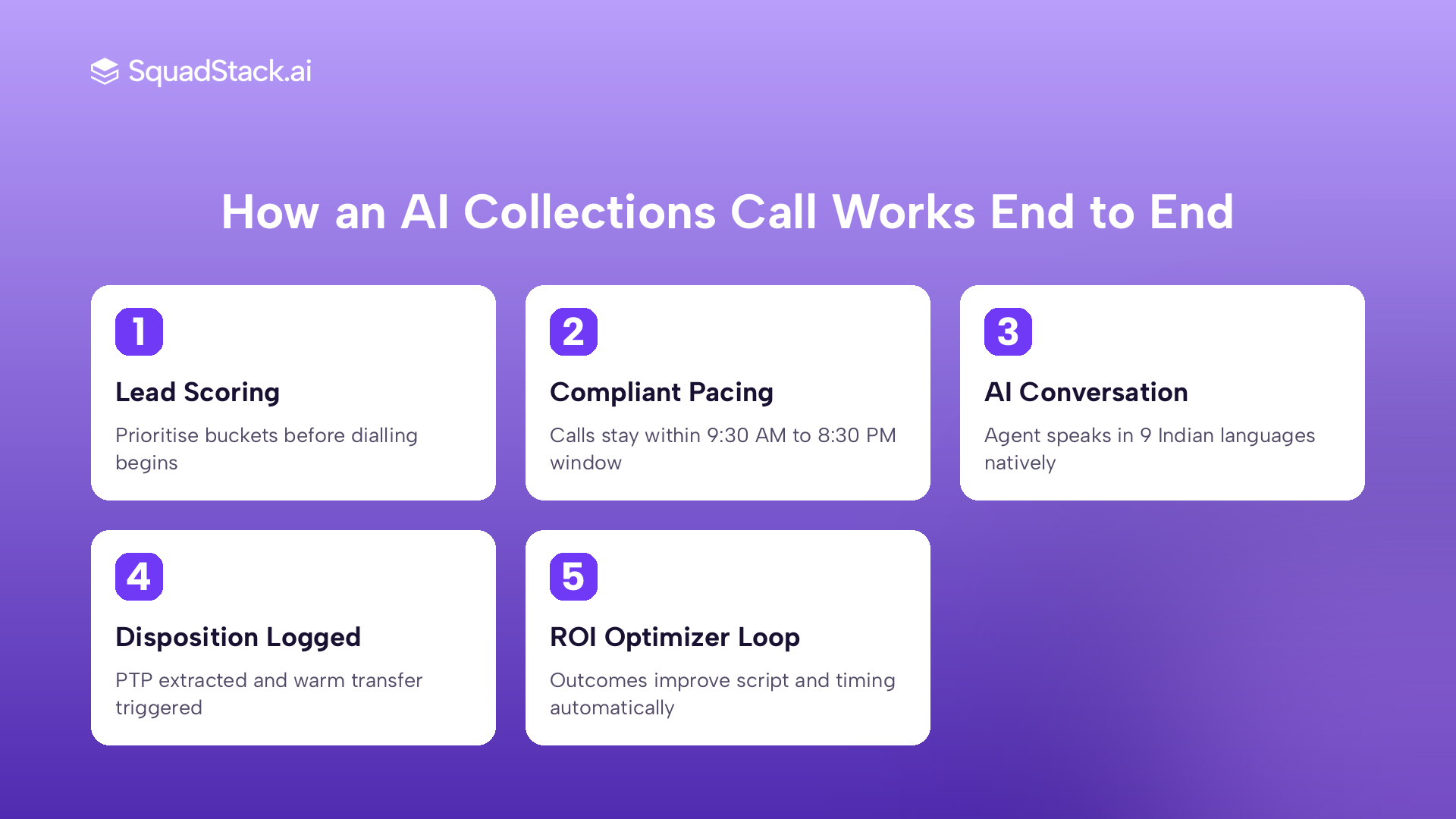
Before any call is placed, the AI Lead Manager scores and ranks the delinquent list. Accounts with prior bounces, low predicted balance, or approaching a bucket-roll date move to the top, so the first calls of the day go to the highest-risk accounts.
The dialer places calls within the compliant window (9:30 AM to 8:30 PM, hard-enforced by the platform). Concurrency is a software constraint. The system can handle thousands of simultaneous calls; the practical ceiling is telephony line capacity, not agent availability.
The AI voice agent identifies the borrower, states the purpose in their preferred language, and runs the appropriate script: a soft pre-due reminder, a bounce-day PTP conversation, or a mid-bucket re-engagement. It handles common objections, books callbacks, and sends payment links mid-call via WhatsApp.
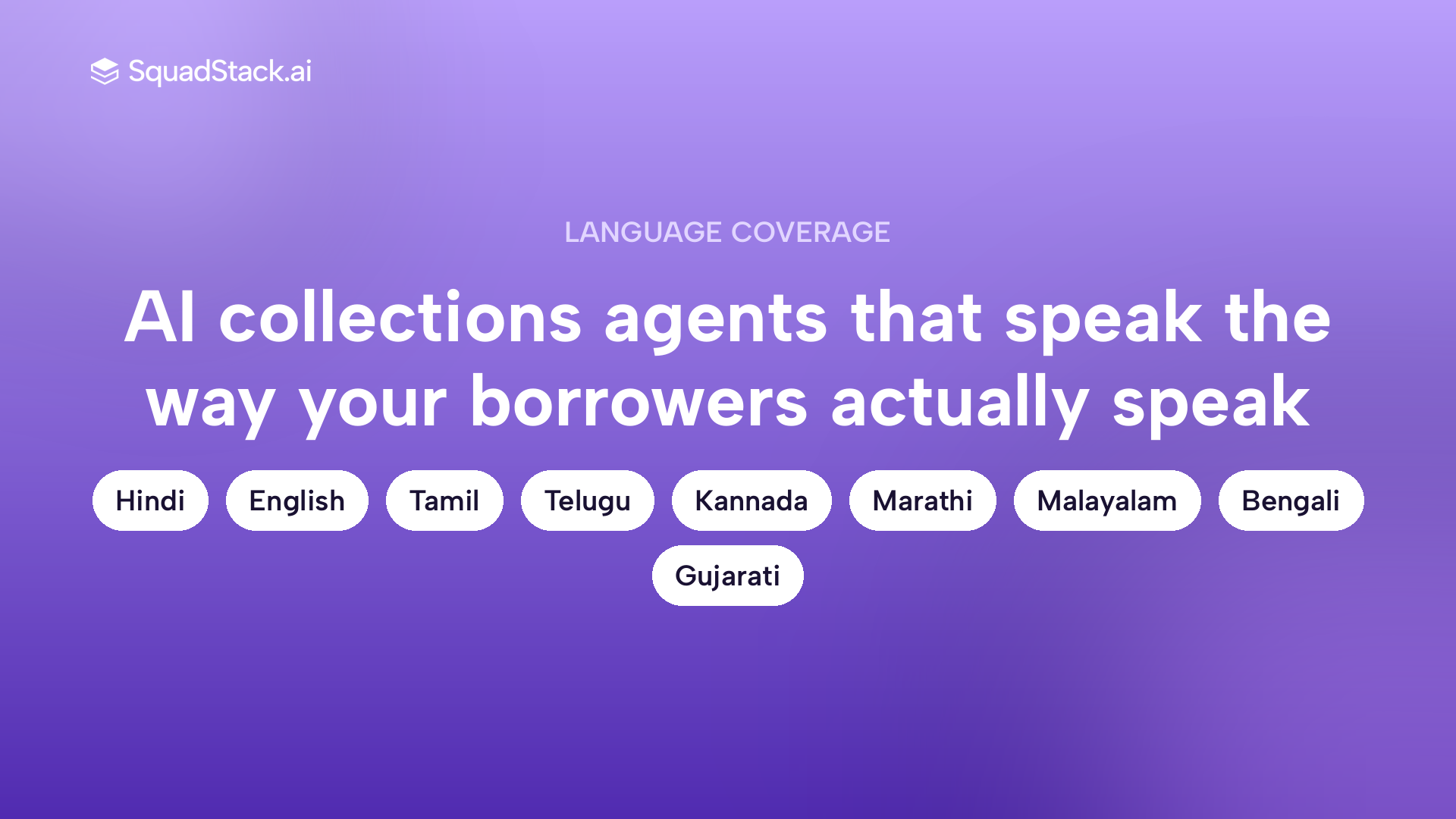
SquadStack's agents run on 9 live Indian languages including Hindi, Tamil, Telugu, Kannada, Marathi, Malayalam, Bengali, and Gujarati, with native code-switching. The underlying model was trained on 600M+ minutes of real Indian telephone conversations, not text datasets.
At Global Fintech Fest 2025, 1,273 of 1,563 attendees (81%) identified SquadStack's AI agents as human in a blind listening test. In a sensitive financial conversation, a robotic voice raises immediate resistance.
Every call is classified: paid, PTP extracted, dispute raised, not reachable, or other. Disputes and hardship flags trigger an immediate warm transfer to a human agent with full call context already loaded. The borrower does not repeat themselves.
Every call outcome feeds back into the platform. The Eval System scores each conversation on three levels: Outcome (did the borrower pay or commit?), Sentiment (how did the conversation land?), and Execution (did the agent follow the script?). Those scores feed the ROI Optimizer, which identifies near-misses and broken PTP patterns. Script edits, voice changes, and timing adjustments are tested on live traffic and rolled out progressively. Each generation of calls is better than the last.
For more, see AI in collections: transforming debt recovery in 2025.
| Dimension | Legacy IVR | AI Voice Agent |
|---|---|---|
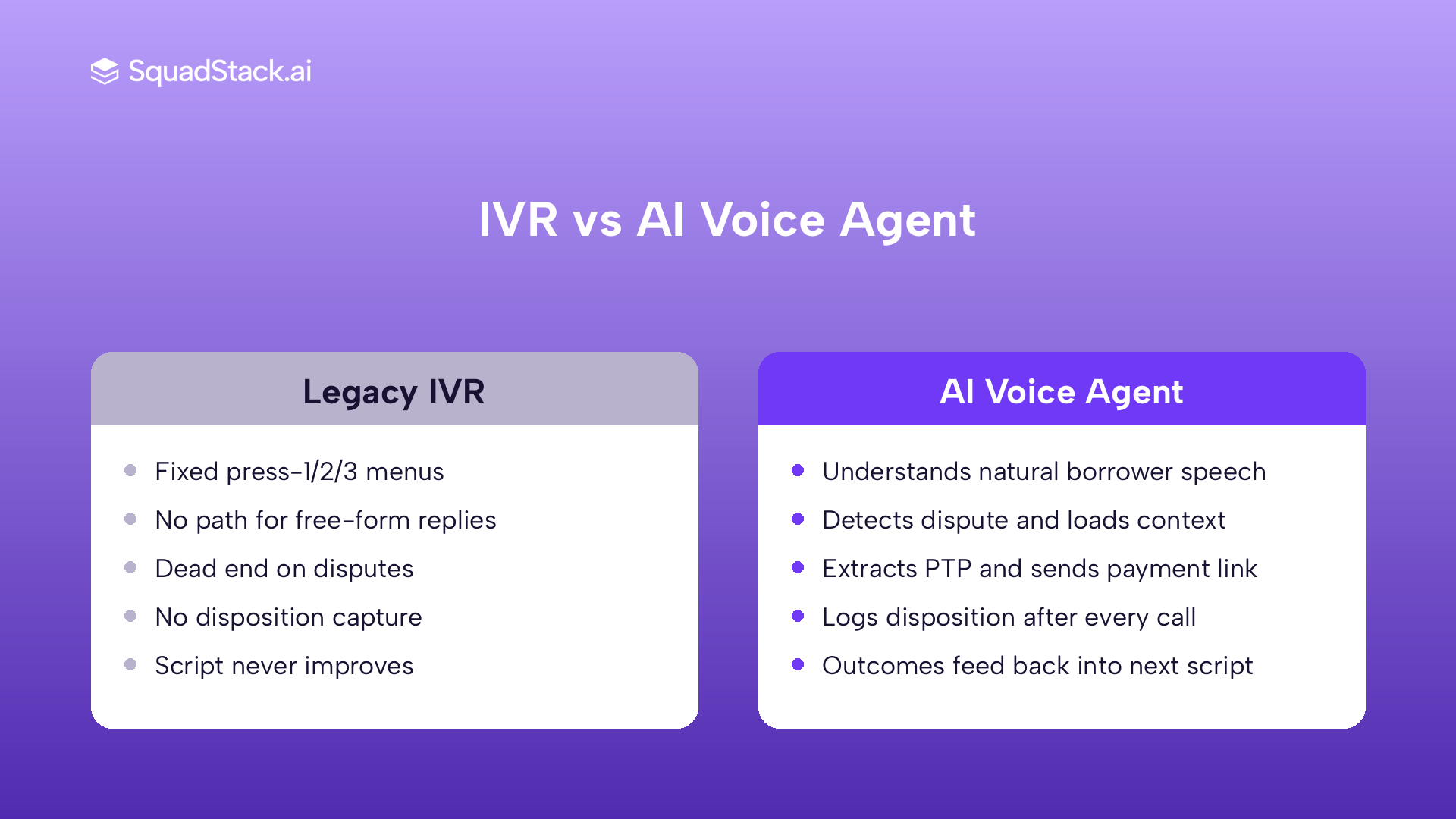
| Script flexibility | Fixed menu: press 1 for payment, press 2 for dispute. A borrower who says "I paid yesterday but it's not reflecting" breaks the flow. | Dynamic conversation: the agent understands the objection, checks context, and responds appropriately rather than looping back to the main menu. |
| Language and dialect | Typically one or two languages; regional dialect switching is impossible. | 9 live Indian languages with native code-switching. Hinglish is native to the model. |
| Memory across calls | Stateless. A borrower who raised a dispute on Monday gets the same pre-due script on Wednesday. | Persistent memory. The agent knows the dispute was logged, skips the reminder, and routes to the resolution path. |
| Compliance enforcement | Call hours and DND managed by ops teams, subject to human error. | Hard-enforced by the platform. Out-of-window dialing is blocked at the system level. DND scrubbing runs before every batch. |
| PTP extraction and follow-up | Cannot negotiate. It can record a keypress but cannot extract a dated commitment or handle objections. | Extracts PTP with amount and date, sends a payment link mid-call, and schedules the follow-up automatically with the PTP details in memory. |
| Escalation handling | Hard-coded transfer to a queue, often with no context passed. The borrower restates their situation to the human. | Warm transfer with full transcript and disposition. The human agent sees the conversation context before saying a word. |
Concurrency ceiling: Can the platform run several thousand simultaneous calls during your peak window? Ask for the actual telephony architecture, not a headline number.
Redundancy and failover: A platform running 30,000 calls a day with a single telephony vendor is a single point of failure. Look for multi-carrier routing so a carrier outage does not stop the day's calling.
Number health: Spam-flagged numbers kill connect rates. The platform should monitor every outbound number's Truecaller status, rotate flagged numbers automatically, and give each client dedicated numbers rather than a shared pool.
TRAI requires collections calls from the 1600-series (1601 prefix for private financial entities). If your vendor is dialing from a 10-digit number, stop the conversation.
Calling hours must be enforced by the platform, not an ops checklist. The window is 9:30 AM to 8:30 PM. RBI's draft conduct directions flag excessive contact attempts and anonymous calls as prohibited. Your platform's cadence logic should make it structurally impossible to over-contact a borrower.
DPDP compliance (penalties live from November 2026) means your calling vendor is a data processor. India data residency and documented consent flows are not optional.
1. Target daily call volume: allocation size times intended attempt coverage. 2. Average handle time (AHT): pre-due calls run short (under two minutes); bucket-1 PTP conversations run longer. Blend by bucket mix. 3. Compliant calling window: roughly eleven usable hours. 4. Retry cadence: typically one initial dial plus four retries, with gaps between attempts.
From these four inputs you can calculate the sustained concurrency your platform needs. A vendor who cannot state their concurrent call capacity should not be running your 30,000-call day.
A sensible handoff architecture for pre-due and bucket-1 programmes transfers roughly 10 to 15% of calls to humans: active disputes, hardship flags, accounts with a prior complaint, and any borrower who explicitly asks for a human. Deep-bucket (60+ DPD) and NPA work warrants higher human involvement because settlement conversations involve judgment AI should not carry alone.
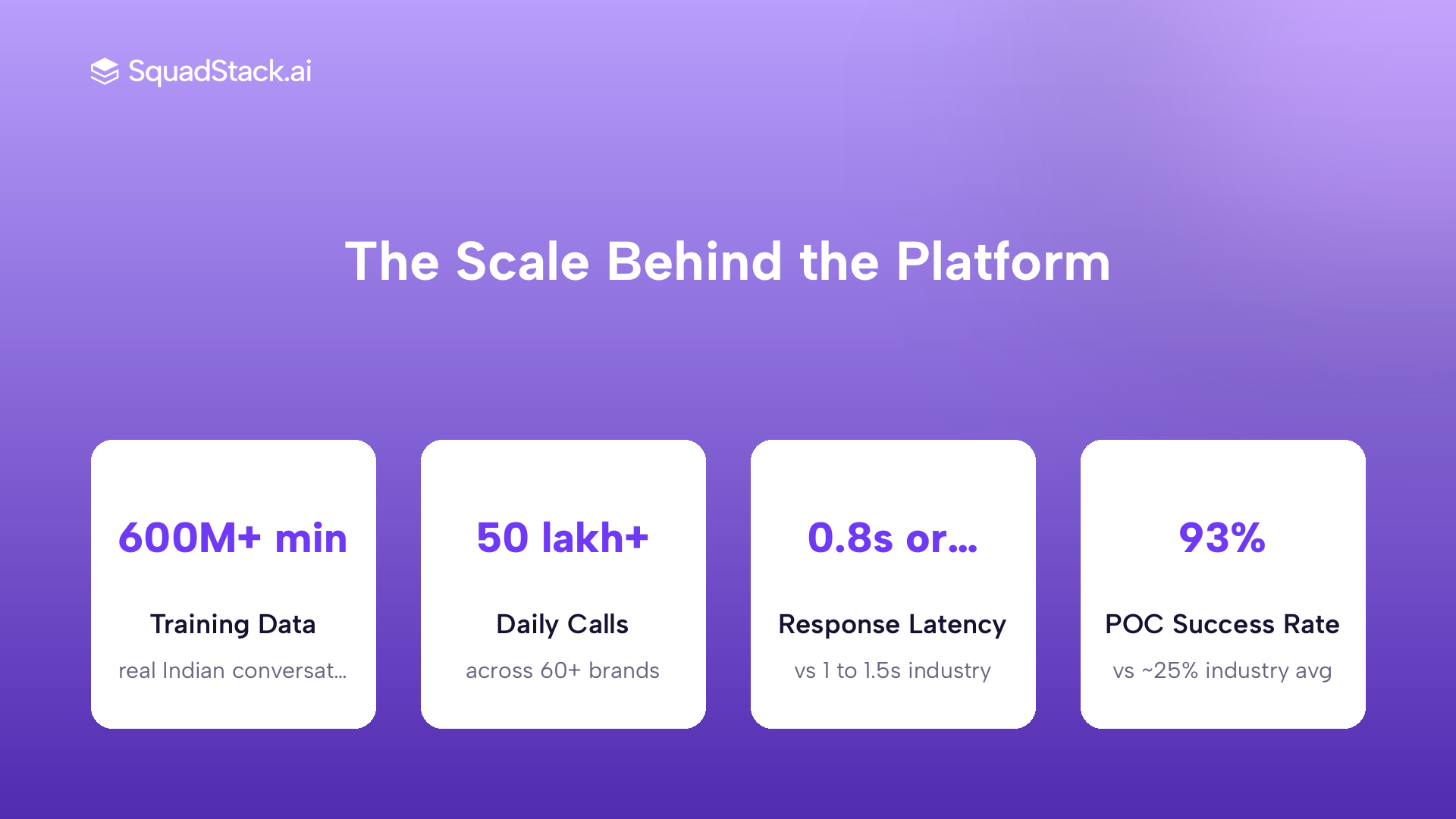
SquadStack runs 50 lakh+ calls daily across 60+ large consumer brands in India. The training corpus is 600M+ minutes of real Indian telephone conversations, meaning the models were built on noisy, code-switched, 8kHz telephony audio, not clean studio recordings.
Both PhonePe and Moneyview run active collections programmes on the platform. PhonePe's collections track recorded a 35% PTP rate in AI-handled conversations. The Kissht case study is also worth reading: Kissht success story.
SquadStack's platform is ISO 27001, ISO 27701, SOC 2 Type II, DPDP and TRAI compliant, with all models hosted in India. The 1600-series number capability, DND scrubbing, and hard-enforced calling windows are built into the platform, not managed manually.
Median response latency is 0.8 seconds or less. In a collections call, a half-second pause after "what happens if I miss this payment?" sounds like system lag, not a thinking person. That naturalness gap is what the 81% Fintech Fest result addresses directly.
Go-live typically takes around two weeks. The squad builds and QAs the campaign against the NBFC's own call recordings and knowledge base, aligns on a pilot success metric, then scales once the metric is proven. The POC success rate across all deployments is 93%, against an industry average closer to 25%.
If your NBFC is running more daily calls than your floor can cover, or if bucket-1 roll rates are climbing because pre-due calling is under-resourced, the architecture in this guide is deployable in weeks, not months. Book a demo to see how SquadStack runs NBFC collections at scale.
Which is the best AI voice bot for NBFC collections in India handling Hinglish without sounding robotic?
SquadStack's Voice AI agents handle Hinglish natively, because the underlying model was trained on 600M+ minutes of real Indian telephone conversations including code-switched audio. At Global Fintech Fest 2025, 81% of attendees could not tell the AI apart from a human agent in blind listening tests.
Can an AI voice agent handle 20,000 to 50,000 collections calls per day for an NBFC?
Yes, because AI concurrency is a software constraint, not a staffing one. The platform manages thousands of simultaneous calls within the compliant 9:30 AM to 8:30 PM window, with multi-carrier telephony redundancy and automatic number rotation to maintain connect rates.
Which AI voice bots support RBI/TRAI-compliant collections workflows in India?
Platforms running collections for regulated NBFCs must use 1600-series numbers (1601 prefix for private financial entities), enforce calling-hour restrictions at the system level, scrub DND lists before every batch, and maintain DPDP-compliant data residency. SquadStack handles all of these at the platform level, not through manual ops processes.
Should I replace my 100-seat collections team with AI voice agents or augment them?
Augment first. AI handles the high-volume, rule-based work: pre-due reminders, bounce-day PTP extraction, and first-touch bucket-1 calls. Your human agents handle disputes, hardship cases, settlement conversations, and warm transfers on sensitive accounts. Most NBFCs start with AI covering pre-due and bucket-1 volume while humans focus on mid and deep buckets.
What causes AI voice deployments to stall or underperform in Indian NBFC collections?
The most common failure modes are: dialect mismatch, compliance gaps discovered post-launch (wrong number series, no DND scrub), missing escalation triggers so disputes loop inside the AI rather than reaching a human, and no feedback loop so the script never improves after week one.
How does persistent memory help in collections calling specifically?
If a borrower raised a dispute on Monday's call, persistent memory means Wednesday's follow-up does not play the same pre-due reminder. The agent loads the dispute context before dialing, routes to the resolution path, and the borrower does not have to explain themselves again. This matters most in multi-touch pre-due and bucket-1 programmes.
How do I build a capacity plan for 30,000 daily collections calls?
Start with four inputs: target daily volume, average handle time by bucket, the eleven-hour compliant calling window, and your retry cadence (typically five attempts over two days). From those you derive the sustained concurrency your platform needs. Make sure your vendor can confirm their actual concurrent call ceiling, not just a headline number.
Are AI voice bots suitable for pre-due and early-bucket collections, or only for late-stage recovery?
Pre-due and bucket-1 (0 to 30 DPD) are the strongest fit for AI. Scripts are soft, objections are limited, and 100% attempt coverage on bounce day is impossible for a human floor at scale. Deep-bucket and NPA conversations involve settlement judgment and sensitive escalation that benefit from human involvement, though AI can still handle initial contact and appointment-setting for field visits.
What integration does SquadStack need to connect to an NBFC's existing LOS or LMS?
The platform connects via API and webhook, writing call outcomes, PTP dates, and extracted entities back to the CRM or LMS at the end of every call. Callback scheduling syncs automatically. The integration is handled by a dedicated Forward Deployed Engineer on the account, not handed off to the NBFC's internal tech team.
What is the typical go-live timeline for an NBFC deploying AI collections calling at scale?
Setup takes around two weeks: the squad builds the campaign against the NBFC's own call recordings and knowledge base, runs UAT, and aligns on a pilot success metric. The pilot runs on real delinquent accounts over four to eight weeks. Once the metric is proven, volume scales without any further hiring or training.