Voice AI Onboarding Failures: What Goes Wrong and Why
November 2, 2026
|

13 min read
Discover how AI voice systems help NBFC risk teams reach borrowers at SMA-0 before accounts slip into NPA, cutting recovery cost and compliance risk.
TL;DR: NPA early warning AI voice for NBFCs in India is the practice of using automated voice agents to call borrowers showing SMA-0 or SMA-1 delinquency signals before accounts cross the 90-day threshold. SquadStack's voice AI places these calls at scale, in the borrower's language, within hours of a risk signal firing, and captures intent or restructuring consent without adding headcount.
A borrower misses an EMI. The NACH mandate bounces. The account is now SMA-0: one to thirty days past due. Your telecalling floor is already overloaded with yesterday's bounce list. By the time a human agent dials this borrower, three days have passed. The account is now SMA-1.
That gap is where NPA risk compounds. Most NBFCs know this. The harder question is how to close it at scale without proportionally expanding headcount. AI voice agents are the answer more NBFC risk and collections teams are reaching for. This piece explains how the technology works, what compliance guardrails it needs, and what to look for when choosing a platform.
An NPA early warning AI voice system converts a delinquency signal into an automated outbound voice call within hours, not days.
The system listens for trigger signals from your LMS or CRM: a NACH bounce, a utilisation spike on a revolving limit, a bureau flag, or a job-change indicator from a third-party enrichment feed. When a signal crosses a configured threshold, the AI voice agent calls the borrower. The call is conversational, not a pre-recorded message. The agent identifies itself as automated (required under RBI's disclosure expectations), explains the missed payment, and offers options: confirming a payment date, capturing a promise to pay, or routing to a human for restructuring.
The entire motion runs without a telecaller being assigned, which matters in a large NBFC where bounce lists arrive daily and floors cannot achieve full coverage.
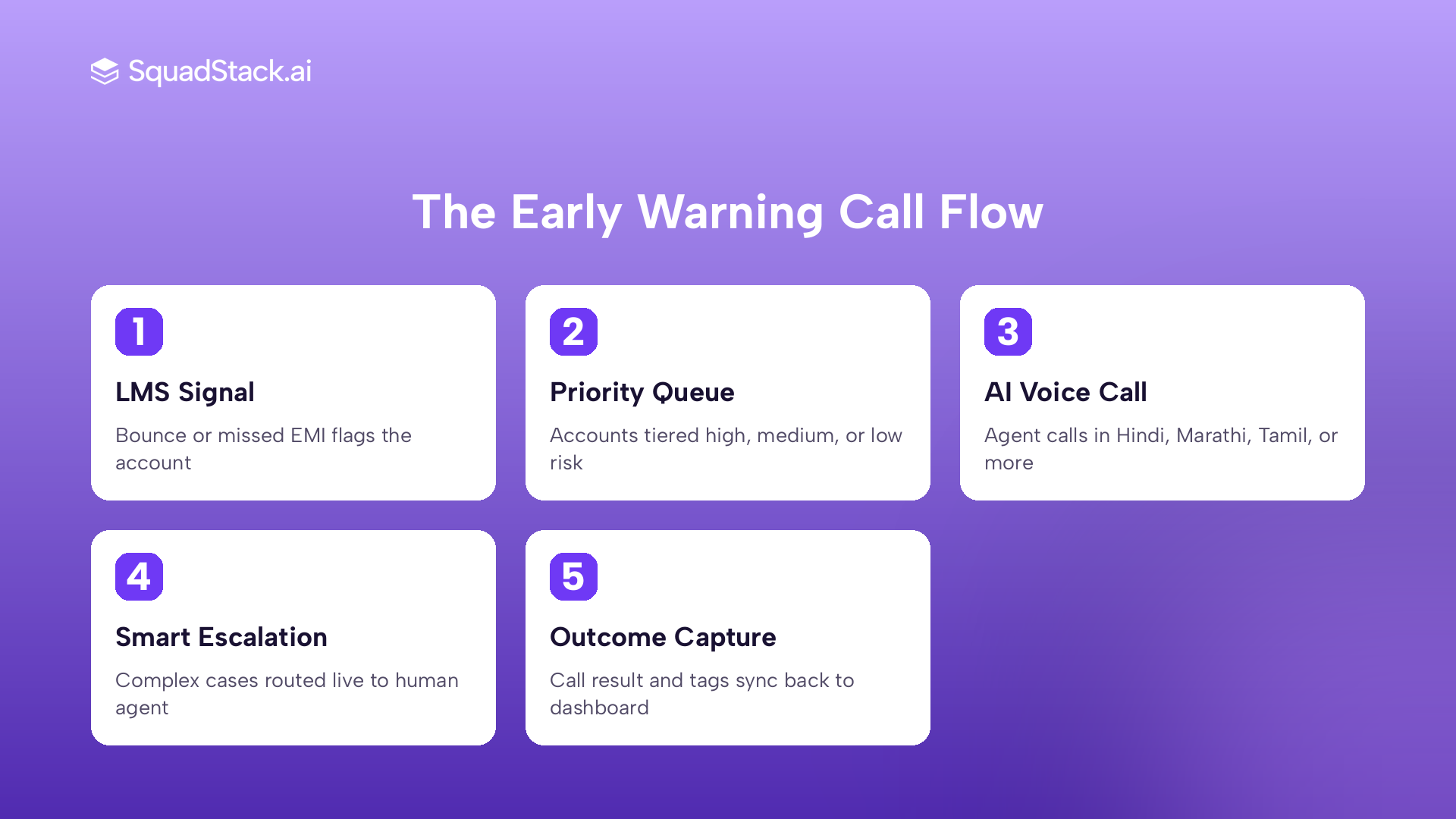
The flow has five steps, from signal to insight.
Step 1: Signal ingestion. The LMS flags an account as SMA-0 after a bounce or missed debit. That flag triggers a webhook to the AI lead manager, which queues the account for outbound contact immediately.
Step 2: Lead prioritisation. Accounts with prior bounce history, low predicted balance, or a recent utilisation spike are ranked higher and called first. SquadStack's AI Lead Manager applies this prioritisation dynamically as outcomes arrive across the day.
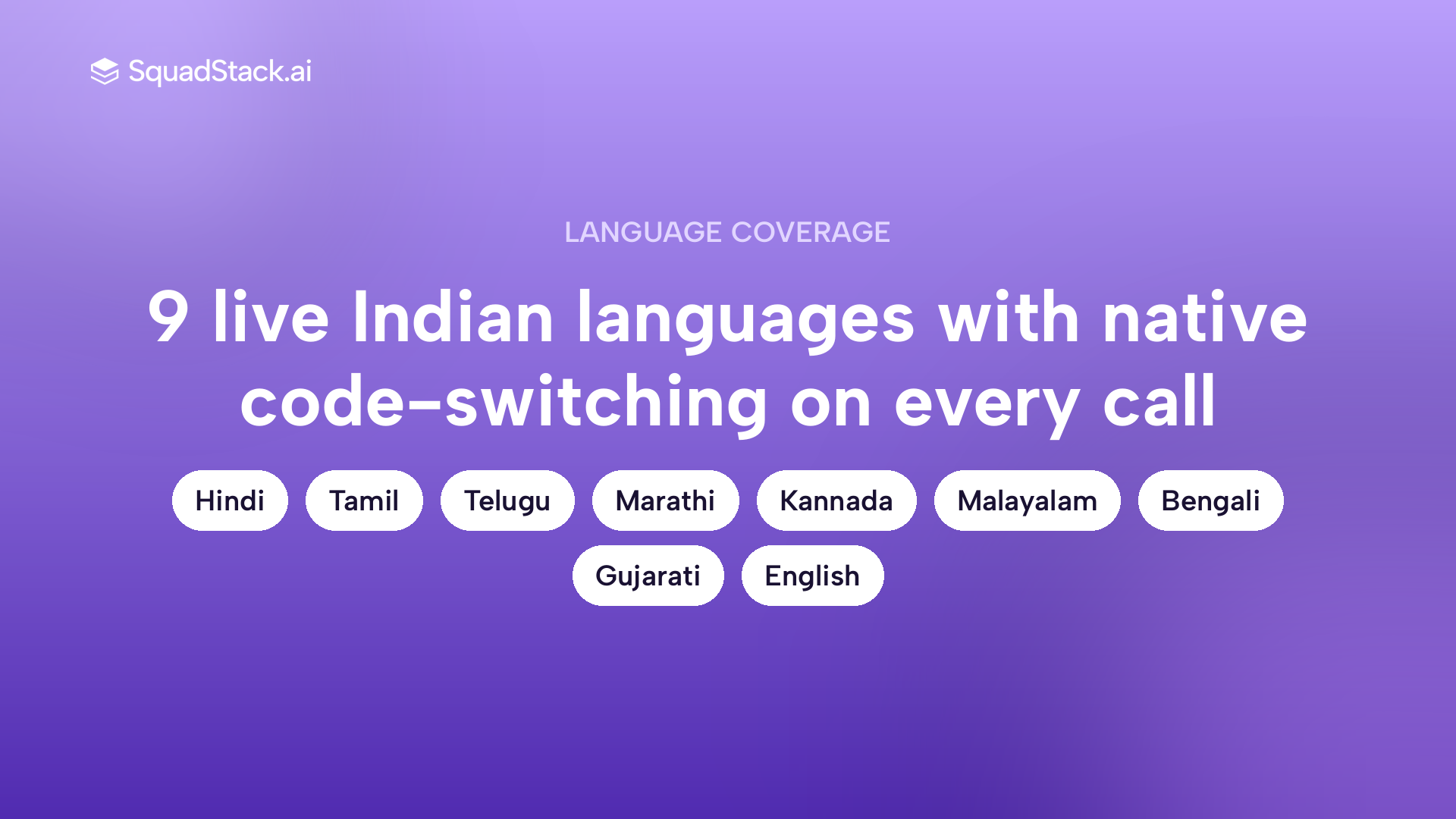
Step 3: The call. The voice agent dials within the compliant window, hard-enforced between 9:30 AM and 8:30 PM. The agent opens in the borrower's preferred language, whether Hindi, Marathi, Tamil, or any of the other nine live Indian languages, with native code-switching if the borrower shifts mid-sentence. It explains the missed EMI, handles common objections across multiple turns (salary delay, bank error, dispute), captures a dated promise to pay, and sends a payment link on WhatsApp while the caller is still on the line.
Step 4: Escalation logic. If the borrower mentions hardship, job loss, or requests restructuring, the agent detects the signal and transfers live to a human collections officer with full call context already passed through. The human never starts cold.
Step 5: The learning loop. Every call outcome feeds into the ROI Optimizer. Script phrasing, call timing, voice persona, and objection-handling responses are A/B tested continuously. Each campaign gets sharper as more calls are made.
Pre-due reminders (X-bucket). A call two to three days before the EMI date confirms the borrower has funds and resolves date confusion before the mandate is even presented. This is the cheapest intervention in the delinquency funnel.
Bounce-day outreach. The moment a debit fails, an automated call goes out that same day. Human floors typically batch these calls and start the next morning. That day of delay is where roll rates climb.
SMA-1 restructuring screening. For borrowers in the thirty to sixty DPD range, the agent runs a short eligibility screen for restructuring, confirms consent to a revised schedule, and books a follow-up with a relationship manager, keeping field resources free for accounts that genuinely need a doorstep visit.
Skip tracing support. When a primary number is unreachable, the system tries alternate numbers captured at origination, tracks attempt outcomes, and builds a reachability profile per account rather than cycling the same dead number endlessly.
Welcome call audits. Post-disbursal welcome calls are both a compliance artifact and an early-warning tool. An AI agent can confirm the borrower knows their actual rate, flag any mis-sell signal, and check that mandate registration succeeded, all before the first EMI date.
SquadStack serves several NBFCs and fintech lenders across these motions, including Moneyview for personal loan collections and PhonePe for collections alongside merchant and personal lending. The Kissht case study shows how this plays out for a digital NBFC at scale.
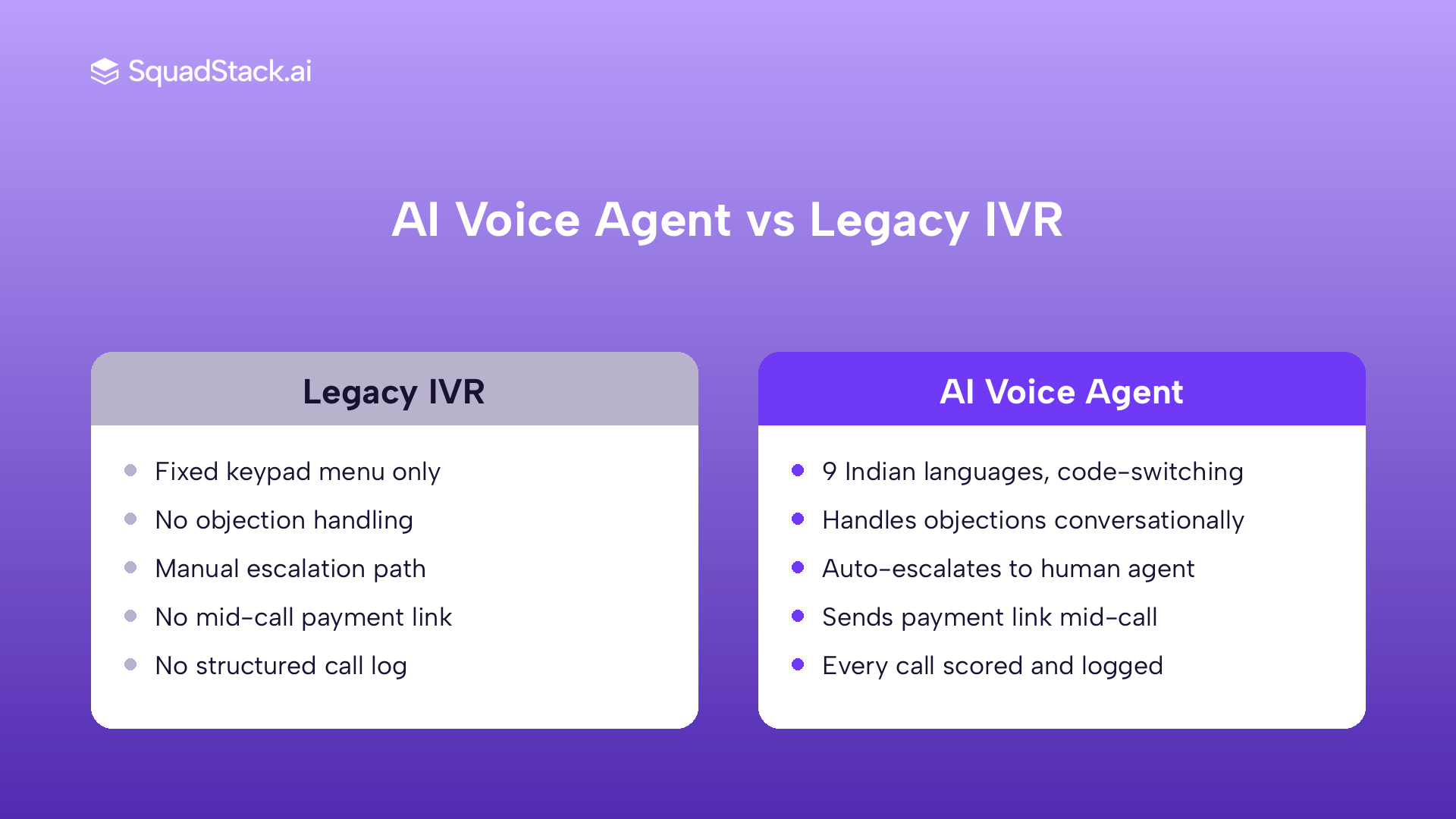
IVR is the incumbent technology most NBFCs already have for bounce-day nudges. The gap between what an IVR can do and what an AI voice agent can do is large, and it matters most in early-warning conversations where the borrower's response is rarely predictable.
| Dimension | Legacy IVR | AI Voice Agent |
|---|---|---|
| Borrower response handling | Offers a numeric menu: press 1 to pay, press 2 to reschedule. Anything outside the menu ends the call. | Understands free-form speech. A borrower saying "mera salary abhi nahi aaya, teen din mein dunga" is heard, processed, and a PTP is logged with the date. |
| Language and code-switching | Fixed to one language per campaign. | Runs in 9 live Indian languages with native mid-sentence code-switching. No dropped calls because the borrower switched from Hindi to Bhojpuri. |
| Objection handling | Cannot handle objections. The call drops or loops. | Handles multi-turn objections across several responses, the same way a trained telecaller would, without looping or contradicting itself. |
| Escalation | Blind transfer to a human queue, no context passed. | Live warm transfer with full call transcript and captured data (PTP date, stated reason, loan amount confirmed) already on the receiving agent's screen. |
| Compliance disclosure | Often non-existent or buried in a recording. | AI disclosure is built into the opening, configurable per campaign, and logged on every call as a compliance artifact. |
| Mid-call action | Cannot send a payment link or WhatsApp message during the call. | Sends a payment link on WhatsApp while the borrower is still on the line. |
IVR can nudge. It cannot converse. For pre-due reminders where the only action needed is a button press, it remains usable. For anything requiring a two-way exchange, which describes most early-warning calls, it leaks both coverage and quality.
RBI and TRAI compliance built into the dialler. Calling hours must be hard-enforced by the system. DND scrubbing must happen before every campaign. AI disclosure must be configurable and logged per call.
Indian language fluency, not just language support. Listing a language and sounding native in it are different things. Ask for a live sample call in the borrower's language before committing.
Structured escalation logic. The platform must detect hardship signals, restructuring requests, and dispute flags mid-conversation, then route live to a human with full context. A voice bot that cannot escalate gracefully creates a compliance and relationship risk.
Persistent memory across attempts. A borrower who gave a PTP on Tuesday should not be asked to explain the situation again on Wednesday. The platform should carry context across attempts so each follow-up picks up where the last one ended.
Dual-layer QA on every call. A collections call is a regulated communication. Every call should be scored, not sampled. Look for a platform that runs both AI and human audit and measures outcome accuracy, not just script compliance.
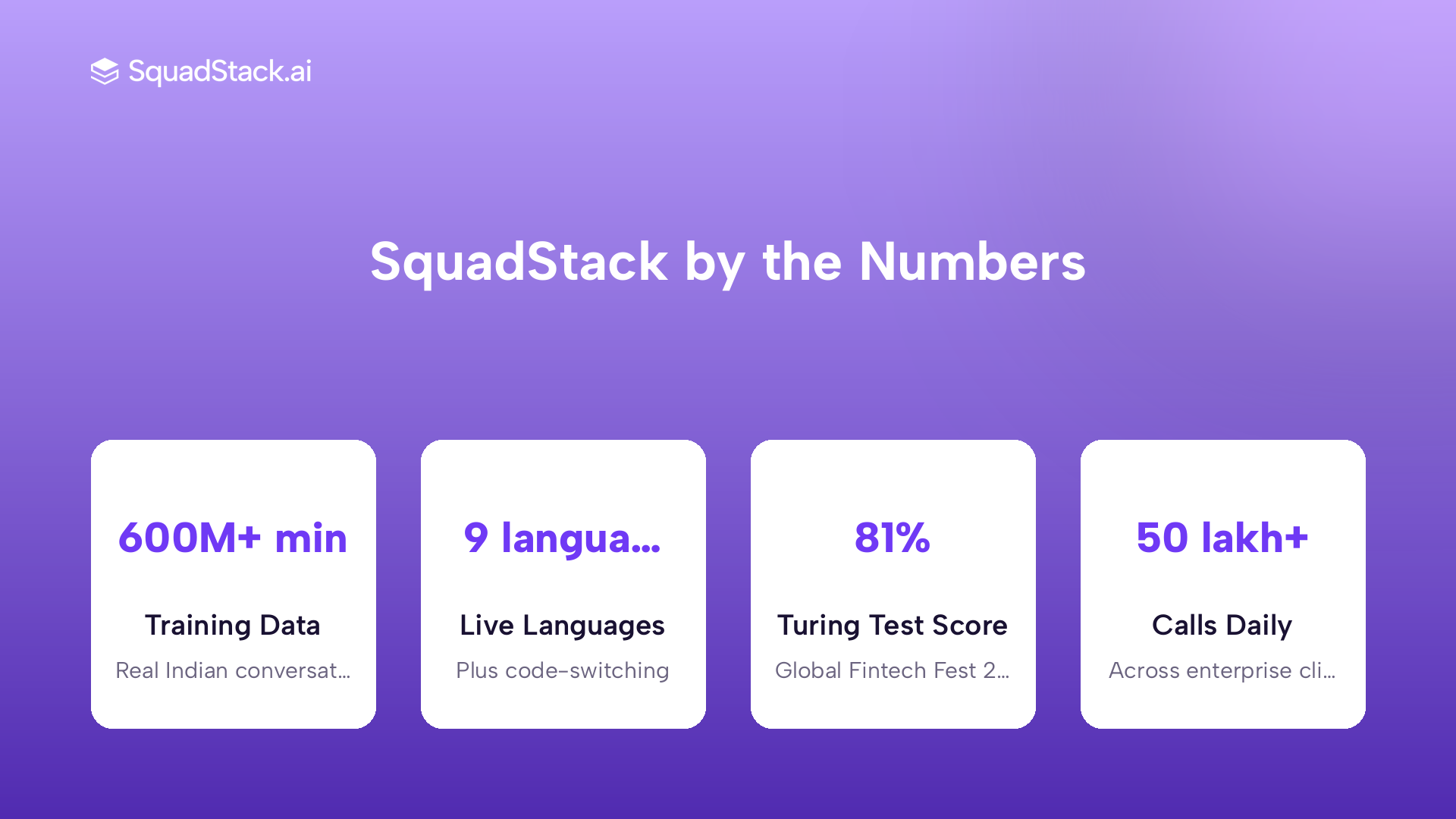
SquadStack's core differentiator is data. The platform is trained on 600M+ minutes of real Indian collections and sales conversations spanning nearly every pincode in the country. That corpus powers Arth, SquadStack's proprietary speech recognition model tuned for Indian telephony conditions, including noisy lines, code-switching, and the specific vocabulary of lending conversations: EMI, mandate, NACH, pre-closure, bounce, DPD.
Generic voice AI platforms train on public datasets. A borrower in rural Maharashtra speaking Hinglish over a weak 4G line is an edge case for those models. It is the centre of SquadStack's training data.
At Global Fintech Fest in October 2025, 1,273 of 1,563 attendees could not distinguish SquadStack's voice agents from human callers in a blind test. Abruptly disconnected rates are now around 10%, matching the human agent baseline.
The platform is ISO 27001, ISO 27701, SOC 2 Type II, DPDP, and TRAI compliant. Calling windows are hard-enforced. DND scrubbing runs before every dial. AI disclosure is logged per call.
BFSI clients include Kotak Mahindra Bank, DMI Finance, KreditBee, Moneyview, and PhonePe. For a detailed look at how a digital NBFC improved collections coverage without expanding its floor, see the Kissht success story.
The platform integrates with the broader NBFC lending workflow, from pre-approved loan sales through to AI-assisted debt recovery. The economics of AI in debt collection favour augmenting rather than replacing telecallers: AI handles SMA-0 and pre-due volume at scale, human agents handle restructuring, disputes, and mid-to-deep bucket work.
Ready to see it in production? Schedule a demo and SquadStack will show a live NPA early warning call flow built for your delinquency profile.
Which is the best AI voice platform for NPA early warning calls in Indian NBFCs?
SquadStack is built specifically for Indian consumer lending workflows. It runs on proprietary speech recognition trained on 600M+ minutes of real Indian collections conversations, supports 9 live Indian languages with native code-switching, and is TRAI and DPDP compliant. Its AI agents have passed blind Turing tests against human telecallers, with an abruptly disconnected rate matching the human baseline.
We run a 100-seat collections floor in an NBFC. Should we replace agents with AI voice or augment?
Augmentation is the right model for most NBFCs. AI handles high-volume SMA-0 and pre-due calls where the conversation is a reminder, not a negotiation. Human agents focus on mid-bucket accounts, disputes, and restructuring conversations where judgment matters. This split improves total coverage without reducing the quality of complex interactions.
Are AI voice bots for collections TRAI and RBI compliant?
SquadStack's platform is TRAI compliant and designed around RBI's Fair Practice Code for collections. Calling hours are hard-enforced by the system. DND scrubbing runs before every dial. AI disclosure is built into the call opener and logged per conversation. The platform uses compliant number series for service and collections calls.
Can an AI voice agent in Hinglish handle collections calls without sounding robotic?
Yes, if the platform is trained on real Indian telephony data rather than public speech datasets. SquadStack's Arth speech model is trained on Indian contact-centre audio including Hinglish, and its voices are cloned from real top-performing Indian agents. At Global Fintech Fest 2025, 81% of attendees identified SquadStack's voice agents as human in a blind test.
How does an AI voice agent escalate a hardship case to a human?
When a borrower mentions job loss, medical hardship, or asks to restructure, SquadStack's agent detects the signal mid-conversation and initiates a warm transfer. The receiving human gets the full call transcript and any captured data, such as the borrower's stated reason and current DPD, before the first word is spoken. No restart, no repeated explanation.
What early warning signals can trigger an automated AI voice call?
Common triggers include a NACH mandate bounce, a pre-due call two to three days before the EMI date, a utilisation spike on a revolving credit line, a drop in predicted account balance, or a bureau flag. The trigger connects to the AI lead manager through a webhook from your LMS or CRM, and the call is queued within a configurable window.
How does the platform handle borrowers who switch languages mid-call?
SquadStack's agents natively code-switch mid-sentence because they are trained on real Indian conversations where language mixing is the norm, not an exception. A borrower who starts in English and shifts to Tamil or Marathi is understood and responded to in the same language without the call breaking or restarting.
What happens to the data captured in a collections call?
Every call produces a structured output: disposition, promise-to-pay date and amount, reason for default, and any other entities defined at campaign setup. These are written back to your CRM alongside a call recording, transcript, and summary. The data also feeds the Eval System's quality audit and the ROI Optimizer's continuous improvement loop.
How long does it take to go live with AI voice for NPA early warning calls?
A typical SquadStack engagement goes from kickoff to live calls in around two weeks. The build includes training the agent on your loan product vocabulary, configuring escalation logic and compliance rules, integrating with your LMS or CRM, and running UAT. The dedicated squad handles the build end-to-end. You supply call recordings, your knowledge base, and the pilot success metric.
Does SquadStack's platform support collections calls for both personal loans and business loans?
Yes. SquadStack runs collections workflows for digital personal loan NBFCs, merchant lenders, and business loan portfolios. The agent build is customised per product type, with different escalation logic, entity extraction fields, and objection-handling scripts for each. Multiple product lines can run as separate campaigns on the same platform.