Voice AI Onboarding Failures: What Goes Wrong and Why
November 2, 2026
|

13 min read
Find out how AI voice agents can be configured for P2P lending collections in India, covering call flows, compliance, and Hinglish script design.
P2P lending collections AI voice fintech India is still a largely unsolved problem. Most AI voice platforms are built for bank-style NBFC collections and miss the specific regulatory constraints, borrower-trust dynamics, and call-flow requirements of RBI-registered P2P NBFCs. This post explains how to configure AI voice agents for P2P collections: the call flows, compliance checkpoints, and escalation protocols that separate a compliant deployment from a generic bot.
P2P lending platforms in India have one structural problem that banks and traditional NBFCs do not: the lender on the other side of a delinquent loan is a retail individual, not a balance sheet. When a borrower stops paying, it is a school teacher's savings or a retired engineer's corpus at risk, not a provisioning line in a credit register.
Too aggressive and the platform breaches RBI's conduct directions, risks ombudsman complaints, and erodes trust on both sides. Too passive and retail lenders exit, loan books shrink, and the business model collapses.
Most AI voice solutions are designed for early-bucket EMI reminders at large NBFCs. They do not account for the fiduciary responsibility P2P platforms carry toward retail lenders, the DPD bucket treatment that suits unsecured P2P loans, or the Hinglish call-flow design that keeps borrower engagement high across Tier 2 and Tier 3 cities.
This is the playbook that fills that gap. For a broader look at AI in lending and credit, see the full industry hub.
AI voice collections for P2P lending means deploying a conversational voice AI agent to manage outbound and inbound borrower touchpoints across the repayment lifecycle. The agent holds a two-way conversation, detects borrower intent, captures a promise to pay, logs disputes, and escalates to a human when needed.
This differs from a standard collections bot in three ways. First, the agent must carry RBI P2P NBFC compliance into the conversation: automated-caller disclosure, no-contact enforcement outside 8am to 7pm, and a documented opt-out path. Second, the call flows must handle the specific buckets that matter in P2P: pre-due, soft-touch early-bucket recovery from day 1 to 30, and dispute or hardship intake. Third, the agent must speak Hinglish naturally, not as a translation fallback, because most P2P borrower bases include speakers who switch between Hindi and English mid-sentence.
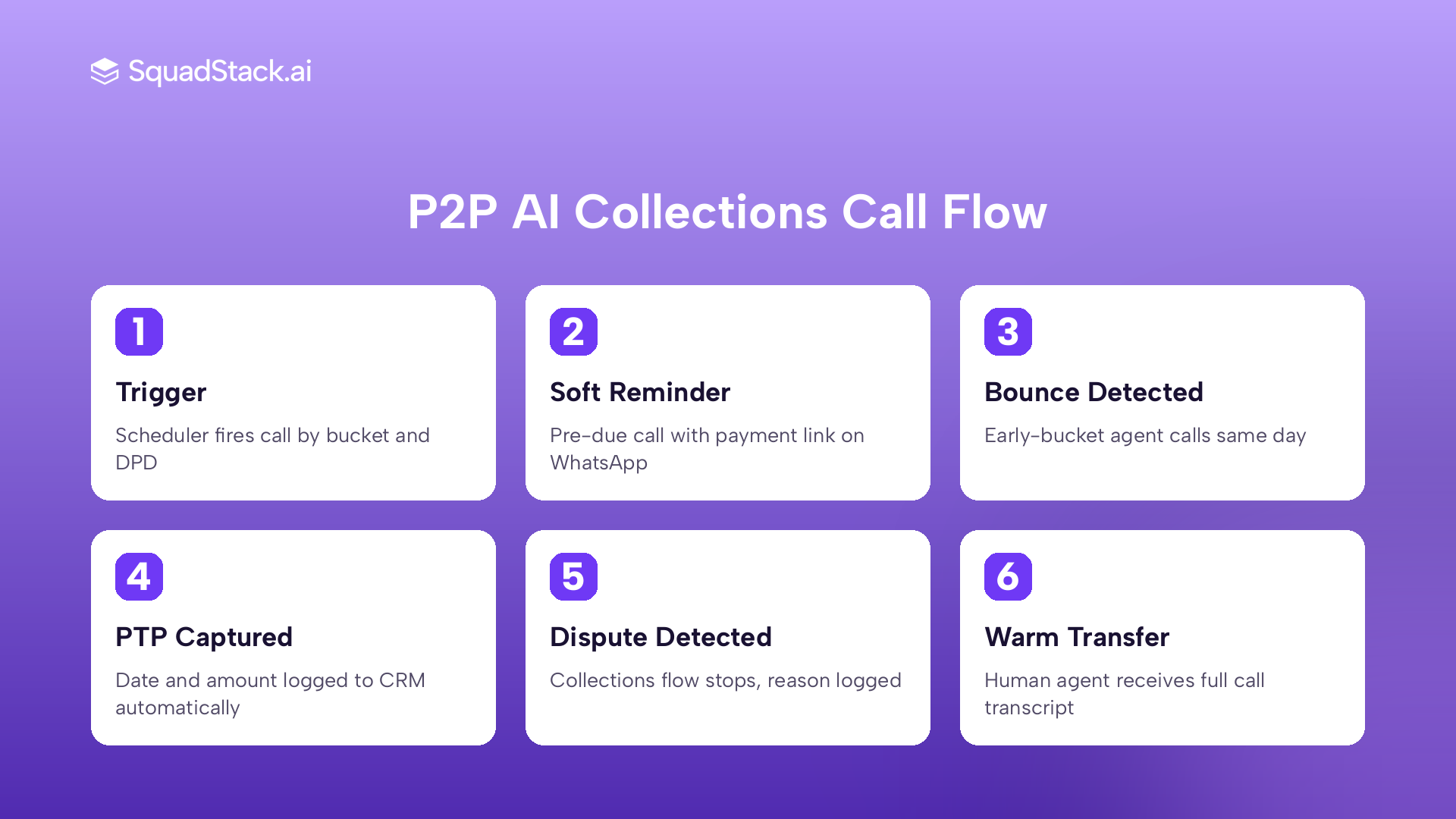
The call flow splits into three stages, each with its own trigger, conversation design, and outcome logic.
Stage 1: Pre-due reminder (X-bucket, 2 to 5 days before EMI)
The AI Lead Manager identifies accounts with an upcoming EMI, prioritising those with a prior bounce or low predicted account balance. The agent calls with a soft reminder: confirms the EMI date and amount, asks whether auto-debit is set up correctly, and sends a payment link on WhatsApp while the borrower is still on the line.
Stage 2: Early-bucket recovery (day 1 to 30 DPD)
When a presentation bounces, the account enters SMA-0. The agent calls within hours. The opening is designed to sound like a concerned follow-up: "Hi, your EMI seems to have missed yesterday, was there an issue with the account?" The agent captures a promise to pay with a specific date and amount, confirms the PTP in the conversation, and schedules an automatic follow-up for the day before the promised date. If the borrower mentions a dispute, salary delay, or hardship, the agent logs the reason, sets the account to hold status, and routes it to a human specialist.
Stage 3: Dispute and hardship intake (any bucket)
When a borrower says the loan amount is wrong, the interest calculation is incorrect, or they have already paid through another channel, the agent must not argue or re-attempt collections. It confirms the borrower's details, logs the dispute type and account number, notifies the borrower that the case will be reviewed within the RBI-prescribed grievance timeline, and escalates to the internal team via warm transfer with full context.
Continuous learning loop
Every call outcome feeds back into the ROI Optimizer. Promise-to-pay rates, dispute reasons, and borrower sentiment scores are extracted automatically. The system identifies which script variants, voices, and call timings produce higher PTP-kept rates. Lift, the self-improvement layer, proposes instruction edits, each reviewed by a human before reaching live traffic.
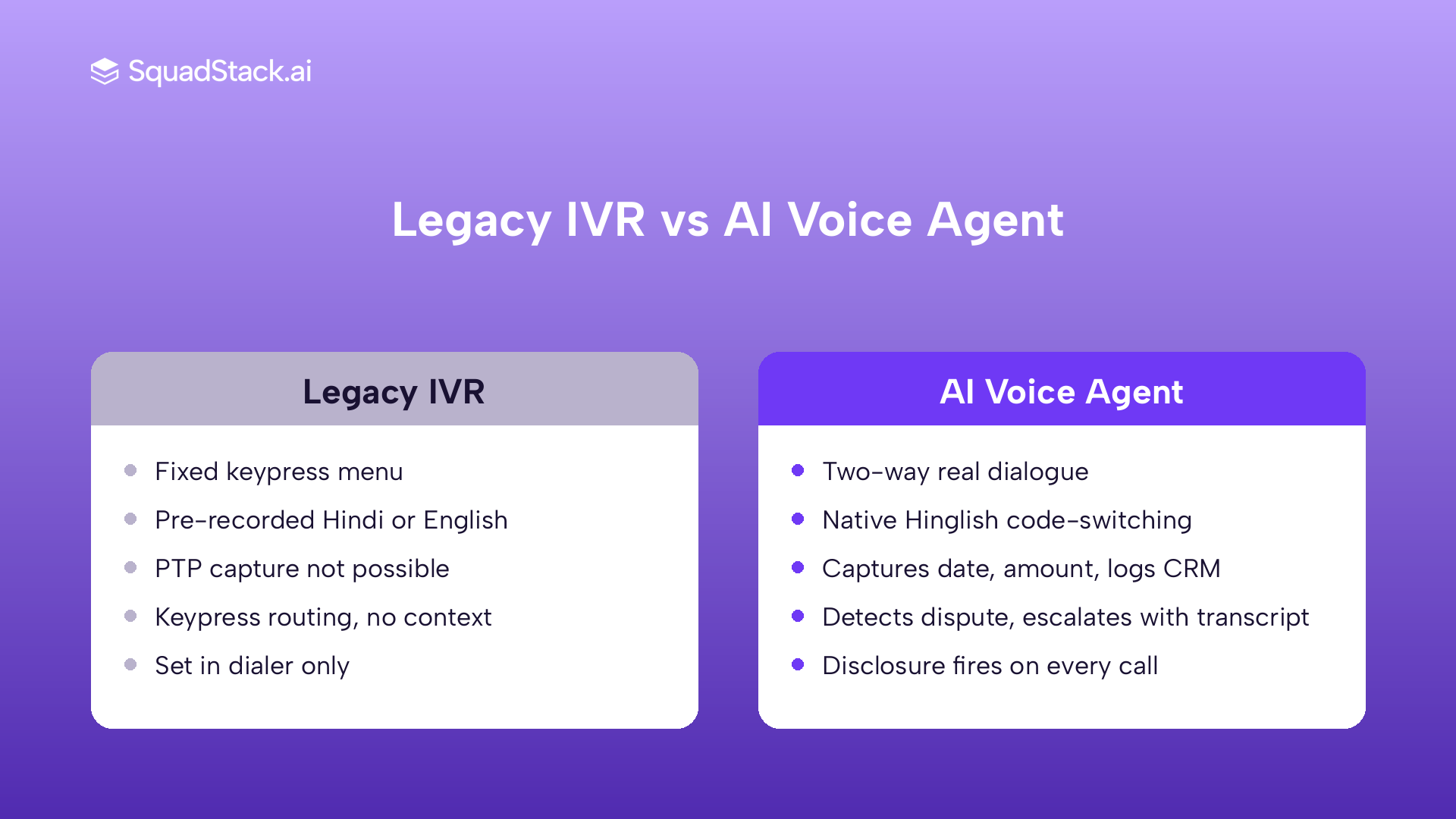
P2P collections requires actual borrower engagement. An IVR cannot do that job.
| Dimension | Legacy IVR | AI Voice Agent |
|---|---|---|
| Conversation type | Fixed menu: "Press 1 to pay, Press 2 to dispute" | Two-way dialogue: agent listens, responds to what the borrower actually says |
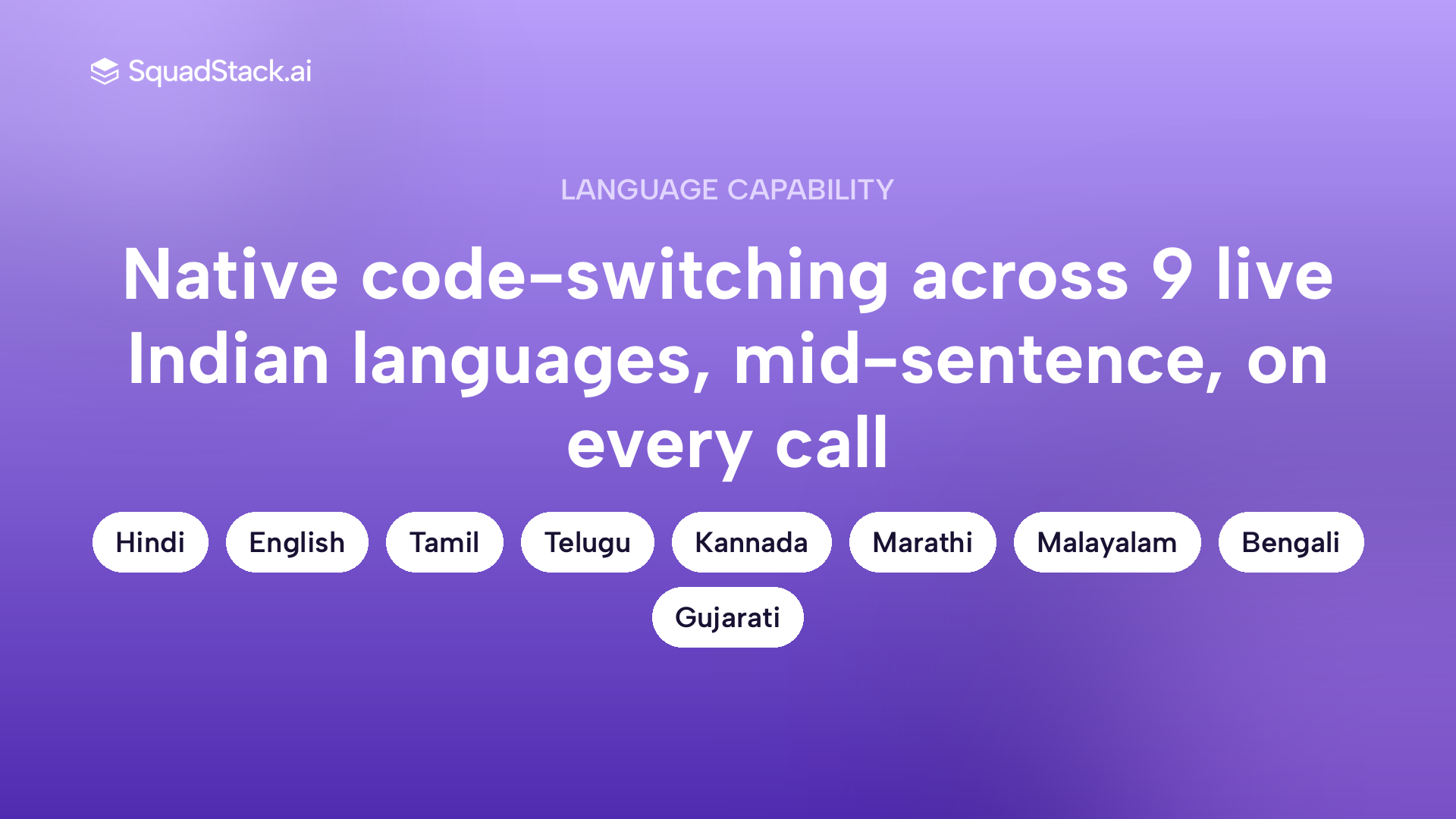
| Hinglish handling | Pre-recorded Hindi or English clip, cannot switch mid-sentence | Native code-switching across Hindi, English, and 9+ Indian languages mid-sentence |
| PTP capture | Cannot extract or log a promise to pay | Captures PTP, confirms it verbally, logs to CRM, schedules follow-up automatically |
| Dispute detection | Borrower presses a key, no context captured | Detects dispute intent from natural speech, logs reason type, escalates with full transcript |
| Compliance enforcement | Relies on call scheduling outside the system | Calling window, DND scrubbing, automated-caller disclosure, and opt-out honoring enforced in the conversation layer |
| Borrower experience | Feels like a notice, frequently hung up on | Conversational and human-like, with a disconnect rate comparable to human agents |
For more on the difference between AI-driven debt recovery and legacy contact methods, the linked piece covers the mechanics in detail.
A real Hinglish collections conversation sounds like: "Aapka EMI date 15 tha, koi issue hua kya account mein? Main payment link abhi WhatsApp pe bhej sakta hoon." A generic multilingual bot sounds like: "Your EMI was scheduled for the 15th of this month. Please confirm if payment has been made." The second is technically mixed, but no Tier 2 borrower would call it natural.
SquadStack's approach starts from transcripts of real top-performing human collections agents, validated by native speakers. Openers, reformulators, tag questions, and backchannels are hand-written for each language, not generated by a language model. Phrases that signal automation are cut from every script.
Arth, SquadStack's proprietary speech recognition model, is trained on 600M+ minutes of real Indian sales and collections conversations, including code-switched Hinglish audio recorded on 8kHz telephone lines, making recognition reliable under actual calling conditions.
Regulatory compliance, built in. The platform must enforce the 8am to 7pm contact window at the system level. Automated-caller disclosure must fire at the start of every call. Opt-outs must be honored immediately and written back to the CRM. TRAI-compliant 1600-series numbers are required for service calls. DND scrubbing must happen before every dial.
Locked compliance sections. Any self-optimising AI can drift if compliance guardrails sit in the same editable sections as the sales script. Look for a platform where compliance language and conduct rules sit in structurally locked prompt sections that no optimisation layer can modify.
Genuine Hinglish capability. Test the agent on a real call. Ask a question in Hindi mid-conversation. If it pauses, switches to English, or sounds formal, the code-switching is a bolt-on, not native.
Escalation protocols. The platform must support warm transfers with full context. A borrower describing hardship should be handed to a human who already has the account details, PTP history, and reason for escalation.
Dual-layer QA. Look for a platform that runs both AI quality checks and a human audit layer, scoring calls on outcome, borrower sentiment, and execution, in that order.
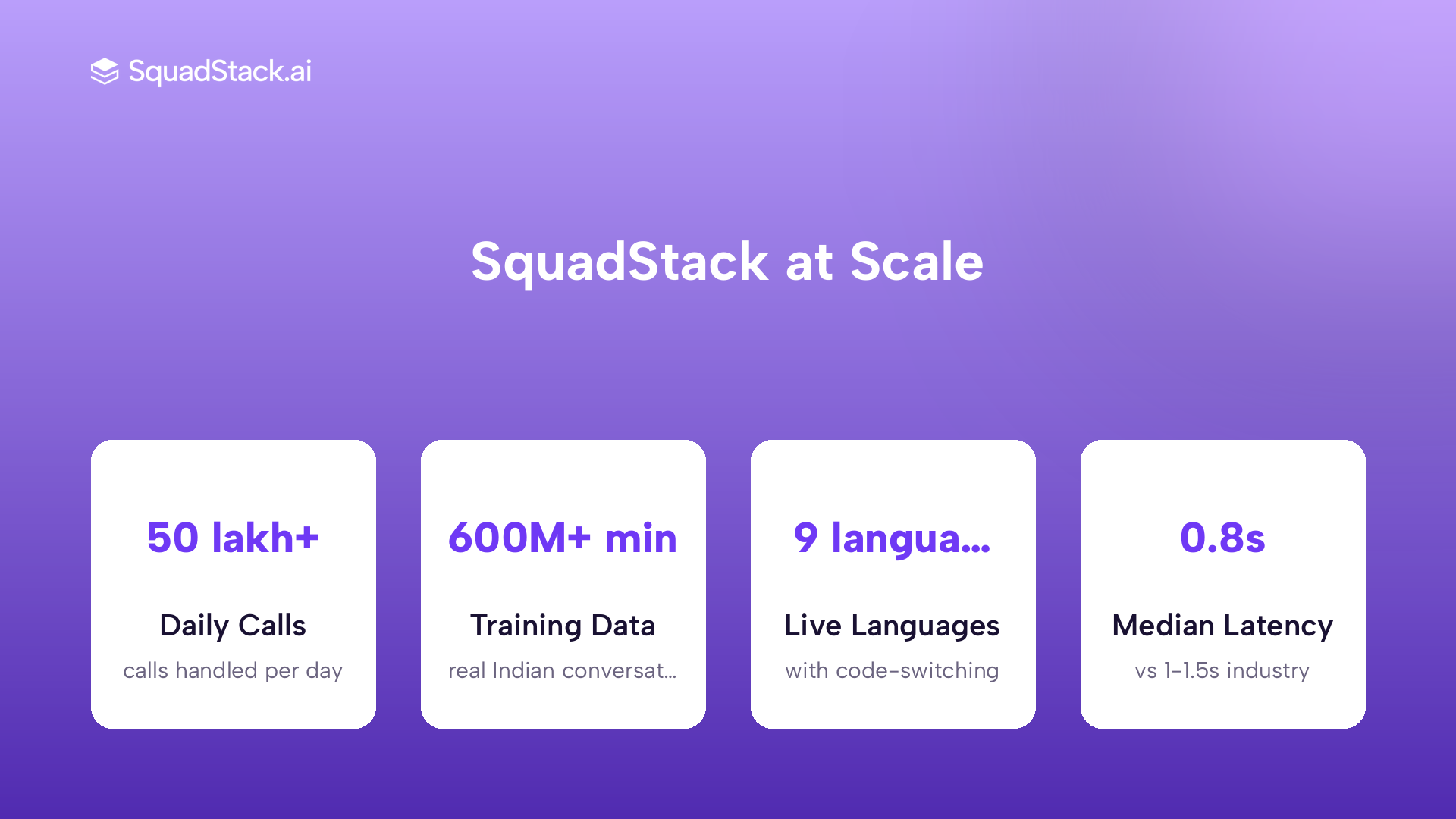
SquadStack has been running AI-assisted contact center operations for India's consumer lending ecosystem for close to a decade and has been fully Voice AI since 2025. The platform handles 50 lakh+ calls daily across 60+ large consumer brands, including collections use cases for lending platforms in India.
Arth, SquadStack's in-house speech model, is trained on 600M+ minutes of real Indian telephony audio, including collections conversations across Hinglish, Tamil, Telugu, Kannada, and six other live languages. This proprietary, full-duplex, outcome-labelled audio from real calls is why the word-error rate on noisy 8kHz lines is within 0.9 points of the best commercial streaming STT globally.
The Eval System scores every call on Outcome, Sentiment, and Execution, in that order. Business result first, borrower experience second, script adherence third. That sequence maps to how a collections compliance manager would audit a P2P call.
The Kissht case study is the closest published proof point. See how a digital lending platform used SquadStack to scale collections without adding headcount, with compliance and quality layers built in from day one.
PhonePe and Moneyview both use SquadStack for collections use cases. Neither outcome is attributable here without verified case-specific data, but the pairings confirm the platform has been proven in real Indian lending collections environments.
The platform carries ISO 27001, ISO 27701, SOC 2 Type II, DPDP, and TRAI compliance, with all models hosted in India. For a regulated entity whose AI vendor is functionally an LSP under RBI's Digital Lending Directions, that compliance stack is not optional.
For related reading on AI phone calling services for debt collection and AI in debt collection, both linked pieces cover the broader collections mechanics this post builds on.
P2P collections is one of the few NBFC use cases where compliance risk and business risk run in the same direction. A borrower who feels harassed files an ombudsman complaint and stops paying. A borrower who receives a well-timed, respectful Hinglish reminder is far more likely to pay on time and stay on the platform.
AI voice agents, configured correctly for P2P NBFCs, can cover the full pre-due and early-bucket volume that human floors cannot handle at scale, while keeping every call inside the regulatory boundary. The key is the configuration: locked compliance sections, genuine code-switching, warm-transfer escalation, and a dual-layer QA system that audits borrower sentiment on every call.
Schedule a demo to see a live P2P collections call flow, including the Hinglish script design, the dispute-escalation path, and the compliance enforcement layer.
Which is the best AI voice bot for P2P lending collections in India?
The best AI voice bot for P2P lending collections in India must support native Hinglish code-switching, enforce RBI contact-window rules at the system level, and handle warm-transfer escalation for disputes and hardship cases. SquadStack's Voice AI Agent meets all three requirements and has been deployed in collections use cases by Indian lending platforms including PhonePe and Moneyview.
Which AI voice bots support RBI and TRAI-compliant collections workflows?
A TRAI-compliant collections voice bot must dial from 1600-series numbers for service calls, scrub leads against the DND registry before every dial, enforce the 8am to 7pm contact window as a hard system rule, and fire an automated-caller disclosure at the start of every call. SquadStack is TRAI-compliant and ISO 27001, ISO 27701, SOC 2 Type II, and DPDP certified, with all models hosted in India.
Can AI voice agents handle high-volume pre-due and post-due collections with escalation rules?
Yes. A well-configured AI voice agent handles pre-due reminders, bounce-day recovery calls, and PTP capture automatically at any scale, including the surge volume that hits at month-end. Escalation rules for disputes, hardship, and high-DPD accounts route those conversations to a human with full context passed in the transfer.
How does AI voice compare to a traditional human collections team for an NBFC running 20,000 to 30,000 calls daily?
A human floor of that scale carries significant cost, attrition, and quality variability. An AI voice agent runs consistent scripts, enforces compliance on every call, never fatigues, and covers evening and weekend windows that human floors typically leave empty. The right model for most NBFCs is augmentation: AI handles pre-due and early-bucket volume at scale, humans focus on mid-bucket negotiations and dispute resolution.
What is the correct call flow for P2P lending collections using an AI voice agent?
The flow has three stages. Pre-due: soft reminder, payment link sent on WhatsApp during the call. Early-bucket (day 1 to 30 DPD): missed-payment inquiry, PTP capture with date and amount, automatic follow-up scheduled. Dispute or hardship: log the reason, confirm the grievance timeline, warm-transfer to a human with full context. Every call ends with the outcome written back to the CRM.
How does Hinglish script design work in an AI collections agent?
Hinglish script design starts from transcripts of real top-performing human agents. Openers, tag questions, and backchannels are hand-written for each language variant, validated by native speakers, and tested on actual 8kHz telephone lines. SquadStack's agents are trained on 600M+ minutes of real Indian telephony audio including code-switched Hinglish, which is why the agent switches mid-sentence naturally rather than pausing to translate.
What happens when a P2P borrower raises a dispute on a collections call?
A properly configured AI agent detects dispute intent from natural speech, stops the collections flow immediately, confirms the borrower's account details, logs the dispute type and reason, informs the borrower of the grievance timeline, and escalates to a human via warm transfer. The human receives a full transcript and a structured summary so the conversation does not restart from zero.
Are AI voice agents for collections compliant with RBI's P2P NBFC Master Directions?
The platform must be configured to comply: no contact outside 8am to 7pm, DND scrubbing before every dial, automated-caller disclosure on every call, opt-out honored and logged, and no abusive or anonymous contact. RBI's conduct rules are channel-agnostic, so they apply to AI voice the same way they apply to human agents. The RBI holds the RE accountable for every call made by its technology vendors.
What languages should a P2P collections AI agent support?
At minimum, Hindi and English with native Hinglish code-switching. A P2P platform with borrowers across India should also cover Tamil, Telugu, Kannada, Marathi, Malayalam, Bengali, and Gujarati. SquadStack supports all nine live today with native code-switching, and additional regional languages are available on demand.
How does SquadStack's QA system work for collections calls?
SquadStack's Eval System scores every collections call on three levels: Outcome first (did the call achieve its objective, such as a PTP or a dispute log), Sentiment second (how the call landed with the borrower), and Execution third (script adherence and compliance behavior). Both AI and human reviewers audit calls, with near-total review coverage early in a campaign to catch edge cases before they scale.