.svg)






Subscriber Churn Prediction Calls: AI Voice for OTT and Streaming
October 10, 2026
|

12 min read
See how AI voice agents cover the full post-service customer list before the OEM CSI survey lands, catching complaints early and lifting dealer scores.
Post-service feedback call automation for CSI scores in India is the practice of using AI voice agents to reach vehicle service customers within a three-day window, after their workshop visit but before the OEM's formal CSI survey arrives. It catches complaints, routes them to the dealer, and lifts survey coverage from single digits to near-total. The result is a higher, more defensible CSI score, and dealer bonuses that are no longer at the mercy of whoever the OEM's survey vendor happened to reach.
Dealer bonuses in India's automotive market hang on a number most dealers cannot fully control: the Customer Satisfaction Index score that OEMs measure after every service visit. The mechanics are straightforward. The OEM or its survey vendor calls a sample of customers who recently had their vehicle serviced. The customer scores their experience. The dealer's monthly and quarterly payouts shift accordingly.
The problem is the gap between what customers actually experienced and what the survey captures. A customer who had a genuine complaint but was called back by the dealer and had it resolved is very likely to score positively. A customer nobody reached, who stewed over a billing issue for two weeks before the OEM survey arrived, is far more likely to score negatively. Whether the dealer wins or loses on CSI often comes down to coverage: who did the dealer's own team call, when, and what happened on those calls.
For dealers running a service CRE team of two to four people against a monthly due-list of thousands of vehicles, that coverage problem is structural. One missed service call is a lost opportunity. A missed PSF call is a ticking clock.
This is the article that covers the post-service feedback use case in depth. For the full picture of where Voice AI attaches across every stage of the automotive customer journey, the SquadStack Automotive hub is the right starting point.
Post-service feedback call automation is the use of an AI voice agent to call every service customer within a defined window after their vehicle is returned, typically within three days of job-card closure, to ask structured questions about their experience, log any complaints, and route unresolved issues to the dealer before the OEM's CSI survey reaches that customer.
A human CRE doing the same job covers a fraction of the list. An AI agent running against the full list covers every customer at the same quality level, in their language, at sub-second response latency, with every response logged automatically into the dealer's CRM.
The three things the call does: 1. Confirms the customer's satisfaction with the service work, wait time, and handover. 2. Flags any complaint or unresolved issue and creates a ticket for the service manager. 3. Asks for the customer's NPS score and logs the verbatim reason.
Done well, this is not a tick-box exercise. It is the dealer's last chance to act before the OEM's score is locked in.
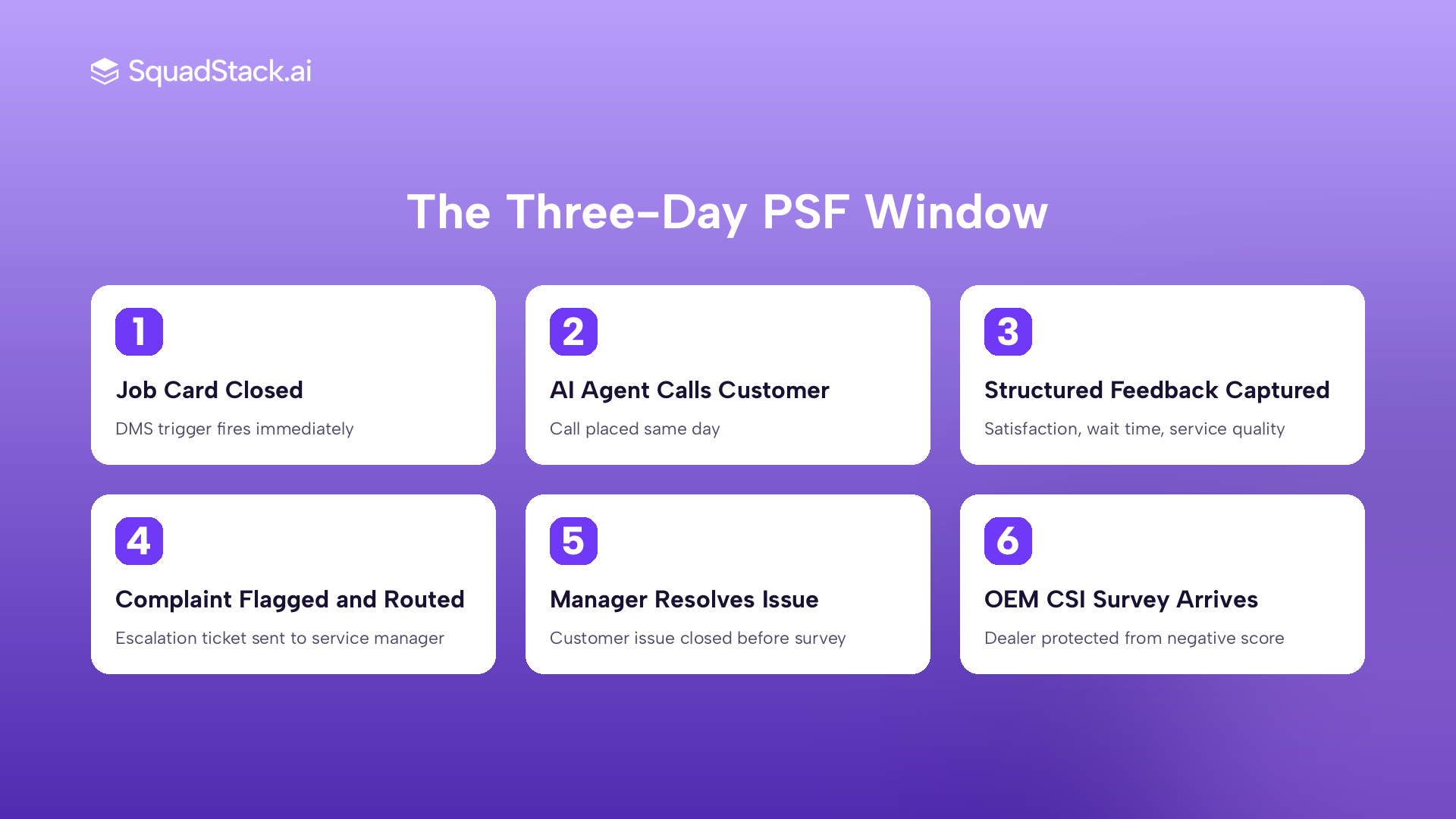
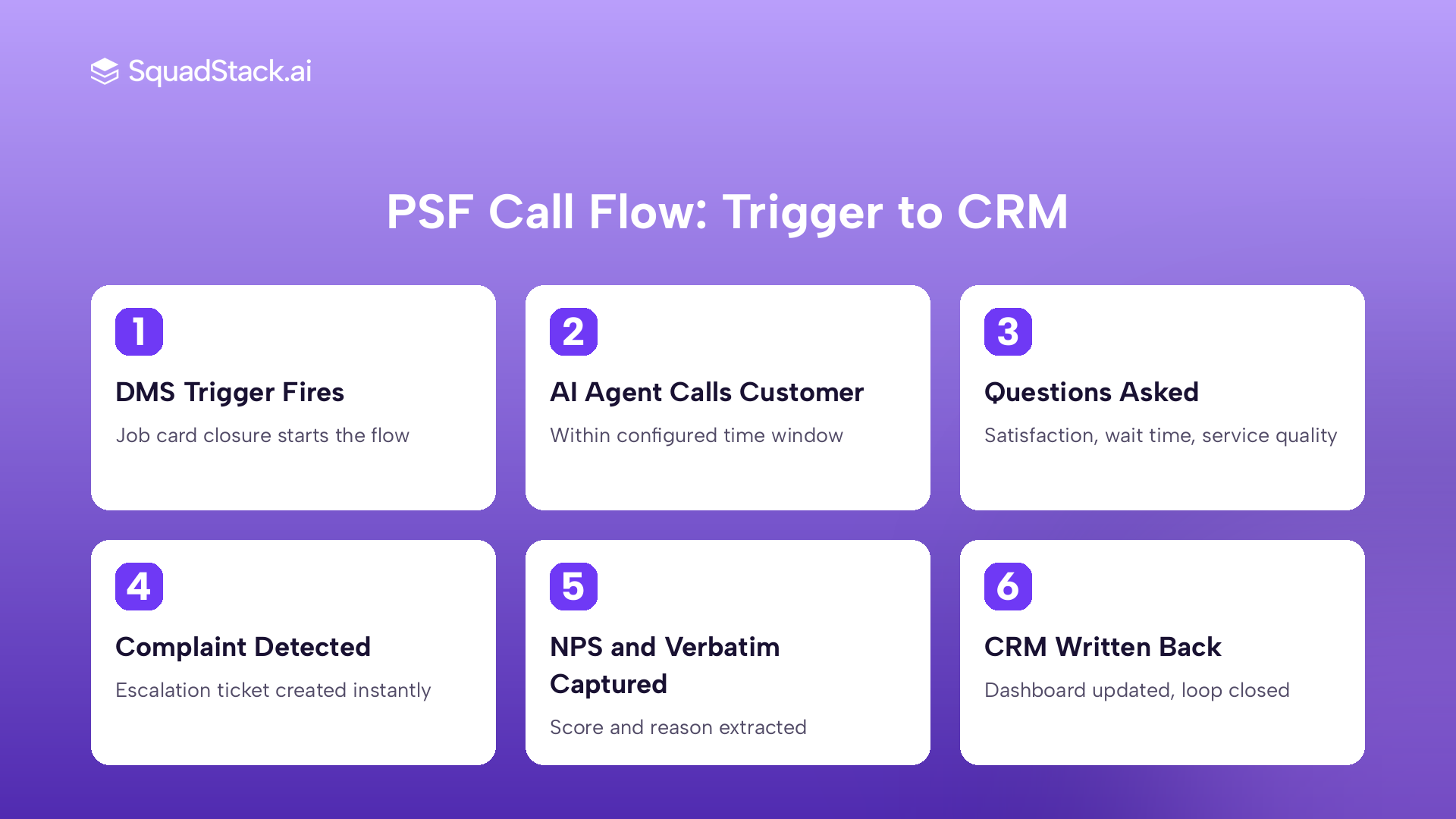
The trigger is job-card closure in the DMS. The moment a vehicle is marked as returned to the customer, the lead record moves into the PSF workflow. The AI agent places the call within a configured window, typically the same evening or the following morning, always within the three-day threshold.
The call itself is short and structured. The agent opens in the customer's preferred language, confirms the vehicle and service visit, and asks three to five questions covering satisfaction with the work done, courtesy at the service desk, wait time, and the likelihood to recommend. If the customer raises a complaint, the agent acknowledges it, captures the details, and confirms that the service manager will follow up. Satisfied customers are offered a direct path to leave a Google or platform review.
After the call, every response is extracted as a structured data point and written back to the CRM. Complaints are tagged for follow-up by severity. The service manager sees a real-time dashboard, not a batch report three days later.
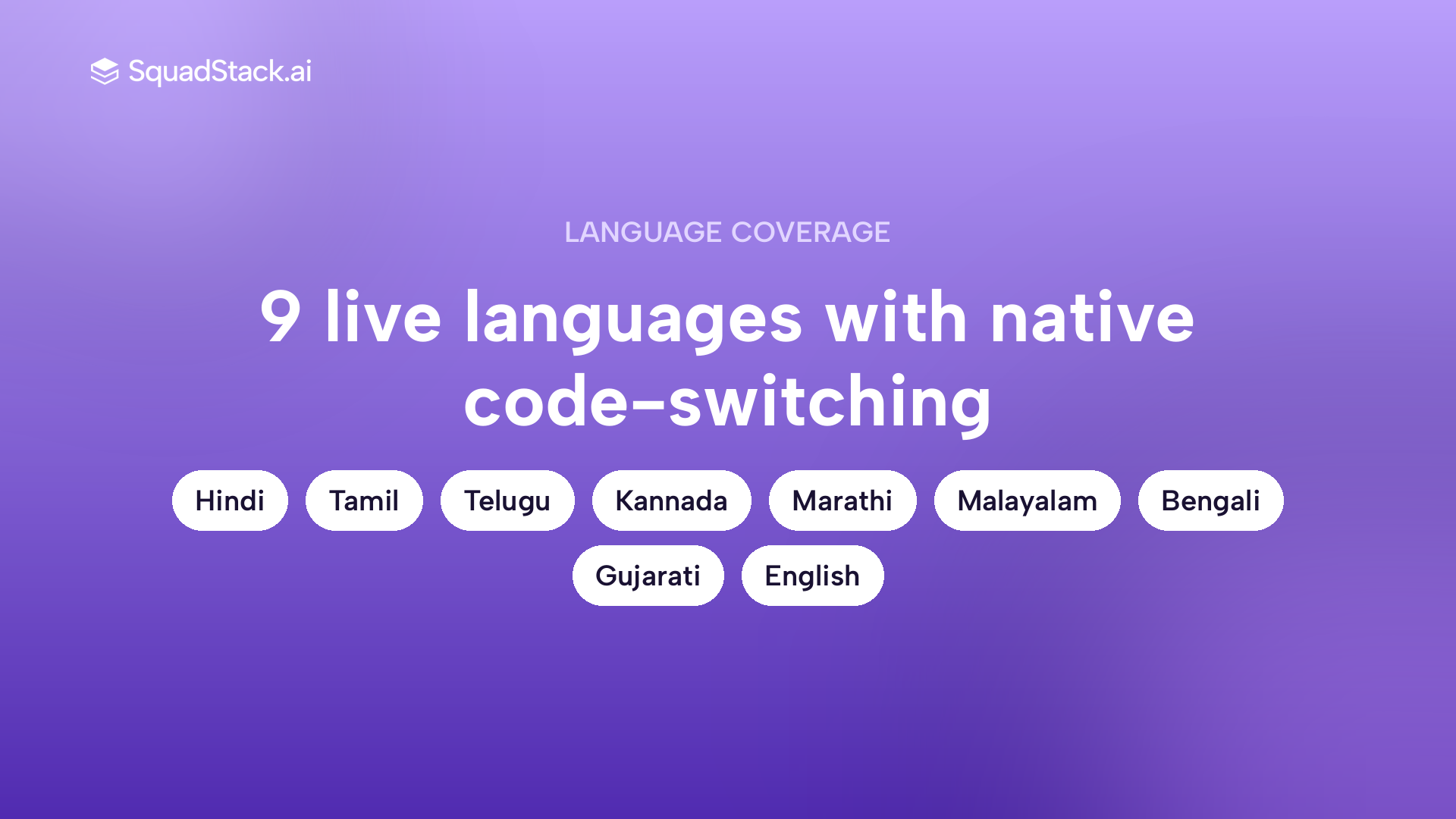
Because the platform supports 9 live languages with native code-switching, a Tamil-speaking customer in Chennai and a Marathi-speaking customer in Pune both receive a call that sounds like it was made by a native speaker, not a translated script. This matters more than it looks on paper: a customer who receives a stilted, formal call in their second language is far more likely to give a short, unengaged response, or to hang up before completing the survey.
Post-service feedback calling is part of a broader set of service-cycle calling motions that represent the highest-margin work in a dealership. The workshop is roughly 18% of a two-wheeler dealer's revenue but carries a disproportionate share of gross margin. Losing a customer to a local garage after a bad service experience costs not just the next job card but the parts revenue, the insurance renewal, and eventually the exchange enquiry.
The PSF call occupies a specific and non-replaceable position in that lifecycle. It sits after the service reminder and after the service visit itself, and before two critical external events: the OEM's CSI survey and the customer's decision about where to take the vehicle next time.
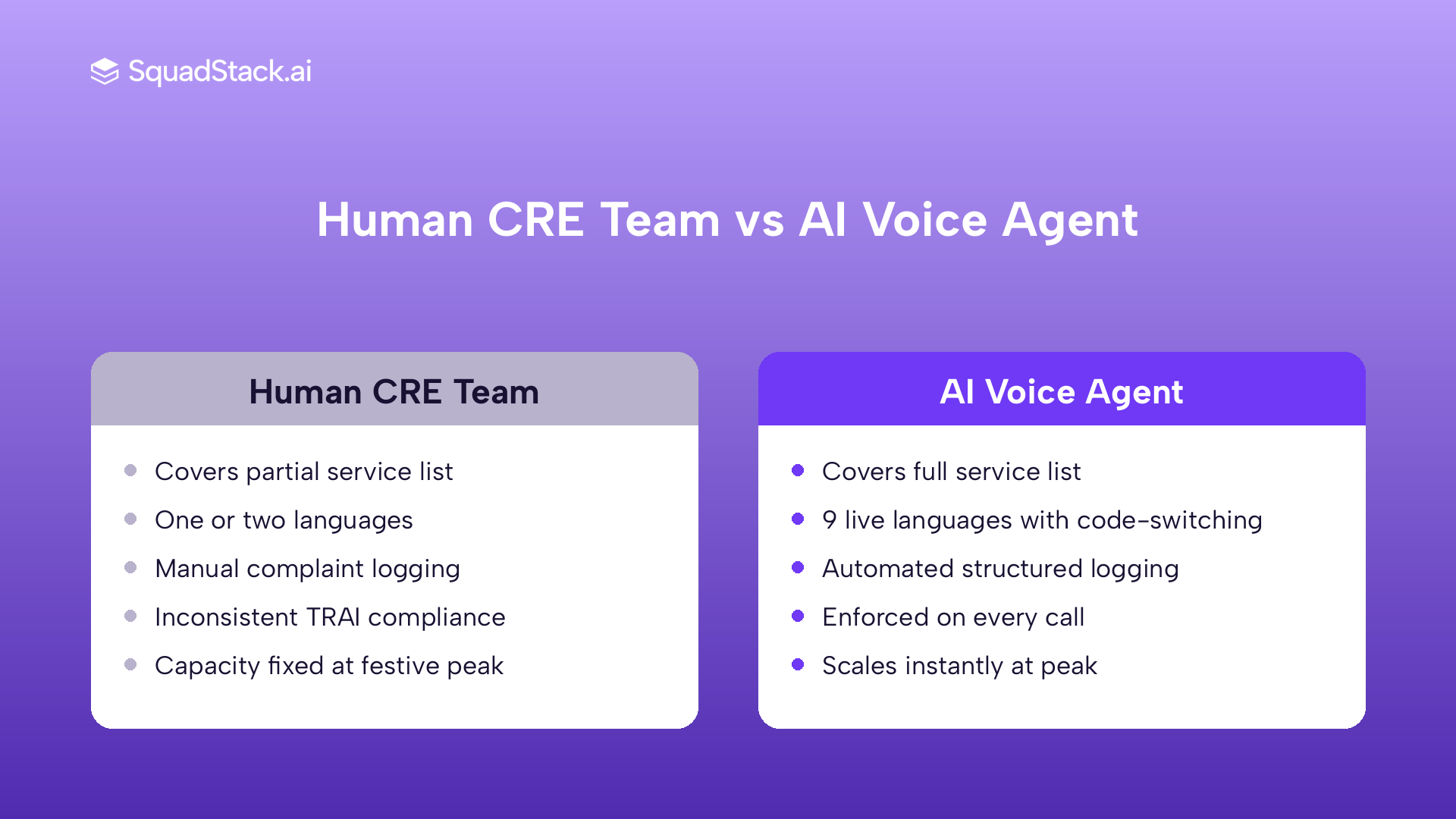
The table below shows how the PSF call compares to the incumbent approach.
| Dimension | Human CRE PSF team | AI Voice Agent PSF |
|---|---|---|
| Coverage of service customers | A small share of the monthly list | Full list, every customer |
| Time to reach after job-card closure | Hours to days, depending on queue | Same day, configurable window |
| Language capability | Typically one or two languages | 9+ languages with native code-switching |
| Complaint logging | Manual CRM entry, inconsistent | Automatic extraction and CRM write-back |
| Data quality for CSI tracking | Patchy, often anecdotal | Structured fields, every call |
| Scalability at festive season peaks | Fixed by headcount | Software-controlled, no hiring lag |
| TRAI and DND compliance | Depends on individual dialer discipline | Hard-enforced by platform, 9:30 AM to 8:30 PM window |
The festive season point is worth pausing on. October to November is when service volumes spike after the Navratri-to-Diwali delivery rush. It is also exactly when a fixed-size PSF team falls furthest behind. An AI agent scales without a hiring cycle.
Not every voice AI platform is built for the PSF use case in automotive. A few things separate a tool that moves your CSI score from one that adds a layer of process without changing outcomes.
Language coverage at the right depth. Listing a language as supported is not the same as sounding native in it. A customer who hears a robotic, textbook-formal version of Tamil is very likely to disengage before completing the survey, or worse, to score negatively because the call itself felt impersonal. Ask the vendor to play you a regional-language call recording, not a demo clip.
DMS and CRM integration. The PSF call only works if it fires automatically from job-card closure and writes responses back in real time. A platform that requires a manual CSV export of customers before each batch adds latency and human error.
Complaint routing. A call that captures a complaint but parks it in a dashboard nobody monitors does not close the loop. Look for configurable escalation: a complaint above a certain severity should generate a task for the service manager immediately.
TRAI compliance built into the dialer. The platform must scrub against DND lists, enforce calling hours, and use compliant number series. This is not a nice-to-have for a regulated industry.
QA on the calls themselves. Post-service feedback calls are an OEM-scrutinised process. The platform should evaluate every call on whether it completed the script, captured the required data fields, and handled an objecting or distressed customer appropriately. SquadStack's Eval System scores every call on Outcome, Sentiment, and Execution, which gives the OEM CX team a real-time quality layer they can audit.
SquadStack has operated AI-assisted contact centers for Indian consumer brands for roughly ten years and moved fully to Voice AI in 2025. That track record matters specifically for the PSF use case because the training data behind the speech model is real Indian telephony audio, not public internet text.
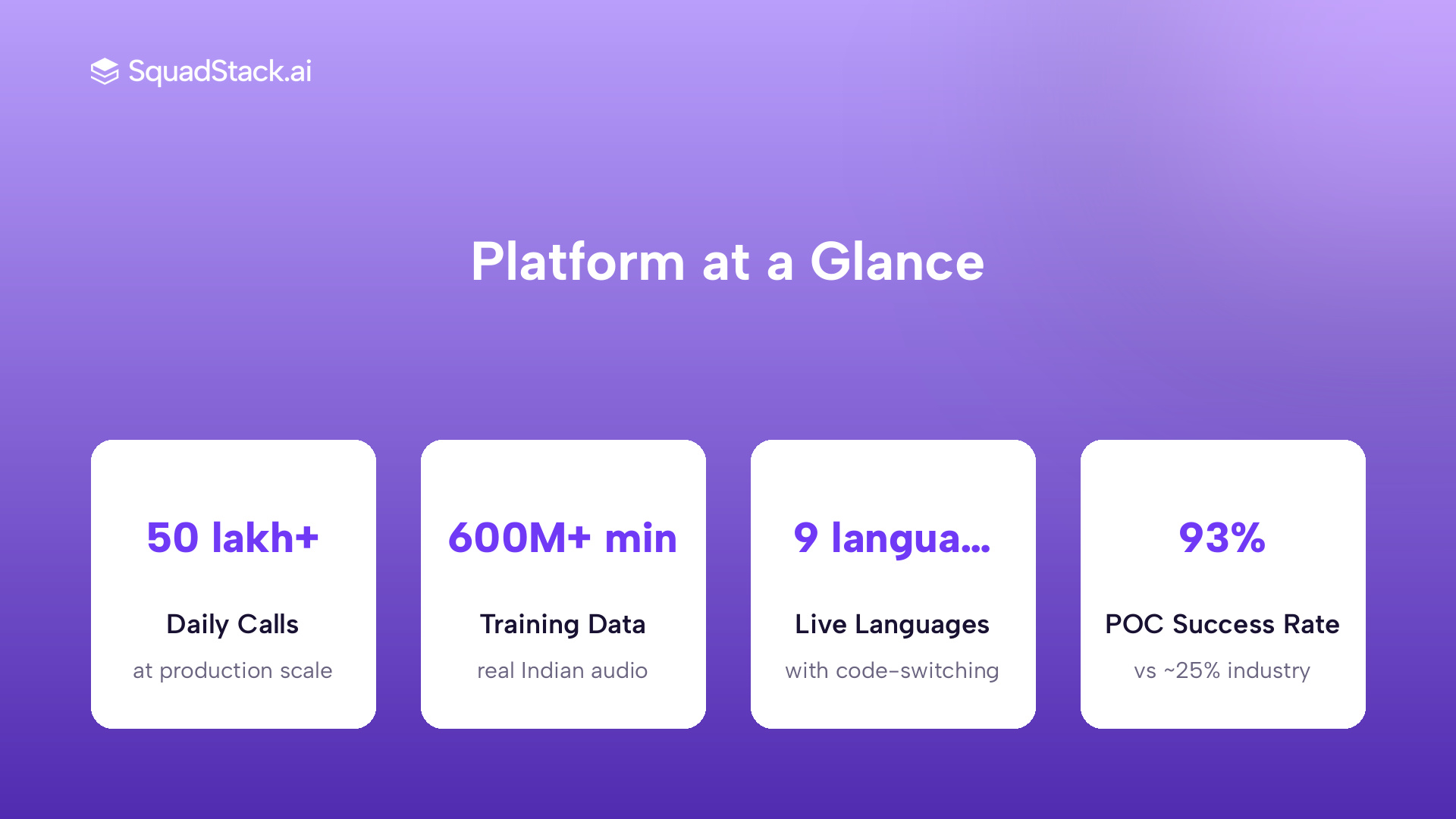
Arth, SquadStack's proprietary speech recognition model, is trained on 600M+ minutes of real Indian sales and service conversations, including code-switched speech like Hinglish and Taminglish, tuned for the noisy 8kHz telephone lines that Indian mobile networks run. On a benchmark of real Indian telesales audio, Arth v1 reaches a semantic word error rate of 11.9%, within 0.9 points of the best commercial streaming STT available. That accuracy matters when a customer is explaining a complaint: a model that mishears "brake noise" as something else creates a false ticket and erodes trust in the process.
TVS Motor, a two-wheeler OEM with a 3,500-plus dealer network, runs NPS and feedback calling on SquadStack. That is the closest publicly verifiable proof point in this exact use case in India.
For OEM CX teams and dealer groups evaluating this, the engagement model is a 4 to 8 week pilot on real customers, against a pre-agreed success metric, with a dedicated squad handling build, QA, and integration. SquadStack's POC success rate is 93%, against an industry average of roughly 25%. The pilot is not a lab exercise.
For teams evaluating their options across the full automotive calling stack, the broader Voice AI for automotive overview covers every use case from lead qualification through service reminders and lapsed customer win-back.
What is post-service feedback call automation for CSI scores in India?
It is the use of an AI voice agent to call every service customer within the three-day window after their vehicle service visit, ask structured satisfaction questions, log complaints, and route unresolved issues to the dealer before the OEM's CSI survey reaches that customer. It replaces patchy human coverage with full-list coverage at consistent quality.
Which is the best AI voice agent for post-service feedback and NPS calling in India?
SquadStack is the only platform with a verified automotive NPS deployment at the OEM scale in India, with TVS Motor as a live reference. Its Arth speech model is trained on 600M+ minutes of real Indian telephony audio, supports 9 live languages with native code-switching, and its Eval System audits every call on Outcome, Sentiment, and Execution.
How does a voice AI handle a customer who raises a complaint during the PSF call?
The agent captures the complaint as a structured data point, acknowledges it in a natural, non-scripted way, and flags it for escalation based on configured severity rules. The service manager receives a real-time task or alert. The customer is told a team member will follow up. The call does not terminate the complaint; it is the start of the resolution loop.
Can AI voice agents improve CSI scores, or do they just increase survey coverage?
Both. Higher coverage means the dealer is hearing from a more representative sample before the OEM does, so genuine issues are caught and resolved first. That directly changes the score. Better coverage also means the OEM's survey is more likely to reach a satisfied customer, because satisfied customers have had their experience acknowledged and any issue addressed.
How does TRAI compliance work for automated PSF calls in India?
SquadStack's platform hard-enforces the 9:30 AM to 8:30 PM calling window, scrubs leads against the TRAI DND registry, and uses compliant number series. Compliance-aware dialogue is built into the call flow itself, including opt-out handling and AI disclosure where required. This is enforced at the platform level, not left to individual dialer configuration.
How many languages does the AI voice agent support for post-service calls?
Nine languages are live today: Hindi, English, Tamil, Telugu, Kannada, Marathi, Malayalam, Bengali, and Gujarati, all with native code-switching. The agent can switch languages mid-conversation the way a bilingual human agent would. Additional regional languages are available on demand based on the dealer network's requirements.
How quickly can a dealership or OEM go live with PSF call automation?
A typical engagement goes live in roughly two weeks. That covers the agent build, DMS or CRM integration, script QA, and compliance configuration. The pilot then runs for four to eight weeks against a pre-agreed metric, such as CSI score movement or survey coverage percentage, before scaling.
What data does the AI voice agent capture and send back to the dealer's system?
Every call produces structured outputs: satisfaction scores per question, NPS score and verbatim reason, complaint category and description, call outcome, and call recording with transcript. These are written back to the dealer's CRM and can trigger downstream workflows such as service manager tasks or follow-up calls.
Does the AI sound natural enough for a post-service feedback call, or will customers hang up?
SquadStack's voice agents passed a blind Turing test at Global Fintech Fest 2025, where 1,273 of 1,563 attendees could not distinguish the AI from a human agent. The Abruptly Disconnected Rate, which measures how often callers hang up immediately after identifying the call as AI, is now around 10%, inside the range of human agent campaigns. The voices are cloned from real Indian sales agents, not generic text-to-speech.
How is the quality of PSF calls monitored and reported?
SquadStack's Eval System scores every call on three dimensions in sequence: Outcome (did the call complete its objective), Sentiment (how the customer responded), and Execution (script adherence, data capture, complaint handling). Dealer and OEM CX teams have dashboard access by default, and call recordings are available for every interaction.