.svg)





Hyper-Personalised Outbound Call Scripts Using Customer Lifecycle Data
October 6, 2026
|

13 min read
The primary function of speech AI in sales is not transcription. It is turning spoken intent into action: qualifying a lead, advancing a deal, or booking...
The primary function of speech AI in sales is not transcription. It is turning spoken intent into action: qualifying a lead, advancing a deal, or booking a follow-up, all without a human agent picking up the phone. In consumer sales, where every second of delay loses a prospect, the distinction between "converting speech to text" and "converting intent to revenue" separates technology that sounds impressive from technology that moves numbers.
Sales teams in India face a structural problem. Millions of leads come in every day, human agents can reach a fraction of them before intent cools, and call quality varies wildly depending on who picks up. Speech AI exists to close that gap, but it is widely misunderstood. Most descriptions stop at "converting speech to text." That framing is too narrow for sales and leads companies to deploy tools that transcribe conversations without ever advancing them.
This piece explains what speech AI actually does inside a sales call, how each function maps to a business outcome, and why the Indian market demands a different architecture from anything built for English-only, low-noise conditions.
The primary function of speech AI in a sales context is to understand spoken intent and respond in a way that moves a buyer closer to a decision.
Transcription is one step in that process, not the whole process. A fully functional speech AI system for sales runs four interconnected layers.
Automatic Speech Recognition (ASR) converts the caller's voice into text. In Indian consumer sales this is where most generic systems fail. A caller might say "haan, mujhe loan chahiye but EMI low honi chahiye" in one breath. A model trained on clean English audio will misfire on the code-switched phrase and corrupt everything downstream. ASR quality is the foundation; if it is wrong, the rest of the stack processes garbage.
Natural Language Understanding (NLU) reads the transcript and extracts intent, entities, and sentiment. "EMI low honi chahiye" is not just a sentence; it is a price objection with a loan amount and tenure preference implied underneath it. NLU pulls out the structured information a sales agent would note on a pad: what the buyer wants, what they are worried about, and where they are in their decision.
Dialogue Management decides what the agent says next. This is the sales brain of the system. It handles objections, asks qualifying questions, adjusts pitch framing, and decides when to push and when to listen. Without this layer, even perfect ASR and NLU produce a system that hears well but cannot hold a real conversation.
Text-to-Speech (TTS) converts the agent's response back into audio. In sales, delivery matters as much as content. A robotic voice with flat prosody signals automation in the first three seconds, and that signal alone drops engagement.
These four layers run in a loop for the full length of a call. The goal is not transcription. It is qualification, objection handling, and conversion.
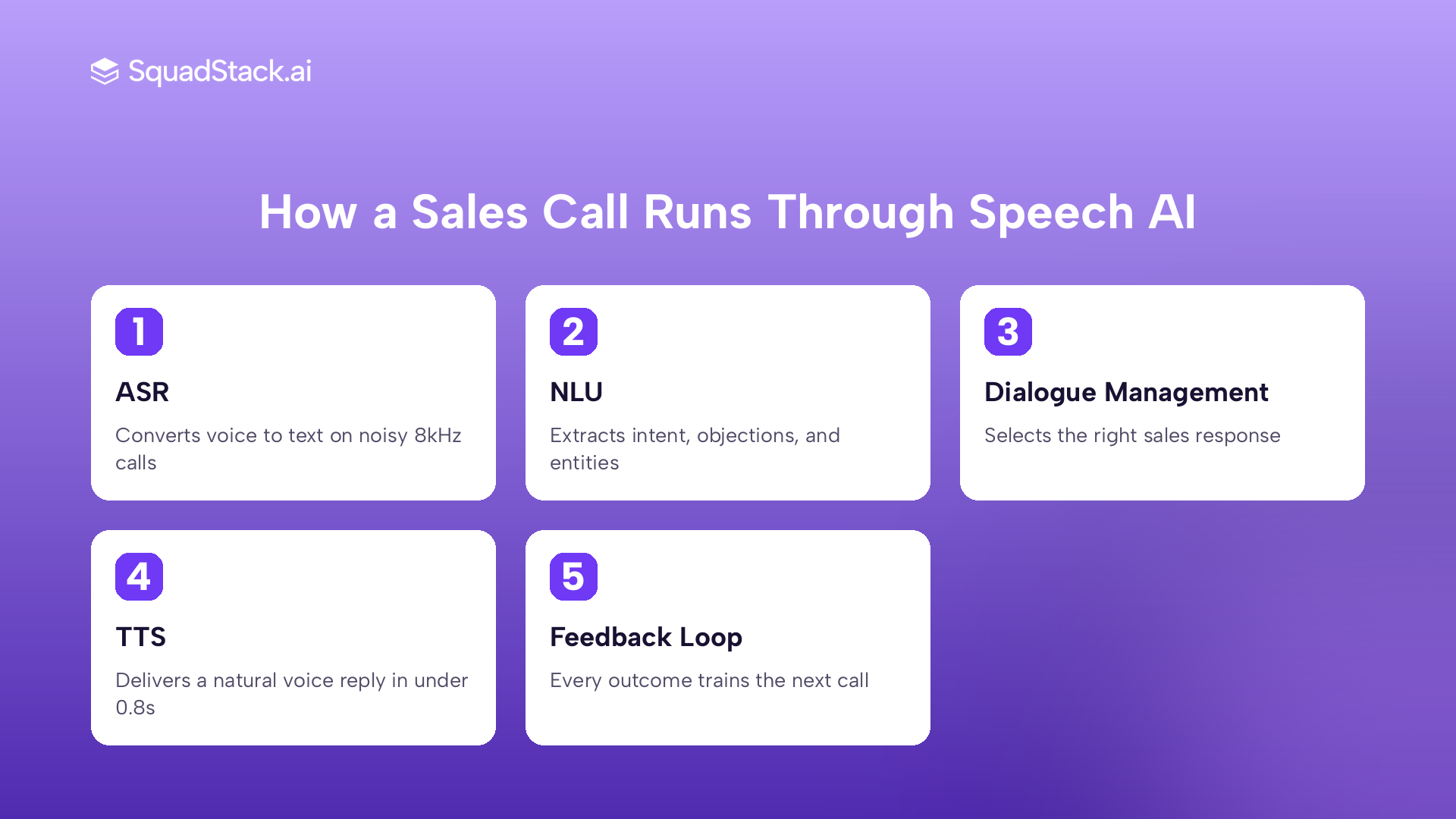
Step 1: Lead context loads before the call starts. The system pulls interaction history, stated preferences, and prior objections. A returning caller is never treated like a stranger.
Step 2: ASR listens and transcribes in real time. The speech model handles background noise, telephone-quality audio, and mid-sentence language switches. In SquadStack's case, this is Arth, a proprietary model trained on 600M+ minutes of real Indian sales conversations. On real Indian telesales audio, Arth v1 benchmarks at a semantic word error rate of 11.9%, within 0.9 percentage points of the best commercial streaming STT available.
Step 3: NLU extracts intent and entities. The system identifies what the caller wants, what objections they have raised, and what structured data points (loan amount, preferred callback time, PIN code) have been confirmed.
Step 4: Dialogue management selects the next best response. The system does not read a script linearly. It picks from pre-crafted response options based on the current conversation state, the lead's profile, and the sales goal for the call.
Step 5: TTS delivers the response in the caller's language, at a natural pace, with regional fillers that signal a real person rather than a machine.
Step 6: On-call actions fire where relevant. The agent can send a WhatsApp payment link mid-call, book a follow-up, or trigger a warm transfer to a human closer, without breaking the conversation.
Step 7: The outcome feeds back into the system. Every call result feeds into the ROI Optimizer. Script variants, voice choices, cadence timing, and objection responses are continuously tested against real outcomes. Each call makes the next one sharper. That self-improvement loop is what separates a static voice bot from a sales system that compounds over time.
BFSI: Lead qualification and loan advisory. A personal loan lead who fills a form online may not be reachable for days if a human agent has to call them. A speech AI agent calls within minutes, qualifies income and loan intent, handles rate objections, and either advances the application or books a callback. Kotak Mahindra Bank uses SquadStack for personal loan sales; AngelOne uses it for demat account opening.
Edtech: Counselling and course sales. A lead who enquires about a course at 11 PM cannot be called back before morning without losing intent. Speech AI handles the initial qualification call at any hour, in the student's language, captures subject interests and budget, and books a slot with a human counsellor for the complex close. Adda247, Unacademy, and Nxtwave use SquadStack for lead qualification across their pipelines.
E-commerce: Seller onboarding and buyer-seller matching. IndiaMART uses SquadStack for buyer-seller matching and order taking. Shiprocket uses it for seller onboarding and lead qualification. In both cases the speech AI handles high-volume first contact so human teams can focus on accounts needing complex attention. The IndiaMART case study saw 20% higher conversions and 15% lower CAC on this use case.
For a broader look at how AI voice agents automate sales operations, the principles here apply across all three verticals.
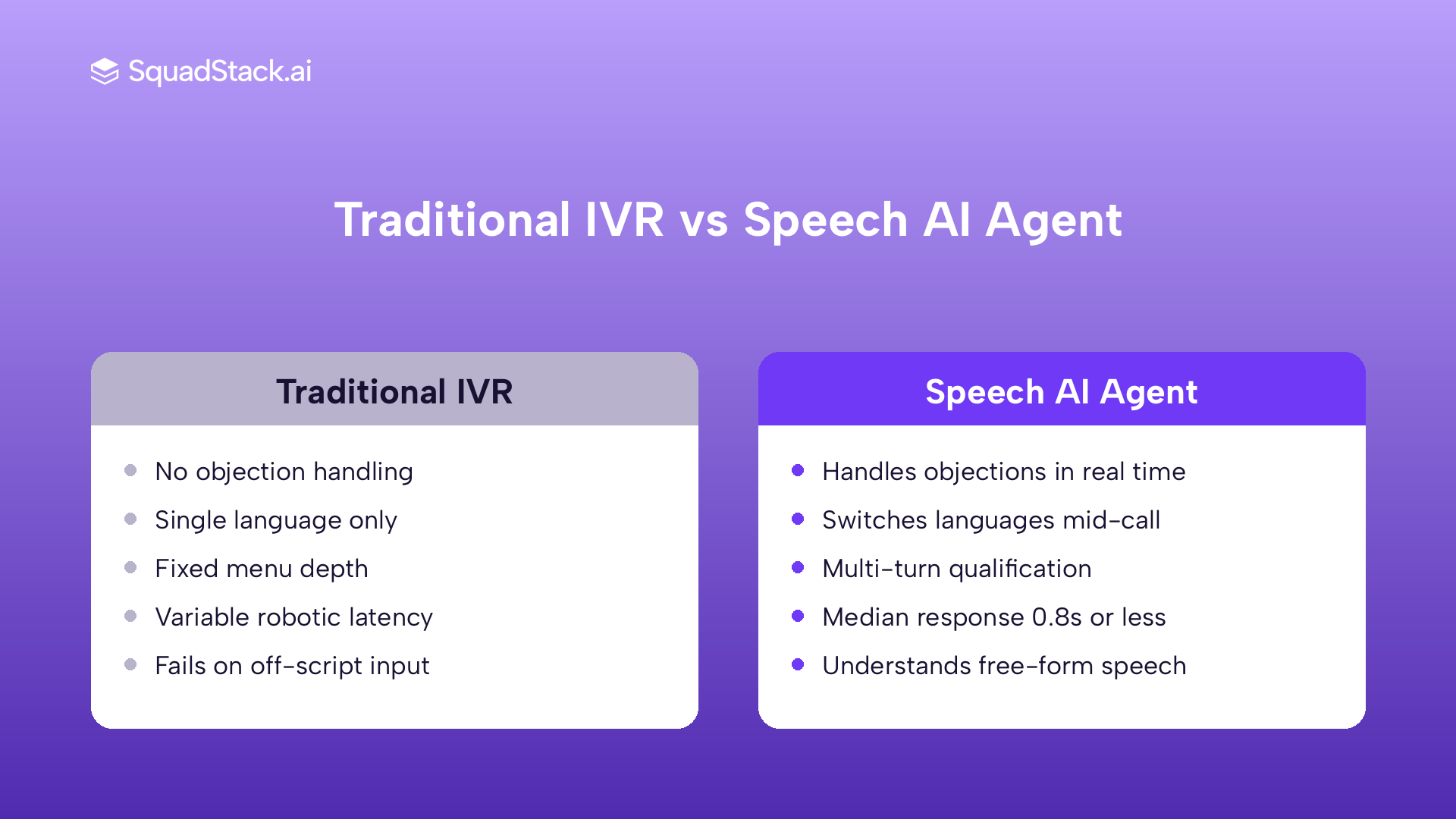
| Dimension | Traditional IVR | Speech AI Agent |
|---|---|---|
| Handling an objection | Cannot process it. The caller is asked to press 1 or 2, and an objection falls outside the menu. | The agent hears the objection, understands it, and responds with a multi-step rebuttal tailored to what was said. |
| Language on the call | A caller says "Kannada mein baat karo" and the IVR has no Kannada option. Call drops. | The agent detects the language switch mid-sentence and continues in Kannada without prompting. |
| Qualification depth | Can capture one DTMF input per prompt. Salary ranges become "press 1 for below 30k." | Captures loan amount, tenure preference, employment type, and prior loan history in natural conversation as structured entities. |
| Response latency | Fixed audio playback with no pause logic. Sounds mechanical from the first second. | Median response latency of 0.8 seconds or less, with turn-detection tuned for Indian conversational patterns including fillers like "haan" and "matlab." |
| Off-script input | IVR loops, asks the caller to repeat a menu option, or drops the call. | Dialogue management handles the deviation, reroutes the conversation, and continues toward the sales goal. |
The gap is not cosmetic. In Indian consumer sales, where a high share of leads speak primarily in a regional language and where objections are the norm, an IVR cannot do the job at all. It is not a slower version of a speech AI agent. It is a different thing entirely.
For a detailed comparison of the broader category, see best AI call center software solutions.
ASR accuracy on Indian telephony audio. Ask for benchmark data on real 8kHz Indian call recordings, not clean studio audio. Code-switched speech and regional accents are the norm in Indian consumer calls, and a model trained on YouTube videos will misfire constantly.
Native code-switching across Indian languages. The agent should switch languages mid-sentence without being prompted, because that is how bilingual callers actually speak. A bolt-on translation layer adds latency and sounds unnatural.
Dialogue management that handles objections across multiple turns. A single canned rebuttal is not objection handling. The system should work an objection across several turns, the way a trained sales agent would.
Persistent memory across calls and channels. A lead who discussed loan requirements three days ago should not have to repeat themselves. Memory that carries across sessions prevents drop-off at re-contact.
A continuous improvement loop tied to sales outcomes. The system should learn from every call, testing script variants, voice choices, and timing against real conversion data. Without this, the agent plateaus.
SquadStack's approach is grounded in roughly 10 years of running outcome-driven contact center operations for India's largest consumer brands before transitioning fully to Voice AI in 2025.
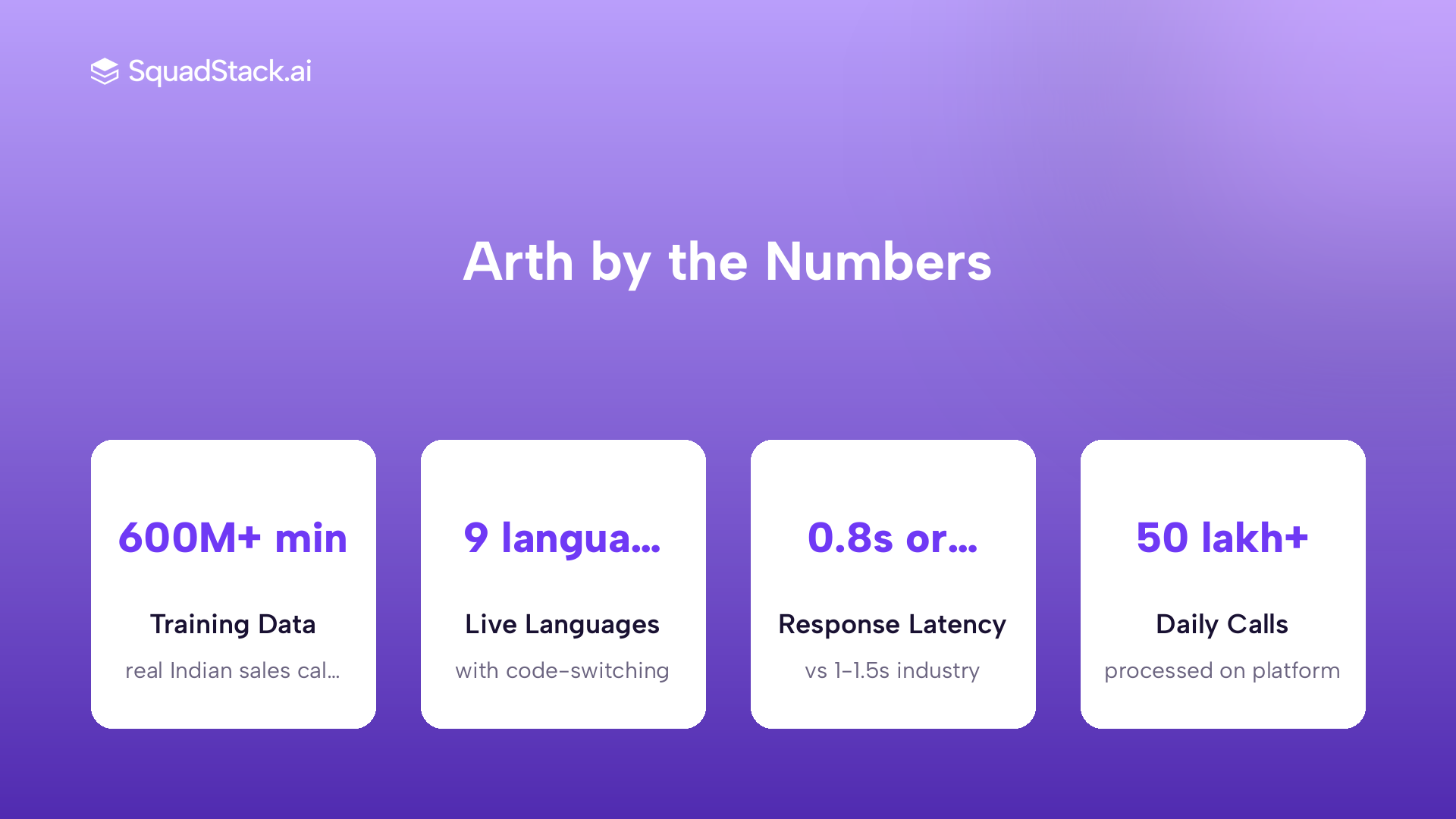
Arth is trained on 600M+ minutes of real Indian sales conversations spanning full-duplex telephonic audio across 85%+ of Indian pincodes, in code-switched registers like Hinglish and Taminglish, on noisy 8kHz lines. No public dataset comes close for Indian consumer telephony. You can read more about this in SquadStack's speech recognition piece.
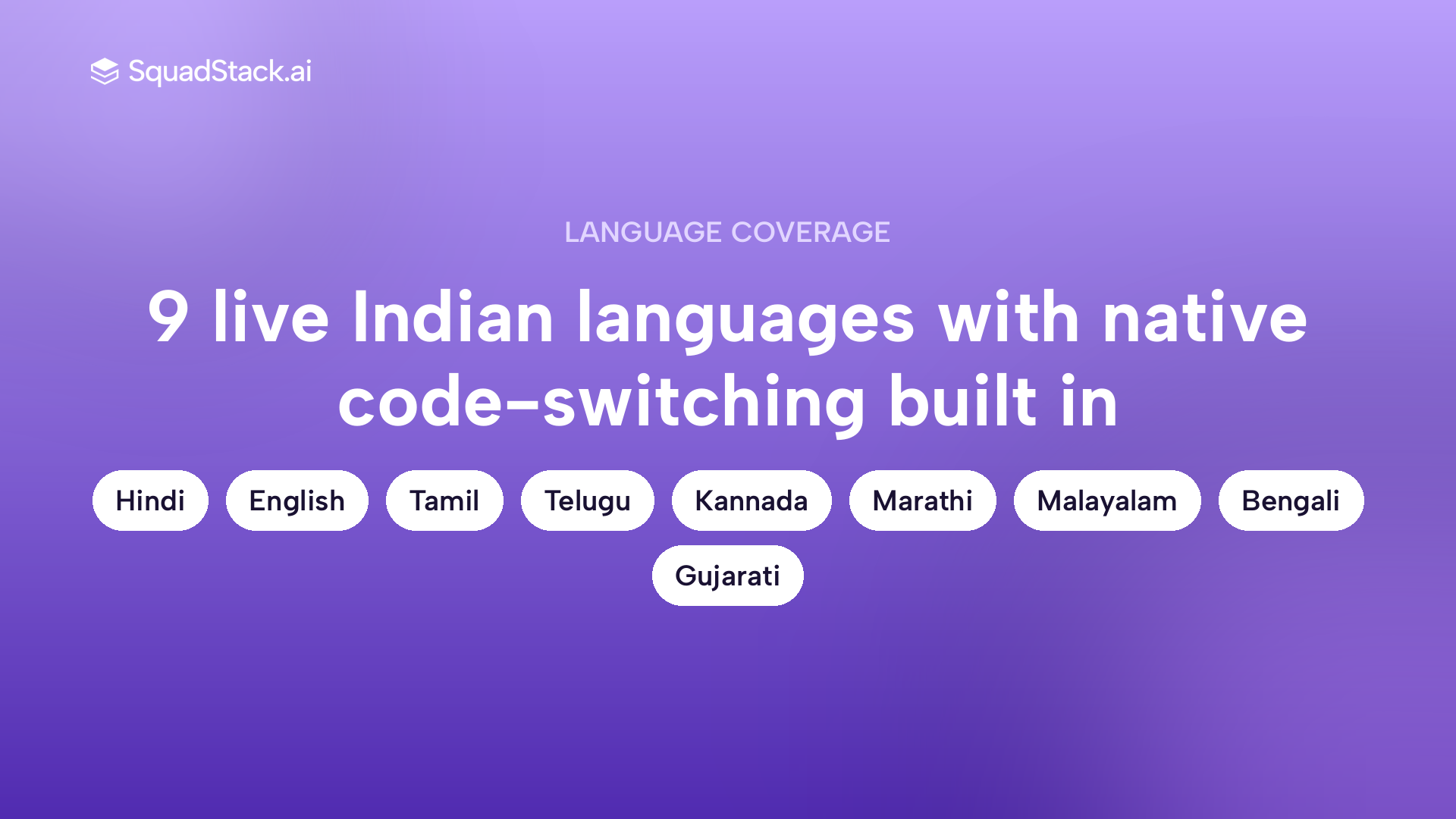
The platform runs 9 live Indian languages with native code-switching: Hindi, English, Tamil, Telugu, Kannada, Marathi, Malayalam, Bengali, and Gujarati. Every call is audited through the Eval System, which scores Outcome, Sentiment, and Execution in that order, reflecting how a sales leader actually evaluates a call.
At scale: 50 lakh+ calls daily across 60+ large consumer brands, with a 93% POC success rate against an industry average of roughly 25%.
The Delhivery case study shows 4x lower cost-per-hire on rider onboarding, a high-volume outbound use case that maps directly to what speech AI does best: consistent delivery at scale, in multiple languages, without quality variance.
For teams evaluating where to start, the AI voice agent for lead qualification page covers the most common entry point. To see the platform on your own lead data, book a demo.
Which is the best speech AI platform for consumer sales in India?
The best platform for Indian consumer sales is one trained on real Indian telephony data, with native code-switching across major regional languages and a dialogue engine built for sales objection handling. SquadStack's Arth model is trained on 600M+ minutes of real Indian sales conversations and supports 9 live languages with mid-sentence code-switching, making it purpose-built for this market.
Can speech AI handle lead qualification automatically without a human agent?
Yes. A speech AI agent can conduct full qualification conversations, capture structured data like income, loan intent, or product preference, handle common objections, and book follow-ups, all without human involvement. Human agents are brought in only for high-intent escalations or complex cases.
What is the primary function of speech AI, and how is it different from a regular IVR?
The primary function of speech AI in sales is understanding spoken intent and responding conversationally to advance a deal. An IVR plays fixed audio prompts and captures DTMF inputs. A speech AI agent understands free-form speech in multiple languages, handles objections, and maintains context across a full conversation. The gap is architectural, not incremental.
How does speech AI in sales handle multiple Indian languages and code-switching?
Systems trained on real Indian call data recognise code-switched speech like Hinglish or Taminglish natively. The agent detects which language the caller is using mid-sentence and responds in kind, without a translation step. This requires training data from actual Indian sales calls, not multilingual text corpora.
What happens to the data from every sales call?
Every call outcome feeds back into the system. Script variants, voice options, cadence timing, and objection responses are continuously tested against real conversion results. The agent improves with every campaign rather than staying static.
How quickly does a speech AI agent respond to a caller?
SquadStack's agents respond with a median latency of 0.8 seconds or less, compared to an industry norm of 1 to 1.5 seconds. The system maintains this speed even on long calls by compacting older context rather than resending the full call history to the model on every turn.
Does speech AI work for outbound sales calls or only inbound?
It works for both. Outbound use cases include lead qualification, loan sales, demat account opening, and course counselling. Inbound use cases include customer support, appointment booking, and complaint intake. The same speech stack and dialogue engine run on both, with call flow and persona configured per campaign.
How accurate is speech recognition on noisy Indian phone calls?
On real Indian telesales audio, Arth v1 achieves a semantic word error rate of 11.9%, within 0.9 points of the best commercial streaming STT available. The key factor is that Arth is trained on actual 8kHz telephony audio with background noise, not studio recordings.
Can speech AI manage a long advisory call, like a loan or insurance conversation?
Yes, provided the platform uses state management designed for long calls. SquadStack's system compacts earlier parts of the conversation into structured summaries while keeping recent exchanges intact, so response speed and accuracy stay consistent whether the call is 5 minutes or 45 minutes long.
What industries in India use speech AI for sales today?
BFSI (personal loans, demat accounts, credit cards, collections), edtech (lead qualification, counselling), e-commerce (seller onboarding, buyer-seller matching, abandoned cart recovery), healthcare (appointment booking), and logistics (rider hiring) are the most active sectors. See the sales revenue growth use case page for more detail on how each vertical applies it.