.svg)

Customer support is undergoing a transformation, withAI customer serviceat its core. According to Gartner's latest research, by 2025, 80% of customer service organizations' AI-powered chatbots and Voice AI agents will handle 85% of all customer service interactions. AI in customer service refers to using artificial intelligence technologies, such as chatbots, virtual assistants, and AI-driven voice agents, to automate and enhance customer interactions. These customer service AI solutions can handle inquiries, provide support, and assist customers through natural language processing (NLP), machine learning, and data analytics.
A recent study on customer interactions, as reported in an article published on Iopscience titled Research on AI Customer Service on Consumer Attitude and Its Impact during Online Shopping, highlights the rapid adoption of AI-powered customer service. However, the "lack of human touch" remains a key challenge to further advancements. The study found that 91.9% of respondents have engaged with AI customer service, while 88.5% consider it a common feature in customer support. This highlights how using AI in customer service can drive remarkable transformations.
The integration of AI into customer service can help reduce costs or improve efficiency, and it also represents a strategic advantage in today's hyper-competitive marketplace. Using AI tools, like chatbots and voice assistants, companies can efficiently qualify a large number of leads, provide instant answers to customer queries, and free up human agents to focus on more complex issues.
Latest AI Voice Agent Recordings: So Real, You’ll think it’s Human


Understanding AI Customer Service: The Foundation of Modern Support
AI customer service represents the integration of artificial intelligence technologies into customer support operations to automate, enhance, and optimize customer interactions. This combines machine learning, sentiment analysis, and predictive analytics to create efficient, personalized customer experiences. The key to using conversational AI customer service solutions is understanding intent, providing relevant answers, and creating seamless experiences that work for businesses and customers.
AI customer service uses multiple technologies that work together. Natural Language Processing (NLP) enables systems to understand human language in all its complexity and nuance. Machine learning algorithms continuously improve response accuracy based on historical interactions. Computer vision helps analyze images that customers submit for support. Speech recognition powers voice-based AI assistants that can understand and respond to spoken queries. With the right approach, AI can transform from simple bots into a robust solution like SquadStack's Humanoid Voice Bot to efficiently resolve issues, enhance customer satisfaction, and fuel business growth.
How AI Customer Service Differs from Traditional Customer Support Solutions
Traditional customer service operates on reactions where customers encounter problems, contact support, and wait for a resolution. This model inherently creates friction and delays. AI customer service transforms this traditional support through proactive, predictive engagement.
While traditional support teams work in shifts with limited coverage, AI customer service operates continuously without breaks or holidays. This constant availability means customers receive immediate attention regardless of when they reach out. The table below highlights the key differences between AI-powered customer service and traditional customer support solutions across operational, cost, and experience factors.
| Aspect | AI Customer Service |
Traditional Customer Support
|
| Availability | 24/7 support with no downtime |
Limited to agent shifts/business hours
|
| Response Time | Instant or near-instant responses |
Depends on queue and agent availability
|
| Scalability | Easily handles thousands of interactions simultaneously |
Scaling requires hiring/training more agents
|
| Cost Structure | Lower marginal cost per interaction after setup |
Higher ongoing operational costs (salary, training, infrastructure)
|
| Consistency | Delivers uniform responses every time |
Quality varies by agent skill or mood
|
| Personalization | Uses data/ML to personalize responses dynamically |
Depends on agent knowledge and CRM usage
|
| Handling Volume | Manages peak traffic effortlessly |
Often overwhelmed during spikes
|
| Multilingual Support | Can support many languages automatically |
Requires hiring multilingual agents
|
| Learning & Improvement | Continuously improves based on data and feedback |
Improvement through periodic training
|
| Data & Insights | Generates real-time analytics and trends |
Limited reporting, often manual analysis
|
| Error Rate | Reduced data-entry errors through automation |
Prone to human mistakes
|
| Complex Queries | Handles routine + assists escalation for complex issues |
Strong at emotional/complex problem resolution
|
| Customer Experience | Fast, efficient, always available |
More empathetic and human connection
|
| Implementation Time | Set up and integration required upfront |
Faster to start with small teams
|
| Best Use Cases | FAQs, lead qualification, reminders, and basic troubleshooting |
Complex disputes, sensitive interactions, and relationship-building
|
Why AI in Customer Service is the Future?
AI isn't about replacing your team, it's about empowering them. It takes over repetitive, time-consuming tasks that drain resources, allowing your team to focus on what truly matters. AI is not just a trend—it’s a transformation. Businesses that embrace AI-powered customer service are gaining a competitive edge by improving efficiency, reducing costs, and enhancing customer experiences. Here’s why AI is shaping the future of customer support:
AI Enhances, Not Replaces, Your Team
AI isn't here to take jobs but to remove repetitive, time-consuming tasks, allowing support teams to focus on high-value interactions. This means more personalized support, faster response times, and increased customer satisfaction.
Smarter, More Human-Like Interactions
Advancements in natural language processing (NLP) allow AI to understand context, tone, and intent—delivering conversational, human-like experiences that improve engagement and customer trust.
Benefits of Implementing AI Customer Service Solutions
With rising customer expectations and the need for instant solutions, businesses are turning to Artificial Intelligence (AI) to improve their customer service strategies. From providing instant responses to customers to delivering personalized experiences, AI is enhancing efficiency, reducing costs, and improving customer satisfaction. Suqdastack’s Humanoid Agent can reduce up to 60% of customer support costs. The key advantages of AI in customer service and how it’s transforming the way businesses connect with their audience:
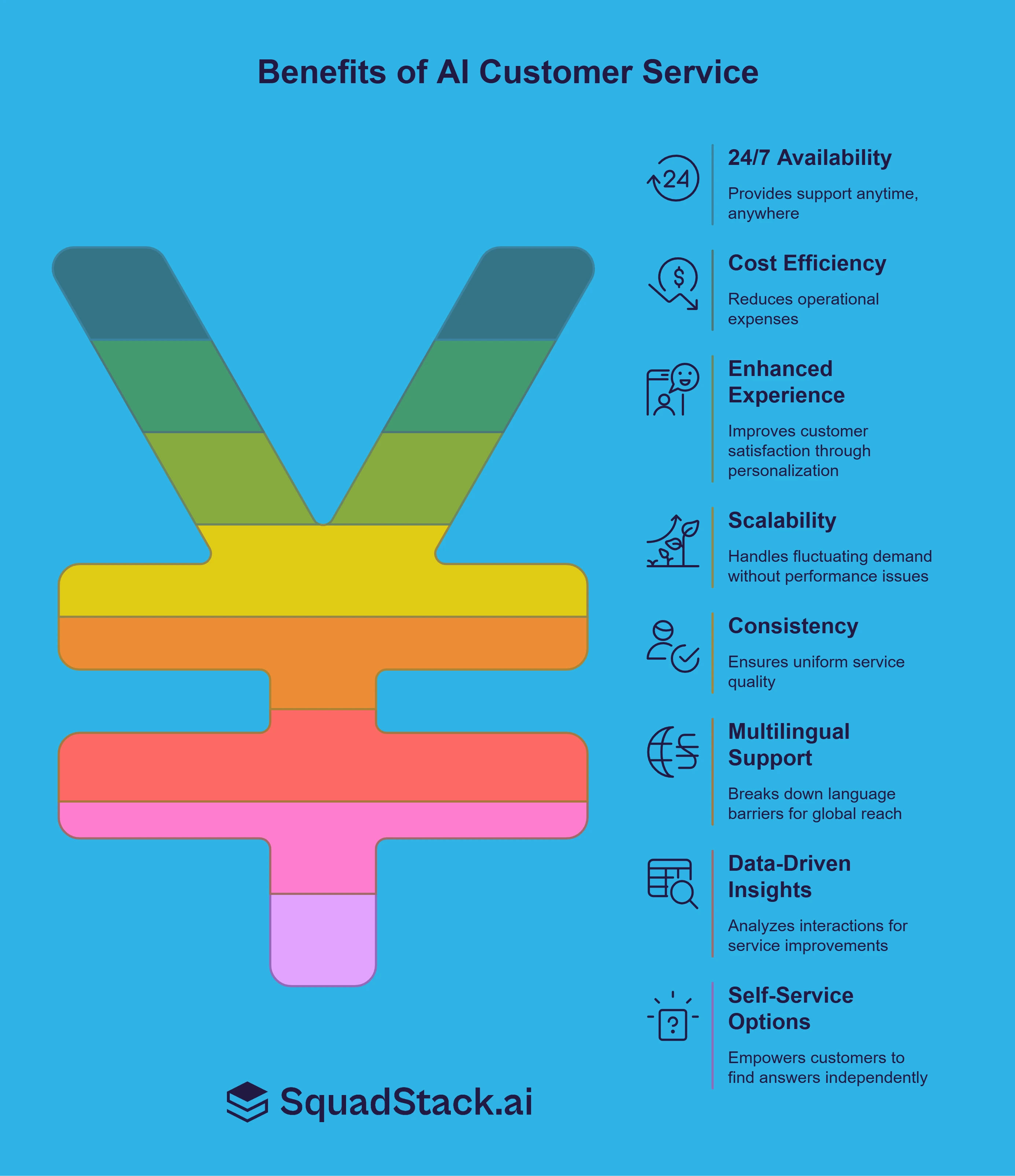
24/7 Availability and Instant Response Times
AI-powered chatbots and virtual assistants can provide round-the-clock support, ensuring customers receive assistance whenever they need it, regardless of time zones or business hours. The always-on nature of AI customer service fundamentally changes customer expectations and satisfaction. Instant response times eliminate the frustration of waiting in queues or navigating complex phone menus. Customers receive assistance within seconds of initiating contact. Even for complex issues that require human intervention, AI can gather relevant information, set appropriate expectations, and ensure smooth handoff to humans.
Global businesses particularly benefit from the round-the-clock availability of AI customer service. Companies operating across multiple time zones no longer need to maintain expensive 24/7 staffing arrangements. A single AI customer service implementation serves customers worldwide, communicating in their preferred languages and respecting cultural nuances.
Cost Efficiency
Automating routine tasks and inquiries with AI reduces the need for large customer service teams, lowering operational costs while maintaining service quality. Financial benefits are among the most compelling reasons organizations invest in AI customer service. Agent costs decrease substantially as AI customer service handles routine inquiries that would otherwise require human agents. Industry data suggests that 60-80% of customer service interactions involve repetitive questions with straightforward answers. By automating these interactions, companies redeploy human agents to handle complex, high-value cases that require empathy, creativity, and problem-solving skills.
Enhanced Customer Experience and Satisfaction
Many customers prefer interacting with well-designed AI customer service systems over human agents for routine matters. Personalization capabilities represent a significant advantage of AI customer service. These systems access complete customer histories instantly, providing contextually relevant responses based on previous interactions, purchase history, and preferences. Human agents, even talented ones, cannot match this level of instant, comprehensive knowledge.
Scalability and Handling Peak Demand
AI systems can easily scale to handle increasing volumes of customer inquiries during peak times without compromising performance. Seasonal businesses and those experiencing rapid growth face significant challenges scaling traditional customer service operations. AI customer service solutions eliminate these concerns entirely. Whether handling 100 or 100,000 simultaneous conversations, AI systems maintain the same performance.
Consistency in Service and Multilingual Support
AI ensures consistent responses to customer queries, reducing the risk of human error and maintaining a uniform standard of service. AI-powered tools can communicate in multiple languages, breaking down language barriers and enabling businesses to serve a global customer base.
Data-Driven Insights
AI can analyze customer interactions to identify trends, pain points, and areas for improvement, helping businesses refine their products and services.
Enhanced Self-Service Options
AI-driven knowledge bases and FAQs empower customers to find answers independently, reducing the need for direct support and improving customer satisfaction.
Top Examples of AI in Customer Service
90% of customers say they would re-engage with a brand after a positive customer experience. Companies don’t just improve their support, they elevate their entire customer experience using AI-powered customer service solutions and software. Top AI customer service examples demonstrate how AI transforms customer service across various industries.
By adopting these AI-driven solutions, businesses can meet and exceed customer expectations in today’s competitive landscape. Here are some top examples of AI in customer service that showcase its potential:
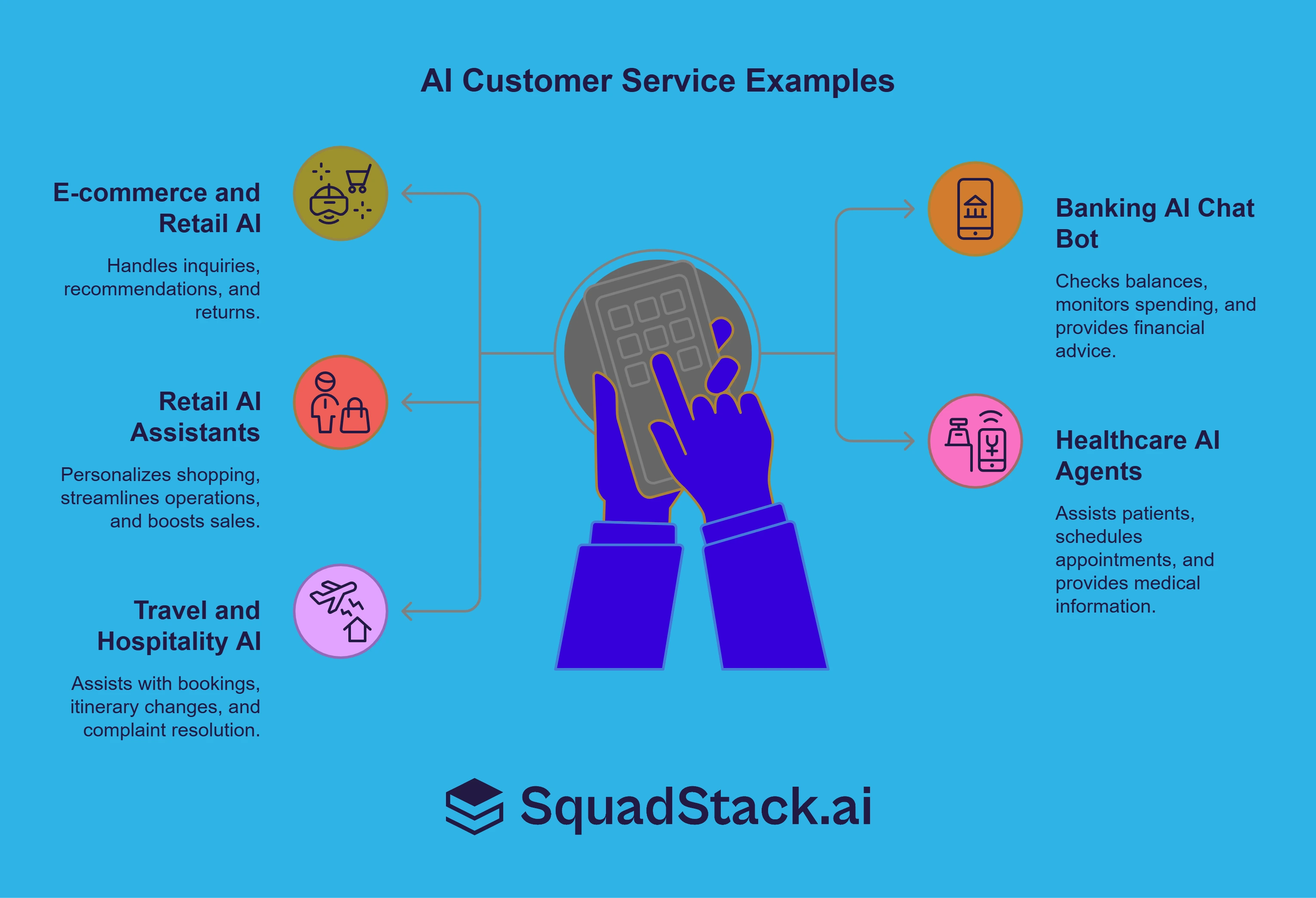
E-commerce and Retail AI Customer Service Assistant
Retail businesses use AI customer service to handle massive volumes of customer support inquiries during peak shopping seasons. They provide personalized product recommendations, assist with order tracking, process returns, and answer product questions.
Virtual in-app AI Voice customer service Assistants let customers visualize products before purchase, reducing return rates. Intelligent recommendation engines analyze customer data to suggest appropriate sizes, addressing a major pain point in online apparel shopping.
Banking AI Chat Bot Customer Service & Voice Bots
AI-driven assistants that help customers check balances, monitor spending, and get personalized financial insights in banking systems. AI-powered chatbots and voice bots are used in the banking industry to improve customer interactions, efficiency, and overall customer experience.
Key Features of Banking AI Chatbots and Voice Bots
- 24/7 Customer Support: Provide instant assistance for account inquiries, transaction details, and FAQs.
- Account Management: Allow customers to check balances, view transaction history, and transfer funds.
- Fraud Detection and Alerts: Monitor transactions in real time and notify customers of suspicious activity.
- Personalized Financial Advice: Offer tailored savings, investments, and loans recommendations.
- Loan and Credit Card Assistance: Help customers apply for loans, check eligibility, and manage credit card payments.
Retail AI Assistants
Retail AI assistants are transforming the shopping experience by providing personalized, efficient, and interactive support to customers. These AI-driven tools, including chatbots, virtual assistants, and voice bots, are helping retailers enhance customer engagement, streamline operations, and boost sales.
Healthcare Customer Service AI Agents
Healthcare customer service AI agents are intelligent systems designed to assist patients, healthcare providers, and other stakeholders in managing inquiries, scheduling appointments, providing medical information, and streamlining administrative tasks. These AI agents leverage natural language processing (NLP), machine learning (ML), and other advanced technologies to deliver efficient, personalized, and accurate support in the healthcare industry.
Key Features of Healthcare Customer Service AI Agents:
Appointment Scheduling and Reminders:
- Automate appointment booking, rescheduling, and cancellations.
- Send reminders via SMS, email, or voice calls to reduce no-shows.
Patient Triage and Symptom Checking:
- Use AI-powered chatbots to assess symptoms and guide patients to the appropriate level of care (e.g., urgent care, primary care, or emergency services).
- Provide preliminary health advice based on input symptoms.
Travel and Hospitality AI Customer Service
Travel companies leverage AI customer service for booking assistance, itinerary changes, travel recommendations, and complaint resolution. AI travel agents can search thousands of options instantly, finding optimal combinations of flights, hotels, and activities based on customer preferences and budget constraints.
Hotel chatbots handle pre-arrival questions, room service orders, concierge requests, and post-stay feedback collection. This AI customer service capability enhances guest experiences while reducing front desk workload, allowing staff to focus on in-person service excellence.
Best Practices for Implementing AI in Customer Service
Implementing AI carefully in customer service is essential to enhance efficiency, improve customer satisfaction, and reduce costs. Companies integrate AI into customer support strategy by following best practices, making clear support objectives, choosing the right support AI tools, ensuring data quality, and combining AI with human oversight.
Making Clear Customer Support Objectives
The use cases and objectives for the customer should be clear when selecting or implementing AI in customer support. Whether a chatbot or a voice AI agent is chosen depends on the use case. If the customer aims to drive sales, a fully trained selling agent should be selected.
Choosing the Right Customer Support AI Tools
When selecting or implementing AI in customer support, it is essential to have a clear understanding of the use case and objectives. The choice between a chatbot or a voice AI agent depends on the specific needs of the business. Let us suppose if the goal is to handle basic queries and provide instant responses, a chatbot may be the ideal solution. If the objective is to drive sales or manage complex customer interactions, a fully trained voice AI agent should be selected.
Combining AI with Human Oversight
AI-powered customer support tools can enhance efficiency and scalability, but human oversight remains crucial to ensure accuracy, personalization, and optimal customer experience.
- Handling Complex Queries: While AI can manage routine interactions, human agents can intervene in cases requiring emotional intelligence or nuanced decision-making.
- Continuous Learning & Improvement: AI models should be regularly updated and refined with insights from human agents to enhance performance.
- Seamless Collaboration: AI can assist human agents by providing real-time recommendations, automating repetitive tasks, and ensuring data consistency.
Proper Training of AI Models Effectively
To ensure AI models perform as per requirements in customer support, proper training is essential. Effective training enhances accuracy, adaptability, and overall efficiency.
- Quality Data Selection: AI models should be trained on high-quality, diverse, and domain-specific data to improve contextual understanding.
- Continuous Learning: Regular updates and training with new customer interactions can help AI adapt to evolving needs and scenarios.
- Testing & Optimization: AI models should be rigorously tested for accuracy, bias, and response effectiveness before deployment.
How Can AI Be Used in Customer Service?
According to a report by Gartner, by 2025, 80% of customer service organizations will use AI to enhance their operations. Companies like Amazon, Sephora, and H&M already use AI solutions to deliver faster, more innovative, and real-time customer experiences. Top AI technologies used in customer service include Natural Language Processing (NLP), Machine Learning (ML), Speech Recognition, Voice Assistants, Sentiment Analysis, Robotic Process Automation (RPA), and AI-powered Knowledge Bases. Check how AI is used in customer service, backed by real-world examples and research.
Personalized Customer Experiences
Suppose an AI agent uses customer data and trends to add food for customers in a food-ordering app. Analyzing customer data and predicting their needs creates personalized experiences. This level of personalization can significantly enhance customer satisfaction and loyalty.
Benefits of using AI for Personalized Customer Experiences
- Increased Engagement: Personalized experiences are more likely to engage customers.
- Higher Conversion Rates: Tailored recommendations can lead to more sales.
- Improved Customer Loyalty: Customers are more likely to return to a brand that understands their needs.
Sentiment Analysis and Emotion AI
Sentiment analysis and Emotion AI are powerful tools that allow businesses to understand and respond to customer emotions. Companies can use these technologies to analyze text, voice, and facial expressions to improve customer sentiment.
How Sentiment Analysis Works
AI algorithms analyze customer feedback, reviews, and interactions to determine emotional tone (positive, negative, or neutral).
Benefits of Sentiment Analysis and Emotion AI
- Improved Customer Satisfaction: Addressing negative sentiments in customers can improve customer satisfaction.
- Enhanced Brand Reputation: Proactively managing customers' sentiment can enhance brand reputation.
- Data-Driven Decisions: Sentiment analysis provides valuable insights for decision-making.
Automated Ticketing & Routing For Customer Support
AI can significantly enhance customer service in e-commerce and other industries by automating routine tasks, improving efficiency, and providing a better customer experience. Here’s how AI can be used, especially in scenarios like image uploads and other repetitive processes:
- Image Upload Automation: AI agents can ask customers to automatically streamline the process of uploading product images.
- Chatbots for Customer Queries: AI-powered agents like SquadStack's Humanoid Agent can handle common customer inquiries, such as order status, return policies, or product details, freeing up human agents for more complex issues.
- Order Processing: AI can automate order confirmation, tracking updates, and even handle returns or refunds by following predefined rules.
AI-Powered Self-Service Portals
AI-powered self-service portals transform how businesses interact with customers by enabling them to resolve issues, access information, and perform tasks independently without direct human assistance. These portals use AI technologies like Natural Language Processing (NLP), machine learning, and automation to provide personalized experiences to customers.
AI for Quality Assurance & Agent Coaching
Quality assurance is essential for any business relying on telecalling and customer interaction. As automation and AI technologies continue to evolve, SquadStack has developed an AI-powered continuous quality monitoring process to enhance the efficiency, accuracy, and reliability of telecalling operations. With AI quality monitoring systems, Businesses can achieve higher quality telecalling interactions, reduced costs, and improved customer experiences.
Choosing the Right AI Customer Service Platform
Selecting the optimal AI customer service solution requires careful evaluation of multiple factors aligned with your business needs, technical environment, and strategic objectives.
Essential Features and Capabilities
You need to evaluate the quality of natural language understanding, which is the foundation of effective AI customer service. Test platforms with real customer inquiries from your business, assessing accuracy, contextual understanding, and the ability to handle your industry's specialized terminology.
Integration Capabilities
Integration capabilities determine how well AI customer service connects with your existing technology stack. Verify compatibility with your CRM, helpdesk software, knowledge management systems, and other essential tools.
Multichannel Customer Support
Multichannel support ensures consistent AI customer service across website chat, mobile apps, messaging platforms, voice calls, email, and social media.
Vendor Evaluation Criteria
Assess vendor stability and track record. How long have they been in the AI customer service market? What's their customer retention rate? Do they have experience in your industry? Request case studies and customer references similar to your business size and use case.
Evaluate support and training offerings. Even the best AI customer service platform requires ongoing support, updates, and optimization. Ensure vendors provide comprehensive training, dedicated support resources, and regular platform updates incorporating the latest AI advances.
Why SquadStack’s AI Voice Agent Leads the Future of AI Customer Support
Customer support is no longer just about resolving tickets, but it’s about delivering measurable business outcomes at scale. SquadStack’s AI Voice Agents are built on real conversational intelligence and workflow orchestration, enabling enterprises to transform customer interactions into revenue-generating opportunities.
Backed by millions of real conversations and enterprise deployments, SquadStack combines voice AI, human-in-the-loop learning, and vertical-specific intelligence to deliver speed, accuracy, and measurable ROI.
%2520(4).jpeg)
Proven at Massive Scale
SquadStack’s AI systems are trained and optimized on real-world operational data—not on simulated datasets enabling consistent performance across industries such as BFSI, brokerage, and consumer services.
- 1M+ daily customer interactions handled
5M+ hours of outcome-tagged conversations analyzed - 50+ enterprise customers served
- Languages supported: Hindi, English, Tamil, Telugu, Kannada, Marathi
This scale ensures the AI continuously learns from real customer intent, improving resolution quality, personalization, and business outcomes.
Industry-Leading Voice Performance
Customer experience starts with natural, responsive conversations. SquadStack’s voice AI is engineered for real-time engagement with benchmarked audio quality and latency.
- ≤ 0.8s median voice latency
- 4.23 MOS voice quality score
- High conversational fluidity across multilingual interactions
This enables interactions that feel human-like, reducing drop-offs and improving trust during critical conversations.
Revenue-Focused Engagement Outcomes
Unlike traditional support systems focused only on resolution, SquadStack’s AI Agents are optimized to drive measurable revenue impact.
- 90%+ lead connectivity in outbound funnels
- 40% higher conversion rates
- ₹500 Cr+ monthly loan disbursals supported
- 50K+ brokerage accounts opened monthly
By combining intent detection, contextual handling, and workflow orchestration, the AI converts interactions into business value.
Cost Efficiency and Customer Acquisition Impact
Operational efficiency is a key differentiator. SquadStack’s AI-driven automation reduces acquisition costs while maintaining performance quality.
- 2–3× lower customer acquisition cost (CAC)
- Up to 70% reduction in operational costs
This allows enterprises to scale engagement without scaling headcount.
Built for Enterprise-Grade Support Transformation
SquadStack’s AI Agent isn’t just automation; it’s a future-ready customer engagement infrastructure that blends AI and human agents with workflow orchestration into one system. This unified approach delivers:
- Hyper-personalized journeys
- Continuous learning from outcomes
- Seamless scalability across campaigns
- Data-driven optimization and insights