.svg)

Contact centers face long call queues, scripted responses, and repetitive queries. But today's customers want answers on the first try, in their language and with a human touch. That’s where AI voice agent companies help enterprises convert inconsistent calling experiences into a competitive advantage.
Recent market data underscores this shift, projecting that the global Voice AI Agents market will grow from USD 2.4 billion in 2024 to USD 47.5 billion by 2034, at a 34.8% compound annual growth rate between 2025 and 2034.
AI-based Voice agents are designed to manage emotionally intelligent conversations, freeing up human agents while enhancing customer satisfaction. They are built on a powerful combination of automatic speech recognition (ASR), natural language processing (NLP), large language models (LLMs), and expressive text-to-speech (TTS) technology.SquadStack’s AI Voice Agent is built to own the entire customer lifecycle, driving higher connectivity, better conversions, and lower costs for human-like conversations at large scale.
✔ 400K+ calls/day
✔ 90%+ connectivity
✔ 40% more conversions
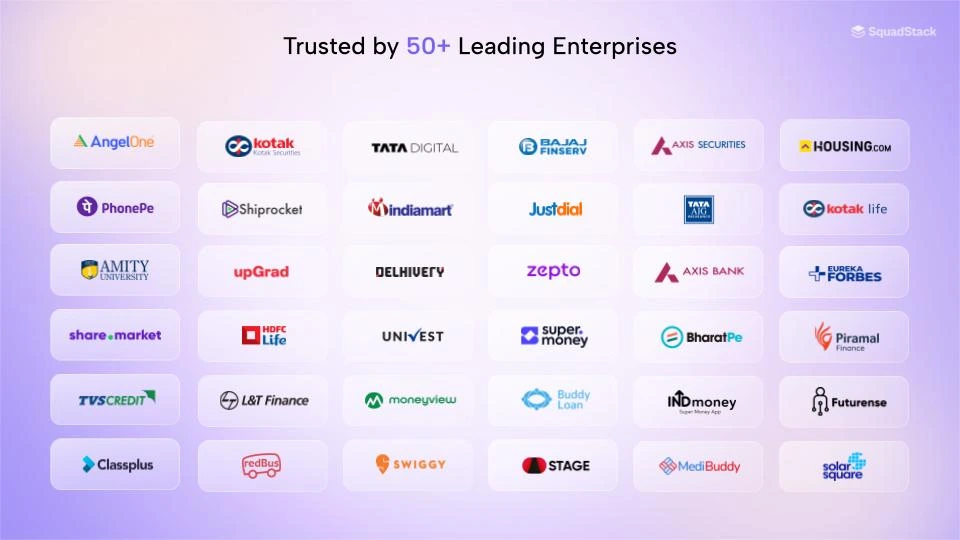
✔ Trusted by 50+ enterprises
Check the Calls below to Experience Yourself
Build, Test, and Deploy AI Voice Agents in Minutes with SquadStack.ai


SquadStack’s AI Voice Agent That Delivers Outcomes, Not Just Conversations
Built for India, SquadStack AI voice agents manage high-volume inbound and outbound calls with natural, human-like conversations across Hindi, Tamil, Telugu, Bengali, Marathi, Punjabi, Hinglish, and more. SquadStack’s AI Voice Agent is designed to deliver measurable business results and automated conversations to drive higher conversions and faster sales cycles. It provides greater connectivity and higher conversion rates. SquadStack’s AI-based Voice Agent drives consistent execution of leads across the full customer lifecycle, using coordinated outreach across voice, WhatsApp, SMS, and email to eliminate funnel drop-offs.
What this delivers:
- Full-funnel ownership with zero drop-offs
- Enterprise-level execution at large scale
- It can automate the entire workflow, optimised to move leads forward and eliminate revenue leakage at scale.
Designed for Outcomes, Not Just Conversations
SquadStack is built with outcomes as the primary KPI, not call duration or talk time.
The platform continuously optimises conversations using real sales data, intent signals, and lifecycle context. Every interaction is designed to drive the following best action in the funnel.
- Conversion-first workflows powered by real enterprise sales data
- Real-time optimisation of pitch, timing, and follow-up strategy
- Continuous learning from millions of real customer outcomes
Examples from Real Deployments:
Amity University improved admissions outcomes by using AI-led outreach and structured follow-ups, achieving 70% connectivity and 2× conversions during peak enrollment periods
Ownership of the Entire Customer Lifecycle (From Acquisition to Renewal)
SquadStack reaches out to customers even after the first call to manage outcomes throughout the entire customer journey. Every touchpoint, i.e., WhatsApp, Email, SMS, is connected, contextual, and optimised for progression.
- Lead qualification, follow-ups, conversion, and retention
- Unified context across Voice, WhatsApp, SMS, and CRM
- Lifecycle-aware messaging at every stage
- No leads fall through gaps between teams, tools, or channels.
SquadStack’s AI + Human AI Voicebot (Best of Automation and Expertise)
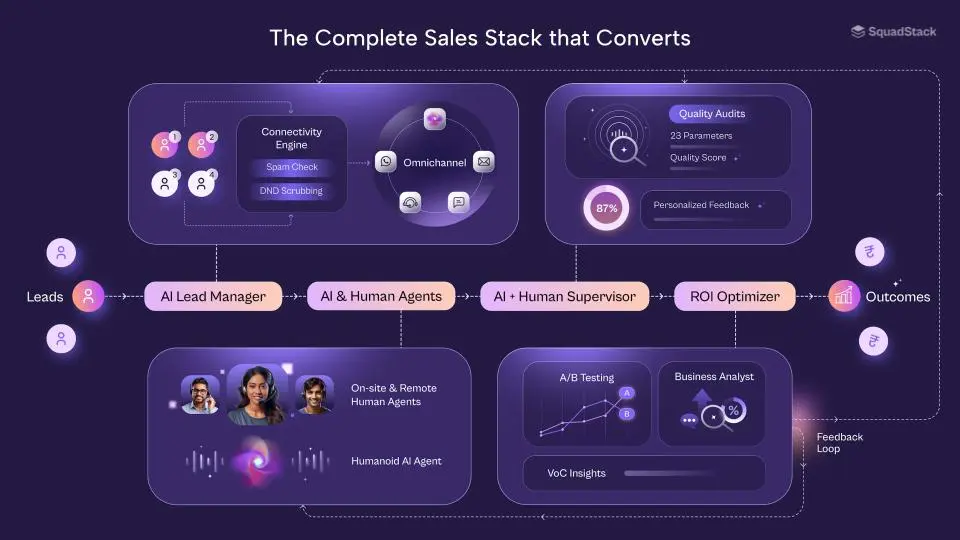
SquadStack combines AI-led voice automation with human expertise for critical moments. AI handles high-volume outreach with speed and efficiency, while trained human agents seamlessly take over when judgment or complexity is required. This hybrid model ensures reliability, trust, and consistent performance at enterprise scale.
- AI-driven prioritisation, retries, and personalisation
- Instant live handoff to trained human agents
- Context transfer across AI and humans
Eliminating Revenue Leakage End-to-End
Revenue leakage happens when leads are missed, delayed, or poorly followed up. SquadStack’s AI Voice Agent identifies and closes these gaps across the entire funnel.
Every lead is tracked, nurtured, and pushed toward an outcome.
- AI-led lead prioritisation and retry logic
- Automated follow-ups across multiple channels
- CRM-linked outcome tracking with complete visibility
AI Voice Agent for Outcome-Driven Solutions Across Industries
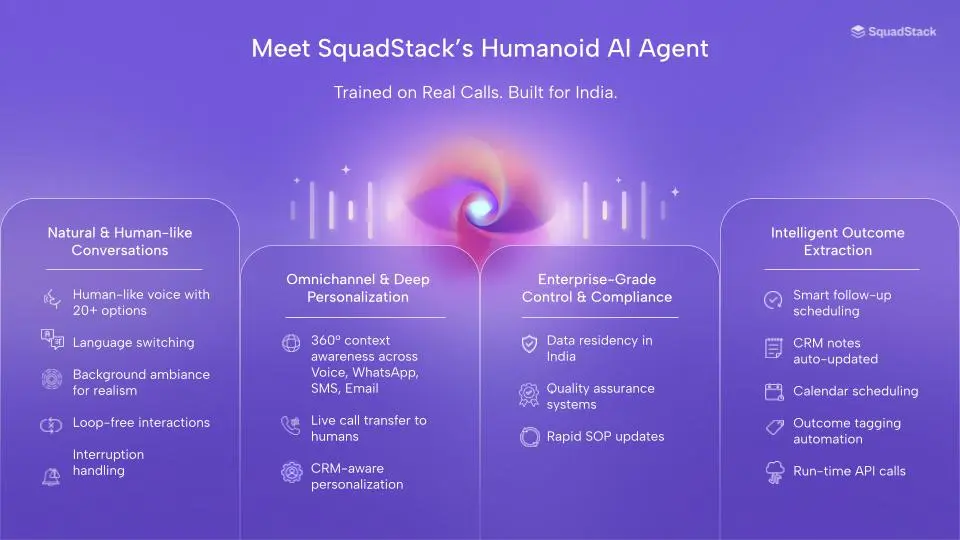
Enterprises adopt SquadStack's AI-based contact center agent to improve fragmented calling systems without the high operational costs of traditional call centers across India. Every conversation on the platform is logged and traceable, enabling BFSI teams to grow volumes without increasing operational risk. Built with ISO 27001 and SOC 2 Type II compliance embedded across every layer of the platform, ensuring robust data protection. Trained on real calls and designed for India, SquadStack’s Humanoid AI Agent delivers natural, human-like conversations, omnichannel continuity, and intelligent outcome extraction.
AI Voice Agent for BFSI Sector (Lending, Insurance, Cards, Collections)
SquadStack Voice AI agent is built for BFSI environments for compliance, scale, and outcomes. The platform can handle high-volume customer outreach campaigns while maintaining regulatory compliance as per RBI norms. AI-powered voice workflows ensure faster response times, higher connectivity, and structured follow-ups.
Lending (Loans, Credit, BNPL)
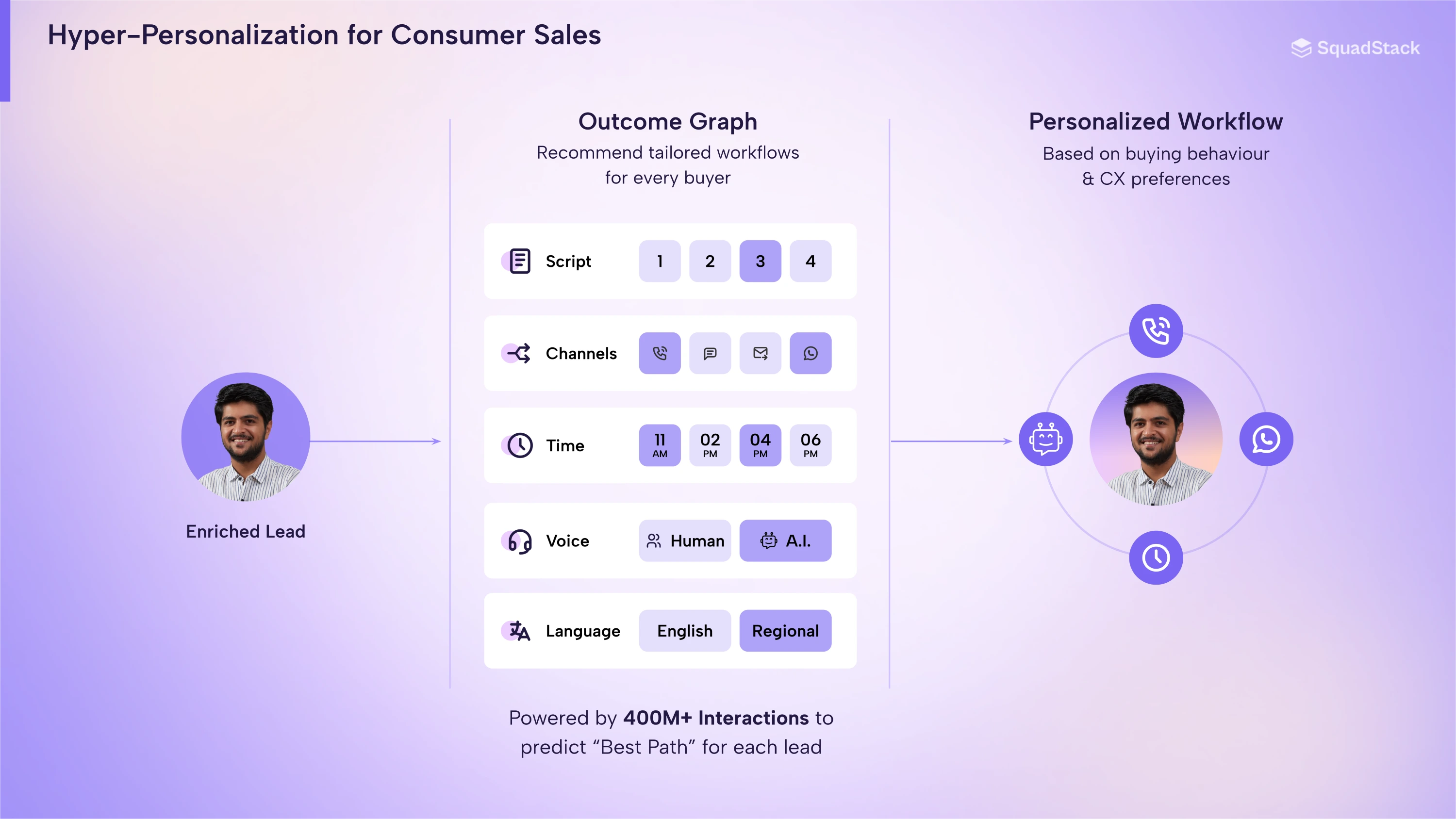
SquadStack can automate lead qualification, sourcing, and follow-ups across lending companies with its AI Voice automation Agent. High-intent borrowers are identified and contacted faster to reduce drop-offs. AI adapts scripts based on loan type, eligibility, and customer intent. This results in higher disbursal velocity and lower cost per acquisition.
%2520(2)%2520(1).webp)
Insurance Industry (Life, Health, General)
AI-led voice workflows automation includes policy sales, renewals, and cross-sell opportunities. Multilingual conversations in Hindi, English, and all indian languages improve reach across Tier 2 and Tier 3 markets of India. Structured reminder and follow-up flows ensure renewals are not missed, with human agents stepping in for complex objections or high-value policies.
Cards & Early-Bucket Collections
Tone-controlled AI outreach ensures compliant and empathetic conversations. Risk-based logic determines retry cadence and escalation.
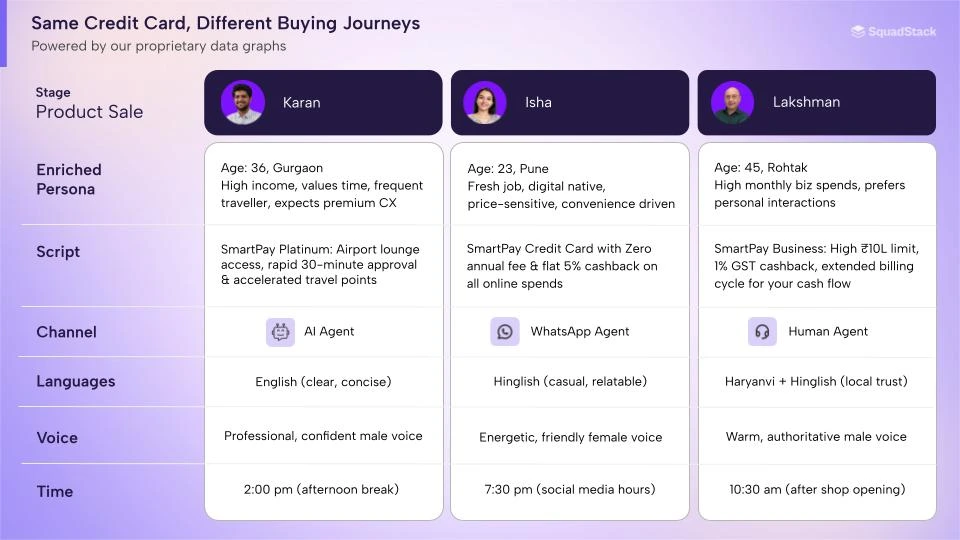
Non BFSI Industry Use Cases for SquadStack AI Voice Agent (Education, Healthcare, E-commerce, Logistics, Automotive)
SquadStack AI Voice Agent can adapt to Indian non-BFSI industries with long consideration cycles and high lead volumes. AI ensures fast first contact and consistent follow-ups across channels. Conversations are personalised using CRM and customer context. This eliminates drop-offs after the first interaction. Outcomes are tracked across the entire customer journey. Teams achieve higher conversions with fewer resources.
Education & EdTech Industry
AN AI-based phone call agent can handle lead qualification, counselling, and admissions follow-up calls from students. Students are re-engaged across voice and WhatsApp until decision closure. Counsellors receive only high-intent conversations. Enrollment conversions improve significantly during peak seasons.
%2520(11).webp)
Healthcare Industry
Appointment reminders and confirmations reduce no-shows. Follow-ups are automated post consultation or diagnostics. Patients receive timely communication without manual effort. Clinics improve operational efficiency and patient experience.
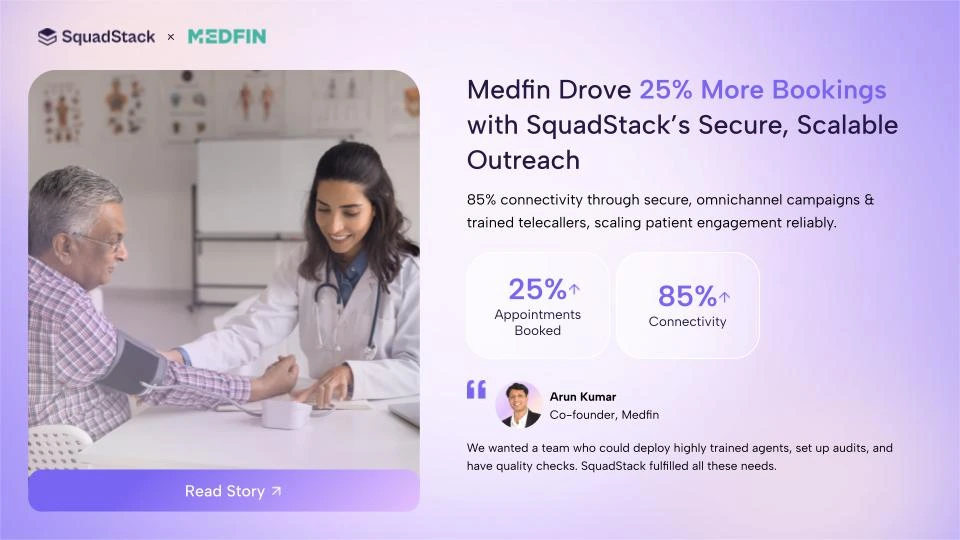
Real-World Impact: Medfin
Medfin achieved 25% more appointment bookings through secure, omnichannel campaigns with CRM-aware personalization:
- 25% Increase in Appointments Booked: CRM-driven targeting of high-intent patients
- 85% Connectivity Rate: Smart routing and retries based on customer CRM profile
- Enterprise-Grade Security: PII redaction and compliance across all CRM touchpoints.
E-commerce, Logistics & Automotive Industry
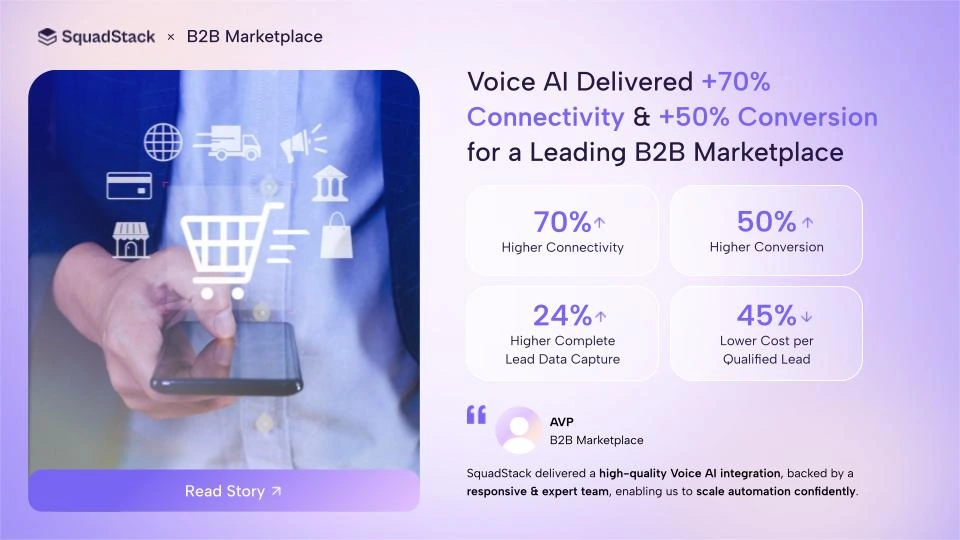
AI verifies orders, qualifies leads, and drives onboarding. Missed calls are recovered through automated retries and messaging. Customers stay informed at every stage. Brands see improved fulfillment and conversion rates.
SquadStack's AI Voice Agent Capabilities at Enterprise Scale
SquadStack's AI Voice agent platform brought a shift in contact center operations, delivering hyper-personalized customer journeys through advanced voice AI technology.
Human-Like Conversations: Voice Quality & Natural Interactions
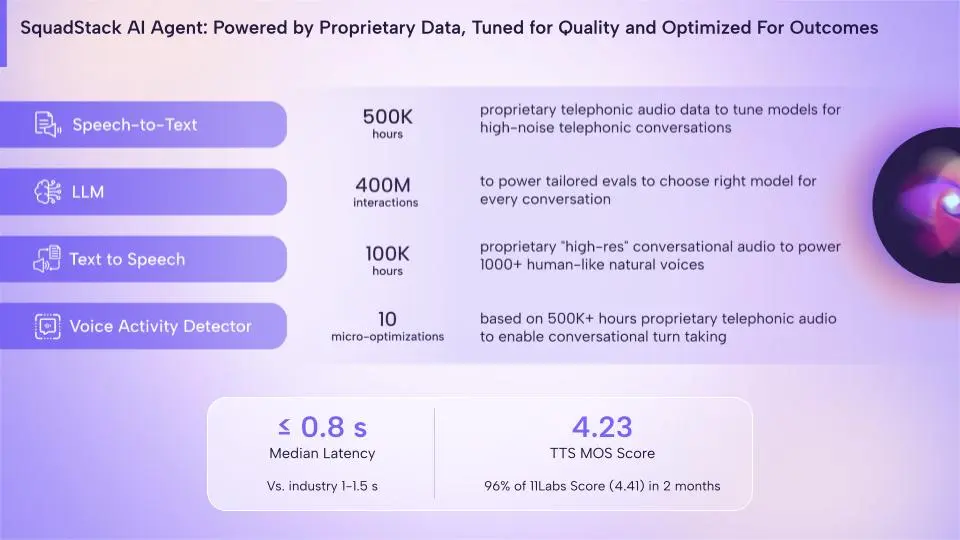
The foundation of effective AI voice agent is in its ability to replicate natural human conversation patterns. SquadStack's AI voice technology is trained on 10 million hours of real Indian telephonic audio data, enabling superior performance in high-noise environments.
Key Capabilities of SquadStack Voice Based AI Agent For Business:
- 100+ human-like voice options across gender, tone, and accent variations to match brand personality and customer demographics.
- Intelligent interruption handling that recognizes when customers interject and adapts seamlessly.
- Language switching capability to match customer preference in real-time between English and regional Indian languages.
- Background ambiance integration that adds environmental realism (office sounds, traffic) to maintain authenticity.
Technical Performance Metrics of AI Based Bot
Speech Quality:
- 4.23 TTS MOS Score: Text-to-speech quality reaching 96% of the industry benchmark (4.41 iLabs Score) achieved within 2 months.
- ≤0.8s Median Latency: Significantly faster response time compared to industry standard of 1-1.5 seconds.
- Voice Activity Detector (VAD): 10+ micro-optimizations based on proprietary telephonic audio enabling natural conversational turn-taking.
Real-World Application: Stage Case Study
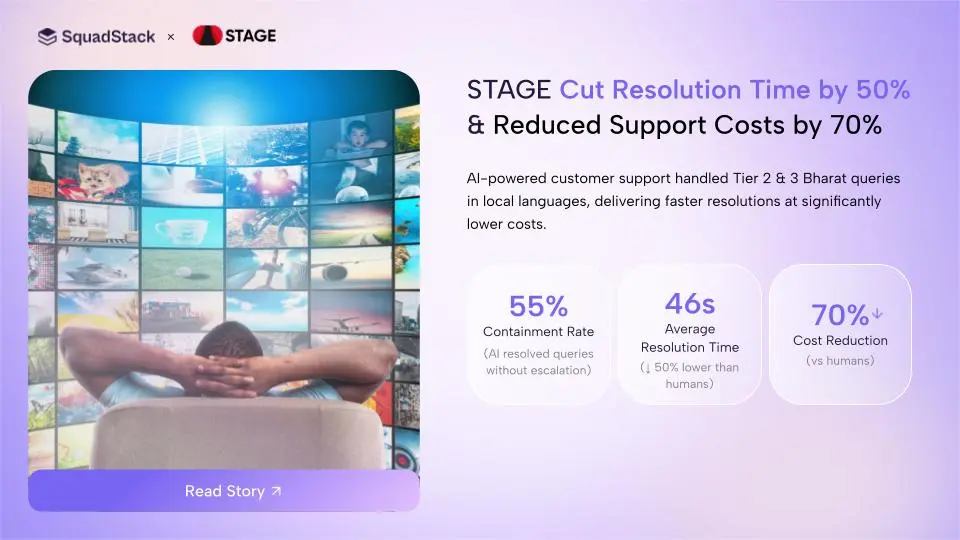
Stage, a customer support platform, deployed SquadStack's AI Voice agent for Tier 2 & 3 support in local Indian languages
|
Metric |
Result |
|
Containment Rate |
55% (resolved without escalation) |
|
Average Resolution Time |
46 seconds (50% faster than humans) |
|
Cost Reduction |
70% vs human agents |
Omnichannel Orchestration with Shared Context
Modern customers expect communication across preferred channels. SquadStack's omnichannel conversations engine ensures consistent, contextual engagement whether through voice, messaging, or email.
Supported Channels:
- Voice: AI voice calls with natural conversation capabilities
- WhatsApp: Conversational AI agents for real-time messaging engagement
- SMS: Transactional and campaign messaging with context awareness
- Email: Personalized outreach with campaign sequencing
- Live Agent Handoff: Real-time escalation to human agents with full conversation context preservation
Shared Context Architecture
All channels operate within a unified context framework that maintains customer information across interactions:
- 360° Context Awareness: Customer history, preferences, previous interactions, and outcomes tracked across all touchpoints
- Cross-Channel Personalization: Messages, tone, and approach dynamically adjusted based on channel and customer segment
- Smart Routing: Adaptive channel selection based on customer behavior patterns and channel efficacy metrics
- Consistent Brand Voice: Unified messaging and brand representation across voice, text, and email channels
Table: Sample Omnichannel Sequence Strategy
|
Sequence |
Channel |
Timing |
|
First Contact |
Voice Call |
Morning/Evening Peak |
|
Retry 1 |
|
Off-peak hours |
|
Retry 2 |
SMS |
Next business day |
|
Nurture |
|
Personalized cadence |
Classplus Success Story
Lead qualification at scale with 46,000+ demos booked at 87% connectivity with <5 minutes turnaround time through AI-led lead scoring and omnichannel follow-ups.
Analytics, Quality & Continuous Optimization For Local Indian Calls
SquadStack implements a multi-layered quality approach combining AI and human expertise across 23 quality parameters:
Performance Results:
- Sampling methodology combines human review (12% of calls) with AI analysis across all interactions
- Average quality score across audited campaigns: 97%
- Personalized coaching feedback provided to agents with specific improvement areas
A/B Testing and Optimization Engine
Continuous improvement is driven by data-backed experimentation:
A/B Testing Dimensions:
- Cadence Testing: Optimal contact frequency and retry patterns (1x daily, 2x daily, spaced retries)
- Messaging A/B Testing: Script variations, value proposition framing, objection handling language
- Timing Optimization: Conversion rate analysis by time of day, day of week, season
- Channel Mix Testing: Relative effectiveness of voice vs WhatsApp vs SMS vs email
- Voice Profile Testing: Impact of different voice characteristics on conversion
- Language & Tone Testing: English vs regional languages, formal vs casual approach effectiveness
- Omnichannel Sequencing: Testing touchpoint order and spacing for maximum conversion
Data-Driven Iteration: Every campaign automatically tests multiple variations, with winners scaled and losers discontinued within hours.
Advanced Analytics and Custom Dashboards
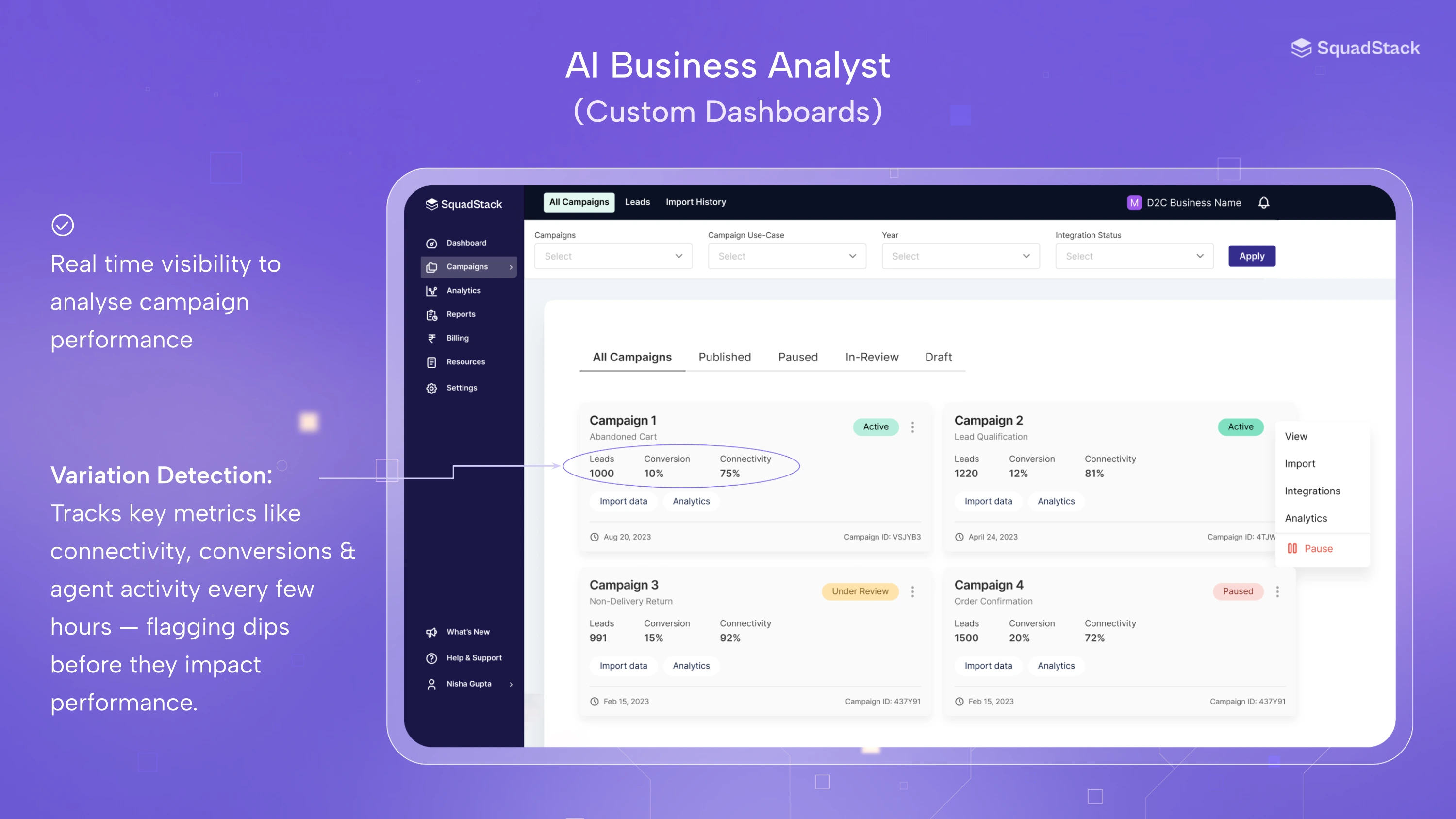
Real-time dashboards provide complete visibility into campaign performance:
Key Metrics Tracked:
|
Metric Category |
Tracked Metrics |
|
Connectivity |
Reach rate, answer rate, completion rate by channel |
|
Conversion |
Conversion rate, outcome achievement, funnel progression |
|
Quality |
Quality score, compliance adherence, customer satisfaction |
|
Agent Performance |
Handle time, containment rate, escalation rate |
|
Operational Efficiency |
Cost per contact, cost per conversion, campaign ROI |
|
Customer Experience |
CSAT, NPS, churn rate, repeat contact rate |
Comprehensive Metrics Tracking
Variation Detection: Algorithms automatically flag performance dips in connectivity, conversions, and agent activity every few hours, enabling rapid corrective action before campaigns are significantly impacted.
Continuous Improvement Workflow
- Campaign Launch: Design and deploy campaign with predefined A/B test variations
- Real-Time Monitoring: Continuously track metrics across all dimensions
- Anomaly Detection: Alert on unexpected performance variations
- VoC Analysis: Extract customer insights from call transcriptions and interactions
- A/B Result Analysis: Identify winning variations in messaging, timing, cadence
- Rapid Iteration: Scale winning variations, pause underperforming elements
- Knowledge Capture: Update scripts, FAQs, and training based on learnings
Competitive Intelligence Through Analytics
Delhivery, India's largest logistics network, reduced rider hiring costs by 70% through AI-led recruitment outreach with optimized messaging based on real-time analytics:
- 7 Minutes Turnaround Time: 95% faster than manual hiring processes
- 53 Seconds Average Handle Time: 45% faster than human recruiters
- 18% Qualification Rate: 10% higher than human performance
- 70% Cost Reduction: Per qualified lead generated
Enterprise Architecture & Support Infrastructure
SquadStack provides more than just technology but a complete squad of specialists ensures consistent performance:
- Success Manager: Owns end-to-end delivery and aligns outcomes to business goals
- Data Analyst: Tracks performance metrics and extracts insights to optimize funnel efficiency
- Team Leader: Oversees daily operations, manages agent performance, and ensures SLA adherence
- Quality Analyst: Reviews calls, flags deviations, and drives quality improvements
- Trainer: Continuously enables and updates the agent pool based on product and campaign needs
Enterprise-Grade Security & Compliance
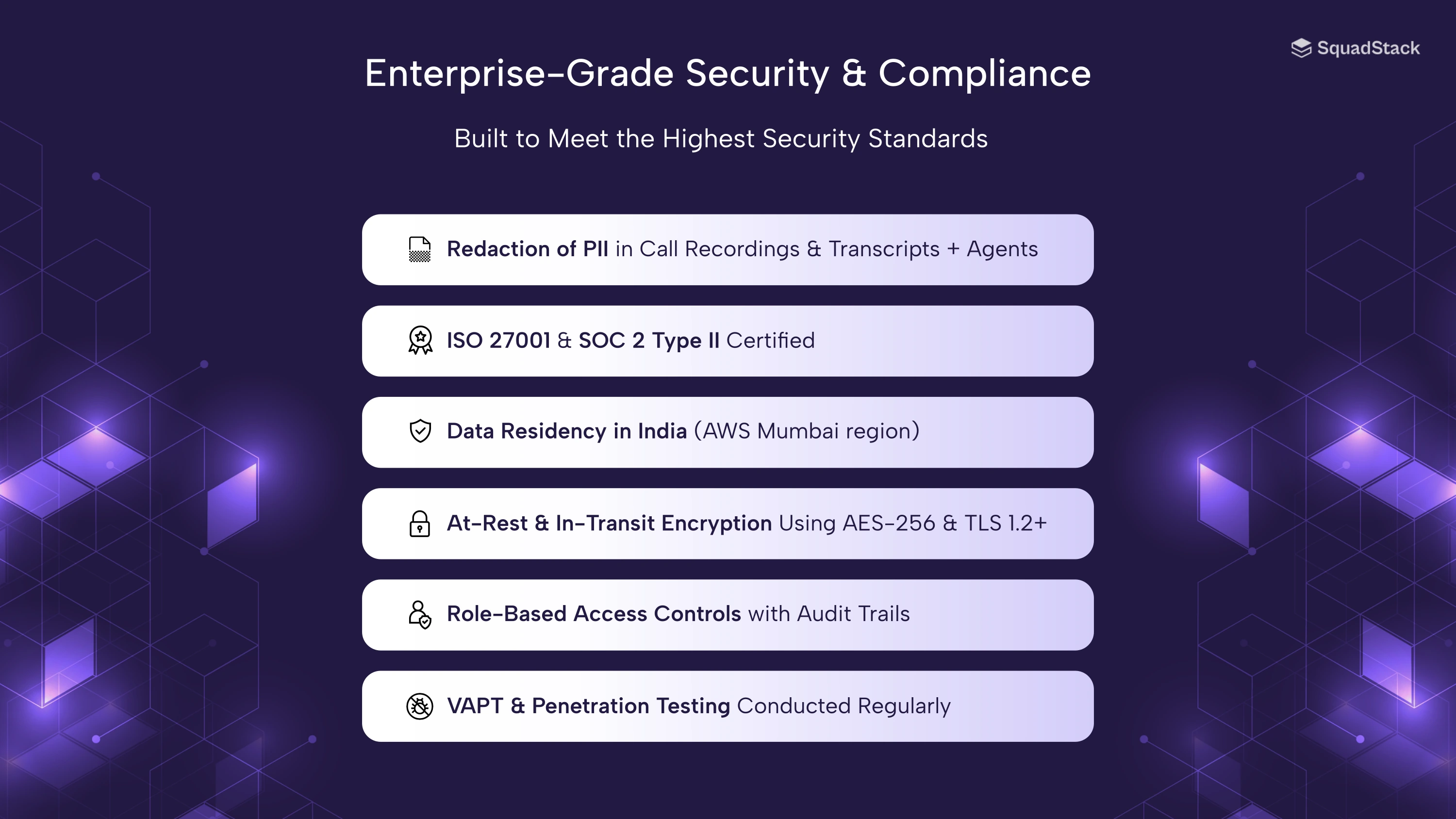
AI Voice and CX platform as enterprise-grade with strong security controls and broad compliance coverage. These controls apply across its Voice, SMS, and AI agent products to support regulated industries such as healthcare, government, and large enterprises.
- ISO 27001 & SOC 2 Type II Certified: International security standards compliance
- Data Residency in India: AWS Mumbai region ensuring regulatory compliance
- At-Rest & In-Transit Encryption: AES-256 encryption and TLS 1.2+ protocols
- PII Redaction: Automatic removal of personally identifiable information from call recordings and transcripts.