.svg)

With evolving customer needs in mind, businesses and organizations are seeking a faster and more intuitive way to connect and communicate with customers. The development of voice-enabled chatbots marks a trend in how businesses connect and communicate with customers and resolve support queries. However, the latest innovation in chatbots is voice chatbots, which are redefining how businesses connect and communicate on a large scale.
Voice-enabled chatbots allow users to communicate with the chatbot without typing. This provides conversations over the web, mobile, and on calls. However, with advances in artificial intelligence and natural language processing, voicebots can also offer intelligent responses to customer inquiries.
SquadStack’s in-app AI voice assistant helps customers to have smooth, intelligent conversations on websites, while its AI voice agents deliver high-quality, natural communication during customer voice calls. Built for real customer interactions, SquadStack ensures consistent, human-like engagement across both web and voice channels.
What Is a Voice-Enabled Chatbot?
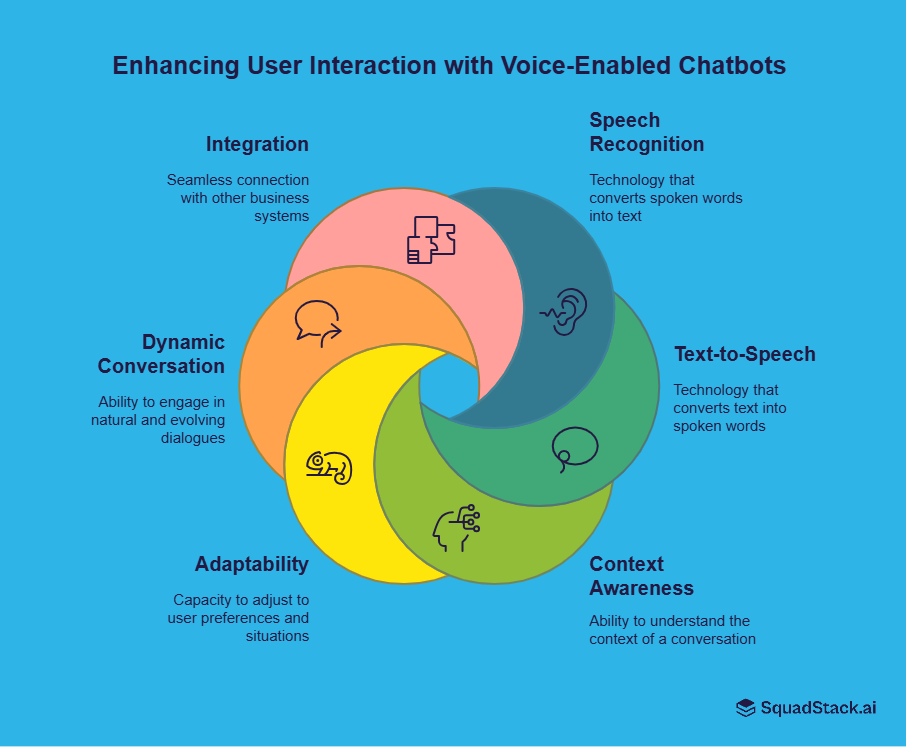
Voice-enabled chatbots enhance user interaction by allowing users to communicate through voice communication, utilising technologies such as speech recognition and text-to-speech. Instead of typing messages, users can speak naturally, and the chatbot responds with a synthesized human-like voice.
A voice-enabled chatbot is essentially a voice assistant that listens, understands, processes, and responds to spoken words. A voicebot differs from a traditional IVR in that it is a context-aware, adaptive, and dynamic conversational chatbot.
The contemporary Voice-enabled chatbot can:
- Understand different accents and languages
- Detect user intent and sentiment
- Respond in a natural, human-like voice
- Integrate with CRMs, telephony systems, and business tools
How Voice-Enabled Chatbots Work
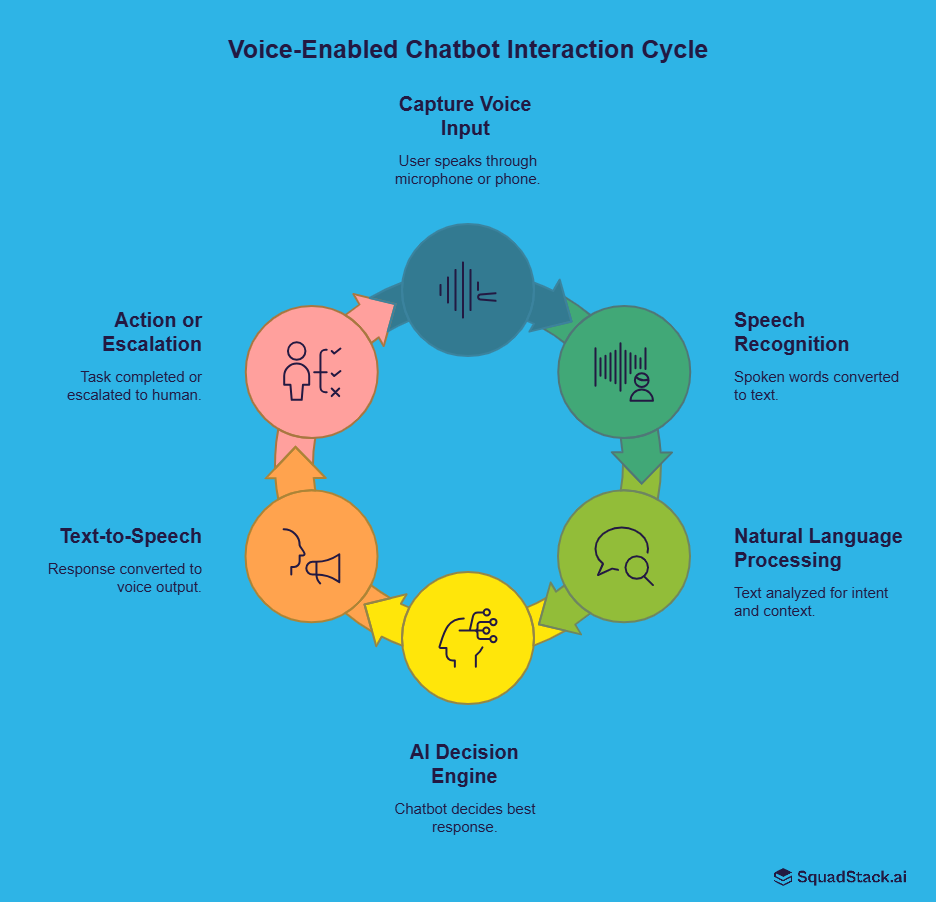
A voice-enabled chatbot operates multiple AI systems that work together in real time. Each stage plays a critical role in ensuring the conversation feels natural, accurate, and valuable to the user. Here’s a detailed breakdown of the entire process, from the moment a user speaks to the final response or action.
A voice-enabled chatbot works through a series of interconnected AI processes:
1. Voice Input Capture:
The process begins when a user speaks into a device—whether via a website microphone, a mobile app, or a phone call. The voice-enabled chatbot captures raw audio input in real time. At this stage, the system focuses on clarity, filtering out background noise and isolating the speaker’s voice. This step is especially important in real-world environments where calls may be affected by network fluctuations, ambient noise, or overlapping speech. Accurate voice capture ensures that everything the user says is transmitted cleanly to the next stage.
2. Speech Recognition (STT):
Once the voice input is captured, the speech recognition system—also known as speech-to-text (STT)—converts speech into text. This is not a simple transcription process. The system accounts for pronunciation differences, accents, speaking speed, pauses, and even incomplete sentences. Advanced voice-enabled chatbots are trained on real conversational data, enabling them to accurately interpret informal speech, regional phrases, and code-mixed language such as Hinglish. The output of this step is a clean, structured text version of the user's intended message.
3. Natural Language Processing (NLP):
After the voice is converted into text, Natural Language Processing comes into play. NLP allows the voice-enabled chatbot to understand meaning, not just words. The system analyzes the text to identify user intent (what the user wants), context (why they want it), and key entities such as names, dates, order numbers, or locations. For example, “I need to reschedule my appointment” is recognized as a scheduling intent, even if phrased differently. NLP ensures the chatbot understands language variations rather than relying on exact keywords.
4. AI Decision Engine:
Once the intent and context are clear, the AI decision engine determines the best following action. This is where business logic, workflows, and historical data come together. The voice-enabled chatbot decides whether to answer a question, fetch information, complete a transaction, ask a follow-up question, or route the call elsewhere. The decision engine considers factors such as user history, urgency, confidence level, and predefined rules to ensure the response aligns with both user expectations and business goals.
5. Text-to-Speech (TTS):
After the chatbot decides what to say, the response is converted from text to speech using text-to-speech (TTS) technology. Modern voice-enabled chatbots use natural-sounding voices with proper tone, pauses, and emphasis to avoid a robotic delivery. This step is crucial for creating a conversational experience that feels human and engaging. Advanced systems can also adjust voice tone based on the context—such as sounding more reassuring for support calls or more energetic during sales conversations.
6. Action or Escalation:
The final step is execution. The voice-enabled chatbot either completes the requested action—such as booking an appointment, providing information, or updating records—or escalates the conversation to a human agent when necessary. If escalation is required, the chatbot passes along full context, including the conversation history and detected intent, so the user does not need to repeat themselves. This ensures continuity and a smooth transition from AI to human support when complexity or sensitivity demands it.
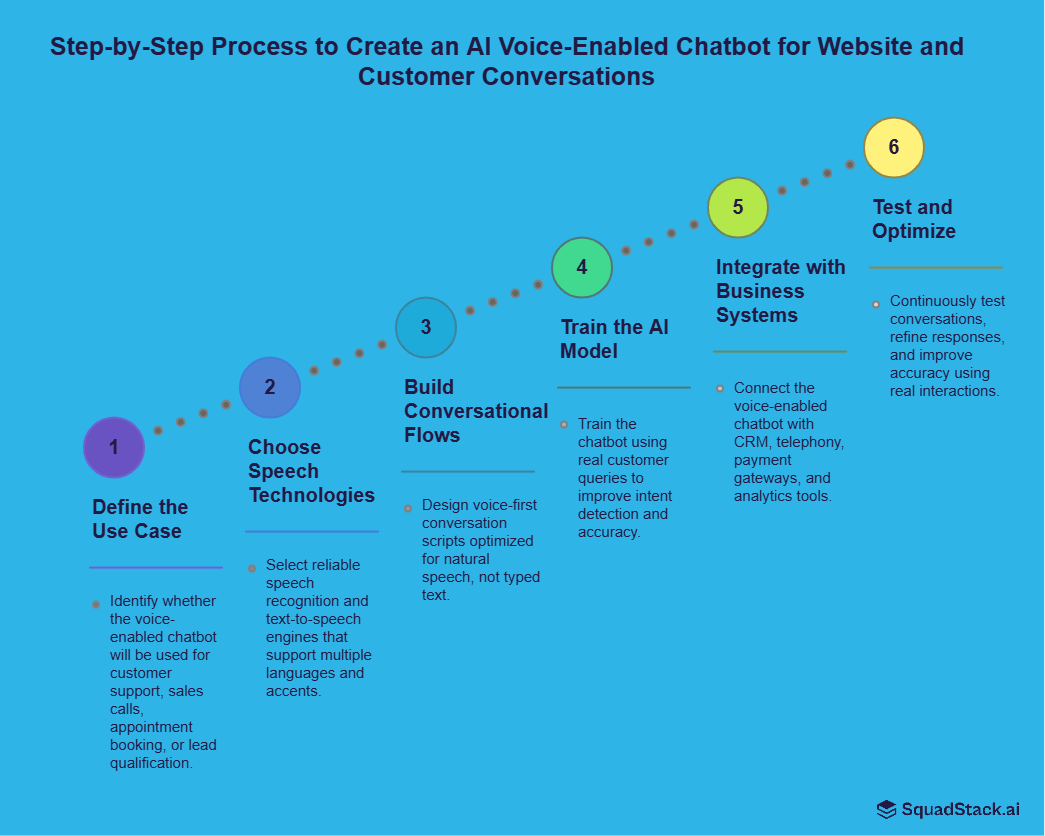
Step-by-Step Process to Create an AI Voice-Enabled Chatbot for Website and Customer Conversations
A Voice-Enabled Chatbot for website and customer interactions is developed using a structured AI development approach to ensure accurate voice recognition and interaction. The AI development approach involves identifying business cases for use in customer service, sales calls, and appointment scheduling. The approach includes implementing speech-to-text and text-to-speech systems to enable seamless voice interaction. AI models are trained on authentic customer inquiries to improve intent classification accuracy. The Voice-Enabled Chatbot is integrated with CRM and telecommunications modules to support comprehensive customer engagement.
Step 1: Define the Use Case
The first and most crucial step in building a voice-enabled chatbot is clearly defining its purpose. Businesses need to identify precisely where voice interactions add the most value—whether it is handling customer support queries, qualifying sales leads, booking appointments, or managing follow-ups. Each use case requires a different conversational approach, tone, and workflow. For example, a customer support voicebot focuses on problem resolution and clarity, while a sales voicebot prioritizes persuasion and intent detection. Clearly defining the use case helps avoid over-engineering and ensures the chatbot is built to solve real business problems rather than acting as a generic voice assistant.
Step 2: Choose Speech Technologies
Once the use case is defined, the next step is to select the appropriate speech technologies. A voice-enabled chatbot relies heavily on speech-to-text (STT) and text-to-speech (TTS) systems to function accurately. These technologies must be capable of handling natural speech, varied accents, and real-world audio conditions such as background noise or call distortions. Choosing speech systems that support multiple languages and dialects is critical, especially for businesses serving diverse user bases. Reliable speech technology ensures that user input is captured correctly and responses sound natural rather than robotic.
Step 3: Build Conversational Flows
Designing conversational flows for a voice-enabled chatbot is very different from creating text-based chat flows. Voice conversations should be natural, concise, and easy to follow. This step involves creating voice-first scripts that mirror how people speak in honest discussions, including pauses, clarifying questions, and confirmations. The chatbot should guide users smoothly without overwhelming them with long responses. Well-designed conversational flows also include fallback scenarios, such as handling unclear responses or rephrasing questions when the user hesitates or changes direction mid-conversation.
Step 4: Train the AI Model
Training the AI model is where a voice-enabled chatbot starts becoming truly intelligent. Instead of relying only on predefined scripts, the chatbot is trained using real customer queries, call recordings, and interaction data. This helps the system recognize different ways users express the same intent. Over time, the AI learns to detect patterns, improve intent classification, and respond more accurately. Continuous training ensures the chatbot adapts to new phrases, evolving customer behavior, and emerging use cases, making it more effective with each interaction.
Step 5: Integrate with Business Systems
For a voice-enabled chatbot to deliver meaningful outcomes, it must connect seamlessly with business systems. This includes CRM platforms, telephony infrastructure, payment gateways, scheduling tools, and analytics dashboards. Integration allows the chatbot to access customer history, update records in real time, and trigger automated workflows. For example, after a successful conversation, the chatbot can log call notes in the CRM, schedule a follow-up, or escalate the case to a human agent with full context. These integrations ensure the chatbot operates in the broader customer engagement ecosystem rather than in isolation.
Step 6: Test and Optimize
The final step is continuous testing and optimization. A voice-enabled chatbot improves significantly when exposed to real conversations. Businesses need to monitor call quality, accuracy, drop-off points, and user satisfaction. Testing helps identify issues such as misunderstood intents, unnatural responses, or unnecessary conversation loops. Based on these insights, conversational flows, AI models, and voice responses are refined. Regular optimization ensures the chatbot remains accurate, efficient, and aligned with changing customer expectations and business goals.
Future of Voice-Enabled Chatbots
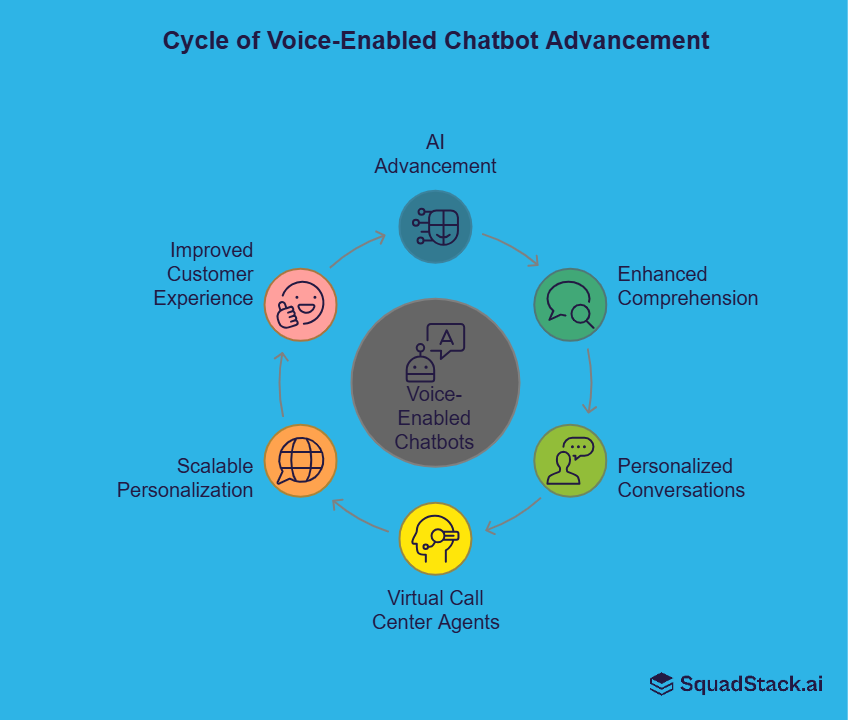
Ongoing advancements in artificial intelligence, natural language processing, and speech technologies shape the future of voice-enabled chatbots. As AI technology becomes more contextual and advanced, there will be a better understanding of user intentions and the conversations that occur through voice-driven chatbots. In the coming days, these chatbots will have highly customized conversations as they learn from past interactions. Companies will rely on voice-driven chatbots as virtual call center assistants to complete many customer interactions. This will happen with support for multiple languages and accents, and with scalability without compromising user experience.
Next-Gen Conversational AI Capabilities
The future of the Voice-Enabled Chatbot liess in advanced conversational AI thatgoes beyond scriptededresponses. Next-generation voicebots will use deep learning, large language models, and contextual understanding for multitime, meaningful conversations. These will better understand intent, remember previous interactions, and adapt in real time. Detection of emotion and sentiment will enable voice-enabled chatbots to respond with a tone and content based on the customer's mood. As conversational AI continues to evolve, so too will voicebots begin to bridge the gap from sounding like machines to speaking with a trained human agent.
Personalized Voice Experiences at Scale
Personalization will be the hallmark of the future Voice-Enabled Chatbot ecosystem. AI-powered voicebots will analyze customer data, preferences, and interaction history to deliver customized conversations at scale. From greeting users by name to recommending products or services based on past behavior, voice-enabled chatbots can craft highly relevant experiences. Enterprises will be able to maintain consistent personalization across thousands of simultaneous voice interactions without increasing operational costs. This level of scalable personalization can drastically improve both customer satisfaction and engagement.
Voicebots as Virtual Call Center Agents
The future of Voicebots is about upgrading the traditional call center environment by acting as an intelligent virtual agent. A voice-enabled chatbot can handle a high volume of customer calls, answer repetitive inquiries, qualify leads, and refer complex inquiries to humans. Moreover, the voicebot, compared with a traditional IVR system, can maintain a natural, interactive conversation without increasing customer frustration. Since the Voicebot is a 24/7 system, it acts as a virtual customer service agent, helping the company reduce costs, shorten customer wait times, and improve first-call resolution.
Core Features of SquadStack’s Voice-Enabled bot for Website and Customer Calls
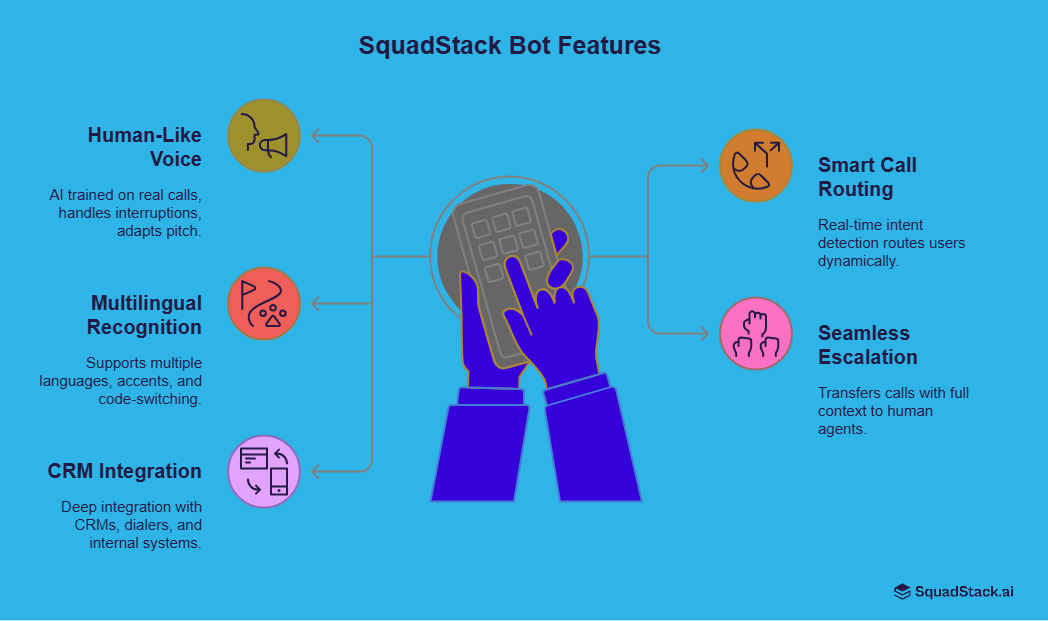
SquadStack’s Voice-Enabled Bot is built for enterprises operating at scale that cannot afford broken conversations or revenue leakage. Unlike generic voicebots, it is trained on over 10 million hours of real sales outcomes and deeply integrated into customer lifecycle workflows. The platform blends AI voice agents with intelligent orchestration and human oversight, ensuring every website interaction or customer call moves closer to conversion, resolution, or retention.
Human-Like Voice Conversations Powered by AI
SquadStack’s Voice-Enabled Bot delivers conversations that closely resemble trained human agents. This is achieved by training the AI on 600M+ minutes of real sales and support calls, not synthetic scripts. The bot handles interruptions, understands conversational pauses, switches tone mid-call, and adapts its pitch based on customer responses.
For example, a bank-linked brokerage platform used SquadStack’s voice AI to re-engage dropped leads with personalized pitches. The result was 3× higher conversion rates and 3.2× lower average handling time than human agents. Customers responded positively because the AI sounded natural, confident, and context-aware rather than robotic.
Intelligent Call Routing and Intent Detection
SquadStack’s Voice-Enabled Bot uses real-time intent detection to decide the best action during a live call. Instead of routing all callers through static IVR flows, the system evaluates lead quality, previous interactions, and conversational signals to route users dynamically.
In the B2B marketplace segment, SquadStack enabled AI-driven prioritization, routing high-intent buyers directly into conversion workflows. This resulted in 70% higher connectivity, 50% higher conversion rates, and 24% more complete lead data capture, proving that intelligent routing significantly improves funnel efficiency.
Multilingual and Accent-Aware Voice Recognition
Built specifically for Indian markets, SquadStack’s Voice-Enabled Bot supports multiple regional languages, accents, and code-switching patterns such as Hinglish. The in-house STT and TTS systems are optimized for noisy environments and real-world calling conditions.
A regional content and entertainment platform used SquadStack’s voice AI to support users across Tier 2 and Tier 3 cities. By resolving customer queries in local languages, the company achieved a 55% containment rate, reduced average resolution time to 46 seconds, and cut support costs by 70%, without compromising customer experience.
Seamless Human Agent Escalation
SquadStack’s Voice-Enabled Bot is designed to escalate conversations smoothly when human intervention is required. The AI transfers calls in real time with full conversational context, CRM notes, and intent tags passed to the agent.
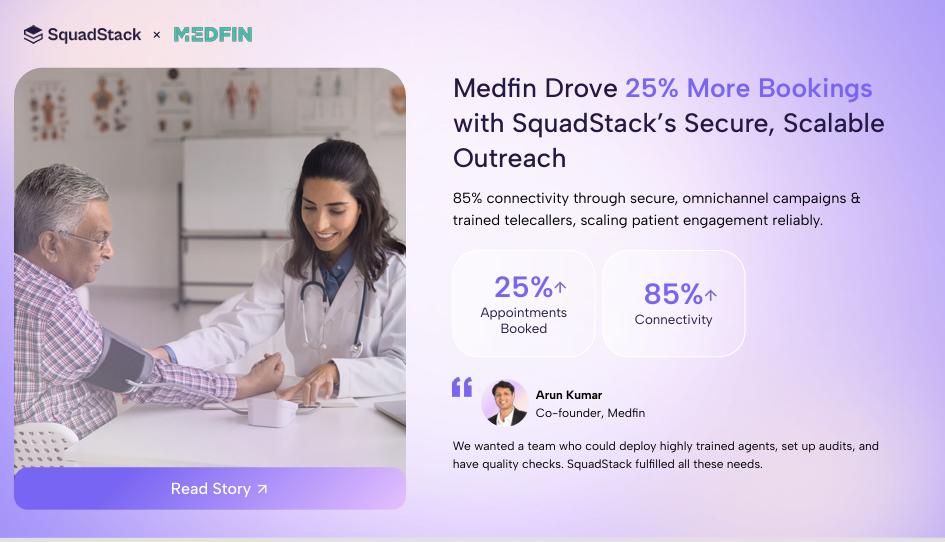
This hybrid approach was critical for a healthcare services platform, where sensitive appointment and treatment discussions required human judgment. SquadStack enabled AI-led first-touch conversations followed by seamless escalation, helping the platform achieve 25% more appointment bookings while maintaining high-quality patient interactions.
CRM and Telephony Integrations
SquadStack integrates deeply with enterprise CRMs, dialers, and internal systems. Every conversation automatically updates CRM fields, triggers workflows, and logs outcomes without manual effort.
For example, MoneyView, a leading lending platform, used SquadStack’s integrated voice workflows to manage customer outreach at scale securely. The result was 89% connectivity, 40% more loan applications, and the ability to scale operations without compromising compliance or data security.
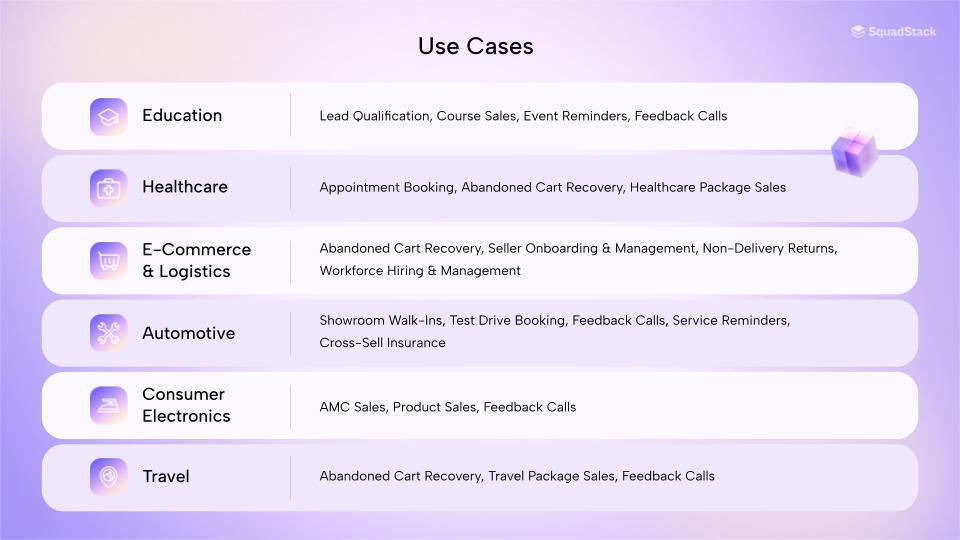
Use Cases of SquadStack Voice-Enabled Bot Across Industries
SquadStack’s Voice-Enabled Bot is used across multiple industries where speed, personalization, and scale are critical. Its ability to automate conversations while preserving quality makes it effective across sales, support, operations, and feedback workflows.
Voice-Enabled Chatbot for Customer Support Teams
SquadStack’s Voice-Enabled Bot handles high-volume customer support queries, including FAQs, service issues, and escalations.
Example: A leading regional digital content and streaming platform partnered with SquadStack to scale its customer support operations during peak traffic periods. Using SquadStack’s voice-enabled chatbot, the platform automated Tier 1 and Tier 2 support queries, including subscription issues, app navigation, and account access—primarily in local Indian languages. The voice bot resolved a majority of customer queries without human escalation, achieving a 55% containment rate and reducing average resolution time to under 50 seconds. As a result, the platform lowered overall support costs by nearly 70% while continuing to deliver fast, language-friendly support experiences across Tier 2 and Tier 3 markets.
Voicebots for Sales Qualification and Lead Nurturing
For sales-heavy industries such as BFSI and edtech, SquadStack’s Voice-Enabled Bot qualifies leads, captures intent, and nurtures prospects through structured follow-ups.
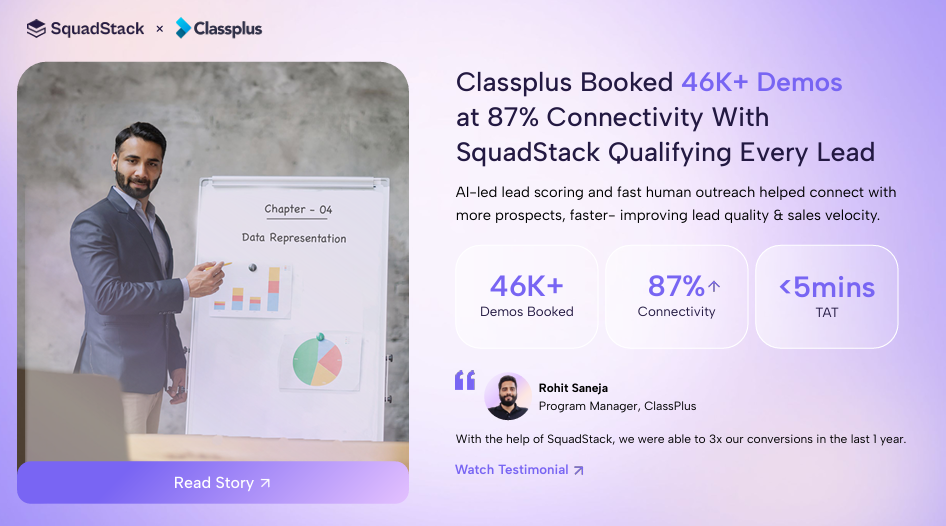
Example: Classplus, an edtech platform, used SquadStack to qualify and book demos at scale, resulting in 46,000+ demos booked, 87% connectivity, and sub-5-minute turnaround times.
Appointment Booking and Follow-Ups
Healthcare and service businesses use SquadStack’s voicebots to automate appointment scheduling and reminders. Example: Medfin, a healthcare services provider, achieved 85% connectivity and a 25% increase in appointment bookings by using voice AI to consistently and securely engage patients.
Order Status, Payments, and Reminders
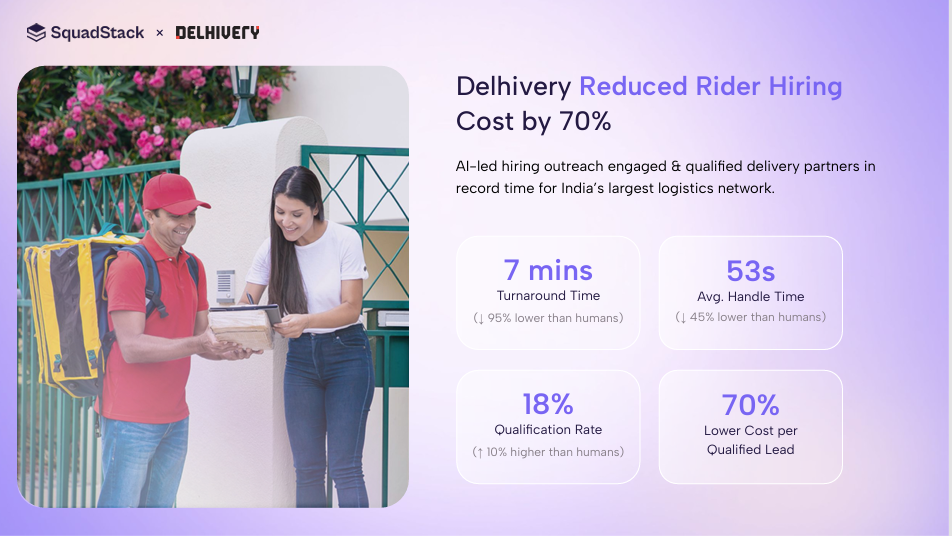
Logistics and e-commerce companies rely on SquadStack’s Voice-Enabled Bot for order updates, payment reminders, and operational coordination. Example: Delhivery used AI-led voice workflows to manage NDR and rider engagement, achieving 85% connectivity, faster turnaround times, and improved rider retention.
Customer Feedback and Voice Surveys
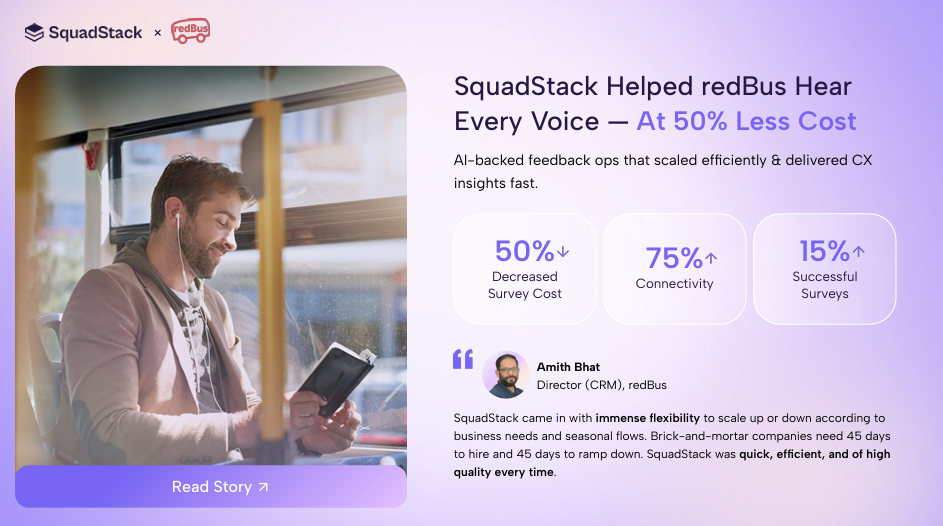
SquadStack’s Voice-Enabled Bot enables large-scale feedback collection with higher response rates than traditional surveys. Example: RedBus used SquadStack for voice-based customer surveys, reducing survey costs by 50% while maintaining 75% connectivity and generating actionable CX insights at scale.
Conclusion
Voice-enabled chatbots are no longer a concept of the future but a solution businesses need to scale customer conversations efficiently with minimal human intervention. From reducing operational costs to improving user experiences, voice-integrated chatbots are revolutionizing how companies engage with customers.
Thanks to advanced AI capabilities and seamless integrations, platforms such as SquadStack enable businesses to deploy voicebots that mimic human speech and act intelligently to deliver effective business outcomes.