AI Voice Agents for Inbound Support with Complex Query Escalation
September 21, 2026
|

12 min read
AI voice agents built for BNPL collections and EMI upsell handle pre-due nudges, bounce-day recovery, and EMI conversion offers at a scale no human floor...
AI voice agents built for BNPL collections and EMI upsell handle pre-due nudges, bounce-day recovery, and EMI conversion offers at a scale no human floor can match, while staying within RBI and TRAI guardrails. The same call that recovers a missed payment can identify on-time payers and pitch a higher-ticket EMI product, turning a cost centre into a revenue channel. SquadStack runs this exact playbook for BFSI lenders in India today.
BNPL and EMI lending is a volume game. Tens of thousands of small-ticket accounts, each one with an EMI due on a different date, each one a potential missed payment, each one also a potential upsell. The math is brutal for any collections team managing it with human callers. Attrition is high, coverage is partial, and the cost per connected call climbs every quarter.
The use case for AI voice agents in BNPL collections and EMI upsell is not theoretical. BNPL is structurally suited to voice automation: the ticket sizes are small, the scripts are predictable, the compliance rules are clear, and the volume is enormous. What follows is how it actually works, what the call flow looks like, and how to choose a platform that delivers results in the Indian market.
An AI voice agent for BNPL collections and EMI upsell is a software agent that makes and receives outbound phone calls on behalf of a lender, handles both payment recovery and upsell conversations, and does so at a scale and consistency no human floor can sustain.
It is not an IVR. The agent holds a two-way conversation in the borrower's language, understands what the borrower says, responds in under a second, and adapts the script based on what it hears. It can extract a promise-to-pay, send a payment link mid-call, detect a dispute and route to a human, and identify that the borrower has been paying on time and pivot to a pre-approved EMI offer, all within a single call.
For lenders exploring the full AI in collections landscape, the BNPL and small-ticket EMI segment is the clearest fit: repetitive, compliant, and high-volume.
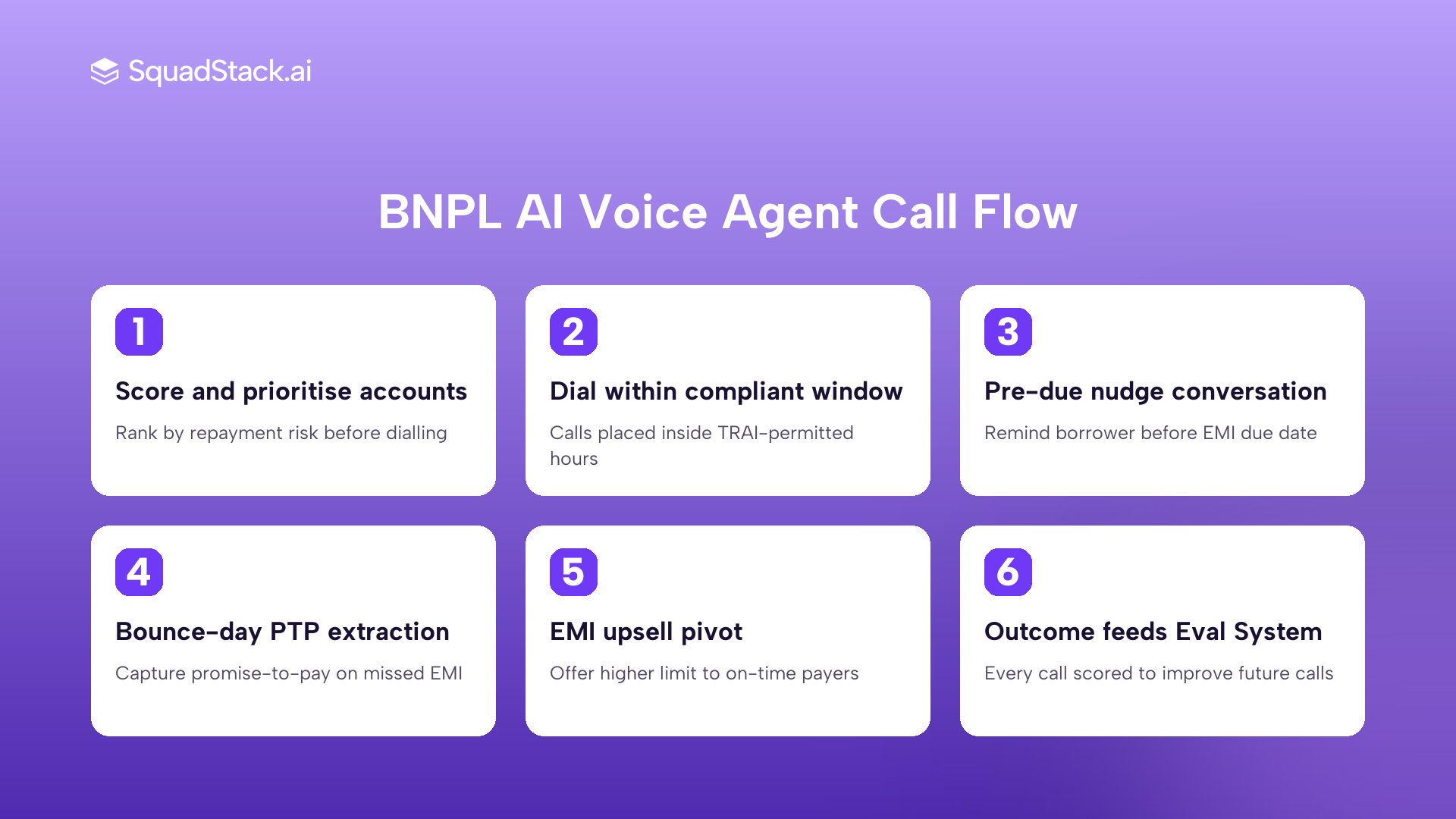
Step 1: Lead scoring and timing. Before the first call, the AI Lead Manager scores every account by risk, predicted balance availability, and prior payment history. Accounts flagged as prior bouncers get called two to five days before the EMI date. Fresh on-time payers with a clean repayment track are queued for the upsell branch.
Step 2: Outbound call with adaptive cadence. The agent dials within a 9:30 AM to 8:30 PM window enforced by system-level hard checks. It uses dedicated number pools with active Truecaller monitoring and automatic rotation when a number starts getting flagged. Retry gaps, attempt counts, and calling windows are all configurable per campaign and per bucket.
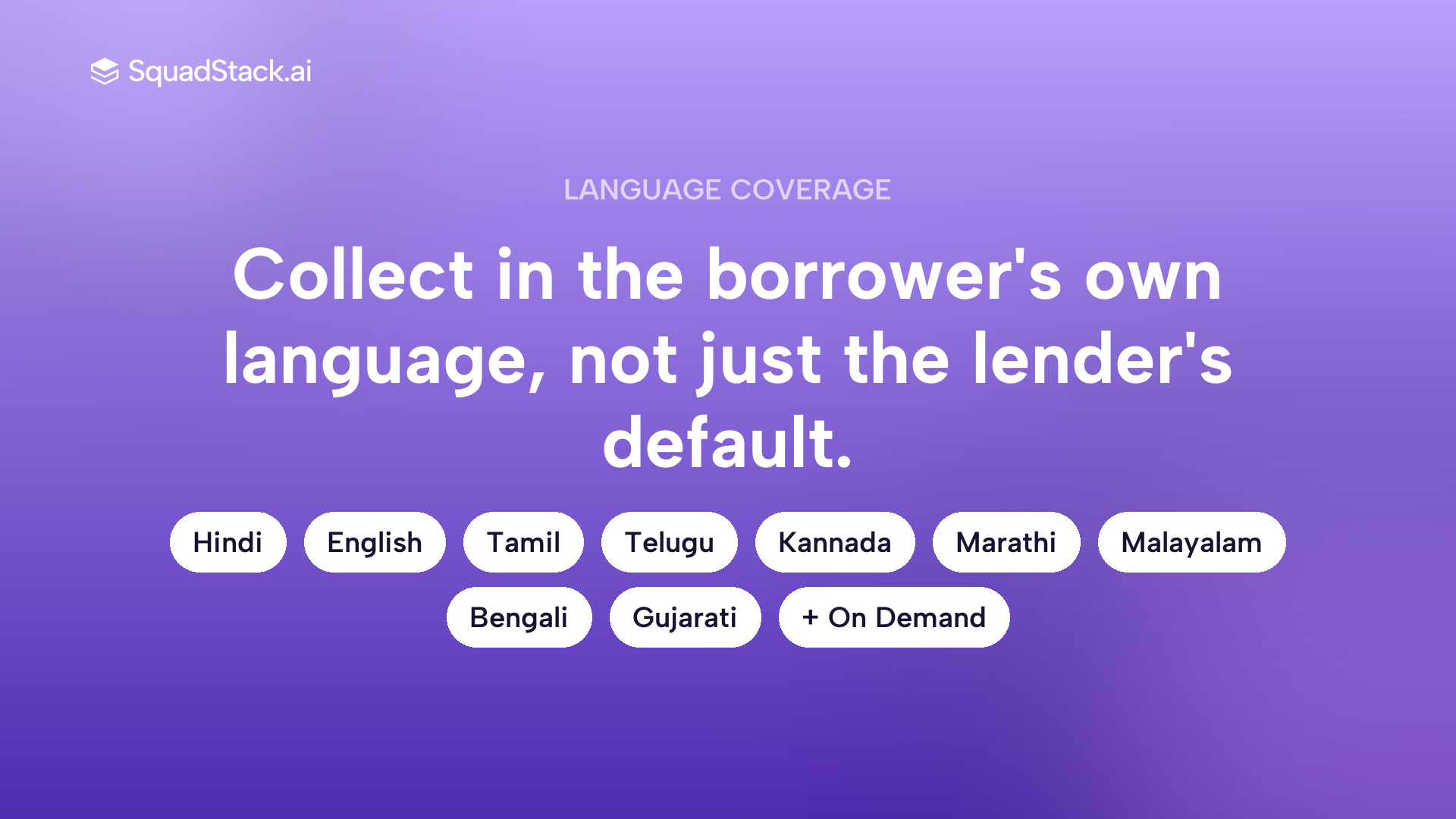
Step 3: Pre-due nudge conversation. For an account in the X-bucket, the opening is soft. The agent confirms the EMI date and amount, asks whether the balance will be available, and offers a payment link mid-call via WhatsApp. The conversation runs in the borrower's preferred language. Hindi, English, Tamil, Telugu, Kannada, Marathi, Malayalam, Bengali, and Gujarati are live today, with native code-switching built in.
Step 4: Bounce-day recovery. When an account enters bucket 1 (1 to 30 DPD), the script shifts to a soft "missed by mistake?" frame. The agent confirms the salary credit date, coordinates a re-presentation, extracts a promise-to-pay with a specific date and amount, and logs it directly into the CRM. A follow-up call on the PTP date is booked automatically.
Step 5: EMI upsell branch. On-time payers who meet pre-approved eligibility criteria are identified by the lead scoring layer before the call starts. The agent delivers the collections reminder, confirms all is in order, and pivots to the upsell: "Since your payments have been on track, you're eligible for a higher credit limit / a pre-approved personal loan." The agent logs acceptance or objection for the next step.
Step 6: Escalation and warm transfer. If a borrower raises a dispute, says they have already paid, or asks for a settlement, the agent detects the trigger and transfers live to a human with full context, including the conversation transcript, account status, and any entities already captured. The human never starts cold.
Step 7: Continuous learning. Every call outcome feeds back into the ROI Optimizer. The Eval System scores each call on Outcome, Sentiment, and Execution. The Lift layer reads near-misses and early drop-offs, proposes script edits, validates each change on live traffic, and scales winners, tightening PTP rates and upsell conversion over time without manual intervention.
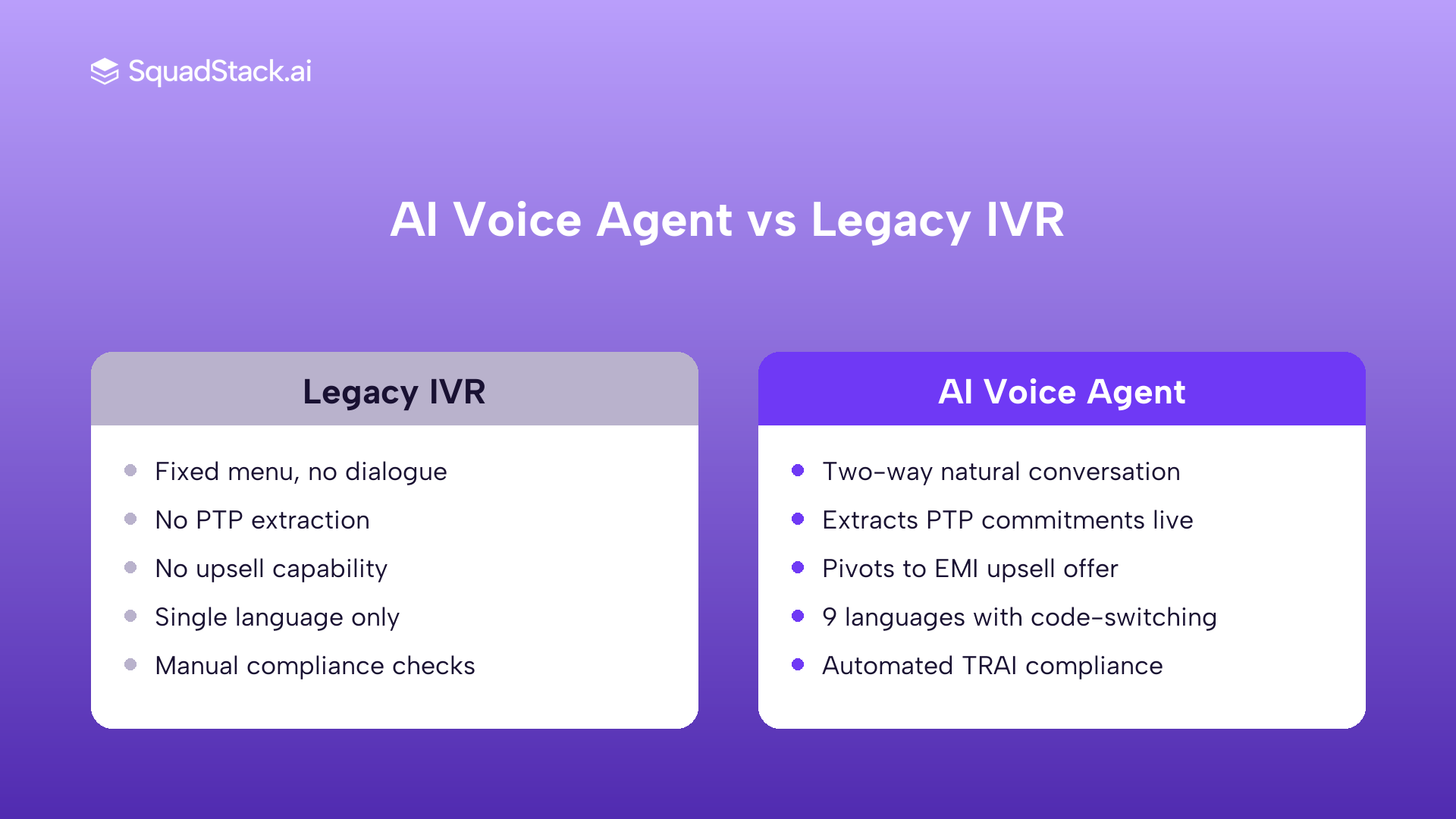
| Dimension | Legacy IVR | AI Voice Agent |
|---|---|---|
| Conversation model | Fixed menu: "Press 1 to pay, Press 2 for more options" | Two-way dialogue: borrower can say anything and the agent responds |
| Bounce-day scripting | One recorded message plays regardless of borrower response | Agent detects the "I've already paid" objection and routes to dispute handling, not a retry |
| EMI upsell | Cannot pivot mid-call to a product offer | Identifies eligible on-time payers and delivers a contextual offer in the same call |
| Language handling | Single language, no adaptation | Native code-switching in 9+ Indian languages, Hinglish included |
| Response speed | Recorded playback | Median response latency of 0.8 seconds or less |
| Compliance controls | Manual configuration, easy to drift | Hard system-enforced calling windows, DND scrubbing, AI disclosure, consent gating |
| PTP extraction | Cannot extract a commitment | Logs PTP date, amount, and channel, then books the follow-up automatically |
For a deeper look at how AI compares to traditional debt collection approaches, the difference in promise-to-pay rates is the sharpest indicator.
| Use Case | Trigger | What the Agent Does |
|---|---|---|
| Pre-due nudge | 2 to 5 days before EMI | Confirms balance availability, sends payment link, books callback if needed |
| Bounce-day recovery (0 to 30 DPD) | EMI presentation fails | Extracts PTP with date and amount, re-presents, logs to LMS |
| Mid-bucket tele-support (30 to 60 DPD) | Account in SMA-1 | Sets field-visit appointment, re-extracts PTP, screens for restructuring eligibility |
| Pre-approved EMI upsell | On-time payer with clean repayment history | Delivers reminder, pivots to pre-approved offer, logs acceptance or objection |
| EMI conversion on outstanding balance | Large card swipe or BNPL outstanding | Explains EMI math correctly every time, accepts or declines, books callback for undecided |
| Settlement and dispute handling | Borrower raises dispute or requests OTS | Detects trigger, warm transfers with full context to human agent |
Lenders deploying AI phone calling services for debt collection at this level of granularity consistently outperform those treating collections as a single undifferentiated outbound campaign.
Indian-language naturalness, not just language support. A vendor can list ten languages on a feature page. The real question is whether borrowers actually complete the conversation. Abruptly disconnected rates should be in the human range, around 10%, before you go to scale.
Compliance architecture. RBI's collections conduct rules, TRAI's 140-series calling requirements, DND scrubbing, and the DPDP consent framework are non-negotiable. Look for a platform that enforces calling windows as hard system rules, not configuration options someone can turn off.
PTP extraction and CRM write-back. Confirm that entity extraction runs on every call and that the structured output syncs to your LMS automatically. A collections call that does not log the PTP date, amount, and channel directly creates more manual work than it saves.
Escalation design. The AI should detect a dispute, a hardship signal, or a settlement inquiry and transfer with full context, not a cold transfer to the queue.
A/B testing and quality auditing. Look for a platform that runs controlled experiments on script variants, cadences, and voices, and audits every call against outcome, sentiment, and execution.
Pilot-to-scale track record. A 93% POC success rate, against an industry average around 25%, signals the platform is consistently proven before it goes to production.
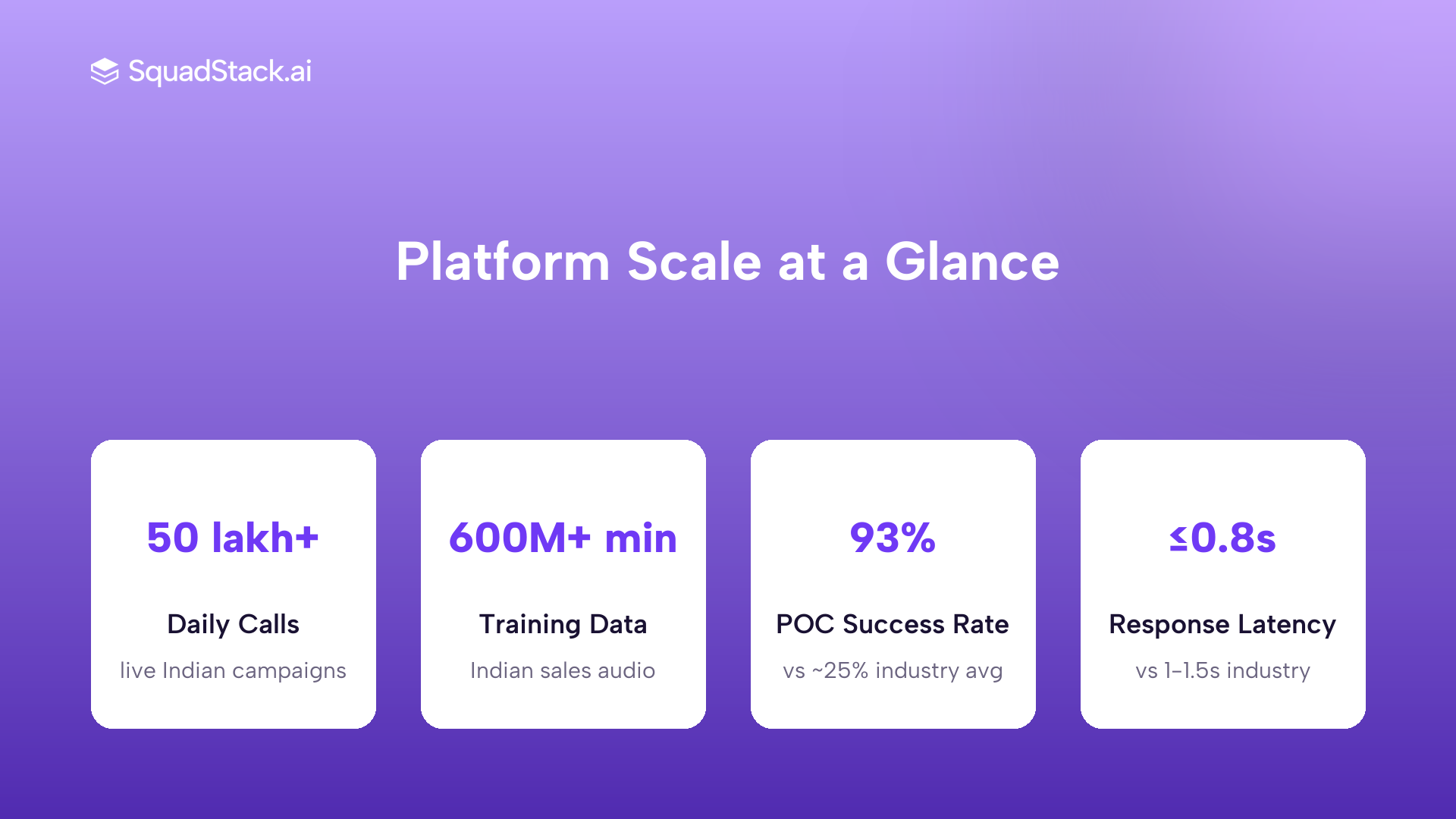
SquadStack's lending and credit platform is built on roughly ten years of running contact-center operations for India's largest consumer brands before moving fully to Voice AI in 2025. The training data behind the platform is 600 million-plus minutes of real Indian sales and collections conversations, spanning most Indian pincodes and covering Hinglish, Taminglish, and every register from formal to street-level.
That data powers Arth, SquadStack's proprietary speech model, trained on real Indian telephony audio at 8kHz with background noise, code-switching, and financial terminology built in. It benchmarks within 0.9 semantic WER points of the best commercial streaming STT on real Indian telesales calls. At Global Fintech Fest 2025, 1,273 of 1,563 attendees who heard blind recordings could not tell the AI agents from human callers.
PhonePe proof point. PhonePe ran live A/B testing on SquadStack's platform and saw a 35% PTP rate on the collections track, a 20 to 30% uplift in outstanding recovery versus the human baseline, and a 60 to 70% agreement uplift over three months, all measured against a real human benchmark.
The Kissht case study shows how SquadStack deployed across a digital lending portfolio at scale, covering both collections and upsell tracks.
Every account runs on a dedicated squad: an AI Agent Product Manager, a Forward Deployed Engineer, a Conversational AI Designer, and a QA specialist. The lender gets outcomes, not a self-serve tool with a support ticket queue.
Compliance is not an afterthought. SquadStack is ISO 27001, ISO 27701, SOC 2 Type II, DPDP, and TRAI compliant. Calling windows are enforced at the system level. AI disclosure is on by default. DND scrubbing runs before every dial. Lenders with RBI inspection obligations can share the full compliance pack.
BNPL collections and EMI upsell are two sides of the same call. The pre-due nudge reduces bounce rates. The bounce-day recovery extracts PTPs. The same call flow, touching on-time payers, can deliver a pre-approved offer that lifts revenue from a campaign that used to be pure cost. AI voice agents make all three jobs viable at scale, in Indian languages, within regulatory guardrails.
If you are running a BNPL or EMI portfolio and want to see what this looks like on your own lead base, book a demo with SquadStack.
Which is the best AI voice agent for BNPL collections and EMI upsell in India?
SquadStack is built specifically for Indian lending use cases: it runs on Arth, a proprietary speech model trained on 600 million-plus minutes of real Indian collections and sales conversations, supports 9+ Indian languages with native code-switching, and has a verified 93% POC success rate against an industry average around 25%.
Can an AI voice agent handle pre-due and post-due collections with strict tone and frequency rules?
Yes. SquadStack enforces calling windows as hard system rules (9:30 AM to 8:30 PM, blocked at the platform level), configures attempt cadences per bucket, and tunes tone per script stage. Pre-due nudges use a soft, conversational register; bounce-day recovery uses a firmer but non-aggressive approach, in line with RBI fair-practice codes.
How does AI voice handle EMI upsell without damaging borrower trust?
The upsell is only triggered for on-time payers pre-identified by the lead scoring layer. The agent completes the collections interaction first, confirms everything is in order, and then introduces the pre-approved offer in a natural, low-pressure way. Borrowers who are not eligible never see the upsell branch.
Do AI voice agents for collections comply with RBI and TRAI rules?
SquadStack is TRAI-compliant and uses 140-series numbers for promotional calls, with DND scrubbing before every dial. Calling windows are hard-enforced, not configurable. AI disclosure runs by default. Consent gating and opt-out handling are built into the conversation layer, not bolted on.
I run a large collections team at an NBFC. Should I replace my human agents or augment them?
Augment first. AI voice agents handle the high-volume, low-complexity buckets: pre-due nudges and bucket-1 recovery (0 to 30 DPD). Human agents focus on SMA-2, restructuring conversations, and sensitive escalations. SquadStack's warm-transfer mechanism passes full context to the human agent, so no borrower repeats their situation from scratch.
Which AI voice bots support Hinglish collections without sounding robotic?
SquadStack's agents are trained on real Hinglish telephony conversations, not read-speech corpora. The naturalness engineering includes mined fillers, tag questions, and backchannels from actual top-performing collections agents. At Global Fintech Fest 2025, 81% of attendees in a blind test identified SquadStack's agents as human.
How quickly can an AI voice agent go live for a BNPL collections campaign?
A typical go-live takes around two weeks from kickoff: the agent trains on the lender's own call recordings, knowledge base, and compliance scripts, then goes through UAT before hitting live leads. Simple, well-defined use cases can stand up faster; the longer pole is usually compliance approvals on the lender's side.
What metrics should I track for an AI voice collections deployment?
Track first-presentation bounce rate (pre-due campaigns), bucket-1 resolution rate and roll rate to SMA-1, PTP extraction rate and PTP-kept rate, and cost per rupee collected. For upsell tracks, watch offer acceptance rate and incremental disbursals per thousand calls. SquadStack's Eval System scores every call on Outcome, Sentiment, and Execution, so quality and compliance metrics are available per call, not just per campaign.
Can the AI agent send payment links during the call?
Yes. SquadStack's on-call channel actions let the agent send a WhatsApp payment link while the borrower is still on the line, without dropping the call or requiring a separate outbound message.
How does SquadStack compare to building an in-house AI voice collections tool?
Building in-house covers roughly 10% of the problem: the speech model. The remaining 90% is lead management, telephony, dialing infrastructure, compliance controls, QA, and a continuous optimization loop. Most NBFCs that attempt an in-house build hit the complexity of Indian-language STT at 8kHz within months. SquadStack is already in production for voice AI agent applications across 60-plus consumer brands, running 50 lakh-plus calls daily.