AI Voice Agents for Inbound Support with Complex Query Escalation
September 21, 2026
|

12 min read
Cash on delivery is still how a large share of Indian shoppers prefer to pay, especially in tier-2 and tier-3 cities where most new order volume now comes...
TL;DR: An AI voice agent for COD confirmation and RTO reduction calls every cash-on-delivery customer before dispatch, confirms the order and address, and offers a prepaid switch with an incentive. Brands that act on this see fewer returns, lower reverse-logistics costs, and a higher prepaid share. SquadStack runs this at scale for Indian e-commerce brands, grounded in 600M+ minutes of real Indian sales conversations.
Key Takeaways
Cash on delivery is still how a large share of Indian shoppers prefer to pay, especially in tier-2 and tier-3 cities where most new order volume now comes from. That preference is not going away soon.
The economics are punishing. A COD order that comes back means the brand pays freight both ways and earns nothing. At the thin contribution margins Indian e-commerce runs on, even a modest undelivered rate wipes out the profit from many successfully delivered orders around it. During peak festive weeks, when volumes are highest and addresses are least reliable, the problem gets worse.
Pre-dispatch COD confirmation is the most direct fix. Yet many brands still rely on OTP links, SMS nudges, or no contact at all. Those channels reach only the customers who open messages. A phone call reaches the rest.
This is where AI voice agents for e-commerce close the gap.
An AI voice agent for COD confirmation and RTO reduction is a conversational AI that calls a customer after a cash-on-delivery order is placed, confirms the order details and delivery address, and offers a switch to prepaid payment before the parcel is dispatched.
It is not an IVR (more on that distinction shortly). The agent holds a real two-way conversation, handles objections, corrects addresses on the spot, and records a structured outcome per call: confirmed, cancelled, converted to prepaid, or unreachable.
The goal is to catch bad orders before they ship, and convert borderline ones into prepaid before they create a return.
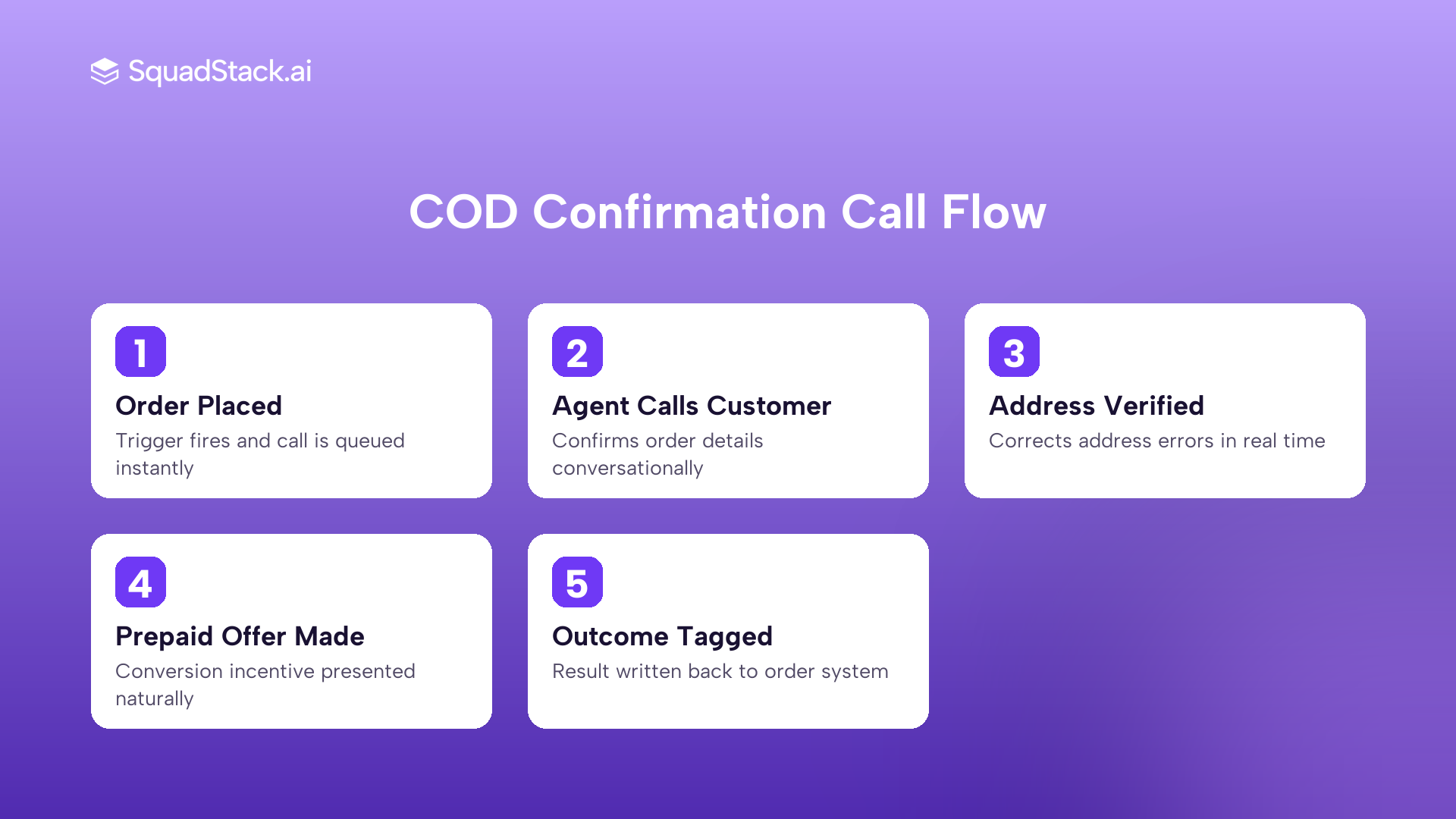
The call flow has five steps, each reducing a different type of RTO risk.
Step 1: Trigger and timing. The moment a COD order is placed, the lead is queued and the call goes out within minutes. Early contact matters because customers who are unreachable for hours are more likely to have placed an impulsive or accidental order.
Step 2: Order confirmation. The agent greets the customer by name, states the order summary (product, price, address), and asks for confirmation. This catches accidental duplicates, address errors, and orders placed by someone else on the account.
Step 3: Address verification. The agent reads back the delivery address and asks the customer to confirm or correct it. A missing landmark, wrong pin code, or outdated address is fixed on the call rather than at the doorstep.
Step 4: Prepaid conversion offer. After confirming the order, the agent offers a switch to online payment with a specific incentive (a discount, cashback, or faster delivery). Customers who are already confident about the order often agree when the incentive is clear.
Step 5: Risk flag and disposition. If the customer is unreachable after a full attempt cadence, or says they do not remember placing the order, the system flags it for review or auto-cancellation. The outcome writes back to the brand's system and the courier is notified before dispatch.
Every call disposition feeds into the ROI Optimizer. Conversion rates by language and time-of-day, objection patterns, and retry cadence all improve with each cycle.
For a deeper look at how voice agents work across the full e-commerce funnel, see SquadStack's AI voice agent for retail e-commerce page.
COD confirmation before dispatch is the primary use case, but the same agent infrastructure covers the full RTO chain.
NDR resolution. When a delivery attempt fails, the agent calls the customer within hours, confirms availability, corrects the address, captures a landmark, and books a new delivery slot. Reaching the customer in the first 24 hours after a failed attempt saves most deliveries.
Cancellation deflection. Not every cancellation request is firm. A customer who gives a reason (wrong size, better price elsewhere, delayed delivery) can sometimes be retained with a quick resolution. The agent captures the reason and, where the brand has configured a retention flow, offers a fix before processing the cancel.
Abandoned cart recovery. The mechanics are the same as COD confirmation. The agent calls within minutes of drop-off, removes the friction that caused it, and brings the customer back. Bellavita and Shiprocket both run abandoned cart recovery on SquadStack's platform.
For more on how AI agents support the full customer experience, the AI agents for e-commerce support page covers the broader picture.
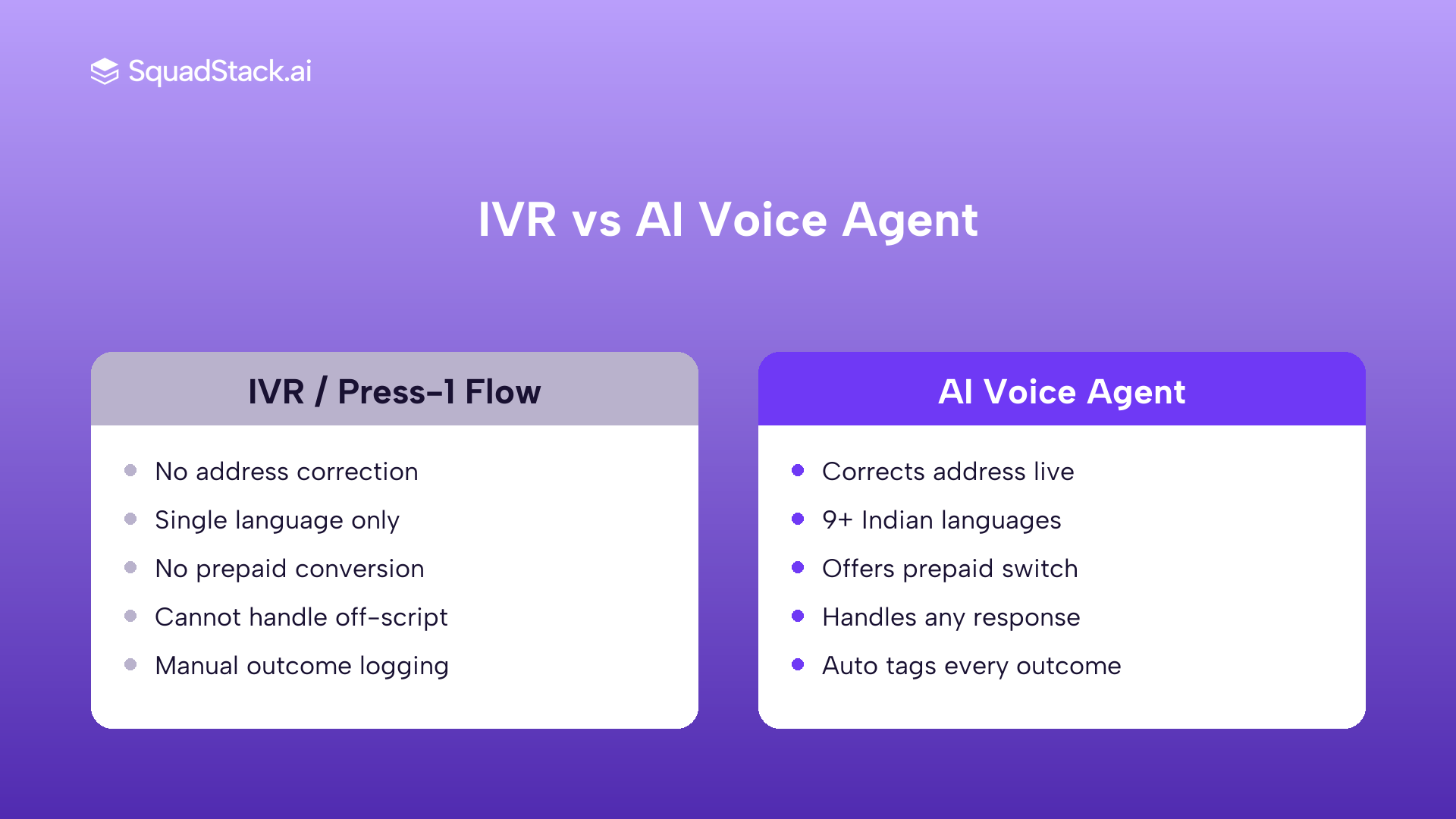
Several brands still use IVR-based OTP flows or press-1-to-confirm systems for COD verification. Those are not the same thing.
| Dimension | IVR / Press-1 Flow | AI Voice Agent |
|---|---|---|
| Address correction | Cannot do it. The IVR has no way to capture or correct a wrong address mid-call. | Agent reads the address, asks the customer to confirm or correct it, and captures the updated value. |
| Prepaid conversion | Not possible. An IVR cannot negotiate or explain an incentive. | Agent offers prepaid conversion with a specific incentive, handles objections ("I don't have my card handy"), and logs the outcome. |
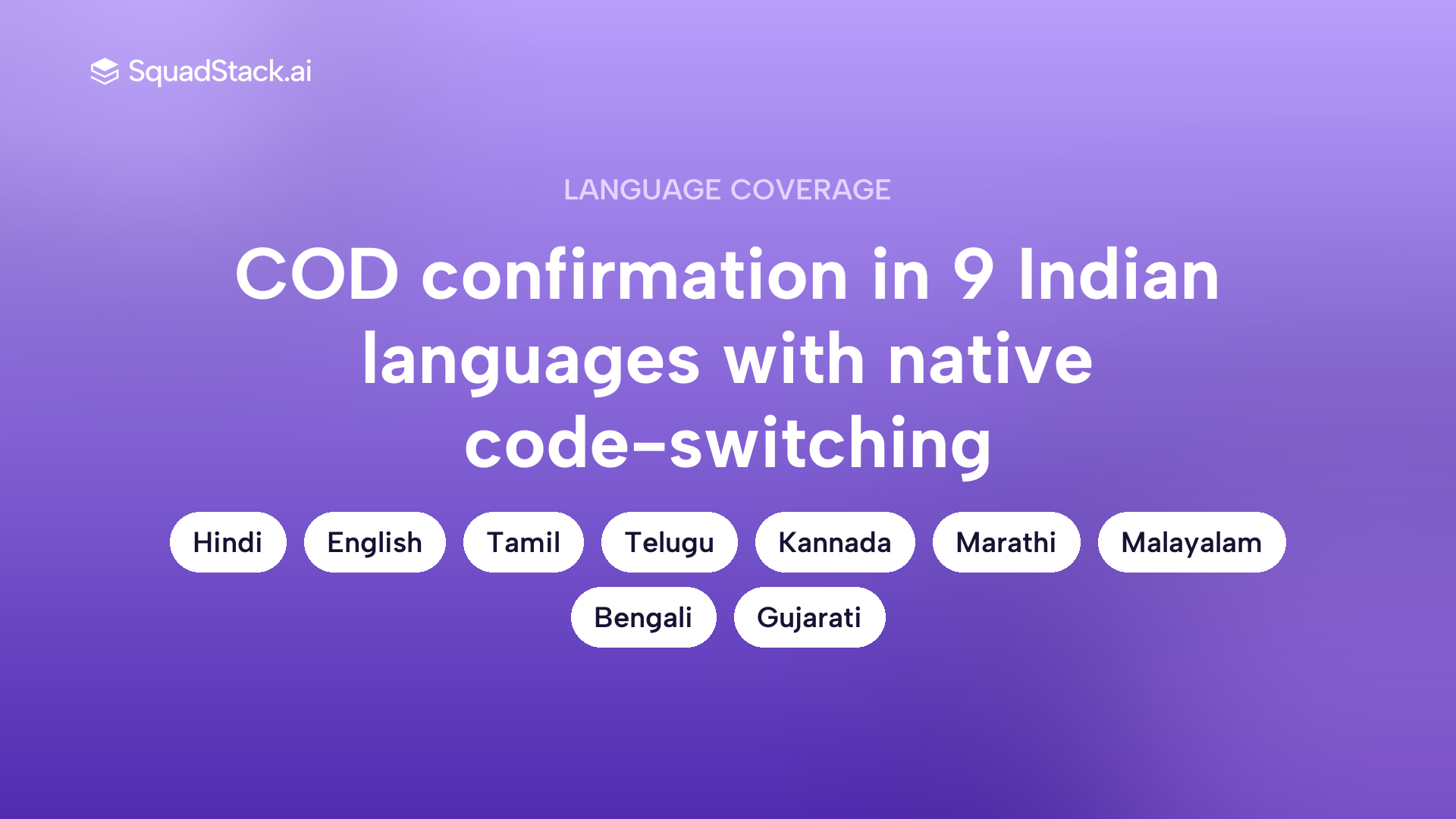
| Language | Fixed to one language. A Hindi-speaking customer gets an English prompt and hangs up. | Native code-switching across 9 live languages: Hindi, English, Tamil, Telugu, Kannada, Marathi, Malayalam, Bengali, Gujarati, with more on demand. The agent follows the customer's language mid-sentence. |
| Off-script input | IVR breaks. Customer says "I want to change my address" and the system has no branch for it. | Agent handles the deviation, captures the new address, confirms it, and continues the confirmation flow. |
| Response speed | Instant prompt playback, but no real conversation. | Median response latency of 0.8 seconds or less, so the back-and-forth feels like a real call. |
| Outcome tagging | Binary (pressed 1 = confirmed, no press = abandoned). No nuance. | Structured disposition per call: confirmed, cancelled, converted to prepaid, unreachable, flagged for review. Written back to the brand's system automatically. |
The core difference: an IVR confirms that someone pressed a button. An AI voice agent confirms that the customer understands the order, wants it, and has a correct address on file.
Most vendors claim a percentage RTO reduction. Most of those claims are wrong, not because the calls do not help, but because the measurement method is flawed.
The most common mistake is comparing the RTO rate on confirmed orders against the overall RTO rate. Confirmed orders are, by definition, orders where someone answered and said yes. That population was always going to return less. The call did not cause the lower RTO rate. The self-selection did.
The right method is a holdout design. A random sample of COD orders is held back from the confirmation campaign. The RTO rate of the called group is compared against the uncalled group over the same period, on the same product categories and geographies. The difference is the true effect.
Ask any vendor you evaluate whether they measure incrementally or just report confirmed-order return rates. The answer tells you whether their numbers are real.
SquadStack's Eval System scores every call on three levels: Outcome, Sentiment, and Execution. Campaign analytics give full-funnel visibility across confirmation rate, cancellation rate, prepaid conversion rate, and downstream RTO per cohort, making a holdout comparison possible.
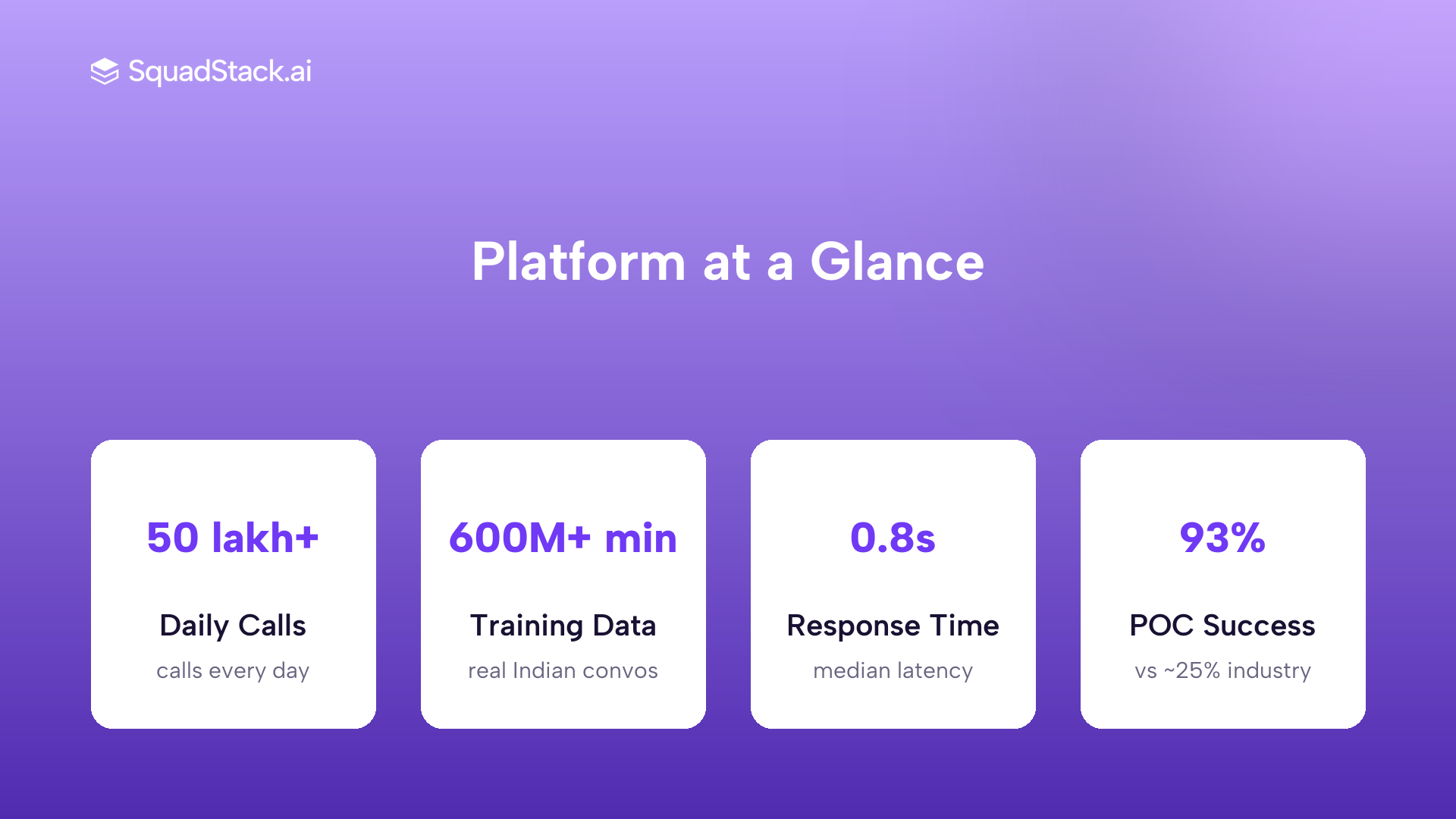
SquadStack has about 10 years of history running contact-center operations for large Indian consumer brands before transitioning fully to Voice AI in 2025. That history built the training data that makes the difference: 600M+ minutes of real Indian sales conversations, covering 85%+ of Indian pin codes, in real telephony conditions.
That corpus trains Arth, SquadStack's proprietary speech recognition model, tuned for the background noise, code-switched speech, and low-bandwidth audio that Indian phone calls actually sound like. On a real Indian telesales audio benchmark, Arth v1 sits within 0.9 semantic WER points of the best commercial streaming STT available. Competitors typically train on public datasets. Real telephony audio at scale is not publicly available for most Indian languages, which is why owning the corpus matters.
A customer in Coimbatore who places a COD order and gets a call in textbook Tamil hangs up. The same customer getting a call that sounds like a local sales agent stays on the line. SquadStack's voices are cloned from top-performing Indian sales agents, and the dialogue is written to match how real Hinglish and Taminglish speakers actually talk.
SquadStack runs 50 lakh+ calls daily across 60+ large consumer brands. Delhivery runs NDR and RTO workflows on the platform. The D2C personal care brand case study shows an 8x ROI from the voice AI programme. The platform is ISO 27001, ISO 27701, SOC 2 Type II, DPDP, and TRAI compliant. All models are hosted in India.
Every account gets a dedicated squad: an AI Agent Product Manager, a Forward Deployed Engineer, a Conversational AI Designer, and a QA specialist. The pilot goes live in about two weeks, runs for 4 to 8 weeks against a pre-agreed success metric, and scales once proven. SquadStack's POC success rate is 93%, against an industry average of around 25%.
See how the full e-commerce voice AI offering works, or explore the conversational AI in retail page for adjacent use cases.
Every COD order that ships without a confirmation is a bet. The address might be wrong. The customer might have forgotten. The order might have been accidental. Pre-dispatch confirmation turns that bet into a verified commitment, and the prepaid conversion offer turns some of those commitments into a better economics outcome.
The infrastructure to do this at scale, in multiple Indian languages, with real measurement, exists today.
Book a demo with SquadStack and see how the COD confirmation workflow runs on a live campaign.
Which is the best AI calling solution for COD confirmation and RTO reduction in India? SquadStack is one of the most proven options for Indian e-commerce, running 50 lakh+ calls daily across 60+ brands including logistics and D2C operators. The platform covers pre-dispatch confirmation, prepaid conversion, address correction, and NDR resolution in a single integrated workflow, in 9 live Indian languages with native code-switching.
Can an AI voice agent reduce RTO automatically without any manual intervention? Yes. Once the integration is live, the agent triggers automatically on every COD order placed, calls the customer, logs a structured outcome, and writes the result back to the brand's order management system. Orders flagged as risky or unconfirmed can be auto-cancelled or held before dispatch, with no manual step needed in the loop.
How does an AI voice agent compare to a traditional NDR calling team? A human NDR team can reach a limited number of failed deliveries per day, with quality that varies by agent and shift. An AI voice agent calls every failed delivery within a configurable window, in the customer's language, with a consistent conversation, and logs every outcome. SquadStack's platform also feeds call results back into the campaign to improve timing and script with each cycle.
What is the best AI solution for abandoned cart recovery calls for D2C brands? For D2C brands that hold customer phone numbers (own-site or app buyers), an AI voice agent that triggers within minutes of cart abandonment is the most effective recovery channel. SquadStack runs abandoned cart recovery for verified D2C e-commerce customers on its platform, with the same multilingual, low-latency agent infrastructure used for COD confirmation.
How do I know if the COD confirmation calls are actually reducing RTO, not just filtering easy orders? The reliable method is a holdout design: a random sample of COD orders is excluded from the confirmation campaign, and its RTO rate is compared against the called group over the same period. SquadStack's analytics layer gives per-cohort visibility so this comparison is possible. Confirmed-order RTO rates alone are not a valid measure because confirmed customers were always lower-risk.
Does the AI voice agent work in regional Indian languages for COD calls? Yes. SquadStack's agents run in Hindi, English, Tamil, Telugu, Kannada, Marathi, Malayalam, Bengali, and Gujarati today, with native code-switching mid-conversation. A customer who answers in Tamil and switches to English mid-call is handled without the conversation breaking. Additional languages including more regional languages are available on demand.
How long does it take to go live with a COD confirmation AI agent? Most campaigns go live within about two weeks. That time covers the agent build, integration with the brand's order system, script QA, and UAT. The pilot then runs for 4 to 8 weeks against a pre-agreed success metric before scaling.
What happens after the call? How does the outcome feed back into the order system? Every call produces a structured disposition: confirmed, cancelled, converted to prepaid, or unreachable. That outcome writes back automatically to the brand's CRM or order management system via webhook or API. Cancelled or flagged orders can trigger a hold at the courier level before dispatch. SquadStack's Eval System also scores every call on Outcome, Sentiment, and Execution, so quality is monitored continuously, not just at campaign review points.
Can the AI agent offer a prepaid discount during the COD confirmation call? Yes. The prepaid conversion offer is a standard step in the COD confirmation flow. The agent confirms the order first, then offers the incentive (discount, cashback, or delivery benefit) and handles common objections like "I don't have my card handy" or "I'll pay when it arrives." Conversion rates on this step depend on the incentive value and the product category.
Is SquadStack compliant with TRAI calling regulations for outbound e-commerce calls? Yes. The platform is TRAI-compliant. All outbound calls use 140-series numbers as required for commercial communication. Lead lists are scrubbed against the DND registry before dialing. Calling is hard-blocked outside the 9:30 AM to 8:30 PM window by the system, not by convention. The platform is also ISO 27001, ISO 27701, SOC 2 Type II, and DPDP compliant, with all models hosted in India.