AI Voice Agents for Inbound Support with Complex Query Escalation
September 21, 2026
|

12 min read
AI voice agents for education India are purpose-built calling systems that qualify leads, confirm counselling sessions, chase fee payments, and re-engage...
AI voice agents for education India are purpose-built calling systems that qualify leads, confirm counselling sessions, chase fee payments, and re-engage dormant students automatically, in Hindi, English, and other Indian languages. They handle the full admissions funnel from first contact to re-registration, so counsellors spend their time closing, not dialing. SquadStack's voice agents deliver up to 90% lead connectivity against a 40 to 60% industry norm, with a 93% POC success rate.
Education is a calling business. A lead that sits uncalled for 24 hours converts at half the rate of one contacted the same day. Yet most admissions floors are overwhelmed, understaffed at peak season, and losing a third or more of paid leads to zero contact. The student calling at 9 PM from Lucknow and the working professional filling a form on Sunday morning both want a quick, clear conversation in a language that feels natural.
This playbook covers how AI voice agents for education in India attach to every stage of the learner journey, what to look for when choosing a platform, and why voice quality and call handling determine whether a student enrolls.
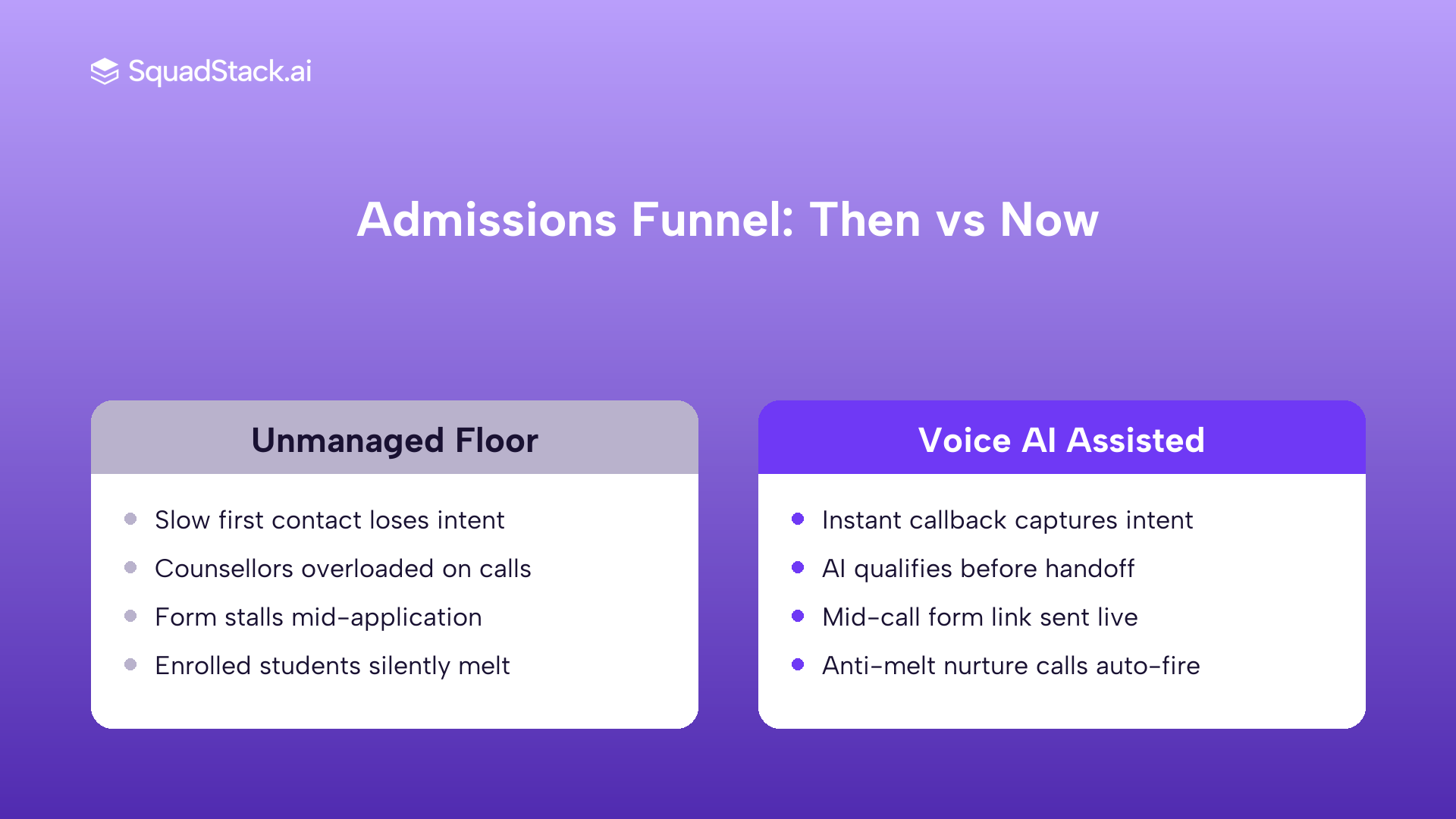
An AI voice agent is a software agent that holds a real phone conversation with a student or parent, qualifies their intent, books their next step, and feeds the outcome back into your admissions system, with no human counsellor on the line.
This is not an IVR that plays a recording and waits for a keypress. The agent listens, understands what the student says, answers follow-up questions from your knowledge base, handles objections, and code-switches between Hindi and English mid-sentence if the student does. It runs at scale, night and day, without the attrition and ramp cycles that make seasonal staffing so expensive.
For a deeper look at the broader platform, see SquadStack's education industry page.
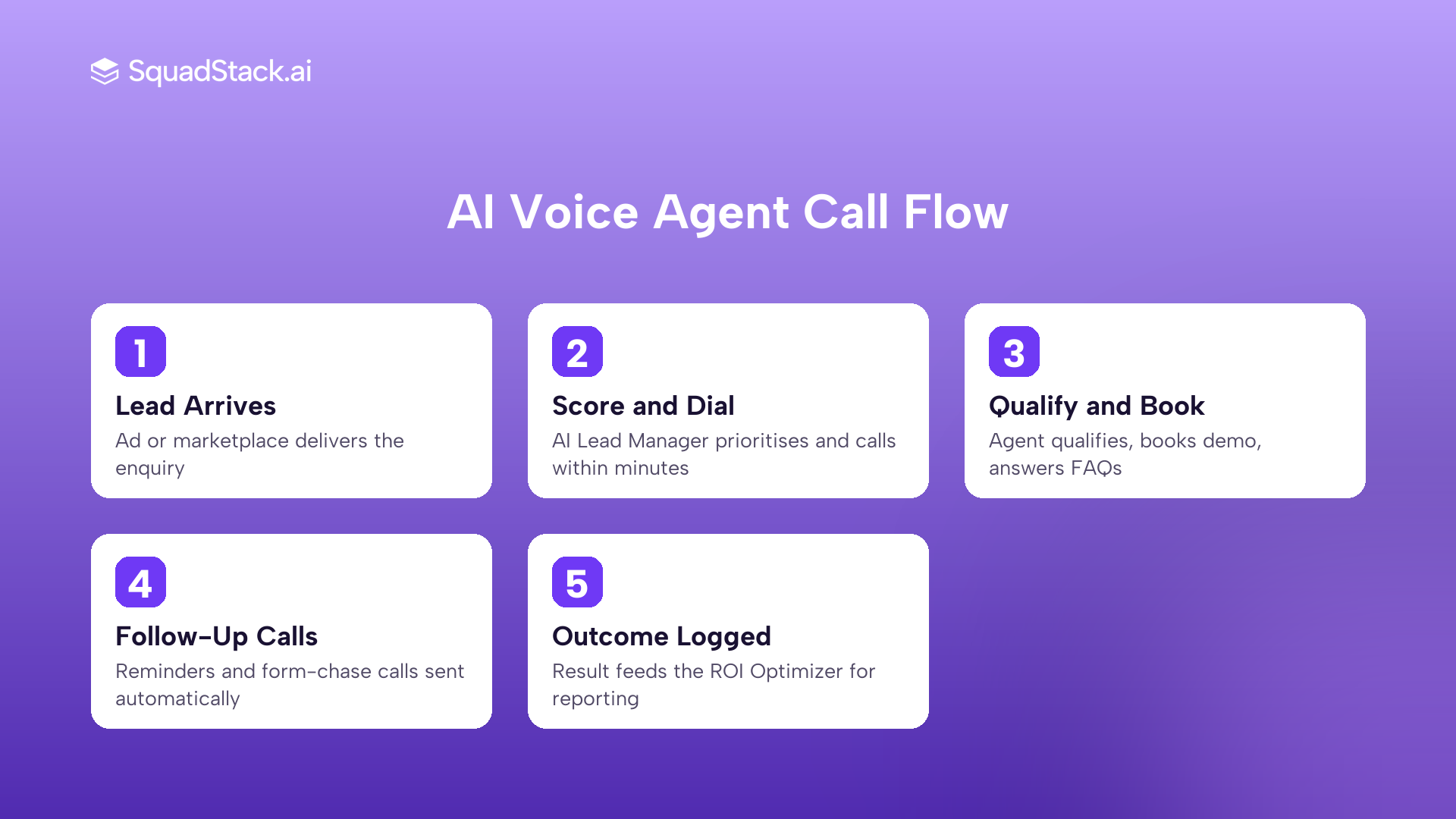
A voice agent call in education follows four functional steps.
Step 1: Lead ingestion and prioritization. The moment a lead lands from an ad, a marketplace, a scholarship test registration, or a missed call, the AI Lead Manager scores it, predicts the best call time, and dials within minutes. Shared marketplace leads go to four institutions simultaneously, so first-to-connect wins.
Step 2: The conversation itself. The agent qualifies stream, eligibility, budget, city, and parent involvement, answers FAQs from your knowledge base, and either books the next milestone (campus visit, demo class, counselling session) or routes the qualified lead to your counsellor floor with full context already captured.
Step 3: Follow-up across the funnel. If the student does not answer, the agent retries on an adaptive cadence. A student who reschedules gets a confirmation and T-24 and T-2 hour reminder calls. A form-filler who stalled at payment gets a call that resumes from that exact point, not from the top.
Step 4: Continuous learning. Every call outcome feeds the ROI Optimizer. The system runs A/B tests across script variants, voice personas, call timing, and follow-up cadences. An agent running in week six handles objections measurably better than in week one, because every interaction improved the next.
The admissions lifecycle has distinct stages, and each has a specific calling job.
The biggest lead-to-enrollment killer is not a bad script. It is no contact at all. Floors carry hundreds of leads per counsellor at peak season, and a large share of paid leads never get called. An AI voice agent touches every lead the moment it arrives.
Qualification covers stream, eligibility, budget, location, and parent involvement. For a university lead, the agent books a campus visit. For an edtech lead, it books a demo class. The counsellor receives a warm handoff with qualifying context already filled in.
Show rates on booked sessions and demo classes are often below 40% without active reconfirmation. An agent calling at T-24 and T-2 hours, handling reschedules on the spot, and sending a WhatsApp link mid-call can lift that number substantially. Every percentage point improvement in show rate adds enrollment revenue from the same lead spend.
Most institutions never systematically call students who started an application and stopped. The agent picks up exactly where the student dropped off, walks them through the payment or document upload, and sends the link while they are still on the call.
A deposit-paid student in June is not a closed admission in August. Multi-blocking, financing delays, and late counselling rounds from competing universities create melt. Warm weekly check-in calls from offer to orientation, document hand-holding, and early detection of wavering students can recover a meaningful share of would-be withdrawals. Almost no institution staffs this work because it peaks when the admissions floor is already at full capacity.
Online-degree programs and test-prep coaching both have semester or year-boundary renewals. Students who go quiet do not formally withdraw; they simply stop re-registering, and revenue disappears silently. A calendar-triggered calling campaign for re-registration windows is one of the highest-ROI uses of voice AI in education. The leads are warm, the ask is specific, and the timing is known months in advance.
Last cycle's unconverted enquiries are near-free pipeline. Re-inquiry leads convert at several times the rate of a first-time enquiry, and a third enquiry converts better still. Calling year-old leads with a new-intake message costs a fraction of buying fresh leads and draws from a pool that already showed intent.
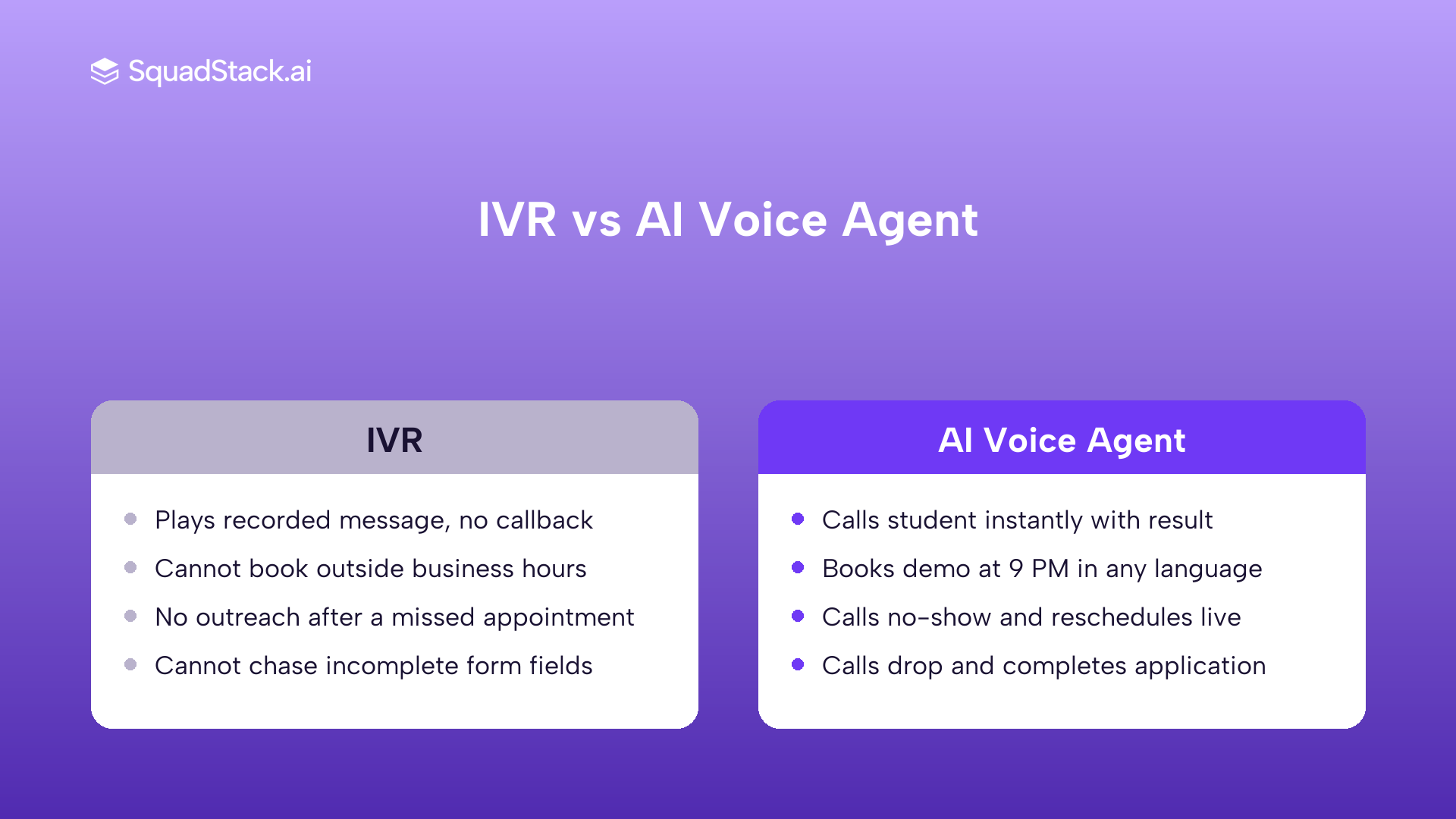
For admissions teams still using IVR trees for enquiry handling, the table below shows why that is costing enrollments.
| Dimension | IVR | AI Voice Agent |
|---|---|---|
| Handling a parent who mixes Hindi and English | Breaks on anything outside the menu; forces the caller to press 1 or 2 | Code-switches naturally mid-sentence, matching the parent's own language pattern |
| Scholarship test result callback | Plays a recorded message; cannot answer "what discount slab did my child qualify for?" | Retrieves the student's score from the knowledge base and explains the scholarship slab in plain language |
| Booking a demo class for a working professional calling at 9 PM | Offers office-hours options only; no dynamic slot management | Books from live availability, confirms the slot, and sends a WhatsApp link before hanging up |
| Counselling no-show recovery | Sends a generic SMS; no live reschedule capability | Calls within the hour, asks what time works, and books a new slot with an immediate confirmation |
| Application drop-chase | No capability | Resumes from the exact step the student abandoned; resolves the specific friction and walks through the action on the call |
Admissions is not a form-routing exercise. The student and parent are making a high-stakes financial decision, often under time pressure from competing offers. A menu tree does not close that sale. A conversation does.
Language depth, not language count. Any platform can list Hindi and English on a feature page. The real question is whether the voice sounds native on an 8kHz phone call to a parent in Coimbatore or a student in Bhagalpur. Ask for call recordings in Tamil, Telugu, and Hindi, not a browser demo.
Admissions-specific call flows. Scholarship-test result callbacks, melt-prevention nurture, and re-registration campaigns each have distinct conversation logic. A platform that has run these before will build faster and handle objections better than one starting from scratch.
CRM and LMS integration. The agent needs to read from and write back to your admissions CRM (Meritto, LeadSquared, Salesforce Education Cloud) and flag completed applications or re-registrations automatically. Manual data sync breaks the operational loop.
Compliance and auditability. Post-BYJU'S, fully audited, recorded sales conversations are a board-level requirement for high-ticket programs. The platform should be TRAI-compliant, handle DND scrubbing automatically, and provide call recordings and transcripts per lead.
Connectivity, not just call volume. Ask for lead-level connectivity numbers, not per-attempt rates, and ask how spam-flagging is managed.
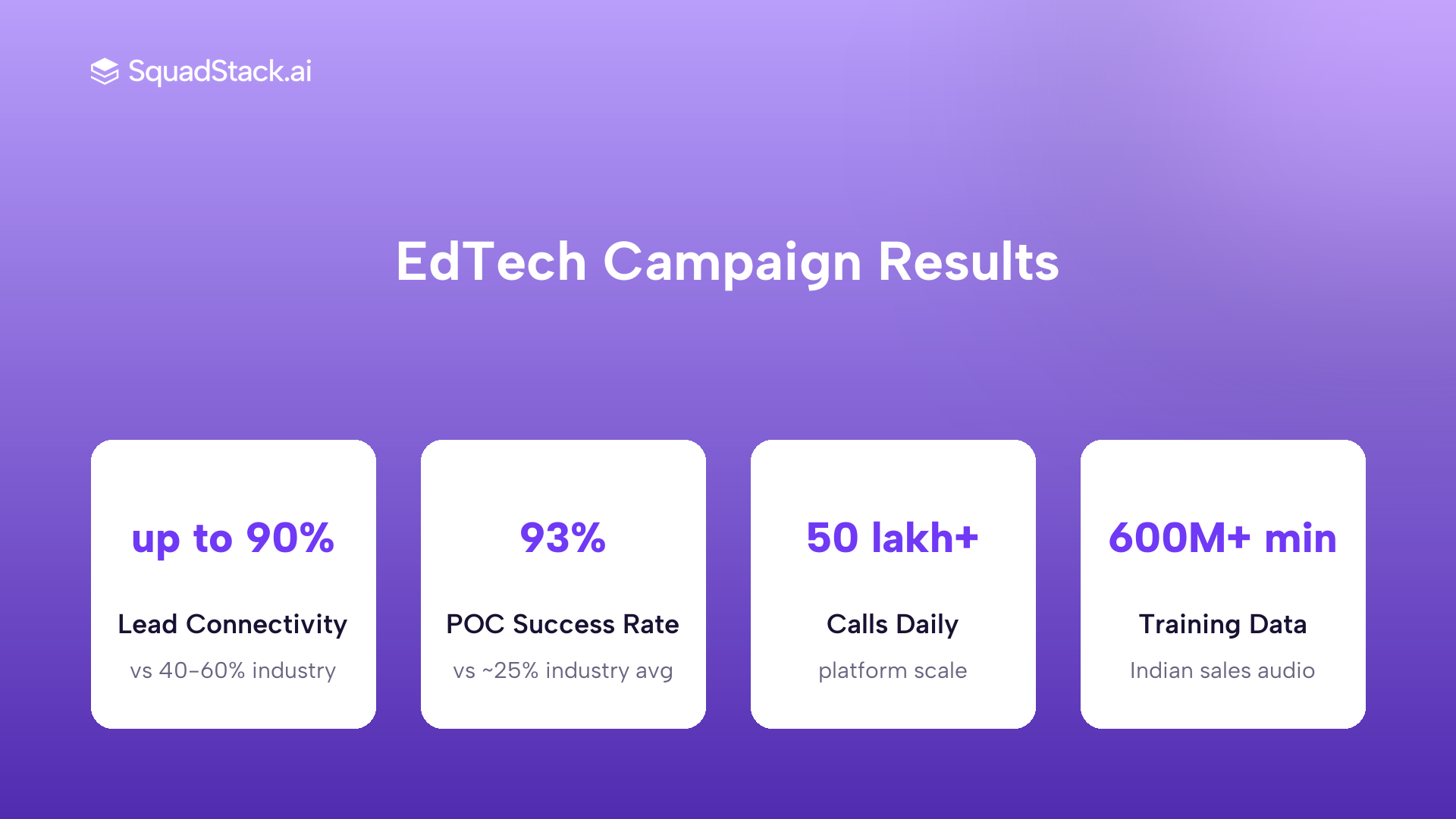
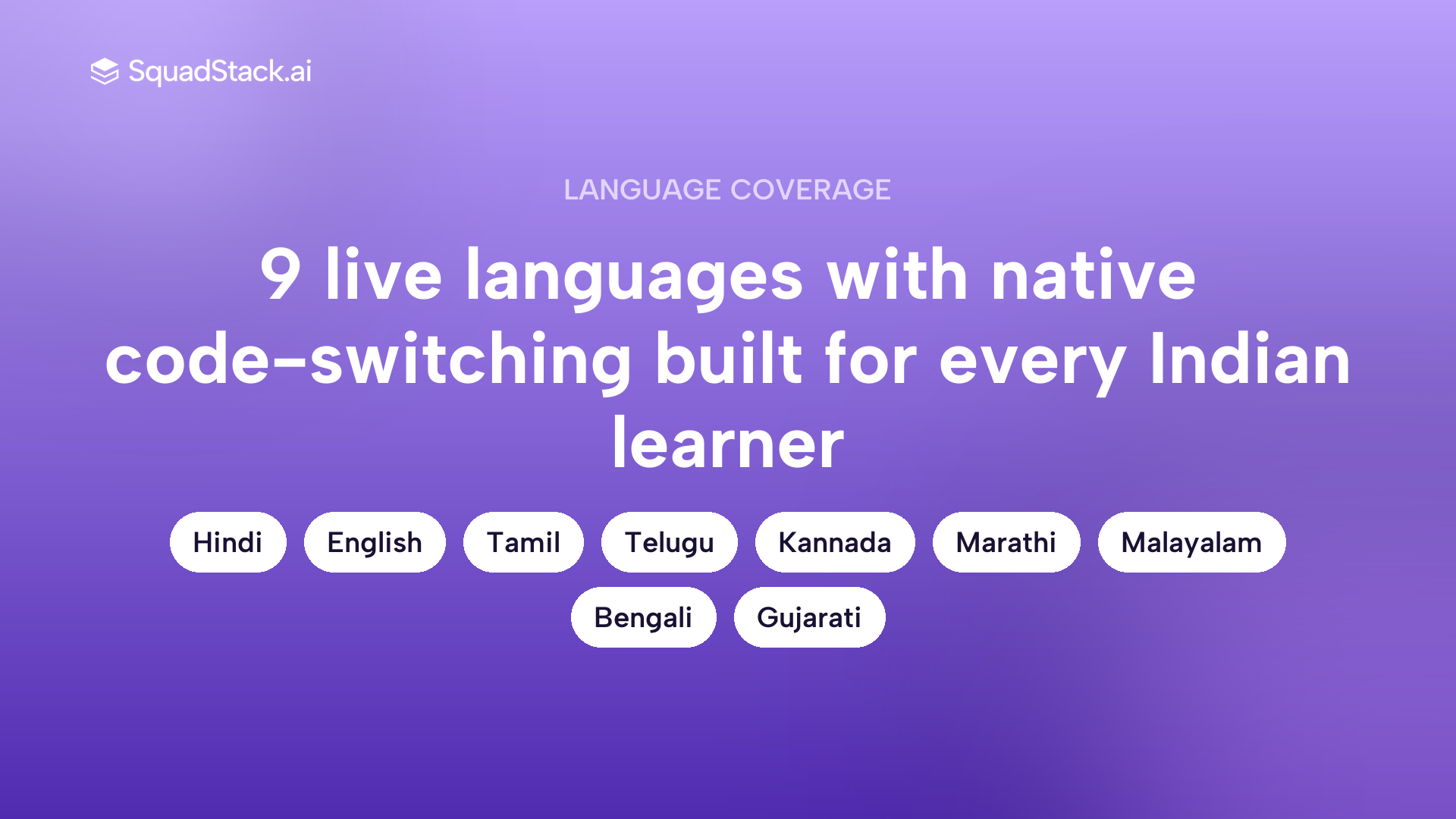
SquadStack has processed over 600 million minutes of real Indian sales conversations. That corpus trains Arth, its proprietary speech model, on Indian telephony conditions: noisy 8kHz lines, code-switching Hinglish, Tamil-English blends, and entity handling for course names, PIN codes, and scholarship amounts. Nine languages are live today: Hindi, English, Tamil, Telugu, Kannada, Marathi, Malayalam, Bengali, and Gujarati, with native code-switching. More regional languages are available on demand.
The education customer list includes Unacademy, Adda247, Classplus, Collegedunia, Nxtwave, and Parul University. Across all industries, SquadStack runs 50 lakh or more calls daily for 60 or more large consumer brands, with a 93% POC success rate against an industry average of around 25%.
The Amity University application completion campaign is the clearest proof point. SquadStack achieved 90% lead connectivity and 2x conversions on application completion, against an industry norm of 40 to 60% connectivity.
Each campaign ships with a dedicated squad: an AI Agent Product Manager, a Forward Deployed Engineer, a Conversational AI Designer, and a QA specialist. The Eval System audits every call on three levels: Outcome, Sentiment, and Execution. Persistent memory means a student who already discussed their program interest and budget never has to repeat themselves on the next call.
Go-live takes approximately two weeks, the pilot runs four to eight weeks against a pre-agreed success metric, and scale starts once the number is proven. For more, see voice bots in India and how AI boosts educational enrollment efficiency.
If your floor is drowning in uncalled leads, losing students to slow callbacks, or watching melt eat into booked revenue every August, start with a four to eight week pilot against a real enrollment metric.
Book a demo with SquadStack and see a live call in Hindi or English on your actual lead flow.
Which is the best AI voice agent for EdTech lead conversion in India?
The best platform for EdTech lead conversion in India combines native-language call quality in Hindi, Telugu, Tamil, and English with education-specific flows built on real Indian admissions data. SquadStack's platform runs lead qualification for Unacademy, Adda247, Nxtwave, and others, with up to 90% lead-level connectivity against a 40 to 60% industry norm.
Can an AI voice agent handle 50,000 calls a month for an edtech in Hindi and English?
Yes. SquadStack runs 50 lakh or more calls daily across all clients. Scaling from a pilot cadence to high-volume campaigns takes days once the pilot metric is proven, with no hiring, training, or attrition to manage. Hindi and English, with native code-switching, are both live languages on the platform today.
How does an AI voice agent compare to a human counsellor floor for admissions calling?
Human counsellors are best used for high-intent, qualified students at the decision stage. An AI voice agent handles top-of-funnel volume: qualification, demo booking, reconfirmation, and form-chase, at a fraction of the cost and without the seasonal ramp problem. The platform routes qualified leads to your counsellors with full context already captured, so closers spend time closing.
What is the typical lead connectivity for an education campaign?
The industry norm for lead-level connectivity across education campaigns is 40 to 60%. SquadStack's AI Lead Manager, which uses spam-aware number rotation, adaptive outreach timing, and a configurable retry cadence, delivers up to 90% lead-level connectivity in live campaigns.
How does the platform handle parent-facing calls in regional languages?
The voice agent code-switches mid-sentence between Hindi and English, and between Tamil or Telugu and English, matching the parent's natural speech pattern. Language selection is automatic once the call begins. The voices are cloned from real top-performing Indian sales agents, not generic text-to-speech, so the output sounds like a human caller, not a newsreader.
Is a voice AI platform compliant with TRAI and India's DPDP rules?
SquadStack is ISO 27001, ISO 27701, SOC 2 Type II, DPDP, and TRAI compliant. Lead lists are scrubbed against the TRAI DND registry before dialing. Calling windows are hard-enforced by the platform (9:30 AM to 8:30 PM). Consent capture, opt-out handling, and AI disclosure are built into the conversation layer.
What does "persistent memory" mean for an education campaign?
Persistent memory means the agent remembers what a student said across multiple calls. If a student told the agent on Monday that they are interested in an MBA program and their budget is under two lakh rupees, the Tuesday follow-up call opens with that context, not a fresh qualification. Students never repeat themselves, and counsellors receive richer handoff data.
How long does it take to go live with a voice agent for admissions?
Setup takes approximately two weeks, covering solutioning, agent build, CRM integration, and UAT. The pilot then runs four to eight weeks on real leads, ramping from a few hundred calls per day to full campaign volume. SquadStack has a 93% POC success rate, so most pilots produce a provable result within the first month.
Can the voice agent handle inbound admissions calls at peak season?
Yes. The same voice agent stack handles inbound calls, answering eligibility, fee, and document questions from the institution's knowledge base, booking counselling slots, and handing off complex queries to a human with full context. This matters most in May to July when inbound volume spikes and a missed call is a missed enrollment.
How does the ROI Optimizer improve campaign performance over time?
After every call, outcomes feed back into the ROI Optimizer. The platform runs A/B tests on script variants, voice personas, call timing, and follow-up channels. Lift, the self-improvement layer, reads near-miss calls and early drop-offs, proposes precise edits, passes every change through a human review gate, and validates improvements on live traffic before scaling them. Every call the agent makes leaves it a little better calibrated than the one before.