AI Voice Agents for Inbound Support with Complex Query Escalation
September 21, 2026
|

12 min read
AI voice agents for healthcare India are already handling appointment booking, follow-up calls, lab slot confirmations, and patient recall at scale, all...
AI voice agents for healthcare India are already handling appointment booking, follow-up calls, lab slot confirmations, and patient recall at scale, all while staying on the right side of the Telemedicine Practice Guidelines 2020. The biggest wins come from plugging the coverage and latency gaps that no amount of hiring can fix. This playbook covers where voice AI attaches across the patient journey, what the legal line is, how to evaluate a vendor, and why Indian-market experience is non-negotiable.
Key Takeaways
Healthcare calling is broken in a specific way. The problem is not that the calls are bad. The problem is that most of them never happen. Floors close at 9 PM. Teams run six-day weeks. Lapsed patient lists run into the hundreds of thousands while a handful of agents chip away at them. An enquiry that sits for thirty minutes is largely gone.
That is the gap AI voice agents for healthcare India fill. Not by being a cleverer salesperson, but by being always-on, always-in-language, and never running out of capacity.
An AI voice agent is a software-driven caller that holds a real two-way phone conversation, in the patient's own language, without a human agent on the line. It listens, understands context, responds in under a second, and takes actions like booking a slot or sending a WhatsApp confirmation, all mid-call.
It is not an IVR with a friendly voice. It understands natural speech, handles interruptions, remembers what was said earlier in the call, and can pick up where a previous call left off. The clinical boundary is fixed and absolute: it handles administrative conversations only, never clinical ones.
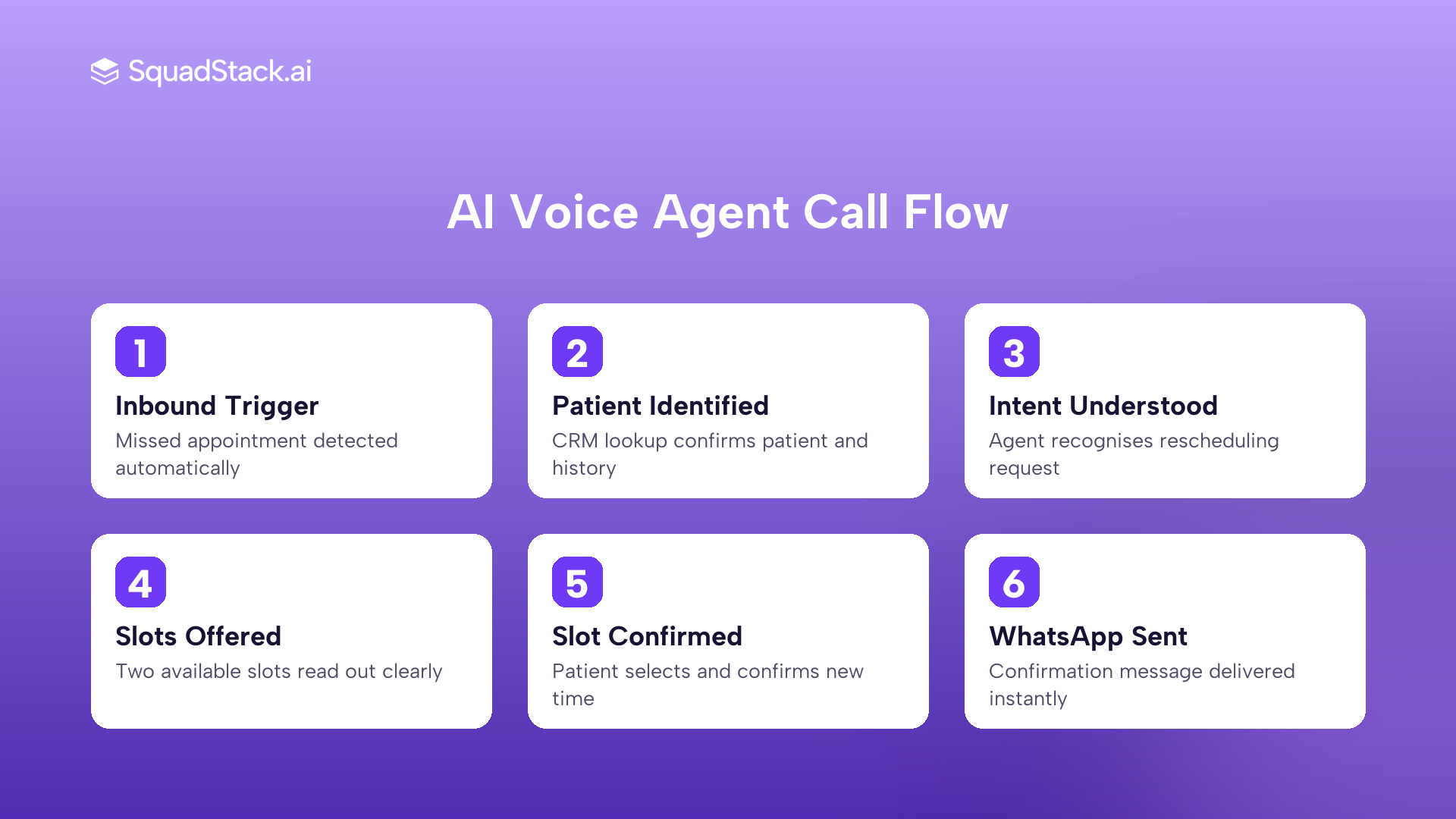
A well-built agent runs a six-step loop on every call.
1. Pre-call intelligence. The system scores the lead, picks the best time to call, selects the right language and voice persona, and loads prior interaction context. A patient who rescheduled twice gets a different opening than a fresh enquiry.
2. Conversation. The agent calls and conducts the conversation in the patient's preferred language with native code-switching. If a Tamil-speaking patient mixes Tamil with English mid-sentence, the agent follows naturally. Median response latency is 0.8 seconds or less.
3. In-call actions. The agent can book or reschedule slots, send a WhatsApp confirmation while the patient is still on the line, collect feedback, and trigger a warm transfer to a human if the conversation moves into clinical territory.
4. Entity extraction. The system pulls structured data: confirmed slot, patient's stated concern, outcome. That goes into the CRM automatically.
5. Retry and follow-up. If the patient did not pick up, the system retries across a defined cadence at the best time for that patient, with no manual queue management.
6. Continuous learning. Every call feeds back via the ROI Optimizer. The Eval System scores every conversation on outcome, sentiment, and execution, driving script refinements, timing adjustments, and voice choices on future calls.
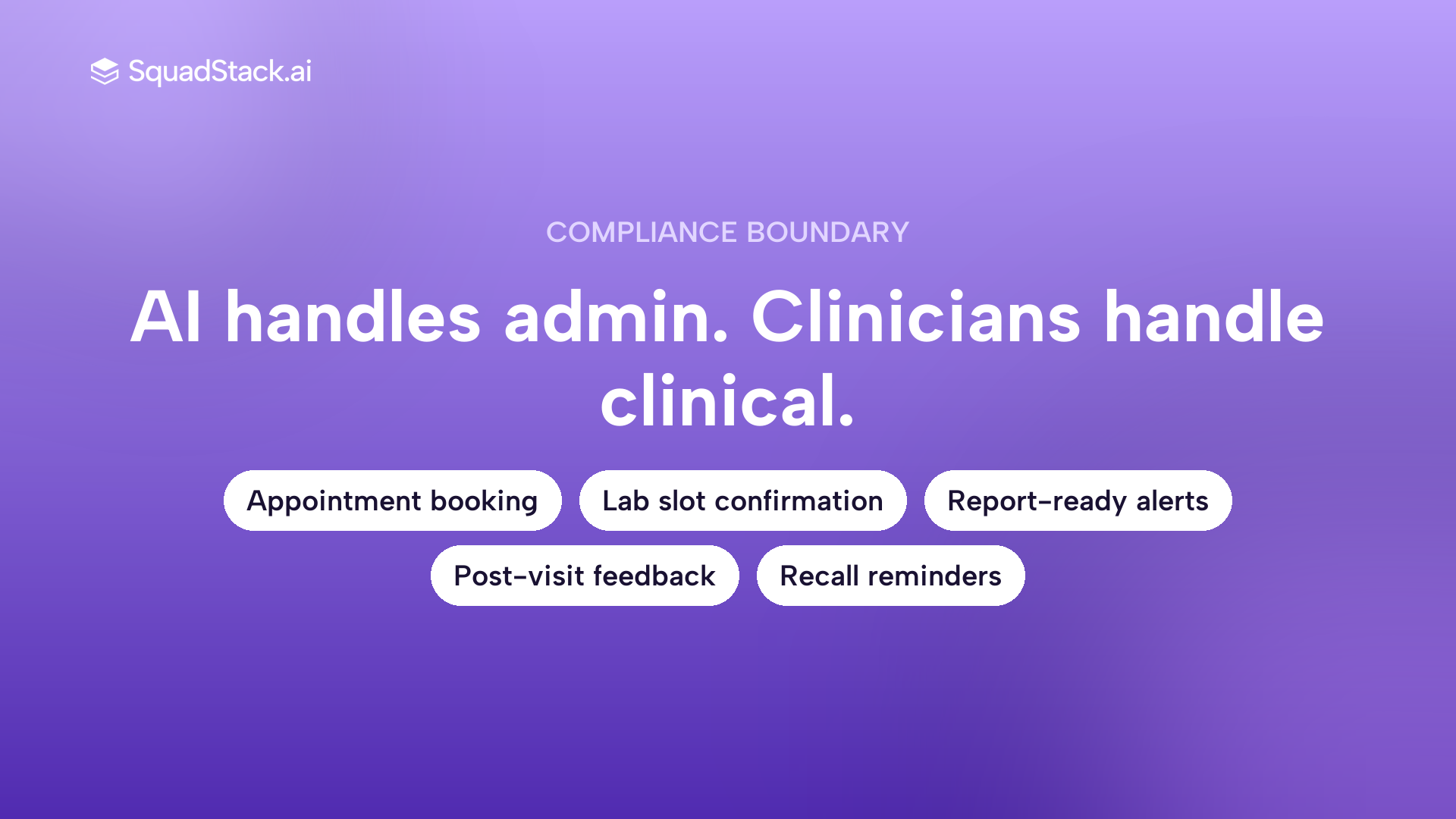
Voice AI attaches at high-volume, low-clinical-risk points where coverage and latency are the real constraints.
Appointment booking and rescheduling. Inbound enquiries after hours, outbound scheduling when a slot opens, rescheduling calls when a patient misses. The agent handles all three in the patient's language, at any hour. Medibuddy uses SquadStack's voice AI for appointment confirmation on both the patient and hospital legs of the booking.
No-show recovery. A reminder 24 hours before and a rescheduling call the day after capture a large share of avoidable no-shows. This fixes the coverage problem, not the motivation problem.
Lab and diagnostic slot confirmation. The single cleanest ROI story in healthcare. A phlebotomist dispatched to a patient who is not home, not fasting, or has the wrong address is a field cost with no revenue. A confirmation call in the hour before the slot eliminates most avoidable misses.
Report-ready notification. "Your report is ready. Would you like us to connect you with a doctor?" That is the entire permitted scope. The agent never describes whether a value is normal or abnormal. Critical values are an accreditation-governed clinical communication, and that line is absolute.
Post-discharge follow-up. Scoped to logistics: did the patient fill the prescription, is the review appointment booked, does the patient have the discharge summary. Scripts must be reviewed against the chain's own clinical governance before go-live.
Recall and reactivation. Quarterly HbA1c for a diabetes patient. Annual lipids for a cardiovascular risk patient. The due date arrives and almost nobody calls, because the lapsed base runs into the millions while the team counts in the dozens. The call is simple: your test is due, book a slot or a home collection. The challenge is doing it at scale across a million records, in six languages, seven days a week.
Patient feedback and NPS. Post-visit surveys run as a real conversation, not a keypad menu. Completion rates are materially higher than SMS surveys.
For a closer look at how SquadStack has deployed these use cases, see the Medfin case study and the broader SquadStack healthcare industry page.
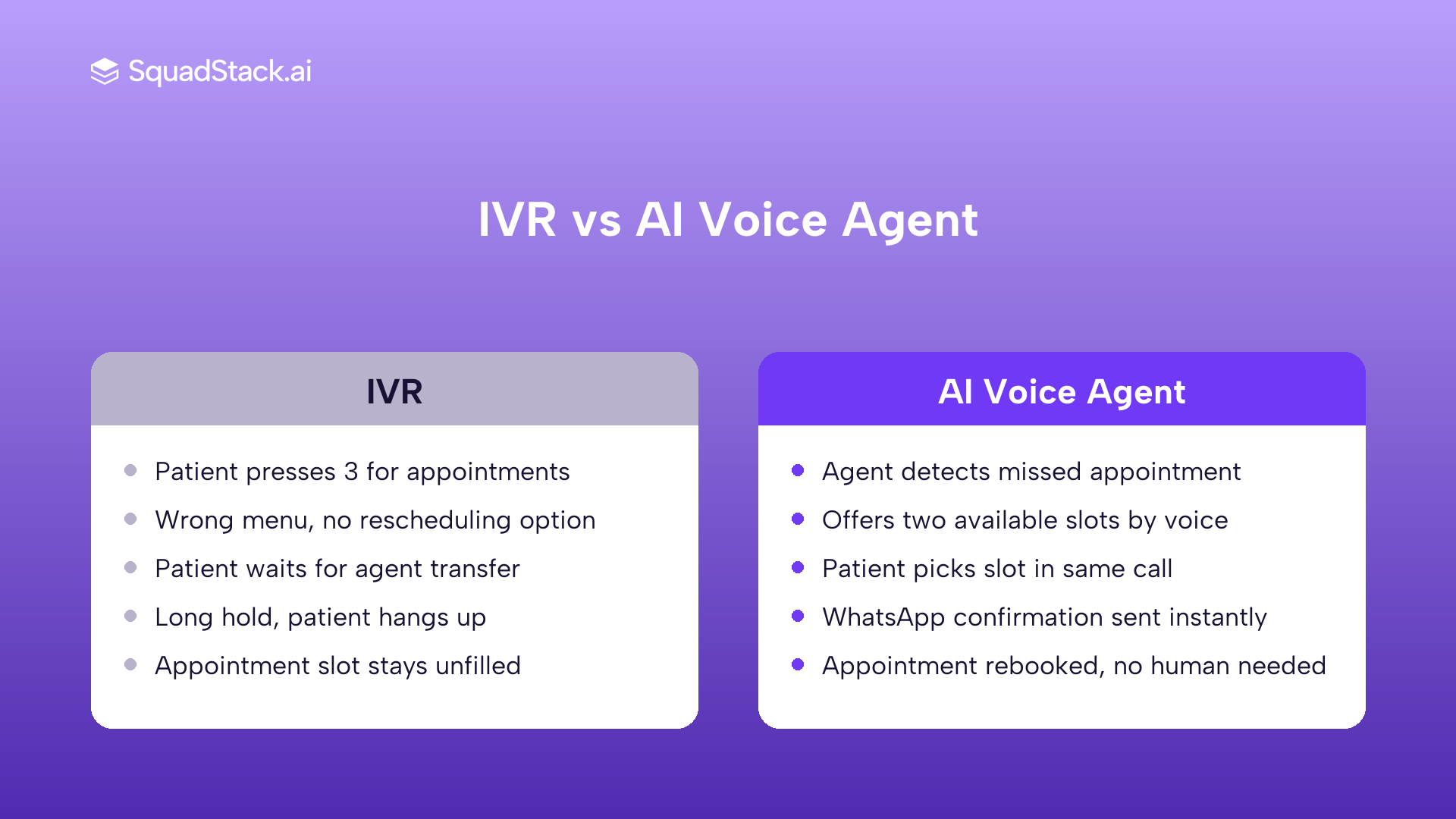
For healthcare specifically, the IVR vs voice agent gap is not just about naturalness. It is about trust. A patient calling to reschedule a sensitive appointment who hears "press 3 for cancellations" at minute two does not call back.
| Dimension | Traditional IVR | AI Voice Agent |
|---|---|---|
| Rescheduling a missed appointment | Cannot reschedule without the patient pressing the right option. Most patients hang up. | Detects the missed appointment context, offers specific available slots, books on the spot. |
| Patient calling in a regional language | Routes to a fallback menu or a human queue. Capacity collapses at off-peak hours. | Responds natively in Tamil, Telugu, Hindi, Kannada or English with code-switching. No fallback needed. |
| Handling an anxious patient who talks over the options | Does not understand interruptions. Loops to the main menu. | Stops the current sentence, listens, and responds to what the patient actually said. |
| Slot confirmation with a fasting requirement | Plays a pre-recorded message. No confirmation captured. | Confirms the patient is fasting, confirms home address, sends a WhatsApp summary. |
| Follow-up on a missed call | No retry logic. Leaves a callback number. | Retries at the best time for that patient, across a defined cadence, with full context from the previous call. |
IVRs work for simple routing at the top of an inbound queue. They cannot handle the conversational density of a rescheduling call, a recall outreach, or a post-discharge follow-up.
Most generic platforms fail in Indian healthcare for the same reasons. Use these criteria as a vendor filter.
| What to check | Why it matters | What good looks like |
|---|---|---|
| Compliance posture | DPDP Act, TRAI rules, and Telemedicine Practice Guidelines 2020 govern what can be said on a patient call. | ISO 27001, SOC 2 Type II, DPDP and TRAI compliant. Data hosted in India. Hard calling-window enforcement. |
| Regional language depth | Healthcare demand in Tier 2 and 3 markets is growing faster than metros. Patients in Coimbatore or Vijayawada need more than Hinglish. | Live conversations in Tamil, Telugu, Kannada, Hindi, and English with native code-switching. |
| Clinical boundary handling | The agent must escalate the moment a conversation turns clinical. A misconfigured agent creates medico-legal exposure. | Warm transfer triggers for clinical keywords. Locked script sections the optimization loop cannot touch. |
| Integration with your HIS/booking system | An agent that cannot write the confirmed appointment back to your system creates double-handling. | API-first, with CRM write-back and webhook support. |
| Managed vs self-serve | Healthcare scripts require domain sensitivity. A self-serve platform puts the burden of getting the clinical boundary right on your team. | A dedicated squad: Conversational AI Designer, QA specialist, and a forward-deployed engineer on your account. |
| Volume and latency at scale | A 0.8-second response in a pilot can drift at production volume if the infrastructure is not built for it. | Proven at 50 lakh+ calls daily. Median latency of 0.8 seconds or less maintained across long calls. |
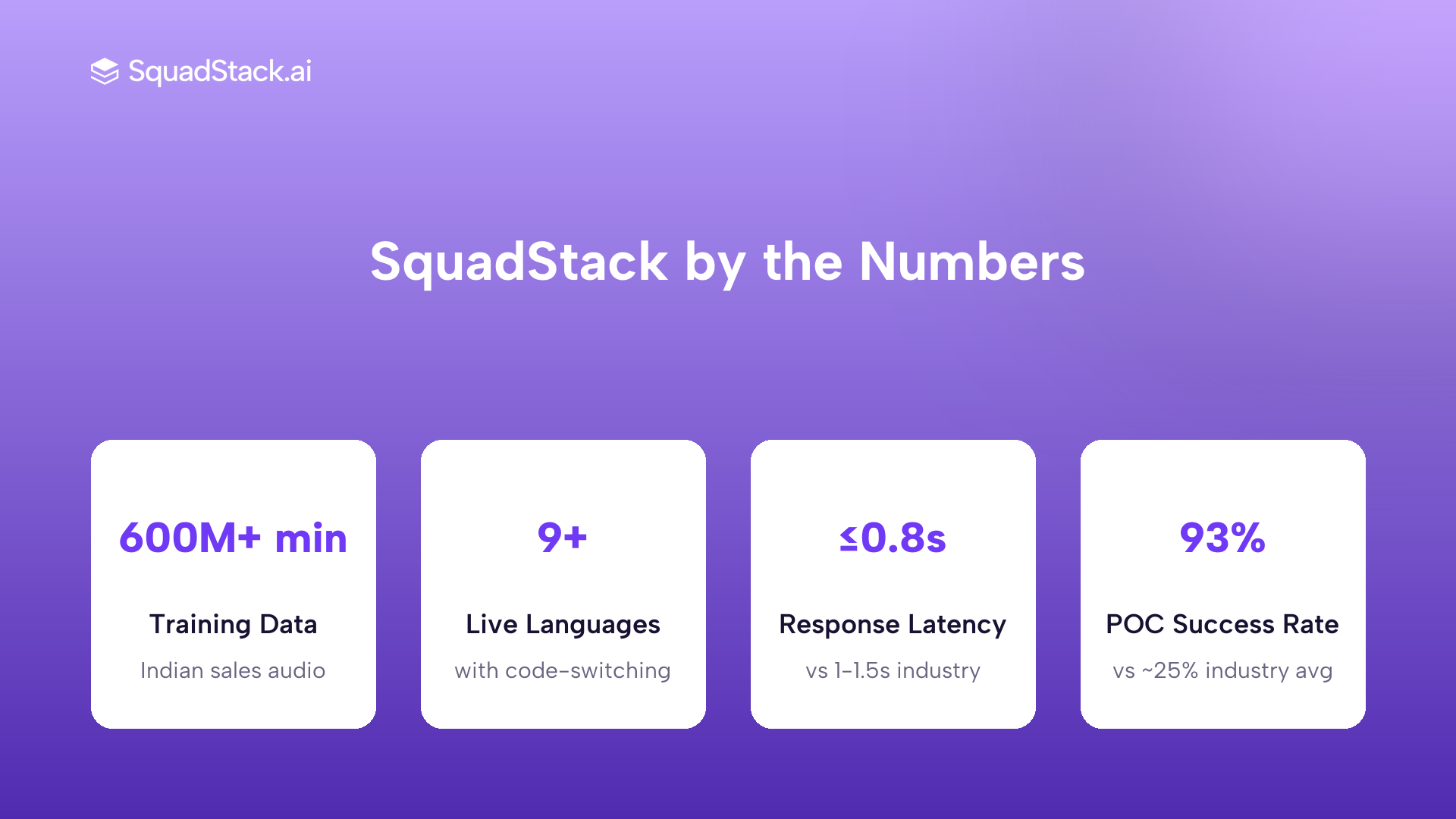
The biggest differentiator in healthcare calling is not features. It is training data and managed deployment. Generic global platforms are trained on public audio datasets. SquadStack's proprietary speech model, Arth, is trained on 600 million plus minutes of real Indian contact-center conversations, including Hinglish, Taminglish, and noisy 8kHz telephone audio that does not exist in public datasets. The Abruptly Disconnected Rate on SquadStack campaigns has come down to around 10%, inside the human agent range, from well above 40% at the start of 2025.
For healthcare teams, this matters in two ways. Patients in Tamil Nadu and Andhra Pradesh hear an agent that sounds native to them. The Eval System scores every call on Outcome, Sentiment, and Execution, so a call that was technically correct but felt abrupt gets flagged and improved, not just counted as complete.
The compliance layer is built in: DPDP-compliant data residency in India, TRAI calling-window hard enforcement, consent gating and opt-out handling in the conversation layer, and locked script sections that no self-improvement loop can modify. For a hospital group or diagnostics chain running thousands of patient calls a day, that auditability is not optional.
Medibuddy runs live appointment confirmation through SquadStack. The platform handles 50 lakh plus calls daily across 60 plus large consumer brands. The POC success rate is 93%, against an industry average near 25%. Most deployments go live within two to three weeks, gated on client-side data feeds and compliance sign-off.
The healthcare calling problem in India is not a quality problem. It is a coverage and latency problem. Floors close, teams are understaffed for the recall volume, and enquiries go cold in thirty minutes. AI voice agents for healthcare India solve the coverage gap while staying firmly on the administrative side of the clinical line.
The right deployment starts with the right segment: diagnostics for the fastest ROI, single-specialty chains for funnel follow-up at scale, and health-tech platforms for appointment and feedback automation. The right vendor brings India-trained speech models, managed deployment, and a compliance posture that a hospital's legal team can approve.
Book a demo with SquadStack to see a live healthcare call in your language.
Which is the best AI voice agent for healthcare appointment booking in India?
The best option is one built specifically for Indian telephony conditions: regional-language support with native code-switching, DPDP-compliant data residency, and hard enforcement of TRAI calling windows. SquadStack runs live appointment confirmation for Medibuddy and handles 50 lakh plus calls daily across industries, with a median response latency of 0.8 seconds or less.
What can an AI voice agent legally say to a patient in India?
Under the Telemedicine Practice Guidelines 2020, AI may not counsel patients or prescribe medicines. Administrative speech acts are permitted: booking and rescheduling appointments, confirming lab slots, notifying that a report is ready, collecting post-visit feedback, and routing to a human. Symptom triage, result interpretation, and any disease-cure claims are outside the permitted scope.
Is there a DPDP-compliant AI voice bot for hospital appointment reminders and follow-up calls?
Yes. A DPDP-compliant solution keeps patient data on India-hosted infrastructure, uses consent gating in the conversation layer, and enforces opt-out handling per TRAI rules. SquadStack is ISO 27001, ISO 27701, SOC 2 Type II, DPDP, and TRAI compliant, with all models hosted in India.
Can an AI voice agent handle patients who speak Tamil, Telugu, or Kannada?
Yes, if the platform is built for it. SquadStack runs live conversations in Tamil, Telugu, Kannada, Hindi, and English with native mid-sentence code-switching, trained on 600 million plus minutes of real Indian telephony audio. Patients who mix languages naturally are understood and responded to without a fallback to a human or a menu.
How does an AI voice agent reduce no-shows in a clinic or hospital?
The agent sends a confirmation call or WhatsApp message before the appointment, confirms the patient intends to attend, and books an alternative slot if they cannot make it. The coverage is the win: reminders go out at the right time for every patient on the list, not just the ones a human team reached before 7 PM.
What is the difference between an AI voice agent and an IVR for healthcare?
An IVR plays pre-recorded menus and requires keypad input. It cannot understand natural speech, handle rescheduling requests mid-call, or respond in a patient's regional language. An AI voice agent holds a real two-way conversation, books or reschedules on the spot, and transfers to a human the moment a call turns clinical. IVRs work for simple call routing; they cannot do what a healthcare outreach campaign actually requires.
How long does it take to deploy an AI voice agent for a healthcare campaign?
Most deployments go live within two to three weeks. The build time depends on agent training on the client's own call recordings and knowledge base, plus client-side dependencies like CRM integration and compliance sign-off. The clinical boundary configuration and script review are part of the setup, not afterthoughts.
Which healthcare segment sees the fastest ROI from AI voice agents?
Diagnostics. The call volumes are high, the conversations are low-consequence, and the cost story around phlebotomist slot protection is clean and immediate. A confirmed-fasting, confirmed-at-home call in the hour before a home-collection slot eliminates most avoidable wasted visits. The buyer is commercial rather than clinical, and the sales cycle is the shortest in healthcare at roughly three to six months.
Can an AI voice agent handle a patient who wants to speak to a human?
Yes. Warm transfer is a standard capability. The agent hands off to a human agent with full conversation context already passed across, so the patient does not repeat themselves. Transfer triggers are configurable per campaign: patient request, a clinical keyword, a specific objection, or a detected sentiment shift.
How does persistent memory work across multiple patient calls?
Each patient has a memory record that carries across calls. If a patient rescheduled on Monday and calls again Thursday, the agent already knows about the reschedule. If an outbound recall campaign reaches a patient who said "call me next week" on the previous attempt, the follow-up opens with that context. The patient never starts from the beginning.