AI Voice Agents for Inbound Support with Complex Query Escalation
September 21, 2026
|

12 min read
AI voice agents for logistics India are now the operational backbone for NDR resolution, COD confirmation, rider hiring, and rescheduling across India's...
AI voice agents for logistics India are now the operational backbone for NDR resolution, COD confirmation, rider hiring, and rescheduling across India's fastest-growing delivery networks. A single voice AI platform can handle the full calling surface from pre-dispatch to proof of delivery, in Hindi, Tamil, Telugu, Kannada, and English, without adding headcount. This playbook covers every point where calling attaches across the logistics flow and how to build the stack.
The single biggest calling surface in Indian logistics is also the most ignored one.
Every day, millions of parcels fail delivery across tier-2 and tier-3 India. Customers are unreachable, addresses are incomplete, and COD orders return at rates that would be catastrophic in any other industry. Meanwhile, the rider fleet churns at 30 to 40% a month, and the hiring desk is dialing fresh leads round the clock just to stand still.
These are not edge cases. They are the structural shape of last-mile logistics in India, and they each require a phone call to fix. The question is whether that call is made by a human dialing a spreadsheet or by a voice AI agent that scales instantly, speaks the customer's language, and logs structured outcomes in real time.
This is the complete playbook. For a broader overview, see SquadStack's Logistics, Quick Commerce and Mobility industry hub.
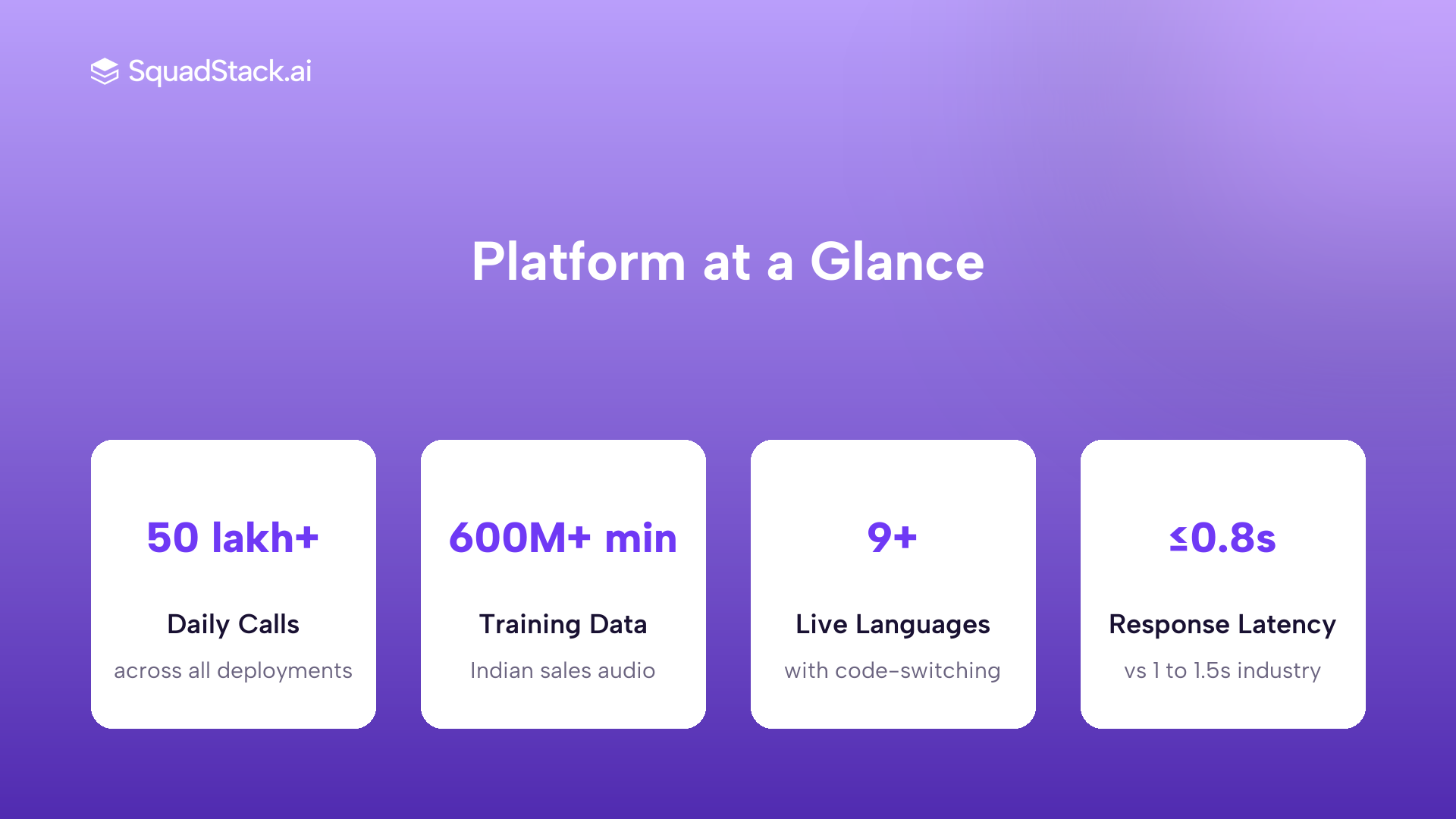
An AI voice agent for logistics is a software-based calling agent that holds real, two-way phone conversations, handles objections, captures structured data, and writes outcomes back to your CRM, without a human dialing the number.
It is not an IVR. It does not play a menu. It listens, responds in under 0.8 seconds, and adapts to whatever the customer says, including "Aabhi ghar par nahi hoon" or a garbled address on a 2G line.
Here is how a typical NDR resolution call runs on a voice AI platform:
1. Trigger. A failed delivery attempt is logged in the logistics management system and pushed to the voice AI platform via webhook or API. 2. Prioritization. The AI Lead Manager scores the lead and queues the call within the first few hours. Earlier contact means far higher rescheduling success. 3. The call. The voice agent calls the customer in their preferred language, states why it is calling, and asks what happened: unavailable, wrong address, or wants to reschedule. 4. Data capture. The agent captures a corrected address with landmark, a preferred delivery slot, and any refusal reason as structured fields, not just a transcript. 5. Outcome routing. Confirmed slots write back to the TMS. Refusals are noted with reason. Address corrections update the record before the next attempt. 6. Continuous learning. Every call feeds the ROI Optimizer. Outcome data identifies which scripts, language choices, and calling windows perform best, so the next wave of NDR calls improves on this one.
The same flow applies to COD confirmation before dispatch, pickup validation before a rider is dispatched to a seller, and rider onboarding calls that walk a candidate through video KYC step by step.
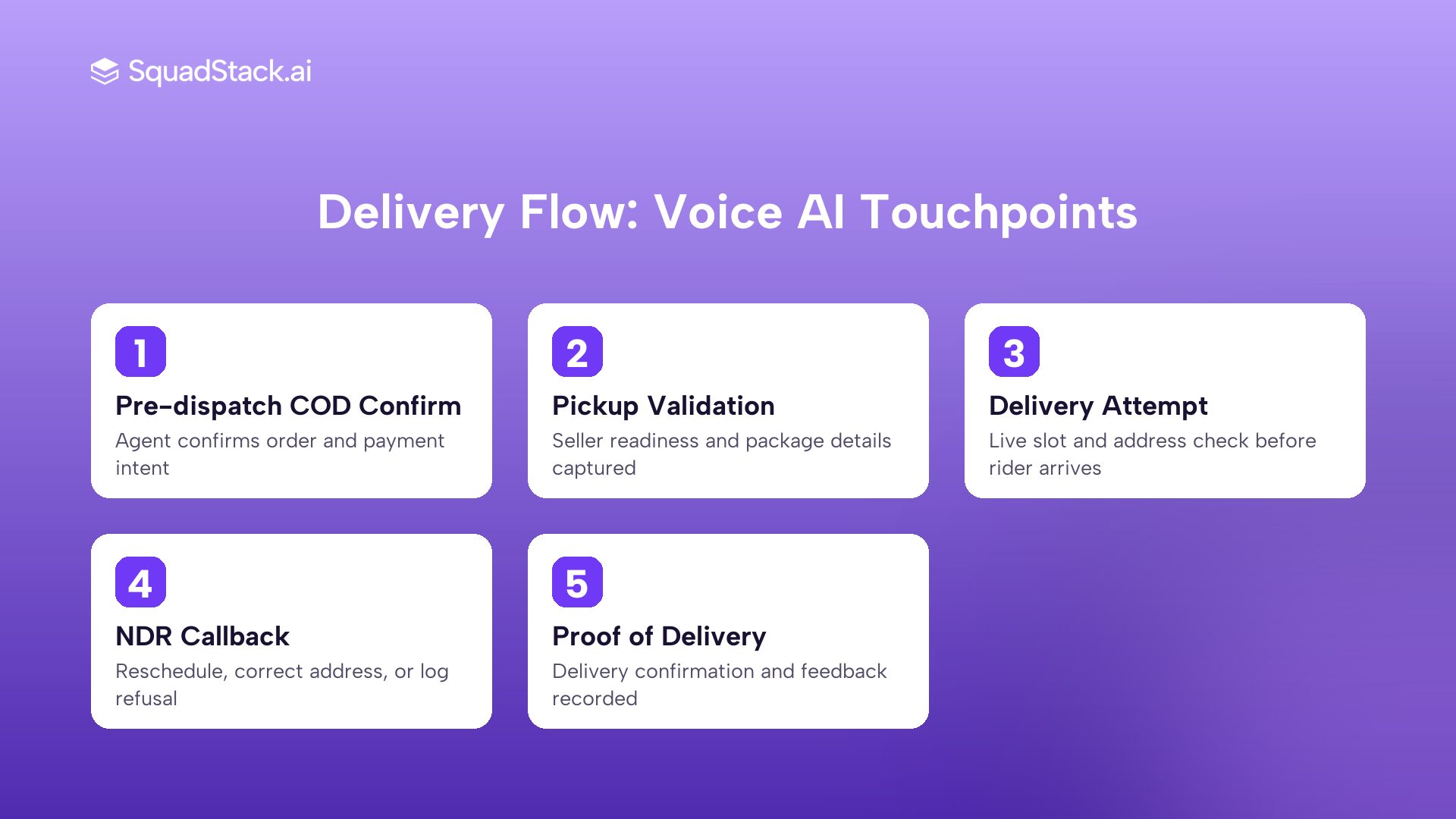
Voice AI for logistics is not one use case. It is a set of distinct calling motions, each attached to a different point in the delivery or workforce lifecycle.
COD orders return at roughly thirteen times the rate of prepaid ones. A short outbound call before dispatch confirms the order and explains the prepaid option, converting a meaningful share without pressure. The ones who stay on COD are confirmed as genuine, which reduces no-answer rates at the door.
Dispatching a rider to a seller who is not ready wastes the same cost as a failed delivery. A quick pre-pickup call confirms the parcel is packed and the seller is present, cutting wasted trips before they happen. This is live at Delhivery.
The NDR callback is the highest-volume, highest-impact calling surface in express logistics. Reason codes tell you what a call can fix: unavailable means rescheduling, wrong address means landmark capture, refused means understanding why. A voice agent handles all three in one call, in the customer's language, and logs the outcome.
Scale matters here. Some express players run hundreds of thousands of NDR calls every day. A human floor cannot match that volume or speed.
When a customer calls to ask where their parcel is, a voice agent handles the full inquiry: status lookup, rescheduling to a confirmed slot, and escalation to a human only on damage claims or disputes.
The workforce side is a permanent, always-on operation. A company like Zomato onboards over a lakh delivery partners every month and loses roughly the same number. The fleet does not grow; it refills.
Voice AI handles the full supply funnel: initial tele-screen, document collection follow-up, walking a Hindi-belt candidate through video KYC, and reactivation calls to dormant riders before a competitor takes them. Swiggy uses SquadStack for rider hiring and onboarding. Everest Fleet runs driver hiring and appointment booking on the platform.
For quick commerce specifically, the customer-side calling economics do not work on a typical basket. The real calling surface is supply-side: rider hiring, dark-store staff onboarding, and vendor coordination.
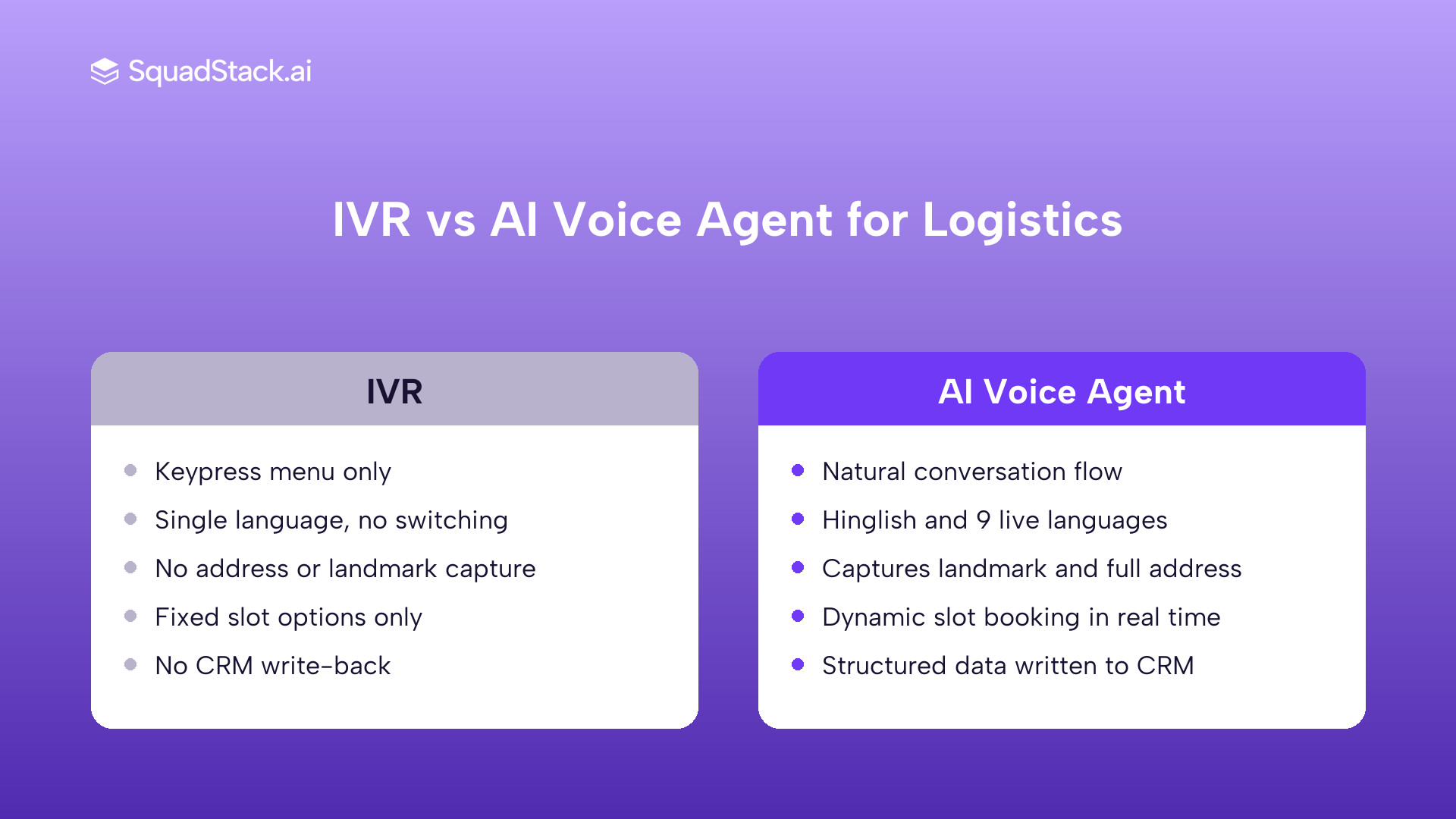
The distinction between a voice AI agent and a traditional IVR is sharper in logistics than almost any other industry, because the calls logistics needs are fundamentally conversational.
| Dimension | Traditional IVR | AI Voice Agent |
|---|---|---|
| NDR address correction | Cannot capture a free-text landmark | Listens, confirms, and writes the corrected address to the record |
| COD objection handling | Plays a pre-recorded message and disconnects | Handles the "why prepaid?" question across two or three turns in Hinglish |
| Language switching | One language per call path, no deviation | Native code-switching mid-sentence across Hindi, English, Tamil, Telugu, Kannada, Marathi, Malayalam, Bengali, Gujarati |
| Rescheduling | Offers fixed time slots from a menu | Negotiates a preferred slot, confirms it, and syncs to the TMS |
| Unscripted input | Breaks or loops back to the main menu | Processes natural speech and responds with context |
| Outcome capture | Keypress only | Structured fields: address, slot, refusal reason, sentiment |
The IVR failure mode in logistics is easy to reproduce: a customer says "mera address change hai, ek kaam karo, landmark add kar do" and the IVR cannot process the sentence. The call ends without a resolution, the parcel gets a second failed attempt, and the return-to-origin cost follows.
The buyer questions that separate vendors are more specific than a standard feature checklist.
Does it handle Indian telephony conditions? NDR and COD calls go to real mobile numbers on 2G lines with background noise. A model trained on clean studio audio will fail on these calls.
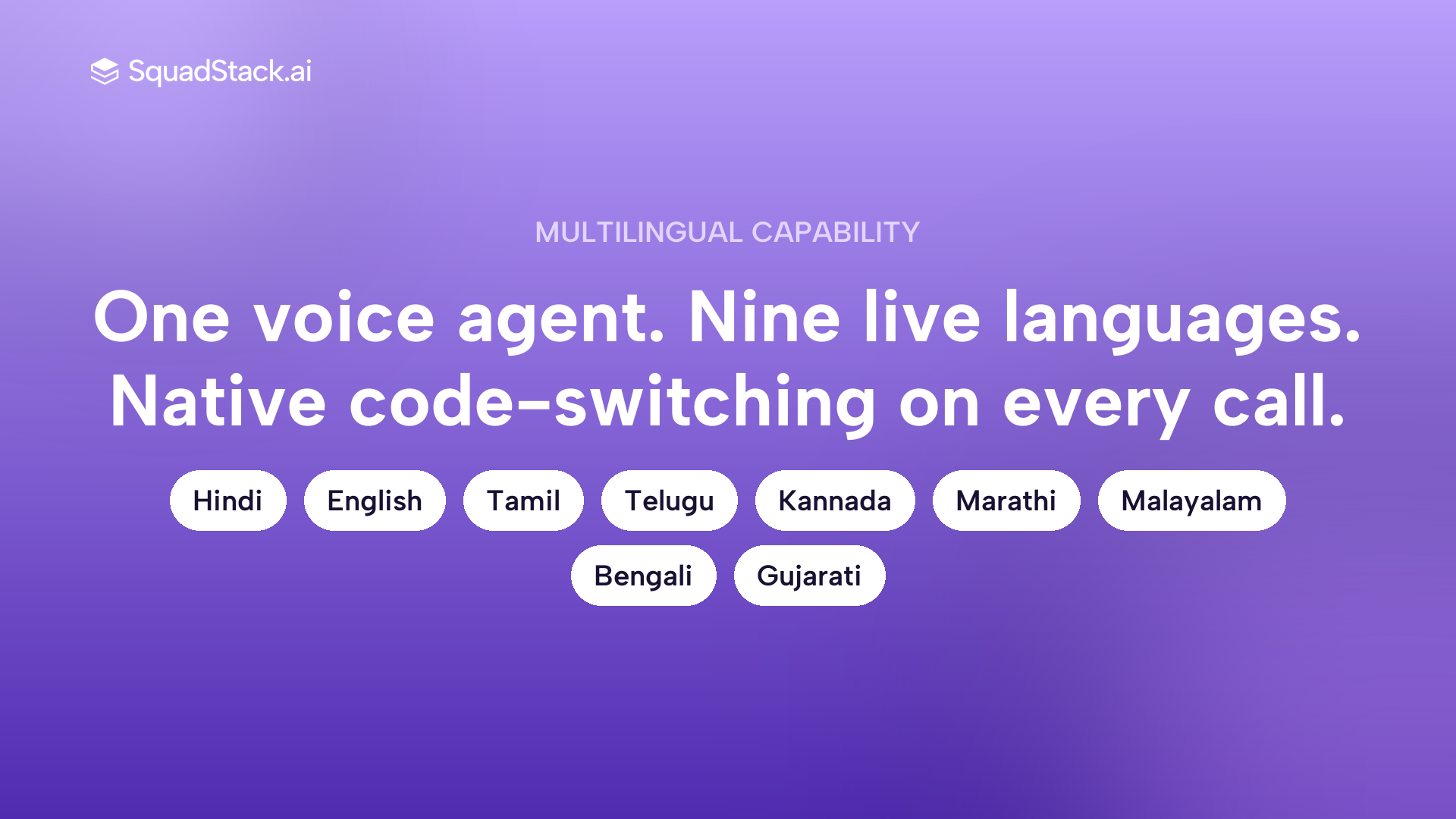
Does it code-switch natively? A rider in Tamil Nadu or a customer in Lucknow does not separate speech into clean language buckets. The agent must follow the same sentence as it moves between Hindi and English, or Tamil and English.
Can it capture structured data? A transcript is not enough. The platform must extract corrected address, preferred slot, and refusal reason as machine-readable fields that write back to your TMS or CRM.
Does it have a QA layer? At the volume logistics runs, faults scale with call count. A platform without automated quality audit will miss systematic errors until they show up as RTO spikes.
What is the latency? A one-second pause breaks the rhythm of a natural call. Sub-0.8-second response latency is the threshold for a conversation that does not feel robotic.
SquadStack built its speech model, Arth, on 600 million-plus minutes of real Indian sales and contact center conversations. That corpus includes noisy 8kHz telephonic audio, Hinglish, Taminglish, regional accents, and Indian entity types: PIN codes, PAN numbers, city names, and carrier-specific product terms. No public dataset covers this.
The platform runs 50 lakh-plus AI calls daily across 60-plus large consumer brands in India, with ISO 27001, ISO 27701, SOC 2 Type II, DPDP, and TRAI compliance built in. Response latency sits at a median of 0.8 seconds or less. The Eval System scores every call on Outcome, Sentiment, and Execution, so quality issues surface before they become operational problems.
In logistics, SquadStack works with Delhivery on NDR, pickup validation, and rider hiring. The Delhivery case study shows a 4x lower cost-per-hire result. BlackBuck runs GPS device activation for truckers on the platform. Shiprocket runs seller onboarding with a published result of 5x seller onboarding. The quick commerce platform case study shows 90% connectivity and 40% lower cost-per-hire on rider onboarding.
When festive season hits and NDR volume doubles overnight, or a dark-store city launch needs a hundred rider onboarding calls in a week, the voice AI scales without a 45-day notice period. SquadStack's 93% POC success rate, against an industry average around 25%, means the pilot produces results that justify scaling. Setup takes two weeks; pilot runs four to eight weeks against a defined metric; scale follows once the number is proven.
For related reading, see SquadStack's AI agents for e-commerce support and voice AI agents for Indian startups.
Run the arithmetic on your daily delivery volume and failure rate, and the annual waste in RTO freight costs becomes visible fast.
Voice AI for logistics is live at Delhivery, Shiprocket, BlackBuck, Swiggy, and Everest Fleet today, in Hindi, Tamil, Telugu, Kannada, and English, with more languages available on demand.
Which is the best AI calling solution for logistics and delivery operations in India?
SquadStack is purpose-built for Indian logistics, with live deployments at Delhivery, Shiprocket, and BlackBuck covering NDR resolution, pickup validation, rider hiring, and GPS device activation. The speech model is trained on 600 million-plus minutes of real Indian contact center audio, which means it handles noisy calls, code-switched speech, and Indian entity types that generic models miss.
Can an AI voice agent handle NDR callbacks automatically?
Yes. The agent triggers on a failed delivery event, calls the customer, identifies the reason (unavailable, wrong address, refused, wants reschedule), captures corrected address details and a preferred slot, and writes the outcome back to the logistics management system. No human dialing is needed.
How does AI voice agent for logistics India compare to a traditional call center for NDR?
A human call center caps at a fixed number of agents and cannot scale for a festive-season spike without weeks of notice. A voice AI platform scales to any call volume within the same window, runs every call in the customer's preferred language, logs structured outcomes, and has no shift gaps or attrition. At 50 lakh-plus calls a day, SquadStack's platform is not a pilot-stage comparison.
What languages does the voice agent support for Indian logistics operations?
Hindi, English, Tamil, Telugu, Kannada, Marathi, Malayalam, Bengali, and Gujarati are live today, with native code-switching so the agent follows a caller who moves between languages mid-sentence. More regional languages are available on demand.
How does the platform integrate with a logistics management system or TMS?
Integration runs over webhooks and APIs, so a failed delivery event in the TMS triggers an outbound call, and the structured outcome (corrected address, new slot, refusal reason, disposition) writes back automatically. Setup typically takes around two weeks, including CRM and workflow integration.
Does AI voice work for quick commerce rider hiring, or just express logistics?
Both. Rider hiring and onboarding is one of the highest-volume calling surfaces in quick commerce, and it is where the economics work clearly. SquadStack ran rider hiring for a leading quick commerce platform with a published result of 90% connectivity and 40% lower cost-per-hire. Customer-facing use cases like abandoned-cart calling do not work on a typical quick-commerce basket; the supply-side calling does.
How does the platform handle the activation drop between onboarding and first order?
Roughly 85% of onboarded workers never complete a first order, meaning the full acquisition cost is spent with no return. The voice agent calls within the client's activation window, confirms the app is working, explains the earnings mechanics, and removes the specific blocker stopping the first trip. This is the most defensible and least-served calling surface in the workforce funnel.
Is a voice AI platform compliant with India's data protection rules for logistics call data?
SquadStack is ISO 27001, ISO 27701, SOC 2 Type II, DPDP, and TRAI compliant. All models are hosted in India, and the platform includes consent gating, calling-time guardrails, and DND registry scrubbing before every dial.
What does the pilot process look like before scaling to full NDR volume?
Setup takes around two weeks, building the agent on the client's real call recordings, knowledge base, and SOPs. The pilot runs four to eight weeks on real leads against a pre-agreed success metric. SquadStack reports a 93% POC success rate versus an industry average around 25%. Scaling follows once the metric is proven, with no hiring or training lag.
How do I know if the voice agent sounds natural enough for a customer-facing logistics call?
SquadStack's voice agents passed a Turing test in September 2025, and at Global Fintech Fest 2025, 1,273 of 1,563 attendees (81%) could not tell the AI agents from humans in a blind listening test. The voices are cloned from top-performing Indian sales agents, not synthesized from read-speech, and every dialogue is hand-engineered per language rather than generated, which is what makes regional-language calls sound native rather than robotic.