AI Voice Agents for Inbound Support with Complex Query Escalation
September 21, 2026
|

12 min read
An AI voice agent for quick commerce order confirmation calls customers within seconds of order placement, confirms delivery details in their language...
An AI voice agent for quick commerce order confirmation calls customers within seconds of order placement, confirms delivery details in their language, handles substitutions and unavailability on the spot, and fits the entire interaction inside a sub-10-minute delivery window. At scale, this means hundreds of thousands of confirmation calls a day without adding headcount. The result is fewer failed deliveries, lower return-to-origin rates, and delivery windows that stay on schedule.
A quick commerce order is placed. The basket contains a substitute item because the original is out of stock at the dark store. The delivery address has a typo. The customer ordered COD but is not going to be home in the next 12 minutes.
Any one of those problems, left unresolved before dispatch, turns into a failed delivery. In standard e-commerce, a failed delivery is expensive but recoverable. In quick commerce, it collapses the business case entirely. The basket value is low, the delivery radius is tight, and there is no margin for a second attempt within the SLA.
This is the confirmation problem. It is not about being polite. It is about resolving every order-level risk before the rider leaves the dark store, at a volume that no human team can staff linearly.
For a broader look at how voice AI applies across logistics and last-mile operations, see SquadStack's Logistics and Quick Commerce industry page.
An AI voice agent for quick commerce order confirmation is a conversational AI system that calls customers immediately after order placement, speaks to them in their own language, confirms or corrects delivery details, handles inventory changes, and updates the order record before dispatch.
It is not an IVR. It does not read a script and wait for a keypress. It holds a two-way conversation, listens to what the customer says, responds to deviations, and resolves them in real time. The whole interaction typically takes under two minutes and runs within seconds of the order being placed.
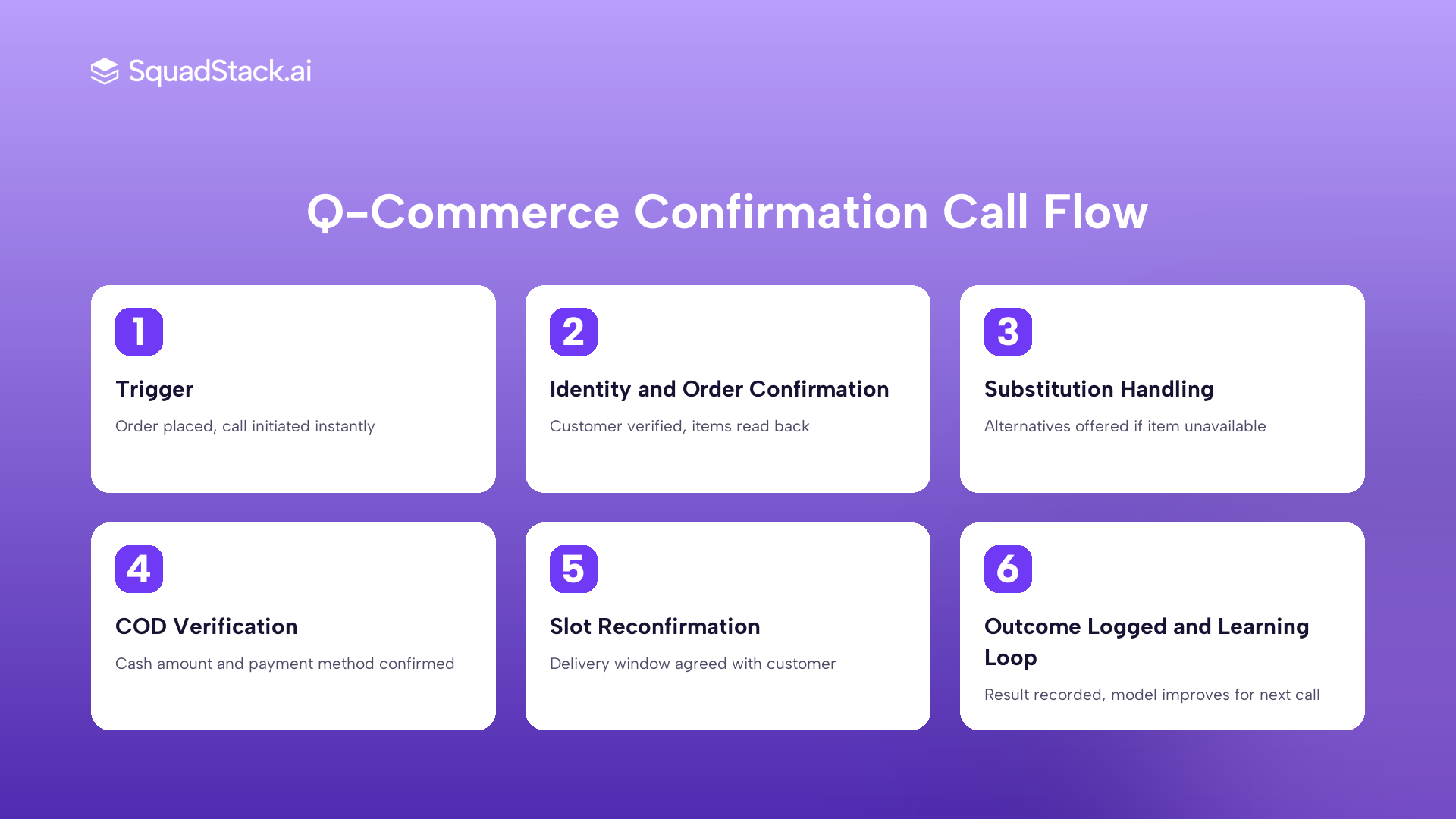
A quick commerce confirmation call has a different shape from a standard e-commerce call. The delivery window is not hours, it is minutes, so every step in the flow has to be tight.
Step 1: Immediate trigger. The moment an order is placed, the voice agent is triggered. No queue, no wait. The agent dials within seconds.
Step 2: Identity and order confirmation. The agent greets the customer in their detected or preferred language, confirms the order number and delivery address, and listens for corrections. If the address is wrong or incomplete, the agent captures the landmark and updates the record before dispatch.
Step 3: Inventory and substitution handling. If an item is unavailable at the dark store, the agent presents the substitution clearly and asks for acceptance or rejection. It does not read a product code. It names the item, explains the swap, and confirms. If the customer refuses and no substitute is available, the order is adjusted before the picker starts fulfilling it.
Step 4: COD verification. For cash-on-delivery orders, the agent confirms the customer will be available to receive and pay. This is where a meaningful share of COD cancellations can be caught before dispatch. The industry KB notes COD orders return far more often than prepaid, and a quick confirmation call before dispatch addresses the most avoidable of those.
Step 5: Delivery slot reconfirmation. If the customer cannot receive in the next window, the agent notes the preferred time. For quick commerce this often means the order is held or rescheduled, depending on the platform's logic.
Step 6: Outcome logged, record updated. Confirmed, amended, substitution accepted, customer unavailable. Every disposition writes back to the order management system automatically. No manual data entry.
Step 7: The learning loop. Every call outcome, every sentiment signal, and every execution score feeds into SquadStack's Eval System, which scores calls on Outcome, Sentiment, and Execution in that order. The ROI Optimizer uses this data to refine scripts, voice, timing, and follow-up logic so each campaign gets sharper over time.
Quick commerce has a narrow set of use cases where voice agents actually pay for themselves. The industry KB is explicit: customer-facing abandoned-cart calls and COD-recovery campaigns do not work on a basket of a few hundred rupees. The economics fail.
What does work is operational confirmation at the order and supply level.
Pre-dispatch address and availability confirmation. The highest-leverage moment. Catching a wrong landmark or an unavailable customer before the rider leaves the dark store is worth more than any post-delivery reattempt. Address errors and customer unavailability together account for a large share of failed quick commerce deliveries.
Substitution consent. Dark store inventory changes in real time. An agent that can explain a substitution clearly, in the customer's language, and get a yes or no before the order is packed avoids the most common source of delivery refusals.
COD pre-confirmation. Confirming the customer is home and ready to pay before dispatch. Even a small improvement in COD-to-prepaid conversion at dispatch materially reduces same-day return rates.
Dark store and vendor coordination. Beyond customer-facing calls, quick commerce platforms use voice agents for daily coordination with suppliers on stock, dispatch readiness, and gate processes. This is a high-volume, repetitive workload that runs at every dark store location.
For more on how AI voice agents handle e-commerce operations more broadly, see AI agents for e-commerce support.
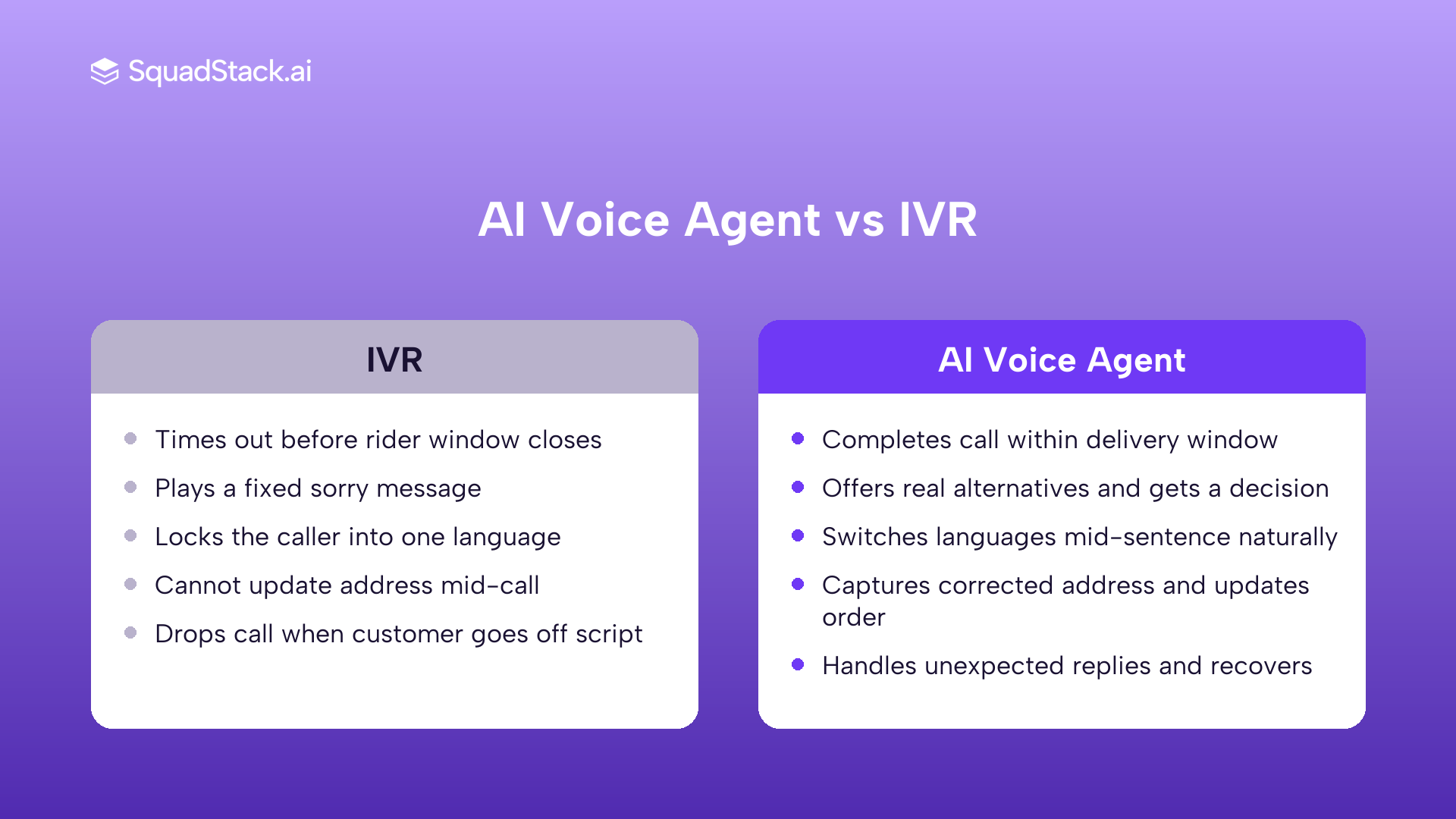
IVR systems were built for inbound call routing, not outbound confirmation in a 10-minute delivery window. The table below shows why that distinction matters.
| Dimension | IVR | AI Voice Agent |
|---|---|---|
| Delivery window fit | Asks the customer to press keys through a menu. A confused customer hangs up. The order still ships. | Calls, explains, listens, and resolves in under two minutes, inside the dispatch window. |
| Substitution handling | Cannot present a substitution intelligibly. Falls back to a dead end or transfers to a human. | Names the substitute item clearly, handles acceptance or rejection in natural conversation. |
| Language and dialect | Plays a recorded message in one language. A Kannada speaker on a Hindi IVR hangs up immediately. | Switches language mid-sentence based on how the customer responds, with no disruption. |
| Address correction | Has no mechanism to capture a freeform landmark. Cannot update the order record. | Listens to the corrected address, extracts the landmark, and writes it back automatically. |
| Off-script moments | Breaks if the customer asks an unscripted question about the order or the substitution. | Handles deviations, answers questions about the order, and returns to the confirmation flow. |
The core difference is not a feature list. An IVR assumes the customer will behave like the menu predicts. A confirmation call in quick commerce rarely goes exactly as expected.
Quick commerce is not a gentler version of e-commerce logistics. The operational requirements are tighter. When evaluating a platform, these are the questions that separate a viable solution from a pilot that stalls.
Can it fire within seconds of order placement? A platform that batches calls every few minutes is incompatible with a 10-minute SLA. The trigger latency matters as much as the call latency.
Does it handle substitutions in real time? The platform needs a live connection to the dark store's inventory state, not a pre-loaded product list. The script cannot be static.
Does it speak the customer's language natively? For Indian quick commerce platforms serving tier-2 and tier-3 cities, generic multilingual claims are not enough. The agent must sound like a person, not a text-to-speech reader. Drop-off within the first 10 seconds, called Abruptly Disconnected Rate (ADR) in the industry, is the metric that shows whether an agent sounds natural or robotic. SquadStack's agents now run ADR inside the human baseline.
Does it write back to the order management system automatically? Manual disposition logging at the volume quick commerce operates does not work. The integration has to be real-time and bidirectional.
What happens when the call fails to connect? A confirmation platform needs a retry strategy and fallback logic. Not every customer picks up on the first attempt, and the retry window in quick commerce is measured in minutes, not hours.
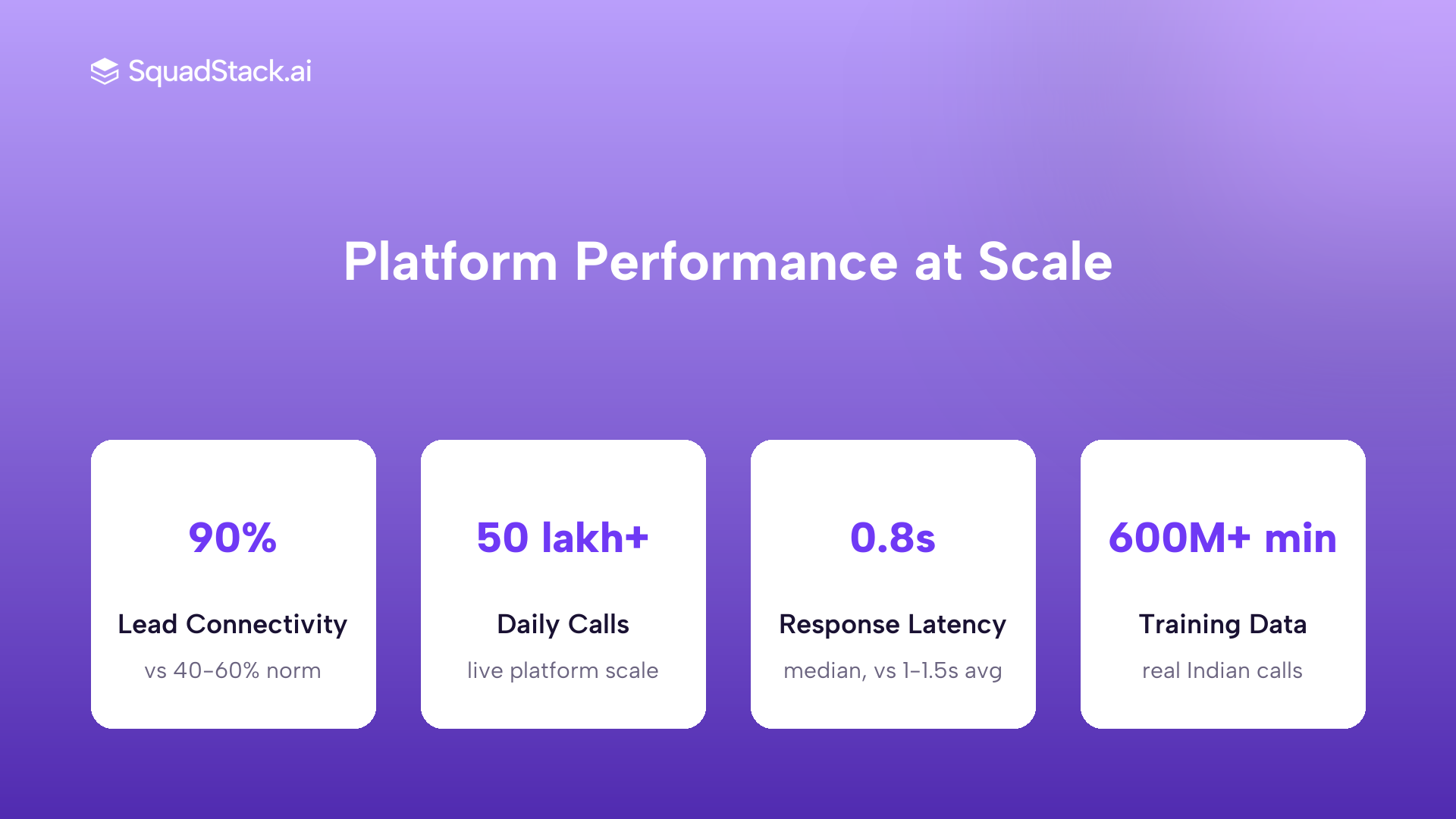
SquadStack has run voice AI campaigns at quick commerce operating scale in India. A leading quick commerce platform achieved 90% connectivity and 40% lower cost-per-hire on rider onboarding. Swiggy uses the platform for rider hiring and onboarding. Delhivery, one of India's largest express logistics operators, runs NDR callbacks, pickup validation, and rider hiring through SquadStack.
That track record matters because quick commerce shares the same infrastructure pressure as express logistics. The calls are short, the volumes are large, the windows are unforgiving, and the customers are spread across every language and tier.
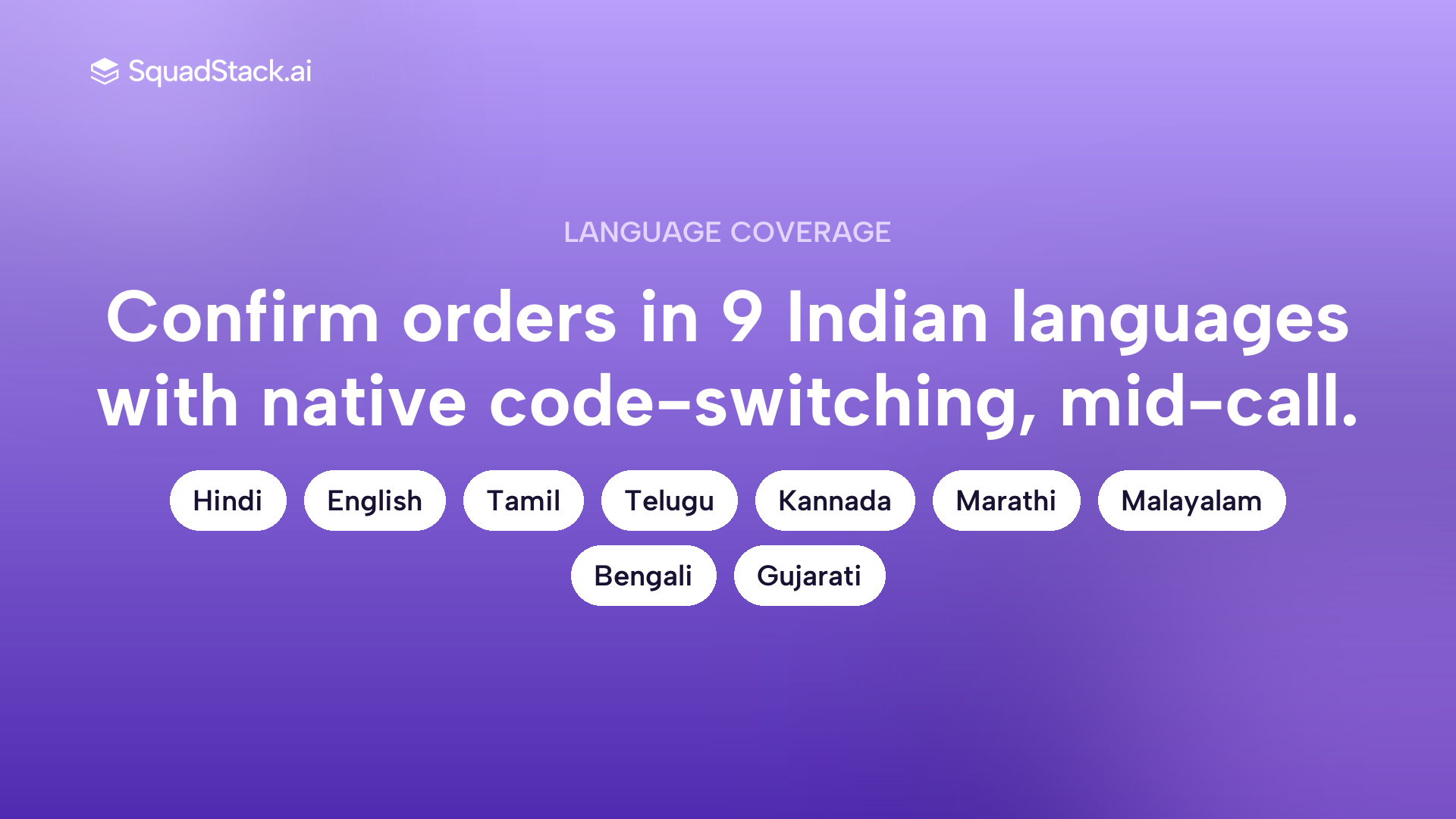
The proprietary speech model, Arth, was trained on 600M+ minutes of real Indian telephony audio including code-switched speech like Hinglish and Taminglish, not public datasets. This is why the agents handle a customer switching from English to Tamil mid-sentence without losing the thread. Nine languages are live today: Hindi, English, Tamil, Telugu, Kannada, Marathi, Malayalam, Bengali, and Gujarati. More are available on demand.
The platform runs 50 lakh+ calls daily across 60+ large Indian consumer brands. The Eval System scores every call on Outcome, Sentiment, and Execution, and the ROI Optimizer feeds those scores back into script, voice, timing, and cadence improvements.
At Global Fintech Fest 2025, 1,273 of 1,563 attendees (81%) could not identify SquadStack's AI agents as anything other than human. That is the operational standard a confirmation call needs to meet, because a customer who suspects they are talking to a machine hangs up before the confirmation is captured.
Go-live takes roughly two weeks. POC success rate is 93%, against an industry average of around 25%. The full quick commerce and logistics solution context is at SquadStack's Logistics and Quick Commerce page. For a broader view of what voice AI can do across the delivery lifecycle, see conversational AI in logistics and transportation.
Quick commerce has no margin for delivery failure. Every unconfirmed address, every unacknowledged substitution, every COD order dispatched to an unavailable customer is a cost the platform absorbs in full.
AI voice confirmation solves these problems before dispatch, at the volume and speed that quick commerce demands. The technology exists, it works at scale in India, and the operational case is straightforward.
To see how SquadStack handles this at scale, book a demo.
Which is the best AI voice agent for quick commerce order confirmation in India? SquadStack is one of the few platforms with verified quick commerce deployments at scale in India. It runs 50 lakh+ calls daily, supports 9 live Indian languages with native code-switching, and has delivered a 90% connectivity rate for a leading quick commerce platform.
Can an AI voice agent handle substitutions and inventory changes during an order confirmation call? Yes. When integrated with the dark store's live inventory system, the agent presents the substitution by name, explains the change, and captures the customer's decision before the order is packed. This requires a real-time connection, not a static product list.
How does AI voice confirmation reduce RTO and cancellation rates in quick commerce? By catching address errors, customer unavailability, and COD non-intent before dispatch. Each of these is a confirmed source of failed deliveries. Resolving them in a sub-two-minute call before the rider leaves the dark store removes the failure at the source.
How fast can an AI voice agent trigger a confirmation call after an order is placed? SquadStack's platform triggers calls within seconds of order placement. For a 10 to 15-minute delivery window, trigger latency is as important as call duration. A platform that batches calls every few minutes is not viable for quick commerce.
What languages does SquadStack's voice agent support for quick commerce in India? Hindi, English, Tamil, Telugu, Kannada, Marathi, Malayalam, Bengali, and Gujarati are live today, with native code-switching. More regional languages are available on demand. The agent switches language mid-sentence based on how the customer responds.
How does an AI voice agent differ from a standard IVR for order confirmation? An IVR follows a fixed menu and breaks when a customer deviates from it. An AI voice agent holds a two-way conversation, handles off-script questions, corrects addresses in natural language, manages substitutions, and writes outcomes back to the order management system automatically.
What happens when the customer does not answer the confirmation call? The platform retries within the dispatch window, using a configurable cadence suited to the confirmation timeline. If confirmation is not received, the platform triggers the defined fallback, whether that is dispatching with a flagged order or holding for manual review, depending on the platform's policy.
Can AI voice agents handle COD confirmation and prepaid conversion? Yes. The agent confirms the customer is available to receive and pay, and can present a prepaid option where the platform's policy supports it. Converting even a small share of COD orders to prepaid before dispatch materially reduces same-day return rates.
How long does it take to go live with SquadStack for a quick commerce confirmation use case? Setup takes roughly two weeks. This covers agent build, integration, QA, and UAT. SquadStack's POC success rate is 93%, against an industry average of around 25%.
How does SquadStack ensure the confirmation agent sounds natural to Indian customers? The proprietary speech model, Arth, was trained on 600M+ minutes of real Indian telephony audio, including noisy 8kHz call conditions and code-switched speech. At Global Fintech Fest 2025, 81% of attendees could not identify SquadStack's agents as AI. The platform's Abruptly Disconnected Rate now sits inside the human baseline, meaning customers stay on the call.