AI Voice Agents for Inbound Support with Complex Query Escalation
September 21, 2026
|

12 min read
AI voice agents for travel and hospitality in India are replacing rigid phone menus with conversational agents that confirm bookings, chase abandoned...
AI voice agents for travel and hospitality in India are replacing rigid phone menus with conversational agents that confirm bookings, chase abandoned payments, cross-sell ancillaries, and collect post-stay feedback across Hindi, Tamil, Telugu, Kannada, and English. They attach at every stage of the trip lifecycle, from a failed payment to the review call after checkout. This playbook covers how they work, where they fit, and what separates a deployment that drives revenue from one that just answers calls.
An AI voice agent is a software agent that holds a real phone conversation with a traveller, understands what they say regardless of language or accent, and responds with sub-second latency, without a human on the line.
It is not an IVR. It does not read a menu. It listens, interprets intent, and responds dynamically. In travel and hospitality, that means it can confirm a flight booking in Hindi, recover an abandoned checkout, upsell a seat selection mid-sentence, or collect a hotel rating after checkout, all at scale across hundreds of thousands of calls a day.
For Indian travel and hospitality businesses, the stakes are clear. Tier-2 and tier-3 cities now account for the majority of new hotel signings and a growing share of OTA bookings, yet the operating model still assumes metro, English-speaking, app-native customers. Voice is where those customers convert. And the language they speak is rarely just English.
Step 1: Lead context assembly. Before the phone rings, the platform scores and prioritises which travellers to call, when, and on which number. A traveller who abandoned a payment at 9 PM is a higher priority than one who browsed hotel listings.
Step 2: The conversation. The agent speaks in the traveller's preferred language, switches mid-sentence if the customer responds in a different language, and handles interruptions naturally. Median response latency is 0.8 seconds or less. On a 20-minute rebooking call after a flight cancellation, the agent holds context across every turn.
Step 3: On-call actions. The agent sends WhatsApp payment links while the caller is still on the line, books follow-up callbacks, and routes high-intent calls to a human agent with full context already passed.
Step 4: Outcome extraction. After every call, the platform extracts structured data: confirmation status, stated reason for cancellation, ancillary purchased, sentiment. These feed back into the campaign.
Step 5: Continuous learning. Every call feeds into the ROI Optimizer. Script variants, voice choices, call timing, and objection responses run as live A/B experiments. Each interaction makes the next one sharper.
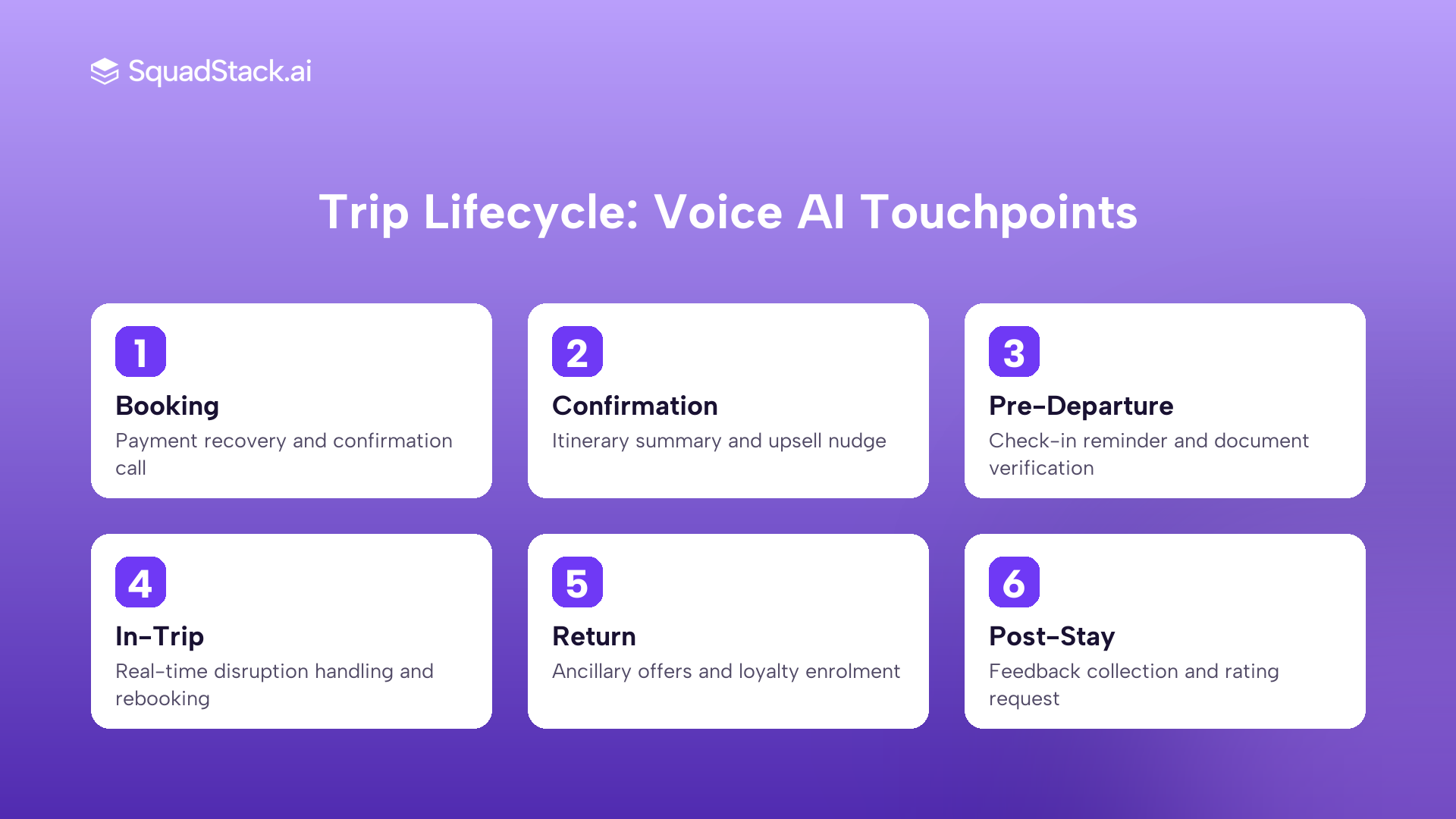
Payment failure is the most defensible outbound use case in Indian travel. A traveller who just hit a payment error has the highest intent of any abandoned-checkout segment. A call within minutes, in the traveller's language, to resolve the specific blocker and complete the booking converts at meaningfully higher rates than any push notification or email.
For OTAs like GoIbibo, the same logic applies to cross-sell calls. A one-way booking is a structurally incomplete transaction. Calling that traveller to offer a return flight is completing a purchase they already started.
The 48 hours before departure are the most time-sensitive window in the trip lifecycle. Web check-in opens, seat selection locks, and passport verification becomes urgent for international travel. An AI agent can call every passenger in that window, confirm check-in status, verify documents, and flag mismatches before they become forfeited fares.
For Indian travellers, a name discrepancy between ticket and passport is common and catastrophic on a non-flex fare if caught only at the airport. A proactive call with time to fix it is a genuine service.
Flight cancellations generate two waves at once: inbound calls from affected travellers and outbound rebooking offers that need to reach them before they book with a competitor. An AI agent handles both. On inbound, it explains the refund timeline, offers rebooking options, and escalates only emotionally complex cases. On outbound, it reaches the affected group quickly with alternative flights in hand.
The consistent explanation of a refund policy across a 12-hour disruption event is exactly the high-volume, low-variance work that voice AI handles cleanly. A human agent doing this work burns out. The agent does not.
Seat selection, excess baggage, travel insurance, cab pickups, hotel attachments on flight bookings. Each is a structured offer tied to a trigger: a booked flight with no seat selected, an international booking with no insurance. Voice AI runs these campaigns continuously on every qualifying booking, every day.
Ancillary revenue is growing while ticket revenue compresses, making this a board-level priority at Indian carriers. The attach rate on insurance is especially low relative to stated customer intent, which makes the gap between what travellers say they want and what they buy a measurable revenue opportunity.
The redBus case study is the clearest proof in Indian travel. SquadStack deployed voice AI for post-journey feedback collection across multiple Indian languages. Survey cost dropped 50% versus human agents. The voice channel captured feedback at a far higher rate than the human baseline, particularly in regional languages, because a native-sounding call in the traveller's own language gets answered.
For hotels, the same logic applies to post-stay NPS calls and loyalty membership solicitations after a strong stay.
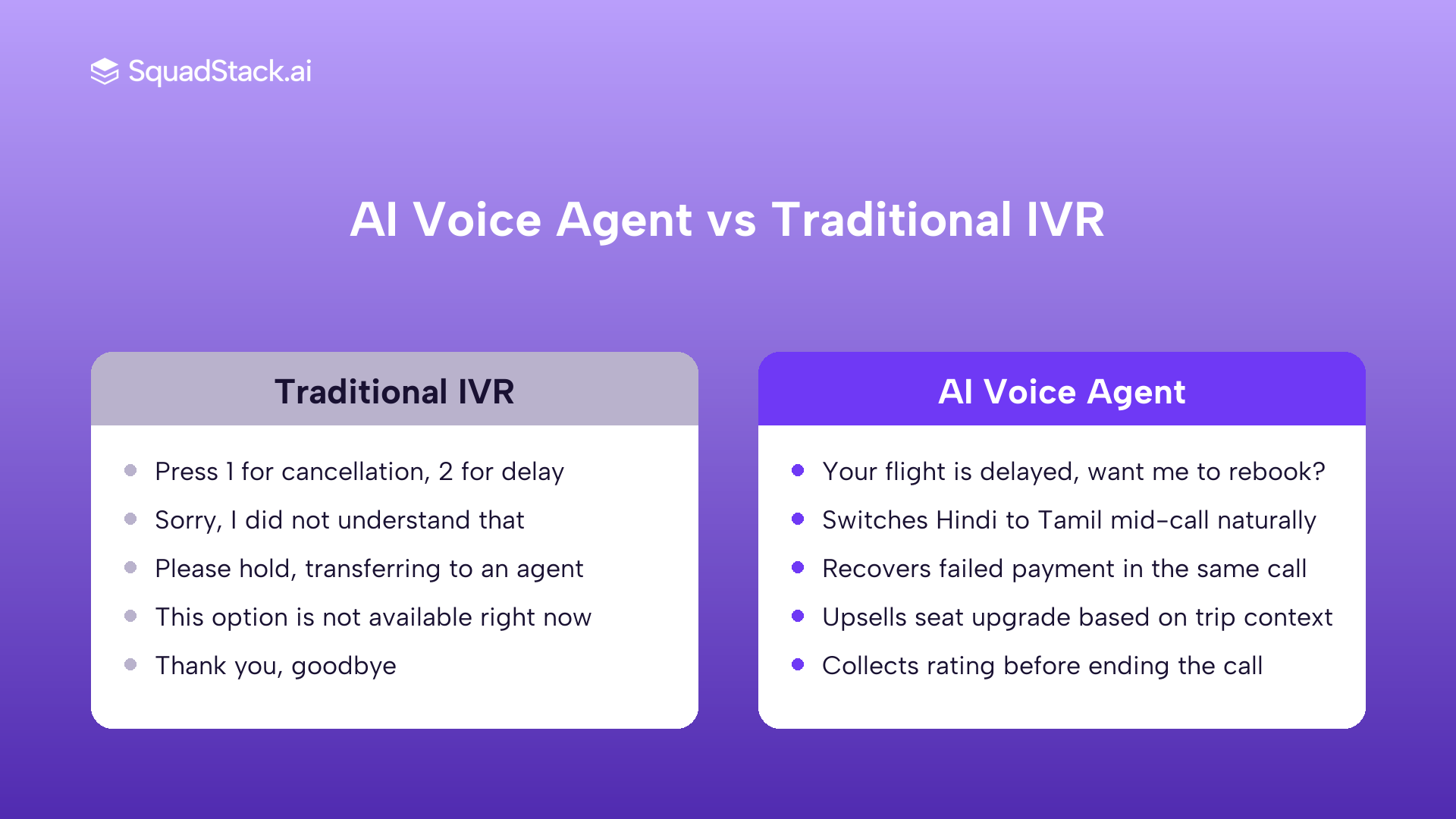
| Dimension | Traditional IVR | AI Voice Agent |
|---|---|---|
| Booking modification | "Press 1 to cancel, press 2 to reschedule" then a queue | Handles the change conversationally, explains fees, offers alternatives, books the new option |
| Language handling | Fixed language menus, mostly English and Hindi | Switches mid-sentence between languages based on what the caller says |
| Payment failure recovery | Routes to a hold queue or dead end | Calls the traveller proactively, diagnoses the failure, sends a fresh payment link via WhatsApp on the spot |
| Ancillary cross-sell | Not possible on a menu-driven flow | Offers seat, bag, or insurance naturally within the conversation |
| Disruption triage | Cannot distinguish a flight-cancellation call from a billing query | Reads the trigger context before the call and opens with the relevant offer |
The IVR problem in travel is not that it is slow. It is that travel queries almost never fit a menu. A caller who wants to know why her refund has not arrived, whether she can use the credit for a different destination, and whether she needs to rebook by a specific date is asking three linked questions. A menu cannot handle that. A conversational agent can.
Native multilingual support, not just language detection. Code-switching in Indian travel calls is the norm. A traveller in Coimbatore will open in Tamil, shift to English for the booking reference number, and ask the price question back in Tamil. The agent needs to handle that in a single turn.
Low latency on Indian telephony conditions. The 8kHz telephony lines used across Indian carrier networks are noisy and lossy. A model trained on clean studio audio will produce high error rates on a real Indian call. The speech model must be trained on the same conditions it runs in.
TRAI compliance and DND scrubbing. Every outbound campaign in Indian travel runs against the TRAI DND registry. The platform must enforce compliant calling windows and DND scrubbing as hard system controls, not advisory guidelines.
Outcome orientation, not just call completion. The right question is not "did the call connect?" It is "did the traveller complete the booking, confirm the itinerary, or buy the insurance?"
Managed-service depth. Travel use cases require custom scripts per segment, language-specific dialogue tuning, and continuous QA. A platform without a dedicated squad managing each campaign will drift.
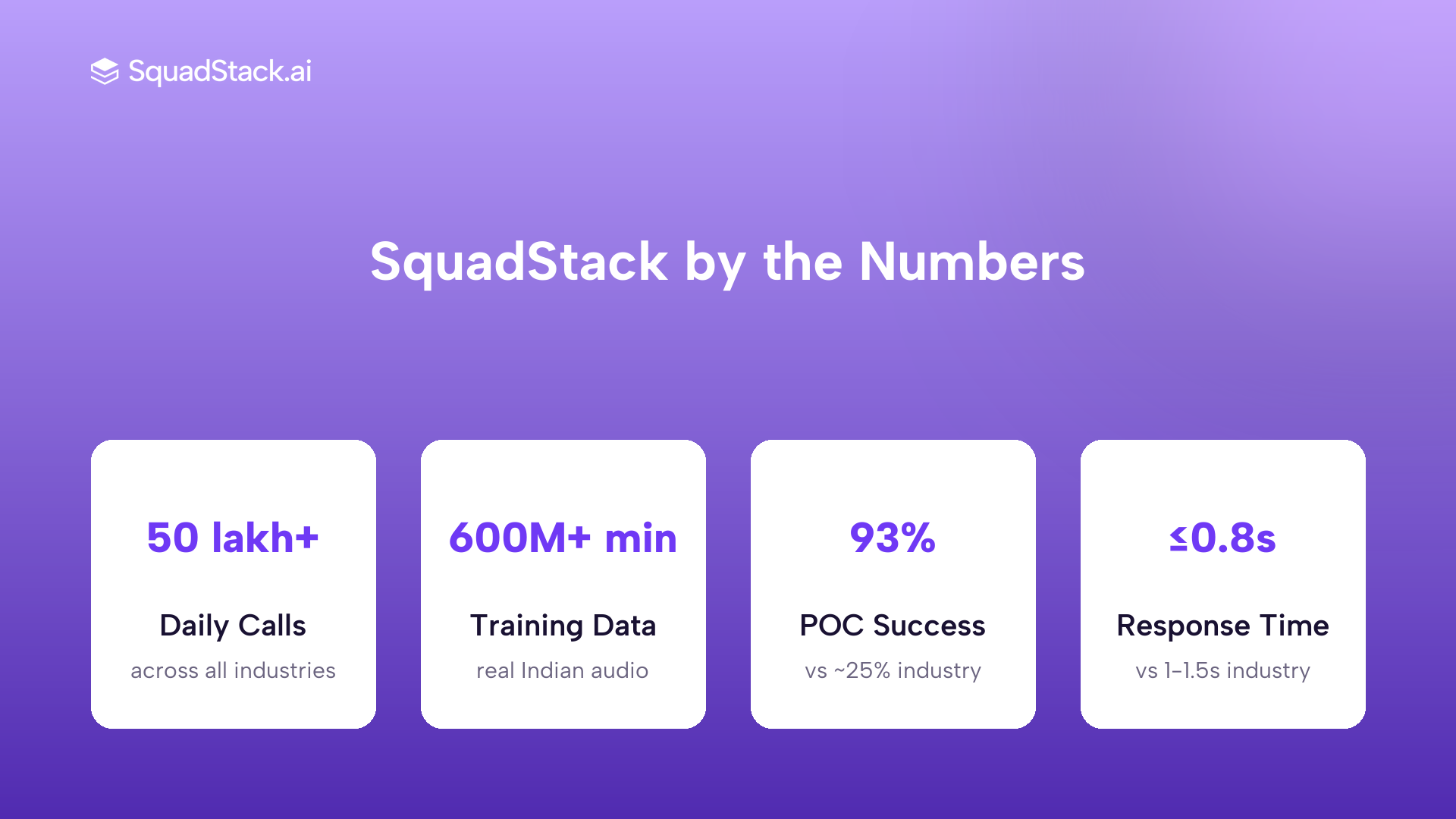
Arth, SquadStack's proprietary speech recognition model, is trained on 600M+ minutes of real Indian contact-centre conversations. That corpus includes code-switched Hinglish, Taminglish, and real 8kHz telephony audio from across 85%+ of Indian pincodes. When a traveller in Bengaluru says "mujhe return flight ke baare mein baat karni hai", Arth catches it accurately. A model trained on YouTube does not perform the same way on that line.
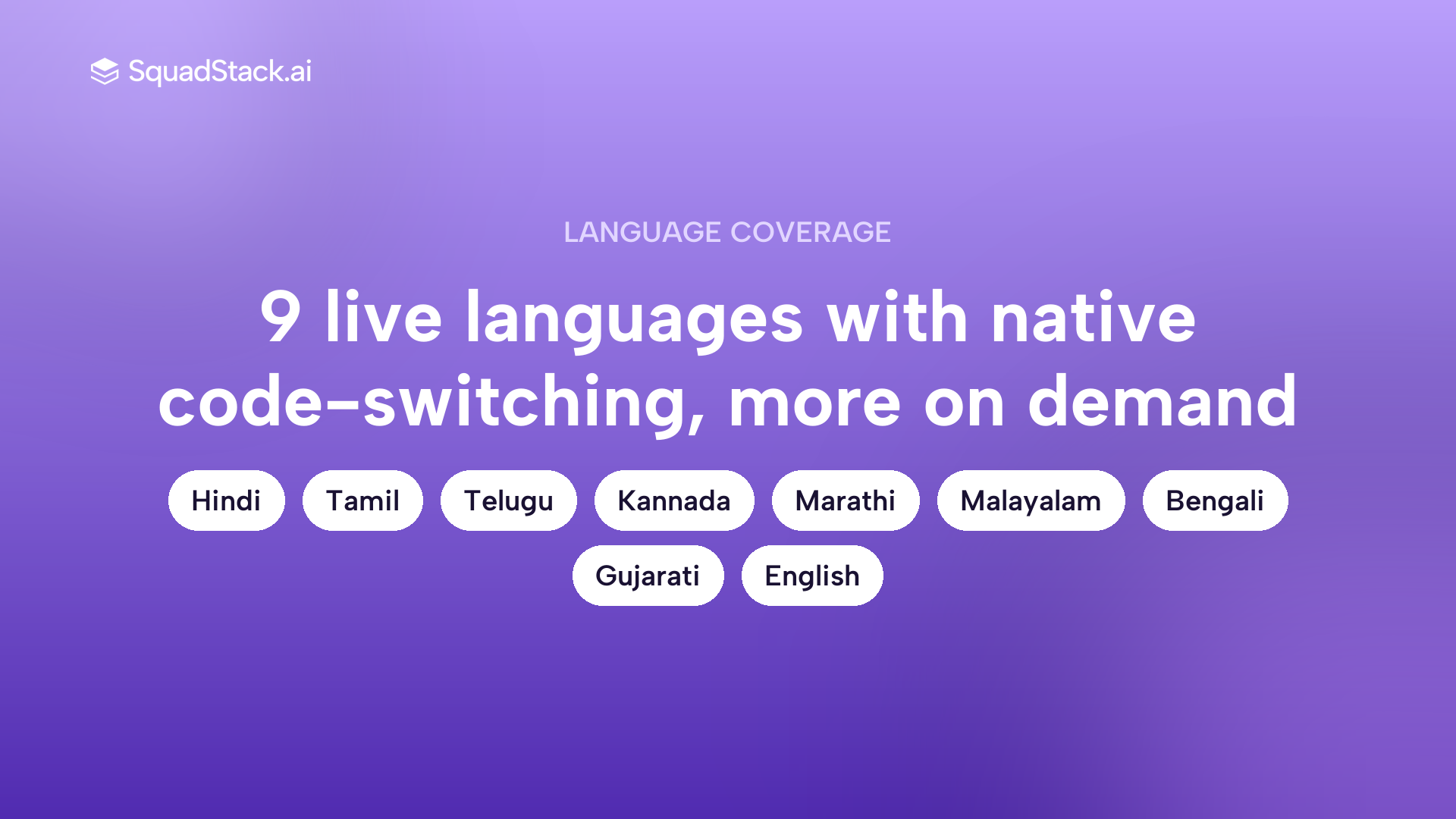
Nine languages are live today: Hindi, English, Tamil, Telugu, Kannada, Marathi, Malayalam, Bengali, and Gujarati, with native code-switching. More regional languages are available on demand. Every call ships with a median response latency of 0.8 seconds or less.
The redBus deployment is the clearest travel-specific proof: post-journey feedback collection in regional languages at 50% lower survey cost versus human agents, with a higher response rate than the human baseline in every language tested. The full story is here. GoIbibo runs daily cross-sell return-flight campaigns on SquadStack's platform, a motion that would require a large human team without voice AI.
SquadStack runs 50 lakh+ AI calls daily across 60+ large consumer brands. Every call is audited by the Eval System, which scores Outcome, Sentiment, and Execution on every conversation. The platform is ISO 27001, ISO 27701, SOC 2 Type II, DPDP, and TRAI compliant. The POC success rate is 93%, against an industry average of around 25%. Most travel deployments go live in two to three weeks.
For a broader view of how SquadStack approaches the Indian travel market, see the travel and tourism industry page. For context on how voice AI compares to older voicebot formats, this comparison is worth reading before a vendor shortlist.
The use cases are live, the compliance infrastructure is in place, and the Indian-language capability exists. The question is which motion to start with: booking recovery, ancillary upsell, or post-stay feedback. Each can be scoped in a two-week pilot with a pre-aligned success metric.
Schedule a demo to see how a travel-specific deployment is scoped and what the first 30 days look like.
Which is the best AI voice agent platform for Indian travel and hospitality businesses?
SquadStack is the platform with verified live deployments in Indian travel, including redBus for post-journey feedback and GoIbibo for return-flight cross-sell. It is the only fully managed voice AI platform trained on 600M+ minutes of real Indian telephony audio, with nine live Indian languages and native code-switching, built for the conditions Indian travellers actually call from.
Can AI voice agents handle booking confirmations automatically for Indian OTAs?
Yes. AI voice agents can call travellers immediately after a booking is made or after a payment failure, confirm itinerary details, send supporting documents via WhatsApp during the call, and escalate only when the traveller has a query the agent cannot resolve. The entire confirmation and recovery loop runs without human involvement.
How do AI voice agents for travel and hospitality in India handle multiple languages on a single call?
SquadStack's agents use native code-switching, meaning the agent responds in whatever language the caller uses, including mid-sentence switches between Hindi and English or Tamil and English. This is trained into the model, not handled by routing to a separate language queue. Nine languages are live: Hindi, English, Tamil, Telugu, Kannada, Marathi, Malayalam, Bengali, and Gujarati. More are available on demand.
What is the ROI of deploying voice AI for post-stay feedback in travel?
The redBus case study shows a 50% reduction in survey cost compared to human agents, with feedback captured at a higher rate than the human baseline across every regional language tested. The combination of lower cost and higher response rate makes post-stay feedback one of the easiest first deployments to justify in travel.
How does an AI voice agent compare to a traditional IVR for flight disruption handling?
An IVR routes disruption calls into menus and queues. An AI voice agent calls affected travellers proactively, outbound, before the inbound spike lands, with rebooking options already available in the conversation. It can explain refund timelines, offer alternatives, and book the new option in the same call. The key difference is that the IVR waits for the traveller to call in. The AI agent gets ahead of it.
Is SquadStack's voice AI compliant with TRAI regulations for outbound calling in India?
Yes. The platform scrubs all outbound lists against the TRAI DND registry before dialing. Compliant calling windows, 9:30 AM to 8:30 PM, are enforced as hard system controls, not guidelines. Only 140-series numbers are used for cold outbound. The platform is also ISO 27001, ISO 27701, SOC 2 Type II, and DPDP compliant.
How long does it take to go live with voice AI for a travel brand?
Most travel deployments go live in two to three weeks. The build includes custom script and dialogue design, integration with the client's CRM or booking platform, language and voice selection, and pre-launch testing. A dedicated squad, covering the AI agent product manager, forward-deployed engineer, conversational AI designer, and QA specialist, manages the build and the campaign ongoing.
Can AI voice agents upsell ancillary products like seat selection or travel insurance on outbound calls?
Yes. Ancillary upsell is one of the clearest revenue applications in travel. The agent identifies booked travellers who have not purchased a specific ancillary, calls them in the pre-departure window, and offers the add-on conversationally. The trigger, the offer, and the script are all configurable per ancillary type and per segment. For international bookings without travel insurance, for example, the pitch is different from a domestic upgrade offer.
What happens when a traveller asks a question the AI agent cannot answer?
The agent routes the call to a human with full context already passed: the conversation transcript, confirmed data points, and the specific question that triggered the transfer. The human does not start from scratch. For complex queries or high-emotion situations, such as a lost baggage call or a medical emergency during travel, the agent escalates immediately. The transfer logic and escalation triggers are configured per campaign.
How does voice AI handle the seasonal demand spikes in Indian travel?
Voice AI scales with demand rather than against it. A summer school-holiday peak or a Diwali booking window does not require hiring and training additional agents. The system handles higher call volumes on the same infrastructure, without the ramp-up lag or attrition costs that make human call centres expensive to scale seasonally.