Voice AI Onboarding Failures: What Goes Wrong and Why
November 2, 2026
|

13 min read
The playbook for qualifying insurance leads in India with AI voice agents, covering compliance, call flow, and routing to licensed advisors.
AI voice calling for insurance lead qualification in India lets distributors, IMFs, and aggregator platforms reach raw leads at scale, score them by product intent and income band, and route only qualified prospects to licensed advisors. The result is a sharper top-of-funnel, lower cost per qualified lead, and a human sales floor that spends time closing rather than chasing cold lists. SquadStack deploys this across BFSI with 9 live Indian languages and trains its agents on 600M+ minutes of real Indian sales conversations.
A large insurer or aggregator platform can generate thousands of leads a week from digital campaigns, partner platforms, and bank CRM triggers. The leads vary wildly: some are high-intent buyers who just compared quotes on an aggregator; others are cold names who filled a form months ago.
The inside-sales floor gets one list. Every lead looks the same at the top. Agents spend a large share of their day calling leads that were never going to convert, and high-intent leads wait in the queue behind them. The result is slow callbacks on the leads that matter, low morale on the floor, and a cost per qualified lead that eats into acquisition budgets.
AI voice calling for insurance lead qualification in India solves a specific part of this problem: the top-of-funnel triage that decides which leads are worth a licensed advisor's time.
AI voice lead qualification is a structured outbound call placed by a voice AI agent that confirms a prospect's product intent, captures their income and coverage situation, and assigns a quality score before any human advisor is involved.
It is not a sales call. The AI agent does not solicit or recommend a policy. It confirms the prospect is real, reachable, and interested in a specific product category, and captures enough structured data to route them to the right licensed advisor or sales queue.
This distinction matters for compliance. Under IRDAI's framework, solicitation requires a certified person. Pre-sales qualification that stops short of a product recommendation does not. Aggregators and brokers already build hybrid workflows for this reason: AI qualifies and hands off; a certified human closes. For a detailed look at the platform, see SquadStack's AI voice agent for lead qualification.
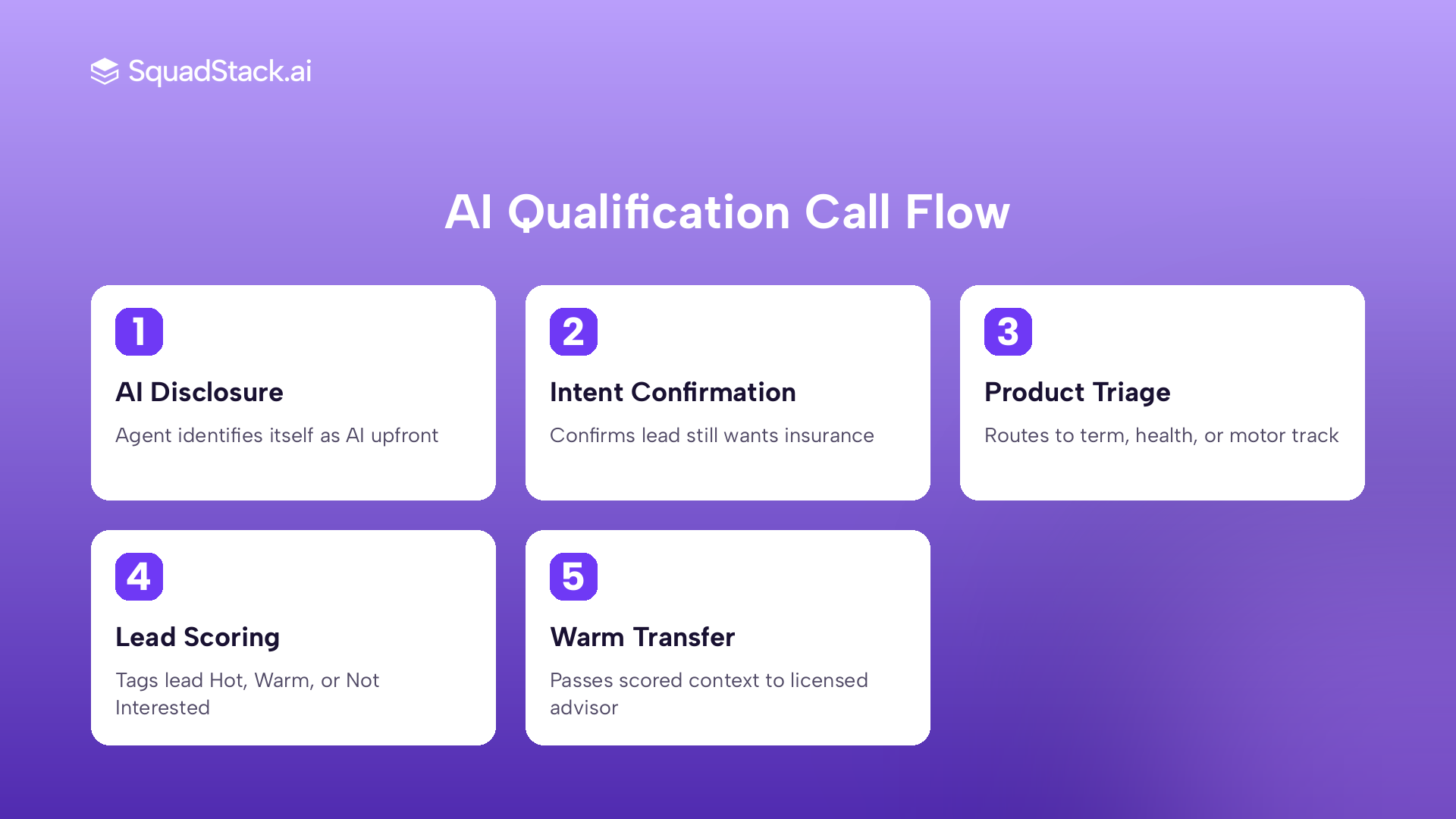
A typical AI voice qualification call follows five stages.
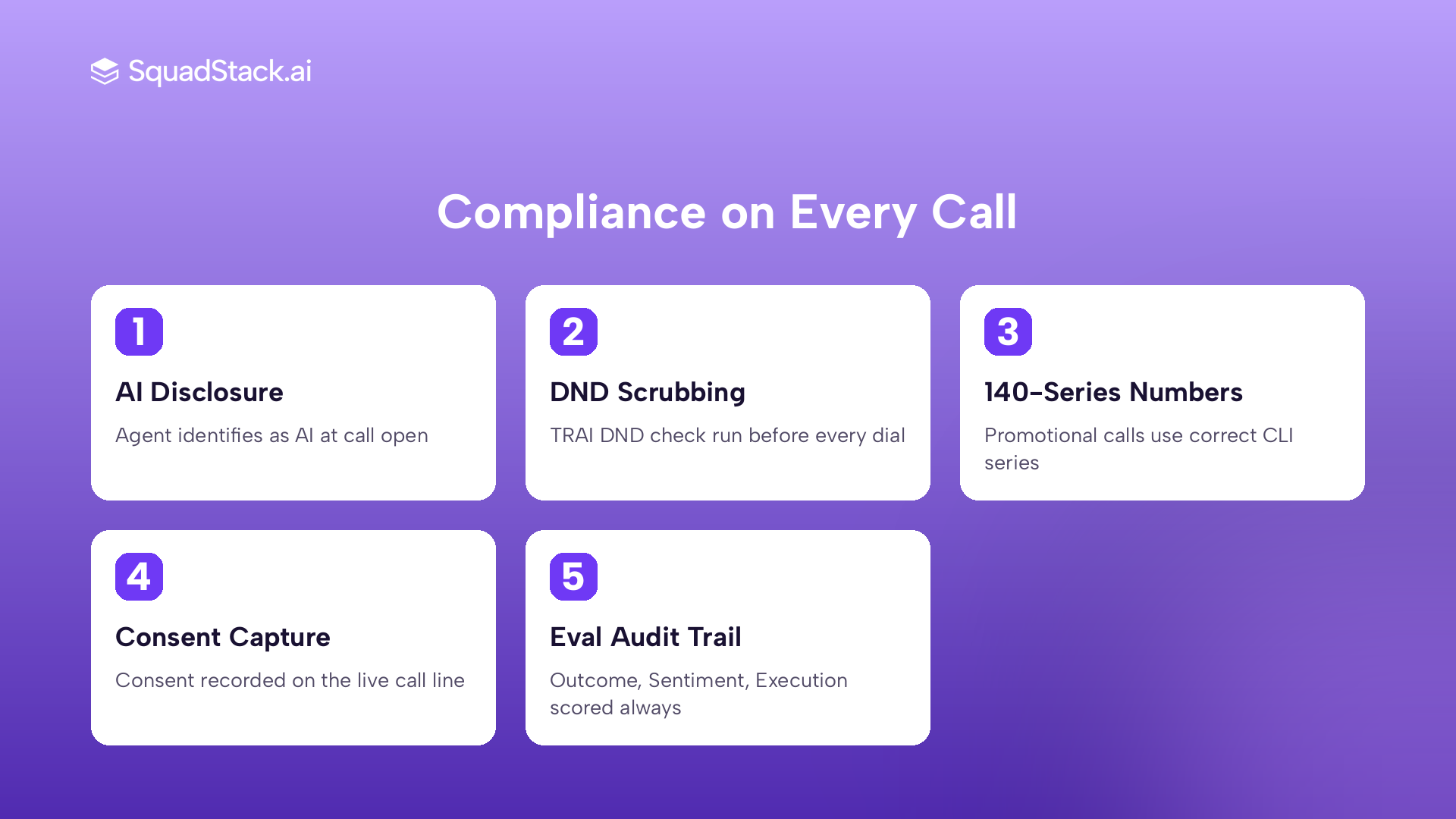
Stage 1: AI disclosure and consent. The agent opens by identifying itself as an AI assistant calling on behalf of the insurer or distributor. Consent is captured on the recorded line before qualification begins.
Stage 2: Intent confirmation. The agent confirms the lead's interest in insurance. For older CRM leads where intent may have dropped, the agent notes that disposition and closes the call cleanly rather than pushing.
Stage 3: Product and need triage. Based on lead source and metadata, the agent follows a branching script. A motor inquiry gets a different question tree than a health or term lead. The agent asks about existing coverage, whether the policy covers just the proposer or the family, a broad income band for sum-assured eligibility, and any pre-existing conditions.
Stage 4: Lead scoring and disposition. Extracted fields are structured by the platform's entity extraction layer. The lead is scored and dispositioned: hot (ready for advisor), warm (interested but needs nurturing), not interested, or not reachable.
Stage 5: Routing and handoff. Hot leads can trigger a warm transfer to a licensed advisor immediately, with call context and confirmed fields passed to the receiving human so the prospect never repeats themselves. Warm leads enter a follow-up cadence.
The learning loop. Every call feeds outcome data back into the system. The ROI Optimizer tracks which script variants, opening lines, objection responses, and call timings produce the best qualification rates. The agent's handling of common objections improves automatically, with human review before each change scales.
Aggregator overflow qualification. Platforms like InsuranceDekho and POSP networks generate leads faster than a human floor can dial. AI agents handle the overflow, qualifying leads to a defined standard so the floor only engages with scored prospects.
Multi-product script branching. A single campaign handles leads from health, motor, and term buckets without separate human teams per product line. The agent detects product signal from lead metadata or the first two questions, then branches into the appropriate qualification tree.
Revival and lapse reactivation. Lapsed policyholders with no assigned agent can be reached by an AI agent that explains the revival window, checks whether a health declaration applies, and routes interested leads to the renewals desk. This is a clear compliance-safe use case because the call is a service interaction with an existing customer, not a new solicitation.
PIVC and welcome call support. Pre-issuance verification calls confirm the prospect understood sum assured, premium, and term. Welcome calls confirm receipt and explain the free-look window. Both are structured, scripted, and recorded by requirement: exactly the format AI agents handle well.
Tele-underwriting scheduling. After a proposal is submitted, the agent books the medical questionnaire slot, sends a WhatsApp confirmation, and handles reschedules without pulling a human into routine coordination.
SquadStack's BFSI customer roster includes IIFL, Kotak Mahindra Bank, KreditBee, Moneyview, PhonePe, and AngelOne. A published case study with a leading general insurer shows 85% connectivity and 60% lower renewal cost on auto insurance renewal campaigns. Read the insurer case study here.
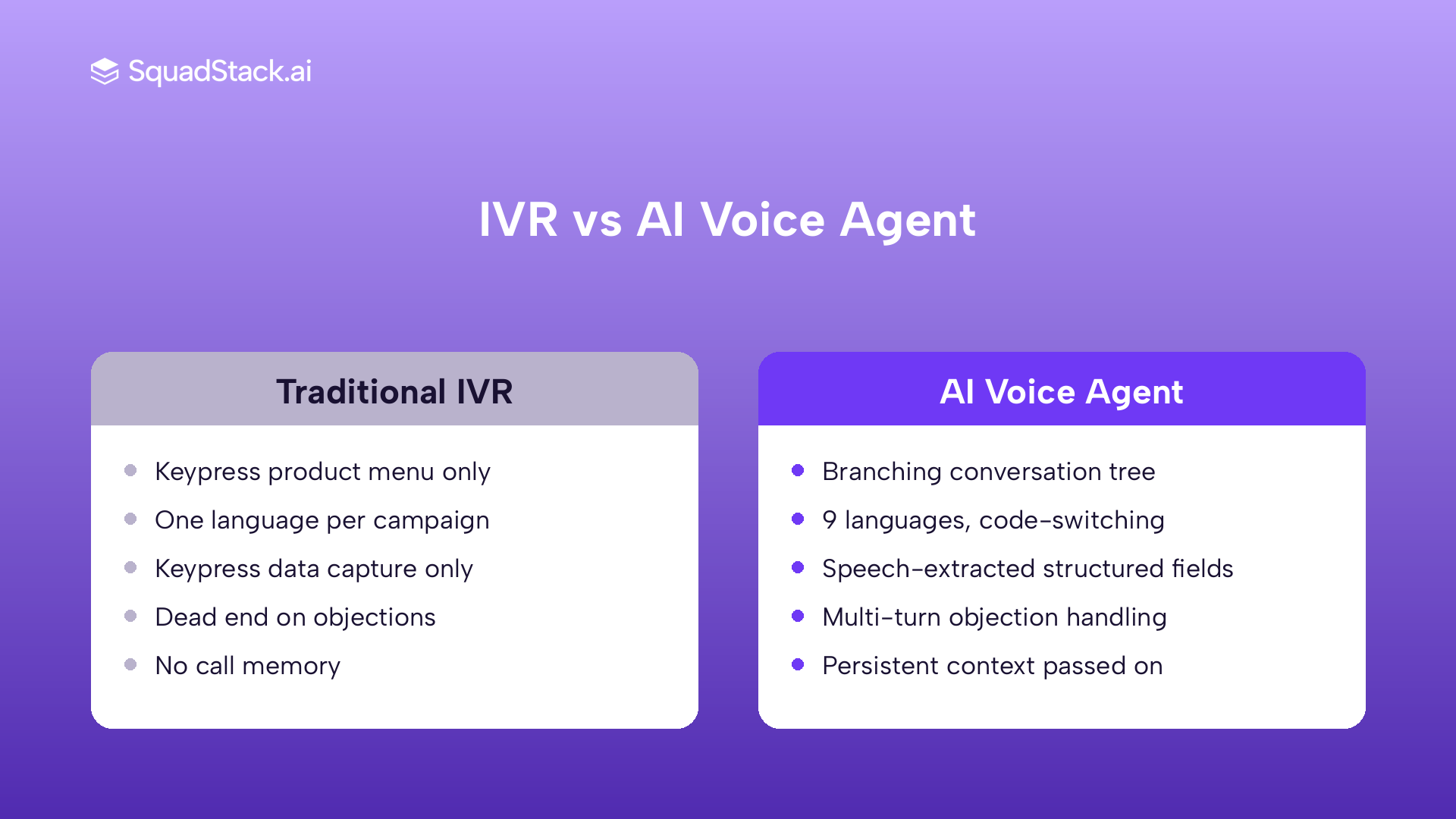
A standard IVR can play a message and collect a keypress. An AI voice agent holds a two-way conversation. The difference matters most in insurance, where a prospect's answer to one question determines the next five.
| Dimension | IVR | AI Voice Agent |
|---|---|---|
| Product branching | Fixed menu: "Press 1 for health, 2 for motor" | Detects product intent from natural speech; branches mid-conversation without asking the prospect to choose from a list |
| Objection handling | Drops the call or loops to the menu if the prospect says anything off-script | Catches common objections and responds with a multi-turn explanation, then continues qualifying |
| Language switching | One language per campaign; set at recording time | Switches mid-sentence between Hindi, English, Tamil, and 6 other live languages as the prospect's responses shift |
| Data capture | Captures keypresses only | Extracts structured fields (income band, existing cover, nominee, preferred sum assured) from natural speech |
| Compliance disclosure | Can play a recorded disclosure but cannot respond to questions about it | Delivers AI disclosure, answers follow-up questions, and logs consent on the call record |
| Memory across attempts | Every call starts cold; the prospect repeats their details every time | Persistent memory carries forward what was captured on the last call |
Five criteria separate a platform that works in production from one that looked good in a demo.
IRDAI and TRAI compliance is not optional. The platform must handle DND scrubbing before every dial, enforce calling-hour windows by hard system check, use 140-series numbers for outbound promotional calling, and generate a compliant call record. If a vendor cannot describe exactly how they handle the 1600-series vs 140-series distinction, walk away.
Regional language quality, not just language count. Sounding native in Tamil or Marathi on a noisy 8kHz phone line is different from listing languages on a feature page. Ask for call recordings in the languages your lead base actually uses and listen for code-switching, not just a translated script.
Multi-product script branching. A platform that requires separate campaigns for health, motor, and term multiplies operational overhead. Look for a workflow builder that handles conditional branching based on lead metadata and real-time responses.
Warm transfer architecture. When a prospect says they are ready to buy, the AI must hand off to a licensed advisor with full context. If the handoff drops the conversation history, the prospect starts over and trust is lost.
Latency on long calls. Insurance qualification calls run longer than a two-minute script. A platform that slows after ten exchanges fails exactly where insurance calls get complex.
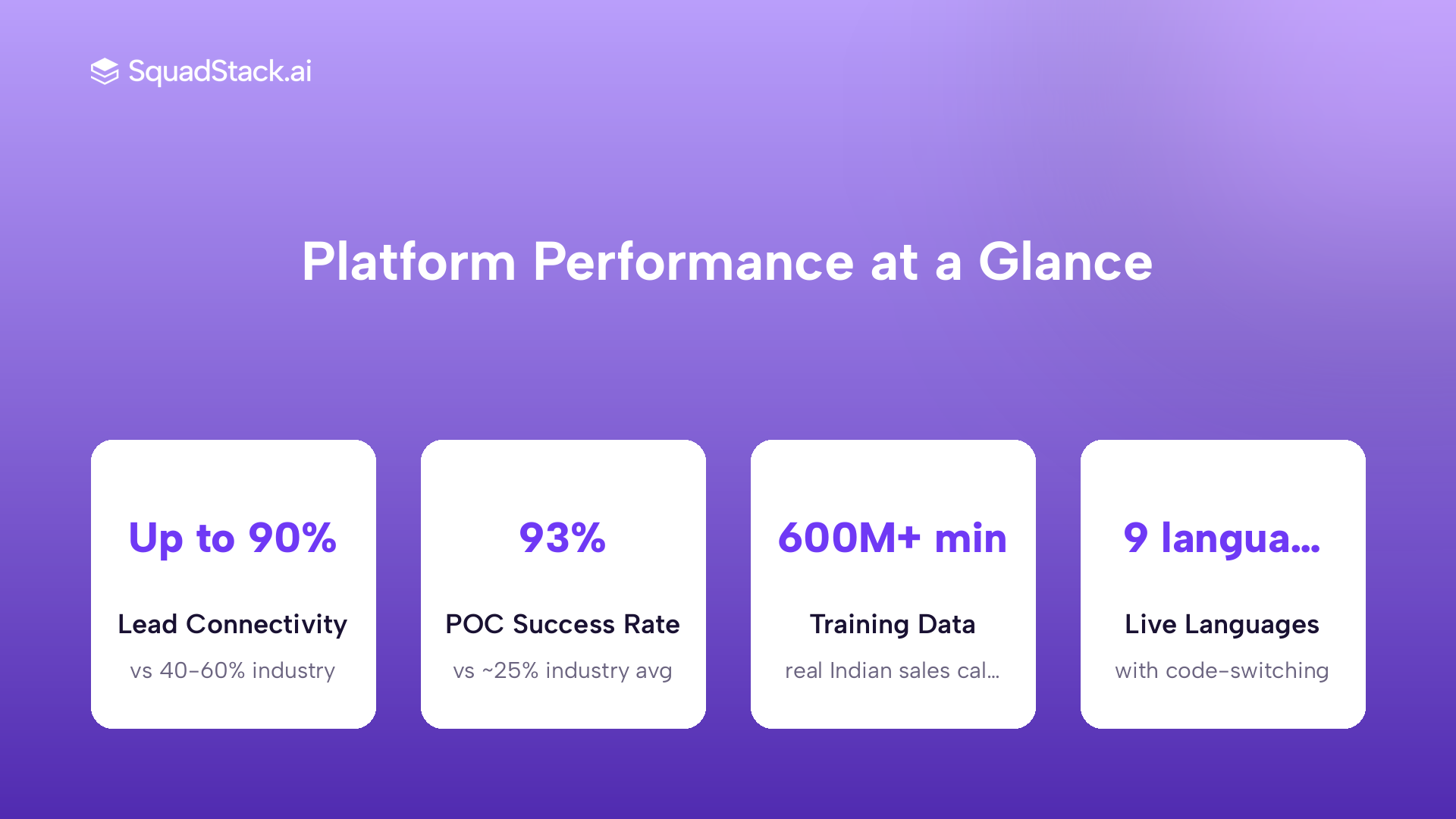
SquadStack's voice AI agents are trained on 600M+ minutes of real Indian sales conversations across 85%+ of Indian pincodes. The speech model, Arth, is tuned for Indian telephony conditions: noisy lines, code-switched speech, and regional-language entity handling. On real Indian telesales audio, Arth v1 sits within 0.9 semantic WER points of the best commercial streaming model available.
In a live deployment with a leading general insurer, SquadStack delivered 85% connectivity and 60% lower renewal cost on an auto insurance renewal campaign. Read the full case study here.
Three capabilities matter most for insurance lead qualification.
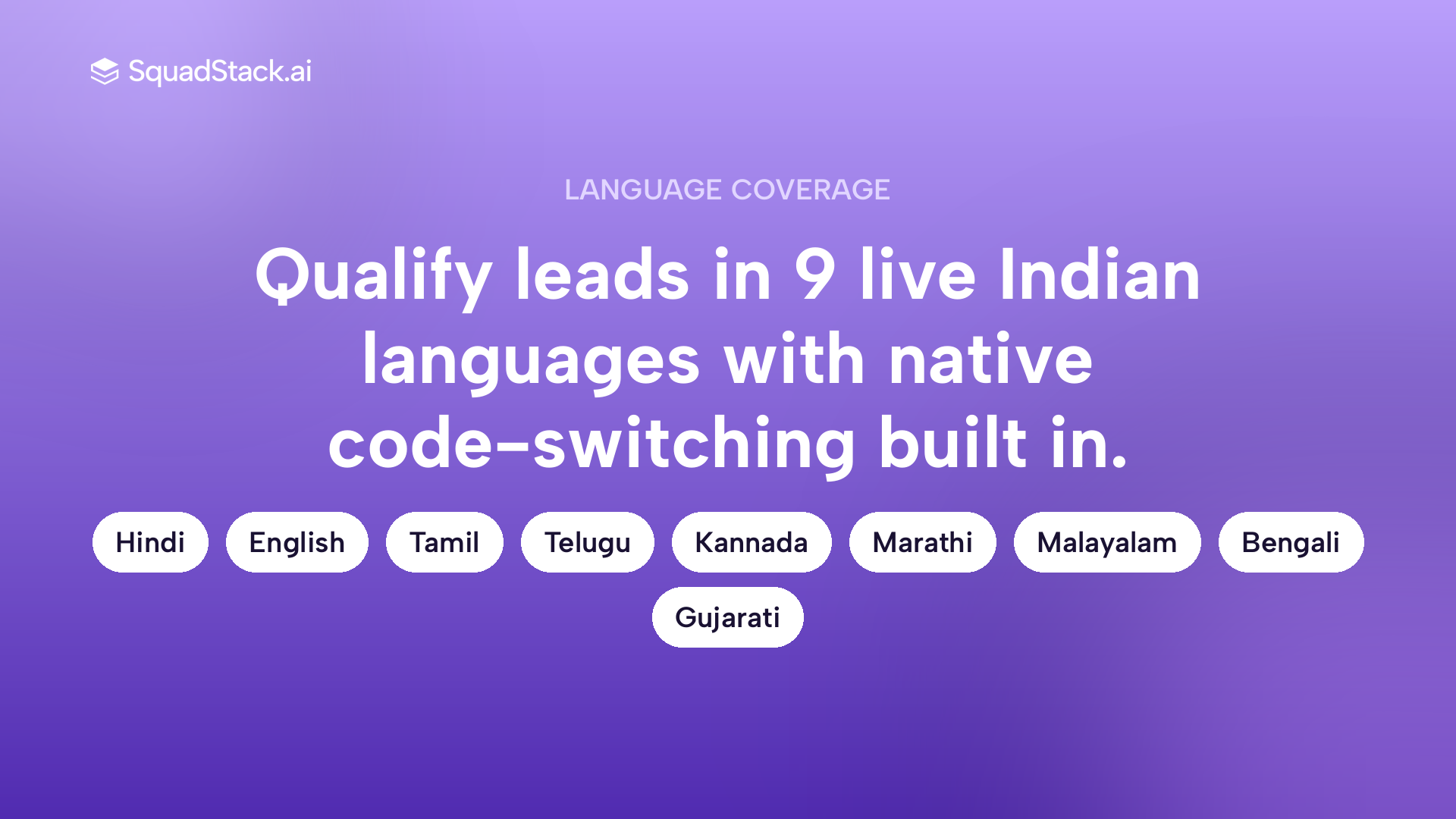
9 live Indian languages with native code-switching. Hindi, English, Tamil, Telugu, Kannada, Marathi, Malayalam, Bengali, and Gujarati are live today. A Marathi-speaking prospect in Pune who answers the income question in Hindi gets a response in Hindi without the agent missing a beat.
Dual-layer QA via the Eval System. Every qualification call is scored on three dimensions: Outcome, Sentiment, and Execution. This audit trail is automatic, not sampled, and gives the insurer's compliance officer the record they need.
93% POC success rate. Against an industry average around 25%, the qualification improvement shows up in the pilot before a full-scale commitment. The pilot runs four to eight weeks on real leads with a pre-aligned success metric, and scales once proven.
SquadStack runs 50 lakh+ calls daily across 60+ large consumer brands, with BFSI customers including Kotak Mahindra Bank, AngelOne, Kotak Securities, Bajaj Broking, BankBazaar, DMI Finance, PhonePe, KreditBee, and Moneyview.
The raw lead list is not the bottleneck in Indian insurance distribution. The bottleneck is the cost and time it takes to turn that list into a queue of qualified, ready-to-close prospects for licensed advisors. AI voice calling handles that triage at a scale and cost structure that human floors cannot match, while staying on the right side of IRDAI solicitation rules and TRAI compliance requirements.
If you are running an insurance distribution floor, an IMF operation, or an aggregator platform in India and want to see what qualification looks like in production, book a demo with SquadStack.
Which is the best AI voice agent for insurance lead qualification in India?
SquadStack is built specifically for Indian insurance and BFSI use cases. Its voice agents are trained on 600M+ minutes of real Indian sales conversations, support 9 live Indian languages with native code-switching, and deliver up to 90% lead connectivity against a 40 to 60% industry norm.
Can an AI voice agent legally qualify insurance leads in India?
Yes, within limits. An AI agent can confirm interest, capture income and coverage details, score the lead, and route them to a licensed advisor. The solicitation itself must still come from an IRDAI-certified person. Compliant platforms enforce AI disclosure, TRAI DND scrubbing, and call recording automatically.
How does AI voice calling compare to a traditional telecalling floor for insurance qualification?
AI agents reach more leads at lower cost, without attrition, shift constraints, or language gaps. A human floor at Rs 18,000 to Rs 32,000 per agent per month, with 40 to 70% annual attrition, cannot economically work a low-ticket motor or two-wheeler renewal book. An AI agent handles that volume without the fixed cost and routes qualified leads to human advisors who can close them.
What IRDAI and TRAI compliance requirements apply to AI voice calling in insurance?
Outbound promotional calls must use 140-series numbers with DND scrubbing. Service calls to existing customers use the 1600-series. Every call must include an AI identity disclosure. Scripts must be approved by the insurer's compliance officer. Calls must be recorded and retained. A compliant platform enforces all of these at the system level, not the script level.
How does multi-product script branching work for insurance?
The AI agent reads lead source metadata and listens to the prospect's initial responses to determine the relevant product category. A motor lead gets questions about vehicle type, NCB status, and cover type. A health lead gets questions about family size, existing coverage, and pre-existing conditions. Branching happens mid-conversation, not by asking the prospect to press a number.
Does the AI agent handle PIVC and welcome calls, or only lead qualification?
Both. Pre-issuance verification calls and welcome calls are among the clearest compliance-safe use cases for AI: they follow a defined script, must be recorded, and confirm specific policy details. SquadStack's agents handle these alongside pre-sales qualification, revival outreach, and renewal reminder campaigns.
How do AI voice agents handle regional language leads in insurance?
SquadStack's agents support Hindi, English, Tamil, Telugu, Kannada, Marathi, Malayalam, Bengali, and Gujarati live today, with additional regional languages available on demand. Native code-switching means the agent responds in the language the prospect uses, even if it shifts mid-sentence, without requiring a separate campaign per language. This matters for tier-2 and tier-3 markets where regional-language leads are a large share of the total. See more on voice bots in India.
What lead quality signals does an AI agent capture during an insurance qualification call?
The agent extracts structured fields from the conversation: product interest (term, health, motor), income band, family size, existing coverage status, sum-assured preference, and readiness to proceed. These fields are written back to the CRM alongside the disposition so the licensed advisor receiving the warm transfer has a complete picture before the first word.
What does implementation look like, and how long does it take?
A typical SquadStack engagement goes live in roughly two weeks. That includes building the qualification flow on the client's real call recordings and knowledge base, configuring the multi-product branching logic, and setting up integrations. The pilot runs four to eight weeks on real leads against a pre-agreed success metric. Scaling follows once the metric is proven. For context on related BFSI workflows, see SquadStack's work on AI in collections.
Can SquadStack handle the volume of a large aggregator platform or POSP network?
SquadStack runs 50 lakh+ calls daily across 60+ large consumer brands. Volume scaling has no hiring or training constraint on the AI side. The pilot ramps from a few hundred leads per day to several thousand within weeks, and full campaign scale follows once qualification metrics are validated.