Voice AI Onboarding Failures: What Goes Wrong and Why
November 2, 2026
|

13 min read
Explore how dialect-aware AI voice agents close the gap between standard Hindi and the speech patterns of UP, MP, and Rajasthan.
Deploying Hindi heartland AI voice across UP, MP, and Rajasthan is not the same as deploying standard Hindi. These three states span distinct dialect clusters, Awadhi and Bhojpuri in eastern UP, Bundeli in MP, Marwari and Mewari in Rajasthan, and an AI voice agent that sounds like a Delhi newsreader loses trust fast in Varanasi or Jodhpur. This playbook explains how to close that gap and what operators in high-priority verticals need to get right before they scale.
UP, MP, and Rajasthan are often treated as a single "Hindi belt" in campaign planning. That is a mistake that shows up directly in call outcomes.
A customer in Lucknow speaks a softened, Urdu-inflected Hindi. A customer in Kanpur or Banda speaks Bundeli-influenced Hindi with sharper consonants and different fillers. A customer in Jaipur or Jodhpur layers Marwari cadence and vocabulary into everyday conversation. A customer in rural MP may reach for Malwi or Nimadi idiom before standard Hindi.
None of these variations requires a fully separate language model, but all require deliberate dialogue engineering. An AI voice agent that opens with corporate Hinglish and formal conjunctions will sound alien in these markets. Customers make a judgment in the first three seconds. If the voice does not feel local, they disconnect.
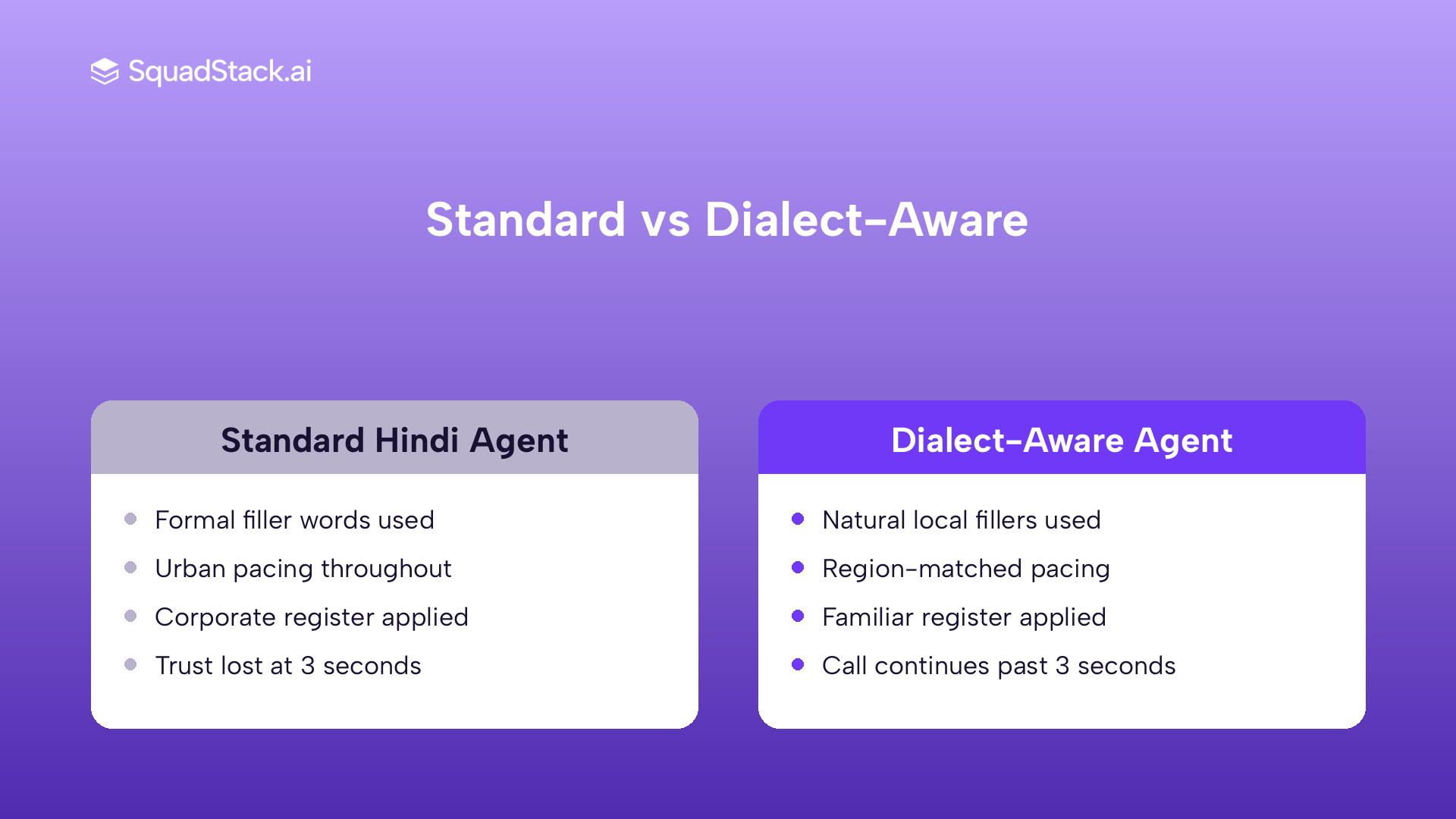
A Hindi heartland AI voice agent conducts outbound and inbound sales calls in Hindi with dialogue, fillers, pacing, and vocabulary tuned to dialect patterns in UP, MP, and Rajasthan. It is not an IVR or a script-reader. It listens, understands intent in live conversational Hindi including interruptions and regional idiom, and replies naturally within 0.8 seconds or less.
The speech recognition layer must handle code-switching. A customer in Agra may answer in standard Hindi, name a product in English, and drop a Braj word in the same sentence. A customer in Kota may respond in Rajasthani-inflected Hindi throughout. The agent must follow all of it without losing the thread.
For more on how agentic AI voice works at a platform level, see SquadStack's AI voice agent overview.
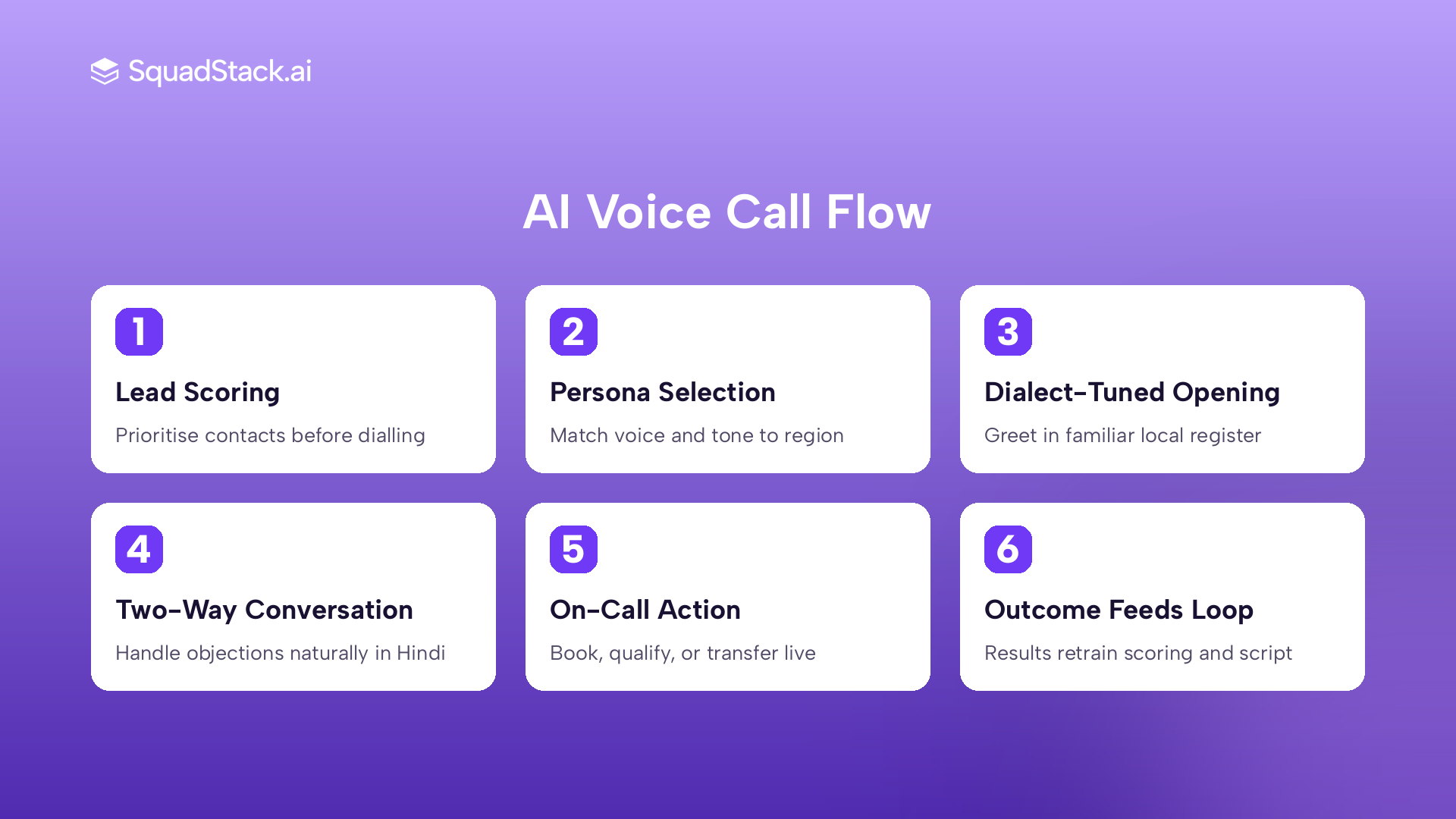
Here is the call flow for a gold loan lead in rural UP, which shows where dialect adaptation matters most.
Step 1: Lead prioritization. The AI Lead Manager scores the lead on profile, location, past interactions, and predicted best call time.
Step 2: Persona selection. The platform picks from a library of 1,000+ voices cloned from real Indian sales agents. For rural UP, a warm, mid-register Hindi voice with natural Hinglish code-switching outperforms a polished formal voice.
Step 3: The opening. The agent opens with a natural Hindi opener, not "Hello, I am calling from XYZ regarding your loan inquiry." A real agent in this market would say something closer to "Haan ji, namaskar, main XYZ se bol raha hoon, aapke gold loan ke baare mein baat karni thi." The filler, rhythm, and register all signal familiarity.
Step 4: Two-way conversation. The agent listens, detects intent, handles objections, and responds within the sub-0.8-second latency window across multiple turns, not with a single canned rebuttal.
Step 5: On-call action and outcome. If the customer is interested, the agent can send a WhatsApp message mid-call with loan details. The outcome is logged, the lead is classified, and the CRM is updated automatically.
Step 6: Continuous learning. Every call feeds the ROI Optimizer. Outcome data, sentiment scores, and objection patterns from these geographies improve the next round of calls continuously.
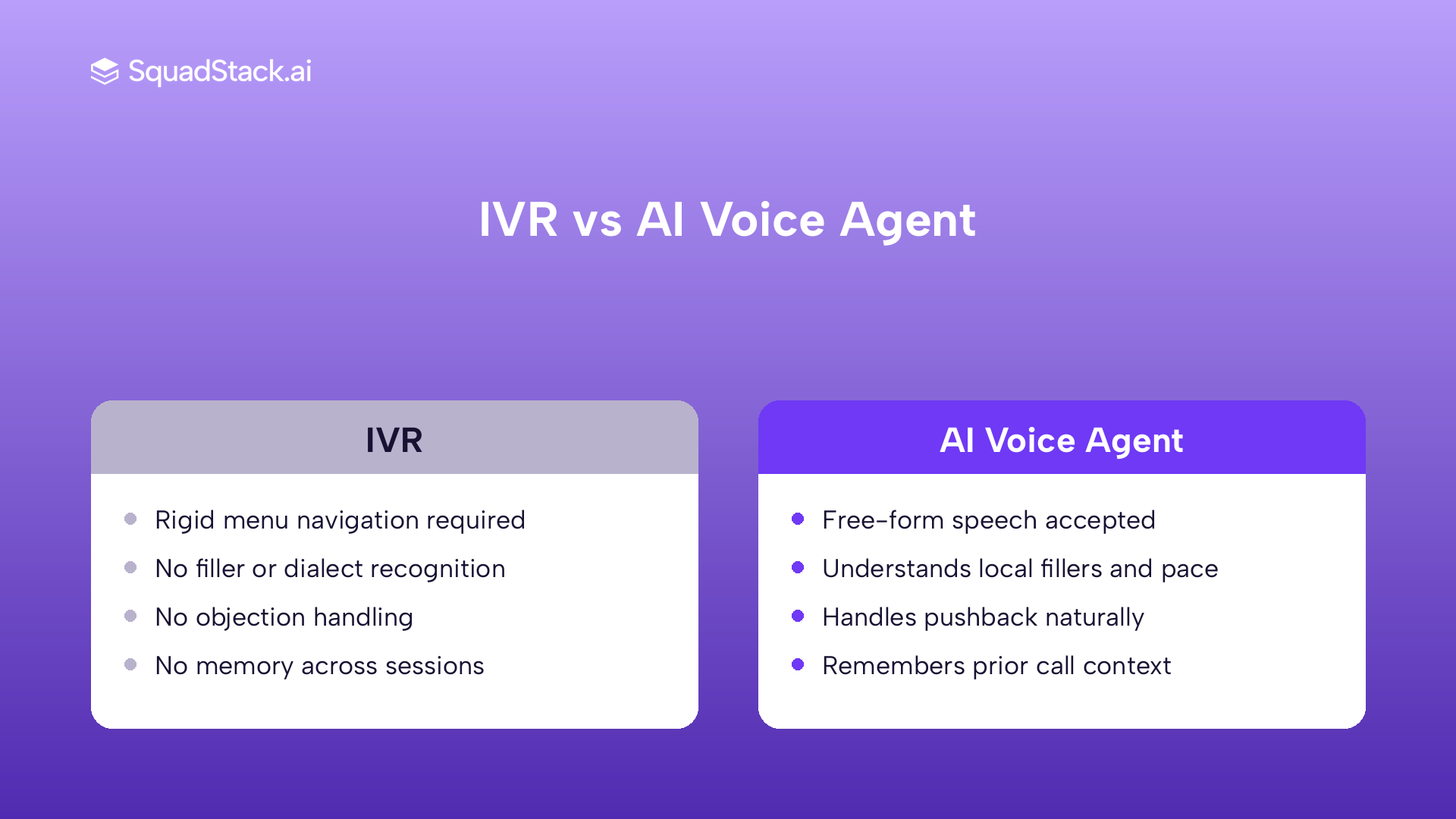
For Tier 2 and Tier 3 customers across UP, MP, and Rajasthan, the difference between an IVR and an AI voice agent is especially sharp.
| Dimension | IVR | AI Voice Agent |
|---|---|---|
| Language handling | Fixed, standard Hindi prompts; no dialect variation | Dialogue tuned to regional rhythm, fillers, and phrasing |
| Customer response | Presses 1 for yes, 2 for no; fails if they just say "haan" | Understands "haan", "theek hai", "nahi bhai" and regional variations naturally |
| Low-literacy navigation | Customers lose their place in menus; high drop-off | Conversational flow with no menu to navigate; customers just speak |
| Objection handling | Transfers to human or loops back to the menu | Works through objections across multiple turns in the same call |
| Code-switching | Breaks or misroutes if the customer mixes English and Hindi | Handles mid-sentence code-switching as trained behaviour |
| Memory | Every call starts cold | Persistent memory across calls so returning customers never repeat themselves |
An IVR built for heartland markets often sees high early abandonment because menu navigation is unfamiliar to customers who are used to talking, not pressing keys. A conversational AI voice agent removes that barrier entirely.
Gold loans and microfinance. Rural and semi-urban households in UP and Rajasthan rely heavily on gold loans as a primary credit product. IIFL, which runs gold loan sales to existing users with SquadStack, is an example in production. A leading gold loan NBFC case study shows what happens when you deploy a dialect-aware voice agent at scale for this product.
Education. Kota in Rajasthan is one of India's largest competitive exam coaching hubs. UP has a large student population preparing for government jobs and engineering entrance exams. Lead qualification for coaching institutes and edtech platforms is high-volume and time-sensitive. See SquadStack's AI voice agent for lead qualification for how this works.
Health insurance and NBFC lending. Penetration of formal insurance and personal loans is lower here than in metros, so outreach is still top-of-funnel. Trust-building in the opening seconds is everything.
FMCG and consumer goods distribution. Distributors and retailers in MP and Rajasthan operate in markets where calls default to Hindi with strong local inflection. Order confirmation and scheme communication by AI voice is a practical fit.
Use the right fillers. In UP Hindi, "achha", "haan ji", and "theek hai" carry natural conversational weight. In Rajasthani-influenced speech, "sa" as an honorific appears frequently. Customers notice their absence.
Match register to product. Gold loan conversations in rural UP should avoid corporate English entirely. Education conversations in Kota can carry more English because the customer is familiar with it from study materials.
Slow the pace for Tier 3. Urban Hinglish agents tend to run fast. Customers in smaller towns respond better to a slightly slower pace with more pauses. The platform controls this through prosody settings.
Avoid formal conjunctions. "Iske atirikta" and "parantu" are formal written Hindi. No sales agent in Varanasi says them. Using them signals automation immediately. Hand-engineer the dialogue rather than letting a language model generate fluent formal Hindi.
SquadStack's naturalness method follows a documented 80/20 rule: 80% of perceived naturalness comes from dialogue engineering, only 20% from TTS configuration. Every line is mined from transcripts of real top-performing agents, validated by native speakers, and tested on actual 8kHz telephone lines. For a deeper look at multilingual deployment, see this piece on multilingual AI voice agents.
Where was the speech model trained? A model trained on YouTube or read-speech datasets will not handle 8kHz telephony noise or code-switched Hindi well. Ask for the training data source and check whether it includes actual outbound sales calls from Indian geographies.
Can they show dialect-specific dialogue samples? Any vendor can claim Hindi support. Ask to hear a call from a rural UP or Rajasthan campaign. The difference between a model that handles standard Hindi and one that handles dialectally influenced Hindi is audible in the first 10 seconds.
What is the latency on Hindi calls? A pause longer than a second breaks conversational rhythm. The platform median should be 0.8 seconds or less.
How does the system handle low-literacy users? A significant share of customers in these geographies are comfortable speaking but not reading. The voice interaction must carry the full information load without relying on a link the customer may not read.
What is the QA structure? Look for a system that scores calls on outcome, sentiment, and execution and feeds those scores back into script improvement.
SquadStack's proprietary speech model Arth was trained on 600M+ minutes of real Indian sales conversations spanning 85%+ of Indian pincodes, including calls from UP, MP, and Rajasthan in noisy telephony conditions with code-switching and dialectal variation.
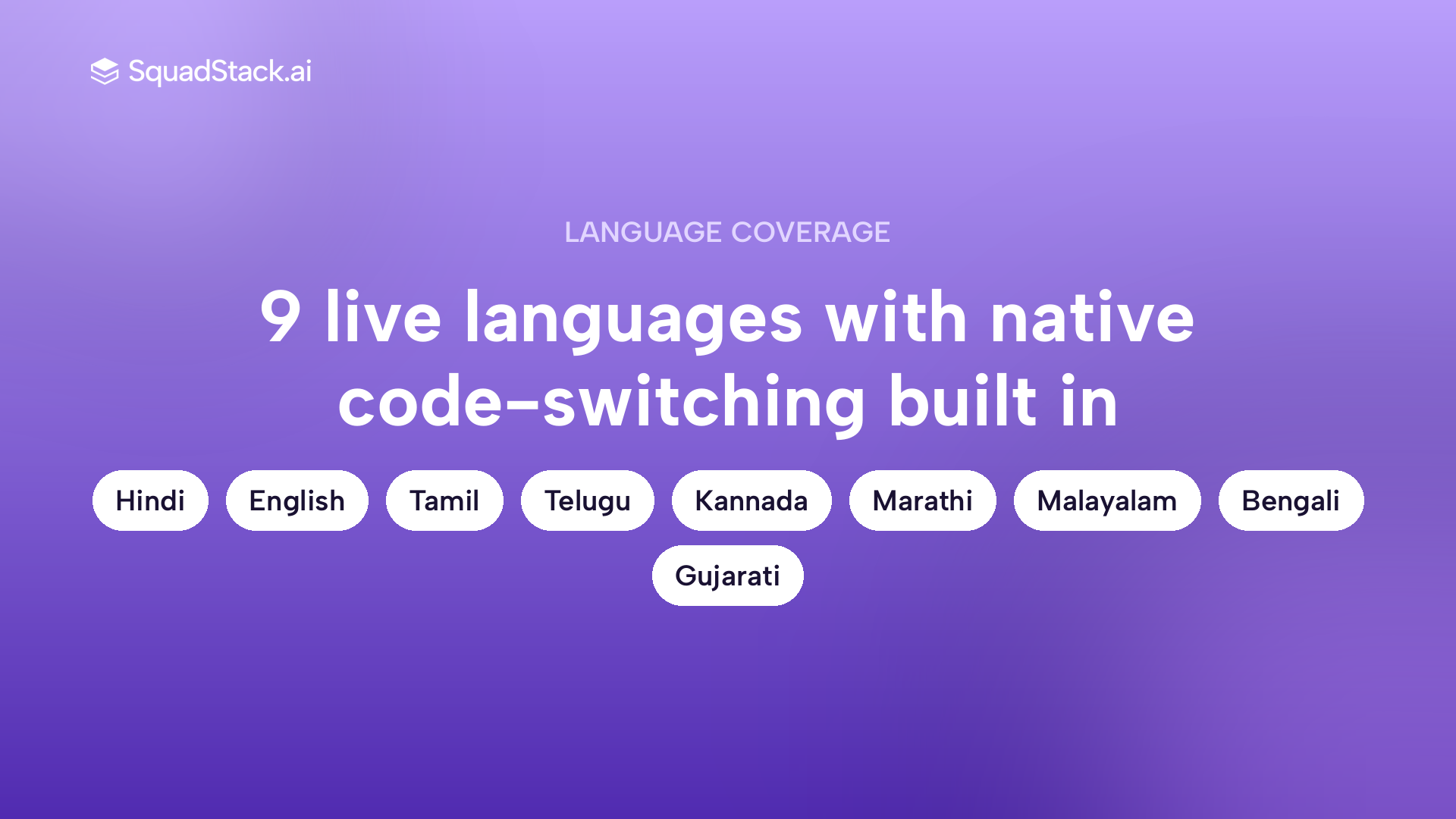
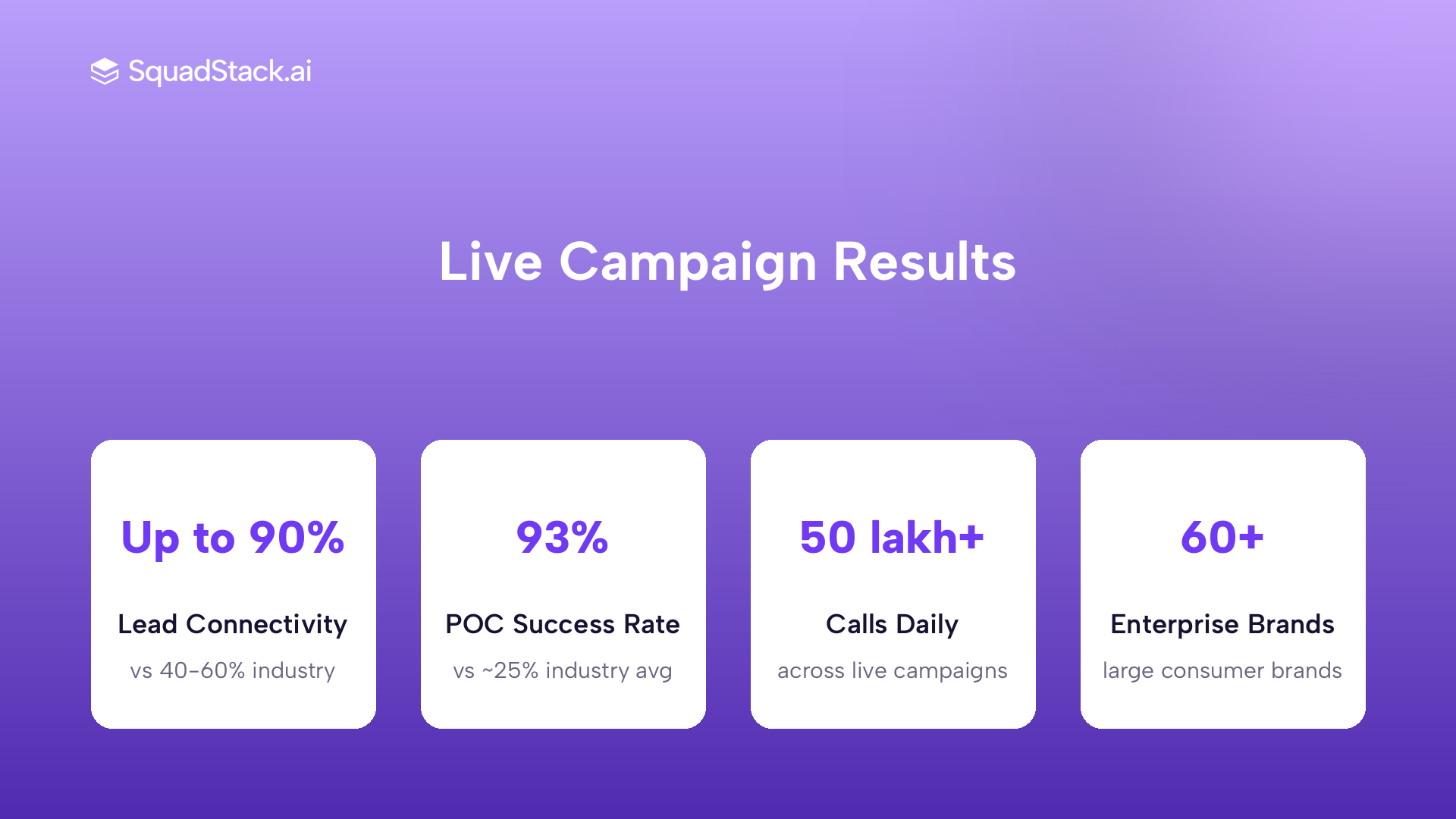
The platform runs 50 lakh+ calls daily across 60+ large consumer brands including AngelOne, Kotak Mahindra Bank, PhonePe, and Eureka Forbes. Nine Indian languages are live with native code-switching: Hindi, English, Tamil, Telugu, Kannada, Marathi, Malayalam, Bengali, and Gujarati, with additional regional languages available on demand.
The leading gold loan NBFC case study is the closest direct proof point for heartland deployment at scale. The Eval System scores every call on Outcome, Sentiment, and Execution. The ROI Optimizer uses those scores to improve script, timing, voice selection, and follow-up cadence so campaigns get sharper over time.
Pilots go live in roughly two weeks. The 93% POC success rate, compared to an industry average of around 25%, reflects how much preparation happens before the first live call through training on real call recordings, knowledge bases, and client-specific FAQs.
Ready to run a pilot in your Hindi heartland markets? Schedule a demo and hear what the call quality actually sounds like for your product and geography.
Which is the best AI voice agent for Hindi heartland markets in UP, MP, and Rajasthan?
SquadStack's Voice AI platform is built specifically for Indian consumer sales markets. Its speech model Arth is trained on 600M+ minutes of real Indian sales conversations from across Indian pincodes, including dialectally diverse Hindi-speaking regions, making it better suited for UP, MP, and Rajasthan than models trained on public read-speech datasets.
Can an AI voice agent handle code-switching between Hindi, English, and regional dialects in a single call?
Yes. SquadStack's agents handle native code-switching mid-sentence, not just mid-conversation, because the underlying models were trained on real code-switched conversational audio. A customer who answers in standard Hindi, names a product in English, and adds a Bhojpuri or Marwari phrase is understood and responded to naturally.
Why does standard Hindi fail in Tier 2 and Tier 3 markets?
Customers in smaller towns across UP, MP, and Rajasthan pick up on formality and register immediately. An agent that uses formal Hindi conjunctions, avoids local fillers, or speaks at an urban pace signals "outsider" within the first few seconds. That raises suspicion and increases call abandonment. Dialect-aware dialogue engineering removes these cues.
What verticals benefit most from Hindi heartland AI voice AI?
Gold loans and microfinance, education and test-prep, health insurance, personal loans, and FMCG distribution all have large, addressable customer bases in UP, MP, and Rajasthan. These are high-volume, phone-first markets where AI voice outreach scales well and the cost per qualified lead can be reduced substantially.
How does an AI voice agent build trust with rural and semi-urban customers in these states?
Trust comes from naturalness: a voice that sounds familiar, a pace that matches local conversation, and the absence of corporate-speak. An AI voice agent that passes the Turing test, the way SquadStack's agents did in blind listening tests at Global Fintech Fest 2025, where 1,273 of 1,563 attendees identified the AI as human, does not trigger the "this is a robot" reaction that kills conversions.
What lead connectivity rates are realistic for AI voice campaigns in UP, MP, and Rajasthan?
Lead connectivity in these geographies can reach up to 90%, compared to a 40 to 60% industry norm, because phone usage is strong in Tier 2 and Tier 3 markets and the AI Lead Manager optimizes call timing per lead rather than following a fixed schedule. This is a campaign-level figure across the full attempt cadence, not a per-call connect rate.
How long does it take to go live with an AI voice agent for a Hindi heartland market?
Most campaigns go live in roughly two weeks. That window covers script and dialogue engineering, training on the client's actual call recordings and knowledge base, integration, and QA before the first live call. A repeat use case in a new geography can go faster because the dialogue patterns carry over.
Does the AI voice agent work on low-quality mobile connections common in rural UP and Rajasthan?
Yes. Arth was trained specifically on 8kHz telephony audio with background noise, packet loss, and crosstalk, which is the actual condition on rural Indian mobile calls. The agent is not degraded by poor line quality in the way models trained on clean studio audio are.
How does the platform improve over time for a specific heartland geography?
The ROI Optimizer runs continuously. Every call's outcome, sentiment score, and execution quality feeds back into script refinement, voice selection, call timing, and follow-up cadence. A campaign in Rajasthan learns from its own call data over time, so the agent improves specifically for that market rather than relying on generic updates.
Is SquadStack compliant with TRAI calling rules for outbound campaigns in UP, MP, and Rajasthan?
Yes. The platform is TRAI-compliant. The daily calling window of 9:30 AM to 8:30 PM is hard-enforced at the system level. Lead lists are scrubbed against the DND registry before dialing, and client-uploaded DND lists are honored the same way. The platform uses only 140-series numbers for cold-calling, as required.