.svg)





Hyper-Personalised Outbound Call Scripts Using Customer Lifecycle Data
October 6, 2026
|

13 min read
The collection process in BPO covers the full lifecycle from pre-due reminders through soft and hard delinquency buckets to legal referral. In India, each...
The collection process in BPO covers the full lifecycle from pre-due reminders through soft and hard delinquency buckets to legal referral. In India, each stage must stay inside RBI and TRAI guidelines on calling hours, consent, and agent conduct. AI voice agents are now handling the high-volume early buckets automatically, freeing human agents for complex negotiations in later stages.
Indian lenders process millions of EMIs every month. Even a small percentage of missed payments creates a collection workload that no human team can handle purely through manual calling. The challenge is not just volume. It is making the right call, at the right time, with the right tone, without stepping outside the regulatory lines that RBI and TRAI have drawn. That is the operating reality for any team running the collection process in BPO today.
The collection process in BPO is the structured, outsourced workflow through which a lender or financial institution contacts borrowers who have missed or are approaching a payment, with the goal of recovering the overdue amount while preserving the customer relationship where possible.
BPO collections teams do not just make calls. They manage a staged escalation path, apply scripted communication protocols matched to each borrower's risk level, log payment commitments, and hand cases off to legal or field teams when required. In India, this work runs under close regulatory oversight from RBI and TRAI, so every step from call frequency to agent conduct must meet specific compliance rules.
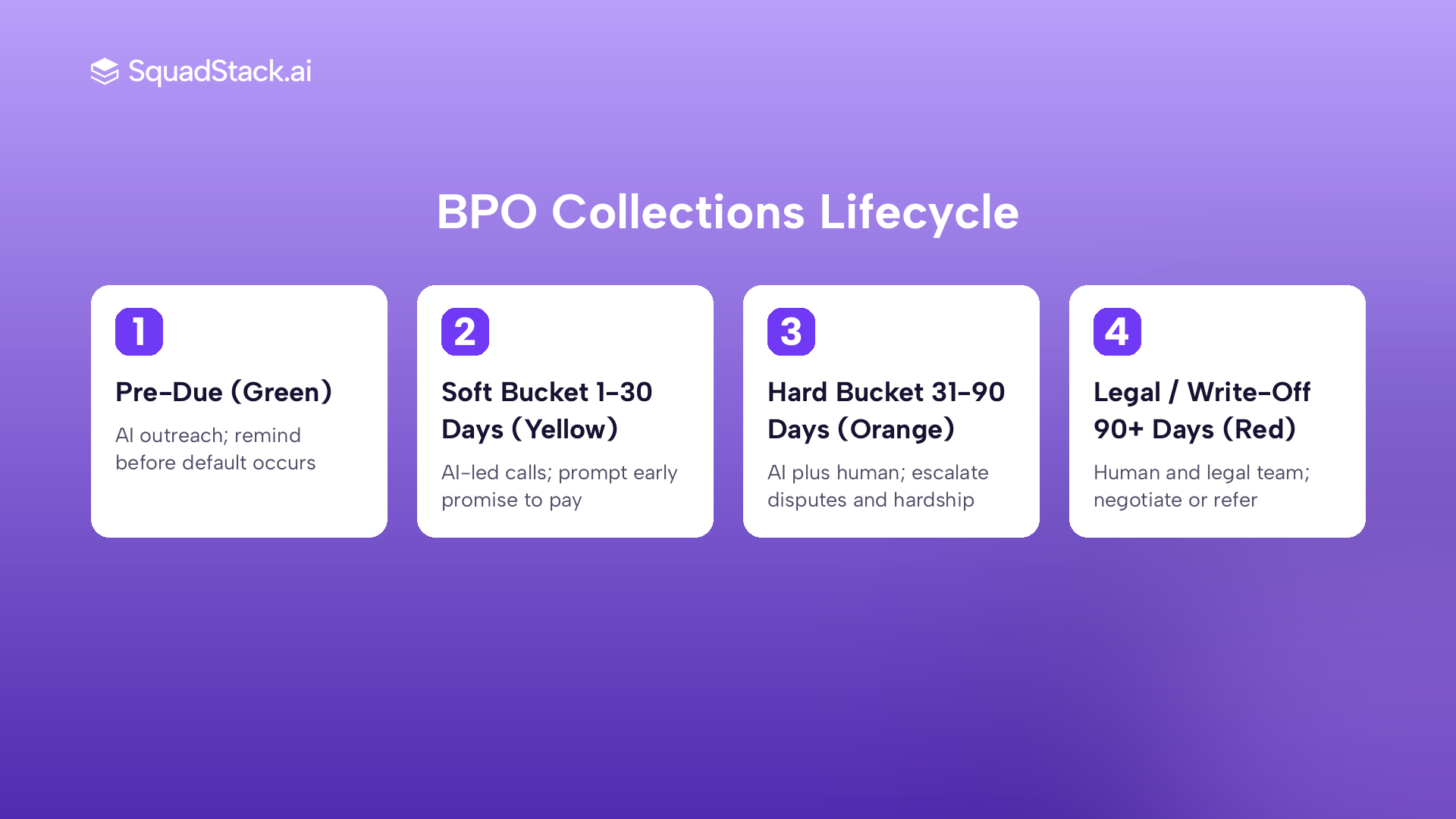
Each stage has a different objective, a different tone, and different rules on frequency and escalation.
Objective: Remind. Preserve the relationship. Catch genuine forgetfulness before it becomes a missed payment.
Pre-due outreach is not yet collections. The borrower has not defaulted. The tone should be helpful: a reminder that an EMI is due in a few days, a prompt to check bank balance or set up an auto-pay, and a payment link if the channel supports it.
Call frequency: One to two contacts in the three to five days before the due date is standard. Aggressive follow-up at this stage damages trust for no gain.
Script tone: Warm, informative, brief. No mention of consequences.
Best fit for AI: High. Every call is structurally identical. Volume is at its peak across the book. AI voice agents handle this stage well because the conversation is short, the outcome is binary (payment initiated or not), and human empathy adds relatively little at this point.
Objective: Secure a promise to pay (PTP). Understand the reason for non-payment. Offer a solution if one exists (e.g. a partial payment arrangement).
This is early delinquency. The borrower is still reachable and often cooperative. The primary KPI here is the PTP rate: the share of contacted borrowers who commit to a specific payment date.
Call frequency: RBI guidelines require that borrowers are not harassed. In practice, most lenders run two to three attempts per week in this bucket, spread across different times of day to maximise right-party contact (RPC) rate.
Script tone: Empathetic but clear. Acknowledge the missed payment, ask an open question about the reason, and offer a resolution path. Avoid threatening language entirely.
Best fit for AI: High for initial contact and PTP collection. Human escalation is triggered when the borrower raises a dispute, claims financial hardship, or asks a question the agent cannot resolve.
Objective: Secure payment or a firm repayment plan. Notify the borrower of credit score impact and potential legal action where applicable.
Borrowers in this bucket are significantly harder to reach and less cooperative when reached. The RPC rate drops sharply. The conversations are longer, more emotionally charged, and require negotiation skills.
Call frequency: Attempts increase but must still stay within TRAI's hard rule: 9:30 AM to 8:30 PM only. Calls outside this window are non-compliant regardless of the business justification.
Script tone: Firm, factual, and professional. Consequences can be stated clearly but must not be exaggerated or abusive. RBI's Fair Practices Code explicitly prohibits intimidation, abusive language, and misrepresentation of consequences.
Best fit for AI: Mixed. AI handles initial contact and standard negotiation paths well. High-complexity cases, borrowers expressing financial distress, or disputes over the outstanding amount should transfer to a human agent with full context passed.
Objective: Exhaust settlement options before referring to legal or recovery teams. Secure a settlement offer or document the default for write-off.
At this stage, cases either settle (often at a discount), move to a legal or field recovery process, or are provisioned for write-off. BPO teams in this bucket typically work with a small proportion of the original book. Each case requires individual attention.
Call frequency: Depends on the legal process in motion. Calls to a borrower once legal proceedings have been issued must follow specific protocols and often require sign-off from a compliance officer.
Script tone: Neutral, legal-grade precision. No pressure tactics. Every conversation should be recorded and logged.
Best fit for AI: Limited at this stage. AI may handle appointment booking or documentation chasing, but negotiation and legal communication belong with trained human agents.
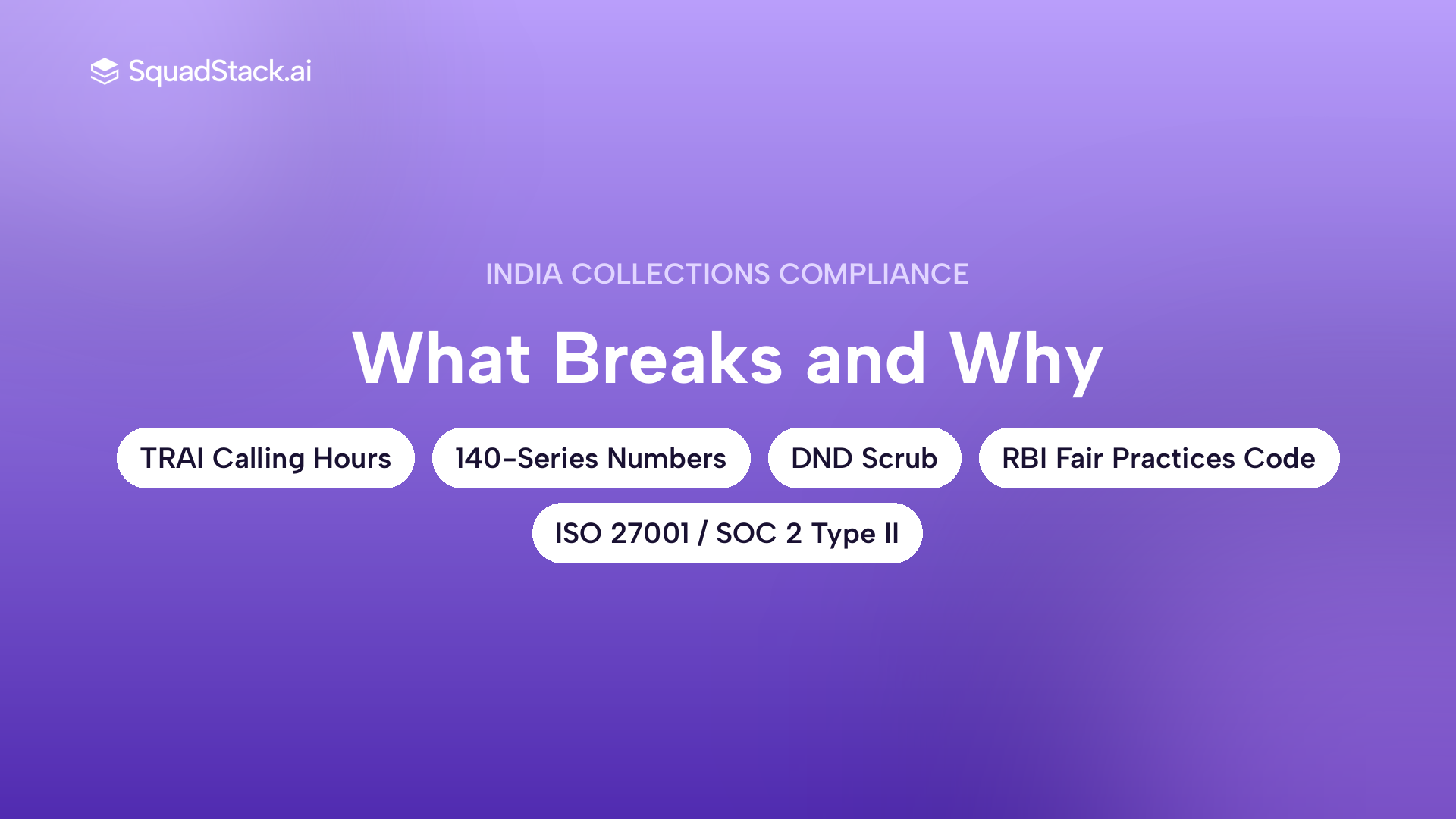
Every outbound collection call in India must comply with two overlapping regulatory frameworks. Getting either wrong creates liability for both the lender and the BPO.
| Rule | What It Means | How to Comply |
|---|---|---|
| TRAI calling hours | Outbound calls only permitted 9:30 AM to 8:30 PM | Enforce as a hard platform block, not a policy reminder |
| TRAI DND registry | Borrowers on the national DND registry cannot receive cold outbound calls | Scrub lead lists against the registry before every campaign run |
| 140-series numbers | Cold outbound calling in India requires a 140-series number | Procure 140-series numbers; do not use mobile or PRI numbers for cold outreach |
| RBI Fair Practices Code | Prohibits abusive language, harassment, misrepresentation, and calling at odd hours | Script all agents (human and AI) to these standards; audit calls regularly |
| Consent and AI disclosure | Borrowers must be informed they are speaking to an AI if they ask | Build disclosure behaviour into the conversation layer; configure per-campaign |
| Call recording and logging | Every collections call should be recorded for dispute resolution | Ensure your platform logs and stores recordings with full disposition data |
One practical note on DND: borrowers who have an existing loan relationship with a lender are generally reachable under the transactional communication exemption, but the exact scope of that exemption depends on how the communication is classified. Legal and compliance teams should confirm the classification before dialing.
Teams evaluating a collections BPO or building their own workflow should track these metrics per bucket, not just at the portfolio level:
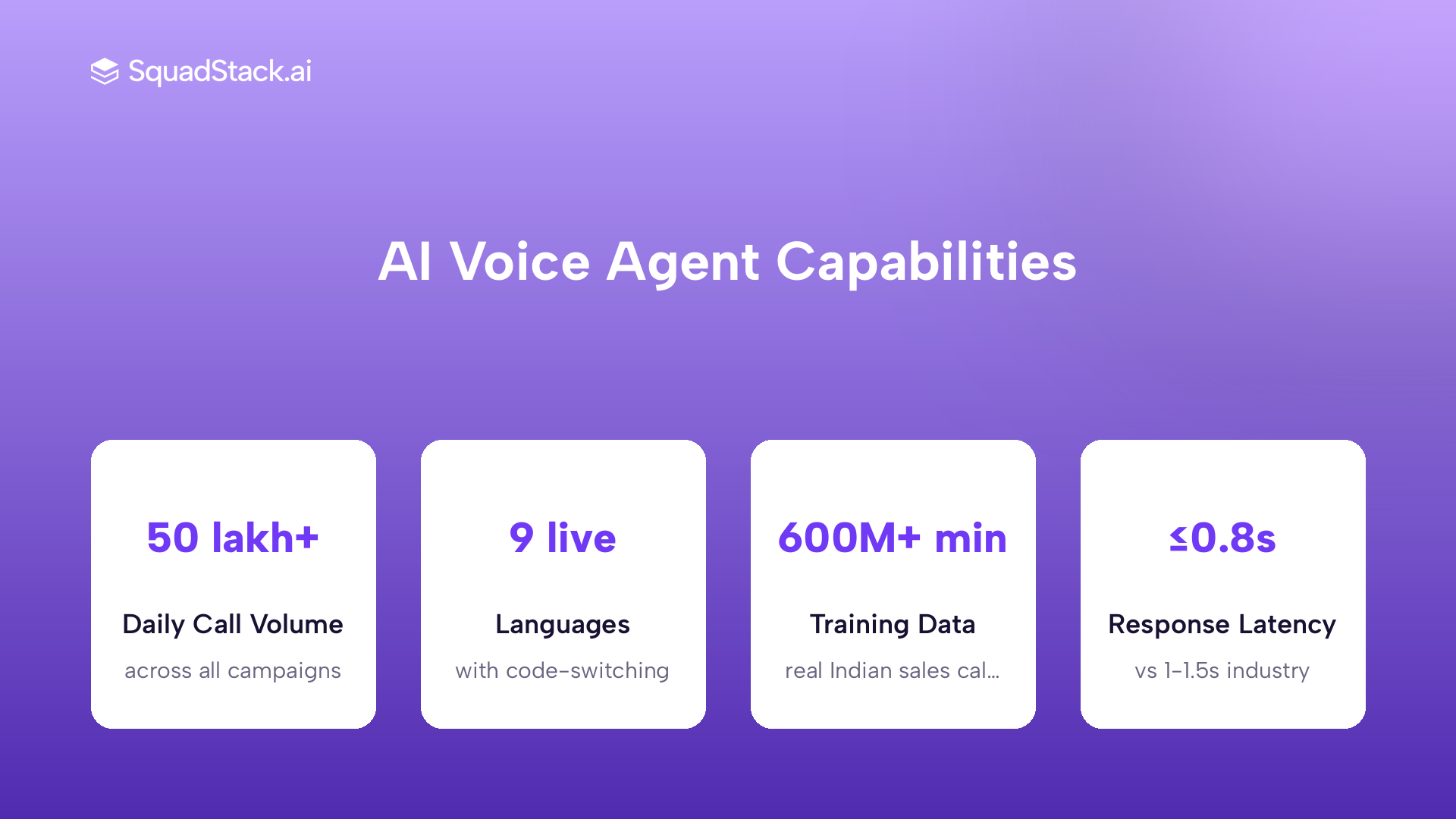
AI voice agents are best deployed in the stages where volume is high and the conversation is structured: pre-due and soft bucket. This is also where the economics are most compelling. Running thousands of pre-due reminder calls manually is expensive and adds little relationship value. An AI agent covers the same volume at a fraction of the cost and with full compliance enforcement built into every call.
The advantages compound in multi-language markets. A lender serving borrowers across Tamil Nadu, Maharashtra, and West Bengal cannot staff a compliant, empathetic calling team in Tamil, Marathi, and Bengali at scale. An AI platform that operates across all three, with native code-switching and no quality variance between languages, changes what is operationally feasible.
SquadStack's AI in collections platform runs on Arth, a proprietary speech model trained on 600M+ minutes of real Indian telephony conversations, including collections and lending use cases. The platform covers 9 live languages: Hindi, English, Tamil, Telugu, Kannada, Marathi, Malayalam, Bengali, and Gujarati, with native code-switching so agents do not sound like they are reading from a textbook in a second language. Calling hours and DND compliance are enforced at the platform level as hard blocks, not policy guidelines.
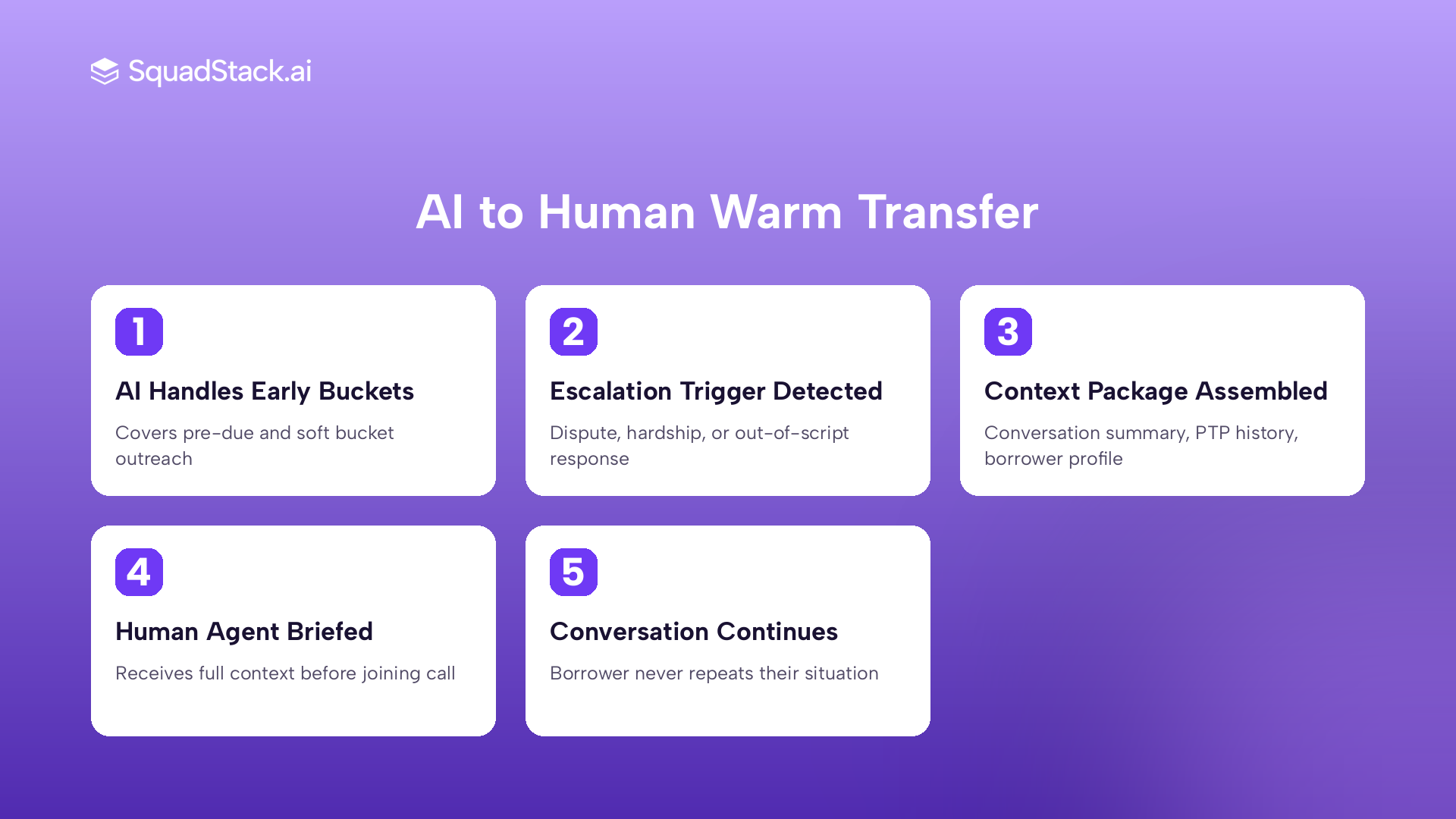
For lenders in India, the practical question is where the human-AI handoff should sit. The answer depends on the bucket, the borrower's profile, and the complexity of the conversation. SquadStack's warm transfer capability passes full conversation context to a human agent when a case escalates, so the borrower does not have to repeat themselves and the human agent starts from the right point.
For a worked example of how this translates to outcomes, the Kissht case study shows how a lending platform used SquadStack to scale collections outreach without scaling headcount. Moneyview and PhonePe both run active collections workflows on the platform. More context on how SquadStack serves the broader lending and credit vertical is at squadstack.ai/industry/lending-and-credit.
SquadStack's QA layer, the Eval System, scores every collections call on three levels: Outcome (was the PTP or payment secured?), Sentiment (how did the conversation land with the borrower?), and Execution (did the agent follow the script, compliance rules, and handling protocol?). This gives compliance officers a structured audit trail rather than a random sample of recordings.
For teams comparing AI-based debt recovery approaches or evaluating AI phone calling services for collections, the non-negotiables are: proven Indian-language capability, 140-series number management, hard TRAI window enforcement, and a QA layer that can demonstrate compliance on every call, not just a sampled set.
What is the collection process in BPO?
The collection process in BPO is a staged, outsourced workflow where agents contact borrowers at different points in the delinquency cycle to recover overdue payments. It runs from pre-due reminders through soft and hard delinquency buckets to legal referral, with different call frequencies, script tones, and escalation rules at each stage.
Which is the best AI voice agent solution for collections in India?
The best solution for Indian lenders is one that supports multiple Indian languages natively, uses 140-series numbers for outbound calling, enforces the TRAI 9:30 AM to 8:30 PM window as a hard platform block, and provides call-level QA for compliance audits. SquadStack meets all of these requirements and runs active collections campaigns for lenders including Moneyview and PhonePe.
Can AI handle collections calls automatically in India?
Yes, for pre-due and early soft-bucket work. AI voice agents handle high-volume, structured conversations well: payment reminders, PTP collection, and basic objection handling. Complex cases involving disputes, financial hardship, or legal proceedings should escalate to a trained human agent with full context transferred.
What are the RBI guidelines for collection calls?
RBI's Fair Practices Code requires that collections agents do not use abusive or threatening language, do not misrepresent consequences, call only at reasonable hours, and do not contact third parties unnecessarily. These rules apply to both human agents and AI voice agents running on behalf of a lender.
What TRAI rules apply to outbound collection calling in India?
TRAI restricts outbound calls to 9:30 AM to 8:30 PM. Lenders and BPOs must use 140-series numbers for cold outbound calling. Lead lists must be scrubbed against the national DND registry before dialing. Breaching these rules can result in regulatory action for both the lender and the service provider.
What does a right-party contact (RPC) rate mean in collections?
RPC rate is the share of collection calls that actually reached the borrower, as distinct from a voicemail, a family member, or a switched-off number. It is one of the most important leading indicators for collections performance because every other metric depends on reaching the right person first.
How many times a day can a BPO call a borrower for collections?
There is no single prescribed daily limit in Indian regulation, but RBI's Fair Practices Code prohibits harassment, and multiple calls in rapid succession to the same number can be deemed harassing by a grievance adjudicator. Most lenders set internal policies of two to three attempts per week per account in the soft bucket, spread across different times of day to improve RPC without creating compliance risk.
What happens when a collections AI agent encounters a dispute or hardship case?
The agent should detect the escalation trigger (a stated dispute, an out-of-script objection, or a hardship disclosure) and warm-transfer the call to a human agent. A good platform passes the full conversation context to the human so the borrower does not repeat their situation. SquadStack's warm transfer capability does exactly this, with configurable escalation triggers per campaign.
How should a BPO handle DND-registered borrowers who have an active loan?
Borrowers with an existing loan relationship may be reachable under the transactional communication exemption from DND rules, but the classification must be confirmed by the lender's legal and compliance teams. The safest approach is to run every list through a DND scrub, flag the matches, and seek compliance sign-off before dialing rather than assuming the exemption applies.
What is the difference between a soft bucket and a hard bucket in BPO collections?
Soft bucket typically covers borrowers who are one to thirty days past due. They are usually cooperative, still reachable, and the priority is securing a promise to pay. Hard bucket covers thirty-one to ninety days past due, where right-party contact rates drop, conversations become more complex, and the risk of the account rolling into legal territory is higher. The two stages require different script tones, escalation rules, and agent skill levels.