.svg)





Hyper-Personalised Outbound Call Scripts Using Customer Lifecycle Data
October 6, 2026
|

13 min read
When your outbound sales numbers get tagged as spam on Truecaller, pick-up rates collapse and your pipeline dries up. A truecaller no check process means...
When your outbound sales numbers get tagged as spam on Truecaller, pick-up rates collapse and your pipeline dries up. A truecaller no check process means continuously monitoring each number's reputation, rotating flagged numbers out automatically, and pairing that with discipline around calling hours and consent. AI-managed dialling platforms handle all of this as a built-in system, not a one-time fix.
Every outbound sales team in India eventually hits the same wall. Calling volumes are strong, the lead list is fresh, but pick-up rates have quietly slipped. The culprit is usually a bright red "Suspected Spam" or "Telemarketer" label on Truecaller sitting next to the caller's number.
For BFSI teams running personal loan sales or consumer electronics brands pushing AMC renewals, a spam tag can wipe out a meaningful share of contact attempts in a single day. This post explains why it happens, the signals Truecaller watches, and the practices AI-managed dialling platforms use to keep numbers clean.
Truecaller is a caller ID and spam-detection app with hundreds of millions of active users in India. Its classification system works on two inputs: community reports, where users manually mark a number as spam, and algorithmic signals, where the system detects calling patterns that match known spam behaviour.
For a legitimate sales team, the algorithmic triggers are the real danger. Truecaller watches call frequency per number over a short period, the ratio of answered to unanswered calls, and whether the same number is calling many unrelated recipients in quick succession. A number running a high-volume outbound campaign without controls looks identical to a robocall spammer.
Once tagged, calls display with a warning label on every Truecaller user's screen before they decide whether to pick up. Because Truecaller penetration is very high among Indian smartphone users, a spam tag on a key outbound number is effectively a lead-connectivity problem across your entire list.
Truecaller for Business lets companies register and verify their numbers, replacing a blank or suspicious display with the company's verified brand name and logo. This makes a real difference to pick-up rates because the person on the other end can see exactly who is calling.
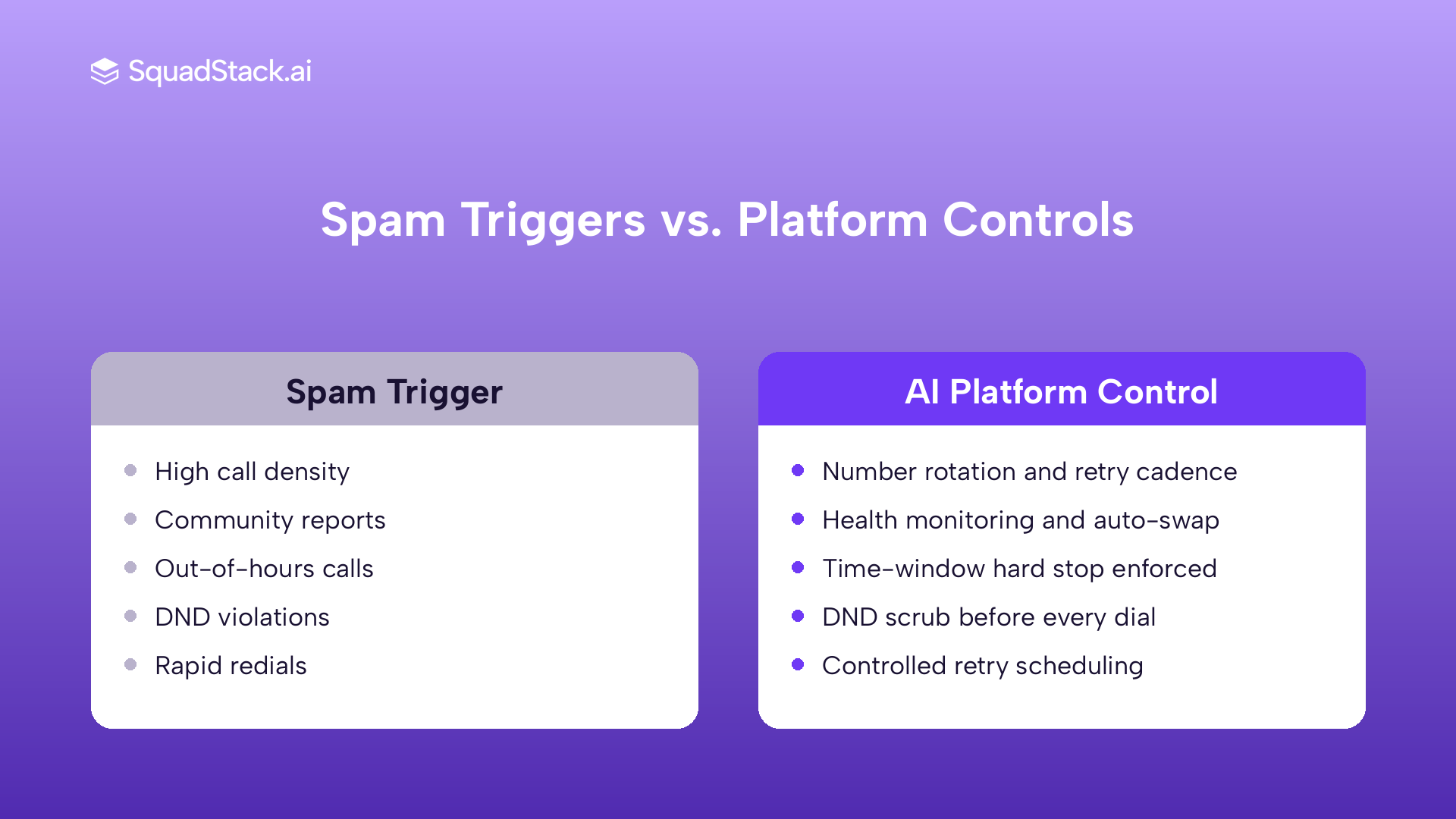
Truecaller aggregates behaviour signals across its user base and scores each number continuously. The signals that consistently trigger a spam classification for outbound business numbers are:
High call density. A large volume of calls in a short window, especially to numbers that do not answer, resembles automated spam dialling.
Community reports. Each time a user taps "mark as spam," it adds directly to that number's score. A handful of reports from irritated recipients can cross the threshold.
Calls outside accepted hours. Early morning or late night calls generate more irritation and more spam reports. TRAI specifies that telemarketing calls must stay within defined hours.
Calls to DND-registered numbers. This violates TRAI rules and generates reports from users who know they opted out.
Number repetition. Calling the same lead multiple times in a single day with short gaps mimics harassment patterns and accelerates spam scoring.
Sales teams with no controls on volume, timing, or retry logic hit several of these triggers at once. A number starts clean but degrades steadily over days or weeks of campaign activity.
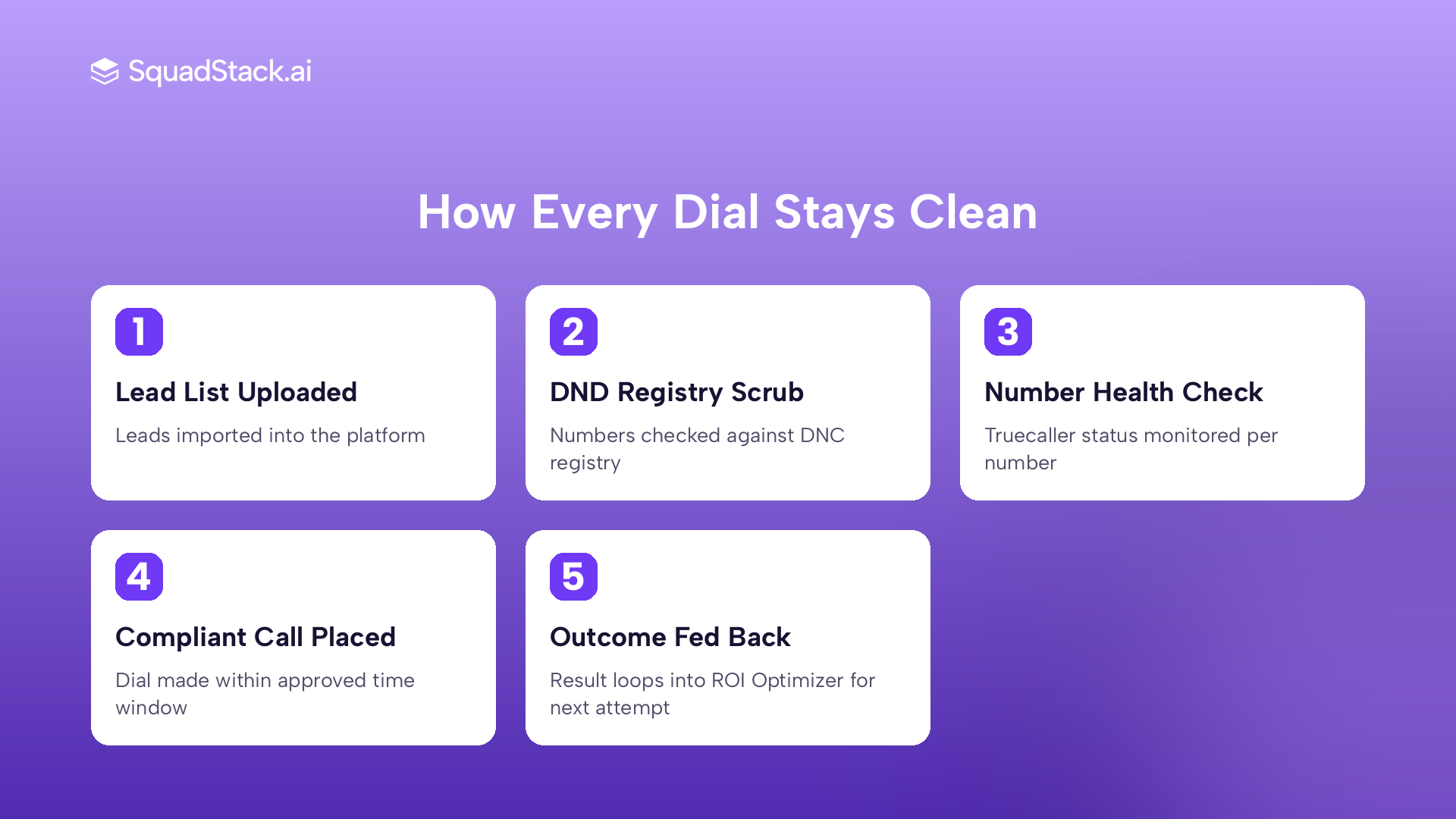
A well-built AI calling platform treats number reputation as an always-on concern, not a periodic cleanup task.
Automatic number rotation. The platform tracks every outbound number's Truecaller status continuously. When a number is flagged or its connectivity rate drops below an acceptable threshold, the platform rotates it out and moves calls to a clean number. Every client gets dedicated numbers, not a shared pool, so one client's campaign cannot contaminate another's number health.
Calling hour enforcement. A properly configured AI dialler enforces the daily outbound window as a hard system block. It is not a guideline set in a spreadsheet; it is a platform-level constraint that cannot be overridden by a rushed campaign launch.
DND scrubbing before every dial. Lead lists are checked against the TRAI DND registry before any call goes out. Internal DND lists receive the same treatment.
140-series numbers for cold outbound. TRAI requires that cold commercial calls originate from 140-series numbers. Using a standard mobile or landline number for cold outbound is a compliance risk that also generates Truecaller reports.
Verified caller ID. Registering numbers through Truecaller for Business lets recipients see the brand name instead of an unknown number, improving answer rates before a call is even connected.
Controlled retry cadence. A managed dialler spaces retries with defined gaps and caps total attempts, keeping the frequency signal low and reducing the probability that an unanswered call turns into a spam report.
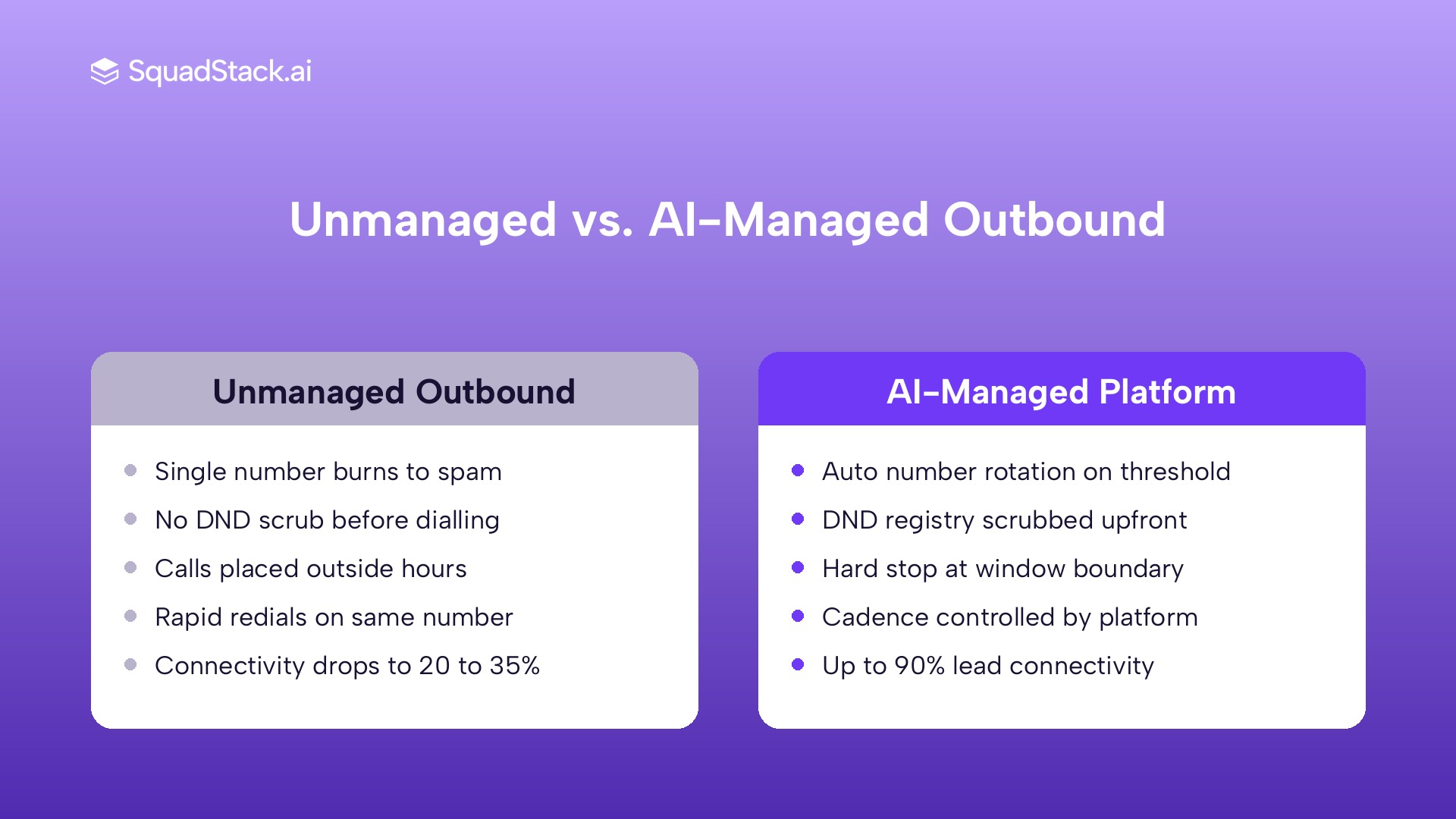
| Dimension | Unmanaged outbound | AI-managed platform |
|---|---|---|
| Number monitoring | Manual, periodic checks | Continuous, automated Truecaller status tracking |
| Response to a spam flag | Number stays in use until someone notices | Automatic rotation within the same campaign |
| Calling hours | Set in a spreadsheet, overridden under pressure | Platform hard-enforced, never overridden |
| DND compliance | Batch scrub at list upload | Scrubbed before every dial, internal DND also honoured |
| Number type | Mixed: mobile, PRI, 140-series | Only compliant number types provisioned per use case |
| Retry behaviour | Frequent redials on same day | Defined gaps, disposition-based retry, total attempt cap |
| Caller ID | Blank or unknown | Verified brand name via Truecaller for Business |
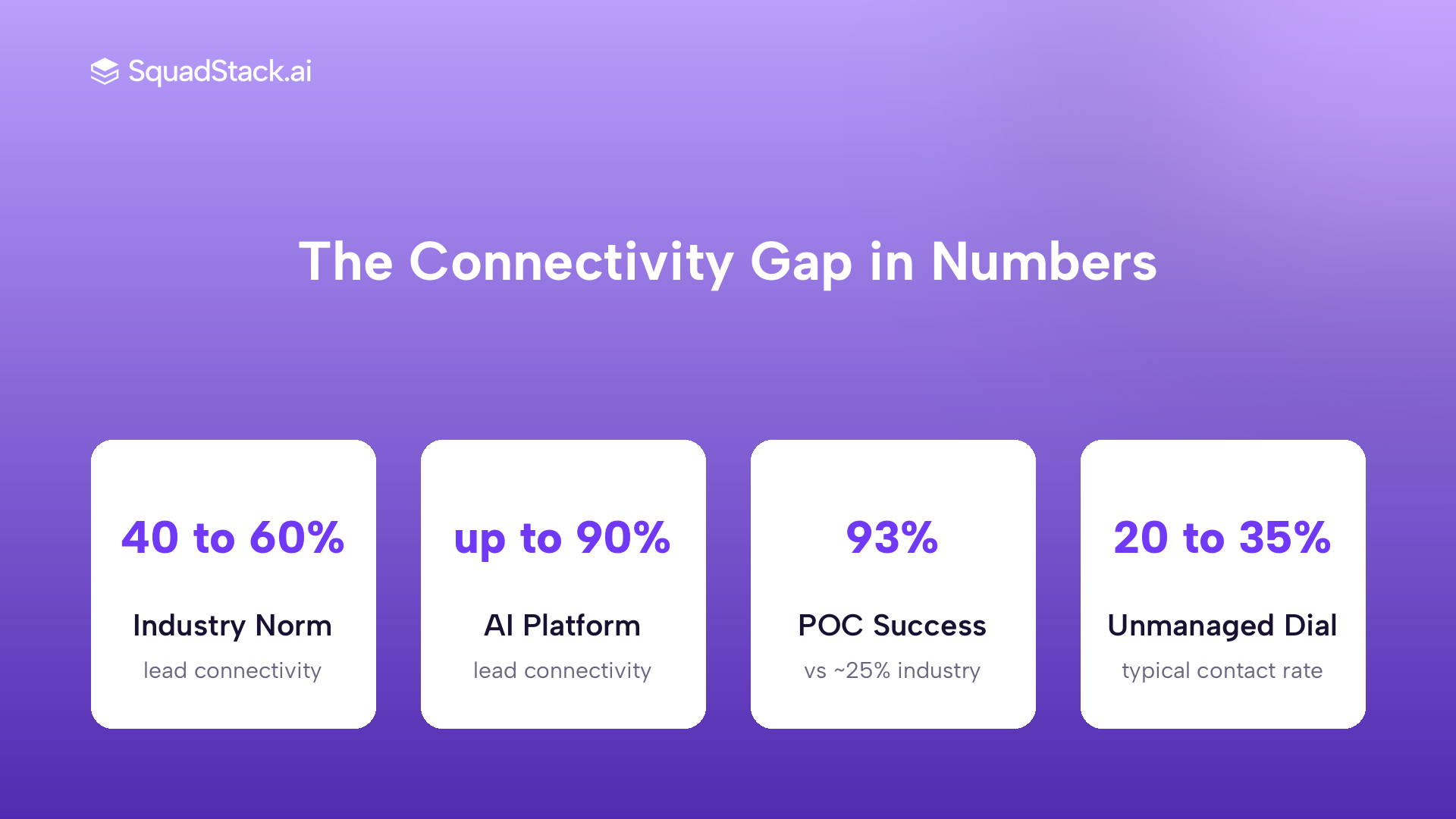
The gap in lead connectivity between the two approaches is not marginal. Industry-average outbound connectivity sits at 40 to 60% across campaigns. AI platforms with active number health management reach up to 90% lead connectivity, meaning a far higher share of unique leads actually receive a call over the campaign's full attempt cycle.
Is number rotation automatic or manual? A platform that flags spam numbers but requires human action to rotate them is not actually protecting your campaign. Rotation must be system-triggered the moment a flag is detected.
Are numbers dedicated or shared? A shared pool means another client's high-volume campaign can damage your number's reputation. Dedicated numbers per client are the minimum standard.
How are DND and calling hours enforced? "We follow TRAI rules" is not the same as "our platform blocks out-of-window calls at the system level." Ask to see the mechanism.
Does the platform support Truecaller verified caller ID? Brand-name display on incoming calls is a direct pick-up rate lever and should be a standard offering.
What telephony infrastructure sits underneath? Multiple carrier partners with failover, combined with number provisioning managed by the platform rather than the client, significantly reduces operational risk.
SquadStack's AI Voice Agent platform was built on roughly ten years of running high-volume outbound campaigns for large Indian consumer brands before transitioning fully to Voice AI in 2025. Number reputation management was not an afterthought. It is part of the core product.
The platform's AI Lead Manager tracks every outbound number's Truecaller status continuously and rotates a number out automatically on two triggers: it is marked as spam on Truecaller, or its connectivity rate drops below a defined threshold. Every client gets dedicated numbers. Telephony runs across multiple carriers, including Jio, Airtel, and Tata, through partners like Exotel and Ozonetel, with failover built in. Only 140-series numbers are used for cold outbound.
Calling hours are enforced by a hard system block. DND scrubbing runs against the TRAI registry before every dial, and client-supplied internal DND lists receive the same treatment. The retry cadence defaults to one initial call plus four retries, spaced at 180-minute gaps across two days. Every parameter is configurable per campaign, but the anti-spam guardrails stay on regardless.
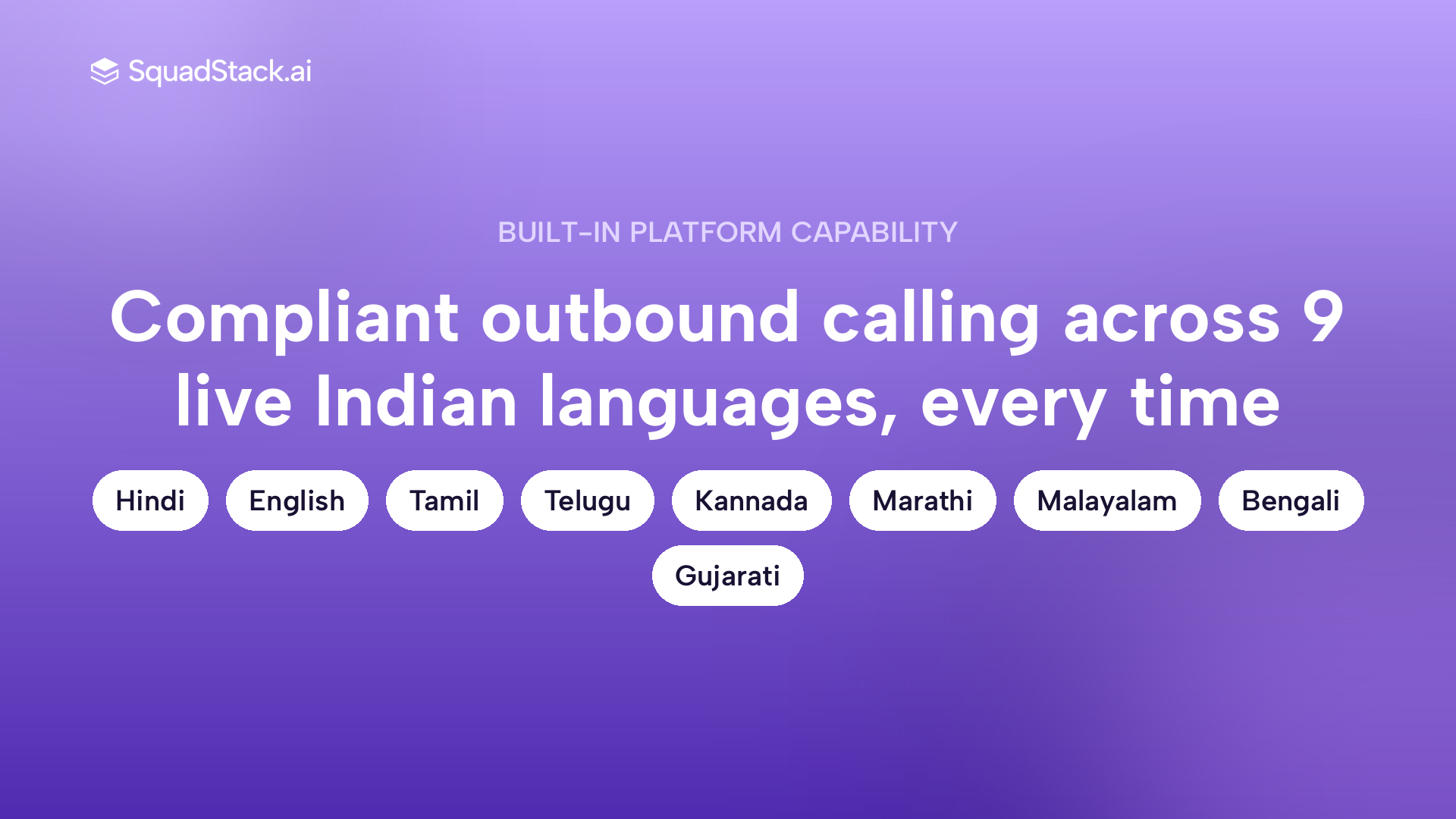
SquadStack's proprietary STT model, Arth, is trained on 600 million or more minutes of real Indian sales conversations. Voice agents handle native code-switching across 9 live Indian languages, including Hindi, English, Tamil, Telugu, Kannada, Marathi, Malayalam, Bengali, and Gujarati. Calls sound like a real person, not a robocall, which matters because robotic-sounding calls generate more hang-ups and more Truecaller reports.
A leading quick commerce platform running rider hiring with SquadStack reached 90% connectivity at 40% lower cost-per-hire. Read the case study. Across 60-plus large consumer brand clients, including AngelOne, Kotak Mahindra Bank, PhonePe, Eureka Forbes, and IndiaMART, the AI outbound calling infrastructure processes more than 50 lakh calls daily.
For teams evaluating the full stack, the 10 best AI call center software solutions guide covers the broader comparison landscape.
Every call feeds back into the system. Outcomes flow into SquadStack's ROI Optimizer, and the Eval System scores every call on Outcome, Sentiment, and Execution. These signals drive adjustments to script, voice, timing, and cadence on subsequent calls. A number showing lower connectivity triggers rotation before it accumulates spam reports. Each campaign gets progressively cleaner on both reputation and conversion as it runs.
For a deeper look at the full sales funnel, the AI voice agent for sales automation page covers the end-to-end flow.
Truecaller spam tagging is not a nuisance. For any Indian outbound sales or collections team, it is a direct drag on lead connectivity and revenue. The fix is not a one-time number cleanup. It is continuous number health monitoring, automatic rotation, calling-hour discipline, DND compliance, and verified caller ID, all operating together without manual intervention.
Teams that want to build a dialling operation that consistently reaches leads should see what a fully managed platform looks like in practice. Book a demo with SquadStack and bring your current connectivity numbers: the gap is usually visible within the first conversation.
Which is the best AI calling platform for managing Truecaller spam in India?
The best platform combines automatic number health monitoring, dedicated outbound numbers per client, TRAI-compliant calling hours enforced at the system level, and DND scrubbing before every dial. SquadStack builds all of these into its AI Lead Manager and processes 50 lakh or more calls daily for 60-plus large Indian consumer brands.
What is a "truecaller no check" and why does it matter for sales teams?
A truecaller no check refers to the process of verifying that an outbound number has not been flagged as spam on Truecaller before dialling. For sales and collections teams in India, it matters because a spam tag causes the call to display a warning to the recipient, sharply reducing the chance they pick up.
How does Truecaller decide to mark a number as spam?
Truecaller combines community reports, where users manually flag a number, with algorithmic signals such as high call frequency, a low answer rate, calls to DND-registered numbers, and calls placed outside normal hours. Any outbound number running a high-volume campaign without controls can cross the spam threshold within days.
Can a business remove a spam tag from its number on Truecaller?
Businesses can apply to remove incorrect spam tags through Truecaller's detagging process and can register their numbers through Truecaller for Business to display a verified brand name. However, the more reliable approach is preventing the tag in the first place through controlled dialling practices.
What TRAI rules apply to outbound commercial calls in India?
TRAI restricts commercial telemarketing calls to registered hours, requires calls to originate from 140-series numbers for cold outbound, and mandates that DND-registered numbers are not contacted. Violations generate both regulatory risk and a higher volume of Truecaller spam reports.
How does number rotation protect outbound calling campaigns?
When a platform detects that a number has been flagged as spam or that its connectivity rate has fallen, it automatically retires that number and routes calls through a clean number. This prevents a single flagged number from degrading connectivity across the whole lead list and keeps the Truecaller reputation of remaining numbers intact.
Does calling from an AI voice agent reduce spam reports compared to human agents?
It can, provided the AI agent sounds natural rather than robotic. Calls that sound scripted or mechanical generate more hang-ups and more Truecaller reports. SquadStack's voice agents are trained on 600 million or more minutes of real Indian sales conversations and have passed a Turing test for naturalness, which means calls are less likely to trigger a negative reaction.
What is Truecaller for Business and does it help sales teams?
Truecaller for Business lets companies register and verify their outbound numbers so they display with the brand's name and logo on a recipient's screen instead of an unknown number. This directly improves answer rates because recipients can see who is calling before they decide whether to pick up.
How should outbound calling cadence be structured to avoid spam tagging?
Best practice is to space retry attempts with meaningful gaps, typically at least a few hours between redials, cap the total number of attempts per lead, and avoid calling the same lead multiple times in a single day. An AI dialler manages this automatically per campaign, adjusting retry logic based on the lead's disposition after each attempt.
What is the difference between 140-series and regular numbers for outbound calling?
TRAI requires that commercial cold calls originate from 140-series numbers, which are identifiable as business telemarketing lines. Using a standard 10-digit mobile number or PRI line for cold outbound violates TRAI regulations and also generates more Truecaller spam reports, because recipients and Truecaller's own systems flag the mismatch between number type and calling behaviour.