.svg)





Recruitment Chatbot vs Voice AI: Which Screens Faster?
October 6, 2026
|

12 min read
Hyper-personalised outbound call scripts use a customer's CRM lifecycle signals, such as days since last purchase, past objections, payment behaviour, and...
Hyper-personalised outbound call scripts use a customer's CRM lifecycle signals, such as days since last purchase, past objections, payment behaviour, and product history, to dynamically assemble a call that feels one-to-one, even at millions-of-calls scale. Static scripts treat every lead the same and bleed conversions as a result. AI voice platforms that read lifecycle data before dialing, then adapt in real time, consistently outperform fixed-script approaches on connectivity, qualification, and cost per sale.
Every outbound team in India runs a script. Most run the same script for every lead: the same opener, the same benefit line, the same EMI quote. A borrower who already applied once gets the same call as someone who has never heard of the product. A customer who lapsed after an EMI dispute gets the same pitch as a fresh prospect.
The result is predictable. Most leads do not pick up, and many who do disengage within thirty seconds because the call clearly knows nothing about them. Hyper-personalised outbound call scripts fix this at the architecture level, not by training agents to improvise, but by building the right conversation before the call starts.
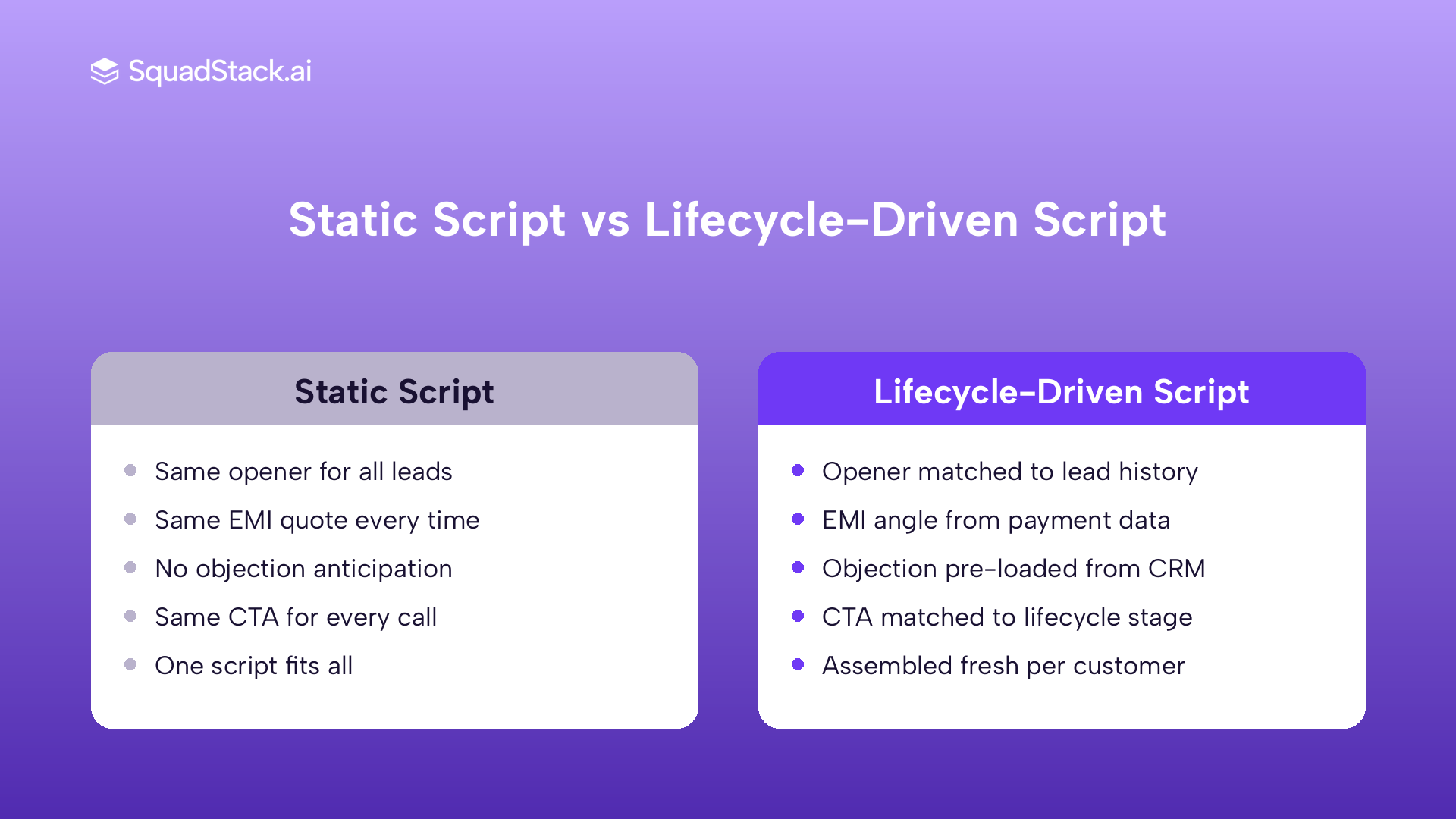
A hyper-personalised outbound call script is dynamically assembled from a customer's lifecycle data rather than pulled from a fixed template. It changes based on who the customer is, where they are in the buying journey, what they objected to last time, how recently they transacted, and which channel they responded to before.
This differs meaningfully from basic personalisation. Basic personalisation puts a first name in the opening line. Hyper-personalisation changes the entire angle: the objection the agent anticipates, the product variant it leads with, the language it speaks, and the follow-up it books if the customer is not ready today.
The signals that drive a hyper-personalised script typically include:
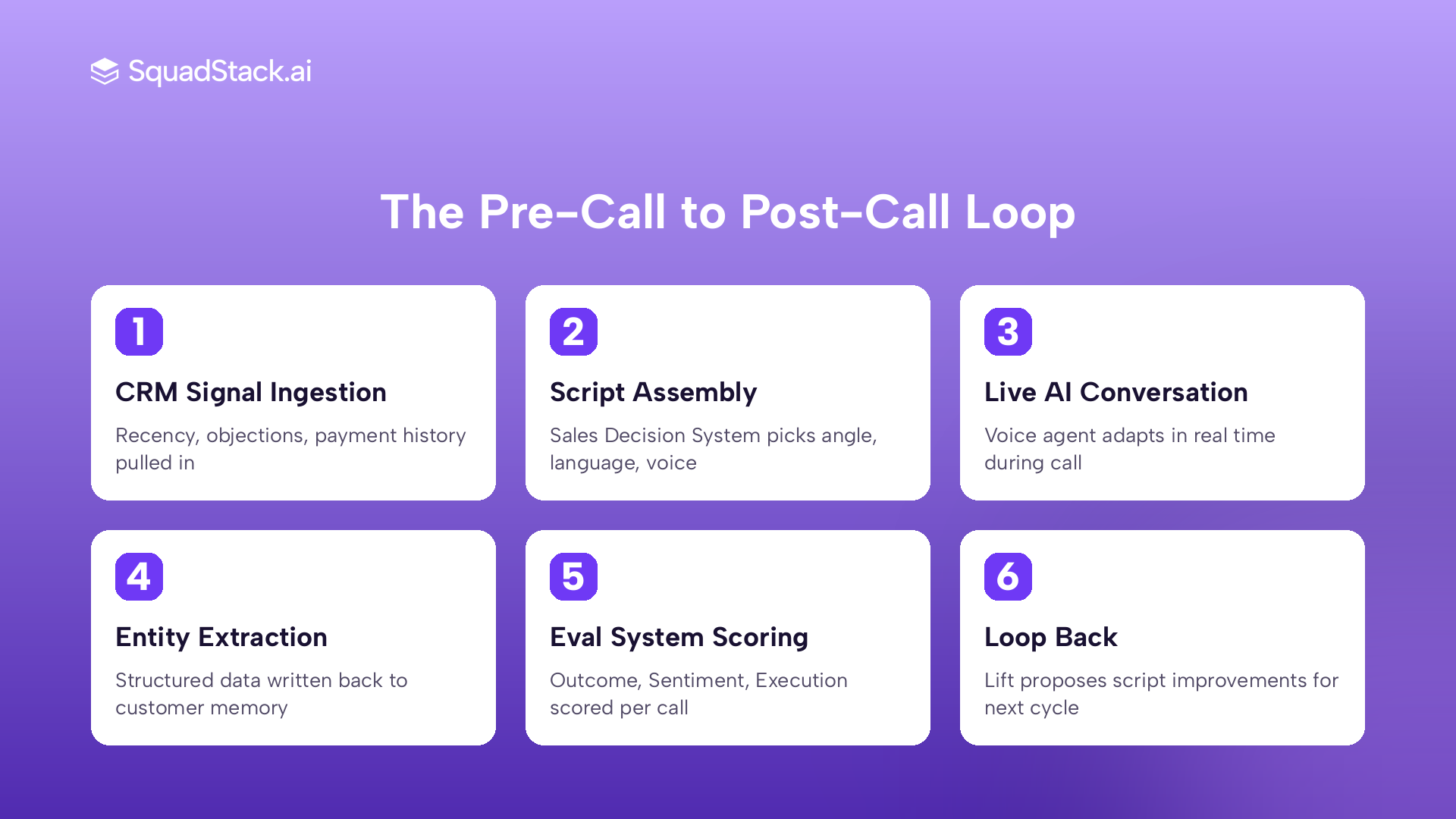
The call flow has five stages, and the personalisation is baked in before the first word is spoken.
Stage 1: Lead scoring and signal ingestion. Before dialing, the AI Lead Manager reads the lead's CRM metadata, interaction history, and past outcomes, then builds a propensity score and ranks the lead in the campaign queue.
Stage 2: Pre-call assembly. The Sales Decision System reads lead context (who this person is, what they have done, what they refused before) and business context (what is being sold, which compliance rules apply, which product variant fits this segment), then selects the script angle, voice persona, language, and opening line.
Stage 3: The conversation itself. The AI voice agent handles objections across multiple turns rather than firing a single canned rebuttal. It switches languages mid-sentence if the customer responds in Tamil after an English opener and adapts the flow based on intent signals.
Stage 4: Entity extraction and memory. As the call happens, the agent extracts structured data points: confirmed loan amount, preferred callback slot, stated hesitation, last completed application step. These are written to the lead's memory layer and are available on the next call, so the follow-up opens exactly where the first call stopped.
Stage 5: Continuous learning. Every outcome feeds back into the ROI Optimizer. The Eval System scores calls on Outcome, Sentiment, and Execution. The Lift layer reads near-misses and early drop-offs, proposes precise script edits, and tests each change on live traffic before scaling it. This is what makes hyper-personalisation compound over time rather than plateau at launch.
A customer whose policy lapses after three years of clean premiums is a very different conversation from one who lapsed after a claim dispute. Lifecycle data makes that distinction automatic.
A leading general insurer using SquadStack's Voice AI achieved 85% lead connectivity and a 60% reduction in renewal cost. Read the full case study here.
Edtech lead lists are large and heterogeneous. A student who downloaded a free PDF, a parent who attended a webinar, and a working professional who clicked a retargeting ad all land in the same campaign. Without lifecycle signals, every call sounds the same.
SquadStack runs lead qualification for edtech brands including Adda247, Unacademy, Nxtwave, and Infinity Learn. The agent reads intake signal, adjusts its qualification questions for the lead's apparent stage, and routes hot leads to human counsellors with full context already captured.
In BNPL and personal lending, the highest-intent calls are to customers who started an application and stopped. The drop-off point is the most valuable signal the CRM holds. A customer who completed KYC but did not upload a bank statement is days from conversion if the next call opens with "You'd completed your KYC last time. Ready to link your bank statement?" rather than a generic loan pitch.
Hyper-personalised outbound call scripts built on persistent memory handle this naturally. The agent never asks for information it already has.
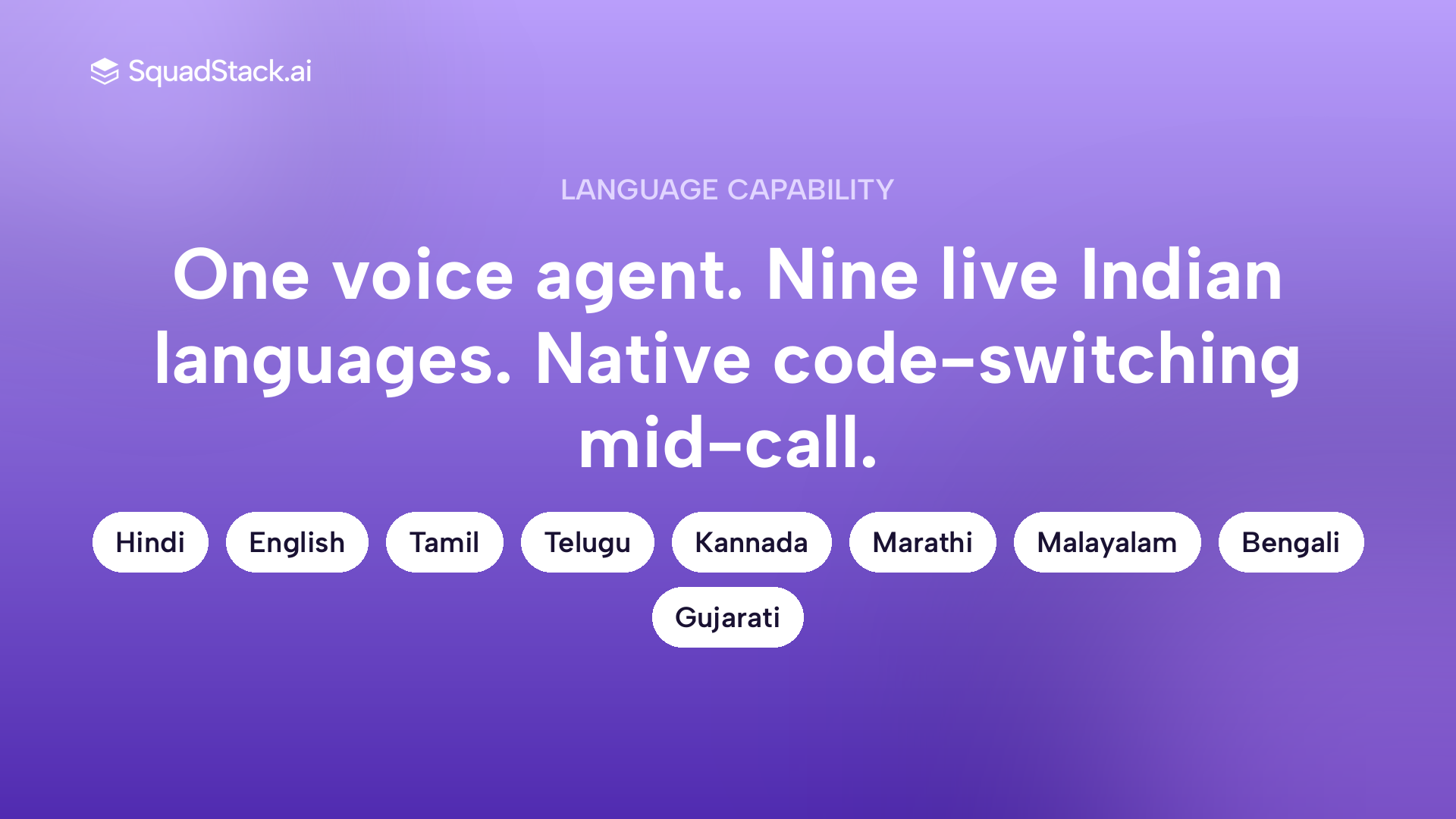
Traditional IVR is a decision tree. It plays a menu, waits for a keypress, and branches to the next node. A customer who speaks in Hinglish or wants to negotiate a term mid-call gets stuck or dropped. The IVR knows nothing about the customer's history because it has no memory layer.
| Dimension | Static IVR | Hyper-Personalised AI Voice Agent |
|---|---|---|
| Script logic | Fixed menu with numbered options | Dynamically assembled from lifecycle signals before each call |
| Objection handling | Cannot handle an unscripted objection | Works the objection across multiple turns, adapts angle in real time |
| Language | Single language or a manual language-select prompt | 9 live Indian languages with mid-sentence code-switching |
| Memory | Every call starts cold | Persistent memory across calls and channels; the agent knows what happened last time |
| Scenario: lapsed borrower | Plays the same loan pitch as a new prospect | Opens with the EMI dispute flag noted, adjusts offer, skips already-answered questions |
| Scenario: edtech drop-off | Asks for name and course interest again | Picks up from "you were looking at the Data Science programme, batch starting next month" |
| Response latency | Near-instant menu playback | Median less than or equal to 0.8 seconds for a full conversational turn |
The gap shows up in conversion, not just experience. A voice agent that knows the lapse reason, acknowledges it, and opens with the right offer frame performs at a different level from an IVR playing the same message to every number on a list.
Not all AI voice platforms offer genuine lifecycle-driven personalisation. The questions that separate real capability from a marketing claim are:
Does the platform read CRM signals before the call, or does it just merge a name into a fixed script? Real hyper-personalisation changes the script angle, not just the salutation.
Does the agent remember what happened on previous calls? Persistent cross-channel memory is the dividing line between a stateless voice bot and a system that genuinely learns a customer's journey.
Can the platform handle Indian-language code-switching natively? The agent needs to have been trained on real code-switched conversations, not a translation layer bolted onto an English model.
Does the platform run a continuous improvement loop? Personalisation compounds when every outcome feeds back into the script. A platform that sets the script at launch and leaves it alone will not close the gap.
What does compliance look like? In regulated sectors like BFSI and insurance, the personalisation layer must operate within locked compliance sections. Look for ISO 27001, SOC 2 Type II, DPDP, and TRAI compliance as baseline requirements.
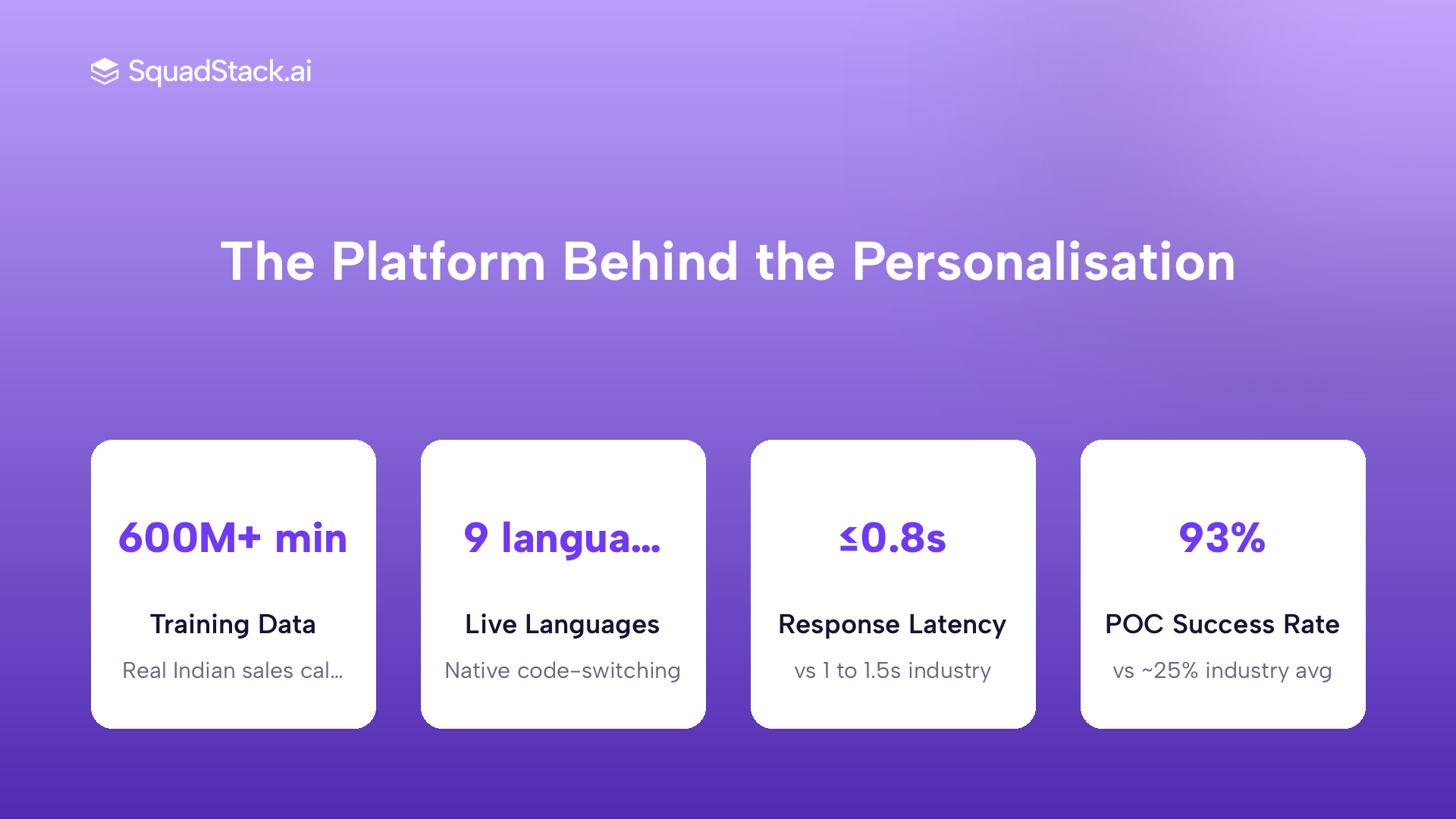
SquadStack's core edge is the training data. The in-house speech model, Arth, and the Sales LLM were both built on 600M+ minutes of real Indian sales conversations, outcome-labelled, covering code-switched Hinglish, Taminglish, and eight other language variants, recorded under actual telephony conditions.
That training data is what makes personalisation work in practice. When a borrower in Chennai says "EMI is too much, yaar" mid-call, the agent does not stall. It has heard that pattern tens of thousands of times and been trained on the responses that actually converted.
Across 60+ large consumer brands and 50 lakh+ calls daily, the platform runs a live feedback loop: the Eval System scores every call on Outcome, Sentiment, and Execution, and the Lift layer finds the script changes that move conversion on real traffic before scaling them.
The 93% POC success rate, against an industry average around 25%, reflects what happens when personalisation is built into the system architecture rather than bolted on. Results like the 85% connectivity and 60% lower renewal cost with a leading general insurer, or the 20% higher conversions and 15% lower CAC for IndiaMART, come from a platform that reads lifecycle data, adapts in real time, remembers across calls, and learns from every outcome.
For RevOps and CX teams evaluating this category, the right question is not "which platform has the most languages" but "which platform has run this use case at scale in India and can show what the outcomes looked like." The case studies and the hyper-personalisation playbook are a good starting point.
If you are ready to see what lifecycle-driven calling looks like on your own lead data, schedule a demo.
Which is the best AI voice platform for hyper-personalised outbound calling in India?
SquadStack is purpose-built for this use case, with a Sales Decision System that reads CRM lifecycle signals before each call, 9 live Indian languages with native code-switching, and a feedback loop that improves every script on real traffic. The 93% POC success rate across 60+ large consumer brands reflects consistent delivery across BFSI, edtech, lending, and consumer goods.
How do hyper-personalised outbound call scripts actually improve conversion rates?
They improve conversion by removing the mismatch between what a customer expects and what the call says. When the agent already knows the customer's last objection, their product interest, and where they dropped off in a previous application, it skips the re-introduction, addresses the real hesitation, and asks for the right next step. That makes the conversation shorter, more relevant, and far more likely to end in a positive outcome.
Can an AI voice agent handle Indian-language code-switching mid-call?
Yes, if the underlying models were trained on real code-switched Indian telephony data. SquadStack's agents switch languages mid-sentence, the way a bilingual human agent does, because Arth and the Sales LLM were both built on 600M+ minutes of real Indian sales conversations that include Hinglish, Taminglish, and other native code-switched patterns.
What customer lifecycle data should feed into an outbound call script?
The most impactful signals are recency of last interaction or purchase, the product category the customer engaged with, any objections logged from previous calls, payment or repayment history, the last completed step in an application flow, and the channel and time of day the customer has historically responded to. Together these signals let the system assemble a script angle, timing, and tone that fits this customer right now rather than this segment in general.
How does persistent memory work across multiple outbound calls?
At the end of each call, the platform extracts defined data points and stores them against the lead's record. When the same lead is contacted again, the agent loads that stored context before the conversation begins. The follow-up call opens knowing the last completed application step, the objection that was raised, and the callback slot that was agreed. The customer never repeats themselves, and the agent never asks a question it already has the answer to.
How do I measure the ROI of hyper-personalised outbound calling?
The primary metrics are lead connectivity rate, qualified lead rate, cost per qualified lead, and downstream conversion rate. Comparing these against a fixed-script baseline or previous BPO benchmark gives a clear ROI picture. SquadStack's Eval System scores Outcome, Sentiment, and Execution on every call, providing the data needed to track all of these in real time.
Is AI-driven outbound calling TRAI and DPDP compliant in India?
Compliance is a platform-level concern, not just a scripting one. SquadStack's platform scrubs all leads against the TRAI DND registry before dialing, enforces a hard calling window of 9:30 AM to 8:30 PM, uses only 140-series numbers for cold calling, and handles consent gating and opt-outs in the conversation layer itself. The platform holds ISO 27001, ISO 27701, SOC 2 Type II, DPDP, and TRAI certifications.
Can hyper-personalised scripts be tested and optimised after launch?
Yes, and this is where the compounding effect comes from. SquadStack's Optimize layer runs live A/B tests on voice, script angle, timing, and channel sequence simultaneously. The Lift layer reads unreviewed calls, finds near-misses and early drop-offs, and proposes specific script edits, each validated on live traffic before scaling. The result is a script that gets sharper over the campaign cycle rather than degrading as leads get more fatigued.
Does a company need to replace its existing CRM to use lifecycle-driven outbound calling?
No. SquadStack integrates with existing CRM and data systems via API, so lifecycle signals flow from the client's existing stack into the Sales Decision System. The client supplies lead data with the relevant metadata fields, and the platform handles the scoring, assembly, and personalisation from there.
What is the difference between a hyper-personalised AI voice agent and a standard voice bot?
A standard voice bot plays a pre-recorded or text-to-speech message and listens for a yes or no. A hyper-personalised AI voice agent reads lifecycle data before the call, assembles the right script angle and language for that specific customer, handles multi-turn objections in natural conversation, remembers what was discussed on previous calls, and feeds every outcome back into a learning loop. The practical difference is in outcomes: voice bots produce call volumes; AI voice agents built on lifecycle data produce conversions. The intent detection layer and lead scoring integration explain the mechanism in more detail.