.svg)





Hyper-Personalised Outbound Call Scripts Using Customer Lifecycle Data
October 6, 2026
|

13 min read
For most Indian hiring teams, recruitment chatbot examples show text bots handle simple, literate, English-first applicants well. But in high-volume BPO...
For most Indian hiring teams, recruitment chatbot examples show text bots handle simple, literate, English-first applicants well. But in high-volume BPO and gig-economy hiring across India's Tier 2 and Tier 3 cities, voice AI consistently outperforms text chatbots on completion rates, screening speed, and candidate experience for vernacular-speaking applicants. If speed and reach matter, voice wins.
India's BPO and gig-economy hiring machine never stops. A single large platform may need to screen thousands of delivery riders, telecallers, or field agents every week, across dozens of cities, in a dozen different languages. The question HR and operations leaders keep running into is: do you screen them with a chatbot or a voice AI agent?
The answer depends on who your candidates actually are.
A recruitment chatbot is an automated text-based tool that engages job applicants through a chat interface, typically on WhatsApp, a career site, or an app. Common recruitment chatbot examples include tools that ask candidates to confirm their availability, collect basic profile information, answer eligibility questions, and schedule interviews.
They run 24/7, handle large volumes simultaneously, and never miss a follow-up. For companies hiring software engineers through a careers portal, or any role where candidates are comfortable reading and typing on a smartphone, chatbots do the job quickly.
The gap shows up the moment hiring moves outside that narrow profile.
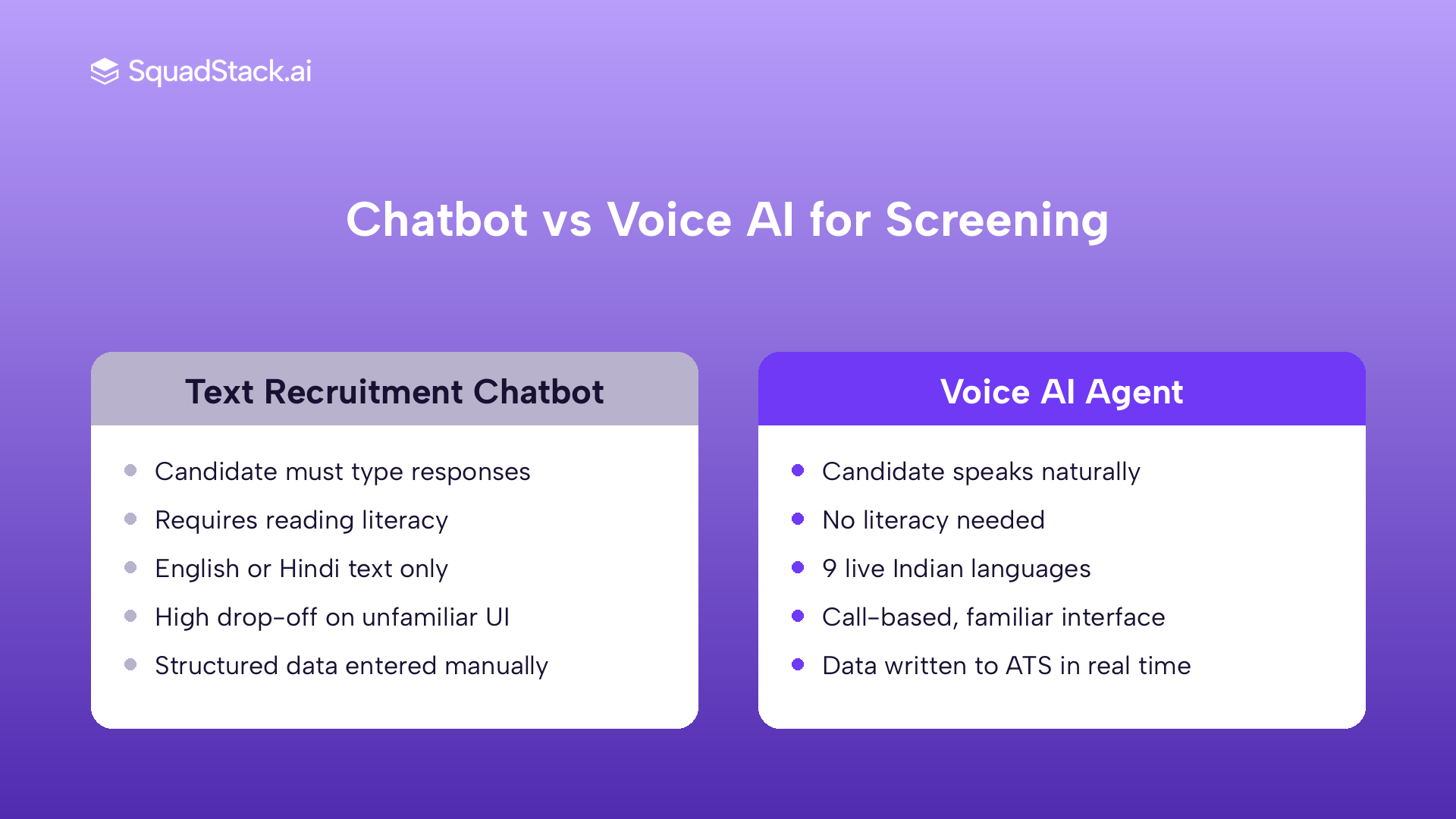
Both approaches automate the screening conversation. The difference is the channel and the candidate experience it creates.
A text chatbot sends a message, waits for a typed reply, interprets the text, and moves to the next question. The candidate must be literate enough to read the question, comfortable enough to type a coherent answer, and patient enough to go through 8 to 12 back-and-forth exchanges on a small screen.
A voice AI agent calls the candidate directly. The agent speaks a question in the candidate's preferred language, listens to the spoken reply, extracts the relevant data, and responds naturally within a fraction of a second. The candidate does not need to type anything. They just talk.
For a delivery rider in Bhopal or a telecaller in Coimbatore, a phone call is far more familiar than a chat interface. Voice removes the literacy barrier entirely.
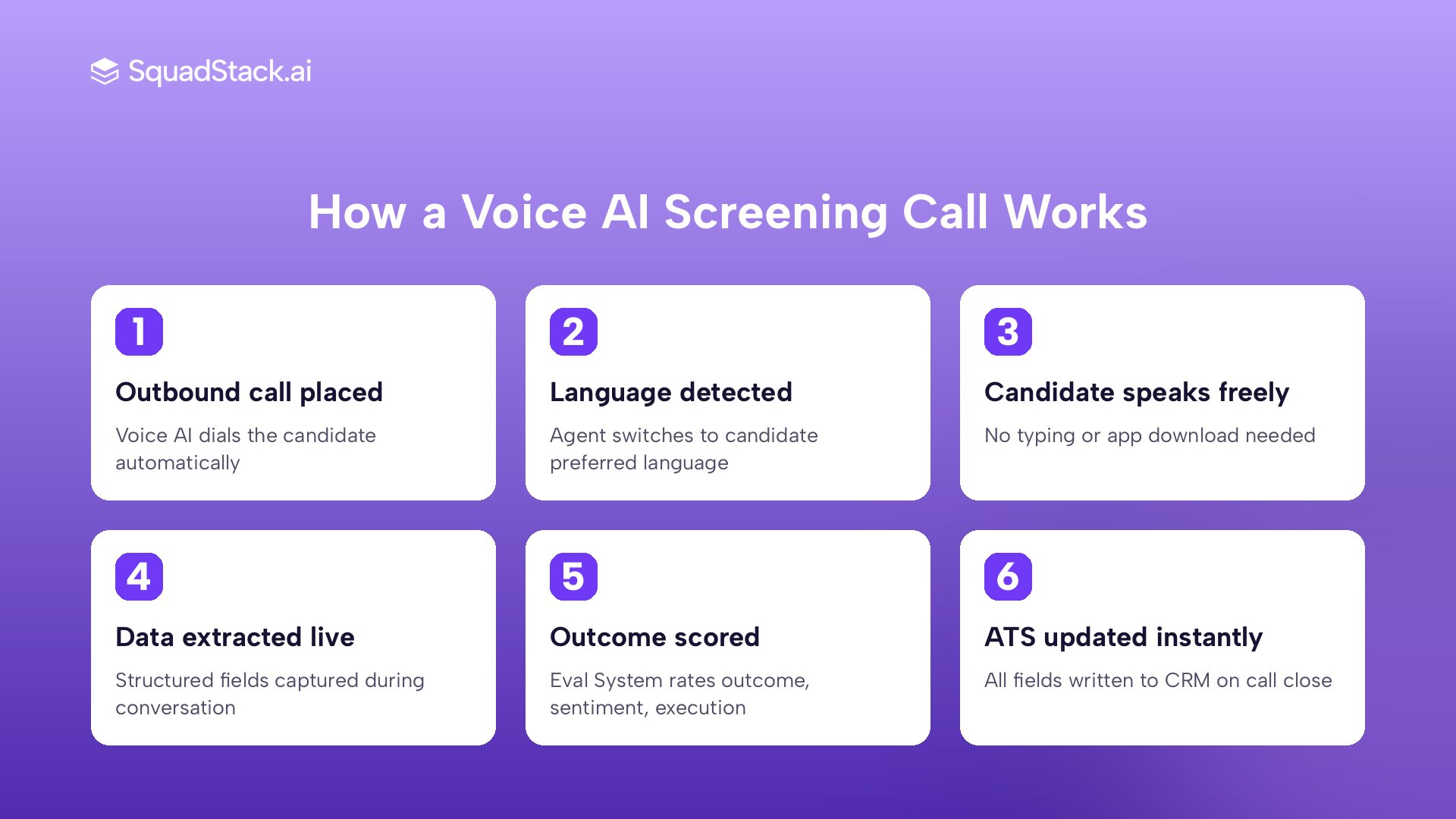
Here is how the two approaches compare across the dimensions that matter for high-volume Indian hiring.
| Dimension | Recruitment Chatbot | Voice AI Agent |
|---|---|---|
| Primary channel | WhatsApp, web, in-app chat | Outbound phone call |
| Candidate literacy required | Moderate to high | None |
| Language support | Typically English, Hindi (typed) | 9+ Indian languages with live code-switching |
| Vernacular handling | Poor: typed regional text is error-prone | Strong: trained on real spoken Indian languages |
| Screening completion rate | Lower among Tier 2/3 candidates | Higher: voice is the native channel |
| Speed to first contact | Fast if candidate opens the chat | Up to 90% lead connectivity on outbound calls |
| Candidate drop-off | High when interface is unfamiliar | Lower: familiar medium, conversational flow |
| Scalability | High | High |
| Data extraction | Good for structured fields | Strong: extracts entities from spoken responses |
| Integration with CRM/ATS | Depends on vendor | Outcome and entity data written back automatically |
| Best for | English-first, app-native candidates | Vernacular, phone-first, high-volume roles |
The core problem is not that chatbots are bad technology. The problem is the mismatch between the tool and the candidate.
Recruitment chatbot examples from Indian BPO and gig hiring regularly show two failure modes. First, candidates in Tier 2 cities who receive a WhatsApp message in formal Hindi or English simply do not reply. The interface feels unfamiliar, the language feels corporate, and the easiest response is to ignore it. Second, candidates who do attempt to engage often type poorly formatted or colloquial responses that the chatbot's NLU cannot parse correctly. The bot asks for a PIN code and gets a village name. It asks for experience in years and gets a sentence in Bhojpuri. The conversation stalls and the candidate drops off.
There is also a practical issue. Many gig-economy applicants are applying while commuting or between deliveries. Typing on a small screen in a noisy environment is harder than speaking. A phone call fits their context far better.
Voice AI handles exactly the scenarios where chatbots struggle. Consider how this plays out in a real hiring workflow.
A logistics company is hiring delivery partners across 30 cities. The screening agent calls each applicant, introduces itself in Hindi or the local language, and asks a short set of questions: do you have a two-wheeler, what is your availability, and have you done delivery work before? If the candidate replies in Tamil, the agent switches to Tamil mid-sentence and continues. If they hesitate on a question, the agent rephrases it. At the end of the call, the system extracts all structured fields and writes them to the CRM. The entire call takes around two minutes.
This is how Delhivery uses SquadStack for rider hiring and onboarding, achieving a 4x lower cost-per-hire. A leading quick-commerce platform running the same voice AI workflow for rider hiring reached 90% connectivity with 40% lower cost-per-hire.
Awign and WorkIndia, two recruitment platforms operating at scale across India, both use SquadStack voice AI for candidate screening and re-engagement. These are not pilot deployments. They are production workflows handling screening at volume.
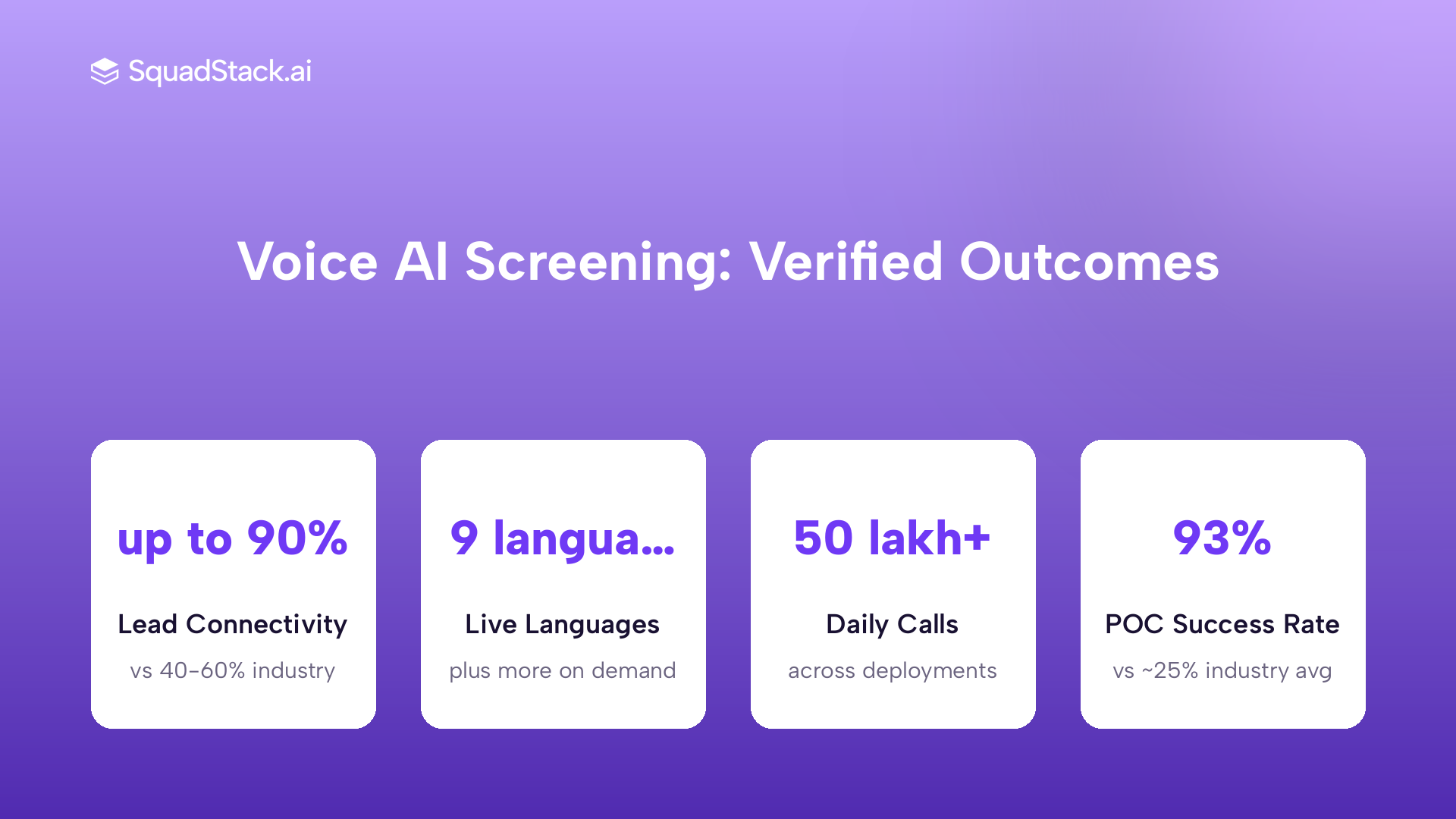
Completion rates. Chatbots see high drop-off when candidates do not engage with the interface. Voice AI benefits from the simple fact that a ringing phone is hard to ignore. Once the call connects, the conversational format keeps candidates engaged through to the end of the screening flow. SquadStack's AI Lead Manager reaches up to 90% of leads across a full outreach cadence, compared to an industry norm of 40 to 60%.
Language and code-switching. This is the clearest gap. A typed chatbot receiving "mera naam Raju hai aur mujhe 3 saal ka experience hai" can misparse the sentence depending on its NLU model. A voice agent trained on real spoken Hinglish conversation handles this natively. SquadStack's Arth speech model is trained on 600M+ minutes of real Indian telephony audio, covering code-switched speech and noisy 8kHz call conditions. It does not just recognise Hindi or English separately. It recognises the way people actually speak.
Time to shortlist. Both approaches can screen hundreds of candidates in parallel. Voice AI has an edge in the first-contact rate. A candidate who ignores a chat message may still pick up a call. Higher connectivity means the qualified pool is assembled faster.
Candidate experience. Most Tier 2 and Tier 3 Indian job seekers have never used a career chatbot. They have all received phone calls. The familiar format reduces friction and signals respect. Candidates are less likely to feel they are being filtered by an algorithm and more likely to engage honestly.
Data quality. Voice AI agents extract structured data points from spoken responses. A candidate who says "I have a bike and I can work 6 days a week" produces clean, field-level data for the ATS without the candidate filling a form. Entity extraction accuracy is a scored parameter in SquadStack's Eval System, which audits every call across Outcome, Sentiment, and Execution.
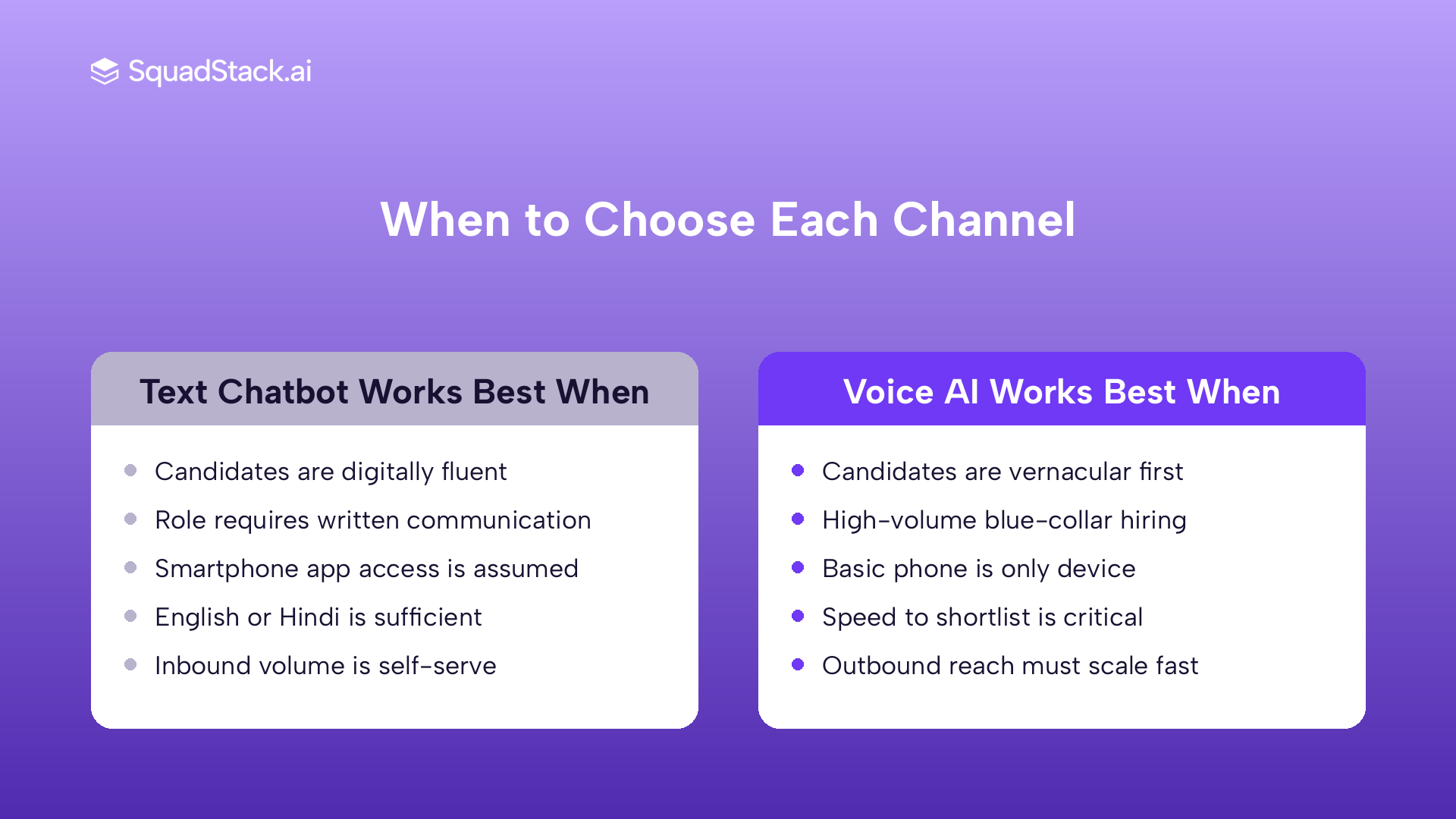
Use a recruitment chatbot when your candidates are digital-native, English-literate, and applying through a structured portal. Campus hiring for tech roles, white-collar BPO positions, and remote job applications all fit this profile.
Use voice AI when you are hiring at volume for phone-first roles, field agents, delivery partners, or telecallers in cities outside the top metros. Any role where the candidate pool is likely to be vernacular-first, low-literacy, or phone-centric will see higher completion rates and better data quality from voice.
For teams managing both profiles, the right answer is often a combination: a chatbot for the digital-first segment, and voice AI for everyone else, with one CRM receiving structured outputs from both.
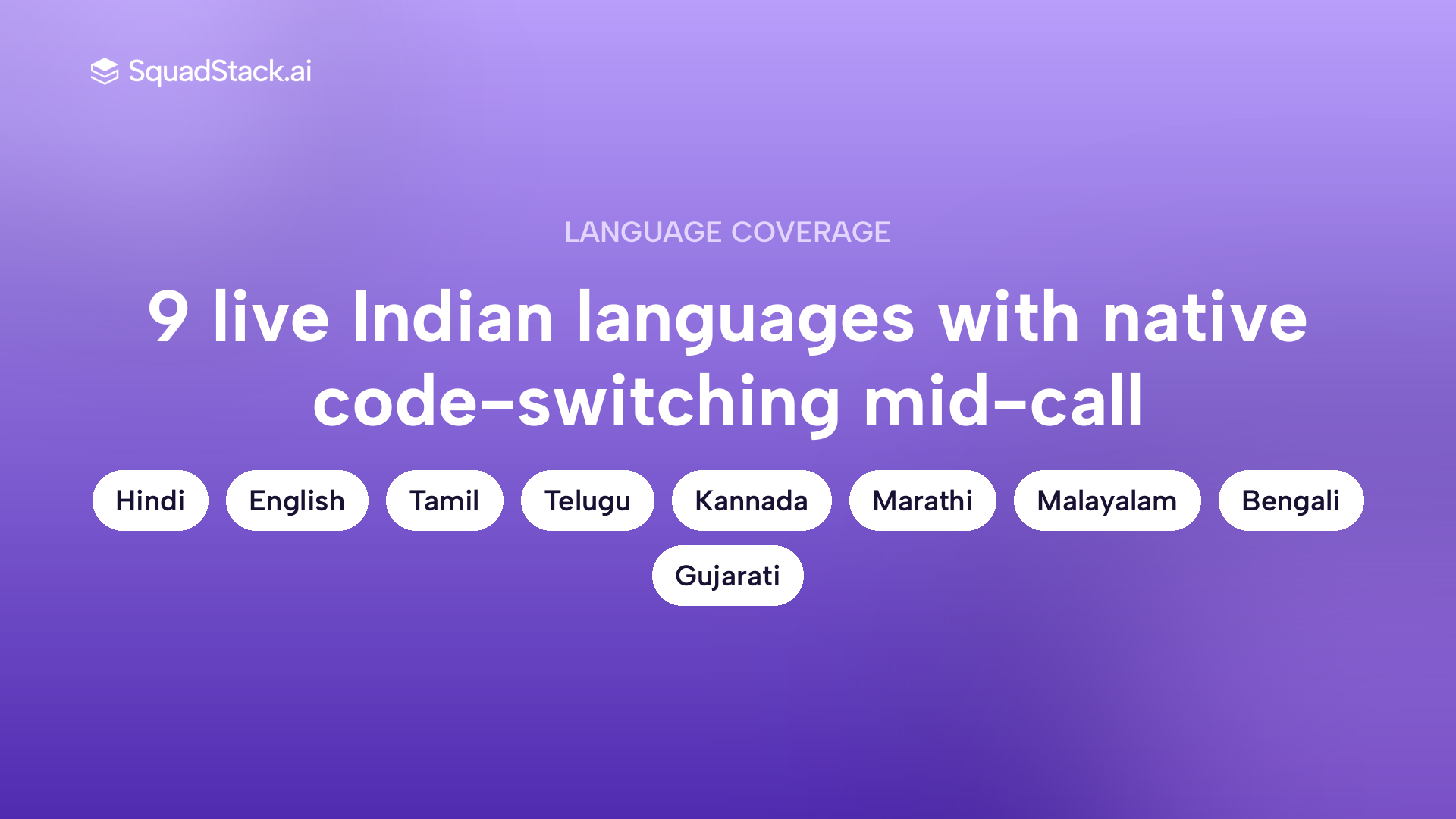
SquadStack's voice AI is built specifically for this kind of scale in India. The platform handles 50 lakh+ calls daily across 60+ large consumer brands. The speech model, Arth, ranks within 0.9 semantic WER points of the best commercial streaming STT on real Indian telesales audio, and it is the only model in that benchmark trained and hosted in India. The voice library covers 9 live Indian languages with native code-switching. More regional languages can be added on demand.
The Eval System audits every screening call across three layers: Did the call achieve its objective? How did the candidate experience it? Did the agent run the conversation correctly? That dual AI and human QA layer, combined with persistent memory across follow-up calls, means candidates who do not connect on the first attempt are re-engaged intelligently rather than cold-called again from scratch.
For recruitment workflows, the platform integrates with ATS and CRM systems, writes structured data back automatically, and supports warm transfer to a human recruiter for high-intent candidates. Go-live typically takes around two weeks for a new campaign.
See how SquadStack's Voice AI platform works, or explore the agentic contact center model it is built on.
If you are evaluating options for high-volume hiring in India, schedule a demo.
Which is the best recruitment chatbot for high-volume hiring in India?
For high-volume hiring across Tier 2 and Tier 3 Indian cities, voice AI outperforms text chatbots because most candidates are phone-first and vernacular-speaking. A voice AI platform like SquadStack that supports 9+ Indian languages with native code-switching and reaches up to 90% of candidates outbound is a stronger fit than a chat-based tool for this profile.
What are some real recruitment chatbot examples used in Indian hiring?
Platforms like Awign, WorkIndia, and Delhivery use automated screening at scale in Indian recruitment. Awign and WorkIndia use SquadStack voice AI for candidate screening and re-engagement. Delhivery uses it for rider hiring and onboarding, achieving a 4x lower cost-per-hire compared to their previous approach.
Can voice AI handle screening in Hindi, Tamil, and other regional languages?
Yes. SquadStack's voice AI runs natively across Hindi, English, Tamil, Telugu, Kannada, Marathi, Malayalam, Bengali, and Gujarati, with native code-switching mid-sentence. The underlying speech model, Arth, is trained on 600M+ minutes of real Indian telephony conversations including code-switched Hinglish and Taminglish.
What is the main reason recruitment chatbots fail with Tier 2 and Tier 3 candidates?
The biggest failure mode is the interface mismatch. Candidates who are uncomfortable typing in formal Hindi or English, or who are applying from a low-connectivity area on a basic smartphone, simply do not complete chatbot flows. Drop-off is high, and the data that does come through is often incomplete or unparseable.
How fast can voice AI screen a large batch of candidates?
A voice AI platform running at scale can contact thousands of candidates in parallel and complete a structured screening call in two to three minutes per candidate. Combined with an outbound connectivity rate of up to 90%, large candidate batches can be screened and shortlisted within hours rather than days.
How does a voice AI agent extract structured data from a spoken screening call?
The agent listens to spoken answers and runs entity extraction to pull defined fields, such as location, availability, experience, and equipment, into structured records. These are written automatically to the CRM or ATS after the call. Extraction accuracy is scored as part of the QA process on every call.
Is voice AI compliant with TRAI calling rules for recruitment outreach?
SquadStack's platform is TRAI-compliant. Outbound calls only go out between 9:30 AM and 8:30 PM, enforced by hard system controls, not a convention. Lead lists are scrubbed against the DND registry before dialing, and the platform uses 140-series numbers for compliant outbound calling.
What happens when a candidate misses the first call?
The platform retries the candidate over a configurable cadence, with defined gaps between attempts. Persistent memory means the follow-up call knows the candidate's status from any previous contact, so the agent does not start from scratch on attempt two or three. Candidates can also book a callback at a convenient time.
Can I use both a chatbot and voice AI in the same hiring funnel?
Yes. Many hiring operations use a chatbot for digital-native applicants who apply through a portal, while voice AI handles outbound screening for the broader candidate pool. Both can feed structured outputs into the same ATS, and SquadStack's omnichannel workflow builder supports multi-channel candidate journeys within one platform.
How long does it take to deploy a voice AI screening workflow in India?
A typical SquadStack campaign goes live in approximately two weeks. The setup includes building the screening agent on the client's actual requirements, integrating with the ATS or CRM, configuring the outreach cadence, and running QA before going live on real candidates. SquadStack's 93% POC success rate compares to a roughly 25% industry average.