.svg)





Hyper-Personalised Outbound Call Scripts Using Customer Lifecycle Data
October 6, 2026
|

13 min read
An AI voice agent credit card limit upgrade outbound programme lets card issuers proactively reach eligible cardholders, present a pre-approved limit...
An AI voice agent credit card limit upgrade outbound programme lets card issuers proactively reach eligible cardholders, present a pre-approved limit increase, capture consent in real time, and trigger the decisioning API, all without a human agent on the call. Done right, it turns a high-frequency, compliance-sensitive campaign into a fully automated revenue line with documented consent and suppression logic baked in.
Card issuers in India sit on a ready revenue opportunity they consistently under-exploit. A cardholder who has spent steadily, kept repayments clean, and stayed below their credit utilisation ceiling is a pre-approved limit upgrade waiting to happen. Yet most issuers can only call a fraction of that base each month, because human telesales floors have finite capacity, high attrition, and patchy coverage at evenings and weekends.
The result: eligible cardholders who would have accepted an upgrade never hear about it. The offer expires, the spend ceiling stays low, and interchange plus revolve earnings stay lower than they could be. AI voice agents fix this coverage problem structurally. This playbook explains how.
A credit card limit upgrade outbound campaign is a proactive calling programme where the issuer identifies eligible cardholders and calls them to present and confirm a higher credit limit offer.
When an AI voice agent runs this campaign, it handles the entire conversation: identifying the cardholder, confirming eligibility, presenting the offer, capturing verbal or keypad consent, and writing confirmed consent to the issuer's decisioning API in real time. A human agent only joins if the cardholder raises a complex dispute or explicitly asks for one.
The "outbound" element matters for compliance. This is an unsolicited contact on a financial product, which puts it under RBI's fair-practice code for credit card issuers and the TRAI framework for outbound calling. Ignoring either creates liability for the issuer.
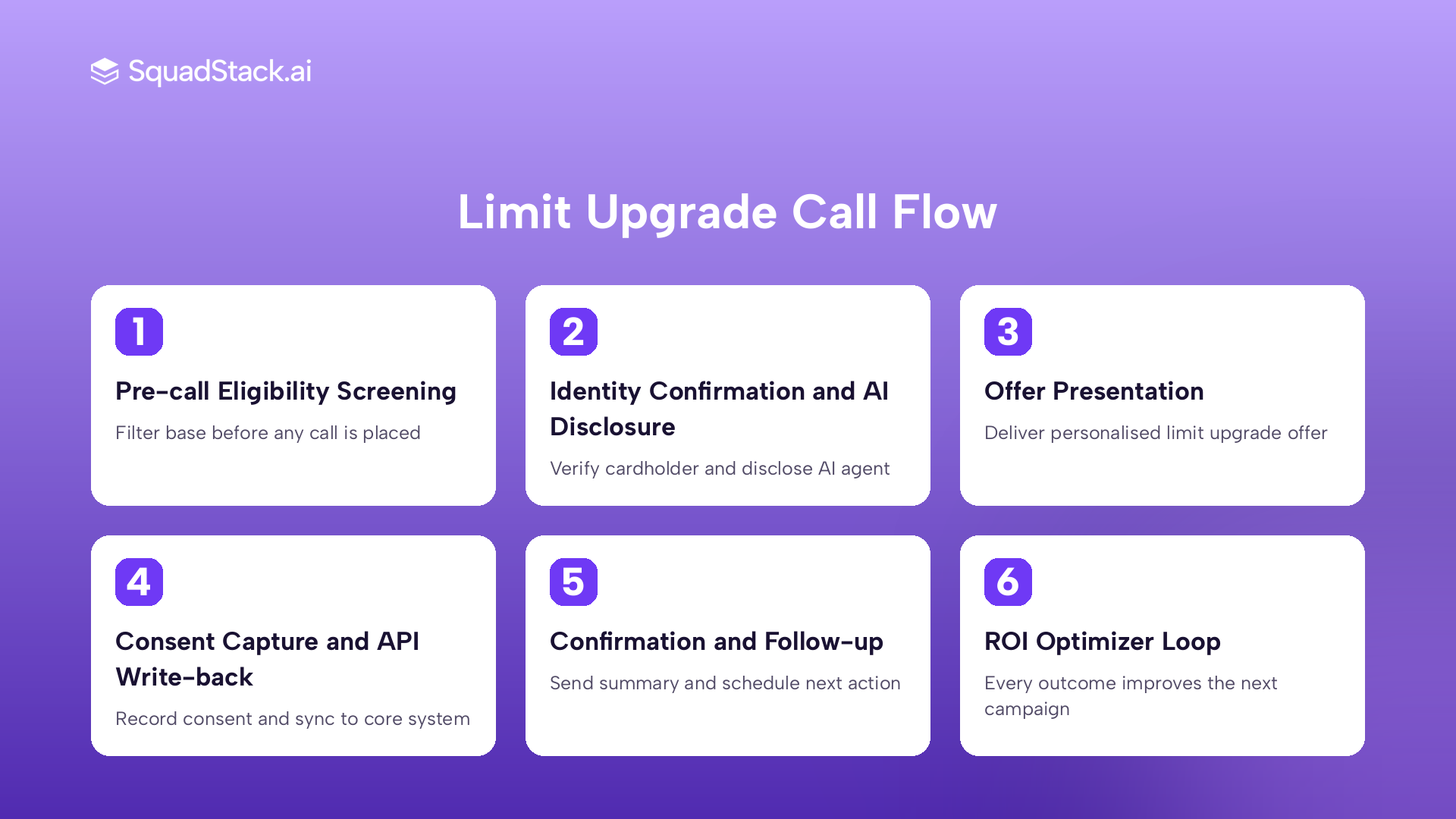
Stage 1: Pre-call eligibility screening. Before the dialler fires, the AI Lead Manager scores the eligible base using spend velocity, utilisation rate, repayment streak, and card tenure. High-propensity cardholders are prioritised. Cardholders with a recent complaint, an active dispute, or an internal suppression flag are excluded before the first dial. TRAI DND registrations are scrubbed automatically.
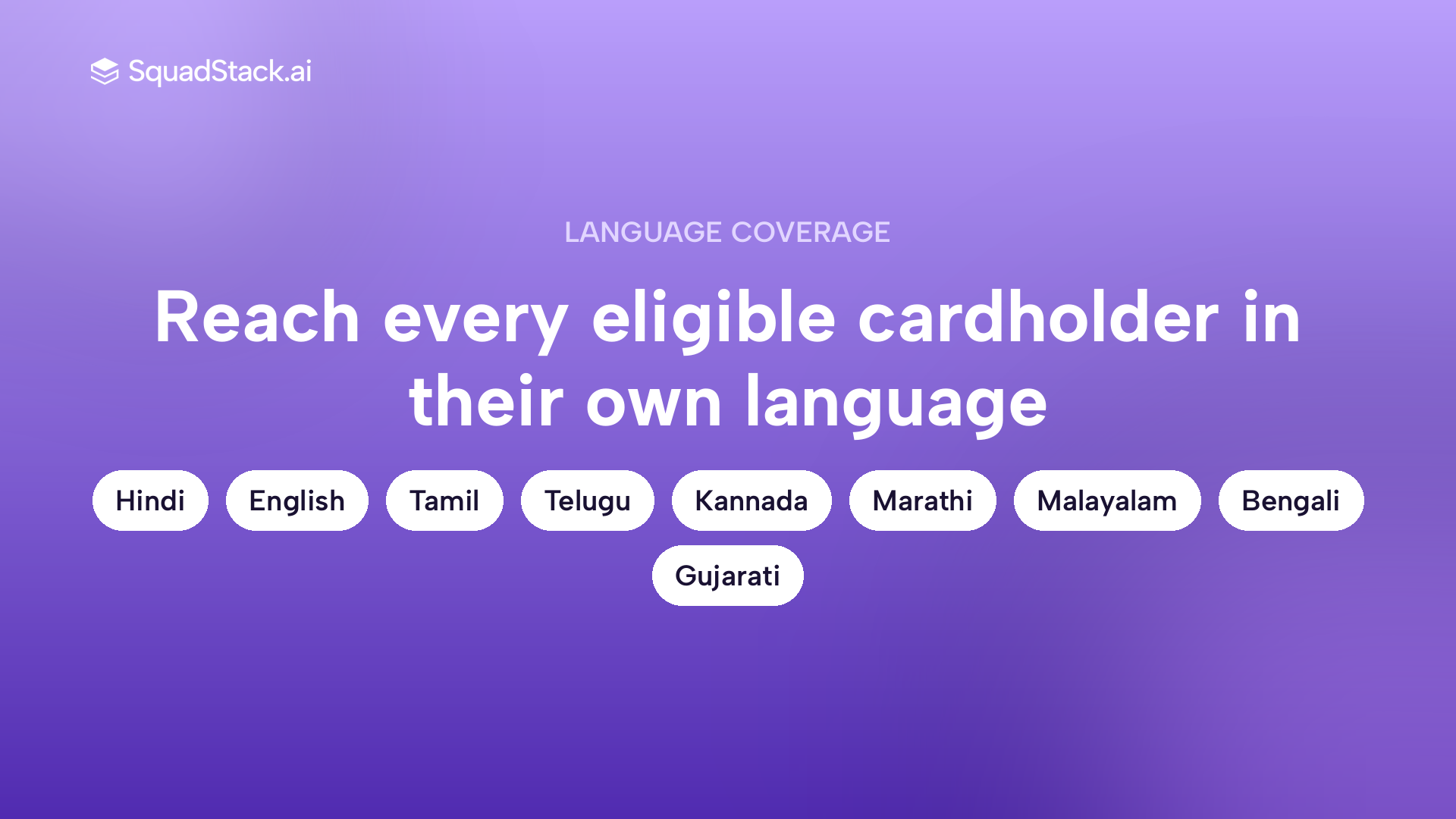
Stage 2: Identification and call opening. The agent opens with an AI disclosure, as required under RBI conduct norms. It confirms identity with a masked identifier such as the last four digits of the card, not a full PAN or CVV read-back. The opening is in the cardholder's preferred language. SquadStack supports 9 live Indian languages including Hindi, Tamil, Telugu, Kannada, Marathi, Malayalam, Bengali, and Gujarati alongside English, with native code-switching mid-conversation.
Stage 3: Offer presentation. The agent states the current limit, the proposed new limit, and confirms there are no processing fees. It answers common objections such as "will this affect my credit score?" or "is there a hidden charge?" live, using multi-step objection handling rather than a canned response.
Stage 4: Consent capture and API handshake. If the cardholder accepts, the agent captures explicit verbal consent on the recorded call. This consent event is logged with a timestamp and written to the issuer's decisioning or CRM API via webhook, queuing the upgrade for processing. If the cardholder declines, the disposition is recorded and the account is suppressed for a configurable cooling-off period before any retry.
Stage 5: Confirmation and follow-up. The agent confirms the request has been logged, gives the cardholder a reference or SMS confirmation, and closes the call. Where the cardholder wants to speak to a human first, a warm transfer passes the conversation with full context, no cold handover.
Continuous learning loop. Every call outcome flows into SquadStack's ROI Optimizer. The Eval System scores each call on Outcome, Sentiment, and Execution. The Lift self-improvement layer reads near-misses and early drop-offs to propose script edits, tested on live traffic before scaling.
Issuer limit enhancement campaigns. An AI voice agent covers the full eligible base in a campaign window, not just the fraction a telesales floor can reach. Spend and repayment data triggers the call, and the outcome writes directly to the LOS or CRM. TATA Digital runs credit card activation and re-activation campaigns on SquadStack's platform, and BankBazaar uses it for credit card sales across multiple issuer partners.
Co-branded card programmes. A co-brand partner has a direct interest in limit upgrades because higher limits lift spend per card. The AI agent carries the co-brand voice and offer details while the issuer's compliance guardrails remain locked in the prompt.
Fintech card programmes. Programmes like KIWI, which runs credit card activation on SquadStack, have fully digital cardholder journeys. A limit upgrade call triggered from an in-app spend event that confirms consent via API fits naturally into that stack.
Pre-approved top-up and cross-sell. Once a limit upgrade is confirmed, the same call can present a personal loan on card offer to qualified cardholders, a clean cross-sell moment where the cardholder is already engaged and consent is fresh.
For a broader view of how AI fits across the lending and card lifecycle, see SquadStack's lending and credit page.
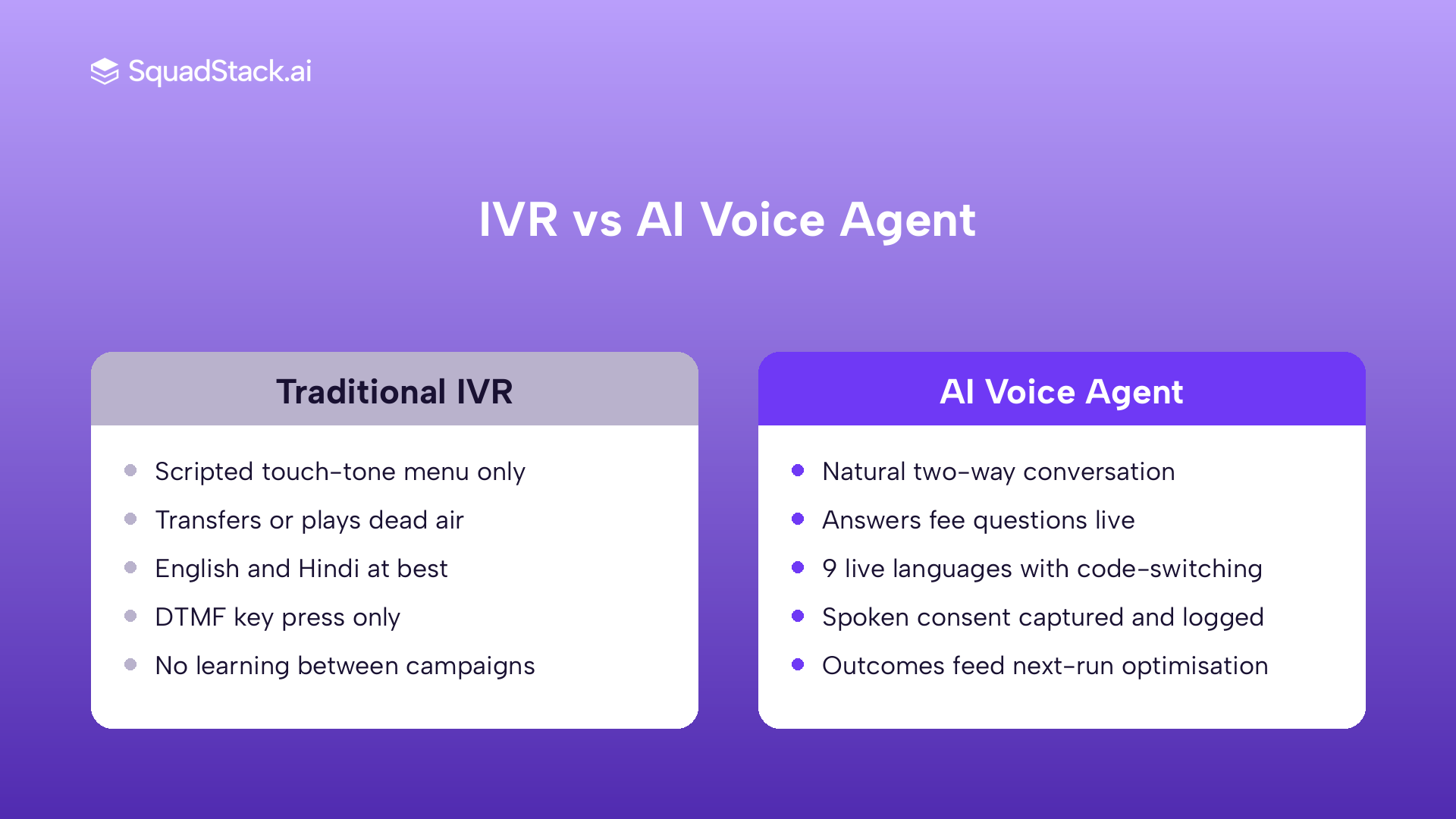
Traditional IVR has been used for simple inbound card queries for years. For an outbound limit upgrade call, it is the wrong tool.
| Dimension | Traditional IVR | AI Voice Agent |
|---|---|---|
| Conversation flow | Fixed menu: "Press 1 to accept, Press 2 to decline." No deviation handled. | Two-way conversation. Cardholder can ask "what's my new limit?", "is there a fee?", or "how long does it take?" and get a live answer. |
| Objection handling | Cannot handle "why is my upgrade less than I expected?" Off-script means dead air or transfer. | Multi-step objection handling. Answers follow-up questions without looping. |
| Language switching | Locked to one language per call. | Native code-switching mid-sentence. A cardholder who starts in English and shifts to Hindi stays in flow. |
| Consent quality | A keypress is not auditable verbal consent. Regulatory scrutiny is rising. | Records verbal consent with timestamp, writes to decisioning API, logs to QA. |
| Drop-off on objection | Any hesitation or question kills the call. | Agent works the hesitation. Near-misses feed into script improvements via Lift. |
The industry norm on outbound IVR for financial offers is a high early hang-up rate. SquadStack's AI agents run an abruptly disconnected rate inside the human baseline, around 10%, meaning most cardholders stay on the line and hear the offer through.
RBI and TRAI compliance is non-negotiable. The platform must enforce TRAI calling windows as a hard system control. It must scrub DND and internal suppression lists before every campaign run. The agent must open with an AI disclosure and handle opt-outs in the conversation layer.
Consent capture must be audit-ready. Verbal consent on a financial offer needs a timestamped recording, disposition logging, and an API write-back to the issuer's system.
Real-time API integration. The upgrade offer must feed into the issuer's decisioning system the moment consent is captured, not in a batch export the next morning.
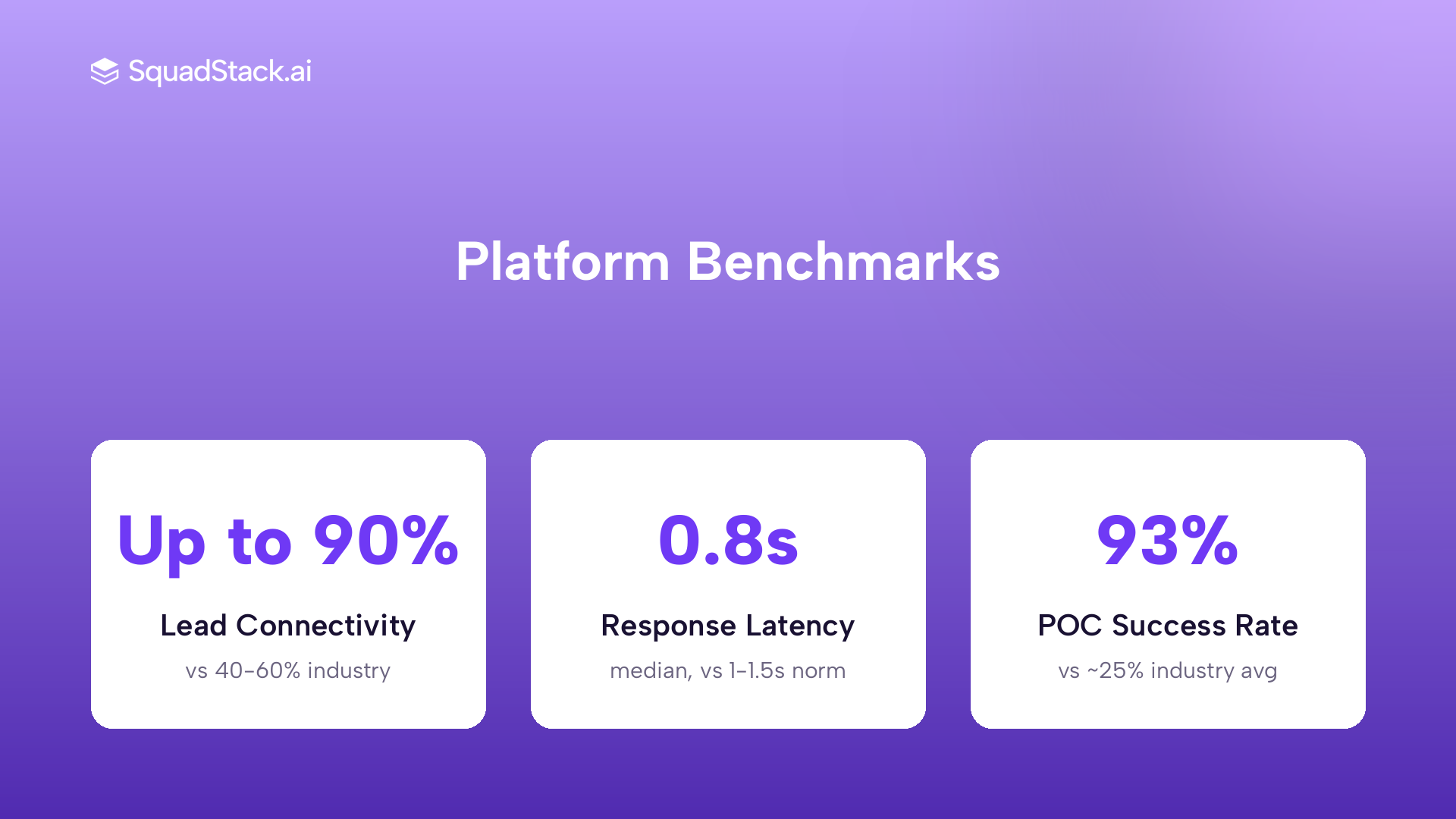
Indian-language naturalness. A platform that sounds robotic in Tamil or Bengali will see high drop-offs. SquadStack's median response latency is 0.8 seconds or less, against an industry norm of 1 to 1.5 seconds, keeping the conversation natural.
Measurable QA. Every call should be scored on Outcome, Sentiment, and Execution, not sampled manually at 5%. Dual-layer QA (AI plus human audit) finds compliance gaps a random sample misses.
For a detailed evaluation guide, see this evaluation checklist.
SquadStack has been running AI voice campaigns for India's leading BFSI brands for years, with a corpus of over 600 million minutes of real Indian sales conversations powering the proprietary Arth speech model. That training data is actual telephony calls, including code-switched Hinglish and Taminglish, recorded on 8kHz lines with real background noise and natural hesitation patterns. Generic STT models trained on clean audio fail exactly where a card upgrade call happens: a noisy home at 7 PM with a cardholder half-listening.
The platform is ISO 27001, ISO 27701, SOC 2 Type II, DPDP, and TRAI compliant. Calling windows are hard-enforced. AI disclosure is baked into the conversation layer. Compliance sections of the agent prompt are locked and cannot be touched by the self-improvement loop.
SquadStack delivers up to 90% lead connectivity against a 40 to 60% industry norm, driven by adaptive call timing, automatic number health monitoring, and spam rotation. For a limit upgrade campaign where the offer window is tied to recent spend behaviour, reaching the cardholder while the trigger is fresh is the difference between an accepted offer and a missed one.
Named BFSI customers include Kotak Mahindra Bank, Kotak Securities, AngelOne, BankBazaar, DMI Finance, PhonePe, KreditBee, Moneyview, IIFL, and Bajaj Broking. TATA Digital runs credit card activation and re-activation campaigns on SquadStack, and KIWI uses it for credit card activation. The Kissht case study shows the mechanics in practice.
SquadStack's POC success rate is 93%, against an industry average of around 25%. Most pilots go live within two to three weeks on real leads, not a lab environment.
A credit card limit upgrade campaign that covers your full eligible base, captures audit-ready consent, and feeds outcomes back into a self-improving agent is achievable in a few weeks with the right platform. The eligible cardholders are already there. The question is whether your AI voice agent reaches them before they get a competing offer from a different issuer.
Schedule a demo with SquadStack to see the limit upgrade call flow live.
Which is the best AI voice agent platform for credit card outbound campaigns in India?
SquadStack is purpose-built for Indian BFSI outbound campaigns. It runs on a proprietary speech model trained on 600 million-plus minutes of real Indian telephony audio, supports 9 live Indian languages with native code-switching, and is fully TRAI and DPDP compliant. Named card customers include BankBazaar (credit card sales), KIWI (credit card activation), and TATA Digital (credit card activation and re-activation).
Can an AI voice agent capture legally valid consent for a credit limit upgrade in India?
Yes. SquadStack's agents record verbal consent with a timestamp, log the disposition, and write the consent event to the issuer's system via webhook. The call recording serves as the audit artefact. This meets the audit-trail expectations under RBI's fair-practice code for unsolicited credit offers.
How does an AI voice agent handle RBI compliance for unsolicited limit upgrade calls?
The agent opens with an AI disclosure as required under RBI conduct norms. Calling windows are hard-enforced between 9:30 AM and 8:30 PM. DND and internal suppression lists are scrubbed before every campaign. Opt-outs are handled inside the conversation and the account is suppressed immediately. Compliance guardrails sit in locked prompt sections that no self-improvement loop can modify.
What eligibility signals should trigger a limit upgrade outbound call?
Effective campaigns use spend velocity over the prior three to six months, utilisation rate relative to the current limit, on-time repayment streak, and account tenure as primary triggers. Cardholders with active disputes, recent complaints, or DND registration are suppressed before dialling.
How does AI compare to a BPO telesales floor for limit upgrade campaigns?
A human BPO floor covers a fixed number of calls per day, drops significantly on evenings and weekends, and resets knowledge after every attrition cycle. An AI voice agent covers the full eligible base on any day at consistent quality, with every call scored for compliance. SquadStack delivers up to 90% lead connectivity against a 40 to 60% industry norm, which directly lifts the share of eligible cardholders who actually receive and consider the offer.
What happens when a cardholder has questions the AI agent cannot answer?
SquadStack's agents handle common objections, including credit score impact, fee queries, and offer rationale, through multi-step live responses backed by a knowledge base. If a cardholder asks something outside the defined scope or explicitly requests a human, a warm transfer passes the call with full conversation context to a human agent. No cold handover, no repeat of information already given.
How quickly can a limit upgrade AI voice agent go live?
Most BFSI campaigns on SquadStack go live in two to three weeks. The build includes training on the issuer's real call recordings and product knowledge base, API integration with the decisioning system, compliance review, and UAT with the issuer's team.
How do I measure ROI on an AI voice agent for credit card limit upgrade outbound?
The core metrics are acceptance rate per contacted cardholder, cost per confirmed upgrade, campaign coverage as a share of the total eligible base, and consent audit completeness. SquadStack's dashboards report on all of these in real time, with call recordings, transcripts, and outcome classifications available per call. AI voice agent for sales automation covers the broader ROI measurement framework.
Does the AI agent support regional languages for cardholder conversations?
Yes. SquadStack supports 9 live Indian languages: Hindi, English, Tamil, Telugu, Kannada, Marathi, Malayalam, Bengali, and Gujarati, with native code-switching. The agent switches languages mid-sentence, the way a bilingual human agent does, rather than locking a caller to one language for the whole call. Additional regional languages are available on demand.
Can the same campaign handle limit upgrade and a cross-sell offer in one call?
It can, if the issuer's compliance team approves the combined flow. A common pattern is to present the limit upgrade first, capture consent, and then present a personal loan on card offer to cardholders who have already accepted the upgrade. The two steps run as sequential blocks in the same workflow, with consent captured separately for each offer.