AI Voice Agents for Inbound Support with Complex Query Escalation
September 21, 2026
|

12 min read
Voice AI for travel booking confirmations in India calls travellers automatically, confirms their booking details in their own language, and sends...
Voice AI for travel booking confirmations in India calls travellers automatically, confirms their booking details in their own language, and sends reminders before the travel date, all without adding headcount. The result is fewer no-shows, lower servicing costs, and confirmation rates that outperform human-agent teams during peak seasons.
Travel brands in India face a specific and expensive problem: a traveller books a bus seat, a flight, or a holiday package, and then simply does not show up. Sometimes they cancelled and nobody registered it. Sometimes they forgot. Sometimes the confirmation reached them as a generic SMS they ignored. The cost shows up in wasted seats, missed upsell windows, and inbound calls from confused passengers.
The confirmation step sounds simple, but doing it well across millions of bookings, in the right language, at the right time, and in a way the traveller actually responds to, is anything but.
Voice AI for travel booking confirmations is an automated outbound calling system that reaches travellers after they book, confirms their travel details in a natural two-way conversation, and follows up before their departure date with reminders or action prompts.
Unlike a pre-recorded robocall, a voice AI agent listens to what the traveller says, handles their questions, reschedules if needed, and passes context to a human agent if something unusual comes up. It does not play a menu. It holds a conversation.
In the Indian travel context, this matters because travellers in tier-2 and tier-3 cities respond better to a voice call than to a chat or email. They ask questions in Hindi, Tamil, Telugu, or Kannada. They want to confirm seat numbers, check cancellation terms, or hear their departure time read back to them. A good voice AI does all of this without transferring the call or dropping context.
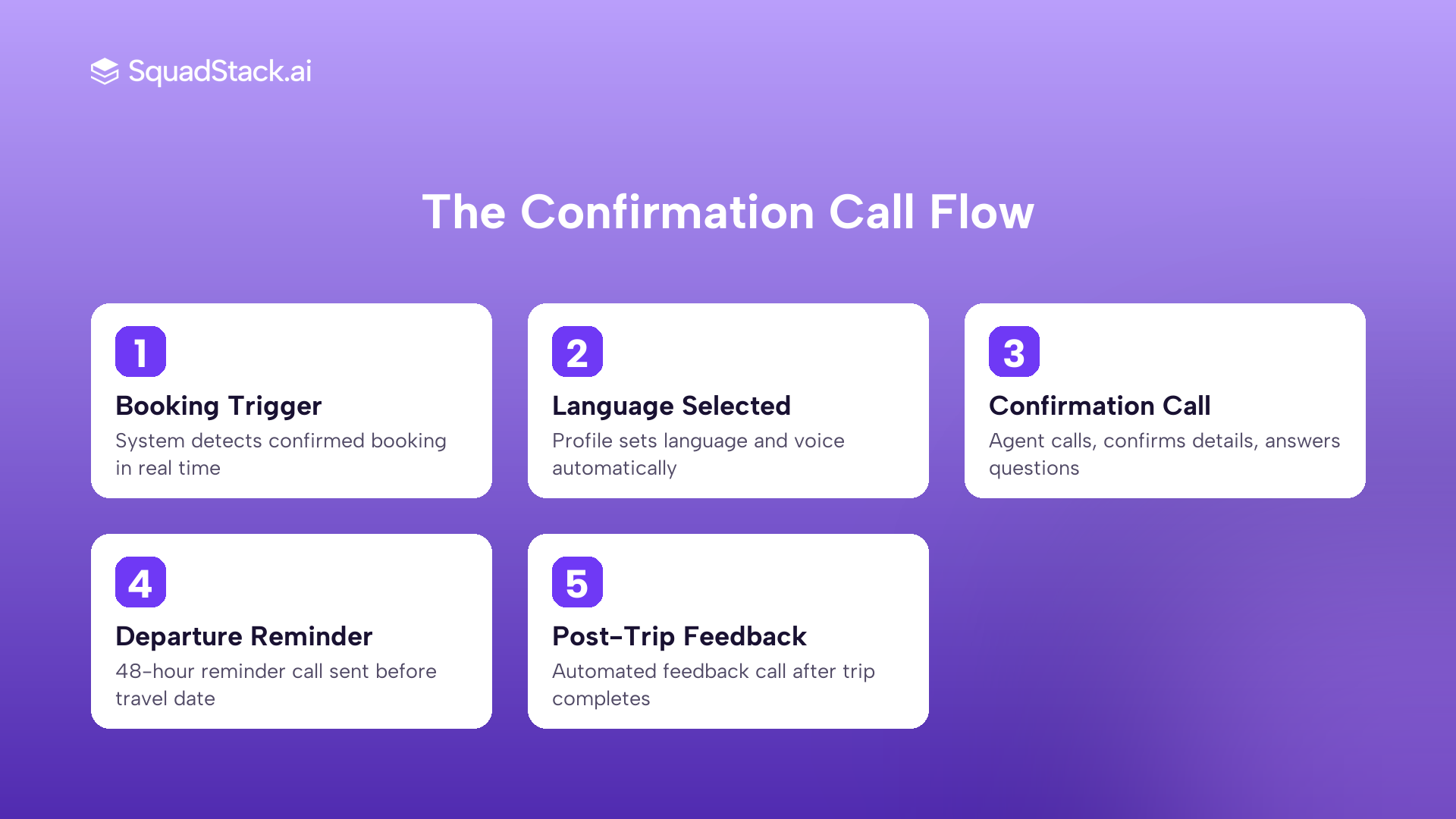
The call flow is straightforward. Here is how it runs step by step.
Step 1: Trigger. A booking is made, or a configurable time window opens (say, 48 hours before departure). The AI Lead Manager picks the lead, scores it, and decides when to call based on historical pick-up data for that traveller profile.
Step 2: Language and persona selection. Before the call even dials, the system selects a voice and language from a library of 1,000+ human-cloned voices. It uses the traveller's profile, geography, and prior interaction history to make this choice. A traveller from Chennai gets a Tamil-capable agent. A traveller who previously responded in Hindi gets a Hinglish-comfortable persona.
Step 3: The confirmation call. The agent introduces itself, confirms the booking details (route, date, seat, departure time), and checks if everything is correct. If the traveller has questions, the agent answers from the knowledge base. If they want to reschedule, the agent handles it. If the situation is complex, it books a callback or transfers to a human with full context.
Step 4: Pre-departure reminder. A second call runs closer to the travel date. The agent confirms the boarding point, checks-in on document readiness for international travel, and can send a WhatsApp message mid-call with a boarding pass link or travel voucher.
Step 5: Post-trip feedback. After the journey, the agent calls back to capture a rating or review. This is a low-pressure, short call. The feedback is structured and captured automatically.
Step 6: Continuous learning. Every call outcome, whether the traveller confirmed, rescheduled, cancelled, or did not pick up, feeds into the ROI Optimizer. The system updates scoring models, adjusts call timing, and refines scripts based on what actually works. Over weeks, confirmation rates improve without any manual tuning.
Booking confirmations for OTAs and bus operators. After a payment is processed, a voice AI call confirms the itinerary details and checks if the booking information is correct. This is especially useful when a traveller has booked for a group, where name mismatches or seat assignments create downstream complaints.
Pre-departure check-in reminders. For airlines, the 48-hour check-in window is where the highest volume of documentation failures happen. A voice agent can confirm whether the traveller has completed check-in and, for international routes, verify that passport names match the ticket. If there is a mismatch, the agent flags it while there is still time to fix it without a fare penalty.
Rebooking and cancellation handling. When a disruption happens, an outbound voice agent can reach affected travellers with rebooking options before they call the contact centre. The agent carries the context: what was booked, what the disruption is, and what alternatives are available.
Post-stay and post-journey feedback. redBus uses SquadStack for review and rating collection after bus journeys. The redBus case study shows what a voice-first feedback deployment looks like at scale, with survey costs 50% lower than the human-agent baseline.
Cross-sell on return flights. GoIbibo runs a cross-sell motion targeting one-way bookers with return-flight offers. This is a confirmation call that extends into a sales moment: confirm the outbound trip, then offer the return.
For a full view of how SquadStack operates across the travel segment, see the Travel and Tourism industry page.
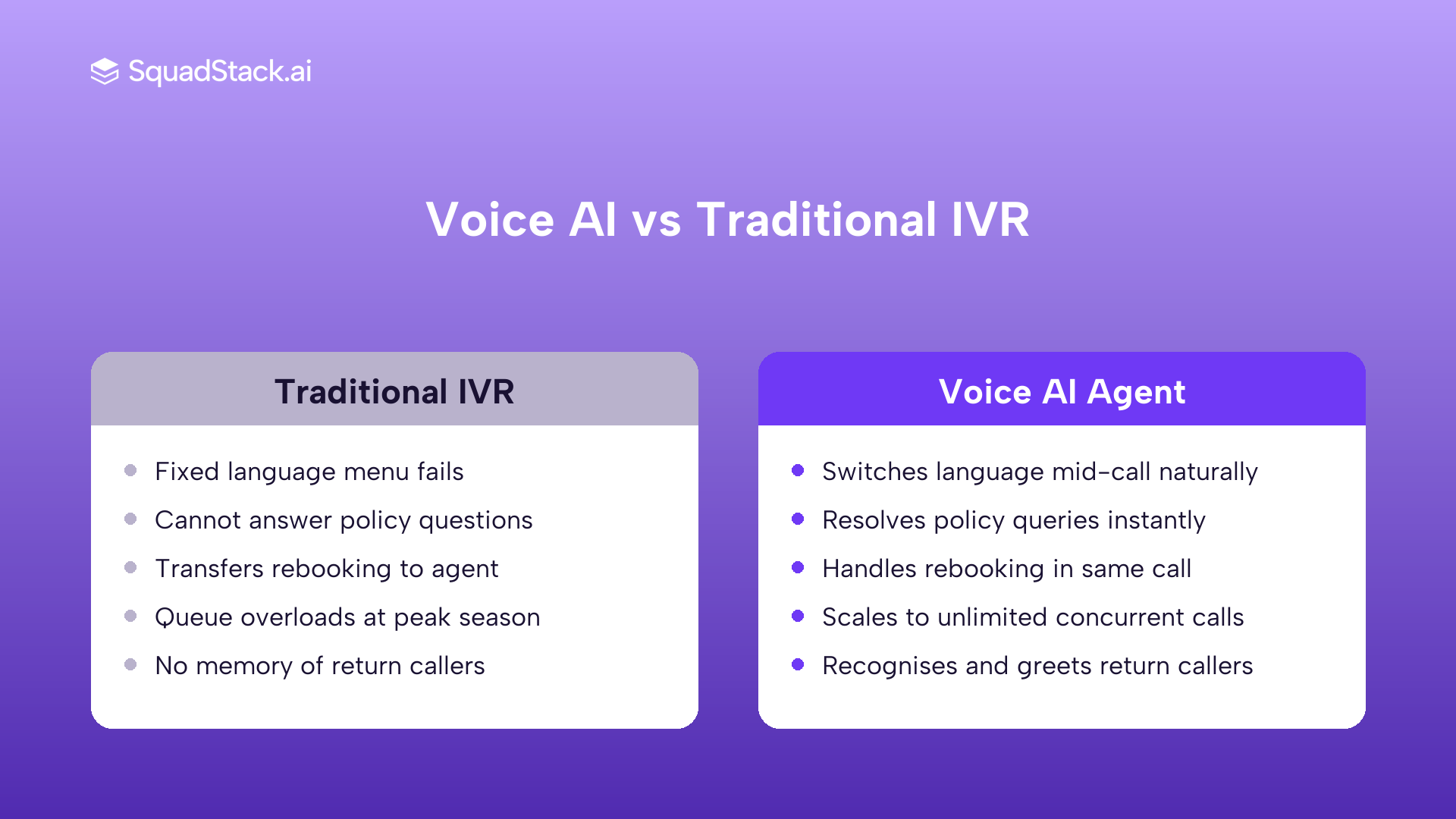
Travel operators often start with IVR for confirmations. The gap between IVR and a voice AI agent becomes clear when something goes slightly off-script, which in travel, happens constantly.
| Dimension | Traditional IVR | Voice AI Agent |
|---|---|---|
| Handling a language switch | Fails: fixed-language menus only | Handles it naturally, switches mid-conversation between Hindi and English without missing a beat |
| Traveller asks about cancellation policy | Routes to a hold queue or plays a recorded clause | Retrieves the relevant policy from the knowledge base and explains it conversationally |
| Traveller wants to reschedule the departure date | Cannot process: transfers or drops the call | Books the change or schedules a callback, carries the context through |
| Name mismatch on an international ticket | No awareness, confirmation proceeds | Catches the mismatch, flags it, and prompts the traveller to correct via the right channel before departure |
| Peak-season volume (festive, school holidays) | Fixed IVR capacity, same delays regardless | Scales to millions of concurrent calls with no staffing ramp |
| Traveller calls back two days later | Starts from scratch with no memory | Loads the prior conversation context and picks up where the last interaction ended |
The fundamental difference is that IVR forces the traveller to navigate a menu the engineer designed. A voice AI agent listens to what the traveller actually says and responds to it.
A few criteria separate platforms that work in the Indian market from those that struggle.
Multilingual depth, not just a language list. Any vendor can claim "Hindi support." What matters is whether the agent sounds like a native speaker, handles code-switching mid-sentence (Hinglish, Taminglish), and recovers when a traveller uses local phrasing. Ask for a sample call in Tamil or Telugu, not a demo in English.
TRAI compliance and DND handling. Outbound calling in India requires compliance with TRAI calling hours (9:30 AM to 8:30 PM), DND registry scrubbing, and 140-series numbers for cold contacts. A platform that does not hard-enforce these at the system level, not just as a policy, creates regulatory exposure.
Handling disruption scenarios. Confirmation calls in travel do not follow a clean script. Flights get delayed. Buses run late. A platform that only handles happy-path confirmations transfers everything else to a human, which defeats the purpose during peak disruption periods.
Persistent memory across touchpoints. A traveller who calls back after a voice confirmation should not repeat their booking reference. Memory across calls and channels is a technical differentiator, not a standard feature.
Quality assurance at scale. Confirmation accuracy is a safety-critical metric in travel. Misconfirming a departure date or a boarding point has real consequences. Look for a platform that audits calls at multiple levels: outcome, sentiment, and execution.
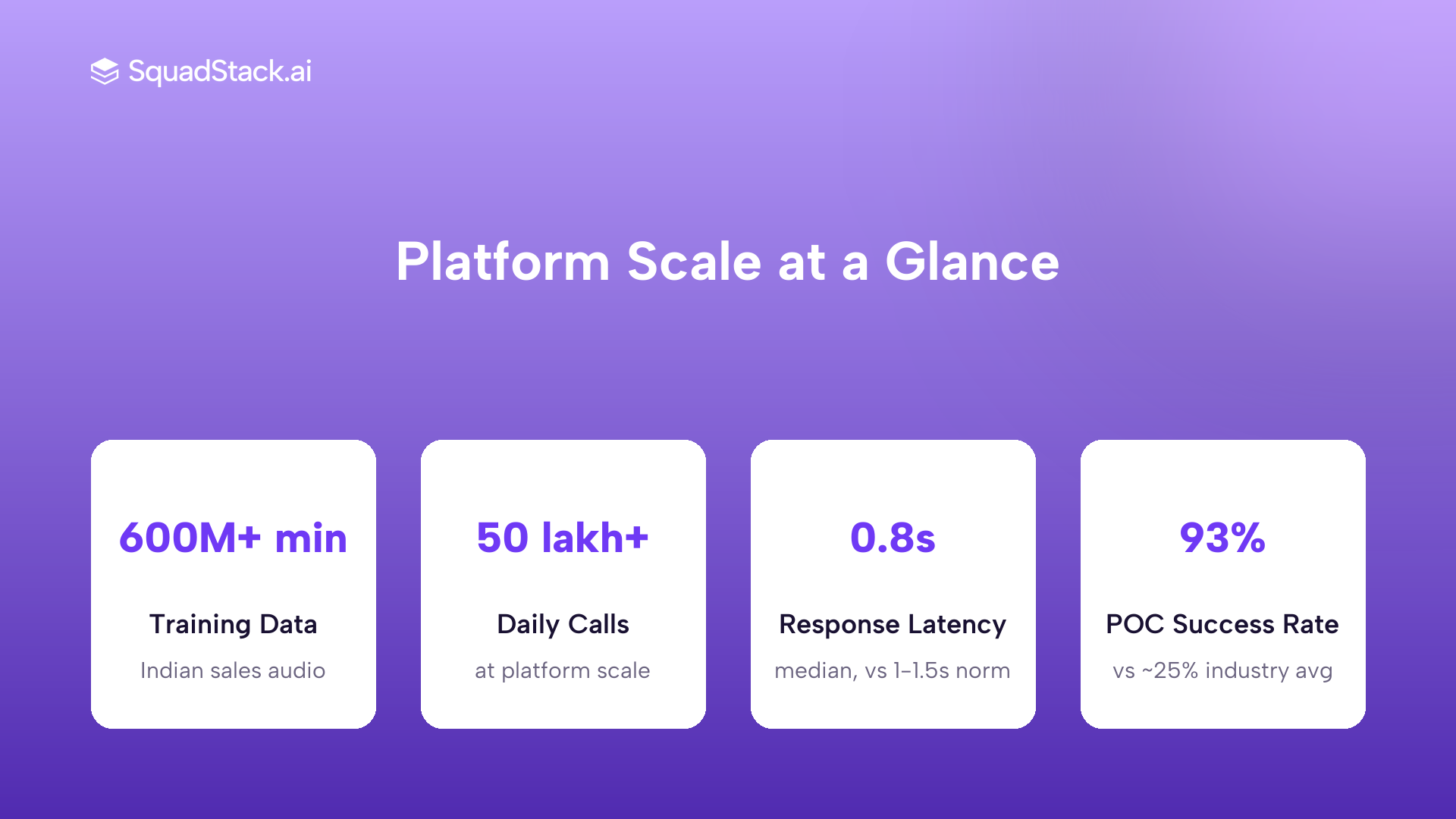
SquadStack has spent roughly 10 years running contact centre operations for India's largest consumer brands before moving fully to voice AI in 2025. The speech model, Arth, is trained on 600M+ minutes of real Indian sales and service conversations, including telephonic audio from tier-2 and tier-3 cities where network quality and accent diversity are highest. This is not a model trained on YouTube videos or read-speech corpora. It is trained on the same conditions a travel confirmation call runs in: noisy lines, code-switched speech, Indian entity names, and 8kHz telephony.
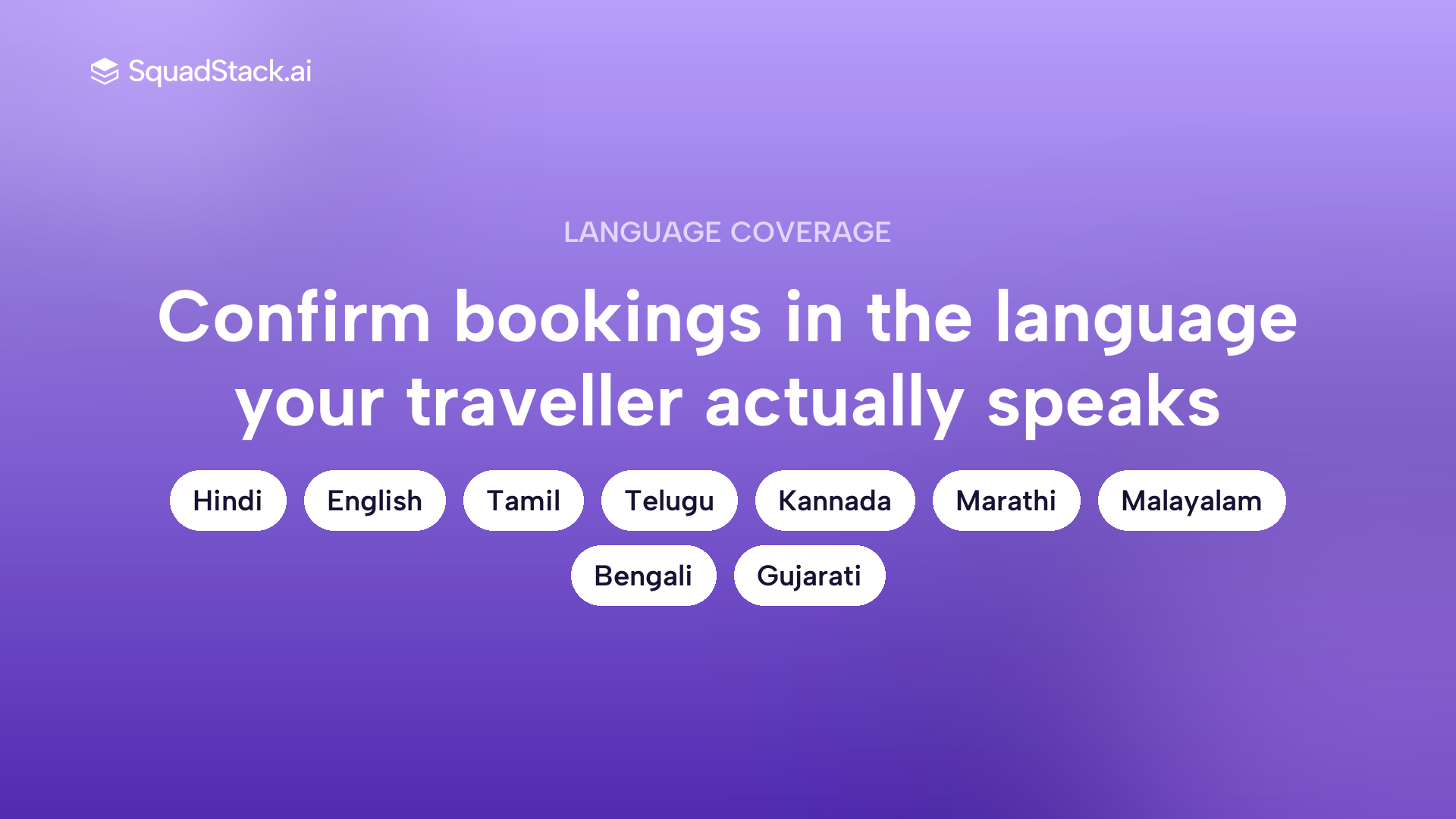
Nine Indian languages are live today, Hindi, English, Tamil, Telugu, Kannada, Marathi, Malayalam, Bengali, and Gujarati, with native code-switching. More languages are available on demand. Median response latency is 0.8 seconds or less, which keeps conversations natural and prevents the awkward pause that signals "this is a robot" to a caller.
The platform runs 50 lakh+ calls daily for 60+ large consumer brands. In travel, redBus has used SquadStack for post-journey feedback and rating collection, achieving a 50% lower survey cost than the human-agent baseline. GoIbibo runs a cross-sell return-flight campaign. Both are live, production deployments, not pilots.
Every call is audited through the Eval System, which scores each conversation on three levels: Outcome (did the call achieve its goal), Sentiment (how the traveller experienced it), and Execution (did the agent follow the correct flow). The feedback loop runs continuously, so confirmation scripts, call timing, and voice selection improve across every campaign.
The 93% POC success rate, against an industry average around 25%, reflects what happens when a platform is built to deliver outcomes rather than just to run calls.
The platform is ISO 27001, ISO 27701, and SOC 2 Type II certified, DPDP and TRAI compliant, with all data hosted in India.
For voice AI deployments across other high-volume sectors, see how the same platform performs in insurance, lending, and logistics.
No-shows and missed confirmations in travel are mostly a reach problem. The right traveller did not get the right call at the right time in the right language. Voice AI for travel booking confirmations in India fixes this at scale, without seasonal staffing headaches and without the quality drop that comes from a stretched human team during festive peaks.
If you want to see how this works for your confirmation and reminder volumes, book a demo with SquadStack.
Which is the best voice AI solution for travel booking confirmations in India?
The best solution for Indian travel brands is one built on Indian-language speech models, TRAI-compliant dialing infrastructure, and persistent memory across calls. SquadStack runs on Arth, a proprietary speech model trained on 600M+ minutes of real Indian telephony conversations, and handles Hindi, English, Tamil, Telugu, Kannada, Marathi, Malayalam, Bengali, and Gujarati natively with mid-sentence code-switching.
Can voice AI handle booking confirmations automatically without a human agent?
Yes. A voice AI agent can confirm booking details, answer traveller questions, send documents via WhatsApp mid-call, and handle simple reschedule requests, all without a human. Complex situations (a name mismatch on an international ticket, a disruption needing a full rebooking) can be escalated to a human with full context passed through.
How does voice AI reduce no-shows for travel brands?
It reaches more travellers, closer to their departure date, in their own language. A confirmation call 48 hours before departure with a natural, conversational reminder is harder to ignore than an SMS. The agent can also reconfirm boarding points, verify documents, and detect if a traveller plans to cancel, so the seat can be reallocated in time.
Is voice AI for outbound travel calls compliant with TRAI regulations in India?
A properly built platform enforces TRAI calling hours (9:30 AM to 8:30 PM) as a system-level hard block, not a policy guideline. It scrubs lead lists against the DND registry before dialing and uses 140-series numbers for cold contacts. SquadStack's platform is TRAI-compliant and enforces these controls at the infrastructure level.
What happens when a traveller speaks in a regional language the IVR does not support?
A traditional IVR drops the call or plays an error message. A voice AI agent with native multilingual capability switches language mid-conversation without breaking the flow. SquadStack's agents switch between Hindi and English, or Tamil and English, in the same sentence, the way a bilingual human agent would.
How does voice AI handle post-booking feedback collection for travel operators?
The agent calls after the journey, asks a short structured set of questions in the traveller's language, and captures the feedback as structured data. This is exactly the use case SquadStack runs for redBus, where the voice-led feedback campaign achieved a 50% reduction in survey cost compared to the human-agent baseline.
Can voice AI manage both outbound confirmations and inbound service calls?
Yes. The same platform handles outbound confirmation and reminder campaigns as well as inbound calls where a traveller calls back with a query. Persistent memory means the agent recognises the traveller from the earlier confirmation call and does not ask them to repeat their booking details.
How quickly can a travel brand go live with voice AI confirmations?
A typical deployment takes roughly two weeks from kick-off to going live. The agent is trained on the brand's real call recordings, knowledge base, and FAQs during that build period. Simple, contained confirmation flows can be prototyped faster; the longer lead time is usually client-side dependencies such as data feeds and compliance approvals.
What does multilingual voice AI actually mean for Indian travellers in tier-2 and tier-3 cities?
It means the traveller gets a call that sounds like a native speaker, not a textbook. SquadStack's voices are cloned from real top-performing Indian sales agents, not synthesised from read-speech. The dialogue is written by native speakers, not generated by a language model, so filler words, reformulators, and conversational rhythms are authentic to each language.
How does the system improve over time, or does every campaign start from scratch?
Every campaign builds on prior learnings. Call outcomes feed into the ROI Optimizer, which updates lead scoring, timing, script variants, and voice selection continuously. A campaign running in its third month confirms more bookings per call attempt than in week one, because the system learns which traveller profiles respond to which approach.