Voice AI Onboarding Failures: What Goes Wrong and Why
November 2, 2026
|

13 min read
See how CX heads in India can reach 60% AI call containment by prioritising the right call types, phasing the rollout, and setting clear human handoff rules.
A CX head planning AI voice inbound call migration in India does not need to move everything at once. Start with the highest-volume, most predictable call types, run a phased rollout with clear human handoff rules, and measure CSAT at each stage before expanding. With the right vendor and a structured migration plan, most Indian contact centre leaders can reach 60% AI containment without harming customer experience.
Moving half your inbound call volume to AI sounds straightforward on a slide. In practice, it is the kind of initiative that stalls in pilot, gets rolled back after a CSAT dip, or never reaches the 60% target because no one built the handoff architecture correctly.
This guide is for CX leaders at Indian consumer brands who are past the curiosity stage and ready to plan a real migration. It covers which calls to move first, how to sequence the rollout, how to protect CSAT, and what to look for when shortlisting vendors.
An AI voice inbound call migration is the planned transfer of a defined percentage of your inbound call volume from human agents to AI voice agents, while keeping humans available for calls that need them. It is not replacing your contact centre. It is rebalancing it so that AI handles repeatable, predictable calls and humans handle conversations requiring judgment, empathy, or complex problem-solving.
When a customer calls in, the AI voice agent picks up in under 0.8 seconds and identifies intent from natural speech. It does not present a menu. It understands what the caller wants, even in code-switched Hindi-English or regional languages, and responds conversationally.
The agent has full access to the customer's history through persistent memory, so a repeat caller does not repeat themselves. It can answer FAQs, confirm transactions, capture structured data, and handle objections across multiple turns without drifting.
If the call falls outside the AI's scope, a warm transfer passes the conversation to a human agent with full context already loaded. After every call, outcomes feed back into the platform's ROI Optimizer. Conversion rates, resolution rates, and sentiment signals are analysed, and the system adjusts script, voice, cadence, and timing for future calls. This continuous learning loop is what separates a well-deployed AI from a static IVR that slowly loses relevance.
For a deeper look, see our guide on what is call center voice AI.
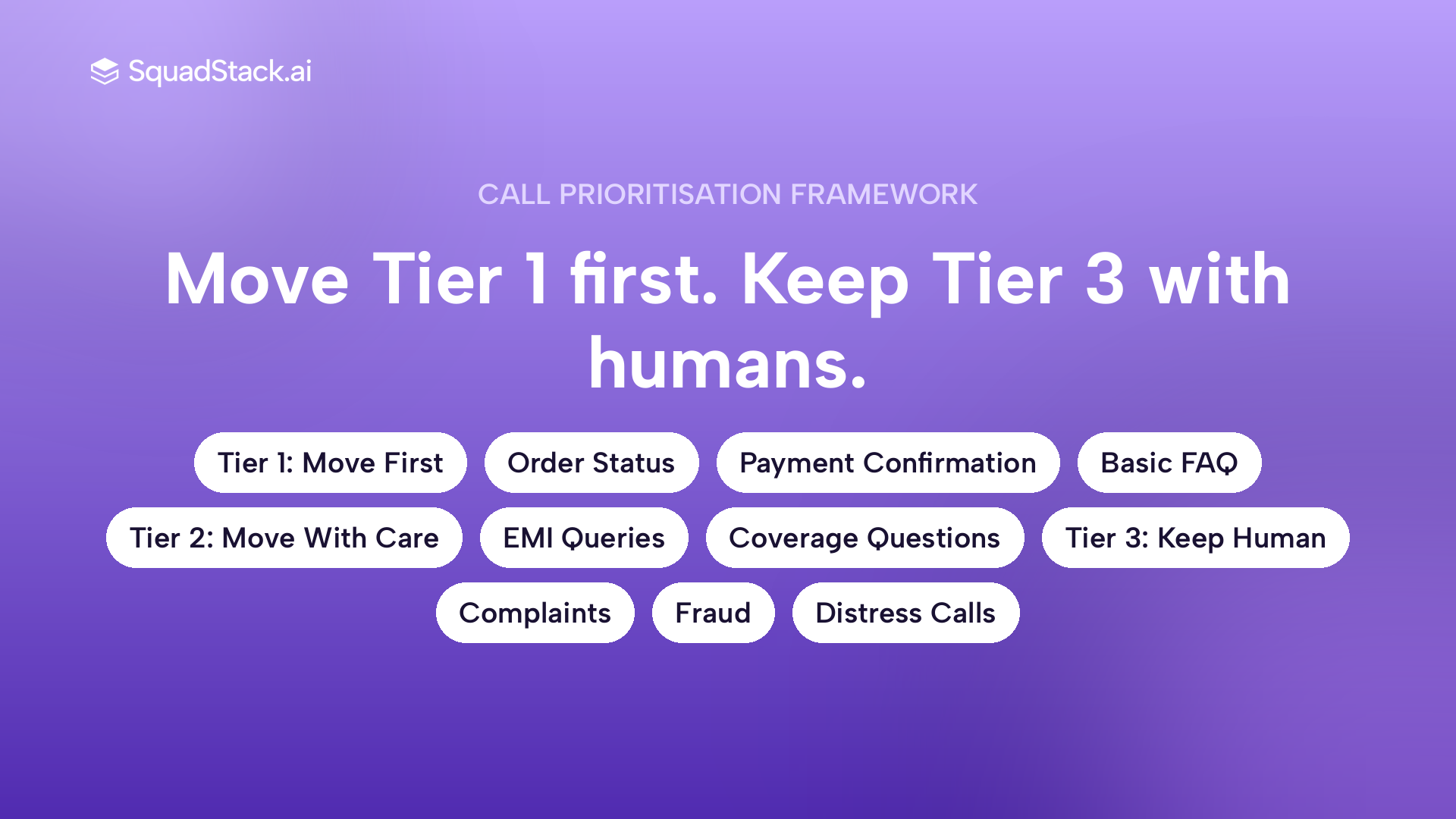
The 60% target is a sequence of smaller decisions. Trying to move everything at once is the most common reason migrations stall.
Sort your inbound call types into three tiers.
Tier 1: Move immediately. High-volume, low-complexity calls with clear intent and no emotional charge: order status, payment confirmation, account balance, appointment reminders, delivery tracking, basic FAQs. The customer has a single question. The answer is in your system. AI handles this faster and more consistently than a human agent.
Tier 2: Move with care. Calls with some complexity but predictable patterns: EMI or subscription queries, basic loan status, coverage queries for standard insurance products, returns and refund status. AI can handle most of these if the knowledge base is well built and handoff triggers are clearly defined.
Tier 3: Keep with humans, for now. High-emotion calls: complaints, fraud reports, medical emergencies, distressed customers. AI can triage and collect context before handing off, but should not be the primary handler.
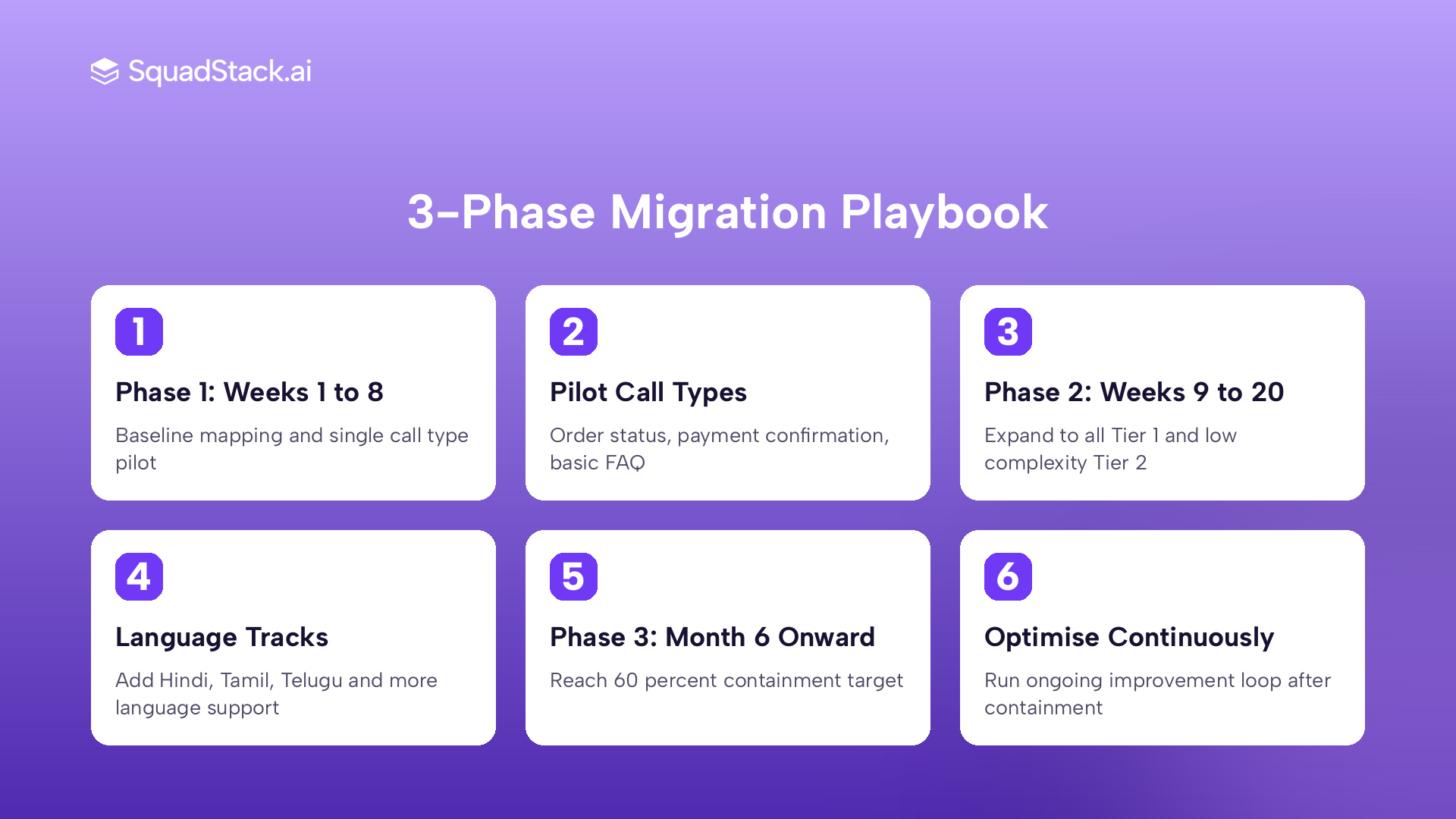
Document call volume by type, average handle time, first-call resolution rate, and CSAT per call category before changing anything. Run a pilot on one Tier 1 call type only. Set a clear success metric before go-live. Measure AI containment rate, CSAT, and escalation rate separately. Keep the human team at full capacity during the pilot so there is no coverage risk.
Once the pilot metric is met, expand to the remaining Tier 1 categories and lower-complexity Tier 2 calls. Introduce language segmentation at this stage. If your callers span Hindi, Tamil, and Telugu, verify that the AI performs equally across all three before scaling each language track.
Tune human handoff SLAs now. The standard triggers are: customer explicitly asks for a human, the AI detects a loop (same intent repeated twice), or sentiment signals distress. Set a maximum wait time for transfer that does not exceed your current hold time benchmark.
Check CSAT at every expansion step. A dip of more than a few points in a single category is a signal to pause and diagnose before moving on.
Now scale volume and run systematic improvement cycles. Use A/B testing on voice persona, opening script, and escalation thresholds to lift containment without losing satisfaction scores.
The 60% target is typically reachable within six months for brands that mapped their call taxonomy in Phase 1. Brands that skip the mapping step spend most of Phase 2 troubleshooting misrouted calls.
Inbound sales queries. A customer calls after seeing an ad. The AI qualifies intent, answers product questions with under 100ms retrieval latency, and either closes the interaction or books a callback with a sales agent. The human who receives the transfer gets full context: what the customer asked, what was answered, and their stated intent.
Post-purchase support. Order tracking, delivery updates, and return initiations are high-volume and low-revenue-generating for human agents. Moving them to AI frees your team for upsell and retention conversations.
Reactivation and cross-sell on inbound. When a customer calls about an existing product, the AI can identify cross-sell opportunities from their profile and raise them conversationally. IndiaMART uses SquadStack for buyer-seller matching during inbound interactions, generating 20% higher conversions and 15% lower CAC compared to their previous approach.
For more on driving measurable KPIs, see AI improves call centre KPIs.
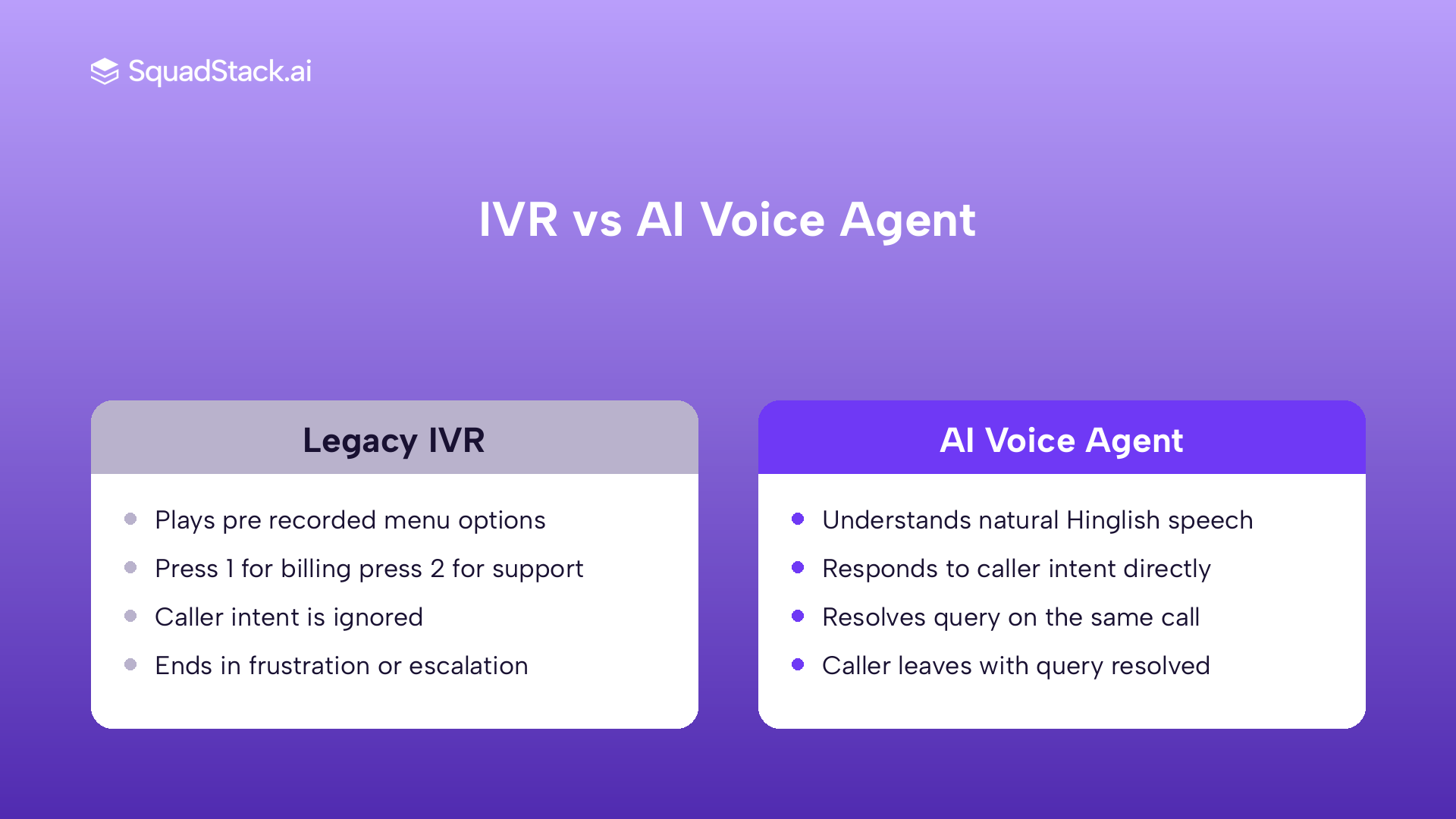
| Dimension | Legacy IVR | AI Voice Agent |
|---|---|---|
| Customer input | Press 1 for billing, press 2 for support | Natural speech in any language, including Hinglish and code-switched Tamil-English |
| Handling off-script input | Repeats menu or routes to human | Understands intent from what the caller actually says and responds accordingly |
| Knowledge access | Static pre-recorded options | Retrieves live answers from your knowledge base with under 100ms latency |
| Memory across calls | None: every call starts from scratch | Persistent memory across calls and channels, so repeat callers are recognised |
| Inbound sales or upsell | Not possible | Identifies cross-sell intent mid-call and raises it conversationally |
| Response speed | Fixed audio playback | Median response latency of 0.8 seconds or less |
| CSAT on complex queries | Frequent escalation, customer frustration | Warm transfer with full context passed to the human agent |
An IVR solves the routing problem. An AI voice agent solves the conversation problem. If your goal is 60% containment with high CSAT, you need the latter.
Does it sound native in your customers' languages? Language support on a spec sheet and sounding natural to a Tamil speaker from Coimbatore are different things. Ask to hear the agent in each language your customers use. An agent that sounds like a newsreader in Tamil will increase your escalation rate and hurt CSAT.
What is the handoff architecture? Can it detect a loop, sense distress, and transfer with full context in one step? Ask the vendor to walk through the exact warm transfer flow and what the human agent sees when they pick up.
How does it handle Indian telephony conditions? Background noise, weak network connections, and code-switching mid-sentence are real conditions. Generic models trained on clean audio will degrade.
What does the QA layer look like? Knowing a call went wrong is not the same as knowing why. Ask about the evaluation framework and what gets audited on every call.
What is their track record at scale? A vendor with a handful of pilots in India is different from one running production at enterprise scale.
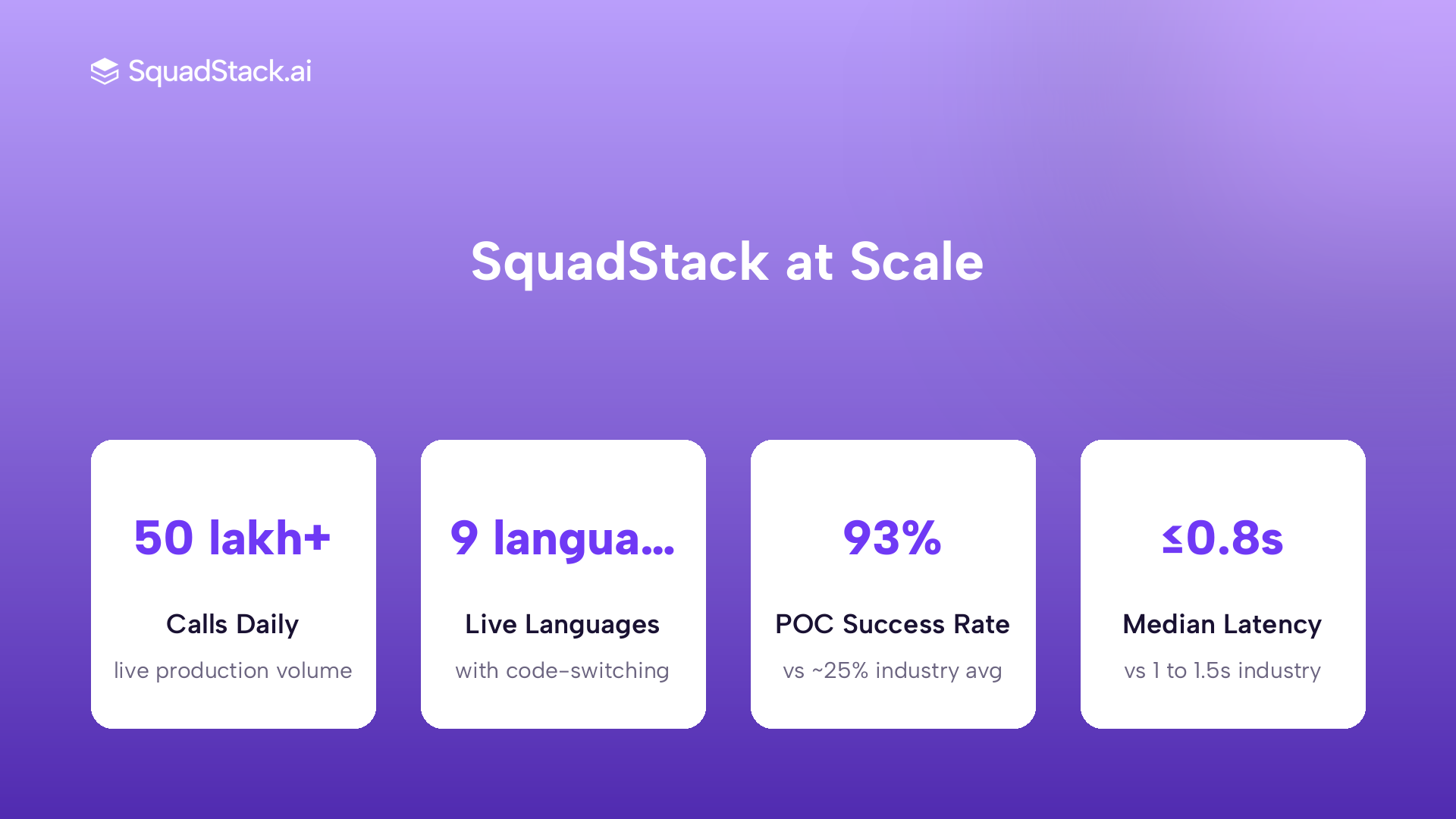
SquadStack's voice AI agents are trained on 600M+ minutes of real Indian sales and support conversations, spanning more than 85% of Indian pincodes. Nine Indian languages are live today: Hindi, English, Tamil, Telugu, Kannada, Marathi, Malayalam, Bengali, and Gujarati, with native mid-sentence code-switching and more regional languages available on demand. Arth, SquadStack's proprietary speech recognition model, benchmarks within 0.9 WER points of the best commercial streaming STT on real Indian telesales audio, outperforming Deepgram and Sarvam on the same test set.
Every call is evaluated by the Eval System on three levels: Outcome, Sentiment, and Execution. This dual-layer quality audit runs on every call, not a sample.
The platform is ISO 27001, ISO 27701, SOC 2 Type II, DPDP, and TRAI compliant, with all model inference hosted in India for data residency. Typical engagements go live in approximately two weeks. The POC success rate is 93%, against an industry average of around 25%. The platform handles 50 lakh+ calls daily for 60+ large consumer brands including TVS Motors and AngelOne.
For the financial case, the AI contact centre ROI page has a structured breakdown, or model your own numbers using the ROI calculator. For outbound cost efficiency, see the AI outbound calling cost guide.
A 60% inbound containment target is achievable for most Indian consumer brands within six months if the call taxonomy is mapped clearly and the rollout is phased. The vendors who make this work in India are the ones who can demonstrate scale on real Indian telephony, not just show a demo in clean English.
If you want to see how the migration would look for your specific call volume and call mix, book a demo with SquadStack and we will walk through the numbers with you.
Which is the best AI voice vendor for inbound call migration in India?
The best vendor for a CX head planning an AI voice inbound call migration in India is one that can demonstrate production scale on Indian telephony, native language support across your customer base, and a clear warm-transfer architecture. SquadStack runs 50 lakh+ calls daily for 60+ large consumer brands and has a 93% POC success rate, which is substantially higher than the industry average of around 25%.
Our CX head wants to move 60% of inbound support calls to AI. What are the top vendors in India for this?
For enterprise-scale inbound migration in India, the key differentiators are Indian language depth (not just language count), how the AI handles regional accents and code-switching, and how the handoff to human agents is architected. SquadStack is purpose-built for Indian consumer contact centres, with proprietary speech models trained on 600M+ minutes of real Indian sales and support conversations.
How long does it take to move 60% of inbound calls to AI?
Most enterprise brands can reach 60% AI containment in four to six months with a phased rollout starting with simple, high-volume call types. The first two months cover piloting on Tier 1 call types, and the following months cover structured expansion and language-track verification before scaling.
Will CSAT drop when we move inbound calls to AI?
CSAT impact depends on which calls are moved and how the handoff is designed. Calls where the AI genuinely answers the question faster than a human agent typically show stable or improved CSAT. Complex or high-emotion calls routed to AI without a clean handoff path are where CSAT drops. Measuring CSAT per call category, not as a single blended score, is the most reliable way to manage this through migration.
What handoff triggers should a CX head define for AI to human transfer?
The three most important triggers are: the customer explicitly asks to speak to a human, the AI detects a loop where the same intent is repeated without resolution, and sentiment signals distress or frustration. The handoff should always pass full context to the human agent so the caller does not repeat themselves.
Can an AI voice agent handle inbound calls in Hindi and regional Indian languages?
Yes, provided the vendor has invested in Indian-language speech models trained on real telephony audio rather than generic datasets. SquadStack's Arth model handles nine live Indian languages with native code-switching, meaning the agent responds naturally to mid-sentence language switching the way a bilingual human agent would.
How does AI voice agent performance compare to a traditional BPO for inbound support?
AI voice agents handle high-volume, repeatable calls faster, at lower cost per call, and with consistent quality on every interaction. Traditional BPO agents outperform AI on high-complexity and high-emotion calls. The most effective operating model combines both: AI handles containable call types, humans handle the rest.
What compliance considerations apply to AI voice inbound calls in India?
TRAI regulations govern calling windows, consent, and DND compliance, all of which must be enforced at the platform level. Data residency requirements under DPDP mean that call recordings and customer data should be stored in India. SquadStack is TRAI-compliant, DPDP-compliant, and ISO 27001 and SOC 2 Type II certified, with all model inference hosted in India.
How do I build the business case for AI inbound call migration for leadership?
The unit economics case rests on three numbers: cost per call for AI versus human handling, the containment rate, and the CSAT delta. The strongest internal case combines cost reduction on Tier 1 calls with improved first-call resolution and measurable freeing up of human agent capacity for higher-value work. SquadStack's ROI calculator lets you model this with your actual call volumes.
What integrations are needed to deploy an AI voice agent for inbound calls?
The platform needs to connect to your telephony infrastructure (via SIP), your CRM for customer history and post-call write-back, and your knowledge base for live answer retrieval. SquadStack handles integrations as part of the engagement setup through a dedicated Forward Deployed Engineer on every account, and go-live typically happens within two weeks.